Repository navigation
Sudoku strategies
In DailySudoku v2, there are no notes. However, in DailySudoku v3, there are notes. If you would like to print the puzzle because you are more comfortable with paper, you may continue to do that. But there are several strategies that will help you with solving Sudoku puzzles. Most of them will be listed here.
These strategies will work for just about any puzzle:
Some rows, columns, or 3x3 blocks will have more prefilled numbers than others. It would be a good idea to start the puzzle with the rows, columns, and 3x3 blocks that have more prefilled numbers, just like it would be better to grab low-hanging fruit from a fruit tree. For example, if a row has 7/9 numbers filled and another that has 3/9 numbers filled, it would be better to start with the row that has 7/9 numbers filled in.
Every number that you fill in will give you more clues as to where other numbers go, so make sure you immediately look in the surrounding area of numbers you fill in to see if you can erase any notes or fill in more numbers.
Make sure you scan the grid to look for any other chances to fill in a number or erase a note.
Below are some strategies that work really well with easier puzzles:
If there is a row, column, or 3x3 block that has one number missing, you can fill in that space with the missing number.
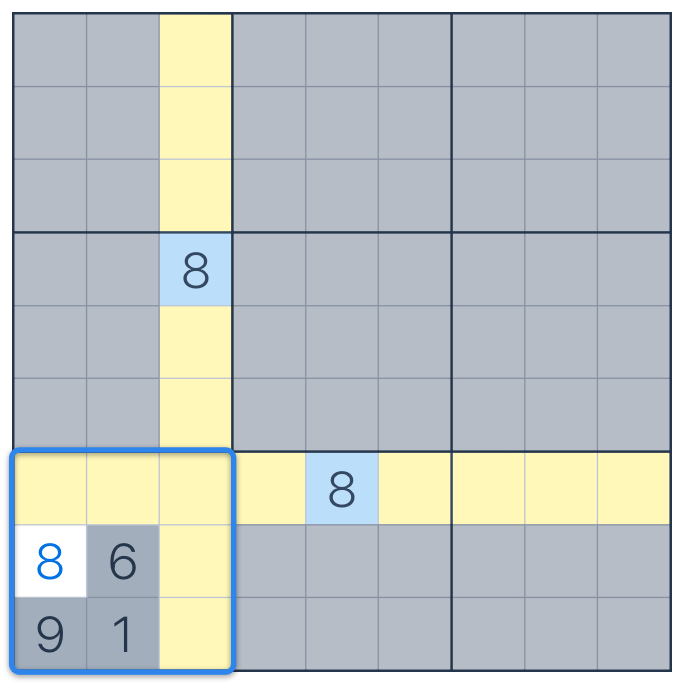
Numbers cannot be repeated in the same row or column so if you see a number in a different 3x3 block, you know that you cannot place that number anywhere else in that row or column. Take a look at this image (image from Sudoku.com).
In this case, the cells highlighted with yellow are where an 8 cannot go.
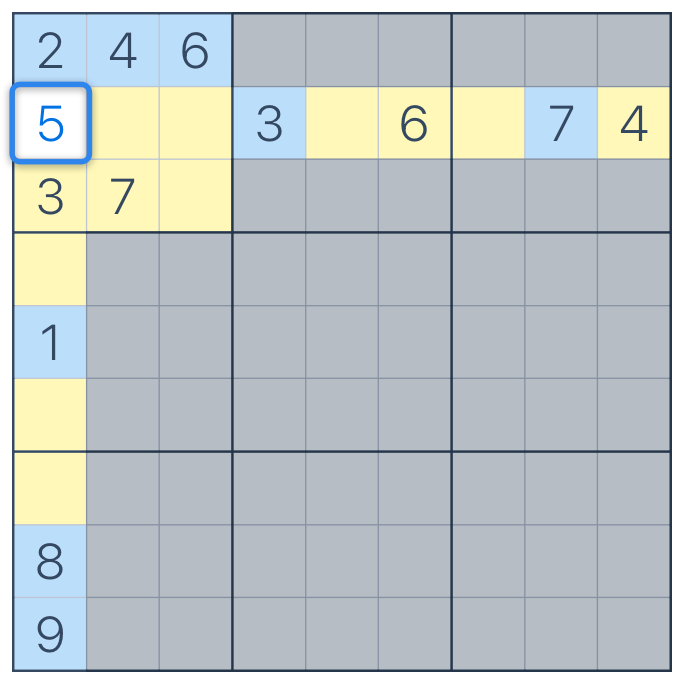
If there is only one possibility for a number in a given cell because of Sudoku rules, you can put that number in the cell. Take a look at this image (image from Sudoku.com).
In this case, 5 is the only number that can go in that cell because of the other numbers in the same row, column, and 3x3 block.
Notes are primarily for when you don't know which number goes in a cell yet. You can use notes by writing smaller numbers on a cell. This makes it easier because you will not have to remember where every number could go, and they're used for advanced strategies.
These strategies work well with notes:
If there is a cell that has only one note on it, make sure that no other number can go there. If no other number can go there, then the note is the number that goes in the cell.
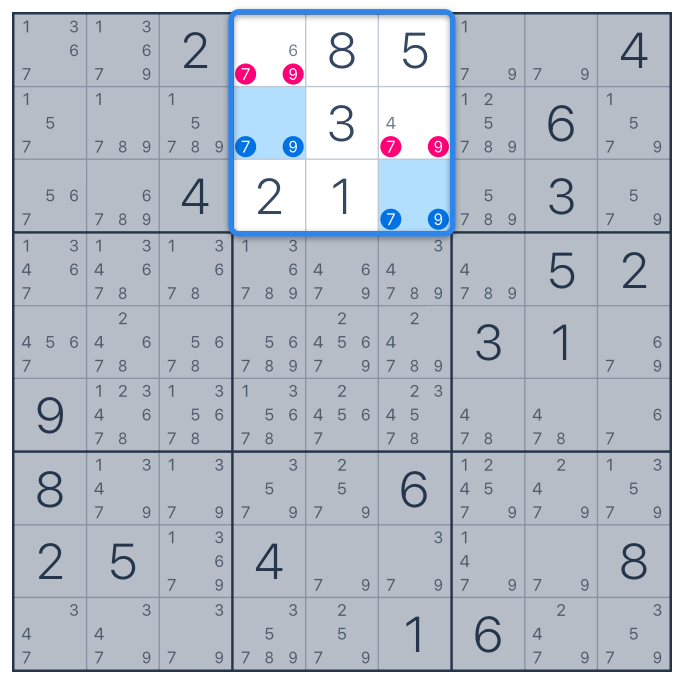
This is similar to the obvious singles strategy, except it involves pairs. If there are two pairs of a number with one pair having other numbers and the other pair only having that pair, then you can remove the pair that has other numbers on it. Take a look at this image (image from Sudoku.com).
In this case, the pink 7s and 9s should be erased.
Hidden singles
This is the same as the last remaining cell strategy, but the number that has only 1 space to go has other notes on it.
Hidden pairs/triples
This is similar to the obvious pairs/triples strategy, except it's harder to spot. If there is 2 or 3 of a number that cannot go anywhere else in that row, column, or 3x3 block, you can erase all other notes in those cells. Take a look at this image (image from Sudoku.com).
In this case, the pink numbers should be erased.
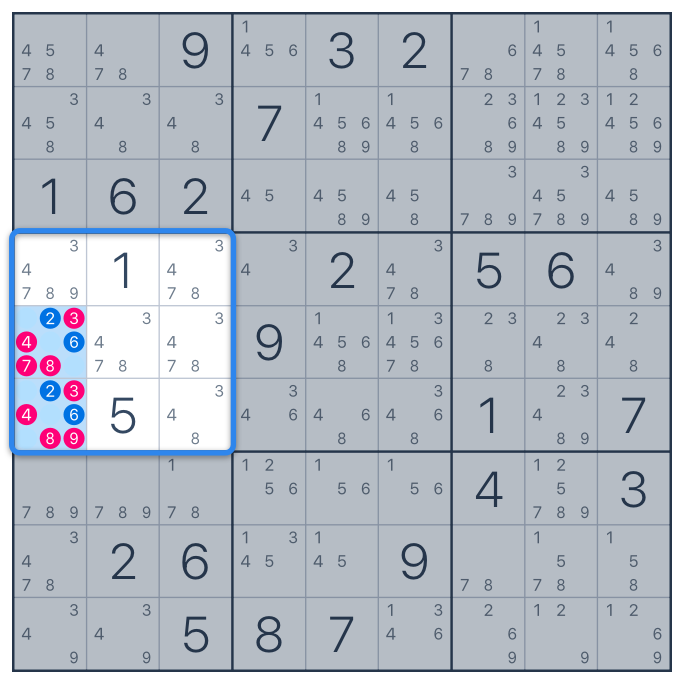
If you see 2 or 3 of a number in a row or column, you know that number cannot go anywhere else in that row or column.
These are strategies that beginners might not know how to use at first because of how they work:
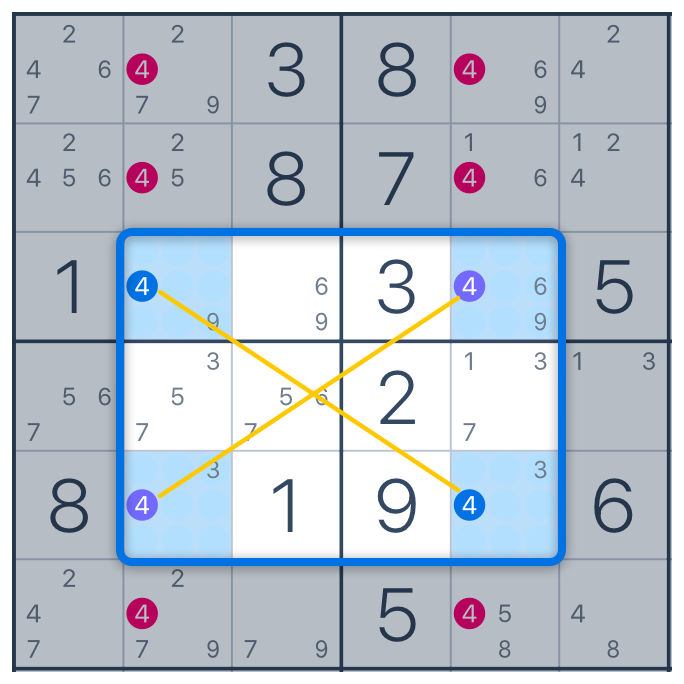
If you see 4 notes of the same number that are in 2 rows, 2 columns, and 4 3x3 blocks, you might have an X-wing. You definitely have an X-wing if there are 2 columns that all have the same note. Since there will be a number in each column, you can erase the other notes of that number in the 2 columns. Take a look at this image (image from Sudoku.com).
In this case, the pink numbers can be erased, and the 4s that are blue and purple are the 2 possibilities.
The Y-Wing is a little different, because it only uses 3 points instead of 4. If you find a cell with 2 notes (the pivot), look for 2 other cells with 2 notes (the pincers). These pincers will need to be in the same row, column, or 3x3 block as the pivot. If they are, then you can erase any numbers that the pincers have in common where they intersect.
This is also slightly similar to the X-wing, but instead of using 2 sets of cells, you use 3. If there are 3 columns that have a number in common that also have 2 options for a specific number (called the "fish number") to go in, then there are only 2 possibilities for the entire arrangement that don't cause 2 6s to be in a column. You can erase any other notes in the 3 columns with the "fish number" because that would cause 2 6s to be in a column.
All of these strategies have their own fair share of usage, so make sure you remember the basics of each strategy.