Repository navigation
Tree Lab #1: LABOR MARKET SHOCK TREE

Tree Lab #1: Vocational & Workforce Intelligence Tree Lab #1 applies the Structural Intelligence methodology to workforce development, career planning, labor market disruption, and resilience. The objective is to determine whether the Structural Intelligence framework can identify recurring patterns of capability development, opportunity alignment, career advancement, and response to labor market shocks.
Workforce Doctrine Principle: Long-term workforce stability emerges from the alignment of individual attributes, skills, knowledge, and capabilities with real opportunities. Market disruptions create stress events that force adaptation, re-routing, or decline. Individuals who maximize transferability, reduce bottlenecks, and continually compound value creation are better positioned for resilience and advancement.
TREE LAB #1: VOCATIONAL & WORKFORCE INTELLIGENCE
[CORE WORKFORCE LOOP] [SHOCK & PIVOT BRANCH]
           INDIVIDUAL                           EMPLOYMENT
                 │                                   │
                 ▼                                   ▼
           ATTRIBUTES                      LABOR MARKET SHOCK
     (Aptitudes, Interests, Traits)       (Automation, Layoffs,
                 │                       Sector Shift, Downturn)
                 ▼                                   │
             SKILLS ──► SKILL GAPS                  ▼
         (Current Abilities)                  SHOCK ZONES
                 │                       • Exposure
                 ▼                       • Runway
            KNOWLEDGE                    • Transferability
       (Education & Training)            • Re-Entry Friction
                 │                                   │
                 ▼                                   │
           CAPABILITIES                            │
                 │                                   │
                 ▼                                   │
 LABOR FORCE STRUCTURES & OPPORTUNITIES              │
                 │                                   │
                 ▼                                   │
         CAREER PATHWAYS ◄───────────────────────────┘
                 │                         (Re-Routing / Pivot)
                 ▼
           EMPLOYMENT
                 │
                 ▼
           PERFORMANCE
                 │
                 ▼
           ADVANCEMENT
                 │
                 ▼
          VALUE CREATION
                 │
                 ▼
        NEW OPPORTUNITIES
                 │
                 ▼
          RECURSIVE LOOP
         (Cycle Repeats)
How to Read Tree Lab #1 👤 Individual Definition: The person operating within the labor force, shaped by circumstances, objectives, limitations, resources, and opportunity.
🧠 Attributes Definition: Natural aptitudes, interests, temperament, personality characteristics, and tendencies influencing learning and performance.
🛠 Skills Definition: Practical abilities a person can currently perform and apply.
⚠ Skill Gaps Definition: Missing abilities, competencies, credentials, or experience required for advancement into desired pathways.
📚 Knowledge Definition: Education, training, conceptual understanding, and domain-specific expertise accumulated through learning and experience.
⚙ Capabilities Definition: The combined operational effectiveness produced when attributes, skills, and knowledge become actionable.
🌐 Labor Force Structures & Opportunities Definition: The real-world employment ecosystem where capabilities can be applied through occupations, industries, business models, contracts, or enterprises.
🛤 Career Pathways Definition: Structured trajectories connecting present capability to future opportunity, advancement, specialization, and resilience.
💼 Employment Definition: Active participation in a workforce structure through work, contracts, business ownership, or organizational roles.
📈 Performance Definition: The effectiveness and reliability with which value is delivered.
🚀 Advancement Definition: Increased responsibility, compensation, authority, influence, leverage, or opportunity.
💎 Value Creation Definition: Measurable economic, organizational, operational, or societal contribution generated by an individual.
🔄 New Opportunities & Recursive Loop Definition: Successful value creation generates additional opportunities which become the starting point for the next development cycle.
Labor Market Shock & Shock Zones Labor Market Shock Definition: A disruption that interrupts normal workforce progression and forces reevaluation of career pathways.
Examples:
Automation Artificial Intelligence displacement Layoffs Industry contraction Economic downturns Regulatory shifts Shock Zones Exposure The degree of vulnerability to disruption.
Runway Available time, resources, savings, and support structures available during transition.
Transferability The extent to which existing capabilities can be redirected into alternative opportunities.
Re-Entry Friction Barriers slowing workforce reintegration.
Examples include:
Credential requirements Licensing requirements Technology shifts Hiring freezes Geographic constraints Experience barriers Ripple / Contagion Effects Secondary impacts extending beyond the individual into organizations, industries, suppliers, or communities.
Diagnostic Zones Talent Zones Skill Gaps Opportunity Zones Drift Zones Bottleneck Zones Growth Zones These zones identify where alignment exists and where constraints, vulnerability, or leverage may be present.
Practical Application Workforce Counselor Example Individual → Skills Assessment → Gap Analysis → Career Pathway Mapping → Employment Strategy → Advancement Roadmap
Workforce Development Example Industry Demand → Capability Requirements → Training Programs → Workforce Pipeline → Employment Outcomes
AI Disruption Example Occupation → Exposure Analysis → Transferability Assessment → Re-Skilling Plan → Career Pivot
Connection to Tree #3 Tree Lab #1 represents a specialized workforce application of Tree #3.
Environment → Labor Market Forces → Economic & Technological Change Load → Workforce Demands Stress → Skill Mismatch & Employment Pressure Stress Distribution → Shock Zones Adaptation → Re-Skilling & Career Pivot Failure → Long-Term Displacement New Conditions → Emerging Opportunities 🌲 Structural Intelligence Forest Reference Tree #1 — SSI Tree of Origin Tree #2 — Tree of Structural Intelligence Tree #3 — Tree of Structural Stability & Endurance Tree Lab #1 — Vocational & Workforce Intelligence Trees #4–#13 — Future Specialized Doctrine Trees Locked Tree Lab #1 Handoff Line
-
Tree Lab #1: Vocational & Workforce Intelligence
(Framework Portability Test)
|
Individual → Attributes → Skills (Skill Gaps) → Knowledge → Capabilities → Labor Force Structures & Opportunities → Career Pathways → Employment → Performance → Advancement → Value Creation → New Opportunities → Recursive Loop(paired withLabor Market Shock → Shock Zones → Exposure → Runway → Transferability → Re-Entry Friction → Re-Routing / Pivot → Career Pathways) |Tree Lab #1 - Labor Market Shock.md
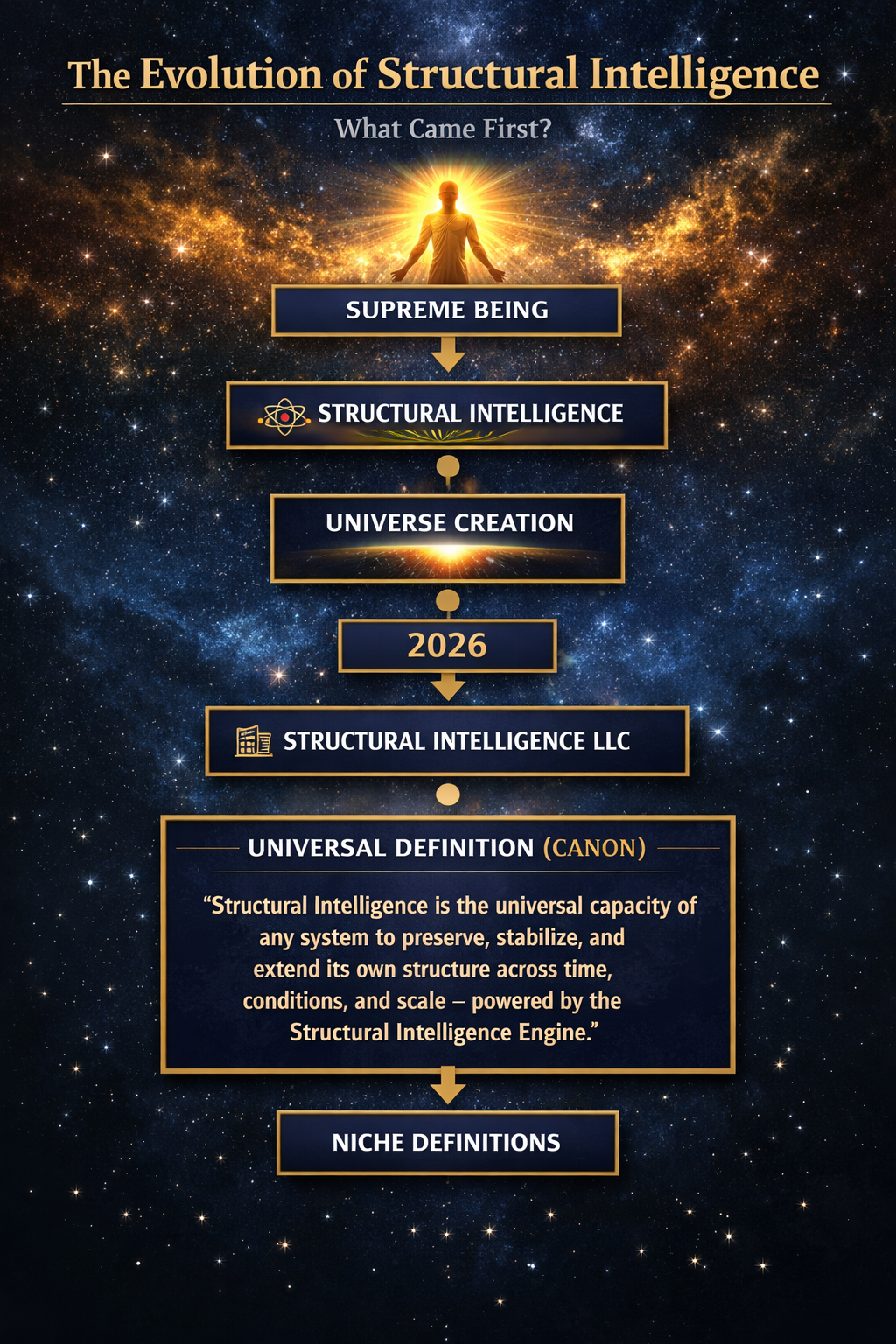
Overview Structural Intelligence operates through specialized divisions organized within the Structural Intelligence Universe. Each division focuses on a structured domain while remaining connected to the foundational doctrine, principles, dictionary, universe model, and canon. Together, the divisions translate Structural Intelligence from theory into practice by applying common structural principles across different domains of activity. While each division serves a unique purpose, all divisions remain anchored to the same doctrine, language, and architectural framework. The Tree of Structural Intelligence provides the visual map that connects these domains through shared structural principles, pathways, and outcomes. © 2026 Structural Intelligence LLC — Zenith Division## Division Navigation
- 🌩 Sentinel Overview
- 📋 Sentinel Menu
- 📚 Atlas Overview
- 📖 Atlas Library
- 🚀 Rare Air Overview
- 🛡 CrownShield Overview
- ⚙ Engineering Standards Overview
- 🎵 Cadence Overview
- 🌌 Zenith Overview