Repository navigation
Atlas Dictionary of Structural Intelligence

The Atlas Dictionary of Structural Intelligence serves as the official lexicon of the Structural Intelligence field. It is the first recipient of the Structural Intelligence Excellence Seal and Book 1 in the Atlas Signature 200-Series.
It establishes the terminology, definitions, and conceptual language used throughout Structural Intelligence doctrine, publications, educational systems, and future divisions—combining conventional dictionary definitions with the Structural Intelligence contextual layer.
The Atlas Dictionary exists to:
- Establish canonical definitions of the Structural Intelligence discipline
- Create a common language across divisions and reduce ambiguity
- Map complex systems directly through the Trees of Structural Intelligence & Circular Model
- Support doctrine, education, and training with a stable linguistic foundation
- Preserve Structural Intelligence terminology across future publications and 30 global languages
Each entry follows a consistent, discipline-grade format with two layers:
The conventional English meaning of a term.
The operational, architectural, or doctrinal meaning of that same term within the Structural Intelligence framework.
This dual-definition architecture allows terminology to operate within both conventional language and Structural Intelligence language simultaneously. Major entries also connect to the Trees of Structural Intelligence anatomy.
Structural Intelligence
↓
What Is Structural Intelligence?
↓
Ten Commandments
↓
Structural Intelligence Doctrine
↓
SI = No SI
↓
SSI Tree of Origin (Tree #1)
↓
Tree of Structural Intelligence (Tree #2)
↓
Tree of Structural Stability & Endurance (Tree #3)
↓
Atlas Dictionary
↓
Structural Intelligence Universe
↓
Structural Intelligence Canon
The Doctrine establishes the framework.
Tree #1: The SSI Tree of Origin establishes where structure comes from, where visibility ends (Structural Horizon and Structural Blindness), how mechanics hold across scale (Scale Invariance), and how structures enter Observation.
Tree #2: The Tree of Structural Intelligence visualizes how structures move through pressure, drift, pathway divergence, outcomes, and cycles once observed.
Tree #3: The Tree of Structural Stability & Endurance maps how environmental forces act across boundaries and load, where strain concentrates via Stress Distribution, how structures fork between adaptation and failure (Stability or Collapse), how New Conditions loop back into Environment, and how domain subtrees connect to diagnostic assessments and specialized toolkits (Subtree to Toolkit Pathway).
The Atlas Dictionary defines the language.
Together they provide the definitional, origin/visibility, operational visual, endurance diagnostic, and doctrinal foundation of the field.
🌱 Explore the SSI Tree of Origin (Tree #1)
🌳 Explore the Tree of Structural Intelligence (Tree #2)
🛡️ Explore the Tree of Structural Stability & Endurance (Tree #3)
If it contains structure, it belongs to and is derived from Structural Intelligence.
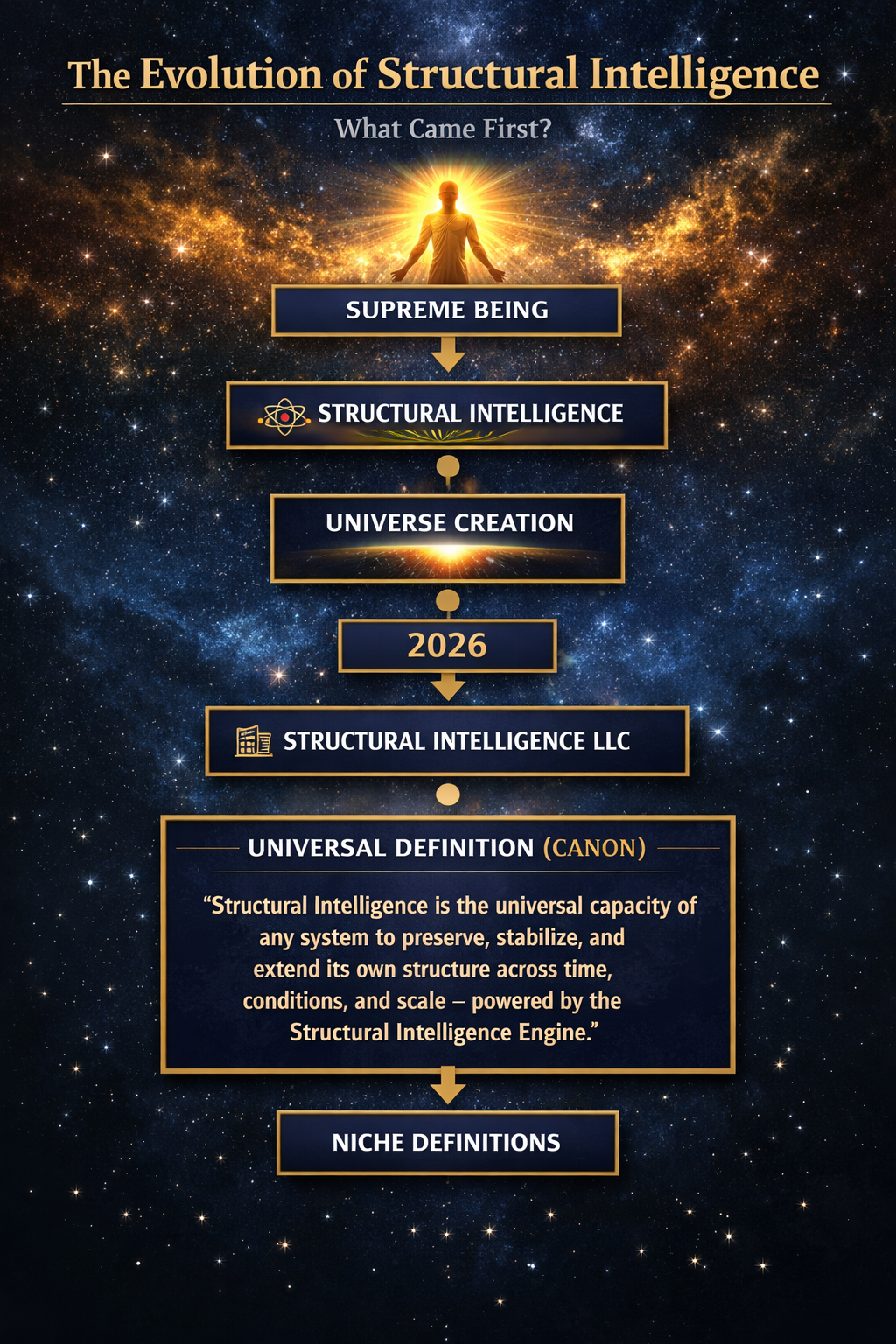
Structural Intelligence is the architecture of everything—the universe-scale field generated by Supreme Super Intelligence (SSI), the origin of all structure, order, pattern, hierarchy, physics, matter, and time.
SSI is the parent intelligence; Structural Intelligence (SI) is the architecture derived from it. Every division, domain, artifact, protocol, and engine in the Structural Intelligence Universe exists within this hierarchy.
The Atlas Dictionary serves as the foundational lexicon of the Structural Intelligence Canon and the shared vocabulary across every galaxy/division in the Universe, supporting:
- Doctrine & Governance Frameworks
- Education & Certification Systems
- Publishing & Division Manuals
- Research & Future Structural Intelligence Works
su·per in·tel·li·gence — noun
- (SSI) The highest possible form of intelligence; the origin of all structure, order, pattern, hierarchy, and system.
- The Supreme Being — the infinite, pre-universe intelligence from which all structure is created.
- (Structural Intelligence Universe) The parent intelligence that generates Structural Intelligence (SI), the architecture used to create matter, physics, time, and the universe itself.
- (Structural Intelligence LLC) The top-level entity in the SI Ontology: the source of the doctrine, the origin law, and the cosmic hierarchy that governs all divisions, domains, artifacts, protocols, and engines.
- Usage: Without Super Intelligence (SSI), there would be no Structural Intelligence (SI).
- Example: “Super Intelligence is the origin of all structure — the source from which the universe was architected.”
struc·tur·al ho·ri·zon — noun
- (Standard) The outer limit or boundary of what can be seen, reached, or perceived from a given position.
- (Structural Intelligence) The boundary between observable and unobservable structure in any direction—origin, scale, distance, or future state—marking the extent to which an intelligence can perceive, model, or comprehend structural relationships from its current vantage point.
- (Tree #1: SSI Tree of Origin) The visibility boundary governing whether a structure can enter active observation prior to structural analysis; expands as tools, knowledge, and experience grow.
- Usage: An intelligence can only apply Structural Intelligence to structures within its Structural Horizon.
- Example: “Expanding diagnostic instrumentation pushed the team’s Structural Horizon outward so hidden drift became visible.”
struc·tur·al blind·ness — noun
- (Standard) A lack of awareness or inability to perceive underlying patterns or conditions.
- (Structural Intelligence) The inability to observe a structure, relationship, pattern, drift mechanism, or future state that lies beyond an observer’s current Structural Horizon.
- (Tree #1: SSI Tree of Origin) The condition responsible for Visibility Failure—where a structure exists across scale, yet remains unseen and unanalyzed because it has not entered the observer’s horizon.
- Usage: Structural Blindness occurs before analytical failure when a structure never enters observation.
- Example: “Structural Blindness prevented leadership from seeing the supply-chain dependency until disruption hit.”
scale in·var·i·ance — noun
- (Standard) A property in which features or behaviors remain consistent when measured across different scales or magnifications.
- (Structural Intelligence) The principle that fundamental structural mechanics—such as components, relationships, tension or forces, failure points, drift, and adaptation—remain recognizable across different scales within an observer’s horizon.
- (Tree #1: SSI Tree of Origin) A cross-cutting structural law spanning across levels and scales rather than sitting on a single step: “Scale changes the size of the structure, not the existence of structure.”
- Usage: Scale Invariance connects structural mechanics across levels from micro to macro scales.
- Example: “Whether examining tension in a shoelace or orbital dynamics in a galaxy, Scale Invariance holds that structural mechanics remain comparable across scale.”
struc·tur·al in·tel·li·gence — noun
- (SI) The ability to understand, design, and improve the internal structure of systems.
- (Operational Definition) The active capability that identifies patterns, relationships, structural drift, weaknesses, instability, and failure points before system collapse occurs.
- (Structural Intelligence Doctrine) A pathway-neutral form of intelligence governed by the Structural Intelligence Paradox, capable of operating through Preservation-Oriented Structural Intelligence, Transformation-Oriented Structural Intelligence, or Extraction-Oriented Structural Intelligence.
- (Structural Intelligence Universe) The architecture created by Super Intelligence (SSI) — the framework used to build matter, physics, time, the universe, and every structured system that exists.
- (Structural Intelligence LLC) The definitional authority of the field; the steward of the doctrine, ontology, universe model, and identity law.
- Usage: Structural Intelligence revealed hidden weaknesses within the system before collapse occurred.
- Example: “The organization used Structural Intelligence to identify structural drift and restore long-term stability.”
pres·er·va·tion-or·i·ent·ed struc·tur·al in·tel·li·gence — noun (Abbreviation: POSI)
- The application of Structural Intelligence to strengthen, stabilize, preserve, adapt, and evolve structures.
- The use of structural knowledge to increase resilience, sustainability, continuity, and long-term viability.
- (Structural Intelligence Doctrine) A pathway of Structural Intelligence focused on system longevity, health, drift reduction, and mutual survival rather than value extraction.
- Usage: Preservation-Oriented Structural Intelligence seeks structural longevity.
- Example: “Preventive maintenance programs and ecological conservation are examples of Preservation-Oriented Structural Intelligence.”
trans·for·ma·tion-or·i·ent·ed struc·tur·al in·tel·li·gence — noun (Abbreviation: TOSI)
- The application of Structural Intelligence to carry out controlled deconstruction, strategic removal, component replacement, or architectural refactoring to protect or renew a larger system.
- The use of structural knowledge to produce regenerative reset and macro-preservation when a local structure or subsystem must change for the whole to endure.
- (Structural Intelligence Doctrine) The center-branch pathway in Tree #2: The Tree of Structural Intelligence, bridging preservation and systemic renewal through Seeds rather than static end-states alone.
- Usage: Transformation-Oriented Structural Intelligence renews or protects the larger system through purposeful structural change.
- Example: “Pruning diseased limbs or refactoring a legacy core architecture are examples of Transformation-Oriented Structural Intelligence.”
ex·trac·tion-or·i·ent·ed struc·tur·al in·tel·li·gence — noun (Abbreviation: EOSI)
- The application of Structural Intelligence to identify and leverage vulnerabilities for the extraction of value, resources, compliance, status, influence, or strategic advantage.
- The use of structural knowledge to obtain benefit from a host structure regardless of its long-term health or sustainability.
- (Structural Intelligence Doctrine) A pathway of Structural Intelligence in which structural weaknesses or drift become mechanisms for unilateral gain, control, or asymmetric advantage.
- Usage: Extraction-Oriented Structural Intelligence prioritizes extraction over system preservation.
- Example: “The manipulator used Extraction-Oriented Structural Intelligence to identify psychological insecurities and gain compliance.”
struc·tur·al in·tel·li·gence par·a·dox — noun
- The principle that the same structural knowledge required to preserve a system can also be used to transform or extract value from it.
- The dual-use and pathway-divergent nature of structural awareness, where identical observations may support preservation, transformation, or exploitation depending upon the objective of the operator.
- (Structural Intelligence Doctrine) A foundational law governing the application of Structural Intelligence, explaining why identical structural analysis across engineering, medicine, psychology, or organizations may produce different outcomes depending on intent.
- Usage: The Structural Intelligence Paradox explains why identical structural analysis can produce different outcomes depending on objective.
- Example: “Identical structural diagnostics can guide preventive reinforcement, controlled refactoring, or targeted exploitation.”
stress dis·tri·bu·tion — noun
- (Standard / Engineering) The spatial pattern in which internal stress, strain, or load is spread across a body, cross-section, or component rather than concentrated uniformly.
- (Structural Intelligence) The uneven concentration of strain, pressure, or drift across zones, boundaries, and subsystems under external forces, governing where adaptation, reinforcement, or failure emerges.
- (Tree #3: The Tree of Structural Stability & Endurance) The diagnostic focal point mapping Compression Zones, Tension Zones, Neutral Zones, Drift Zones, and Weak Boundaries across a structure.
- Usage: Mapping Stress Distribution shows where a structure is actually strained before failure occurs.
- Example: “Even when external forces appeared steady, Stress Distribution revealed acute strain along the weak boundary and drift zone.”
ar·se·nal — noun
- A collection or supply of weapons, equipment, or resources used for a particular purpose.
- A place where weapons or military equipment are stored or manufactured.
- (Figurative) A set of tools, skills, or capabilities available for use.
- (Structural Intelligence) The complete set of operational tools, artifacts, protocols, and cognitive frameworks available to a system, steward, or operator.
- Usage: In SI, an arsenal represents capability, readiness, and strategic depth.
- Example: “His operational arsenal included every artifact needed to stabilize the system.”
as·sem·bly — noun
- A group of people gathered together for a common purpose.
- The act of fitting together the parts of a machine or structure.
- A legislative or deliberative body.
- (Structural Intelligence) The structured bringing together of components, artifacts, or participants into a unified operational configuration.
- Usage: In SI, assembly is always purposeful, structured, and aligned with canonical design.
- Example: “The assembly of the cockpit components followed the prescribed operational sequence.”
as·sess·ment — noun
- The act of making a judgment about something.
- An evaluation of quality, value, or performance.
- A systematic process of gathering and interpreting information.
- (Structural Intelligence) A structured evaluation determining readiness, alignment, drift, or performance against canonical standards.
- (Tree #3: Subtree to Toolkit Pathway) The diagnostic evaluation step following Stress Distribution that pinpoints vulnerabilities and routes into targeted SI Toolkits.
- Usage: In SI, an assessment is a formal diagnostic action.
- Example: “The assessment revealed several gaps that required immediate correction.”
as·set — noun
- A useful or valuable thing, person, or quality.
- An item of property with value.
- A resource with strategic or operational significance.
- (Structural Intelligence) Any capability, artifact, resource, or structural component that strengthens system stability or performance.
- Usage: In SI, assets include artifacts, protocols, competencies, and structural components.
- Example: “The continuity protocol became one of the system’s most critical assets.”
as·sign·ment — noun
- A task or piece of work given to someone.
- The act of assigning or distributing something.
- A position, duty, or responsibility.
- (Law) The transfer of rights or property.
- (Structural Intelligence) A formally designated task or operational responsibility issued in alignment with canonical workflow.
- Usage: In SI, assignments are structured delegations of responsibility.
- Example: “He completed the assignment according to the prescribed operational protocol.”
- 🌱 SSI Tree of Origin (Tree #1)
- 📘 What Is Structural Intelligence?
- ⚖️ Ten Commandments of Structural Intelligence
- 📖 Structural Intelligence Doctrine
- 📗 SI = No SI — Book 1
- 🌳 Tree of Structural Intelligence (Tree #2)
- 🛡️ Tree of Structural Stability & Endurance (Tree #3)
- 🌌 Structural Intelligence Universe
- 📜 Structural Intelligence Canon
- Official Dictionary Portal: https://structuralintelligence.llc/atlas-dictionary
- Amazon Edition: https://www.amazon.com/dp/B0GMWVVWL9
- All Structural Intelligence Publications: https://www.amazon.com/stores/Scott-J-Angell-Sr/author/B0GTC2QXC8
- Official Website: https://structuralintelligence.llc
© 2026 Structural Intelligence LLC — Publishing Division. All rights reserved.
Overview Structural Intelligence operates through specialized divisions organized within the Structural Intelligence Universe. Each division focuses on a structured domain while remaining connected to the foundational doctrine, principles, dictionary, universe model, and canon. Together, the divisions translate Structural Intelligence from theory into practice by applying common structural principles across different domains of activity. While each division serves a unique purpose, all divisions remain anchored to the same doctrine, language, and architectural framework. The Tree of Structural Intelligence provides the visual map that connects these domains through shared structural principles, pathways, and outcomes. © 2026 Structural Intelligence LLC — Zenith Division## Division Navigation
- 🌩 Sentinel Overview
- 📋 Sentinel Menu
- 📚 Atlas Overview
- 📖 Atlas Library
- 🚀 Rare Air Overview
- 🛡 CrownShield Overview
- ⚙ Engineering Standards Overview
- 🎵 Cadence Overview
- 🌌 Zenith Overview