Repository navigation
Home
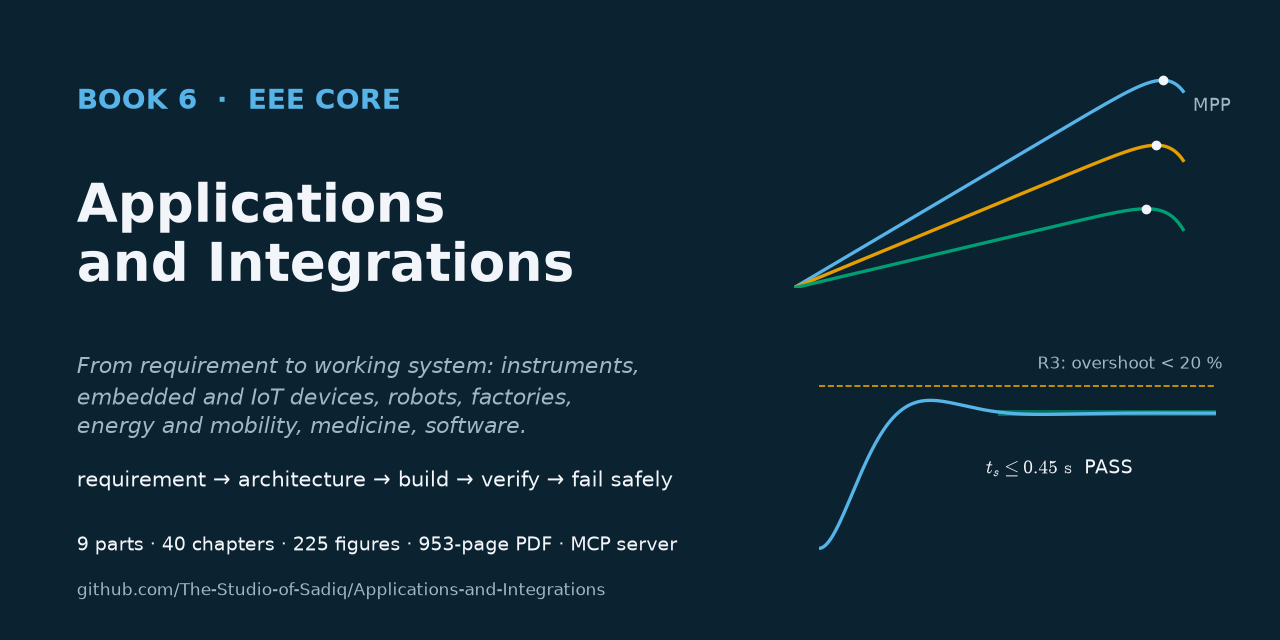
Book 6 — The Applications & Integrations Core. How to combine the other cores into working systems: design method, instrumentation and data acquisition, embedded, IoT and edge-AI devices, robots and drones, industrial automation and functional safety, solar, battery, EV and microgrid systems, communication links, practical DSP and biomedical instrumentation, engineering software and digital twins, and seven complete projects. It is project-oriented: theory is cited from Books 3–5 and the foundation books, never repeated.
| Parts | 9: Engineering Design Methodology → Instrumentation and Measurement Systems → Embedded and Connected Systems → Robotics and Mechatronics → Industrial Automation → Renewable Energy and Electric Mobility → Communications, Signal Processing, and Biomedical Applications → Engineering Software and Computational Tools → Interdisciplinary Engineering Projects |
| Chapters | 40, about 343k words, each following one real system from requirements to failure analysis |
| Figures | 225, each computed from the chapter's own numbers by a reproducible Python script |
| Formats | Markdown with LaTeX math (reads on GitHub and in Obsidian) and a typeset PDF (953 pages) |
| Tooling | One-command PDF build, book checks in CI, and an MCP server for reading and searching the book with an AI client |
| License | MIT |
- New reader: read on, then open the Chapter Guide and begin at Chapter 1.
- Looking for a topic: the Chapter Guide lists every chapter's opening questions and sections.
- Want the PDF: download it here or from the latest release, or build your own (Tooling).
- Using Claude or another AI client: the book ships an MCP server (Tooling).
- Found an error or want to help: see Contributing and House Style.
design method → measurement → embedded and connected devices → robots → factories → energy and mobility → communications, signals and medicine → engineering software → complete projects.
One idea runs through all of it: a working system is a chain of requirements, interfaces and budgets (power, timing, accuracy, cost, risk), and every link in that chain is verified against a number written down before the build. Part I teaches the chain; Parts II–VIII apply it to instruments, devices, robots, plants, energy systems, links and software; Part IX builds seven complete systems end to end.
Each chapter follows one reference system from a real failure or decision (a data logger that drifts once its lid is closed, a PV string that trips its inverter on a cold morning, a palletiser stopped by a broadcast storm, an IoT gateway that loses alarms behind a NAT router) through requirements → architecture → design calculations → component selection → implementation → verification → failure analysis: requirement tables with IDs, budgets with margins, real parts compared, code, test tables with limits and an FMEA. Theory is cited from the book that owns it in one line. Each chapter closes with a What remains open table. There are no exercises.
After every important law, rule or design rule a box states what kind of truth it is:
| Label | Meaning | Examples |
|---|---|---|
| Fundamental | Follows from physical law or the system's definition | Energy conservation in a power budget, the Nyquist rate, Friis free-space transmission |
| Derived | A mathematical consequence of more basic results | RSS combination of uncertainties, odometry from wheel increments, battery runtime, PV string voltage at the coldest cell temperature |
| Approximate | Valid under stated assumptions | Lumped thermal enclosure models, constant-efficiency converters, small-angle attitude models, quasi-static microgrid power flow |
| Empirical | Fitted to observation | Derating rules, the 10 °C capacitor-life rule, cycle life versus depth of discharge, PV performance ratios, path-loss exponents |
| Topic | Where it lives |
What do I need to know first? The EEE cores: circuits, signals and control (Book 3), electronics and computing (Book 4), and electrical energy and machines (Book 5), on top of the mathematics and physics books. Results from those books are cited with links where they are used.
Can I read it in Obsidian? Yes: open the repository folder as a vault; math and links work.
Can I reuse it? Yes, under the MIT License. Please credit the book; CITATION.cff gives a citation.