Repository navigation
HPX Roadmap
Last updated: 2026-11-23. See also: HPX Strategic Development Goals.
HPX reaches its development goals in three phases. First, 2.1.0 consolidates correctness, performance and platforms. Next, later releases open the runtime to compiler and AI/ML input. Finally, the long-term phase delivers the unified control plane, agentic AI orchestration, and safety and security by default. Each phase ends at a gate with measurable exit criteria. Dates and owners are still open (see Open questions).
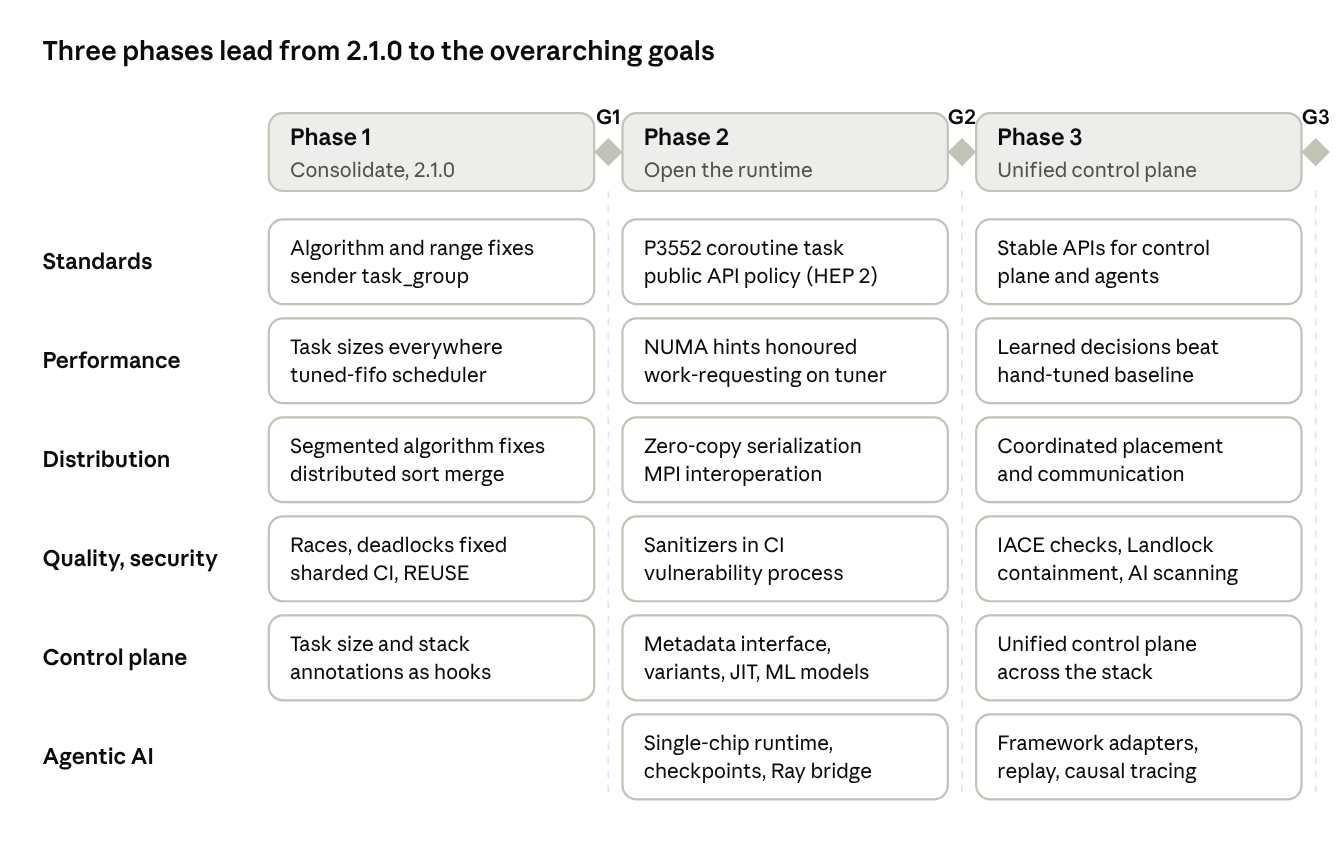
Read each lane left to right: Phase 1 lays the hooks (task sizes, annotations, clean CI) that the control plane and agent work build on in Phases 2 and 3. Agentic AI work starts in Phase 2.
Phase 1 makes the 2.0 foundations correct, measurable and stable, and lays the hooks the later phases build on.
| Workstream | Deliverables |
|---|---|
| Standards | Fix open ranges and algorithm bugs (search_n, set operations, make_heap with par, sentinels); sender policies for the legacy future algorithms; P2300 task_group; start P3552 task<T>
|
| Performance | Task sizes for all parallel algorithms and actions; stack size annotations; local-priority-tuned-fifo scheduler; idle-worker spinning policy |
| Distribution | Action annotations for component actions in reflection builds; correct segmented traversal at partition boundaries; distributed final merge for segmented sort; non-blocking collectives; supervision evicts fenced peers |
| Platforms | Clang and MSVC modules builds green; CUDA builds on Windows in CI; vcpkg, EasyBuild and Spack ports for 2.x |
| Quality and security | Fix the known races and deadlocks (run loop, concurrent_vector, timed waits, stop_token, condition_variable, child threads run directly); sharded CI on all platforms; REUSE compliance; hardened workflows |
| Observability | Tracy as the default tracing back end, with optional call stacks |
Every 2.1.0 deliverable above, with its GitHub issues and pull requests. Status as of 2026-11-12.
| Workstream | Item | Tracking | Status |
|---|---|---|---|
| Standards |
ranges::search_n compiles in all overloads |
#7937, #7938 | In review |
| Standards | Correct results from parallel set operations | #7932, #7933, #8065 | In review |
| Standards | Valid heaps from make_heap with par
|
#7905, #7910 | In review |
| Standards | Ranges algorithms accept sentinels of a different type | #8003, #8004 | In review |
| Standards | Sender policies for the legacy future algorithms | #7983 | In review |
| Standards | P3552 environments, allocators and task<T>, part 1 |
#8043 | In review |
| Performance | Task sizes for all parallel algorithms | #7837, #7947, #7966, #7967, #7968 | In review |
| Performance | Stack size annotations; task size facilities in thread_support | #8020, #8028, #8029 | In review |
| Performance | local-priority-tuned-fifo scheduler | #8035 | In review |
| Performance | One idle worker keeps spinning instead of sleeping | #8036 | In review |
| Performance | False-sharing padding in the moodycamel queue | #8034 | In review |
| Performance | Work-requesting scheduler fixes and optimization | #7921, #7957 | In review |
| Performance | Work-requesting scheduler runs child threads directly | #7789, #7803 | Merged |
| Distribution | Action macros apply to component actions in reflection builds | #8019, #8048 | In review |
| Distribution | Segmented algorithms correct at partition boundaries | #7999, #8000, #7881 | In review |
| Distribution | Distributed final merge for segmented sort
|
#8032, #8033 | In review |
| Distribution | Collectives keep requests for a later generation | #8055 | In review |
| Distribution | Supervision evicts fenced peers safely | #7922, #8027, #8111 | Merged |
| Platforms | C++20 modules CI on Clang 22 (issue #7671 still open) | #7671, #8047 | Merged |
| Platforms | Module builds on MSVC 19.44 and newer; component names | #8059, #8061 | Merged |
| Platforms | CUDA builds on Windows | #7974 | Merged |
| Quality and security | Race and deadlock in run_loop::push_back
|
#7890 | Open |
| Quality and security | Data race in concurrent_vector move assignment |
#7853 | Open |
| Quality and security | Timed waits on futures from non-HPX threads | #7915, #7952 | In review |
| Quality and security | Late wakeups after a condition_variable timed wait |
#7916 | Open |
| Quality and security | Self-deadlock and use-after-free in stop_token callbacks |
#8046 | In review |
| Quality and security | Use after free when checking a child thread run directly | #8062 | In review |
| Quality and security |
shared_future coroutines return the right type |
#8063 | In review |
| Quality and security | Flaky count_direct_children_7830 test |
#7943 | Open |
| Quality and security | REUSE compliance and workflow hardening | #7991, #7992 | Merged |
| Quality and security | Sharded CI portable to macOS and Windows | #8051 | Merged |
| Quality and security | Contracts warn about an ignored HPX_WITH_CONTRACTS_MODE only when it isn't the default |
#7716 | Merged |
| Observability | Optional call stacks for Tracy messages | #8005 | In review |
Exit criteria (gate G1): 2.1.0 released with no open correctness issues in its milestone, performance tests at or above the 2.0.0 baseline on the reference Linux cluster, and green CI on Linux, Windows and macOS.
Phase 2 turns the runtime into a platform others can steer: the information the scheduler already uses becomes an interface, and the first prototypes of the overarching goals run on it.
| Workstream | Deliverables |
|---|---|
| Control plane | Clang/MLIR metadata for HPX constructs and get_compiler_metadata() on executors; a VariantRegistry with predicate-based selection; telemetry exported in one stable schema; a JIT service prototype; fast ML models for chunking and variants (see Unified control plane track) |
| Agentic AI | Single-chip agent runtime with a Python lifecycle API and a LangGraph adapter; heterogeneous CPU and accelerator scheduling; checkpoint and recovery of agent state; Ray and HPX bridge for multi-chip runs (see Agentic AI runtime track) |
| Safety and security | Tiered security CI with sanitizers, fuzzing and merge gates; C++26 contracts on internal and public APIs; signed, reproducible releases with an SBOM; formal incident response; IACE design and prototype (see Safety and security track) |
| Standards | P3552 task<T> complete; public API and namespace policy formalized (HEP 2); deprecations scheduled |
| Performance | NUMA hints honoured by every scheduler; work-requesting schedulers on the tuning policy; no regressions on the performance history graphs |
| Distribution | Zero-copy serialization of action arguments; MPI interoperation in multithreaded and funneled modes |
Exit criteria (gate G2): one compiler extension and one learned decision component driving scheduling end to end, one agentic workflow running across localities, and sanitizer-clean CI.
Phase 3 delivers the three overarching goals as supported features, not prototypes.
- Unified control plane. Scheduling, placement, memory and communication decisions are coordinated across the stack from program intent, runtime telemetry and AI/ML coordination. A full AI loop with continuous retraining and safe fallbacks, memory and communication policies driven by compiler annotations, and an OpenMP entry path. Applications opt in through standard executors and policies; hand-tuned settings become the fallback.
- Agentic AI orchestration. HPX is a supported execution layer for agent frameworks, running long-lived and short-lived agents across nodes with the same API, with adapters for LangGraph, PydanticAI and CrewAI, deterministic replay, causal tracing and isolation and resource limits per agent.
- Safe and secure by default. Intent-aware capability checks on every security-sensitive remote operation; Landlock-based runtime containment derived from those capabilities; AI-driven vulnerability detection in CI; Python (and possibly Rust) bindings as memory-safe entry points; signed releases with an SBOM as standard.
Exit criteria (gate G3): the control plane improves utilization over the hand-tuned baseline on representative HPC and AI workloads, and an external agent framework runs on HPX in production.
The control plane goal is carried by HeliX, a four-year effort that closes the loop between compiler and runtime on top of HPX. The compiler makes HPX constructs visible, emits persistent intent metadata and code variants; the runtime consumes them at decision points (placement, scheduling, batching, protocol and variant choice) and feeds telemetry back for offline tuning and online JIT specialization, steered by lightweight AI/ML models.
| Thrust | Deliverables | Phase |
|---|---|---|
| T1 Compiler-visible constructs and metadata contract | Clang recognizes hpx::async, hpx::for_each and executors and attaches IR metadata (operation counts, strides, dependencies, cost estimates) kept in ELF sections or sidecar files; an MLIR dialect for HPX tasks, futures, algorithms and remote calls; get_compiler_metadata() on executors and policies, queried in under 100 ns |
2 |
| T2 Variant families | The compiler emits variants per kernel (schedules, AoS and SoA layouts, vectorization, tree, ring or GPU collectives); a VariantRegistry selects by predicates over system state, with small ML models for ambiguous cases; telemetry prunes unused variants and finds missing ones | 2 |
| T3 Telemetry loop and JIT | An LLVM ORC JIT service in HPX re-specializes kernels off the critical path (target 10 to 50 ms, else keep the current variant); watchdogs on performance counters trigger it on phase shifts; a persistent, distributed cache of compiled variants | 2 to 3 |
| T4 Memory and communication control plane | Layout descriptors drive NUMA and GPU placement; lifetime analysis enables arena allocation; prefetch hints for pointer chasing; communication regions set batching per region; compiler-extracted communication schedules; per-message protocol choice across MPI, UCX and libfabric | 2 to 3 |
| T5 Standards-aligned migration | Compiler-visible executors behind the standard parallel algorithms and executors; an OpenMP front end that lowers to HPX executors; pluggable CUDA, HIP and SYCL back ends with safe defaults | 2 to 3 |
| AI-driven optimization | Gradient-boosted trees (under 1 µs inference) for frequent choices such as chunk size; neural and RL models for placement, repartitioning and aggregation; continuous retraining from telemetry with validation and safe fallbacks; multi-objective weights for throughput, energy and tail latency | 3 |
Yearly milestones: Year 1, a minimal demo in which Clang/MLIR emits metadata, registers two variants and HPX picks between them. Year 2, memory and communication co-design, fast ML models for chunking and variants, the OpenMP front end and GPU parity. Year 3, the full AI loop with retraining and fallbacks, multi-node GPU scaling and a portability study on two CPU and two GPU generations against MPI+OpenMP+CUDA and Kokkos. Year 4, partner application case studies on scientific applications and emerging accelerators, packaged releases and upstreaming into HPX and, where feasible, LLVM/MLIR.
Phase 1 already supplies the first hooks: task sizes and stack size annotations are runtime-visible intent of exactly the kind the metadata contract formalizes. Earlier adaptive chunk-size work that combined compile-time features with runtime measurements gave 12 to 35% speedups over fixed policies.
Risks specific to this track: metadata and inference overhead eating the gains (strict budgets, per-loop rather than per-iteration decisions, caching), cold starts for learned models (conservative defaults, bounded exploration), and dependence on compiler extension points (keep the metadata schema compiler-independent and publish it).
The agentic AI goal is carried by a native distributed agent runtime, first targeted at a heterogeneous agentic AI platform: a chip that pairs many RISC-V CPU cores with integrated AI accelerators. Agents stay in the frameworks people already use; HPX runs them underneath, routing reasoning to CPU cores and tool execution to accelerators, so developers no longer pin threads and write custom schedulers by hand.
The gaps it closes: existing agent frameworks ignore hardware topology, cluster orchestrators know nothing about accelerator affinity or agent state, and none of them offer deterministic replay, native checkpointing of agent state or core-level observability.
| Layer | What it provides |
|---|---|
| Python API | Framework-agnostic agent lifecycle: deploy(), execute(), checkpoint(), recover(), inspect |
| Framework adapters | LangGraph graph nodes become HPX actions; PydanticAI tool schemas become a distributed tool registry; CrewAI tasks become heterogeneous execution plans; a small interface for other frameworks |
| Native execution | HPX schedules actions across CPU cores and accelerators with topology and affinity awareness; Ray handles multi-node placement and supervision, one Ray actor plus one HPX locality per chip, linked through an HPX parcelport bridge |
First analysis: RayX, an early-stage bridge in which Ray actors launch HPX executables that communicate through an HPX parcelport, shows that the Ray and HPX integration is feasible. The milestone 2 bridge builds on it.
Second analysis: langX runs LangGraph graph nodes as HPX actions on worker localities, with HPX supervision fencing and a coordinator-side commit fence. In 760 failure runs on up to five Rostam nodes (killed, frozen and replaced workers, and a coordinator crash resumed from a checkpoint), every run kept the stock LangGraph final state with no lost step and no outbox effect applied twice, the "survive a node failure without losing work" property of milestone 2, measured on CPUs.
| Capability | Deliverables | Phase |
|---|---|---|
| Heterogeneous scheduling | Profile agent phases (CPU-bound reasoning vs compute-bound tools) and route work automatically; model on-chip and inter-chip interconnects in a parcelport | 2 |
| Deterministic execution and replay | Reproducible scheduling for a given input and hardware configuration; step-by-step replay of a failed run | 2 to 3 |
| Checkpointing and recovery | Extend HPX checkpointing to Python agent state (reasoning history, tool outputs, model context); resume after a crash; pause, migrate to another chip and resume | 2 |
| Observability | Per-action records of core, latency, cross-chip messages and accelerator use, built on the Tracy and performance counter work; a utilization and latency dashboard; causal tracing and a replay UI | 2 to 3 |
Milestones, about 12 months in total:
- Single-chip runtime (months 1 to 3). Python lifecycle API, a LangGraph adapter, HPX scheduling across CPU cores and accelerators, restart on crash.
- Distributed coordination (months 4 to 6). Production-ready Ray and HPX bridge, documented determinism guarantees, checkpoint and recovery across chips, a monitoring dashboard. Exit: five or more agents on two or more chips survive a node failure without losing work.
- Framework ecosystem (months 7 to 12). PydanticAI and CrewAI adapters, replay UI and causal tracing, SLA monitoring of latency, throughput and failure rates.
Risks specific to this track: determinism across mixed-precision accelerators and non-deterministic model sampling (record and replay model outputs rather than re-sampling), access to the target hardware (develop against simulators first), and adapters drifting as agent frameworks change (keep the adapter interface small and versioned).
The safety and security goal is carried by a two-year program that makes safety, security and privacy requirements at every stage of HPX development. It removes whole classes of vulnerabilities (memory safety, concurrency, logic errors) instead of fixing bugs one at a time, and it covers both threats to applications that use HPX and threats to the HPX codebase and supply chain.
| Thrust | Deliverables | Phase |
|---|---|---|
| Security-focused CI/CD | Fast pre-merge checks (linters, unit tests) plus scheduled heavy jobs (ASan, TSan, UBSan, LSan, fuzzing, CodeQL, clang-tidy); merges blocked on critical findings; a regression test or minimized fuzz input required for every fixed defect; dependency and secret scanning | 2 |
| Hardened builds and SBOM | Hardened standard library builds; reproducible, signed release artifacts with provenance; a software bill of materials published with every release | 2 |
| API hardening | C++26 contract specifiers and assertions on internal and user-facing APIs, active in debug and CI builds and off in release builds; bounds checks, safe integer arithmetic and stricter type safety following the standard library hardening proposals; a hardened HPX API build | 2 |
| API call sequencing | Finite-automaton runtime monitors that detect calls in the wrong order or on objects in invalid states | 2 to 3 |
| Intent-Aware Capability Enforcement (IACE) | Security-sensitive parcels carry an intent; the runtime admits a request only if capability, intent, target policy and runtime context all allow it, and authority never widens along asynchronous delegation chains | 2 (design, prototype) to 3 |
| Runtime sandboxing | Landlock-based containment that turns IACE capabilities and intents into OS restrictions on files, network, processes and IPC, adapts as tasks spawn and delegate, runs without root and under Slurm | 3 |
| AI-driven vulnerability detection | A pluggable CI analyzer with domain-adapted open-weight models that finds both conventional vulnerabilities and IACE policy violations, tuned for cost through quantization and staged analysis | 3 |
| Memory-safe language bindings | Python bindings for the most important HPX APIs; Rust bindings as a stretch goal | 3 |
| Community and incident response | Formal vulnerability reporting and triage with a permanent responder; security champions; train-the-trainer program reaching about 240 people; secure coding guidance in the developer and user docs | 2 to 3 |
Runtime sandboxing and AI-driven detection depend on the hardened CI/CD and the IACE prototype, so they start once both are in place. Each milestone ships as an HPX security release for early user feedback.
Risks specific to this track: fuzzing and sanitizer runs are compute-intensive (mitigated by sampling, scheduled runs and donated compute), stricter checks can slow contributors (fast pre-merge tier, clear guidance, mentoring), and tool noise (tuned rule sets, triage by security champions).
| Area | Metric | Target | Phase |
|---|---|---|---|
| Performance | Performance test results vs the 2.0.0 baseline on the reference Linux cluster | No regression | 1 |
| Control plane | Speedup vs MPI+OpenMP+CUDA and Kokkos baselines, or equal speed with less developer effort | Statistically significant | 3 |
| Control plane | Decision quality vs an oracle best-of-variants | Gains traced to specific metadata and knobs | 3 |
| Control plane | Overhead budgets: metadata query, tree inference, JIT latency | < 100 ns, < 1 µs, 10 to 50 ms off the critical path | 2 |
| Control plane | Portability | Two CPU and two GPU generations | 3 |
| Safety and security | CWEs and CVEs found with SARD and Juliet | 50% reduction | 3 |
| Safety and security | ASan, TSan and UBSan failures per release | 60% reduction | 3 |
| Safety and security | Mean time from vulnerability report to confirmed fix | 14 days | 2 |
| Safety and security | Test coverage of scheduler, parcel and AGAS modules | 80% | 3 |
| Safety and security | Parsers and RPC interfaces under continuous fuzzing | 5 interfaces | 2 |
| Safety and security | IACE violations caught per release | Operational | 3 |
| Safety and security | Security releases with an SBOM and published security posture | 4 releases | 2 to 3 |
| Agentic AI | Agents on one chip scheduled across CPU cores and accelerators, without manual pinning | LangGraph agent running end to end | 2 |
| Agentic AI | Multi-agent system that survives a node failure | 5+ agents on 2+ chips, no lost work | 2 |
| Agentic AI | Hardware utilization under agent workloads | Above 85% | 3 |
| Agentic AI | Framework adapters in active use | 3 or more | 3 |
| Community | People trained through the train-the-trainer program | 240 | 2 to 3 |
| Risk | Affects | Mitigation |
|---|---|---|
| Compiler support for modules and reflection lags (Clang crashes, MSVC regressions) | Phases 1 and 2 | Keep non-module builds first-class; narrow, version-guarded workarounds; report upstream |
| Upstream stdexec and P2300 APIs keep moving | Phases 1 and 2 | Track stdexec closely, keep the re-export layer thin |
| Compiler extensions need partners outside the project | Phase 2 control plane | Define the metadata interface first, so any compiler can target it |
| Learned decisions cost more than they save | Phases 2 and 3 | Measure against the hand-tuned baseline; keep decisions off the hot path; fall back to the tuner |
| Agentic workloads differ from HPC tasks (I/O-bound, long waits) | Phase 2 agentic AI | Prototype with real agent workflows early and adjust the scheduler from measurements |
| Contributor time is limited | All phases | Small, reviewable slices; GSoC and mentoring; phases ordered so each one ships value on its own |
- Target dates for 2.1.0 and for gates G2 and G3
- Release cadence: a fixed number of feature releases a year, or release when ready
- Owners for each workstream, in particular the control plane and agentic AI prototypes
- Which compiler extension and which agent framework to partner with first
- Whether Phase 3 warrants a 3.0 version with API breaks