Repository navigation
Releases
Vesora 1.1.0

Vesora 1.1.0
Core, React and Python release identities are 1.1.0. This page is the source note for that version. It does not mean 1.1.0 was already on npm or PyPI. The GitHub release is where downloadable assets and registry publication status belong. 1.0.0 remains the previous release.
1.1.0 keeps scene protocols 1–9 and the 1.0.0 analysis families. The additions are viewer and interaction behavior:
- The shared viewer command bar holds the view actions, a status pill, and one Export menu. The pill reads Live, Frozen snapshot, or Ready. While frozen, it includes the capture time. Export writes PNG or HTML from the displayed frame or the latest accepted data, with a checkbox for the observation record. The full-width Export options row is gone.
- The sample card can take keyboard focus. It shows the layer, coordinates, the unit when one is declared, the source index, and the representation method when available. Revision, byte, and worker details stay in a collapsed Details disclosure. A theme change while frozen updates the chrome immediately and applies the plot theme when the view returns to live.
- Line, band, and spectrogram panels that share a linear or time x axis, and a single panel of those kinds, show an x-range strip under the plot. Dragging sets the x domain, and a double-click clears it.
- When axes share x, the cursor shows each line's nearest recorded sample from x inspection, with no interpolated value. A heatmap or spectrogram cell appears only when the event already includes cell indices.
- The selection table pages the event's indices, 20 rows at a time. Linked selection is still two scatters and one histogram.
- Viridis and magma use the 256 Matplotlib 3.10.7 stops. Coolwarm is available.
colorMapaccepts under, over, and bad colors. - Scatter interaction on worker-owned data replans from a spatial grid, and the first query may build that grid. Mutable caller buffers still scan. An unindexed point query records indices during the visibility pass.
- The renderer can upload a known dirty vertex span when that span is under three quarters of the buffer. A steady streaming append that evicts the front of the window still dirties the retained buffer, so that path remains a full upload.
- 3D picking builds its projected index in chunks and keeps a hit only when it passes the existing hit test.
Same-machine measurements — 17 November 2026
These numbers are from one machine, before and after the engine change. They are not a universal speed claim, and they do not mean the product is faster overall.
npm run benchmark used Chrome 157.0.8103.79 headless, device pixel ratio 1, viewport 1000×700, and the hardware GPU path (softwareGpuRequested false): ANGLE Intel Graphics (0x00007D67) Direct3D11 on an Intel Core Ultra 9 275HX. Both the baseline and the later run were a 1,000,000-point scatter that stayed on density aggregation. Interaction p95 is the 95th percentile of 20 setView/ready() samples.
| Baseline | 1.1.0 | |
|---|---|---|
| First render | 215.8 ms | 460.5 ms |
| Interaction p95 | 317.4 ms | 75.5 ms |
The first render is slower because the spatial grid is built on the first query. Other panel cases on the same machine were mixed: several first renders were slower, including the 1,000,000-point single-panel scatter in npm run benchmark:panels.
npm run benchmark:streaming requested SwiftShader (softwareGpuRequested true). Those timings are software-renderer numbers, not hardware FPS.
Not in this release
SVG export, PDF export, pandas integration, lasso selection, twin axes, and symlog scales are not part of 1.1.0.
Publication
Major version 1 still uses the bounded automatic publication policy. Final publication needs npm run package:release from a clean commit that carries the v1.1.0 tag, then reviewed gate reports bound to those exact archives. npm run verify:next writes local candidate archives and does not mark gates passed. Long-duration endurance, real screen-reader operation, and the five-person unaided pilot remain unverified. The 5 November 2026 verify:next result belongs to 1.0.0.
A later local npm run verify:next on 17 November 2026 passed in 80.024 seconds, including build, candidate packaging, browser/offline checks and the installed wheel's Qt and Jupyter workflows. That run's manifest was a candidate from a dirty working tree at commit 00d9fbfd27586dc46c1650109ac6e6a93eb1a87c, manifest SHA-256 b3f5c96bbcbd87aa25460f5c1c5cf2d670d5d22569e75dc63fdca991a0e239d5. It is not a final publication identity and it did not mark any release gate passed. Report.
Registry and archive status
npm and PyPI were not published. No wheel or npm tarball is attached to this release.
npm run package:release without --candidate stopped with: Release builds require a clean commit; --candidate creates local unpublishable review archives. The working tree still has untracked .vafer/ research notes, and those notes are not in the tag.
The local dist/release-v1.1.0 directory is the earlier candidate from npm run verify:next: candidate true, workingTreeDirty true, commit 00d9fbfd27586dc46c1650109ac6e6a93eb1a87c. npm run publish:packages for both npm and pypi stopped before upload with: Local candidate archives cannot be published.
Release gates were not marked passed. No skip flag was passed to the publisher.
Vesora 1.0.0 — Find, compare, share
Find the event. Compare the observations. Share the source.
Vesora 1.0 brings ten focused analysis families to a shared TypeScript/WebGL2 engine for Python, JavaScript and React.
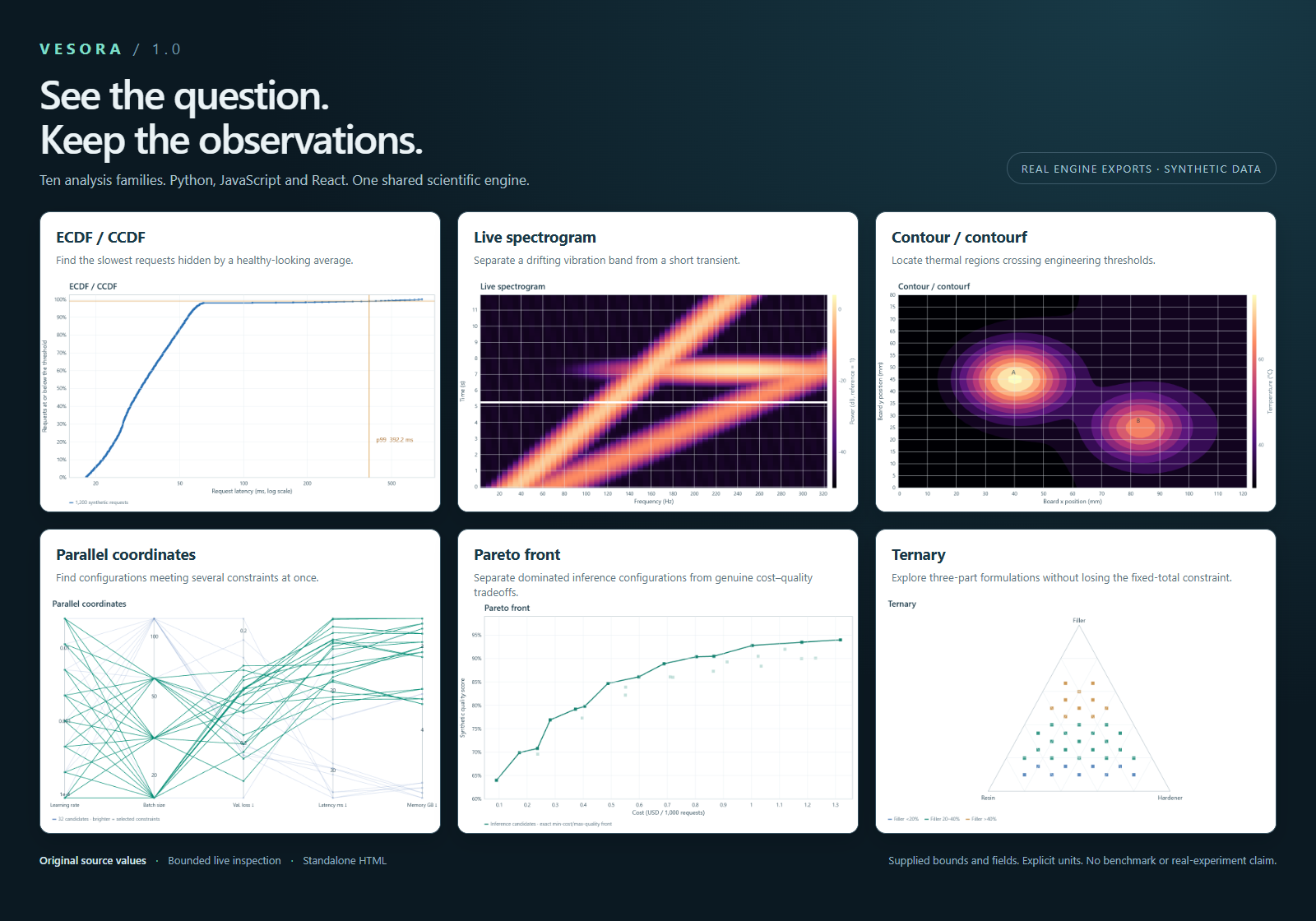
Ten new analysis families
| Chart | The niche question it solves |
|---|---|
| ECDF / CCDF | How many requests meet a deadline, and what remains in the tail? Exact threshold counts and nearest-rank quantiles through queryECDF / query_ecdf. |
| Live spectrogram | When did supplied frequency content drift, burst or disappear? Bounded row retention keeps a live window. |
| Event timeline | Which events and intervals overlapped an anomaly? |
| Asymmetric error bars | Does a difference remain meaningful alongside supplied lower/upper bounds? |
| Contour / filled contour | Where are hot spots, ridges and narrow operating regions in a sampled field? |
| Quiver | Which direction does a supplied vector field move, and by how much? |
| Parallel coordinates | Which stable-ID candidates satisfy several constraints together? |
| Pareto frontier | Which two-objective alternatives remain nondominated under explicit min/max objectives? |
| Phase portrait / hysteresis | Does a response depend on acquisition direction and the path taken? |
| Ternary composition | How do three fractions balance within a recipe or allocation? |
Scene protocol 9 retains their source values and options. Legacy protocols 1–8 remain readable.
Find, compare and share
- Align runs with exact, nearest or linear matching, event offsets, unit guards and source lineage.
- Link static observations by stable row IDs across views, preserving full membership and revision checks.
- Freeze an independent displayed observation while bounded acquisition continues. Share PNG or self-contained interactive HTML with retained source values and the matching runtime.
- Append spectrogram rows with bounded retention and incremental GPU updates under a fixed color domain.
- Use an app-owned Figure with React
VesoraViewer, including development StrictMode lifecycle handling. - Export desktop PNGs at the declared Figure dimensions regardless of window resizing or scrollbars.
A ten-step Turkish chart tour explains real examples with JavaScript/Python code and PNG/HTML export. Four workspaces cover the gallery, signals, run comparison and linked cohorts. The portable skills/vesora skill and llms.txt help agents use the actual APIs.
Installation and registry status
- npm: Pending publication / authentication.
- PyPI: Pending publication / authentication.
Until the registry channels above are verified, download the matching package archives from this release and install locally:
python -m pip install ./vesora-1.0.0-py3-none-any.whl
npm install ./vesora-core-1.0.0.tgz ./vesora-react-1.0.0.tgz react react-dom
Python 3.10+; React 18.3 and 19. The notebook extra adds Jupyter widget support. WebGL2 is required. The wheel includes matching desktop/renderer assets.
Verified scope
The final clean, tagged archives passed all seven required automatic gates: correctness, browser, Qt, Jupyter, independent React consumers, packages and short performance probes. Local final-archive verification took 276.566 seconds, including build/package, installed-package checks, production Vite/Next consumers and real Qt/Jupyter workflows. Dependency/tool setup and previously completed remote CI execution are outside this duration.
- 486 core/React tests; 476 headless Python tests (16 optional host skips, with required real-host checks executed separately); 79 real Qt desktop tests; 70 release contracts and three runner contracts.
- All ten families, offline archives, source values, frozen observations, selection and cleanup exercised through the exact installed wheel and extracted npm packages.
- React 18.3/19 tested through independent production consumers; development StrictMode, narrow layouts and chart-tour exports checked.
- Full Linux CI browser suite: 207 passed, two optional Jupyter tests skipped in that stage; real Jupyter ran separately. Actual 200% browser zoom and genuine back/forward cache restores passed. The engine entries used by those checks match the final archive bytes; the embedded HTML shell differs only in escaped CRLF/LF across platforms and was independently tested from the final local archives.
- The complete source CI matrix passed, including real installed hosts, browser compatibility and both React consumer versions.
Explicitly unverified: long-duration endurance, including the historical two-hour soak; real screen-reader/human accessibility evaluation; and the five-person unaided pilot. The v1 bounded automatic publication policy does not present these as passes or certifications. Historical 0.x release gates remain unchanged.
Scientific boundaries
Spectrograms display supplied spectra; FFT preparation belongs to the analysis pipeline. Error bars display supplied bounds, contours interpolate regular scalar grids, Pareto compares two objectives, and ternary normalization is opt-in. Declared units/transforms do not execute conversions or certify scientific accuracy.
Generic streaming covers numeric 2D line/scatter with a separate bounded-row spectrogram API. SVG/PDF export, WebGPU, arbitrary mesh/volume rendering and persistent full-history recording are outside this release. Fixed short probes do not establish universal frame rates, physical presentation time or endurance.
Archive identity
- Tag:
v1.0.0 - Commit:
00d9fbfd27586dc46c1650109ac6e6a93eb1a87c - Manifest SHA-256:
c1b16b177f5c4b86c1df871d0262b893ad016fa522331b7dddc54926827975cf - Assets: two npm tarballs, one wheel, eleven standalone HTML demos, manifest and
SHA256SUMS.txt. Registry and GitHub downloads are checked against these immutable bytes.
Documentation · Chart guide (Türkçe) · Discord · X — @UEdizaslan
Vesora 0.9.0-rc.8 — Observations & Denge
Vesora 0.9.0-rc.8 — Observations, faster startup and Denge
Release candidate for review. RC8 has a new package identity: JavaScript 0.9.0-rc.8, Python 0.9.0rc8, tag v0.9.0-rc.8. It is published as a GitHub prerelease for evaluation; npm and PyPI publication are not part of this delivery. It is not an accepted stable release. The fixed RC6 and RC7 archives, tags and historical evidence remain unchanged. RC7 remains a draft after its Next.js consumer build stopped on a verified framework security advisory.
Release tooling fix
The source checkout pins the development-only Next.js consumer dependency to 16.4.2. Next 16.4.0 was affected by the October 14 security advisories; the fixed 16.x line starts at 16.4.1. Next is not a runtime dependency of the distributed Vesora core or React packages. RC8 is a new archive identity so RC7's failed evidence remains intact.
What changes
- One observation model. JavaScript and Python can declare channel units, quantities, origins and external transform metadata. Opt-in HTML observations distinguish accepted data from the displayed frame, including frozen source ownership and stream intervals. Declarations use scene protocol 8; protocols 1–7 still import. Metadata describes values; it does not execute transforms or convert units.
- Studio and Embed. One viewer supports both workspaces, scoped theme tokens and explicit controls. Switching modes preserves the mounted figure and frozen observation. React exposes the same options through
VesoraViewer. - Smaller startup imports.
@vesora/core/runtimekeeps the HTML template outside the initial dependency graph. Async HTML export captures source ownership before loading its template. React demos load by route; the viewer does not need the SaaS dashboard styles to start. - Focused performance improvements. Repeated narrow scatter queries can reuse a bounded exact index. HTML encoding uses bulk byte copies while retaining the original binary representation. Cold queries and unsupported inputs retain the scan path.
- Denge Membrane. An experimental React demo expresses a connected pair as two regions in a fixed area. Their curved boundary preserves the exact volume ratio; the hatched area represents the amount needed to reach equal shares. It uses the conservative
@vesora/core/balancemodel and a linked 3D observation. The interface now uses the existing Vesora logo.
The Membrane renderer lives in the React example; it is not a new public @vesora/react export. The curve is a visual encoding, not a fluid-surface simulation. No world-first, patent novelty or newly discovered physical law is claimed. Denge HTML export contains the displayed 3D scene and observation, not the 2D controller or a resumable simulation.
Try the candidate
From this tag's source checkout:
npm ci
npm run build
npm run demo:react
Open the Vite URL with ?demo=workbench for Studio/Embed or ?demo=balance for Denge. Node.js 22.12+ and a WebGL2-capable browser are required for development and viewing.
Install the fixed candidate assets attached to this prerelease into a separate project or environment:
npm install ./vesora-core-0.9.0-rc.8.tgz ./vesora-react-0.9.0-rc.8.tgz
python -m pip install ./vesora-0.9.0rc8-py3-none-any.whl
Python requires 3.10+. The release directory also contains ten self-contained HTML demos, a source/runtime manifest and SHA-256 checksums. The React application is available in the tagged source checkout; the ten standalone demos do not include its Membrane controls.
Validation and remaining acceptance
Source preflight passed TypeScript checking, 415 core tests, 41 React tests, 442 Python tests and 65 release-contract tests. The Python run skipped 15 host-dependent tests; those skips do not establish Qt/Jupyter acceptance. Focused browser checks cover Membrane area ratios in both transfer directions, 320/390 px layouts, keyboard interaction, conservation and displayed 3D export.
These development checks are not substitutes for the final archives' acceptance reports. Each new archive starts with its own pending gate inventory. Exact-file verification, installed-package checks and their raw reports are retained with the candidate when run. The local release directory retains release-gates.json and evidence/; these review records are not distributed package assets. The validation status below lists checks actually completed.
This public prerelease is available for evaluation before full release acceptance. The full same-archive gate set remains required for full release acceptance and stable/package-registry publication: correctness, browsers, Qt, Jupyter, React consumers, packages, performance, endurance, accessibility and the five-person pilot. The real screen-reader/pilot sessions have not been conducted. The earlier RC6 endurance run failed after Windows standby; it does not pass RC8's endurance requirement. Long runs are not being restarted as part of this short release preparation.
The startup measurements refer to the recorded development builds and local paired workload, not the RC8 archive or a universal performance guarantee.
Documentation
- Getting started and product overview
- Observation metadata and Studio/Embed
- Denge model and Membrane geometry
- PRISM API and migration guide
- Acceptance procedure and RC6 history
Publication must use these exact checked archives. A source or archive change requires a new candidate identity and fresh evidence; do not replace fixed RC6, RC7 or RC8 files in place after they are fixed.
Exact RC8 archive checks
| Check | Result |
|---|---|
| All 15 GitHub assets downloaded and SHA-256 matched | Passed |
| Ten standalone offline demos and PNG exports | 10/10 passed |
| Installed wheel/core and protocol-8/runtime/Balance/NodeNext contracts | Passed; 11 installed browser scenarios |
| React 18.3.1 Vite and worker fallback | 2/2 passed |
| React 19.3.0 Vite, worker fallback and Next 16.4.2 App Router | 3/3 passed |
The patched Next consumer completed successfully; RC7's failed result is preserved. Reviewed RC8 acceptance inventory: packages and React consumers passed; eight gates remain pending (correctness, full browser matrix, Qt, Jupyter, performance, endurance, accessibility and beta pilot). Source preflight results above do not automatically satisfy these archive-bound gates. This is a public prerelease with incomplete release acceptance; npm/PyPI and stable publication have not occurred.
Source commit: 8b481a194c9a8cb585abc2f4223613e1e859b3b6. Manifest SHA-256: a60e7ee0c56b896cca67be26fd7b4d1d3f7d49e30820db1cebb012eb4eb5a5fc.
Vesora v0.2.0 — Share Interactive Discoveries
Vesora v0.2.0 — Share Interactive Discoveries
Create a scientific figure in Python or JavaScript, save the viewpoints that explain your findings, and share it as one interactive HTML file. The recipient can open it directly from disk and explore it without Python, a local server, or an internet connection.
Developer preview. The API continues to evolve. Interactive viewing requires WebGL2. HTML files contain the original exported source data; Python callbacks, application code, parameter sliders, and live connections are not included.
Share a discovery
import vesora as vs

fig = vs.figure(title="Measurements")
fig.scatter([1, 2, 3], [2, 4, 3], label="Samples")
fig.bookmark("Overview")
fig.set_axes(xlim=(1.5, 2.5), ylim=(3.5, 4.5))
fig.bookmark("Detail", note="Inspect the highest measurement.")
fig.restore_bookmark("Overview")
fig.save_html("measurements.html")
In JavaScript, the equivalent export is toHTML(fig) for an HTML string or downloadHTML(fig, "measurements.html") for a browser download. Both languages can generate HTML before displaying a figure.
Included in this release
- Self-contained HTML with the shared engine, worker, typed source data, and offline viewer.
- Named bookmarks with plain-text notes, stable replacement order, and complete view restoration, including automatic axis limits and 3D pan.
- An English viewer with bookmarks, reset, PNG download, and a per-layer representation inspector. Density counts are explained separately from individually drawn points.
- HTML downloads throughout the 16-example gallery. The million-sample density example includes
Overview,Separate clusters, andIndividual samplesbookmarks. - Corrected view-state synchronization across reset and bookmark restoration. Existing PNG export and the five plot types remain available.
Bookmarks describe viewpoints of one current dataset. They do not store historical data, styles, layer visibility, or selections. The file opens at the export-time view; reset returns to that view rather than to its first bookmark.
Download and install
Download the packages from the v0.2.0 GitHub Release. Python 3.10+:
python -m pip install ./vesora-0.2.0-py3-none-any.whlFor a JavaScript/TypeScript frontend:
npm install ./vesora-core-0.2.0.tgzThe Python wheel includes the engine. HTML generation does not initialize Qt, although the normal Python installation still includes the desktop dependencies. The npm package has no runtime dependencies. These packages are distributed through GitHub; this release does not publish to the npm or PyPI registries.
The release also includes vesora-discovery-demo.html, a standalone synthetic-data example, and SHA256SUMS.txt covering the downloadable packages and demo.
Validation and compatibility
The release validation covers unit and Python tests, Python/JavaScript scene parity, gallery snippets, browser rendering, direct offline HTML opening, bookmark navigation, 3D pan, PNG export, script-safe text, and a 320px viewer layout. Distribution checks install the wheel and tarball in separate clean environments outside the checkout and open the HTML they produce.
Scene protocol version 1 is retained. New optional bookmark and pan fields do not prevent the new engine from reading older snapshots. HTML has its own format version and embeds its matching engine; older engines are not expected to implement new bookmark or pan behavior.
There are no new plot types, linked multi-view layouts, live streaming providers, SVG/PDF output, or WebGPU renderer in this release. Large datasets increase file size because full source arrays are included. Synthetic examples and software-rendered browser tests do not establish a hardware performance guarantee.
Vesora v0.1.0 - Scientific visualization preview
Vesora v0.1.0 — Initial development prerelease
Python and JavaScript/TypeScript can create 2D scientific plots and basic 3D scenes through the same TypeScript visualization engine. The API is not yet stable in this first prerelease.
Included in this release
- WebGL2 line, scatter, heatmap, surface, and 3D scatter rendering, with axes, legends, and colorbars.
- Pan, zoom, 2D selection, a 3D camera, and data/style updates on existing layers.
- Count aggregation for dense point data, line reduction that preserves extrema and gaps, and inspectable representation metadata.
- Python lists and standard numeric buffers; NumPy is optional.
- A Qt desktop window, notebook adapter, and PNG export using the bundled shared engine.
- Sixteen interactive gallery examples with NumPy-free Python code. AI comparison data is synthetic.
Installation
Download the appropriate file from the release's Assets section. For Python 3.10+:
python -m pip install ./vesora-0.1.0-py3-none-any.whlThe Python wheel includes the engine; end users do not need Node.js. aiohttp and PySide6 are installed automatically. For notebook support, install the same wheel as "./vesora-0.1.0-py3-none-any.whl[notebook]".
In a JavaScript/TypeScript frontend project:
npm install ./vesora-core-0.1.0.tgzThe installed package is named @vesora/core. Import it through a bundler, or serve the package's dist/index.js and dist/worker.js files together in the same directory over HTTP. TypeScript declarations are included.
This release is distributed through GitHub; it does not publish packages to npm or PyPI. For current English usage examples, see the README and API guide. SHA256SUMS.txt contains the SHA-256 hashes of the downloadable packages.
Verification and limits
At release time, TypeScript type checking, 31 unit tests, 105 Python tests (including five real Qt desktop tests), 10 browser tests, Python/JavaScript scene parity, and 32 gallery code examples were verified locally. Browser tests use software WebGL; these results are not GPU performance measurements.
WebGL2 is required, and the desktop host needs a working graphics environment. Data providers are in-memory in this version; there is no general performance guarantee for 100 million records. WebGPU, SVG/PDF export, volume rendering, indexed disk/streaming data, and vector_field are not implemented yet.