Repository navigation
Lightpath 0.1.0

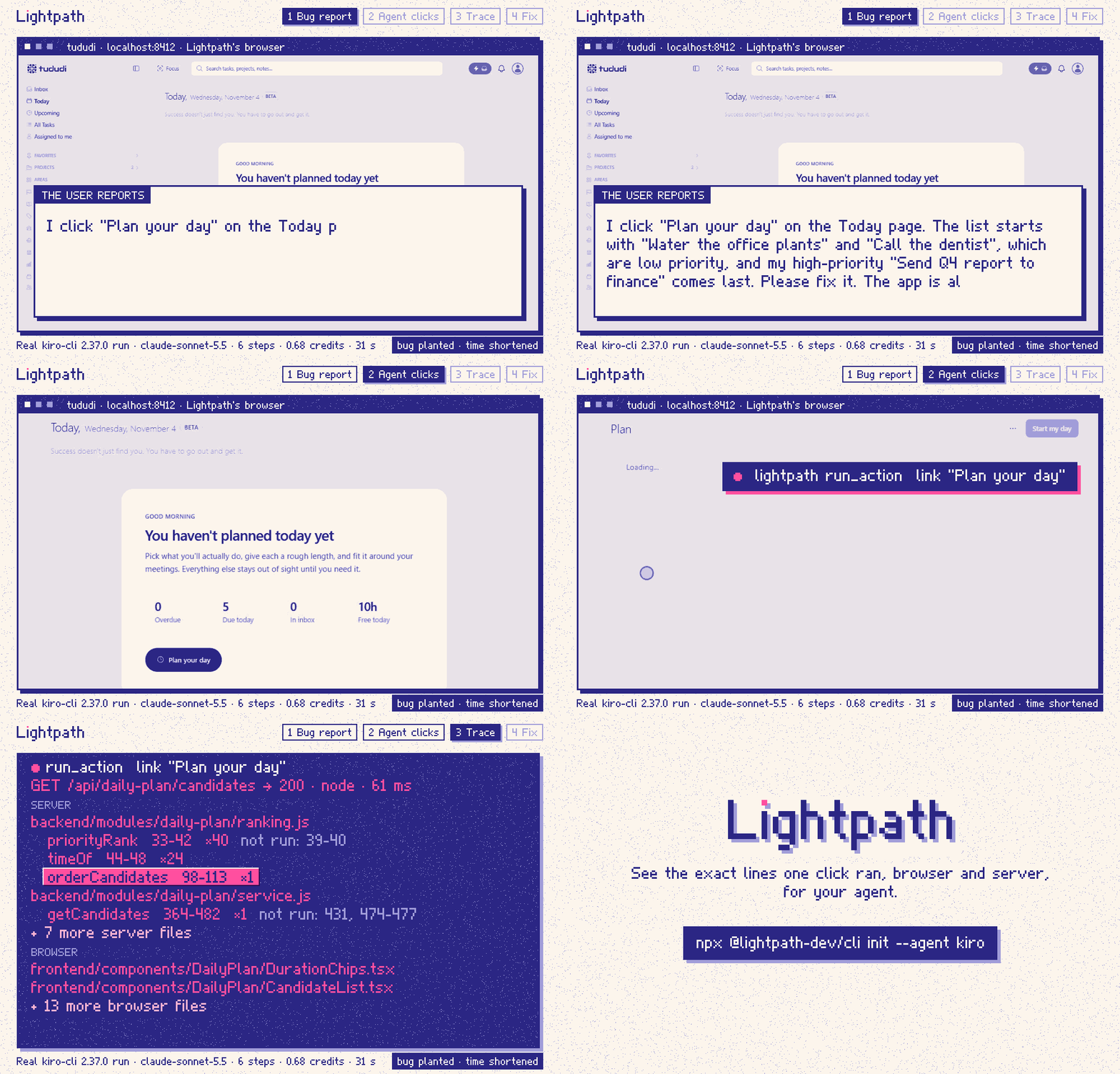
A real kiro-cli run on tududi (MIT, © Tududi Developers), screens recoloured to Lightpath's palette. The bug was planted for the demo. Run files: docs/media/tududi-run.
Your coding agent can now run the loop itself: click something in your app, get the exact lines that click ran in the browser and on the server, look closer, fix, and check the fix.
npx @lightpath-dev/cli init --agent claude-code   # or: cursor, vscode, kiro
npx @lightpath-dev/cli doctorAll 7 @lightpath-dev/* npm packages are at 0.1.0. The VS Code extension stays at 0.0.1, which still reads 0.1.0 traces (D-137). Needs Node.js 22.12 or newer and Chrome or Edge.
Added
run_action: the agent names a button or link, and Lightpath clicks it (or presses Enter or Space) in the browser it opened. The answer is that action's trace, frontend and backend, in one call. It can fill form fields first; typed values never show up in any output. Runs on 127.0.0.1 with the daemon's token and opens no debug port.- Compact output by default: every tool answer is at most 16,000 characters, about 4,000 tokens. A trace reads as a list of functions, grouped into before the request, on the server, and after the response, with line ranges, call counts and the lines that didn't run.
- A deeper look on request:
get_tracewith afileorfunctionshows the lines that ran, in pages. - Fix checking:
diff_tracescompares two traces by function, so a fix that moves lines still compares. lightpath init --agent <claude-code|cursor|vscode|kiro>writes the MCP config and a shortAGENTS.mdblock.lightpath doctorchecks it. CI tests all four on Windows, macOS and Linux.- Errors in traces: thrown errors,
console.error, failed requests and a Node server's crash show in the trace of the action they belong to. - Auto-start:
lightpath mcpstartslightpath devthe first time a tool needs it, and stops it when the agent closes. run_request: for API-only backends. The agent sends one HTTP request to the app on localhost and gets the backend code it ran, with no browser. Loopback only, no redirects, no proxy.
Security
- Secrets hidden in everything a tool returns: token-, key-, secret- and password-like values,
Bearertokens and JWT-like strings become[redacted]. Request and response bodies and headers are never collected.
Fixed
lightpath dev --urlnow waits until the app answers, up to 60 s, instead of opening the page too early.- The page Lightpath opens reloads itself if its own scripts failed to load at start, at most 3 times (webpack apps that compile twice).
Benchmark, stated plainly
Lightpath did not raise the fix rate, and runs with it cost more. Kiro CLI 2.37.0 with claude-sonnet-5.5, seeded bugs in two suites, rules committed before any run (full write-up):
| Set | Fixed without | Fixed with | Credits per run, without → with |
|---|---|---|---|
| Shop, 7 visible bugs | 21 of 21 | 20 of 21 (21 without the flaw) | 0.317 → 0.493 |
| tududi, 3 visible bugs | 15 of 15 | 15 of 15 | 0.980 → 1.329 |
| Shop, 3 held-out bugs | 9 of 9 | 9 of 9 | 0.339 → 0.434 |
| tududi, 2 held-out bugs | 9 of 10 | 6 of 10 (7 without the flaw) | 1.116 → 1.333 |
The scoring's void check wrongly flagged 5 runs; both numbers are given. tududi has only 3 visible bugs, and all 5 of its fixes are public, so the model may have seen them. One agent and one model were run.
What Lightpath gives an agent is the code one click really ran, browser and server, line by line. It doesn't make agents fix bugs faster in this benchmark.