Repository navigation
Releases
26.1a9


Highlights
- Dashboard: delete dead letters that should never run again, with a Delete
button next to Retry (both ask for confirmation first), andpotatoq dead delete
on the command line. Clicking a dead letter now shows its reason and traceback on
Redis too, where results aren't stored by default.
Changes
- Group all Dependabot updates into one monthly PR
- Dashboard: find dead letters when looking up a task, with Retry in the dialog
- Delete dead letters from the dashboard and CLI; confirm before retry and delete
Full Changelog: 26.1a8...26.1a9
Contributors
Thank you to everyone who contributed to this release: @anze3db
Contributors
Assets 4
26.1a8
Highlights
-
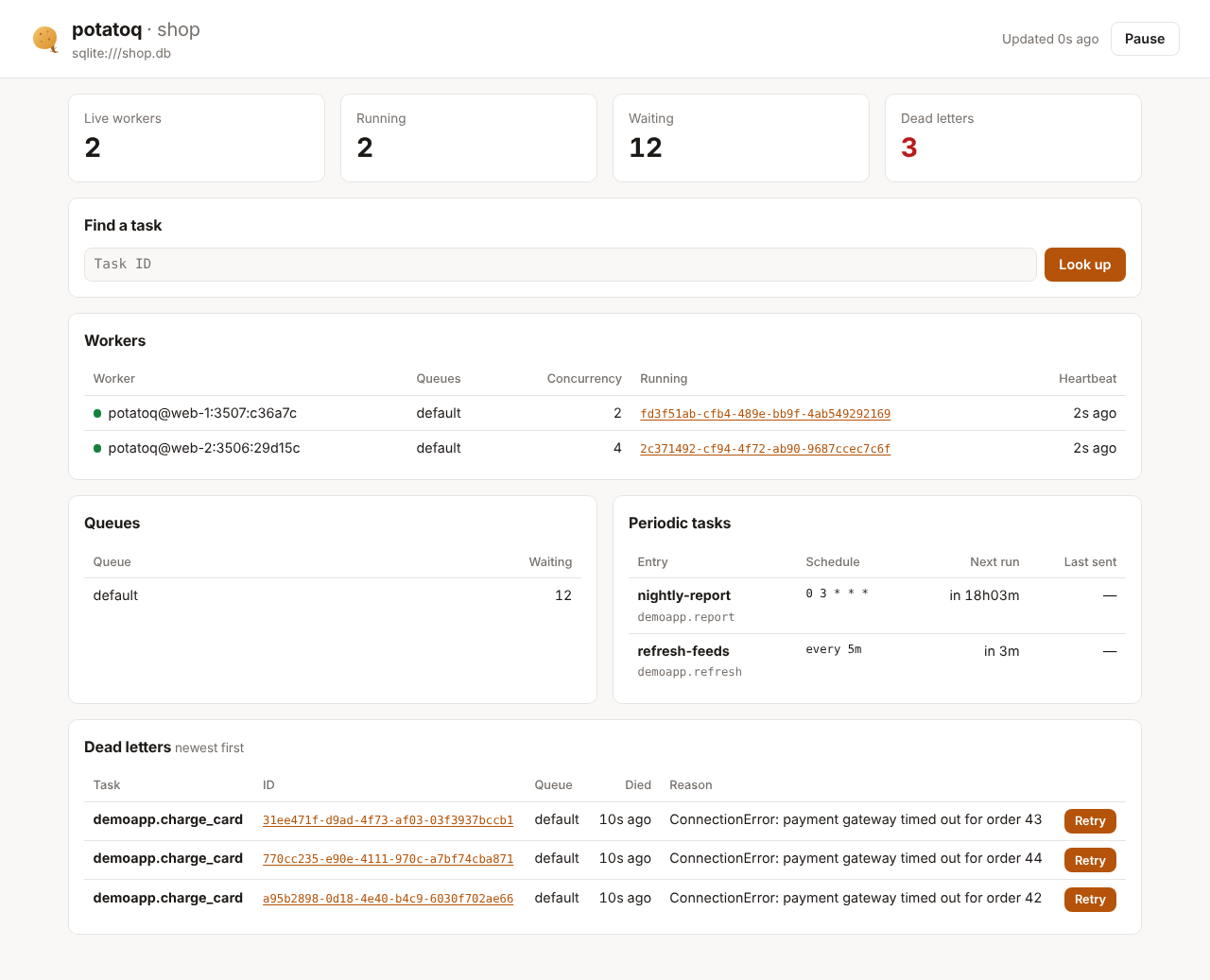
🥔 A web dashboard: a Flower replacement with no extra dependencies.
Docs ·
#3- Live workers and the tasks each one is running right now, queue sizes, and
periodic tasks with their next run and when they were last sent. - Dead letters with their reason, and a Retry button to send one back.
- Any task by ID: its state, arguments, timings, worker, and result or traceback.
Revoke one that hasn't started yet. - It reads the broker and the result backend directly, so there are no events to turn
on, nothing is lost when it restarts, and it works with every broker. - Run it with
potatoq dashboard, on Flower's port 5555, with--auth user:password
and--read-only. Or mount it:include("potatoq.contrib.django.dashboard")
for Django staff users,Dashboard(app).asgiin FastAPI or Starlette, and
Dashboard(app)as a WSGI app in Flask or gunicorn.
- Live workers and the tasks each one is running right now, queue sizes, and
Changes
- Add a bug report form and point questions to Discussions
- Docs: add link preview banners and Open Graph tags
- Wishlist: a chaos test that kills workers and checks no task is lost
- Add a web dashboard, a Flower replacement with no extra dependencies
- Changelog: a fuller highlight for the dashboard
Full Changelog: 26.1a7...26.1a8
Contributors
Thank you to everyone who contributed to this release: @anze3db
Contributors
Assets 4
26.1a7
Highlights
Nonenow means "no limit" fortime_limit,soft_time_limitandmax_retries
on a task (@app.task(...)and Django's@task(...)), as in Celery. They used to fall
back to the app-wide settings, sotime_limit=Nonestill killed the task after 30
minutes andmax_retries=Nonestopped after 10 retries. Leave an option out to use
the app-wide setting.0also turns the time limits off. On RabbitMQ, a task without
a time limit raises the consumer timeout to a day.potatoq worker --time-limit 0(and--soft-time-limit 0) turn the limits off;
0used to be ignored.
Changes
- Release with REST-only gh calls; --no-dry-run pushes
- Let time_limit=None turn a task's time limit off
- Let None mean no limit for soft_time_limit and max_retries; --time-limit 0
- Stop tracking a local Redis dump.rdb
- Name every task the deploy check test finds when it fails
- Finalize the Django app before the deploy check test filters its tasks
Full Changelog: 26.1a6...26.1a7
Contributors
Thank you to everyone who contributed to this release: @anze3db
Contributors
Assets 4
26.1a6
Changes
- New Relic: activate the agent only in worker processes, so forked ones report
- Celery guide: point celery multi users to the systemd example
- Add potatoq.testing.reset() for brokers that outlive a test run
- Tests: cover New Relic's periodic-task attribute
Full Changelog: 26.1a5...26.1a6
Contributors
Thank you to everyone who contributed to this release: @anze3db
Contributors
Assets 4
26.1a5
Highlights
- Tracing, APM and error tracking: integrations for OpenTelemetry (also Logfire and
Datadog), Sentry (errors, tracing, opt-in Crons) and New Relic, with trace context carried
from.delay()into the task, and apotatoq.instrumentationAPI for your own. - Eager mode respects transactions: with
task_always_eager,.delay()inside a
transaction runs the task when it commits, as a worker would see it. - Django deploy check (
manage.py check --deploy) for tasks workers can't import,
and a warning whenCELERY_BEAT_SCHEDULERstill points at django-celery-beat.
Changes
- Tests: connect the consumer before timing a broker-held ETA
- Eager mode: run .delay() inside a transaction when it commits, like a worker
- Django: deploy check for tasks that workers can't import
- Celery guide: django-celery-results/beat, concrete cutover steps and scripts to move leftover tasks
- Test the deploy check with workers that import the URLconf
- Add OpenTelemetry, Sentry and New Relic integrations with distributed tracing
- Django: use the memory broker for an in-memory SQLite database, not ./potatoq.sqlite3
- Django: close the async ORM's connections around async def tasks
- drain() and tick() import task modules like a starting worker
- Add a guide for migrating from schedule (and APScheduler)
- Sentry docs: Crons is opt-in; show how to monitor only some entries
Full Changelog: 26.1a4...26.1a5
Contributors
Thank you to everyone who contributed to this release: @anze3db
Contributors
Assets 4
26.1a4
Changes
- Dramatiq guide: max_retries defaults to 10 now
- Supervisor: don't spin a core when the schedule is off or while shutting down
Full Changelog: 26.1a3...26.1a4
Contributors
Thank you to everyone who contributed to this release: @anze3db
Contributors
Assets 4
26.1a3
Changes
- release --push waits for CI and the Release workflow, then reports the outcome
- SQLite broker: refuse SQLite older than 3.35 with a clear error
- Document the minimum PostgreSQL, Redis/Valkey, RabbitMQ and SQLite versions; test them in CI
- Tests: restore the shared worker app's configuration after each test
- drain() skips ahead to countdowns and retries on Postgres and Redis too
- Keep the banner's labels when a project has its own logging setup
- Docs: retries are opt-in, said plainly; a Migrating section with a Dramatiq guide
- Docs: the same Requirements notice on every broker page
- Docs home: the install command is a code block, not a pill
- Docs home: crashes are requeued, exceptions are retried only on request
- Defaults tables: what happens on an exception sits right below what happens on a crash
- task_autoretry_for: retry every task on these exceptions, in one setting
- Docs: retrying every task, how many times, backoff and jitter
- Retry up to 10 times by default, about 50 minutes, instead of 3
- Defaults tables: a task that raises is dead-lettered, said in the same row
- Django tasks: refresh() of a task that's just finishing no longer raises
Full Changelog: 26.1a2...26.1a3
Contributors
Thank you to everyone who contributed to this release: @anze3db
Contributors
Assets 4
26.1a2
Highlights
potatoq --version(also-V) prints the potatoq and Python versions.- Tests can no longer queue tasks into the development database: with the Django
database as broker,.delay()writes through Django's connection, so it follows the
test database and a test withoutdjango_dbfails with pytest-django's error. potatoq.testing.due()andtick()test periodic task schedules.potatoq/workeris a regular package (it had no__init__.py).SIGHUPreloads the worker in place, like gunicorn: running tasks finish, then the same
process starts again with the new code (systemctl reloadwithExecReload). Before,
it killed the worker on the spot.- Signal handling: the worker's signal handlers only record the signal and its main
loop acts on it, so two SIGTERMs at once (systemd anduv runeach send one) no
longer log "Shutting down" and sendworker_shutting_downtwice.potatoq beatstops
cleanly on SIGTERM, and a child process whose supervisor died exits without a
BrokenPipeErrortraceback. - A SIGTERM that reached a just-forked worker process before it had installed its own
signal handlers was lost, so stopping the worker shortly after a crash or a process
recycle waited out the whole 25 s shutdown timeout. Signals are now blocked across
fork()until the child is ready.
Changes
- Release on the push to main that merging a release PR creates: a merged PR's run has ref refs/pull/N/merge, which the main-only pypi environment rejects
- potatoq --version
- Tests can't queue tasks into the development database; potatoq.testing.due/tick
- Docs home: benchmark table shows enqueue and process throughput for both potatoq and Celery
- SIGHUP reloads the worker in place
- Signal handlers only record the signal; the supervisor's main loop acts on it
- Block signals across fork() so a new child can't lose a SIGTERM; run tests in parallel
- CI: keep RabbitMQ scheduler-leader tests on one xdist worker; run CPU-timing tests alone
- Release from a local commit, published only after CI passes
- Threads: don't leave Python 3.11's async-exception flag raised after every task
- CI: measure coverage on every Python version and combine it
- SQLAlchemy: track every sessionmaker passed to install()
- Tests: wait for RabbitMQ scheduler leadership before checking periodic dedup
- Add a Justfile for tests, coverage, lint, docs, benchmarks and releases
- just release previews the next alpha; --no-dry-run commits it
Full Changelog: 26.1a1...26.1a2
Contributors
Thank you to everyone who contributed to this release: @anze3db
Contributors
Assets 4
26.1a1
Highlights
The first release of potatoq: a Celery-compatible task queue with production-ready defaults.
This is an alpha release in limited production use: use it in production at your own
risk, and expect APIs and defaults to change while potatoq matures.
- Celery-compatible API:
Potatoq(also importable asCelery),@app.task,
@shared_task,delay/apply_async,AsyncResult,chain/group/chord,
signals,beat_scheduleandcrontab, plusCELERY_*settings. - Four native brokers: PostgreSQL (
SKIP LOCKED,LISTEN/NOTIFY, transactional
enqueue), Redis/Valkey (Lua scripts, leases), RabbitMQ (quorum queues, publisher
confirms, TTL delay cascade) and SQLite (WAL,data_versionwake-ups), plusmemory://
for tests. - Safe defaults: ack after completion, requeue on worker crash with a poison-message
limit, one task per idle process, broker-side ETAs, 30-minute time limits, exponential
retry backoff, a dead-letter store, process recycling and a 25-second graceful shutdown. - Prefork workers with optional
--threads, enforcing time limits even with threads,
and support for free-threaded Python. - Scheduler in every worker, deduplicated through the broker: no separate
beat. - Integrations: Django (zero config, the database as broker, enqueue on commit,
django.tasksbackend), Flask, FastAPI and SQLAlchemy. async deftasks,potatoq.testing.drain(), and apotatoqCLI withstatus,
queues,deadandinspect.- Python 3.11–3.15, including free-threaded builds, on Linux and macOS (Windows isn't supported).
- Fully typed (
mypyclean, shipspy.typed), 100% test coverage, MIT licensed.
Full Changelog: https://github.com/anze3db/potatoq/commits/26.1a1
Contributors
Thank you to everyone who contributed to this release: @anze3db