Repository navigation
Team Server
Index · Command Reference § qasight ingest · Ingest and Team Server - 2026-10-22
One QASight server that every CI job uploads its test results to, so the whole team sees one history: the dashboard, run details, Compare, trends and flaky tests across every branch and pipeline. CI keeps running its tests the way it does today; one extra step uploads the JUnit XML (or Playwright's JSON report, which keeps retries and flaky tests).
Quickest, from any machine with Docker and pip install qasight:
qasight server init --domain qasight.example.com --admin ada   # both optional
cd qasight-server && docker compose up -d
qasight server init writes the compose file below, a .env (mode 600) with a generated TESTO_API_TOKEN and Postgres password, and prints what to run next; secrets are never printed. --domain adds Caddy, which gets the HTTPS certificate by itself (ports 80 and 443 open, DNS pointing at the machine), and keeps the server's own port on 127.0.0.1. --admin NAME turns on accounts and the server creates that admin on its first start (TESTO_ADMIN_USER / TESTO_ADMIN_PASSWORD in .env), so nobody needs docker compose exec for the first user.
Or from a checkout of the repository (deploy/server/docker-compose.yml: the qasight-server image, which is the API with the web UI built in, plus Postgres):
export TESTO_API_TOKEN="$(openssl rand -hex 32)"   # keep it: CI needs it to upload
cd deploy/server
docker compose up -d # pulls ghcr.io/arieleven/qasight-server; add --build to build from the checkoutNo machine to run Docker on? 
render.yaml and creates the server from the published image, a Postgres database and a 5 GB disk for run artifacts, with a generated TESTO_API_TOKEN (copy it from the service's Environment tab into your CI secrets). It uses Render's paid plans, because free web services there have no disk. Any host that runs a container image and gives it a Postgres URL works the same way: point it at ghcr.io/arieleven/qasight-server:1, port 8000, a volume on /data, and set TESTO_API_TOKEN and DATABASE_URL. Bare postgres:// and postgresql:// URLs, which Render, Heroku, Railway and Fly hand out, are used with psycopg 3 as they are.
A Helm chart is in deploy/helm/qasight:
helm install qasight deploy/helm/qasight \
  --set auth.token="$(openssl rand -hex 32)" \
  --set database.url="postgresql://qasight:...@postgres:5432/qasight" \
  --set ingress.enabled=true --set ingress.host=qasight.example.com
Without database.url the history is SQLite on the chart's volume. auth.existingSecret takes a Secret you manage (key TESTO_API_TOKEN, plus DATABASE_URL or any other setting), auth.mode: accounts and auth.oidc.* turn on accounts and single sign-on, and env passes any variable from the table below. The chart runs one replica on purpose (Limits today). CI runs helm lint and helm template on it.
Open http://localhost:8000 and sign in with the token on the /login page. That sets an HttpOnly session cookie (30 days, SameSite=Strict), so the UI, report links and the live run stream all work; the cookie is derived from the token, so changing TESTO_API_TOKEN signs out everyone who signed in with it (Rotating the token). CI and scripts send Authorization: Bearer $TESTO_API_TOKEN instead. Signing out only clears that browser's cookie; change the token to sign everyone out. Every write (uploads, starting runs, AI settings) needs one of the two, and so does every read while TESTO_PROTECT_READS is on, which the image and the compose file do by default; only the health checks and the login page stay open. Run logs and report files can carry whatever a test printed, so keep reads protected unless the server is on a network you already trust.
| Variable | Default | Meaning |
|---|---|---|
TESTO_API_TOKEN |
required | Bearer token for every write. The image binds 0.0.0.0, so without it qasight-api refuses to start unless TESTO_ALLOW_UNAUTHENTICATED=1
|
TESTO_API_TOKEN_PREVIOUS |
unset | The old token, still accepted while CI secrets move to a new TESTO_API_TOKEN (Rotating the token) |
TESTO_SESSION_KEY |
unset | Signs account sign-in cookies and report tickets instead of the token, so a new token keeps people signed in. qasight server init generates one |
TESTO_RETENTION_DAYS |
unset (180 from qasight server init) |
Delete runs and report archives that started more than this many days ago. Overrides history.retention.days; 0 keeps everything (Storage) |
TESTO_RETENTION_RUNS_PER_CYCLE |
unset | Keep at most this many of each cycle's newest runs and archives. Overrides history.retention.runs_per_cycle
|
TESTO_HISTORY_MAX_FILE_MB |
unset (100 from qasight server init) |
Files bigger than this (videos, traces) aren't kept in a run's history copy or report archive. Overrides history.max_file_mb
|
TESTO_LOW_DISK_PCT |
10 |
Below this share of free disk, /api/v1/health/ready reports a disk warning and the Runs page says the disk is getting full |
TESTO_PROTECT_READS |
1 (set in the image) |
1: reads need the token or the /login cookie too. 0: anyone who can reach the server can read runs, logs and reports |
TESTO_READ_CACHE_S |
60 |
Seconds the manager report, Needs attention and project health are kept in memory. A new, finished, changed or deleted run makes them recompute at once, so this only bounds staleness from other changes (config, triage). 0 turns the cache off |
TESTO_MAX_CONCURRENT_RUNS |
2 |
Runs started from the UI or API that execute at once; the rest wait as queued
|
TESTO_AUTH |
token |
token: everyone shares TESTO_API_TOKEN. accounts: people sign in with their own username and password, with roles and an audit log (Accounts) |
TESTO_LOGIN_MAX_FAILURES |
5 |
With accounts: failed sign-ins per name in 15 minutes before /login answers 429 for a while (four times this per client address) |
TESTO_REPORTS_ORIGIN |
unset | e.g. https://reports.qasight.example.com: serve report pages from that second hostname instead of the API's (Reports on their own origin) |
TESTO_RUNNER |
host |
container: each stage of a run started on the server runs in a fresh container through the runner service (Runs in throwaway containers) |
TESTO_RUN_QUEUE |
memory |
Where queued runs wait. memory: a restart drops them. db: they are also rows in the database (queued_run) and are queued again when the server starts, so a restart or upgrade loses nothing that hadn't started. A run that was already running is not repeated; it shows as failed in the history |
TESTO_ALLOWED_HOSTS |
unset | Only matters without a token: extra Host names a token-less API answers (it otherwise answers only localhost, 127.0.0.1 and ::1, so a DNS-rebinding page can't read it). With a token, or TESTO_ALLOW_UNAUTHENTICATED=1, any name is answered |
FORWARDED_ALLOW_IPS |
unset | Behind an HTTPS reverse proxy, the proxy's address, so the session cookie is marked Secure
|
TESTO_ADMIN_USER, TESTO_ADMIN_PASSWORD
|
unset | With TESTO_AUTH=accounts and no account yet: the server creates this admin when it starts. Once any account exists they are ignored, so changing them never resets a password |
POSTGRES_PASSWORD |
testo |
Database password (internal to the compose network) |
TESTO_SERVER_PORT |
8000 |
Port on the host |
TESTO_SERVER_TAG |
1 |
Image tag to pull |
Run history lives in Postgres (postgres_data volume); per-run artifacts and reports in testo_data (/data in the container). Put the server behind HTTPS (any reverse proxy) before exposing it beyond your network.
The shared token is fine for one person or a small team. When you want to know who did what, or to let some people look without starting runs, turn on accounts:
export TESTO_AUTH=accounts      # TESTO_API_TOKEN stays set: CI keeps using it
docker compose up -d
docker compose exec server qasight users add alice --role admin
docker compose exec server qasight users add bob --role runner
docker compose exec server qasight users add carol            # viewer
People then sign in at /login with their username and password. Admins can also leave the username empty and use the token, which is how you get in before any account exists.
| Role | Can |
|---|---|
viewer |
See runs, logs, reports and the live run stream |
runner |
Also start and stop runs from the UI or API, upload results and mark failure causes |
admin |
Also change the AI provider settings, delete runs from the history and read the audit log |
- Reads always need a session in this mode, whatever
TESTO_PROTECT_READSsays. - The token is an admin for CI and scripts (
Authorization: Bearer), and it signs the session cookies: changing it signs everyone out.qasight users sign-out NAME,set-roleandreset-passwordsign one person out. - Every write and every sign-in attempt is recorded with its user and status. Admins read the latest at
GET /api/v1/audit?limit=100. - The UI shows who is signed in, with a Sign out button.
- A
runnercan start any command the API can run, as the server's own user, so give that role to people you'd trust with a shell on the server, or run stages in throwaway containers.
After five wrong passwords for one name within 15 minutes (TESTO_LOGIN_MAX_FAILURES), that name has to wait before trying again, even with the right password; the wait is in the audit log as 429.
Set TESTO_AUTH=token (or unset it) to go back; the accounts stay in the database for next time.
With accounts on, people can also sign in with your company's identity provider (any OpenID Connect provider: Google Workspace, Microsoft Entra ID, Okta, Keycloak, Auth0, GitLab, or GitHub through Dex). Register QASight as a web app there with the redirect URL https://<your server>/api/v1/auth/oidc/callback, then set:
| Variable | Default | What it does |
|---|---|---|
TESTO_OIDC_ISSUER |
unset | The provider's issuer URL, e.g. https://accounts.google.com or https://login.microsoftonline.com/<tenant>/v2.0
|
TESTO_OIDC_CLIENT_ID, TESTO_OIDC_CLIENT_SECRET
|
unset | The app you registered. SSO is on when the issuer, id and secret are all set |
TESTO_OIDC_ALLOWED_DOMAINS |
any | Comma-separated email domains allowed in, e.g. example.com. Set it with public providers such as Google, or anyone with an account there gets in as a viewer |
TESTO_OIDC_DEFAULT_ROLE |
viewer |
Role of the account a person's first sign-in creates |
TESTO_OIDC_REDIRECT_URL |
worked out | The full callback URL, when the server can't tell its own public address (behind a proxy without FORWARDED_ALLOW_IPS) |
TESTO_OIDC_LABEL |
Sign in with SSO |
The button's text on /login
|
The sign-in page then shows the SSO button next to the password form. The first sign-in creates an account named after the person's verified email, with the default role; an admin raises it with qasight users set-role. The flow is the authorization-code flow with PKCE, and the ID token's signature, issuer, audience and nonce are checked against the provider's published keys. Every SSO sign-in is in the audit log, failed ones as user sso.
The Report page (/report) summarises a day, week, month or quarter for people who don't read every run, and its Download menu gives the same report as PowerPoint, Excel, HTML, CSV or JSON from the server image as built. PDF and PNG need Chromium in the image, about 400 MB more, so they are opt-in: build with --build-arg TESTO_REPORT_PDF=1 (docker build -f Dockerfile.qasight-server --build-arg TESTO_REPORT_PDF=1 .). Without it the page's "Save as PDF" button still works: the browser prints the page. The server sends it on a schedule itself, with no cron job: set TESTO_SCHEDULE_DIGEST=week (Mondays) or day.
| Variable | Default | Meaning |
|---|---|---|
TESTO_SCHEDULE_DIGEST |
unset (off) |
week or day: send the digest of every cycle for that period |
TESTO_SCHEDULE_TO |
every channel that is set up | Comma-separated slack, teams, email. Chat gets the digest, email gets the manager report with a PDF (TESTO_REPORT_EMAIL_TO and TESTO_SMTP_*) |
TESTO_SCHEDULE_HOUR |
8 |
Hour of the day (UTC) at or after which it is sent |
TESTO_UI_URL |
unset | The server's address, for the "Open QASight" link |
Each period is sent once, even across restarts (the last one sent is kept in .testo-schedules.json next to the run history). Turn it on in one replica only. qasight notify --digest still sends one by hand.
Allure and native reports are web pages that run script. By default they are served from the server's own address, so a script in a report would run with the viewer's session. To keep them apart, point a second hostname at the same server (a DNS name and a reverse-proxy rule) and set:
export TESTO_REPORTS_ORIGIN=https://reports.qasight.example.comReport links in the UI keep working: the server checks that the viewer may read, then redirects to the reports host with a 60-second signed ticket, which that host trades for its own cookie. The reports host serves nothing but /history, its cookie can only read reports, and the API refuses writes that come from the reports origin. Worth turning on when the server is reachable by people you don't fully trust.
Runs started from the server's UI or API (not uploads) normally run inside the server's own container, as its user, next to its token and database settings. To run each stage in a fresh container instead, add the runner service:
export TESTO_RUNNER_TOKEN="$(openssl rand -hex 32)"
export DOCKER_GID="$(stat -c %g /var/run/docker.sock)"
docker compose -f docker-compose.yml -f docker-compose.runner.yml up -d    # add --build from a checkout
deploy/server/docker-compose.runner.yml sets TESTO_RUNNER=container on the server and adds a runner service, the only container with the Docker socket. For every stage it runs docker run --rm with:
- the
testo_repos(/repos) andtesto_artifacts(/data/artifacts) volumes, at the same paths as in the server; put the repositories your cycles test under/repos, - only the stage's own variables (its
env:and what QASight sets), never the server's token or database URL;${env:...}in a stage'sargsandenv:can't read them either (anyTESTO_*,DATABASE_URL,POSTGRES_*or*_API_KEY/*_TOKEN/*_SECRET/*_PASSWORD/*_DB_URLvariable of the server resolves as unset), - no Linux capabilities, no privilege escalation and at most 512 processes,
- the commands in
TESTO_RUNNER_ALLOWED_COMMANDSonly.
Variable (on runner) |
Default | Meaning |
|---|---|---|
TESTO_RUNNER_TOKEN |
required | Shared with the server, which sends it with every stage |
TESTO_RUNNER_MOUNTS |
required |
volume-or-path:target[:ro], comma separated. A stage's directory must be inside one |
TESTO_RUNNER_IMAGE |
ghcr.io/arieleven/qasight-runner:1 |
Image stages run in (Python, pytest, Behave, BehaveX). Build your own FROM it for other tools |
TESTO_RUNNER_ALLOWED_COMMANDS |
python,python3,pytest,behave,behavex,node,npm,npx |
Tools a stage may start, by name. * allows any, still inside the container |
TESTO_RUNNER_NETWORK |
Docker's default |
none cuts stages off the network; or the name of a network your tests need |
TESTO_RUNNER_MEMORY, TESTO_RUNNER_CPUS
|
unset | Per-stage limits, e.g. 2g and 1.5
|
TESTO_RUNNER_PIDS_LIMIT |
512 |
Processes per stage |
TESTO_RUNNER_USER |
10001:10001 |
User stages run as (the images' qasight, so files stay readable by the server) |
TESTO_RUNNER_MAX_RUNS |
4 |
Stages at once; more wait for a slot |
A per: stage resource pool with on_take / on_check / on_release hooks is refused in this mode, because those hooks would run in the server's process; use per: test (Shared Resource Pools). A timeout stops the container the same way it stops a local process (the stage gets 124), and if the server goes away mid-run the runner stops the container. Unset TESTO_RUNNER (or drop the second compose file) to go back. The runner service has no published port, but the Docker socket is root on the host, so keep it on the compose network; rootless Docker or Podman via DOCKER_HOST narrows that further. Why it is built this way: Throwaway Stage Containers - 2026-10-24.
With TESTO_SERVER_URL and TESTO_API_TOKEN set on every laptop and CI agent, qasight lease takes keys (VMs, devices, test accounts) through the server, so parallel workers of different people never get the same one. The leases live in the server's database; its Resources page shows who holds what. See Shared Resource Pools.
After the tests, in any CI system:
pip install qasight
qasight ingest 'reports/**/*.xml' --cycle web-unit --server "$TESTO_SERVER_URL" --token "$TESTO_API_TOKEN"
GitHub Actions, with the Action (it keeps the job summary and pull request comment too):
      - uses: arieleven/qasight@v1
        with:
          server-url: https://qasight.example.com
          server-token: ${{ secrets.TESTO_API_TOKEN }}
qasight init --server https://qasight.example.com writes those lines and, with the GitHub CLI and $TESTO_API_TOKEN set, stores the secret. Or as a plain step:
      - run: npx jest --ci --json --outputFile=jest.json   # your tests, plus Jest's own report
      - if: always()            # record failing runs too
        run: |
          pip install qasight
          qasight ingest jest.json --cycle web-unit
        env:
          TESTO_SERVER_URL: https://qasight.example.com
          TESTO_API_TOKEN: ${{ secrets.TESTO_API_TOKEN }}
The upload carries the job's CI provenance (provider, pipeline, job, commit, branch and repository for GitHub Actions, GitLab CI, Buildkite, CircleCI, Jenkins and Azure Pipelines). The step exits 1 when a test failed, like the test step itself, and 3 when the server can't be reached or refuses the token. Use the same --cycle name for the same suite every time; that name is what Compare, trends and qasight flaky group by.
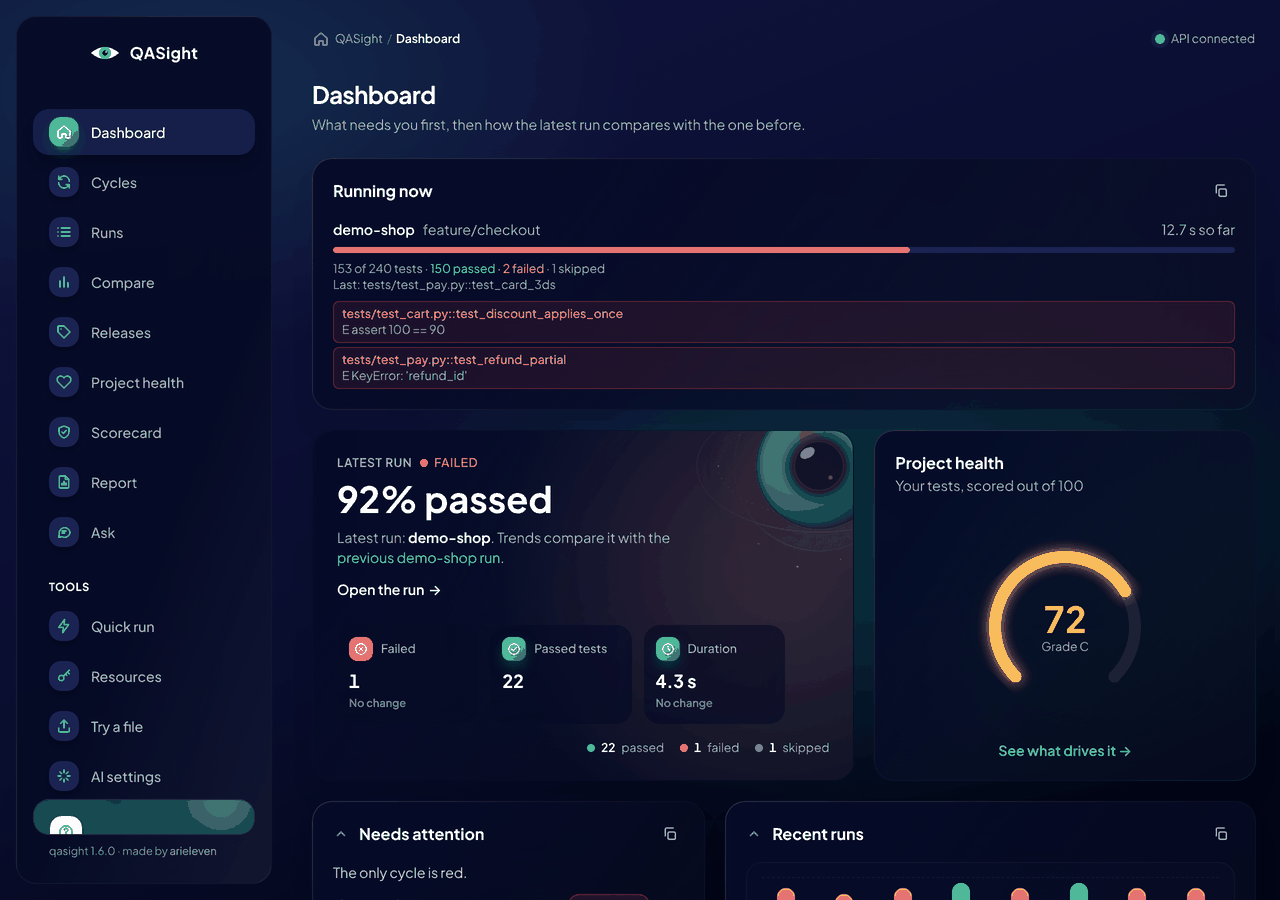
pytest --qasight-server URL (or TESTO_SERVER_URL) sends each test's result to the server as it finishes, so the dashboard shows the session under Running now while it runs: how many of the collected tests are done, the counts, the last test and the first failures with their last lines. When the session ends the report is uploaded as usual and becomes a run; the live entry stays two minutes, then goes. Under pytest-xdist the total isn't known, so only the count shows.
It's best effort: results go in batches (every 2 seconds or 50 tests), and the first error (server unreachable, an older server, a refused token) turns live results off for that session with one line in pytest's summary; it never changes the outcome. --qasight-no-live or TESTO_LIVE=0 turns it off. Starting a live session is a write (the token or a runner account); GET /api/v1/live-runs is a read. Live sessions are kept in the server's memory only, and one that sends nothing for 15 minutes is dropped.
POST /api/v1/ingest (multipart: files, cycle, optional stage, tier and provenance fields) writes the files to a scratch directory and records them through CycleRunService as a one-stage junit cycle, the same path as a local qasight ingest and qasight run. Nothing in an upload is executed. Limits: 200 files, 20 MB per file, 100 MB per upload. The response has the run_id, the counts, the exit code and a link to the run page.
The database schema is upgraded in place when the server starts: the API runs the Alembic revisions in qasight/repository/migrations/ against its Postgres (or SQLite), adopting a database from 1.5.0 or earlier without dropping anything. Upgrade the image, restart, done; see Repository Pattern § Schema migrations.
If the server or a qasight run on its machine dies in the middle of a run (kill -9, out of memory, the machine going down), the run is recorded as failed with the reason "stopped without finishing" when the server starts again, or when that cycle next runs. Its test results are lost; the run no longer disappears without a trace.
The image sets TESTO_UI_DIR=/app/ui, which makes the API serve the built React UI at / (unknown paths fall back to index.html, so /runs/<id> loads directly). With a token set, the UI may write to its own origin; without one, only the TESTO_CORS_ORIGINS allow-list may, and * in that list counts only when a token is set.
History grows with every run: a row per run and per test in Postgres, a copy of each run's result files under /data/static/history/, and a zip of the cycle folder per server-started run (a report archive, qasight report list). Without limits it is kept forever.
-
Limits.
TESTO_RETENTION_DAYSandTESTO_RETENTION_RUNS_PER_CYCLE(or ahistory:section in the server'sqasight.yaml; the variables win) delete expired runs, their per-test rows, their file copies and old report archives at startup and every 6 hours.TESTO_HISTORY_MAX_FILE_MBleaves big files (videos, traces) out of the history copies; the run records which ones.qasight server initsets 180 days and 100 MB. The same pruning runs by hand asqasight clean --history, and single archives go withqasight report delete --id. -
Seeing it. The Runs page ends with a storage line: runs, database size, file size, report archives and free disk (
GET /api/v1/storage, measured at most every 5 minutes). It warns when free space drops underTESTO_LOW_DISK_PCT./api/v1/health/readyreports adiskcheck:warning(still 200) when low,degraded(503) under 200 MB free.qasight doctorprints the same numbers. -
When a copy fails (a full disk), the run is still recorded, the half copy is removed and the run notes
snapshot_error, so a run missing from Compare or flaky detection says why.
TESTO_API_TOKEN is what CI uploads with and an admin login. To replace it (someone who knew it left, a CI log leaked it):
- Set the new value as
TESTO_API_TOKENand the old one asTESTO_API_TOKEN_PREVIOUSin.env, thendocker compose up -d. Both are accepted. - Update the CI secret in every pipeline.
- Remove
TESTO_API_TOKEN_PREVIOUSand restart. The old token stops working.
With TESTO_SESSION_KEY set (servers made by qasight server init 1.6 or later have one), account sign-ins are signed with it, so people stay signed in through the rotation. Without it, they stay signed in only while the previous token is set. Changing TESTO_SESSION_KEY itself signs every account out. To remove one person, use qasight users remove (Accounts); that needs no token change unless they also knew the token.
The compose file's backup service runs qasight backup when it starts and then every TESTO_BACKUP_EVERY_S seconds (default a day), keeping the newest TESTO_BACKUP_KEEP files (default 7) in their own testo_backups volume at /backups, so backups never fill the disk the server writes to; put that volume on another disk if you can. A backup cut short leaves a .partial file, which the next round removes. Each backup is the whole history: every table and each run's stored results. Copy them off the machine, since a backup on the same disk doesn't survive losing it:
docker compose cp backup:/backups ./testo-backups
docker compose run --rm --entrypoint qasight backup restore /backups/testo-<time>.tar.gz --replace --yes
Compose files from before 1.6 kept backups in /data/backups; after updating the compose file (it needs the 1.6 image, which owns /backups), copy any you want to keep out of that folder, then delete it.
They hold password hashes when accounts are on; keep them as private as the database. Don't want it: docker compose up -d --scale backup=0.
- Cycles that exist only as uploads aren't in the server's
qasight.yaml, so they can't be started from the UI. They still get a cycle page, and show on the Cycles page, Dashboard, Runs and Compare. - One server process: the run manager, queued runs and live run streams live in its memory, so the server (and the Helm chart) runs one replica. Uploads and reads are quick, so one replica serves a large team; starting many runs from the UI is what it limits.
- No projects: everyone who can read sees every cycle. Accounts give per-person roles, not per-project ones.
- Starting runs from the server's UI only makes sense for cycles defined in the server's config. Without throwaway containers they run inside the server container. The team server is mainly meant for uploads.
CI checks all of this end to end: the team_server job in ci.yml builds the image, starts the compose file and uploads with qasight ingest --server (scripts/team_server_smoke.sh).
Generated from docs/Processes & Guides/Team Server.md. Edit it there; changes made in the wiki are overwritten.