Repository navigation
Releases
ShandalarGodot 0.70.11 - robustness release


ShandalarGodot — an open-source remake of MicroProse's 1997 Magic: The Gathering, its duels and its Shandalar adventure.
The Urza block joins the game. Pack 10 brings Urza's Saga, Urza's Legacy and Urza's Destiny as one optional pack: 591 new cards, every one with its rules, for duels, the deck builder and the adventure. With all ten packs the game knows 3,684 different cards. Adventure plugins open Shandalar to new lands made by its players, and an adventure can now travel from one device to another.
This release gathers everything since 0.60.16; what is new since 0.70.5 comes first. New to Shandalar? The 0.60.0 notes tour the whole adventure, from the Embark screen to the Hall of Fame. It is still being playtested, so tell us what you notice, as an issue on GitHub.

The world of Shandalar, with the classic 1997 skin.
New in 0.70.11 — the robustness release
- The whole game can be played with a controller. On the world map the D-pad now walks your hero like the arrow keys, and the adventure has its own buttons for the map, your hero, the options and a pane's first choice, all listed and changeable in Options → Controls → World map. Every other screen answers the pad too: B closes or cancels everywhere, scrolling texts scroll, and text fields bring up an on-screen keyboard. Found with the help of a player's report. Thank you!
- Card packs and the classic skin, made inside the game. Options → Get Card Packs... downloads the card pictures from Scryfall and builds the 1997 card pictures and Packs 1 to 10 for you, with a progress bar; nothing else needs to be installed. Options → Build from a 1997 install... makes the classic skin from your own copy of the 1997 game: its folder, its CD, or a CD image. Not in the browser version, and the skin builder is not on Android.
- Six places come with the game. Beside An Old Adventurer's Hut and the Conjuration Wizard Guild there are now The Duelist's Ring, The Gambler's Den, The Riddle Stone and The Wandering Collector, each a plugin you switch on at Embark. The old adventurer now sells the way to five dungeons, one after another, each with treasure of its own, and plugin authors can make places that teach, teleport, duel and trade.
- An empty deck no longer ends an adventure. Leaving the deck editor on an empty deck slot used to end the adventure at the next creature. The game now switches to a deck that plays and tells you, and a save already caught in this is rescued when it is loaded.
- Smoother all round. Cards and menus no longer stutter on a dash, an accent or an arrow in their text. LAN duels and replays redraw two to four times faster. The Card Packs page no longer freezes when a pack is switched on. Searching the Deck Builder with every pack on is several times faster. The coin toss and the end-of-duel count-down can be hurried.
- More forgiving decklists. Pasted and imported decklists recognize cards whatever their capitals, accents or apostrophes. In the Deck Builder's Stats, 1000 hands deals a thousand opening hands and counts their lands, colors and plays.
- A sharper, fairer computer. It no longer casts cards that lose it the game, locks its own winning attack, or aims Flare at itself. Masticore and six more cards now let you choose what you pay at upkeep, found with the help of a player, Chris. Thank you!
- Safer files. A crafted zip or settings file can no longer get past the game's checks. Past Games has Delete and Delete all and keeps the newest 500 recordings. "Make the game portable" can be cancelled. A LAN guest who leaves while reconnecting no longer keeps the other player waiting.
- The browser version can start a new adventure again on browsers without threads, and on phones and headsets the adventure is saved when the app is paused.

Two of Shandalar's castles, the Deck Builder, and a duel.
New in 0.70.5
- New places in the adventure. Two new plugins come with the game, each a place of its own. An Old Adventurer's Hut stands in the mainland's woods: the old man inside, once a planeswalker of another world, tells you for 1000 gold where a dungeon lies that nobody else knows of, and it rises on your map with its treasure. The Conjuration Wizard Guild has a tower on the mainland and on every island you sail to: its conjurers copy a card you carry for 2000 gold, then 4000, 8000 and 12000, and after that never again. Each is a separate plugin, switched on or off by itself on Embark under Expanded adventure plugins.... Left unticked, they change nothing: the vanilla adventure plays exactly as before.
- Make your own places. Plugin authors can now make places, not only islands: a picture, a map sprite, panes of words and services with prices, and dungeons of their own cards. The authors' guide has a new page on them, and
tools/adventure_plugin.pyhas new commands to start a places plugin, add a place or a dungeon, play a place through as text, and check its pictures. - Smoother duels. A card that did not change stays as it is when the table redraws, so the card under your pointer keeps its glow and its tooltip. The pictures of both decks are read while the duel is dealt. The computer plays at an even beat, and a long thought no longer freezes the screen.
- A smoother adventure map. Walking no longer stutters at a tile's edge on slow machines: the world, the small map and the big map redraw only what changed, and the game saves in the background as you meet a creature, enter a lair or leave a place.
- The arrow keys walk every selection window of the duel. In a question, a tutor's list, a spell's modes and a LAN table's menus, Up and Down walk the lines and Enter takes the one that is lit. A tutor's list, such as Vampiric Tutor's, shows the large card of the name you are on, and you can let your choice go again to find nothing.
- Closing the window after a duel keeps its result. An adventure duel you lost, and the card lost in it, no longer comes back on the next load.
- Rules fixes. A creature that taps to attack can no longer pay its own attack tax, such as Propaganda's. Reincarnation on a Clone brings it back as a fresh copy. Two players' Jade Monoliths on one creature each send their own share of the damage to their own controller. The computer no longer pays life for mana, or taps for an ability, when the play then cannot be made.
- Saves, LAN and the portable game. Damaged saves open more forgivingly, and an adventure whose save file you renamed can be exported. When a LAN guest closes the game the host learns of it at once, and you can concede while the other player is away. Asking to make the game portable and then canceling no longer leaves an empty
portablefolder behind. - Shandalar opens Embark at once, without a notice first.

The pictures show two expanded-world plugins made as proof-of-concept experiments: an old adventurer's hut with a secret to sell, and the Conjuration Wizard Guild, which copies a card you carry. Each is its own plugin that you switch on or off for an adventure on Embark, and both are off unless you tick them: the vanilla game is not affected in any way. Both work and come with the game, and they are left for the community to play with, take apart and build on.
Pack 10 — The Urza Block
- One optional pack: 636 printings, 621 names, 591 of them new, and none left uncastable. The 30 reprints use the cards the game already has. Build it on your own computer with Options → Get Card Packs... (or
tools/pack_10_urza_block.py) and turn it on in Options → Card Packs. Its badge is 10-USG, and the Deck Builder's Extras get gears, a hammer and a flask, one for each set. - New to play: echo: pay the cost again at your next upkeep or sacrifice the card. Cycling: click a card in your hand and choose Cycling to discard it for a new card. The Opal, Veiled and Hidden enchantments that turn into creatures, and Opalescence, which meets Humility the way the rules say. Spells that untap the lands that paid for them (Frantic Search, Snap, Peregrine Drake, Great Whale, Palinchron), the Monoliths and Voltaic Key, Tolarian Academy, Gaea's Cradle and Serra's Sanctum. Yawgmoth's Will, played straight from the graveyard view. Temporal Aperture: click your library to play its top card. Show and Tell, Replenish and Exhume putting their cards onto the battlefield all at once, the verse enchantments, and much more.
- The computer opponent plays them too: it pays echo when the card is worth it, cycles the cards it can't use, casts untap spells when the lands pay for the next spell, saves Yawgmoth's Will for a graveyard worth replaying, weighs Show and Tell and the gifts for both sides, and uses Sneak Attack only for an attack that wins or nearly does.
- Help explains the block in plain words on nine new "Abilities — Urza block" pages.
- In the adventure: tick Pack 10 on Embark, alone or with Packs 2–9, to add ...


ShandalarGodot 0.70.5 - polish and community support

ShandalarGodot — an open-source remake of MicroProse's 1997 Magic: The Gathering, its duels and its Shandalar adventure.
The Urza block joins the game. Pack 10 brings Urza's Saga, Urza's Legacy and Urza's Destiny as one optional pack: 591 new cards, every one with its rules, for duels, the deck builder and the adventure. With all ten packs the game knows 3,684 different cards. Adventure plugins open Shandalar to new lands made by its players, and an adventure can now travel from one device to another.
This release gathers everything since 0.60.16; what is new since 0.70.3 comes first. New to Shandalar? The 0.60.0 notes tour the whole adventure, from the Embark screen to the Hall of Fame. It is still being playtested, so tell us what you notice, as an issue on GitHub.

The world of Shandalar, with the classic 1997 skin.
New in 0.70.5
- New places in the adventure. Two new plugins come with the game, each a place of its own. An Old Adventurer's Hut stands in the mainland's woods: the old man inside, once a planeswalker of another world, tells you for 1000 gold where a dungeon lies that nobody else knows of, and it rises on your map with its treasure. The Conjuration Wizard Guild has a tower on the mainland and on every island you sail to: its conjurers copy a card you carry for 2000 gold, then 4000, 8000 and 12000, and after that never again. Each is a separate plugin, switched on or off by itself on Embark under Expanded adventure plugins.... Left unticked, they change nothing: the vanilla adventure plays exactly as before.
- Make your own places. Plugin authors can now make places, not only islands: a picture, a map sprite, panes of words and services with prices, and dungeons of their own cards. The authors' guide has a new page on them, and
tools/adventure_plugin.pyhas new commands to start a places plugin, add a place or a dungeon, play a place through as text, and check its pictures. - Smoother duels. A card that did not change stays as it is when the table redraws, so the card under your pointer keeps its glow and its tooltip. The pictures of both decks are read while the duel is dealt. The computer plays at an even beat, and a long thought no longer freezes the screen.
- A smoother adventure map. Walking no longer stutters at a tile's edge on slow machines: the world, the small map and the big map redraw only what changed, and the game saves in the background as you meet a creature, enter a lair or leave a place.
- The arrow keys walk every selection window of the duel. In a question, a tutor's list, a spell's modes and a LAN table's menus, Up and Down walk the lines and Enter takes the one that is lit. A tutor's list, such as Vampiric Tutor's, shows the large card of the name you are on, and you can let your choice go again to find nothing.
- Closing the window after a duel keeps its result. An adventure duel you lost, and the card lost in it, no longer comes back on the next load.
- Rules fixes. A creature that taps to attack can no longer pay its own attack tax, such as Propaganda's. Reincarnation on a Clone brings it back as a fresh copy. Two players' Jade Monoliths on one creature each send their own share of the damage to their own controller. The computer no longer pays life for mana, or taps for an ability, when the play then cannot be made.
- Saves, LAN and the portable game. Damaged saves open more forgivingly, and an adventure whose save file you renamed can be exported. When a LAN guest closes the game the host learns of it at once, and you can concede while the other player is away. Asking to make the game portable and then canceling no longer leaves an empty
portablefolder behind. - Shandalar opens Embark at once, without a notice first.

The pictures show two expanded-world plugins made as proof-of-concept experiments: an old adventurer's hut with a secret to sell, and the Conjuration Wizard Guild, which copies a card you carry. Each is its own plugin that you switch on or off for an adventure on Embark, and both are off unless you tick them: the vanilla game is not affected in any way. Both work and come with the game, and they are left for the community to play with, take apart and build on.
Pack 10 — The Urza Block
- One optional pack: 636 printings, 621 names, 591 of them new, and none left uncastable. The 30 reprints use the cards the game already has. Build it on your own computer with
tools/pack_10_urza_block.pyand turn it on in Options → Card Packs. Its badge is 10-USG, and the Deck Builder's Extras get gears, a hammer and a flask, one for each set. - New to play: echo: pay the cost again at your next upkeep or sacrifice the card. Cycling: click a card in your hand and choose Cycling to discard it for a new card. The Opal, Veiled and Hidden enchantments that turn into creatures, and Opalescence, which meets Humility the way the rules say. Spells that untap the lands that paid for them (Frantic Search, Snap, Peregrine Drake, Great Whale, Palinchron), the Monoliths and Voltaic Key, Tolarian Academy, Gaea's Cradle and Serra's Sanctum. Yawgmoth's Will, played straight from the graveyard view. Temporal Aperture: click your library to play its top card. Show and Tell, Replenish and Exhume putting their cards onto the battlefield all at once, the verse enchantments, and much more.
- The computer opponent plays them too: it pays echo when the card is worth it, cycles the cards it can't use, casts untap spells when the lands pay for the next spell, saves Yawgmoth's Will for a graveyard worth replaying, weighs Show and Tell and the gifts for both sides, and uses Sneak Attack only for an attack that wins or nearly does.
- Help explains the block in plain words on nine new "Abilities — Urza block" pages.
- In the adventure: tick Pack 10 on Embark, alone or with Packs 2–9, to add its cards to the shops, trades, rewards and lairs. Its strongest cards, such as Tolarian Academy, Yawgmoth's Will, Tinker and Gaea's Cradle, are never sold in shops and cost four amulets at a trader.
- At a LAN table Pack 10 plays too: cycling, lands from the graveyard under Yawgmoth's Will and Temporal Aperture's top card are played from the networked screen, and every new question reaches the guest's own screen.

Explore Shandalar, build with the Urza block, embark on a new adventure, and meet 591 new cards.
Adventure plugins
- New lands as small packages of data: JSON, text, pictures and music, never code. Drop a plugin into the
expanded_adventurefolder beside the card packs and tick it in Embark's new Expanded adventure plugins... window, under the card packs. Each plugin names the card packs it needs, and ticking it ticks them. - The Last Refuge comes with the game: sail to an island of Sarpadian refugees, win five communities' pledges and challenge the Ebon Crown. It is a finished game-design and learning demo of original fiction for Pack 2: Fallen Empires.
- One tune at a time: every adventure duel, the Last Refuge's pledge battles and its Ebon Crown duel too, plays its own music alone, and the town's tune comes back after the battle.
- Your saves are safe: if a plugin goes missing or changes, your save still opens, the land waits as you left it, and its ship still takes you home.
- Make your own: authors get a local guide,
expanded_adventure/GUIDE/index.html, and a tool,tools/adventure_plugin.py, to start, check, package and compare plugins. New lands are the community's to make. Options shows the plugins folder, and Help has a page on them.
Saves and the adventure
- Take an adventure to another device. Save / Load has Export and Import. Export saves an adventure, every save of it, as one file; Import brings it in on any computer, phone, headset or browser, checks it all first, and asks before it replaces an adventure that's already there. On Android and the Meta Quest your saves now live in
Android/data/<package>/files/adventures, whereadb pullcan copy them. - Ctrl+L loads your Quickslot at once, on the road, on the map and inside a town. Delete removes a save, or every save of an adventure, after asking; the Hall of Fame keeps its lines.
- Go for a creature: over a creature you can see, the pointer is a small sword. Click and your hero goes after it until you meet. Walking straight into a creature now meets it too. Arrow keys and clicks also work together more smoothly while you walk.
- Life at 0: a new Campaign Settings row. Tick Negative life is survivable and every duel of that adventure plays the 1997 rule: a duelist at 0 life or less loses only when the phase ends, so the life you gain from the blow that ends a duel, such as Spirit Link's, counts, and a dungeon carries it to the next room. As 1997 ticks it.
- Cursors in your color: Options → Cursor color dresses the adventure's pointers in Gold, Electric blue, Green, Red, Orange, Purple, White or Black.
- Riddle cards you can read, at full big-card size,...
ShandalarGodot 0.70.3 - Urza’s Block

ShandalarGodot — an open-source remake of MicroProse's 1997 Magic: The Gathering, its duels and its Shandalar adventure.
The Urza block joins the game. Pack 10 brings Urza's Saga, Urza's Legacy and Urza's Destiny as one optional pack: 591 new cards, every one with its rules, for duels, the deck builder and the adventure. With all ten packs the game knows 3,684 different cards. Adventure plugins open Shandalar to new lands made by its players, and an adventure can now travel from one device to another.
This release gathers everything since 0.60.16. New to Shandalar? The 0.60.0 notes tour the whole adventure, from the Embark screen to the Hall of Fame. It is still being playtested, and Shandalar on the main menu asks you to tell us what you notice, as an issue on GitHub.

The world of Shandalar, with the classic 1997 skin.
Pack 10 — The Urza Block
- One optional pack: 636 printings, 621 names, 591 of them new, and none left uncastable. The 30 reprints use the cards the game already has. Build it on your own computer with
tools/pack_10_urza_block.pyand turn it on in Options → Card Packs. Its badge is 10-USG, and the Deck Builder's Extras get gears, a hammer and a flask, one for each set. - New to play: echo: pay the cost again at your next upkeep or sacrifice the card. Cycling: click a card in your hand and choose Cycling to discard it for a new card. The Opal, Veiled and Hidden enchantments that turn into creatures, and Opalescence, which meets Humility the way the rules say. Spells that untap the lands that paid for them (Frantic Search, Snap, Peregrine Drake, Great Whale, Palinchron), the Monoliths and Voltaic Key, Tolarian Academy, Gaea's Cradle and Serra's Sanctum. Yawgmoth's Will, played straight from the graveyard view. Temporal Aperture: click your library to play its top card. Show and Tell, Replenish and Exhume putting their cards onto the battlefield all at once, the verse enchantments, and much more.
- The computer opponent plays them too: it pays echo when the card is worth it, cycles the cards it can't use, casts untap spells when the lands pay for the next spell, saves Yawgmoth's Will for a graveyard worth replaying, weighs Show and Tell and the gifts for both sides, and uses Sneak Attack only for an attack that wins or nearly does.
- Help explains the block in plain words on nine new "Abilities — Urza block" pages.
- In the adventure: tick Pack 10 on Embark, alone or with Packs 2–9, to add its cards to the shops, trades, rewards and lairs. Its strongest cards, such as Tolarian Academy, Yawgmoth's Will, Tinker and Gaea's Cradle, are never sold in shops and cost four amulets at a trader.
- At a LAN table Pack 10 plays too: cycling, lands from the graveyard under Yawgmoth's Will and Temporal Aperture's top card are played from the networked screen, and every new question reaches the guest's own screen.

Explore Shandalar, build with the Urza block, embark on a new adventure, and meet 591 new cards.
Adventure plugins
- New lands as small packages of data: JSON, text, pictures and music, never code. Drop a plugin into the
expanded_adventurefolder beside the card packs and tick it in Embark's new Expanded adventure plugins... window, under the card packs. Each plugin names the card packs it needs, and ticking it ticks them. - The Last Refuge comes with the game: sail to an island of Sarpadian refugees, win five communities' pledges and challenge the Ebon Crown. It is a finished game-design and learning demo of original fiction for Pack 2: Fallen Empires.
- One tune at a time: every adventure duel, the Last Refuge's pledge battles and its Ebon Crown duel too, plays its own music alone, and the town's tune comes back after the battle.
- Your saves are safe: if a plugin goes missing or changes, your save still opens, the land waits as you left it, and its ship still takes you home.
- Make your own: authors get a local guide,
expanded_adventure/GUIDE/index.html, and a tool,tools/adventure_plugin.py, to start, check, package and compare plugins. New lands are the community's to make. Options shows the plugins folder, and Help has a page on them.
Saves and the adventure
- Take an adventure to another device. Save / Load has Export and Import. Export saves an adventure, every save of it, as one file; Import brings it in on any computer, phone, headset or browser, checks it all first, and asks before it replaces an adventure that's already there. On Android and the Meta Quest your saves now live in
Android/data/<package>/files/adventures, whereadb pullcan copy them. - Ctrl+L loads your Quickslot at once, on the road, on the map and inside a town. Delete removes a save, or every save of an adventure, after asking; the Hall of Fame keeps its lines.
- Go for a creature: over a creature you can see, the pointer is a small sword. Click and your hero goes after it until you meet. Walking straight into a creature now meets it too. Arrow keys and clicks also work together more smoothly while you walk.
- Life at 0: a new Campaign Settings row. Tick Negative life is survivable and every duel of that adventure plays the 1997 rule: a duelist at 0 life or less loses only when the phase ends, so the life you gain from the blow that ends a duel, such as Spirit Link's, counts, and a dungeon carries it to the next room. As 1997 ticks it.
- Cursors in your color: Options → Cursor color dresses the adventure's pointers in Gold, Electric blue, Green, Red, Orange, Purple, White or Black.
- Riddle cards you can read, at full big-card size, and the card shop is heard: gold when you sell, the card's own sound when you buy.
The Deck Builder
- One set alone: every row of the Extras window has an Only button, that set alone and every other source off. 1997 at the window's top shows only the original cards, and All switches every source on, or every one off when all are on already. The color, type and search filters still apply.
- Extras in the adventure, too: in a town's Deck Builder the Extras window filters your hero's own cards. It lists the 1997 cards and each pack's sets your cards come from, so the Fallen Empires or Homelands cards you hold can be shown on their own. It never adds a card.
- The deck scrolls smoothly, and the right-click Casting Cost, Power and Toughness windows keep their Done button inside.
At the duel table
- The right color, without asking: while a spell waits for its mana, a dual land, Birds of Paradise, City of Brass, Fellwar Stone or Reflecting Pool taps for the color the cost still needs; you're asked only when the choice is really yours. A card you marked Don't auto tap this card asks, as in 1997, and a new button under the large card shows your marks.
- Casting reads as in 1997: the bar says what to tap, "CASTING: Timetwister, Tap {2}{U}", and counts the mana down as you tap.
- A text change shows in the card's words: a land under Magical Hack or a creature under Sleight of Mind shows its new text on the big card, the changed words in italics.
- See the card behind the name: in a window that lists cards by name, the large card shows the card under your pointer.
- The big card's type line stands at the same height on every card and is always a little smaller than the card's name.
- Two seats, two territories in Hotseat. In Magic Battle's Hotseat mode each seat chooses its own territory background, with its own preview, and each seat's die rolls its own. Against the computer, the opponent's half still follows its own deck.
- Magic Battle's dice roll a seat a random deck, name and look, Booster Draft's building time stands out, and Test hands can mark a permanent Echo due.
- MPN has a home of its own: Magic Public Notation, the open format the game's Export MPN writes, now lives at b0realis/MagicPublicNotation-MPN, for other Magic programs to read, implement and help develop.
- Fixes you may notice: Psychic Purge punishes an opponent's Wheel of Fortune that discards it; Gloom, Cursed Totem and Null Rod no longer touch cards in your hand; Living Death returns every creature at the same moment; Island Sanctuary, Fasting and Breathstealer's Crypt ask you in your draw step; Mana Flare asks which mana to add; Ali from Cairo and Worship limit the life you lose; and the computer opponent answers a lethal spell with its counterspell first and wastes fewer cards. The full notes list every fix.
A portable game, and the tools
- A portable game: Options → Portable game keeps everything the game keeps (your settings, decks and adventures, the Hall of Fame, the game records, the skins and card packs you added, and the logs) in a folder named
portableinside the game folder, so the whole folder can be copied to a USB stick or another computer and played there as it is. Stop being portable... copies everything back and renames the folderportable-off; nothing is deleted. On Windows, Linux, macOS, the Raspberry Pi and the Steam Deck. On ...
Shandalar 0.60.16 — Every card pack in the adventure

ShandalarGodot — an open-source remake of MicroProse's 1997 Magic: The Gathering, its duels and its Shandalar adventure.
Every card pack now travels to Shandalar. Tick any of the numbered card packs you have built, Packs 2–9, on the Embark screen, and their cards join the adventure's shops, duel rewards and lairs: Fallen Empires, Ice Age, Homelands, Alliances, Portal, Fifth Edition, and the Mirage and Tempest blocks. Base cards still fill most of every shelf.
This release gathers everything since 0.60.0, "Embark to Shandalar". New to Shandalar? The 0.60.0 notes tour the whole adventure, from the Embark screen to the Hall of Fame. It is still being playtested, and Shandalar on the main menu asks you to tell us what you notice, as an issue on GitHub.

The world of Shandalar, with the classic 1997 skin.
Card packs on the road
- One pack or all of them. Each pack you tick adds its own cards to the random draws: 20% of the cards per pack, at most 60% together, and the rest are base cards. Choice lists — trades, a castle's pick, "any card of your choice" — still offer every card.
- At their original rarity. Each card keeps the rarity of the pack it first came from; Fifth Edition brings its reprints at its own.
- Strong and ante cards. Strong pack cards such as Necropotence and Force of Will are special: never sold in shops, four amulets at a trader. Ante cards never stand on a shelf.
- Snow-Covered basics from Ice Age are basic lands: a shop's land place may hold one, four come for one amulet at a trader, and a small deck may win one in place of a basic land.
- Your saves keep their packs. Your first deck and the creatures' decks stay base cards. A saved adventure whose pack is switched off in Options switches it on again and says so; one whose pack is missing names it in the save list.
- No waiting. Setting out or resuming with packs shows the hourglass at once, the first town opens without a stall, and the card trader's search keeps up with your typing.

Explore the world, visit its towns, build your deck, and duel for your cards.
Tasks, saves and the journal
- Tasks (T), a fourth tab in your hero's stats: follow several tasks at once, with an arrow on the map for each. Arzakon's portal has its own violet arrow, drawn over the others, and a switch to hide it.
- The Quickslot. Ctrl+S saves at once to a separate blue Quickslot. Loading has one Resume button and a gold Hall of Fame button.
- The journal dates every entry "Day N", and the wise man's news is a dated entry. The save list, the final record and the Hall of Fame count every day of the journey.
- One life — ironman mode: lose the Final Battle and the adventure is over for good; none of its saves, not even one made before the battle, can fight it again. A won adventure always asks End or Return to Shandalar.
Shops, duels and the rest
- Campaign Settings offers an optional wider trader selection, and same-town buy-and-sell profits are gone.
- Names shown once. A castle's or dungeon's board names its kind in the header and the place on its plaque; a creature's meeting and a room's duel name the creature on its banner.
- The adventure's deck builder shows its mini cards' complete frames at once, and with the 2× skin your hero keeps the original size and the whole walk in custom colors.
- At the duel table, Sylvan Library handles identical drawn copies separately, Go is clearer before an adventure duel, and a computer opponent at a LAN table names its new spell and target on the bar and in the Showcase, as at home.
- Tooltips are opaque everywhere, and the path arrows are smaller.
- Help describes the card packs, Randomize, Tasks, the Quickslot and the card rules for pack cards.

The Paths of Chronus: creatures, treasures, and choices around every turn.
Every change, release by release: the notes for 0.60.13, 0.60.14, 0.60.15 and 0.60.16, and for 0.60.1–0.60.4.
Downloads
Every package holds the game 0.60.16, built from 38f1d96.
| Your device | Download |
|---|---|
| Windows, x86-64 | Shandalar-0.60.16-windows64.zip |
| Mac with Apple Silicon (macOS 13+) | Shandalar-0.60.16-macos-arm64.zip |
| Intel Mac (macOS 11+, OpenGL 3.3) | Shandalar-0.60.16-macos-intel.zip |
| Any Mac, one universal app | Shandalar-0.60.16-macos.zip |
| Linux PC, x86-64 | Shandalar-0.60.16-linux64.zip |
| Raspberry Pi 5 / 500, 64-bit OS | Shandalar-0.60.16-raspberry-pi5-arm64.zip |
| Steam Deck | Shandalar-0.60.16-steam-deck.zip |
| Your own web server | Shandalar-0.60.16-web.zip |
| Web server with COOP/COEP headers | Shandalar-0.60.16-web-threaded.zip |
| Web, playable offline once cached | Shandalar-0.60.16-web-offline.zip |
| Meta Quest 3 (also Quest 2 / Pro) | Shandalar-0.60.16-meta-quest.zip |
| RK3326 handhelds on ArkOS, experimental | Shandalar-0.60.16-arkos-rk3326-experimental.zip |
| Android phones and tablets, ARM64, experimental | Shandalar-0.60.16-android-arm64-experimental.zip |
Plain or -with-skin? Every package comes twice. The plain ZIP is the game in its own drawn look, complete and playable. The -with-skin ZIP adds skin/original_skin.zip, the 1997 look and sounds. The same skin is also its own download, original_skin.zip.
The hi-res skin is a separate download, original_skin_realesrgan-anime_2x.zip. It holds the same files with every picture at twice the size, for large and 4K screens. Choose it in Options → Skin, or drop it on the game's window, and restart.
Your own 1997 copy. The original skin needs only the original 1997 MicroProse game: its CD, or the folder you installed it to. The adventure's creatures, meetings, castles, dungeons and ending come from it. If you built your own skin before, build it again to bring them in (the ending movie is converted when ffmpeg, or GStreamer with Theora, is installed):
python3 tools/mtg_assets.py --install /path/to/game --out skin/original_skin.zipCard pictures and the numbered card packs are never distributed. Every package carries the Python tools that make them on your own computer, and CARD-ART-AND-PACKS.md walks through each step. You need Python 3.10 or newer, and on Windows you type py -3 where it says python3. From the extracted game folder, the base card pictures:
python3 tools/fetch_card_art.py --out cache/cardart
python3 tools/mtg_assets.py --from-cardart cache/cardart --out skin/cardart.zip
Each numbered pack has its own builder. For Ice Age:
python3 tools/pack_3_ice_age.py fetch-art
python3 tools/pack_3_ice_age.py build cardpacks/Pack-3-Ice_Age.zip
python3 tools/pack_3_ice_age.py verify cardpacks/Pack-3-Ice_Age.zip
The guide covers Packs 1–9, from 1-tDotP to the Tempest block. If Options → Card Packs says a pack is another version than this game expects, rebuild it with the tool it names. New to command windows? Getting Started goes step by step from the download to your first duel.
Getting started
- Extract the entire folder. Leave the skin and pack ZIPs zipped.
- Start the game. See your device below.
- Put the ZIPs beside the game.
original_skin.zipandcardart.zipgo inskin/, and the numberedPack-*.zipfiles, under their exact names, go incardpacks/. On a Mac that is besideShandalar.app, never inside it. You can also choose a skin in Options → Skin, or add a pack with Options → Card Packs → Add pack.... Then press Rescan and enable the packs you want. - Embark. Press Shandalar on the main menu, read its note, and Go test opens the Embark screen. Make your hero, look over Campaign Settings..., tick the card packs you want, and set out.
Windows x86-64
Open Shandalar.exe and keep Shandalar.pck beside it. The executable is unsigned.
macOS
Choose Apple Silicon (macOS 13+), Intel (macOS 11+ with OpenGL 3.3), or the universal app (the same requirements for each architecture). Open Shandalar.app. It is ad-hoc signed, not notarized, so macOS may ask you to approve an app you trust; do not turn off system-wide security. Keep skin/ and cardpacks/ beside the app, never inside it.
Linux x86-64
Run ./run.sh. I...
Shandalar 0.60.0 — Embark to Shandalar
The whole Shandalar adventure is here. Make your hero on the Embark
screen, step into a land of five colors made exactly as the 1997 game made
it, and walk it: towns and wise men, roaming creatures and hidden
lairs, besieged cities, castles and dungeons, all the way to Arzakon's
portal and on into the Hall of Fame.
Twenty-nine years after MicroProse's Magic: The Gathering first sent a
hero across Shandalar, this fan remake plays from the first step to the
last. The adventure is still being playtested, and Shandalar on the
main menu asks you to tell us what you notice, as an
issue on GitHub. This
release gathers everything since 0.50.34, the last public one.

The world of Shandalar, with the classic 1997 skin.
A world to walk
Every adventure makes its own world from a seed, as 1997 did: type a
number or a word and the same world comes again. Dress your hero's figure
part by part, then click where to go. The way is found around the water
and walked at the 1997 pace, eating food as you march.
The towns are alive. Buy from the 1997 card shop at the 1997 prices,
trade amulets for cards, and ask the wise man for tales, gifts and
quests. Buy the World Magics and cast them on the map. And everywhere,
the 1997 soundscape: footsteps, birds, each town's tune rising as you
come near.

A stop at Sahmal's Sanctum: cards, supplies, and the wise man.
Creatures, lairs and sieges
The five wizards' creatures roam the lands of their colors and come after
you. When one reaches you, the 1997 meeting screen shows both antes: duel
it, pay it gold, answer its riddle, or change your ante with Sleight of
Hand. A kind you have beaten five times offers tribute instead.
Lairs stay hidden until you stand beside one, holding a rare card, a
riddle, a bazaar, or a guardian with a hoard to duel for. Meanwhile the
wizards march on the towns. Beat the creature named in the news flash, or
the town falls, and when one wizard rules three, the Spell of Dominion
ends your quest.
Castles and dungeons
Walk their halls and mazes as 1997 drew them, a new maze in every dungeon
each time, with dice, riddles, treasures and duels inside. Before each
duel you see the creature, what starts in play and the card you stake.
Life lost in a dungeon carries from room to room; a castle's duels start
fresh. Beat a wizard in his own room and choose three cards of his color.

The Paths of Chronus: creatures, treasures, and choices around every turn.
Arzakon, and the end
When the fifth wizard falls, Arzakon appears. Face him at once, or find
his portal, a horned arch near the middle of the map. Win, and the 1997
ending plays: the movie, the people's thanks, the years Arzakon is
banished. Then roam a land at peace, his portal now a stone monument,
with your name in the Hall of Fame.
Campaign Settings: modern choices, or As 1997
The Embark screen keeps 1997's own choices. The modern ones wait behind
Campaign Settings..., and As 1997 sets every row as the 1997 game
played.
- Sieges: Steady (the default), Rare, None, or as 1997's ever-faster
pace. - Creatures: Notice wakes the ranges 1997 designed but never used;
Hunt keeps the old chase from anywhere. - Card rule: the copy limit 1997 intended, no limit as it shipped, or
Classic MTG rules with the 1998 or today's Vintage ban list, or both. - Starting life, Card hold, Ascetic hero, and Final battle: Reload
allowed, or One life.
Smooth from the first step
- The arrow keys walk your hero, as in 1997. Clicks still find the way.
- Path arrows draw your walk on the map: orange while your food lasts,
red where you will walk hungry. - Duels open at once, in under a tenth of a second instead of up to
1.3. The hero glides, and every place's music and pictures are ready
before you arrive.
At the duel table
A new button under the large card opens the duel's own options: targets
named in the log, colorblind-safe mana symbols, a UI scale and an
attack-all key. From Magician up, the computer knows the classic combos
of the card pool, and no loop can freeze a duel.
Matches and the Gauntlet keep your place
Leave between duels whenever you like: Resume match on Magic Battle
and Resume run in the Gauntlet pick up where you stopped.
Magic Public Notation (MPN): a proposal to the community
Every duel you play can be saved as a public history of the game: what
both players could see, never a hidden hand. MPN is a proposed open
format for such records, independent of this game. Reading one needs a
JSON parser and the specification's patch rules, not a rules engine or a
card database. New in this release, Past games shows any record as a
readable move list, every symbol explained at the top.
The specification,
player guide,
move list
and example records
are in the project's docs folder. It is a draft, not an official Magic
standard. Makers of engines, viewers, tournament tools and archives are
warmly invited to read it, try it and tell us what it needs, in an
issue with "MPN" in the title.
Rules and card fixes, a sharper computer opponent, a hundred-step Undo
in the Deck Builder and much more: the
full notes for 0.60.1
list every change.
Downloads
Every package holds the game 0.60.4, built from
272fae0.
| Your device | Download |
|---|---|
| Windows, x86-64 | Shandalar-0.60.4-windows64.zip |
| Mac with Apple Silicon (macOS 13+) | Shandalar-0.60.4-macos-arm64.zip |
| Intel Mac (macOS 11+, OpenGL 3.3) | Shandalar-0.60.4-macos-intel.zip |
| Any Mac, one universal app | Shandalar-0.60.4-macos.zip |
| Linux PC, x86-64 | Shandalar-0.60.4-linux64.zip |
| Raspberry Pi 5 / 500, 64-bit OS | Shandalar-0.60.4-raspberry-pi5-arm64.zip |
| Steam Deck | Shandalar-0.60.4-steam-deck.zip |
| Your own web server | Shandalar-0.60.4-web.zip |
| Web server with COOP/COEP headers | Shandalar-0.60.4-web-threaded.zip |
| Web, playable offline once cached | Shandalar-0.60.4-web-offline.zip |
| Meta Quest 3 (also Quest 2 / Pro) | Shandalar-0.60.4-meta-quest.zip |
| RK3326 handhelds on ArkOS, experimental | Shandalar-0.60.4-arkos-rk3326-experimental.zip |
| Android phones and tablets, ARM64, experimental | Shandalar-0.60.4-android-arm64-experimental.zip |
Plain or -with-skin? Every package comes twice. The plain ZIP is the
game in its own drawn look, complete and playable. The -with-skin ZIP
adds skin/original_skin.zip, the 1997 look and sounds. The same skin is
also its own download, original_skin.zip.
The hi-res skin is a separate download,
original_skin_realesrgan-anime_2x.zip. It holds the same files with every
picture at twice the size, for large and 4K screens. Choose it in
Options → Skin, or drop it on the game's window, and restart.
Your own 1997 copy. The original skin needs only the original 1997
MicroProse game: its CD, or the folder you installed it to. The
adventure's creatures, meetings, castles, dungeons and ending come from
it. If you built your own skin before, build it again to bring them in
(the ending movie is converted when ffmpeg, or GStreamer with Theora, is
installed):
python3 tools/mtg_assets.py --install /path/to/game --out skin/original_skin.zipCard pictures and the numbered card packs are never distributed. Every
package carries the Python tools that make them on your own computer, and
CARD-ART-AND-PACKS.md walks through each step. You need Python 3.10 or
newer, and on Windows you type py -3 where it says python3. From the
extracted game folder, the base card pictures:
python3 tools/fetch_card_art.py --out cache/cardart
python3 tools/mtg_assets.py --from-cardart cache/cardart --out skin/cardart.zip
Each numbered pack has its own builder. For Ice Age:
python3 tools/pack_3_ice_age.py fetch-art
python3 tools/pack_3_ice_age.py build cardpacks/Pack-3-Ice_Age.zip
python3 tools/pack_3_ice_age.py verify cardpacks/Pack-3-Ice_Age.zip
The guide covers Packs 1–9, from 1-tDotP to the Tempest block. If
Options → Card Packs says a pack is another version than this game
expects, rebuild it with the tool it names. New to command windows?
Getting Started goes step by
step from the download to your first duel.
Getting started
- Extract the entire folder. Leave the skin and pack ZIPs zipped.
- Start the game. See your device below.
- Put the ZIPs beside the game.
original_skin.zipandcardart.zip
go inskin/, and the numberedPack-*.zipfiles, under their
exact names, go incardpacks/. On a Mac that is beside
Shandalar.app, never inside it. You can also choose a skin in
Options → Skin, or add a pack with Options → Card Packs → Add
pack.... Then press Rescan and enable the packs you want. - Embark. Press Shandalar on the main menu, read its note, and
...
Shandalar 0.50.34 — The Tempest update
Shandalar 0.50.34 — The Tempest update
Tempest, Stronghold and Exodus arrive as an optional card pack: 574 new cards
with shadow, buyback, licids, Slivers and Humility as printed, and computer
opponents that know how to use them. Since 0.50.13 the game has also been
through three rounds of fixes across the rules, the opponents, the screens,
saved files, the network and the handhelds. You can now choose who orders two
effects on the same damage, and there is help inside the duel. The windows
stay sharp on a large screen, and a new tool makes a hi-res skin from your
own 1997 copy.
The Tempest Block — Pack 9
- Three sets, one pack. Tempest, Stronghold and Exodus: 636 printings,
621 names and 574 new cards, every one with its rules. None is left
uncastable. The 47 reprints use the cards the game already has. Build it
withtools/pack_9_tempest_block.pyand turn it on in Options → Card
Packs. Its badge is 9-TMP, and the Deck Builder's Extras gain a storm,
a keep and a bird. With all nine packs on, the game offers 4,083 set
entries and 3,093 unique cards; the original 897-card core is still
there. - New rules on the table:
- shadow, both ways, and the walls that block as though they had it;
- creatures that must block, and Magnetic Web's forced attacks;
- buyback, Dream Halls' and Aluren's free casting, and Rootwater Shaman's
flash, as choices when you pay; - licids that become Auras, and their "pay to end this effect" action;
- Humility as printed: effects that remove abilities or set power and
toughness apply in timestamp order; - Slivers that share their abilities with every Sliver on the table, yours
and your opponent's; - Volrath's Shapeshifter, Ertai's Meddling, Static Orb, Pandemonium and
the rest.
- Opponents that play them. Shadow attacks, hostile licids on your
creatures, buyback when they can afford to recast it, sweepers priced by
what each side loses, and Slivers valued on both sides of the table.
A hi-res skin for big screens — new tool
tools/upscale_skin.py, in every package, makes a second skin out of your
own 1997 one: original_skin_realesrgan-anime_2x.zip. It holds the same
files under the same names. Every picture is twice the size, upscaled with
Real-ESRGAN's anime model, a free and open-source upscaler, keeping the 1997
colours. Music, sounds, fonts and the coin toss stay as they were.
python3 tools/upscale_skin.py --skin skin/original_skin.zip- On Linux it fetches the upscaler once. It needs Pillow and a graphics
driver with Vulkan. On macOS or Windows, downloadrealesrgan-ncnn-vulkan
for your system from the Real-ESRGAN releases and point the tool at it with
--engine. - Choose the new zip in Options → Skin, or drop it on the window. It is
worn from the next start, with the same layout and twice the pixels, so
the panels, frames, icons and the mana stripes on the cards stay sharp on
a large or 4K screen. Choose the 1997 skin again to go back. - Mix and match. Put a 1997 picture back into the hi-res zip under its
own name, and that place wears it again. A skin may also carry a
catalogue.txtthat says which of its files each place wears, and a
picture may be one to four times its 1997 size.skin/SKIN.txtexplains
both for anyone drawing a skin, and
python3 tools/skin_catalogue.py --check my_skin.zipchecks one. - One skin at a time. The skin you choose dresses the game alone. The one
beside the game no longer fills in what yours lacks.
The hi-res skin is also a separate download:
original_skin_realesrgan-anime_2x.zip, made with this tool from this
release's original_skin.zip. Choose it in Options → Skin, or drop it on
the game's window, and restart. Use the tool yourself to make one from a skin
of your own.
Sharper, cleaner screens
- Window backgrounds at their own grain. The sandstone behind Magic
Battle, Options, Help and the main menu's buttons, the dark stone, the
blue knotwork and the gold rings of the end-of-duel window used to be
stretched to fill each window, and they blurred on a big screen. They are
now laid at their own size, joined without a visible seam, so the stone
keeps its fine grain and the rings stay round. A window that fits inside
its picture shows the picture as it was drawn. - One text face on every computer. Rules text, the duel log and every
window use the game's own Spectral face, whether or not the original skin
is installed. Every font the game ships is under the SIL Open Font
License. - The title menu wears the 1997 bullet: the Celtic-knot square with its
pink gem, lit for the button you are on. - The full-screen card opens with its text in the 1997 box, so the
picture is clear. Text: 1997 / Text: full grows the box over the art
when the text does not fit. Full-screen card on click is now on by
default. - Stronghold and Exodus set symbols closer to the sets' own marks.
Rules choices and help in the duel
- When two effects change the same damage, who decides their order. A
Lightning Bolt at you with your Forethought Amulet and an opponent's
Furnace of Rath: under the modern rules you choose which applies first,
and the computer opponent works out the order that hurts it least.
Options › Rules › Fixed order for damage effects keeps the 1997 way,
where nobody is asked. - Forced sacrifices can wait. With Options › Rules › Forced sacrifices
wait on the chain, a Pirate Ship whose last Island goes can ping once
more before it leaves. Off under every preset, as in the 1997 game. - Help inside the duel. "Help..." in the duel's right-click menus opens
a small panel over the table for exactly what you clicked: a card, your
library, the mana pool, the Phase Bar, the combat window, the Spell Chain
or the graveyard. The full Help stays on the main menu.
Fixes
Three rounds over the whole game since 0.50.13 found and fixed or wrote down
more than 300 problems. Some highlights:
- Smoother duels. A big X spell tapping many lands no longer freezes the
screen. Auto-pass no longer stops at every step because you hold a
creature with an ability, and your turn no longer stops in its upkeep for
nothing. When nothing of yours can block, the empty block is declared for
you. - Rules. Under the 1997 rules, Time Vault, Basalt Monolith and Mana
Vault no longer untap for free. City of Brass and Kudzu payments no
longer get a spell refused. Circle of Protection can name a source that
has already left play, and a Wrath judges every creature as it stood
before any of them left. - Paying mana. The computer opponent and your double-click auto-cast pay
with the least mana left over, and stop once Mana Flare or Wild Growth has
covered the cost, so extra mana no longer floats and burns. - The computer opponent. It casts burn that is lethal only together,
never holds back creatures for a counterspell it cannot pay, and stops
harming itself: no removal on its own creatures, no Humility into its own
board, no drawing itself out of cards. The Apprentice still makes
mistakes, but never the block it needs to survive. - Decks. Import reads MTG Arena, Moxfield/MTGO and Forge lists.
Closing the window in the Deck Builder asks to save unsaved decks first,
and random decks in Magic Battle respect the chosen format. - Files and settings. A skin zip the game won't wear is no longer
deleted at start; Options › Skin says which one and why. A settings file
that could not be read or saved is reported on the title screen. - LAN. A host that closes tells its guests. Hostile connections are cut
off quickly, and network updates cost a half to a quarter of what they
did. SGManalink speaks protocol 29: all players need matching
0.50.34 builds and enabled packs.
Your own copy, your own art
- See what your copy gives before you import it.
python3 tools/mtg_assets.py --check /path/to/gamelists every file the
game can wear, where each would come from, and what is missing. It writes
nothing. - The original skin needs only the original 1997 game, the CD or its
install folder. - The skin catalogue as a table.
skin/SKIN.csv, beside
skin/SKIN.txt, lists every file of the skin zip with its size and
format: a checklist for anyone drawing a skin of their own.
Handhelds and Meta Quest
- Meta Quest.
push_to_quest.shworks again on current headset
software. It copies only what changed and keeps your settings and decks.
quest_fresh_install.shwalks through a clean install. - The first start after adding a card pack shows "Checking the card
packs" with its progress, and the check itself is about four times faster
on a desktop. Later starts skip it. - ArkOS. Select opens the pause menu, so a game can be left from Exit
game. The launcher says why it stopped. - A timing log for stutter reports, off unless you ask for it: put an
empty file namedperf-logbeside the game. See HANDHELD.md.
Downloads and setup
This release offers Windows x86-64, macOS universal, Apple
Silicon Mac, Intel Mac, Web (single-threaded), Web (threaded,
COOP/COEP), Web offline, Linux x86-64, Raspberry Pi 5/500 ARM64, Steam
Deck, experimental ArkOS/RK3326, experimental Android ARM64 and Meta Quest 3 packages, each
plain or -with-skin. Two skins come as separate downloads: the 1997
original_skin.zip, and the hi-res
original_skin_realesrgan-anime_2x.zip for large and 4K screens.
The game in every package is 0.50.34, built from
a30f56e.
Extract the entire folder. Skin and card-art ZIPs go in skin/, numbered
packs in cardpacks/. Card pictures and completed numbered packs are not
distributed. Every p...
Shandalar 0.50.13 — The VR/Mirage update
Shandalar 0.50.13 — The VR/Mirage update
Mirage, Visions and Weatherlight arrive as an optional card pack: 621 new
cards with their rules, phasing and flanking on the table, and computer
opponents that know how to use them. Since 0.40.47 the game has also come to
the Meta Quest 3, LAN tournaments seat up to forty players under the host's
own table rules, starts are faster, and two complete bug passes have tightened
the rules engine, the opponents and the tools.
The Mirage Block — Pack 8
- Three sets, one pack. Mirage, Visions and Weatherlight: 684 printings,
669 names and 621 new cards, every one with its rules — none is left
uncastable. Reprints use the cards the game already has. The menu badge is
8-MIR; the Deck Builder's Extras gain a palm, an eye and a skyship.
All eight optional packs together offer 3,462 set entries / 2,519 unique
cards; the original 897-card core remains available. - Faithful, and measured. Phasing, flanking, Mirage's flash Auras with
the cleanup step's response window, new kinds of costs and damage shields
all follow the rules; the four standard opponents play them well without
reading your hand or library, and every choice the cards give you — down to
Lotus Vale's sacrifice and Sabertooth Cobra's ransom — is yours on screen.
Measured and tested, with more than fifty bugs found and fixed; the few minor
ones left are listed in the bug-pass record. Five deliberate digital
adaptations are explained in Help.
Meta Quest 3
The game runs as a flat panel app in the headset, sideloaded over adb.
The controller's laser is the mouse — point to hover, pull to click, hold to
drag. The skin, card packs and music live in the app's own storage folder.
LAN play on the headset is supported since 0.50.10 (hosting and joining by
invitation; the Game Browser's discovery is untried on hardware — paste the
invitation if a table does not appear). Quest 2 and Quest Pro run the same
APK. See HANDHELD.md for adb setup and folders.
LAN tournaments and table rules
- Forty entrants. A LAN knockout now takes 2–40 players.
- Table rules. The host chooses the table's rules preset, deck rules and
assigned decks before the game starts; every seat plays by them. - Network review. Connection headroom, discovery and robustness fixes;
a networked game now offers only the actions you can actually take, so a
refused ability can no longer cost you mana. SGManalink speaks
protocol 27: all players need matching 0.50.13 builds and enabled
packs.
Faster starts and comfort
On native platforms, the title appears before the card pool finishes building in the background,
the screens behind the menu compile ahead of time, and Magic Battle opens
without re-reading every deck. Power saver and the on-screen
keyboard are in Options. Handhelds gain a card-reading action and
launcher fixes from the first ArkOS hardware report.
Play MTG with your favorite agent
- A readable table every turn. Each answer from the MCP server now
reads like a game board: life, hands, every permanent with its state
(tapped, attacking, phased out, what an Aura enchants), the stack, the
open question with its targets, and the legal options — one line each.
The full JSON still travels alongside for programs. - Smooth play.
until: "mine"passes through the opponent's turn and
stops only where you can act — including their turn whenever you hold
an instant, a flash creature or an ability you could use right then.
referee_castcasts a spell by name with its targets in one call, and
never leaves you paying for a cast the rules refuse. - Initial decision-model support (Laya, Jev and similar). Programs that
choose moves rather than chat — decision models such as Laya or Jev,
small local models, scripted bots or learning agents — get a compact game
state and a numbered menu of every complete legal action with readable
names, and answer with one choice. Point Shandalar at a Laya or Jev
server (tools/shandalar_decide.py --policy systemone --url …), use the
menus through the MCP server (referee_menu,referee_pick), from
Python, or over a simple JSON-lines connection from any language; random
and greedy example players are included. - Still here: the agent's seat keeps a duel alive after the client
that started it, joins a LAN table by name, and can host a LAN table
and tell a person how to join it (referee_host). The play guide
explains banding and the first game's lessons.
Fixes
Two whole-tree bug passes since 0.40.47 — about 150 defects in the first,
over fifty in the Mirage block's — each fixed with a regression test that
failed before its fix. Highlights: the opponents no longer cast Final Fortune
like Time Walk or burn themselves to death; banding blockers' damage is
divided by the attacker; a tutor's search no longer shows your library's
order; cumulative upkeep, phasing and end-step sacrifices follow the rules;
Auras that say "creature you control" fall off when control changes.
Downloads and setup
This release offers Windows x86-64, macOS universal, Apple
Silicon Mac, Intel Mac, Web (single-threaded), Web (threaded,
COOP/COEP), Linux x86-64, Raspberry Pi 5/500
ARM64, Steam Deck, experimental ArkOS/RK3326 and Meta Quest 3
packages — each plain or -with-skin — plus a separate original_skin.zip.
The desktop, handheld and Quest packages are 0.50.13 from
e59c32c. The two Web variants
are 0.50.14 from 7c032e7,
included here with a browser-startup fix and separate hosting options. This
Web-only follow-up changes loading and packaging, not card rules. Each ZIP's
filename and README identify its actual version and source revision.
Extract the entire folder. Desktop skin/card-art ZIPs belong in skin/,
numbered packs in cardpacks/. Card pictures and completed numbered packs
are not distributed. Every package includes the Python construction tools
and metadata for Packs 1–8; follow CARD-ART-AND-PACKS.md. Pack 8 needs
Shandalar 0.50.11 or later.
Windows x86-64: extract the entire folder and open Shandalar.exe;
keep Shandalar.pck beside it. The executable is unsigned.
macOS: choose Apple Silicon (macOS 13+), Intel (macOS 11+ with OpenGL
3.3), or the universal app (the same requirements for each architecture).
Extract the entire folder and open Shandalar.app. Ad-hoc signed, not
notarized: macOS may ask for explicit approval for an app you trust. Keep
skin/ beside the app, never inside it; do not disable system-wide security.
Web, single-threaded (web): serve the extracted folder over HTTP(S), not file:// (for example,
python3 -m http.server 8000, then open http://localhost:8000/). No
COOP/COEP headers are required. The skin package fetches its bundled skin on
first load. Export important decks before clearing the site's browser storage.
Web, threaded (web-threaded): use HTTPS and send
Cross-Origin-Opener-Policy: same-origin and
Cross-Origin-Embedder-Policy: require-corp as HTTP response headers on the
page and assets. Keep the game and its assets on the same origin. For local
testing, python3 tools/serve_web.py --directory . --port 8000 supplies the
headers on http://localhost:8000/; this loopback-only helper is not a public
production server. Use the single-threaded ZIP if your host cannot set these
headers. Do not mix files between the two variants. See setup-web.txt.
Linux x86-64: extract and run ./run.sh.
Raspberry Pi 5/500: requires a 64-bit desktop OS with working OpenGL ES
3.0 graphics drivers; extract and run ./run.sh in a graphical session. The
launcher uses the compatibility renderer and caps rendering at 60 FPS. A
Raspberry Pi 4/400 on a 64-bit OS has a GPU that meets the requirement but is
untested and slower; earlier models cannot run it (their GPUs lack OpenGL ES
3.0), and this is not a 32-bit Raspberry Pi OS binary.
Steam Deck: native Linux, no Proton required. Add run.sh as a
Non-Steam Game in Desktop Mode. Use a gamepad layout for the game's own pad
pointer, or a keyboard/mouse Steam Input layout; avoid mapping both kinds of
input to the same button. Not Steam Deck Verified.
ArkOS — experimental: requires compatible 64-bit ArkOS, current
PortMaster and WestonPack 0.2.6+. Copy Shandalar.sh and shandalar/
together into the active ports/ folder. First reports came from an R36
Ultra; performance and device compatibility still need wider testing.
Meta Quest 3 (also Quest 2 / Pro): turn on Developer Mode in the Meta
Horizon phone app, connect the headset over USB and allow USB debugging, put
your own cardart.zip in the package's skin/ folder, then run
./push_to_quest.sh from a computer with adb. It installs the APK, starts
the game once so the game creates its own folders, and copies the skin and
card packs into them. The game appears under Library → Unknown Sources.
Sideloaded, not a Horizon Store release; see HANDHELD.md (including the
Linux udev rule).
Thank you to the Shandalar community, the original game's creators, Godot,
and the preservation and open-source projects whose work helps keep this
game alive. Bring a friend—or your favorite agent. Good luck, good health,
and happy duelling to everyone!
SHA-256 checksums
The separate SHA256SUMS file contains the same values. From the download
folder, use sha256sum -c SHA256SUMS on Linux or
shasum -a 256 -c SHA256SUMS on macOS to check the downloaded files.
611549bf9f9fd0b125c530dcf6cecdfbdeac67264912e6154f74e7454c4eb6c5  Shandalar-0.50.13-arkos-rk3326-experimental-with-skin.zip
6fc0bbc3cfbaea6cf063ec3c101953bb2c99c07e2fba71aad173f6d167ad893d  Shandal...
Shandalar 0.40.47 — Classic Magic, more ways to play
Shandalar 0.40.47 — Classic Magic, more ways to play
Early Magic with the familiar Shandalar feeling. This release brings expanded
card packs, a 330-deck library, stronger non-cheating opponents, improved deck
tools, full-screen card reading and controller support. Enjoy solo duels,
hotseat, drafting and local-network tournaments—or play MTG with your
favorite agent.
Play MTG with your favorite agent
- A real seat at the table. The local MCP server lets a compatible
agent play against the built-in opponents, run agent-versus-agent games,
or join a human-hosted SGManalink duel on the same computer or local
network. The game supplies decisions and legal options; the agent chooses
its actions and the rules engine checks them. - Build, check, study, play. Browse card records, create and validate a
deck, generate variations with AutoDeck, compare matchups in DeckLab,
then play the deck. Decks created in the agent's workspace can be used
directly by name throughout this loop. - A guide for learning Magic. The included
agentic-playgude-mtg.md
covers turn structure, priority, the stack, combat planning, worked
decisions, fair information and deck-building strategy. Agents can read
it throughplay_guide, one of 16 chapters at a time, or the
shandalar://play-guideresource.AGENTS.mddocuments the tool interface. - Your chosen client, your local game. Shandalar supplies the MCP
connection, not an agent service. You need a client that can launch a
local stdio MCP server and a local Python 3 installation. Web builds do
not run these desktop tools. Give agents access only to files and actions
you intend them to use; the play guide describes the fair-play boundaries.
On Linux and macOS, launch the server from the extracted game folder with
./shandalar.sh mcp, or configure your MCP client to run
python3 tools/shandalar_mcp.py. Use absolute paths in client configuration.
On Windows, use python tools/shandalar_mcp.py or py -3 tools/shandalar_mcp.py
with Python 3.10 or newer. The server automatically finds the packaged
Shandalar.console.exe; no Bash is needed. Keep the whole extracted folder,
including VERSION.txt, together. Deck conversion remains a source-checkout
tool; the other desktop MCP tools are included in the packages.
Bundled decks and reliable MCP sessions
The complete 330-deck public library now ships as readable files beside the
game. Agents can search by deck name or path, browse a chosen folder and
request compact pages of results. Choose a listed deck, read its cards,
check availability and play it—without needing the source checkout.
Historical decks may still need optional packs or contain unavailable cards;
check_deck gives that verdict before play.
Slow referee replies no longer leave an already-answered decision available
for a duplicate action. Input types, deck rows and output destinations are
checked before use; malformed queries produce explicit errors. Finished
sessions release their process handles. These are tooling fixes: card rules
and the fair-information boundary are unchanged.
More comfortable on small screens and controllers
- Full-screen card reading: click or tap the large card in a duel or
Deck Builder to fit it to the screen. Click again, Escape or Cancel closes
it. The normal layout and selected card variant are preserved. Local
computer play waits while you read; network games continue. - Native controller pointer: left stick moves the pointer, D-pad hops
between cards and buttons, A clicks or drags, LB opens right-click menus,
and the right stick scrolls. RB advances the duel, X is Done, B cancels,
Y shows/hides your hand, Start pauses, and Back opens the log. A mouse or
trackpad can take over immediately. - Handheld defaults: the Steam Deck and ArkOS launchers start with full
screen, full-screen card reading and Power saver enabled when you have
not chosen otherwise. Saved preferences always take priority. Desktop
defaults remain unchanged; these options are also available in Options. - Cleaner table: overlapping cards no longer show labels or markers
through the card above them. The opponent's hand window can be dragged
like your own, without revealing hidden cards. Long deck names and
next-draw information fit the End of Duel window.
More cards, better decks, fair opponents
- Portal and Portal Second Age: Pack 6 contains both sets, with 318
distinct card names and 380 printings. Enjoy their land illustrations,
remembered printing choices, historic starter/theme decks and illustrated
Help with a clickable index. - Fifth Edition: Pack 7 brings 434 names and 449 printings, including
four illustrations of each basic land and its gold Roman V emblem.
All seven optional packs together offer 2,793 set entries / 1,898 unique
cards; the original 897-card core remains available. - Deck-building options: AutoDeck's mana-curve, colour-source, splash
and Variety controls; selectable sets for Sealed Deck; casual friendly
duels with 8–39-card decks after a warning. Tournaments and Gauntlet
require at least 40 cards. - Stronger decisions without hidden-information cheats. Apprentice,
Magician, Sorcerer and Wizard do not read your hidden hand, library order
or future draws. Previous improvements to combat, upkeep costs, emergency
life gain, Maze of Ith, extra turns and trample remain included. Berserk
is now used for finishing attacks and, when the damage trade is worthwhile,
to remove an opponent's attacker. - Clearer card choices and rules: Black Vise, The Rack and Cursed Rack
visibly ask which opponent to choose. Earlier damage-prevention, Lure,
extra-combat and land-type fixes remain included. The default preset is
Modern rules, mana burn on.
The optional Unfair — sees your hand challenge is clearly labelled,
separate from the standard difficulty ladder and excluded from fair rankings.
It is not how the four standard opponents play.
DeckLab CLI and AutoDeck CLI
Turn your computer into a Magic testing lab. These powerful command-line
tools work together to generate thousands of candidate decks, run
large-scale game experiments, and discover promising builds through play.
- Parallel game experiments: DeckLab runs headless AI-versus-AI games
across multiple CPU processes and threads, controlled with--procs
and--jobs. Run thousands of games per matchup, test a brew against
a gauntlet, or compare entire fields of decks—without opening a game
window for every duel. - Deck mining: AutoDeck generates large batches of decks from your
chosen card pool, with controls for colours, mana curve, creature/spell
balance, lands and variety. Feed the candidates into DeckLab, rank them
against selected opponents, then take the strongest into deeper rounds
of testing. Generate broadly, shortlist, refine and play the discoveries
yourself. - Whole-deck and single-card optimization: explore different deck
styles and construction settings, or hold an existing deck steady while
testing replacements for selected cards. AutoDeck's--keepand--vary
can replace just one copy, several copies or every copy of a named card,
leaving the other cards and lands intact. Compare the variants with the
original against the same gauntlet to measure whether a change helps.
Seeded runs make experiments reproducible. Win-rate confidence intervals,
charts, CSV/JSON results and optional game logs help you judge the findings
and investigate losses. Preview a study with --dry-run, and resume an
interrupted DeckLab campaign from its checkpoint. Results reflect the
chosen opponents and settings; retest promising candidates with more games
and fresh seeds before declaring a winner.
The same tools are available to an MCP client. See DECKLAB.md for
workflows and examples, and AGENTS.md for the program-facing interface.
Downloads and setup
Windows x86-64, Linux x86-64, Apple Silicon Mac, Intel Mac, universal Mac,
Raspberry Pi 5/500 ARM64 and Web, plus Steam Deck and experimental
ArkOS/RK3326 handheld packages—each plain or -with-skin. A separate
original_skin.zip is supplied too.
Extract the entire folder. Desktop skin/card-art ZIPs belong in skin/,
numbered packs in cardpacks/. Card pictures and completed numbered
packs are not distributed. Every package includes the Python construction
tools and metadata for Packs 1–7; follow CARD-ART-AND-PACKS.md.
Serve Web over HTTP(S), not file://. Numbered gameplay packs, LAN and
command-line/MCP tools require desktop builds. LAN peers should use matching
0.40.47 builds and enabled packs. Adventure, public Internet matchmaking
and global MElo ranking are not included.
Mac apps are ad-hoc signed, not notarized; Windows executables are unsigned.
The Apple Silicon package requires macOS 13+, the Intel package macOS 11+
and compatible graphics. Raspberry Pi requires a 64-bit desktop OS and
compatible graphics drivers.
Steam Deck: native Linux, no Proton required. Add run.sh as a Non-Steam
Game in Desktop Mode. Use a gamepad layout for the game's own pad pointer,
or a keyboard/mouse Steam Input layout; avoid mapping both kinds of input
to the same button.
ArkOS — experimental: requires compatible 64-bit ArkOS, current
PortMaster and WestonPack 0.2.6+. Copy Shandalar.sh and shandalar/
together into the active ports/ folder. See HANDHELD.md for controls,
saved profiles and setup. Neither handheld target has been tested on
physical hardware; this is not Steam Deck Verified status. RK3326
performance and device compatibility still need on-device testing.
Thank you to the Shandalar community, the original game's creators, Godot,
and the preservation and open-source projects whose work helps keep this
game alive. Bring a friend—or your favorite agent. Good luck, good health,
and happy duelling to...
Shandalar 0.20.0 — first comfortably playable duel release
Shandalar 0.20.0 — first comfortably playable duel release
Building on the 0.19.0 debut, this is the first ShandalarGodot release we
consider comfortably playable for duels and deck building. The core
duel experience is now substantially complete: build a deck, choose an
opponent, and enjoy early Magic. There will still be bugs to find and
details to improve, and your playtesting is very welcome.
This is not the Shandalar adventure yet. The world map, adventure and
Manalink online multiplayer remain future features. The online menu button
is a placeholder, not a working network mode.
Screenshots
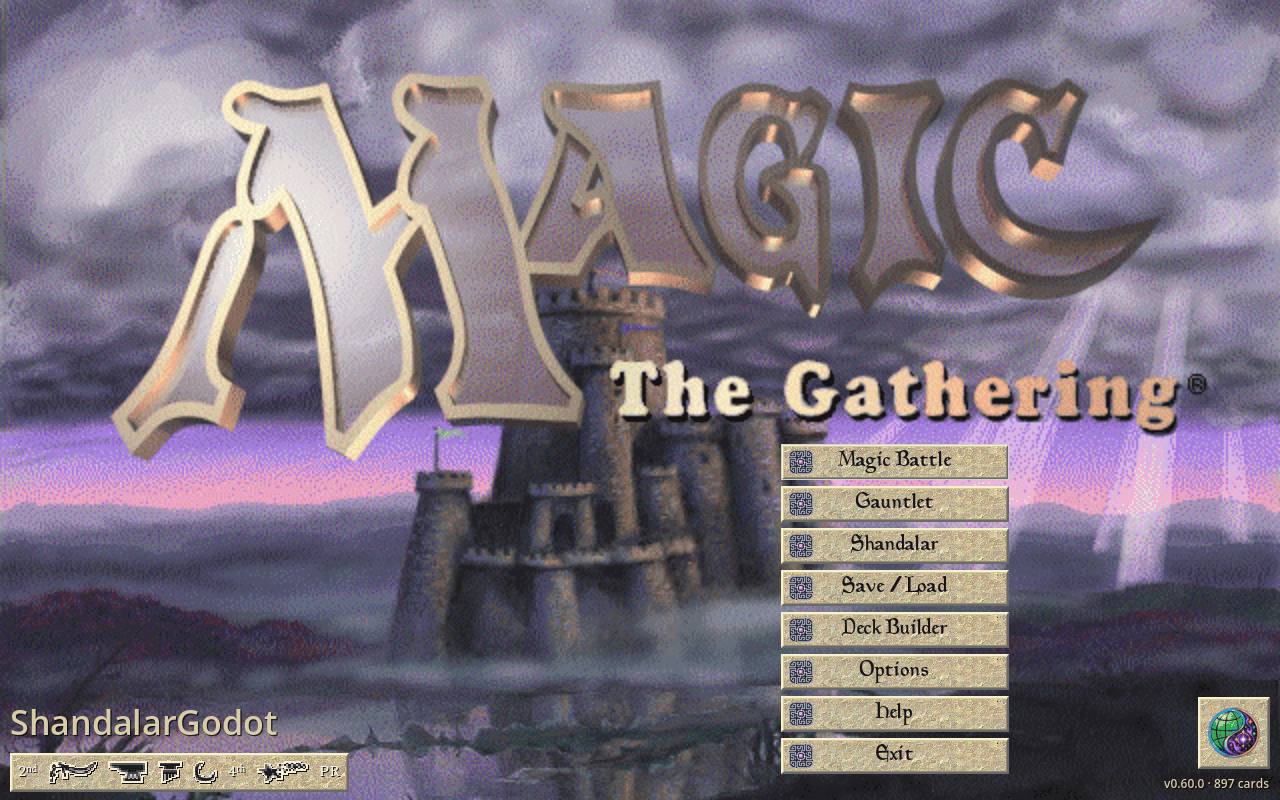
The main menu with the optional original-game skin.
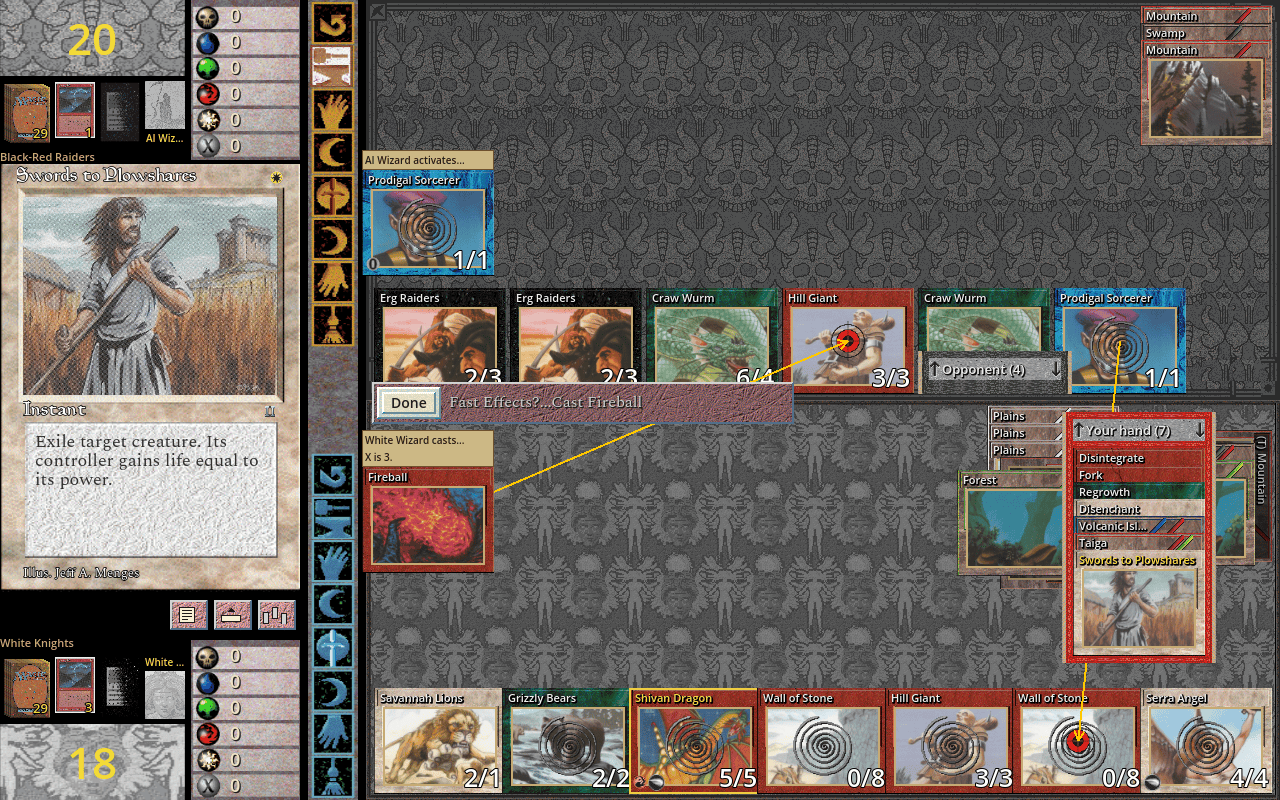
A spell chain in progress during a duel.
Strong play. Fair information.
We are proud of our solid non-cheating AI player. All four standard
difficulties—Apprentice, Magician, Sorcerer and Wizard—use fair information.
The stronger opponents study their own deck, adapt to its strategy, plan
spells and mana, and compare combat outcomes rather than simply ranking
individual creatures.
They do not read your unrevealed hand, either library's secret order,
future draws, or the random generator's state to choose a play. They get
no free cards, extra mana, or special rules. Hidden-information regression
tests protect this design. A stronger difficulty means stronger analysis,
not permission to cheat. The opponent remains fallible; this is not a claim
that it can never make a poor play.
For players who deliberately want something different, the separate,
opt-in Unfair — sees your hand challenge adds knowledge of your current
hand to Wizard. It is off on a fresh installation, clearly labelled,
unrated, and not a fifth standard difficulty. It still gets no future
draw knowledge, free resources, or rule exceptions.
Read the fair-play contract
for the precise boundaries.
What you can play
- Full duels with the 897-card early-Magic pool and 319 included decks.
- Magic Battle against the computer, local hotseat, or computer-versus-computer demonstrations.
- Best-of matches with sideboarding, Gauntlet runs and sealed-deck building.
- The Deck Builder, with large cards on by default, responsive filters,
keyboard card browsing, Enter to add and Backspace to remove. - Combat timing and regeneration fixes, clearer animated-land stats,
immediate damage-assignment markers, and more readable in-game help. - Aswan Jaguar shows its chosen type behind the card, or "No creatures"
when its opponent's library has no creature type available. - More considered spell choices, deck preparation and combat planning.
- The headless Deck Lab for deck testing and reproducible simulations.
The playtested card placement and size are unchanged. Different screen
proportions may leave extra black space beneath the large card; the layout
keeps the cards consistent rather than stretching them.
Downloads
Each platform has two packages. The plain ZIP is the standalone game
with its built-in fallback appearance; -with-skin includes
skin/original_skin.zip for the original look and sounds.
| Platform | Standalone | Original skin included | Start |
|---|---|---|---|
| Windows x86-64 | Shandalar-0.20.0-windows64.zip |
Shandalar-0.20.0-windows64-with-skin.zip |
Extract all files, open Shandalar.exe |
| Linux x86-64 | Shandalar-0.20.0-linux64.zip |
Shandalar-0.20.0-linux64-with-skin.zip |
Extract, run ./run.sh |
| macOS, Apple Silicon + Intel | Shandalar-0.20.0-macos.zip |
Shandalar-0.20.0-macos-with-skin.zip |
Extract, open Shandalar.app |
| Web | Shandalar-0.20.0-web.zip |
Shandalar-0.20.0-web-with-skin.zip |
Serve the extracted folder over HTTP(S) |
original_skin.zip is also available on its own. SHA256SUMS lists the
checksums of all nine downloads. Source archives are available from GitHub.
Keep the whole extracted folder together. On macOS the skin/ folder goes
beside the app, not inside it; on Linux and Windows it goes beside the
executable. Leave the skin ZIP intact. Linux and Windows packages target
x86-64, not ARM devices. The Mac app contains both architectures.
The Windows executable is unsigned. The Mac app is ad-hoc signed, not
Apple-notarized, so the operating system may ask you to approve opening it.
Only approve a download you trust; there is no need to disable system-wide
security settings. See the included README for platform-specific details.
For web, run python3 -m http.server 8000 in the extracted folder, then open
http://localhost:8000/. Do not open index.html directly as a file.
The web package needs no cross-origin-isolation headers. Your browser keeps
settings, decks and imported packs in storage for that site's address;
export important decks before clearing it. These downloads are web-server
packages, not an announcement of a new hosted play site.
Card pictures stay separate
No package contains card pictures. Choose your existing cardart.zip
in Options → Skin, or put it in the desktop game's skin/ folder. The
included Python tools can fetch and assemble a pack for your own use:
python3 tools/fetch_card_art.py --out cardart/
python3 tools/mtg_assets.py --from-cardart cardart/ --out cardart.zip
For web, import your personal pack through Options → Skin. Do not upload
the card pictures with a public web build. You can also import the original
skin from your own game installation using the included tools.
DeckLab CLI
Want to put a new brew through its paces? The desktop releases also include
DeckLab CLI, a headless deck-analysis tool that runs computer-versus-computer
duels without opening the game window. Run simulations in parallel across
CPU cores, test individual matchups or whole gauntlets, and compare deck
ideas using win rates, confidence intervals, charts and CSV/JSON reports.
Seeded runs make experiments reproducible.
Start with ./deck_lab.sh --help on Linux/macOS or .\deck_lab.bat --help
on Windows. Use --procs and --jobs to control parallel workers;
--no-elo keeps experiments out of the ratings ledger. The included
DECKLAB.md explains the options.
We hope it helps you design decks, try unusual combinations and discover
a few surprises!
SHA-256 checksums
These checksums cover the exact ZIP files attached to this release. Compare
your downloaded file with its entry below; a different checksum means the
download does not match. All entries are also in the attached SHA256SUMS.
c6d28e98749710a7566423c9c863dac594f097bb2b10114e7c31e11f489af35c  Shandalar-0.20.0-linux64-with-skin.zip
5f802f6b4500b79a7ef0dddbaf656497be7998eb4c09fccba38f038797b4ad7d  Shandalar-0.20.0-linux64.zip
de42c888e9c9b69f37d8a749ce3119fea2c9e185e212fef1ec115b4a5a5d1ac0  Shandalar-0.20.0-macos-with-skin.zip
459e232eb9a88a30329212a4ed862fc4758c086f2eaa75ff76f66042a3006a19  Shandalar-0.20.0-macos.zip
e1f3b7a3b753c8f29c554ca79686c8f571fc8101e397efb75d91260dad5509a7  Shandalar-0.20.0-web-with-skin.zip
ec52ce0faddee588bdd9c6c1f3b25a1b4cf75166a8194797607108e407c3d808  Shandalar-0.20.0-web.zip
47ab590d77d42bc33454652eb630a0ac7e7c9c3e7cc39c34e6695b283c9231c8  Shandalar-0.20.0-windows64-with-skin.zip
b2b169db032eaa23c3b4a6c2a7bab7cad749959cae691b1898d4c96a30ef7302  Shandalar-0.20.0-windows64.zip
2c1c02b6a370dfd8aefc41bda1a8bd234d9c0ebebfa3cd4d17215b461b927f5c  original_skin.zip
For all downloads saved together, Linux users can run sha256sum -c SHA256SUMS;
on macOS, run shasum -a 256 -c SHA256SUMS. To check one file on Windows,
use PowerShell: Get-FileHash .\Shandalar-0.20.0-windows64.zip -Algorithm SHA256.
Compare the complete 64-character hash, not just its beginning.
Thank you—and enjoy the duels
Thank you to the Shandalar community, Manalink, SlightlyMagic,
the original-game preservation and decompilation contributors, and everyone
who has tested, patched, documented, archived, or simply kept playing.
Our thanks also go to MicroProse for the original game; the Godot
and GUT teams; Ben Prew and the Shandalar 30th Anniversary (s30),
mage-go and mp_pic_tools contributors; the Forge team; The Dojo
and the deck historians; and Scryfall, the artists, and everyone whose
work helped us understand and preserve this corner of Magic. Credits and
sources are recorded in the repository's README and Provenance document.
This is a love letter to early Magic and the people who kept Shandalar
alive. Have fun, try an unlikely deck, and enjoy that next good draw.
All the best, good luck, and good health to every player!
— b0realis
Source code: GPL-3.0. Godot and other components retain their own licences.
The original skin is separate from the source-code licence. Magic: The
Gathering is a trademark of Wizards of the Coast LLC. This is an
unaffiliated, non-commercial fan project; no endorsement is implied.
Shandalar 0.19.0
This is the first release of ShandalarGodot — a from-scratch, open-source remake of MicroProse's 1997 Magic: The Gathering ("Shandalar"), written in GDScript on Godot 4.7. It is a love letter to that game: the feel of early Magic, Fourth Edition and the sets around it, kept as it was — and given the quality of life, the modern spin and the tools that 1997 could not have.
The key is in the limitations. One specific, finite spell library is something you can get creative with, instead of losing time to an ever-widening card pool and its obsolescence. It can be fun, it can be creative, and — would you believe it? — it can even be relaxing.
Have fun with it. This is a modern, re-imagined nostalgia kick, made for the community and with its help — all the best to the players, and good luck and good health to all.
What is in the box
- The duel, whole. All 897 cards of the eight sets the 1997 game shipped — Unlimited, Fourth Edition, Arabian Nights, Antiquities, Legends, The Dark, the Astral set and the promos — each in its own documented file, on a rules engine written for this project: the stack, priority, combat with all its steps, mana, protection, regeneration, prevention, poison, phasing, tokens, control changes, ante and state-based actions. The 1997 screen — the sidebar with its piles and the enlarged card, the draggable hand window or the fanned hand, the phase bar with its stops, the original's own dialogs and their words — and, where it helps, a modern one: Begin Combat or skip, the instant windows, the deck's name in the sidebar, the opening hand in view while you decide your mulligan.
- The Paris mulligan. The winner of the toss chooses play or draw, then each seat looks at its hand and keeps or redraws one card fewer, until it keeps. The AI does the same, with a judgement of its own.
- Four opponents on a ladder — Apprentice, Magician, Sorcerer, Wizard — each a step more capable than the last, and written down knob by knob in
docs/ai-difficulty.md. The Wizard holds counters and tricks with mana open, plays engines, searches its combat, sideboards between duels, counts the cards a spell acts on, prices a Balance by what each side would lose, and paces its draws to the race of the libraries. - 317 decks, ported with their provenance: the 1997 originals of every tier, the enemy and variant decks, and the tournament decks of the era.
- Magic Battle — the original's own pre-duel screen: hotseat, versus the AI, or an AI-vs-AI demo; deck, name, life and difficulty per seat;
<random deck>and the five formats; ante or free play; best-of matches with sideboarding between duels; a seed box so a duel can be replayed. Every choice is remembered for next time. - The Deck Builder — the 1997 screen with its filters window, its stats, its type-ahead, its sort and rarity switches, and a keyboard: the arrows walk a ring along the cards, Enter adds.
- Sealed Deck — the dice medallion, a window that deals the packs, an inventory of what was dealt.
- The Gauntlet — one run, one deck, opponent after opponent, on the original's own options window.
- Touch controls — a finger types the mouse: tap clicks, hold and lift right-clicks, drag drags; Options → Touch controls: Auto / On / Off. The table is landscape.
- The Deck Lab — a headless simulator that plays thousands of duels in minutes (
./deck_lab.sh,DECKLAB.md), with--sweepfor measuring a change to the AI. Every change to the AI in this project was measured with it. - Help — the 1997 help file's own pages, and the game's own.
Adventure mode — the map of Shandalar — is next on the roadmap; this release is the duel and everything around it.
The art
The game plays with no art at all: every panel, button, card and portrait falls back to a drawn equivalent of the same size. To make it look like 1997, it wears skins it mounts in place, never unpacked:
original_skin.zip— the 1997 material: backgrounds, frames, fonts, portraits, music and sounds, the coin-toss movies. A download of its own below, or already in place in the "-with-skin" zips. Put it inskin/beside the game, choose it in Options → Skin, or drop it on the window.- Your own copy. If you own the original,
mtg_assets.py --install /path/to/gamereads your install and writes the same zip;mtg_assets.py --checkonly looks and reports. - The card pictures are not a download — they are Scryfall's, on a licence of their own — but two shipped scripts build the pack in a few minutes:
python3 fetch_card_art.py --out cardart/thenpython3 mtg_assets.py --from-cardart cardart/ --out cardart.zip, and choose the zip in Options → Skin. - A skin of your own.
skin/SKIN.txtcatalogues every file a skin holds — its format, size and name — andskin_catalogue.py --check my_skin.zipsays what one is missing. Your places — the skin, a folder of loose files instead of a zip, extra card packs, portraits, music — are set in Options → Skin, or insettings.cfg.
setup.txt (Linux) and README.txt (web) map every path the game reads or writes.
Downloads
Shandalar-0.19.0-linux64.zip(33 MB) — Linux 64-bit, the game with no art. Unzip,./run.sh;./shortcut.shputs it in your application menu.Shandalar-0.19.0-linux64-with-skin.zip(117 MB) — the same, withoriginal_skin.zipalready inskin/.Shandalar-0.19.0-web.zip(15 MB) — the game as a web page, for any modern browser and a tablet's touch. Serve the folder (python3 -m http.server 8000, then openhttp://localhost:8000/) — a browser will not run it from a file.Shandalar-0.19.0-web-with-skin.zip(99 MB) — the same, with the skin beside the page; the browser fetches it once and keeps it.original_skin.zip(84 MB) — the 1997 art alone, for either of the plain zips above.
Everything is written inside your home directory; nothing is installed.
Under the hood
289 test scripts, 5041 tests and about 136 000 assertions run headless in seconds; a duel soak plays whole games through the live screen under both rule sets; every rules shortcut is marked at the site and listed in docs/simplified-cards.md; every source is ranked in Provenance.md and every behaviour is marked [1997], [s30] or [QoL] where it lives. The engine is pure GDScript with no scene dependency, so a card is one file and a new set touches no engine code.
GPLv3. Magic: The Gathering is a trademark of Wizards of the Coast LLC; this is an unaffiliated, non-commercial fan project. The 1997 art is MicroProse's; the card pictures are Scryfall's and are not distributed here.