Repository navigation
H2: g:Profiler
Use g:Profiler on a list of genes to run an enrichment analysis.
Started: 2023-03-07 | Completed: 2023-03-07
Estimated time: 1 hr | Actual time: 1 hr
- Query gene list was provided.
- g:Profiler can be found here.
- Using g:GOSt, use the following parameters:
- Significance threshold: Benjamini-Hochberg FDR
- Data sources: GO biological process, No electronic GO annotations, Reactome, and Wiki pathways.
- After running the query, select EnsemblID with the most GO annotations and click re-run query.
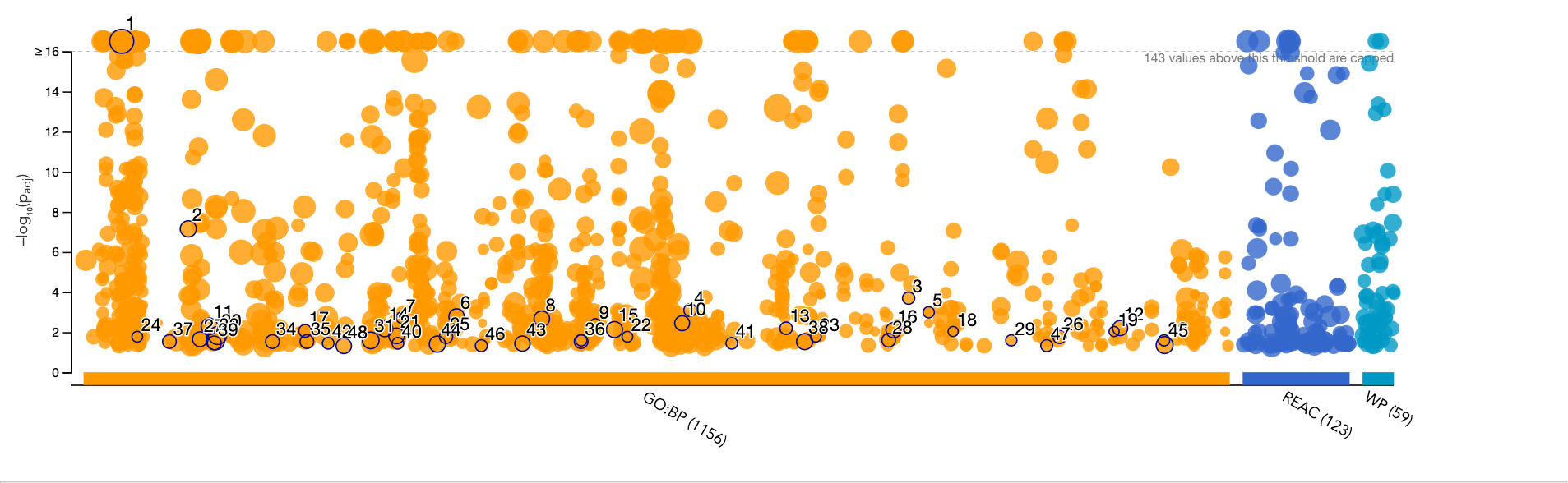 1. What is the top term returned in each data source?
- GO:BP: Immune system process
- REAC: Immune system
- WP: Allograft rejection.
2. How many genes are in each of the above genesets returned?
- GO:BP: 2014
- REAC: 2041
- WP: 88.
3. How many genes from our query are found in the above genesets?
- GO:BP: 255
- REAC: 220
- WP: 32.
4. Change g:profiler settings so that you limit the size of the returned genesets. Make sure the returned genesets are between 5 and 200 genes in size. Did that change the results?
This caused changes in the top term and number of genes for GO:BP and REAC:
- GO:BP: Regulation of leukocyte proliferation, 190
- REAC: Immunoregulatory interactions between a Lymphoid and a non-Lymphoid cell, 181.
5. Which of the 4 ovarian cancer expression subtypes do you think this list represents?
The 4 subtypes we know are immunoreactive, proliferative, differentiated, and mesenchymal. As most of the terms are related to immunopathways, it is probably the immunoreactive subtype.
6. Bonus: The top gene returned for this comparison is TFEC (ensembl gene id:ENSG00000105967). Is it found annotated in any of the pathways returned by g:profiler for our query? What terms is it associated with it g:profiler?
Both before and after changing the term size to 5 to 200, TFEC was not found in REAC and WP. But, it does show annotations in GO:BP for: response to stimulus, response to stress, cellular response to stimulus, and positive regulation of biological process. It is likely that TFEC is involved in multiple processes in cellular response. But, its function may not be specific as it is not annotated on lower levels of the hierarchy of the ontology.
Uku Raudvere, Liis Kolberg, Ivan Kuzmin, Tambet Arak, Priit Adler, Hedi Peterson, Jaak Vilo: g:Profiler: a web server for functional enrichment analysis and conversions of gene lists (2019 update) Nucleic Acids Research 2019; doi:10.1093/nar/gkz369 [PDF].
This work is licensed under a Creative Commons Attribution 4.0 International License.
