

A Multiplatform Physics Interaction SDK for Android Views and Compose Multiplatform (Android, iOS, Desktop, Web/Wasm).
Decouple force-directed physics from layout containers via lightweight Compose Modifiers and Android View extensions. Add attraction-repulsion fields, spring links, and smooth dragging directly to standard UI components without wrapper layouts or view-tree mutations — ideal for knowledge graphs, topology views, interactive tag clouds, and floating cards.
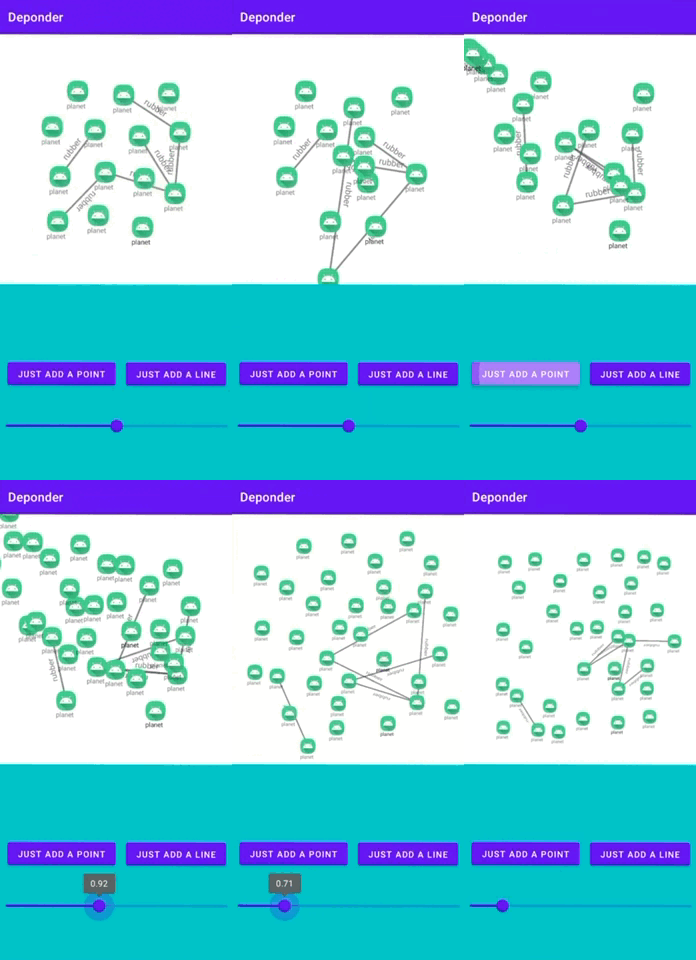
- Unified Cross-Stack API: Identical 5-part mental model and
dp-based physics configuration across Compose Multiplatform and Android Views, with full Java interop. - Low-Intrusive & Gesture-Safe: Preserves standard
.clickable {},OnClickListener, and ripple feedback viatouchSlopgating and root-space coordinate projection; elevates dragged items viazIndex/translationZwithout reordering child views or mutatingclipChildren/clipToBounds. - Content-Adaptive Spring Length & WindowInsets-Style Safe Areas:
RubberPhysics()automatically adapts spring natural length to measured label/badge width by default (RubberPhysics.auto(...)to customize padding & min/max bounds, orRubberPhysics(naturalLengthDp = 120f)/ XMLapp:deponderNaturalLength="wrap_content | 120dp"for fixed rest lengths), whileDeponderRubberInsetsorthogonally controls UI endpoint clearance (Defaultcontour estimation,fixed(dp),Nonecenter-to-center spans,startOnly/endOnly); includes ready-to-useDeponderDefaultRubber(Compose) andDeponderRubberView(Android View / XML) with floating labels and directional arrowheads (automatically omitted on center-anchored endpoints). - Opt-In Sparse Topological Unfolding (
0.6.0,RootPhysics.withUnfold(true)): Disabled by default (false) to preserve strictly local point-mass physics; when enabled, a deterministicO(K * (|V| + |E|))solver (degree-1 tree peeling, Farthest-First PivotMDS, bounded Sparse Stress Majorization, radial subtree fanning, and Procrustes alignment) smoothly untangles knotted cycles, trees, grids, and disconnected islands during topology changes orreheat()before fading out completely into pure Newtonian springs and0% CPUsleep. - Frame-Rate-Independent Physics Kernel (
deponder-core):- Consistent Motion Across 60Hz–240Hz: Adaptive
1/120ssub-stepping keeps simulation speed consistent across display refresh rates, paired with deterministic symmetry breaking for stacked or collinear nodes. - Idle 0% CPU & 3-Tier Hybrid Quadtree: Dual velocity/acceleration sleep thresholds drop CPU usage to 0% at rest with instant drag wakeup, scaling automatically across node counts (
< 64direct array,64–255single-thread quadtree,256+parallel snapshot evaluation onDispatchers.Default). - Layer-Only Frame Updates: Drives displacement and deformation via Compose
Modifier.Nodegraphics layers and AndroidViewlayer transforms without triggering per-frame relayout or recomposition.
- Consistent Motion Across 60Hz–240Hz: Adaptive
- Minimal Transitive Footprint:
deponder-coredepends only onkotlin-stdlibandkotlinx-coroutines-core;deponder-composedepends strictly ondeponder-core,compose-runtime, andcompose-ui(zerocompose-foundationor Material dependency);deponderexposes onlydeponder-coreandlifecycle-common.
| Role | Compose API | Android View API | Purpose |
|---|---|---|---|
| Root Field | Modifier.deponderRoot |
viewGroup.deponderRoot |
Establishes the physics coordinate space and frame loop on a container |
| Node (Planet) | Modifier.deponderPlanet |
view.deponderPlanet |
Registers a UI component as a physics body with mass, repulsion radius, or pinning |
| Spring Link (Rubber) | Modifier.deponderRubber |
view.deponderRubber |
Connects two node IDs with configurable spring attraction (or use built-in default rubbers) |
| Link Transform (Stretch) | Modifier.deponderStretch |
view.deponderStretch |
Stretches and rotates a custom link component dynamically between two nodes |
| Drag Gesture (Drag) | Modifier.deponderDrag |
view.deponderDrag |
Adds opt-in, click-safe physics dragging to a node |
| Artifact | Target UI Stack | Platforms |
|---|---|---|
io.github.cinpecan:deponder-compose:0.6.0 |
Jetpack Compose & Compose Multiplatform | Android, iOS, Desktop (JVM 17), Web (wasmJs) |
io.github.cinpecan:deponder:0.6.0 |
Traditional Android View / ViewGroup |
Android (minSdk 23, JVM 17) |
io.github.cinpecan:deponder-core:0.6.0 |
UI-agnostic KMP physics kernel (custom Canvas / headless graphs) |
Android, iOS, Desktop (JVM 17), Web (wasmJs) |
io.github.cinpecan:deponder-bom:0.6.0 |
Version alignment BOM (optional for hybrid projects) | All |
Compose Multiplatform (commonMain) or Pure Jetpack Compose:
dependencies {
    implementation("io.github.cinpecan:deponder-compose:0.6.0")
}
Traditional Android View:
dependencies {
    implementation("io.github.cinpecan:deponder:0.6.0")
}
Hybrid Android View + Compose Project (with BOM):
dependencies {
    implementation(platform("io.github.cinpecan:deponder-bom:0.6.0"))
    implementation("io.github.cinpecan:deponder")
    implementation("io.github.cinpecan:deponder-compose")
}Host
Modifier.deponderRooton an unconstrained container such asBox. In Compose,deponderPlanetanddeponderRubbercan be declared at any static nesting depth insidedeponderRoot.
val state = rememberDeponderState(
    RootPhysics.fromPreset(DeponderDefaults.Presets.Balanced)
        .withUnfold(true) // Optional (default false): smoothly untangle cycles, trees, and meshes
)

Box(modifier = Modifier.fillMaxSize().deponderRoot(state)) {
    // 1. Ready-to-use default spring link (for custom link UIs, combine Modifier.deponderRubber + Modifier.deponderStretch)
    links.forEach { link ->
        DeponderDefaultRubber(
            startId = link.fromId,
            endId = link.toId,
            label = link.relation,
            arrowMode = DeponderArrowMode.BOTH,
            physics = RubberPhysics(), // Auto-adapts to label length by default; pass naturalLengthDp = 120f or RubberPhysics.auto(...) to customize
            insets = DeponderRubberInsets.Default, // or DeponderRubberInsets.None for center-to-center lines
        )
    }

    // 2. Any standard Composable — layer-only updates with zero recomposition during physics frames
    nodes.forEach { node ->
        NodeCardComposable(
            node = node,
            modifier = Modifier
                .deponderPlanet(
                    id = node.id,
                    physics = PlanetPhysics(repulsionRadiusDp = 90f, pinned = node.isAnchor),
                )
                .deponderDrag()
                .clickable { onNodeClicked(node) },
        )
    }
}

// Runtime control: state.submitScale(1.2f), state.submitRubberElasticity(2.4f), state.setPinned(id, true)Host
deponderRooton an unconstrainedViewGroupsuch asFrameLayout,ConstraintLayout, orCoordinatorLayout(deponderPlanetanddeponderRubberviews must be direct children ofdeponderRoot).
val controller = rootFrameLayout.deponderRoot(
    lifecycleOwner = this,
    physics = RootPhysics.fromPreset(DeponderDefaults.Presets.Balanced)
        .withUnfold(true), // Optional (default false): smoothly untangle cycles, trees, and meshes
)

// Ready-to-use default spring View (also supports XML <com.cinpe.deponder.DeponderRubberView>;
// for custom compound link Views, combine view.deponderRubber(...) with view.deponderStretch() or @string/deponder_stretch)
val rubberView = DeponderRubberView(this)
    .withLabel("depends on")
    .withArrowMode(DeponderArrowMode.END)
rootFrameLayout.addView(rubberView)
rubberView.deponderRubber("core", "ui") // Auto-adapts to label length by default; pass RubberPhysics(naturalLengthDp = 120f) to lock fixed length

// Configure force fields and dragging on direct-child Views while keeping setOnClickListener intact
cardCore.deponderPlanet("core", PlanetPhysics(pinned = true))
cardUi.deponderPlanet("ui")
cardUi.deponderDrag()
cardUi.setOnClickListener { showDetail("ui") }

// Runtime control: controller.submitScale(1.2f), controller.submitRubberElasticity(2.4f), controller.cancel()
Java callers can use static & fluent helpers on
DeponderViews(deponderRoot,deponderPlanet,deponderRubber,deponderStretch,deponderDrag) andnew DeponderRubberView(context).withLabel(...).
Licensed under the Apache License, Version 2.0. See LICENSE for the full text.
Copyright (c) 2022-present, Cinpecan and Deponder Contributors.
Licensed under the Apache License, Version 2.0: https://www.apache.org/licenses/LICENSE-2.0