Repository navigation
Releases
2.17.0-beta

Rolling preview of 2.17.0. Rebuilt every night from
main. Not feature-frozen, and not a release.Currently built from
c67e0e1.
End-to-end suite: success (470/470 scenarios passed). Run.
v2.17.0-betais the only tag a nightly publishes, and it moves. It changes under anyone who already pulled it, and for roughly an hour each night it points at a commit whose images are still building. Where a build has to stay put, resolve the digest once and pin that:skopeo inspect docker://8gears.container-registry.com/8gcr/harbor-core:v2.17.0-beta | jq -r .Digest docker pull 8gears.container-registry.com/8gcr/harbor-core@sha256:...
Commercial Features
Branding
- Branding settings section headings (Product, Login Page, Header Colors) use the same
heading size and weight as the Audit Log settings page (container-registry/8gcr-ee#604)
Federated Robot Accounts
- Fail authentication instead of panicking in core (502 at the ingress) for a Bearer token or
Basic auth password with three segments whose JWT header does not decode (container-registry/8gcr-ee#578) - Reject deleting a trusted issuer's
audorissclaim with 400; they are immutable like on create (container-registry/8gcr-ee#521) - Answer 400 for a trusted issuer id of 0 or less instead of 404 (container-registry/8gcr-ee#521)
- A trusted issuer now declares its audience as a field; issuer plus audience is its
identity, so several trusted issuers may share an issuer URL with different
audiences, and aud or iss are no longer accepted as claim rules (container-registry/8gcr-ee#523) - Upgrade: trusted issuers created before this change have no audience and reject
tokens with the error "trusted issuer has no audience". Set the audience
once on each existing trusted issuer via the portal edit form or
PUT /api/v2.0/trusted-issuers/{id}with{"audience": "<the token aud>"};
robots and claims need no change (container-registry/8gcr-ee#523)
Multi-Format Artifacts
- A project group resolves Cargo reads through its grouped projects in lookup order (container-registry/8gcr-ee#717)
- A project group resolves NPM and Maven reads through its grouped projects in lookup order, and
tags/listincludes grouped project tags (container-registry/8gcr-ee#717) - A project group resolves PyPI reads through its grouped projects in lookup order, so pip and uv need only the project group URL (container-registry/8gcr-ee#728)
- Multi-project is now Project Group, and its sub-projects are grouped projects:
/projects/{p}/grouped-projects, metadatais_project_group, RBAC resourcegrouped-project, "Lookup Order" in the UI. The 2.16/subprojectspaths andmulti_projectkey are removed without aliases; the upgrade migrates stored groups and permissions (container-registry/8gcr-ee#718) - Beta: host NPM, PyPI, Maven, Cargo and Nix packages next to container images, served under
/pkg/<format>/<project>/(container-registry/8gcr-ee#662) - Proxy cache projects for NPM, PyPI, Maven, Cargo, Go modules (with the checksum database)
and Homebrew - The portal push dialog shows the publish commands for each package format (container-registry/8gcr-ee#663)
What's Changed
Features
-
Commercial features grouped under their own heading in Configuration > Features by @bupd in #1547 (7265ebe)
Configuration > Features shows commercial features in their own "Commercial" section below the optional features, and lists the features of each section alphabetically.
-
PostgreSQL 18 data upgraded to 19 on start by @bupd in #1548 (43a4a67)
The Helm chart's in-cluster PostgreSQL and the Docker Compose bundle now upgrade PostgreSQL 18 data to PostgreSQL 19 on their own when they start, with
pg_upgradein link mode. Take a database dump before upgrading; once PostgreSQL 19 has started, the old data can no longer be used directly. Data from PostgreSQL 17 or older still needs the manual steps in the chart'sdocs/postgresql.mdor the compose README. -
PostgreSQL 19 by @Vad1mo in #1534 (d8118e1)
Harbor now runs on PostgreSQL 19. The Docker Compose bundle and the Helm chart's in-cluster PostgreSQL (
postgresql.enabled: true) use PostgreSQL 19.0.
Fixes
-
network: Remove HARBOR_ALLOW_PRIVATE_NETWORK_ACCESS by @Vad1mo in #1537 (56b1023)
HARBOR_ALLOW_PRIVATE_NETWORK_ACCESSand the Helm valuenetwork.allowPrivateNetworkAccessare removed. UseHARBOR_WEBHOOK_EGRESS_POLICY/network.webhookEgress.policyinstead:truebecomesallow_all,falsebecomespublic_only. If you leave the old setting in place, nothing is opened up: Harbor logs an error and allows public webhook targets only, and the Helm chart refuses to render until you replace the value. Compose now defaultsHARBOR_WEBHOOK_EGRESS_POLICYtopublic_only, the same behavior as before. -
portal: Guide First Push From The Empty Repository List in #1492 (2b8f98e)
An empty project now shows how to push a first artifact: pick a client in the repository list and get the commands for that project.
-
portal: Show Proxy Cache Settings Only To System Admins by @bupd in #1501 (6b06dc9)
On Project > Configuration, the Proxy Cache checkbox and its settings (Endpoint, Bandwidth, Max upstream connections, Repository filter, Referrer API) are shown to system admins only, and the checkbox and Endpoint are always read-only. Project admins can no longer edit those settings in the UI. They see a read-only Repository filter on proxy cache projects.
-
portal: Show Push Commands In A Dialog With Format Tabs by @bupd in #1491 (fc07c36)
The Push Command button now opens a dialog with one tab per client (Docker, Podman, Helm, CNAB) instead of one long dropdown.
-
portal: Stop Listing Registries For Project Admins On Project Configuration by @bupd in #1489 (a7b5ebc)
Project admins who are not system admins no longer get a red banner with their username when opening a project Configuration page. The page no longer requests the registry list, which is a system permission.
Helm Chart
No chart release ships this beta. The chart in the tagged source defaults to the v2.17.0-beta images:
git clone --depth 1 --branch v2.17.0-beta https://github.com/container-registry/8gcr.git
helm dependency build 8gcr/deploy/chart
helm install harbor 8gcr/deploy/chart -n harbor --create-namespace -f my-values.yaml
Container Images
Multi-arch images (linux/amd64, linux/arm64) signed with cosign.
| Image | Reference |
|---|---|
harbor-core |
8gears.container-registry.com/8gcr/harbor-core:v2.17.0-beta |
harbor-jobservice |
8gears.container-registry.com/8gcr/harbor-jobservice:v2.17.0-beta |
harbor-registryctl |
8gears.container-registry.com/8gcr/harbor-registryctl:v2.17.0-beta |
harbor-exporter |
8gears.container-registry.com/8gcr/harbor-exporter:v2.17.0-beta |
harbor-portal |
8gears.container-registry.com/8gcr/harbor-portal:v2.17.0-beta |
harbor-registry |
8gears.container-registry.com/8gcr/harbor-registry:v2.17.0-beta |
trivy-adapter |
8gears.container-registry.com/8gcr/trivy-adapter:v2.17.0-beta |
Verify an image signature:
cosign verify \
  --certificate-identity "https://github.com/container-registry/8gcr/.github/workflows/publish-images.yml@refs/heads/main" \
  --certificate-oidc-issuer "https://token.actions.githubusercontent.com" \
  8gears.container-registry.com/8gcr/harbor-core:v2.17.0-beta
Contributors


Assets 2
chart: v2.2.1
What's Changed
Harbor Releases
- chart: keep chart package name harbor (release-2.16) by @Vad1mo in #1539 (9b2084e)
- chart: Name 8gcr A Harbor Distribution In Chart Description by @Vad1mo in #1544 (155ac0f)
- Rename Repository To container-registry/8gcr (ddc9fe9)
Fixes
-
chart: Default Ingress proxy-body-size To 0 (backport #1527) by @github-actions[bot] in #1528 (0743f1d)
The chart sets
nginx.ingress.kubernetes.io/proxy-body-size: "0"on the Ingress by default, so pushing large layers through ingress-nginx no longer fails with 413. Your own Ingress annotations still win: set the key to a size to keep a limit, or tonullto drop it. -
chart: Route /pkg/ To Core (backport #1493) by @github-actions[bot] in #1496 (44f1e51)
The Helm chart now routes
/pkg/to Harbor core on both the Ingress and the Gateway API HTTPRoute, so native package registry clients reach core without an extra Ingress. -
Render Deployment Strategy Explicitly So Recreate Works Under Helm 4 (backport #834) by @github-actions[bot] in #1526 (619dff1)
The Helm chart now supports
deploymentStrategy.type: Recreateon every component under helm 4 server-side apply. Deployments always render their strategy, withmaxSurge/maxUnavailabledefaulting to 25%. Releases installed with an older chart should upgrade once with RollingUpdate before switching to Recreate.
Helm Chart
helm install harbor oci://8gears.container-registry.com/8gcr/charts/harbor \
  --version 2.2.1 -n harbor --create-namespace -f my-values.yaml
Signed with cosign. Verify the chart signature:
cosign verify \
  --certificate-identity "https://github.com/container-registry/8gcr/.github/workflows/publish-chart.yml@refs/heads/release-2.16" \
  --certificate-oidc-issuer "https://token.actions.githubusercontent.com" \
  8gears.container-registry.com/8gcr/charts/harbor:2.2.1
Default Harbor image tags follow the chart appVersion: v2.16.0.
Contributors
Assets 2
chart: v2.2.0
What's Changed
Harbor Releases
Features
-
Default project setting in System Settings by @bupd in #1405 (a851d11)
The default project for project-less pushes can now be set in Configuration > System Settings > Default Project. Only existing projects can be picked. Leave it empty to reject pushes and pulls that have no project in the path. New installs default to
librarywhen that project exists. Helm users can pin it withcore.defaultProjectName(envDEFAULT_PROJECT_NAME), which creates the project if needed and locks the setting. -
Model Sync from Hugging Face (beta) by @bupd in #1478 (32e1f88)
Model Sync (Beta): import Hugging Face models into Harbor projects as OCI model artifacts from a new Administration > Model Sync page. Turn it on under Configuration > Features or with
HARBOR_ENABLE_MODEL_SYNC=true. Based on goharbor/harbor#24318. -
chart: Optional in-cluster PostgreSQL subchart by @bupd in #1404 (f5d7d1d)
The Helm chart can run PostgreSQL in the cluster with
postgresql.enabled: true. A pgautoupgrade init container upgrades the data in place on a major version change, with no downgrade, so back up first. For production we still recommend an external PostgreSQL such as CloudNativePG; seedeploy/chart/docs/postgresql.md. Upgrading from a 2.15 chart: don't usehelm upgrade --reuse-values, which skips the new defaults and is now stopped with an error. Pass your values file (-f values.yaml) or use--reset-then-reuse-values. -
chart: Webhook egress policy levels and allowlist by @Vad1mo in #1185 (ba299a8)
The chart and compose files can set the webhook egress policy,
network.webhookEgress.policy(HARBOR_WEBHOOK_EGRESS_POLICY), toallow_all,block_restrictedorpublic_only, withnetwork.webhookEgress.allowlist(HARBOR_WEBHOOK_EGRESS_ALLOWLIST) for trusted receivers. The chart defaults toblock_restricted, so internal receivers work while loopback, link-local and metadata stay blocked; compose keepspublic_only.network.allowPrivateNetworkAccessis deprecated:truemaps toallow_all,falsetopublic_only.
Fixes
-
chart: extraTemplateManifests silently drops every document after the first by @SurbhiAgarwal1 in #687 (a20dcfc)
Every document in
extraTemplateManifestsis now rendered. Before, a multi-document YAML string silently dropped all documents after the first. Check your values if you worked around this by splitting manifests. -
chart: include service port in harbor.core.url helper in #790 (#847) (43221eb)
-
chart: Rebuild Indexes On PostgreSQL Collation Version Mismatch by @bupd in #1413 (133d1ea)
When a database moved from the goharbor/harbor-helm chart to the PostgreSQL subchart reports a collation version mismatch, the pgautoupgrade init container now reindexes all databases and refreshes the collation version automatically. The manual reindex step is no longer needed.
-
chart: Stop --reuse-values Upgrades From 2.15 Charts by @bupd in #1482 (9713de5)
The chart now fails at render time when
postgresql.enabledis missing, which happens withhelm upgrade --reuse-valuesfrom a 2.15 chart (2.1.x). Before, this created an unrequested PostgreSQL StatefulSet and dropped the new 2.16 defaults. Upgrade with-f values.yamlor--reset-then-reuse-valuesinstead. -
Skip empty component Secrets when identity is fully externalized by @bupd in #835 (cdeadab)
A fully externalized (GitOps) install with
autoGenSecrets: falseno longer creates empty or placeholder-only component Secrets: the chart skips each chart-managed Secret and itsenvFromreference when every key it would carry is pinned to an existing Secret.
Updates
Helm Chart
helm install harbor oci://8gears.container-registry.com/8gcr/charts/harbor \
  --version 2.2.0 -n harbor --create-namespace -f my-values.yaml
Signed with cosign. Verify the chart signature:
cosign verify \
  --certificate-identity "https://github.com/container-registry/8gcr/.github/workflows/publish-chart.yml@refs/heads/release-2.16" \
  --certificate-oidc-issuer "https://token.actions.githubusercontent.com" \
  8gears.container-registry.com/8gcr/charts/harbor:2.2.0
Default Harbor image tags follow the chart appVersion: v2.16.0.
Contributors

Assets 2
v2.16.0
Highlights
Multi-Format Artifacts (Beta, commercial)
8gcr now stores language packages next to container images, in the same projects, with the same users, robot accounts, quotas and audit log.
| Format | Publish to a project | Proxy cache project |
|---|---|---|
| OCI images, Helm charts, CNAB | yes | yes |
| NPM | yes | yes |
| PyPI | yes | yes |
| Maven | yes | yes |
| Cargo | yes | yes |
| Nix | yes | |
| Go modules, with the checksum database | yes | |
Homebrew, including versioned formulae such as openssl@3 |
yes |
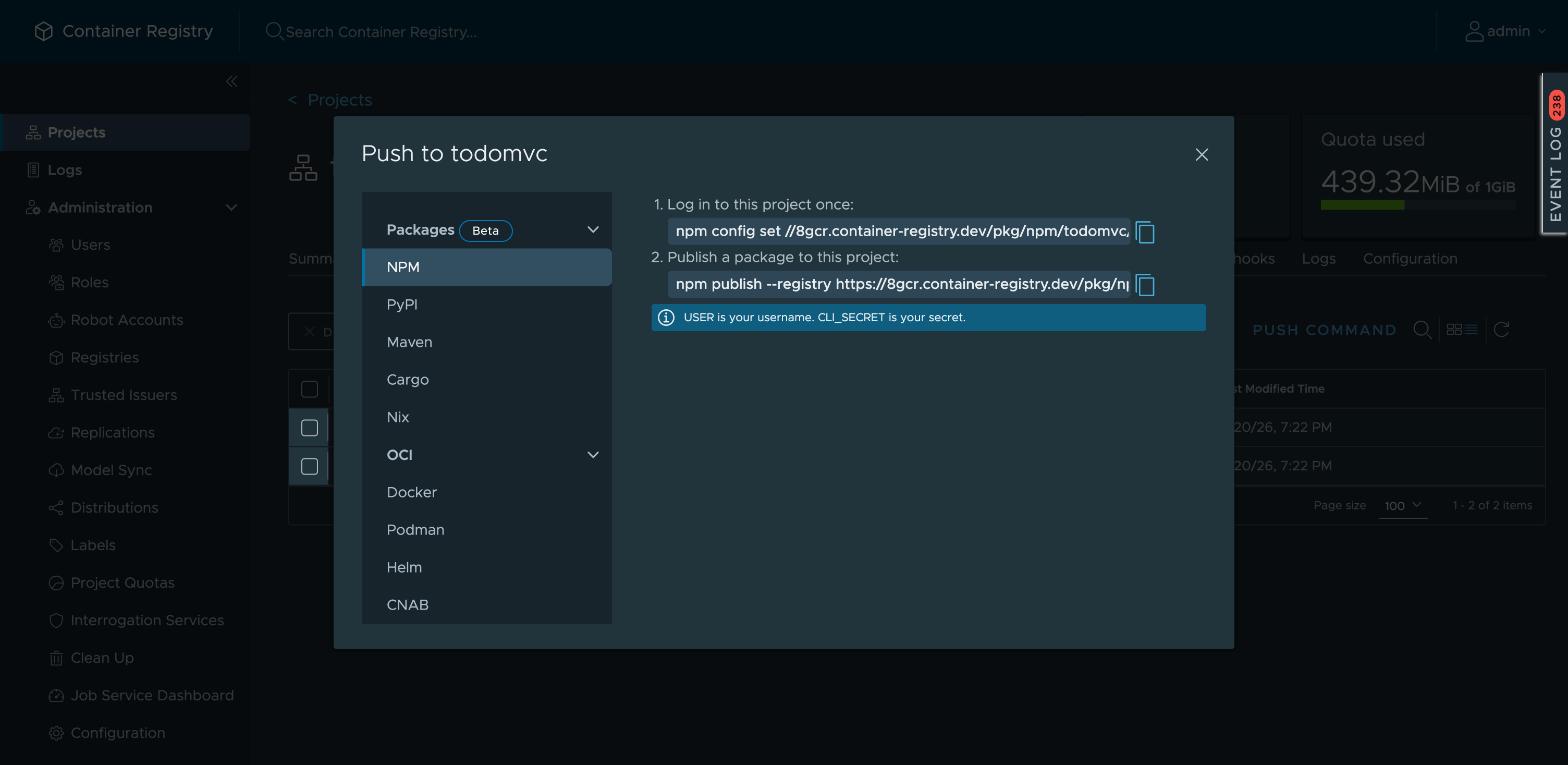
Packages are served under /pkg/<format>/<project>/, and the push dialog of every project shows the login and publish commands for each format. A project group resolves reads through its grouped projects in lookup order, so a client needs only one URL for published and proxied packages. More formats will follow.
Model Sync (Beta)
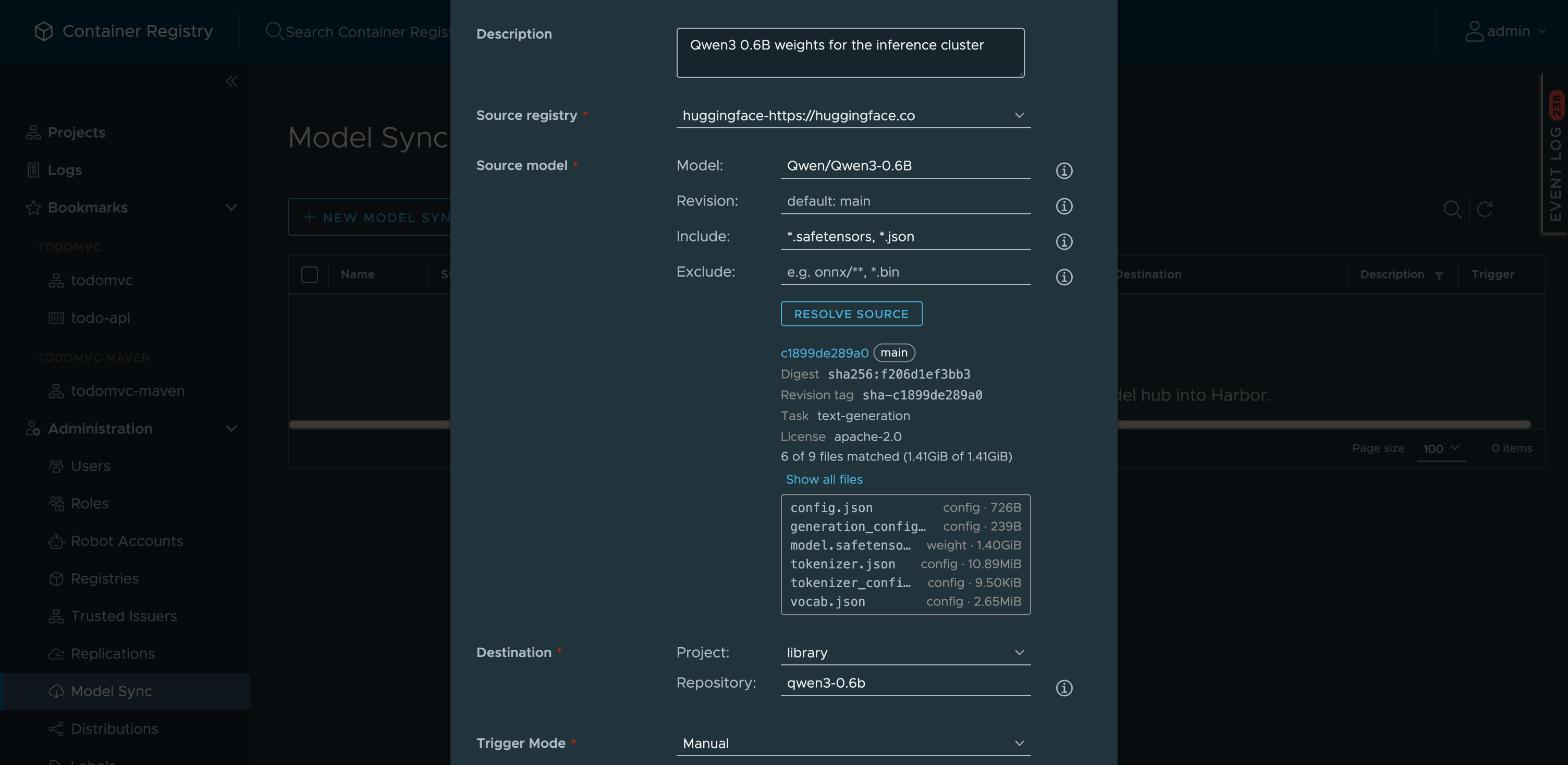
Import models from Hugging Face into a project as OCI model artifacts. Administration > Model Sync resolves the source before you save: revision, digest, license, task and the files your include and exclude patterns match. Policies run manually or on a schedule. Turn it on under Configuration > Features or with HARBOR_ENABLE_MODEL_SYNC=true.
Bookmarks (Beta)
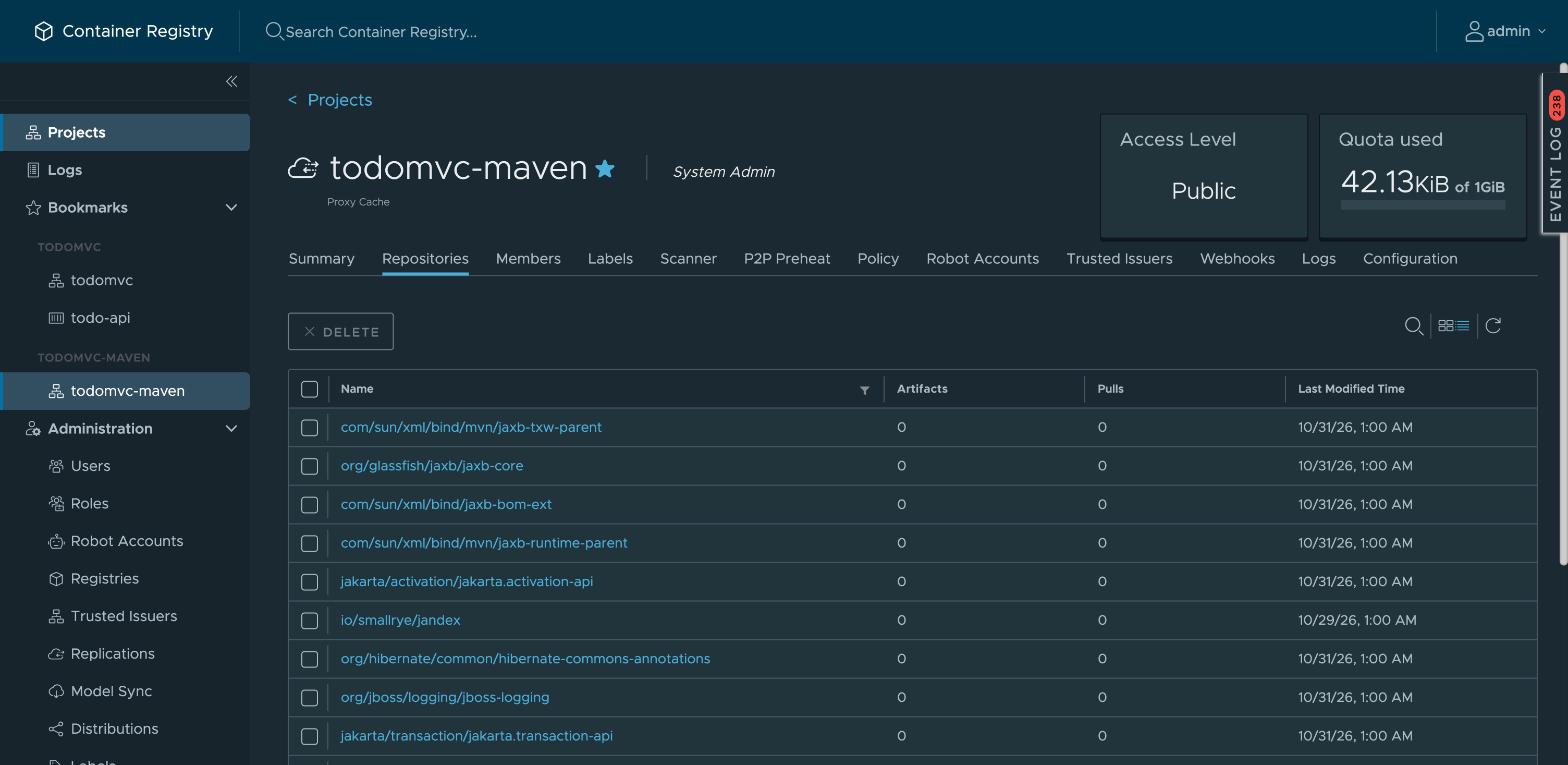
Star a project, repository, tag or a filtered repository or artifact list, and it appears under Bookmarks in the left navigation, grouped by project. Bookmarks can be renamed, deleted and reordered there. A tag bookmark always opens the image the tag currently points to. Bookmarks are stored per user in the browser. Turn them on under Configuration > Features.
Client IP and User Agent in the Audit Log
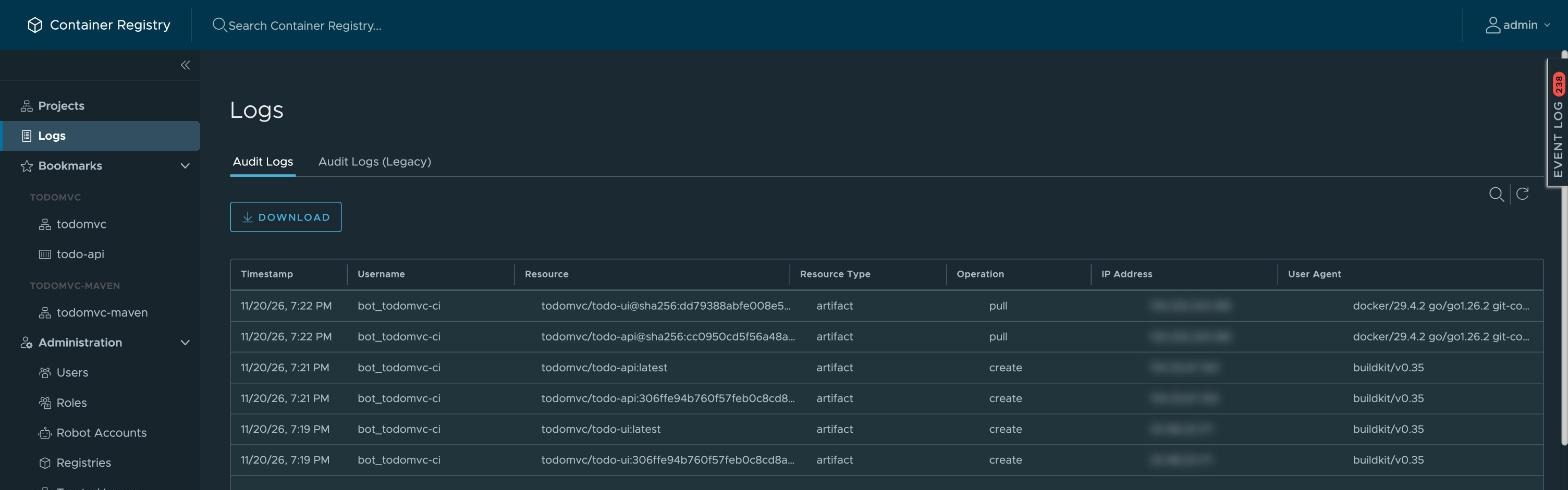
Every audit log entry records the client IP address and User-Agent of the request, including image push, pull and delete. Both are shown in the system and project Logs tabs and included in the API and the JSON export.
Audit Log Forwarding over OTLP (commercial)
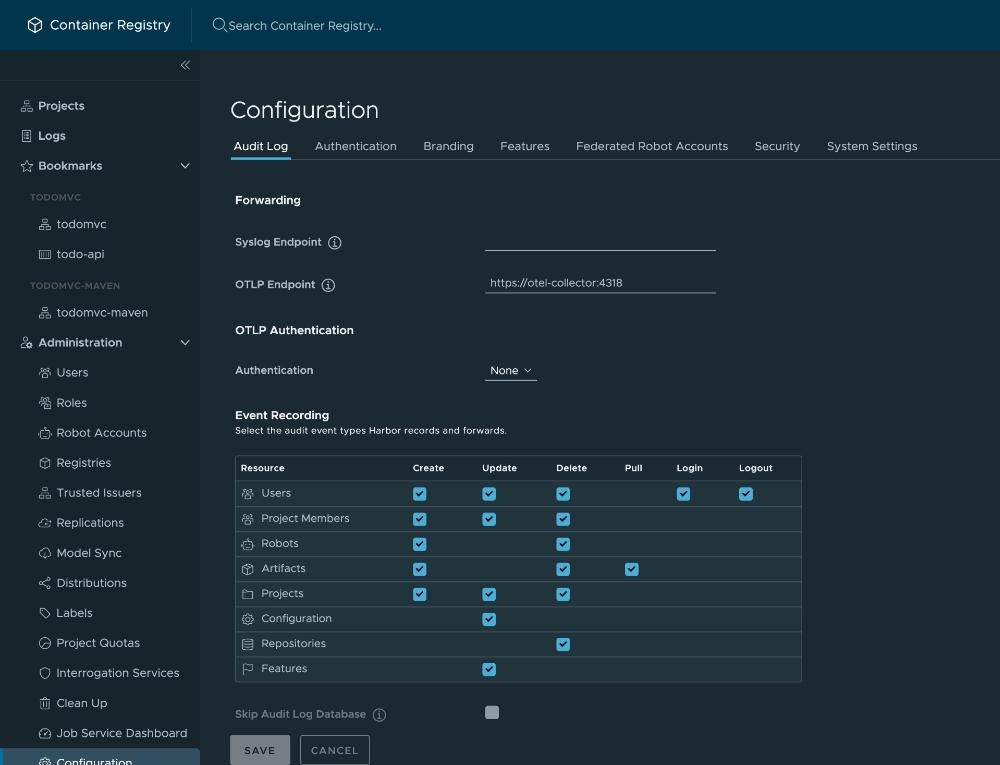
Audit logs have their own configuration page. Next to syslog, 8gcr forwards audit records to an OpenTelemetry collector over OTLP/HTTP, with optional Basic authentication. The event matrix selects which resource and action pairs are recorded and forwarded, and with a forwarding endpoint set, the database copy can be skipped.
Commercial Features
Branding
- Branding settings section headings (Product, Login Page, Header Colors) use the same
heading size and weight as the Audit Log settings page (container-registry/8gcr-ee#604)
Federated Robot Accounts
- Trusted issuer discovery and JWKS requests, including the JWKS fetch at login, follow an
egress policy of their own:HARBOR_TRUSTED_ISSUER_EGRESS_POLICYand
HARBOR_TRUSTED_ISSUER_EGRESS_ALLOWLIST, with the same values as the webhook settings. Each
falls back to itsHARBOR_WEBHOOK_EGRESS_*counterpart (chartnetwork.webhookEgress) when
unset or empty; webhooks never read the trusted issuer settings. The requests refuse
redirects to blocked addresses, stop after 10 seconds and accept only a JSON object of up to
1 MiB. For an in-cluster Kubernetes issuer, keep webhooks locked down and add to
core.extraEnv:HARBOR_TRUSTED_ISSUER_EGRESS_POLICY=public_onlyand
HARBOR_TRUSTED_ISSUER_EGRESS_ALLOWLIST=kubernetes.default.svc, plus the host of the cluster's
jwks_uriwhen it differs - The OpenID configuration and JWKS test endpoints need permission to create a trusted issuer:
system admin, or project admin withproject_idin the request. Creating a trusted issuer
checks that permission before Harbor fetches anything. The endpoints return only the public
keys or the issuer fields Harbor uses, never the raw response, and failed fetches no longer
return the remote error. An OpenID configuration URL with a fragment, an encoded?or#in
its path, or a path that does not end with/.well-known/openid-configurationis rejected with
400; a query such as Azure AD B2C's?p=<policy>is kept and sent as given. The discovered
jwks_urimust use HTTPS, and redirects from HTTPS to HTTP are refused. A URL that fails
these format checks gets 400 before the permission check and before any DNS lookup - Fail authentication instead of panicking in core (502 at the ingress) for a Bearer token or
Basic auth password with three segments whose JWT header does not decode (container-registry/8gcr-ee#578) - Reject deleting a trusted issuer's
audorissclaim with 400; they are immutable like on create (container-registry/8gcr-ee#521) - Answer 400 for a trusted issuer id of 0 or less instead of 404 (container-registry/8gcr-ee#521)
- A trusted issuer now declares its audience as a field; issuer plus audience is its
identity, so several trusted issuers may share an issuer URL with different
audiences, and aud or iss are no longer accepted as claim rules (container-registry/8gcr-ee#523) - Upgrade: trusted issuers created before this change have no audience and reject
tokens with the error "trusted issuer has no audience". Set the audience
once on each existing trusted issuer via the portal edit form or
PUT /api/v2.0/trusted-issuers/{id}with{"audience": "<the token aud>"};
robots and claims need no change (container-registry/8gcr-ee#523)
Multi-Format Artifacts
- Proxy cache fills for a file that is already queued are skipped, and the fill queue is bounded by payload size, so a cold install with many clients caches every file instead of dropping most of them (container-registry/8gcr-ee#702)
- NPM publish streams the package into storage instead of holding it in memory, so a large publish no longer gets core OOMKilled; a body over the size cap gets 413 (container-registry/8gcr-ee#703)
- The NPM and Maven proxies answer upstream failures with 502, 504 or 429 instead of 404, so clients retry instead of treating the package as missing (container-registry/8gcr-ee#701)
- The Projects page has a New Project Group button next to New Project, and the New Project dialog no longer has a Project Group toggle (container-registry/8gcr-ee#737)
- Package proxies serve downloads larger than the cache limit in full and skip caching them, instead of cutting the download off (container-registry/8gcr-ee#700)
- NPM and Maven requests answer 503 instead of 401 when the project lookup fails, so a database outage no longer looks like a wrong password (container-registry/8gcr-ee#698)
- Copies saved by a package proxy cache get their audit log entry again (container-registry/8gcr-ee#699)
- A project group resolves Cargo reads through its grouped projects in lookup order (container-registry/8gcr-ee#717)
- A project group resolves Go checksum database reads through its grouped projects in lookup order, so
GOSUMDBcan point at the project group URL (container-registry/8gcr-ee#717) - A project group resolves NPM and Maven reads through its grouped projects in lookup order, and
tags/listincludes grouped project tags (container-registry/8gcr-ee#717) - A project group resolves PyPI reads through its grouped projects in lookup order, so pip and uv need only the project group URL (container-registry/8gcr-ee#728)
- A project group resolves Go module (GOPROXY) reads through its grouped projects in lookup order, and a hosted project serves the Go modules it stores (container-registry/8gcr-ee#717)
- A project group resolves Homebrew reads through its grouped projects in lookup order (container-registry/8gcr-ee#717)
- Multi-project is now Project Group, and its sub-projects are grouped projects:
/projects/{p}/grouped-projects, metadatais_project_group, RBAC resourcegrouped-project, "Lookup Order" in the UI. The 2.16/subprojectspaths andmulti_projectkey are removed without aliases; the upgrade migrates stored groups and permissions (container-registry/8gcr-ee#718) - Beta: host NPM, PyPI, Maven, Cargo and Nix packages next to container images, served under
/pkg/<format>/<project>/(container-registry/8gcr-ee#662) - Proxy cache projects for NPM, PyPI, Maven, Cargo, Go modules (with the checksum database)
and Homebrew, including versioned formulae such asopenssl@3(container-registry/8gcr-ee#558) - The portal push dialog shows the publish commands for each package format (container-registry/8gcr-ee#663)
What's Changed
Features
-
Database schema reconciled on start, independent of migration numbers by @bupd in #711 (5652b08)
-
Default project for image references without a project by @bupd in #774 (adaf4ac)
Pushes and pulls without a project segment (e.g.
podman push registry.example.com/alpine:latest) now land in a configurable default project instead of being rejected, giving Harbor a Docker Hub / ghcr.io-style flat namespace for every OCI client. The default project islibrary. -
Audit log configuration page by @bupd in #705 ([6553702](https://github.com/con...
Contributors


Assets 2
2.16.0-beta
Rolling preview of 2.16.0. Rebuilt every night from
main. Not feature-frozen, and not a release.Currently built from
97e46a9.
End-to-end suite: success (470/470 scenarios passed). Run.
v2.16.0-betais the only tag a nightly publishes, and it moves. It changes under anyone who already pulled it, and for roughly an hour each night it points at a commit whose images are still building. Where a build has to stay put, resolve the digest once and pin that:skopeo inspect docker://8gears.container-registry.com/8gcr/harbor-core:v2.16.0-beta | jq -r .Digest docker pull 8gears.container-registry.com/8gcr/harbor-core@sha256:...
Commercial Features
Branding
- Branding settings section headings (Product, Login Page, Header Colors) use the same
heading size and weight as the Audit Log settings page (#604)
Federated Robot Accounts
- Fail authentication instead of panicking in core (502 at the ingress) for a Bearer token or
Basic auth password with three segments whose JWT header does not decode (#578) - Reject deleting a trusted issuer's
audorissclaim with 400; they are immutable like on create (#521) - Answer 400 for a trusted issuer id of 0 or less instead of 404 (#521)
- A trusted issuer now declares its audience as a field; issuer plus audience is its
identity, so several trusted issuers may share an issuer URL with different
audiences, and aud or iss are no longer accepted as claim rules (#523) - Upgrade: trusted issuers created before this change have no audience and reject
tokens with the error "trusted issuer has no audience". Set the audience
once on each existing trusted issuer via the portal edit form or
PUT /api/v2.0/trusted-issuers/{id}with{"audience": "<the token aud>"};
robots and claims need no change (#523)
What's Changed
Features
-
Database schema reconciled on start, independent of migration numbers by @bupd in #711 (5652b08)
-
Default project for image references without a project by @bupd in #774 (adaf4ac)
Pushes and pulls without a project segment (e.g.
podman push registry.example.com/alpine:latest) now land in a configurable default project instead of being rejected, giving Harbor a Docker Hub / ghcr.io-style flat namespace for every OCI client. The default project islibrary. -
Audit log configuration page by @bupd in #705 (6553702)
Audit log settings (forward endpoint, per-event-type enable/disable, skip-database toggle) now live on their own "Audit Log" configuration page instead of System Settings, and event-type selection is now a resource x action matrix grouped by resource type instead of a flat checkbox list.
-
Default project setting in System Settings by @bupd in #1405 (a851d11)
The default project for project-less pushes can now be set in Configuration > System Settings > Default Project. Only existing projects can be picked. Leave it empty to reject pushes and pulls that have no project in the path. New installs default to
librarywhen that project exists. Helm users can pin it withcore.defaultProjectName(envDEFAULT_PROJECT_NAME), which creates the project if needed and locks the setting. -
Configuration > Features to turn optional features on and off by @Vad1mo in #1406 (1c2225d)
Configuration has a new Features tab for switching optional features on and off, also available as
GET/PUT /api/v2.0/features. An environment variableHARBOR_ENABLE_<FEATURE>takes precedence and locks the setting in the UI. The tab appears once a release ships an optional feature. -
Model Sync from Hugging Face (beta) by @bupd in #1478 (32e1f88)
Model Sync (Beta): import Hugging Face models into Harbor projects as OCI model artifacts from a new Administration > Model Sync page. Turn it on under Configuration > Features or with
HARBOR_ENABLE_MODEL_SYNC=true. Based on goharbor/harbor#24318. -
Schema for multi-format artifacts and project groups by @bupd in #780 (bec6fbe)
-
Registry built with patches not yet released upstream by @Vad1mo in #1086 (284d0cc)
The registry image now includes three storage patches backported from upstream distribution. Memory per concurrent S3 upload is capped at
chunksize(it used to settle near twice that), a new optionalstorage.s3.spooldirsetting buffers pending upload parts on local disk instead of in memory, and closing an upload releases the storage driver writer even when saving its hash state fails. The registry reports its version as3.1.2+patched.3. Maintainers can add more upstream patches throughDISTRIBUTION_PATCHESinTaskfile.yml. -
Client IP and user agent recorded for push, pull and delete by @bupd in #704 (bf0b195)
-
Client IP and user agent in the audit log by @bupd in #701 (1a2eb25)
Audit logs now capture the client IP address and User-Agent of the request that triggered each entry, including container image push, pull and delete. Both are visible as new columns in the system Logs tab and the per-project Logs tab, and are included in the
AuditLogExtAPI response and JSON export. -
chart: Grafana dashboard for Harbor, including database pool metrics by @Vad1mo in #849 (572676e)
Adds a Harbor Grafana dashboard for health, runtime, API traffic, storage, jobs and project usage. Switch installations using shared datasource, cluster and namespace selectors. The dashboard also highlights PostgreSQL/pgx monitoring available in the 8gcr Harbor distribution. Import the JSON directly or enable
metrics.grafanaDashboard.enabledto provision it through a Grafana sidecar. -
chart: Production Helm chart by @Vad1mo in #56 (2f19897)
New
harborHelm chart atdeploy/chart, published as a cosign-signed OCI chart atoci://8gears.container-registry.com/8gcr/charts/harbor. Oneimage.sourcevalue switches every image between 8gcr builds and upstreamgoharborimages, and the portal, Trivy, exporter and bundled Valkey can each be turned off. Rendering is deterministic for GitOps, andautoGenSecrets: falsefails the render on any unpinned secret. To move from the goharbor chart, followdeploy/chart/docs/MIGRATION.mdor runtask helm:migrate -- old-values.yaml new-values.yaml. -
chart: Webhook egress policy levels and allowlist by @Vad1mo in #1185 (ba299a8)
The chart and compose files can set the webhook egress policy,
network.webhookEgress.policy(HARBOR_WEBHOOK_EGRESS_POLICY), toallow_all,block_restrictedorpublic_only, withnetwork.webhookEgress.allowlist(HARBOR_WEBHOOK_EGRESS_ALLOWLIST) for trusted receivers. The chart defaults toblock_restricted, so internal receivers work while loopback, link-local and metadata stay blocked; compose keepspublic_only.network.allowPrivateNetworkAccessis deprecated:truemaps toallow_all,falsetopublic_only. -
ci: Daily CVE scan of dependencies and published images by @bupd in #359 (d77262f)
-
db: Trusted issuers keyed by issuer and audience by @bupd in #1236 (49190ae)
Trusted issuers carry an audience; the same issuer URL can be registered more than once with different audiences.
-
metric: Exporter metrics served by core, no exporter deployment needed by @...
Contributors
Assets 2
v2.15.15
Commercial Features
Commercial Feature Gate
- The Commercial Features page and
GET /api/v2.0/configurationsshow the real value of a
feature switched on by an environment variable, locked, instead of an off toggle while the
feature runs; a rejected save names the variable that is set (#531) - Commercial feature toggles are locked and show the value when set by their environment variable,
and editable otherwise. PGX Monitoring and AWS RDS IAM Authentication changes made in the UI take
effect after core and jobservice restart
Federated Robot Accounts
- Fail authentication instead of panicking in core (502 at the ingress) for a Bearer token or
Basic auth password with three segments whose JWT header does not decode (#577)
AWS RDS IAM Authentication
- PGX Monitoring and AWS RDS IAM Authentication turned on from the Commercial Features page or
PUT /api/v2.0/configurationsnow take effect after core and jobservice restart. Before, the
stored setting was ignored and only the environment variable worked
What's Changed
Fixes
-
auth: Keep Basic Auth For LDAP And UAA Users (backport #1275) by @bupd in #1372 (3455616)
LDAP and UAA users can again authenticate with their password over basic auth, for the API and for
docker login. Since v2.15.x those requests were rejected with 401 for every user but the admin. OIDC deployments keep skipping basic auth for non-admins. -
build: Stamp Version Metadata Into Trivy Binaries (backport #459) by @bupd in #1380 (88a7945)
Interrogation Services > Scanners shows the real version, commit and build date of the Trivy adapter, and the Trivy version it runs. Before, it showed
dev,none,unknownand a Scanner Version ofUnknown. -
config: Refuse To Save A Secret That Cannot Be Encrypted (backport #1359) by @github-actions[bot] in #1370 (1d54a2e)
Saving a password setting (for example the OIDC client secret) now fails with an error when core cannot encrypt it, instead of answering success and storing the value in plaintext, where it was then ignored.
-
deps: Bump The Registry To Distribution v3.1.2 by @bupd in #1373 (e298000)
The registry is updated to distribution v3.1.2, which fixes CVE-2026-85747, a digest check flaw in pull-through caches.
-
portal: Make Log Rotation settings savable and surface no-op purge schedules (backport #463) by @github-actions[bot] in #1379 (0f1b010)
Clean Up > Log Rotation can be saved again. One SAVE now stores the schedule, retention and event types together. A schedule with no event types selected, which purges nothing, shows a warning. Negative retention values, which deleted nearly all audit logs, are rejected.
Upstream
-
fix: make endpoint validation host case-insensitive (goharbor/harbor#23889) in #866 by @stonezdj in goharbor/harbor#23889 (27e8bcd)
-
fix(project): reject registry_id changes in UpdateProject (goharbor/harbor#24162) (backport #1334) by @nikitakodkany in goharbor/harbor#24162 (ca2485b)
-
fix(registry): validate upload Location against the request origin, n… (goharbor/harbor#24113) in #1202 by @wy65701436 in goharbor/harbor#24113 (0956a59)
Push replication to registries that rewrite the upload host, such as AWS ECR, no longer fails. Upload
Locationheaders are checked against the origin of the request that produced them. Cross-origin, network-path and userinfo locations are still rejected. -
fix(replication): keep type of multi-tier accessories (goharbor/harbor#24200) (backport #1304) by @stonezdj in goharbor/harbor#24200 (6f4a682)
-
fix(replication): make the image resource filter take effect again (goharbor/harbor#24176) in #1279 by @chlins in goharbor/harbor#24176 (ae2272c)
Replication policies with the
imageresource filter now exclude non-image artifacts such as charts, CNAI and WASM, as the filter was meant to. Policies saved withimagesince 2.8 applied no type filter, so review them if they relied on replicating everything; useartifactto replicate all types. -
make hostname and endpoint comparisons case-insensitive (goharbor/harbor#23827, #23842) in #1308 by @stonezdj in goharbor/harbor#23827 (5240af9)
Container Images
Multi-arch images (linux/amd64, linux/arm64) signed with cosign.
| Image | Reference |
|---|---|
harbor-core |
8gears.container-registry.com/8gcr/harbor-core:v2.15.15 |
harbor-jobservice |
8gears.container-registry.com/8gcr/harbor-jobservice:v2.15.15 |
harbor-registryctl |
8gears.container-registry.com/8gcr/harbor-registryctl:v2.15.15 |
harbor-exporter |
8gears.container-registry.com/8gcr/harbor-exporter:v2.15.15 |
harbor-portal |
8gears.container-registry.com/8gcr/harbor-portal:v2.15.15 |
harbor-registry |
8gears.container-registry.com/8gcr/harbor-registry:v2.15.15 |
trivy-adapter |
8gears.container-registry.com/8gcr/trivy-adapter:v2.15.15 |
Verify an image signature:
cosign verify \
  --certificate-identity "https://github.com/container-registry/harbor-next/.github/workflows/release-please.yml@refs/heads/release-2.15" \
  --certificate-oidc-issuer "https://token.actions.githubusercontent.com" \
  8gears.container-registry.com/8gcr/harbor-core:v2.15.15
Contributors
Assets 2
chart: v2.1.2
What's Changed
Harbor Releases
Helm Chart
helm install harbor oci://8gears.container-registry.com/8gcr/charts/harbor \
  --version 2.1.2 -n harbor --create-namespace -f my-values.yaml
Signed with cosign. Verify the chart signature:
cosign verify \
  --certificate-identity "https://github.com/container-registry/harbor-next/.github/workflows/publish-chart.yml@refs/heads/release-2.15" \
  --certificate-oidc-issuer "https://token.actions.githubusercontent.com" \
  8gears.container-registry.com/8gcr/charts/harbor:2.1.2
Default Harbor image tags follow the chart appVersion: v2.15.15.
v2.15.14
Commercial Features
No changes this release.
What's Changed
Fixes
-
Bump Go to 1.27.3 to distrust compromised eMudhra CAs (backport #1305) by @Vad1mo in #1306 (a636767)
Go toolchain updated to 1.27.3. Harbor components now reject TLS certificates chaining to the compromised eMudhra intermediate CAs.
Container Images
Multi-arch images (linux/amd64, linux/arm64) signed with cosign.
| Image | Reference |
|---|---|
harbor-core |
8gears.container-registry.com/8gcr/harbor-core:v2.15.14 |
harbor-jobservice |
8gears.container-registry.com/8gcr/harbor-jobservice:v2.15.14 |
harbor-registryctl |
8gears.container-registry.com/8gcr/harbor-registryctl:v2.15.14 |
harbor-exporter |
8gears.container-registry.com/8gcr/harbor-exporter:v2.15.14 |
harbor-portal |
8gears.container-registry.com/8gcr/harbor-portal:v2.15.14 |
harbor-registry |
8gears.container-registry.com/8gcr/harbor-registry:v2.15.14 |
trivy-adapter |
8gears.container-registry.com/8gcr/trivy-adapter:v2.15.14 |
Verify an image signature:
cosign verify \
  --certificate-identity "https://github.com/container-registry/harbor-next/.github/workflows/release-please.yml@refs/heads/release-2.15" \
  --certificate-oidc-issuer "https://token.actions.githubusercontent.com" \
  8gears.container-registry.com/8gcr/harbor-core:v2.15.14
Contributors
Assets 2
chart: v2.1.1
What's Changed
Fixes
-
chart: Bump Chart appVersion To v2.15.14 by @Vad1mo in #1336 (2c3a3ff)
The chart's default Harbor image tags now follow release v2.15.14.
-
chart: Raise Exporter Probe Timeouts To 5s by @Vad1mo in #1288 (af6e5c0)
The exporter startup, readiness and liveness probe timeouts are now 5s (previously 2s, 2s and 3s). On large registries a slow
/metricsscrape no longer removes the exporter from its Service, which closes gaps in scraped metrics.
Helm Chart
helm install harbor oci://8gears.container-registry.com/8gcr/charts/harbor \
  --version 2.1.1 -n harbor --create-namespace -f my-values.yaml
Signed with cosign. Verify the chart signature:
cosign verify \
  --certificate-identity "https://github.com/container-registry/harbor-next/.github/workflows/publish-chart.yml@refs/heads/main" \
  --certificate-oidc-issuer "https://token.actions.githubusercontent.com" \
  8gears.container-registry.com/8gcr/charts/harbor:2.1.1
Default Harbor image tags follow the chart appVersion: v2.15.14.
Contributors
Assets 2
v2.15.13
Commercial Features
No changes this release.
What's Changed
Reverts
-
Durable Deletion Authority And Limit Developers To Reading Policies (Revert #1171 / #1164) by @bupd in #1268 (20d7f0b)
Reverts the scheduled retention change from v2.15.10, so group-based Project Admins and Maintainers (OIDC, LDAP, auth proxy) and provider-group admins can save scheduled retention policies again. The Developer role keeps only read and list on tag retention, which closes a security issue. Review existing scheduled retention policies after upgrading.
Container Images
Multi-arch images (linux/amd64, linux/arm64) signed with cosign.
| Image | Reference |
|---|---|
harbor-core |
8gears.container-registry.com/8gcr/harbor-core:v2.15.13 |
harbor-jobservice |
8gears.container-registry.com/8gcr/harbor-jobservice:v2.15.13 |
harbor-registryctl |
8gears.container-registry.com/8gcr/harbor-registryctl:v2.15.13 |
harbor-exporter |
8gears.container-registry.com/8gcr/harbor-exporter:v2.15.13 |
harbor-portal |
8gears.container-registry.com/8gcr/harbor-portal:v2.15.13 |
harbor-registry |
8gears.container-registry.com/8gcr/harbor-registry:v2.15.13 |
trivy-adapter |
8gears.container-registry.com/8gcr/trivy-adapter:v2.15.13 |
Verify an image signature:
cosign verify \
  --certificate-identity "https://github.com/container-registry/harbor-next/.github/workflows/release-please.yml@refs/heads/release-2.15" \
  --certificate-oidc-issuer "https://token.actions.githubusercontent.com" \
  8gears.container-registry.com/8gcr/harbor-core:v2.15.13