Repository navigation
Pycodemath 0.4.0 — a verifier: VERIFIED, REFUTED or UNDECIDED

pip install -U pycodemath · PyPI
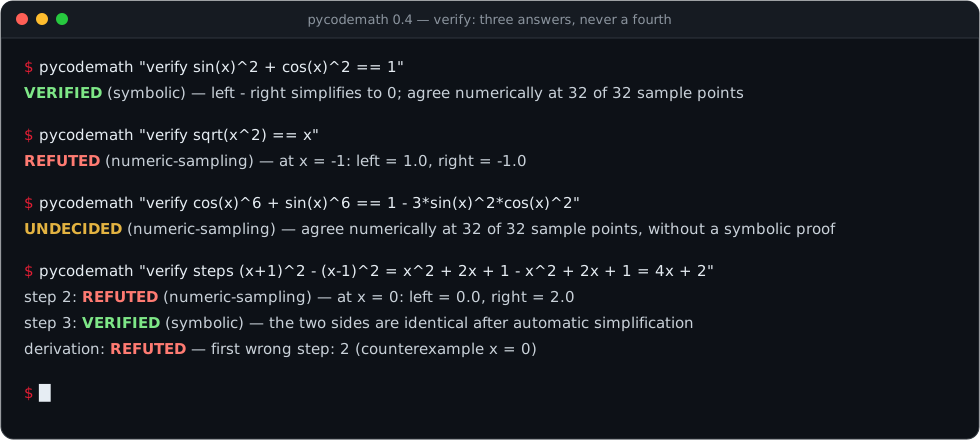
Pycodemath now checks math, not just computes it: a verifier that answers
VERIFIED, REFUTED (with a counterexample you can re-check yourself) or
UNDECIDED — and never promotes "agrees numerically" to "proved".
Added
pycodemath.verify.check_equal(a, b)returns aVerdict
(VERIFIED/REFUTED/UNDECIDED, the method used, a counterexample
and a one-line reason). Symbolic proof first; then deterministic
high-precision sampling that avoids singularities. A counterexample is
re-checked at higher precision before it is reported, so rounding noise is
never called a refutation. Domain traps are caught:sqrt(x^2)vsx
is REFUTED at a negative point, not "simplified" into equality.certify(...)— engine results checked by an independent route:
integrals by differentiating back, roots by substitution plus a
completeness check, derivatives by finite differences, limits by
two-sided numeric sequences, ODE solutions by substitution, numeric
integrals by a second, independent quadrature (certify_integrate,
certify_diff,certify_solve,certify_limit,certify_dsolve,
certify_nintegrate). Existing result types are unchanged.check_steps(...)— checks a derivation step by step: per-step
verdicts, the index of the first wrong step and a counterexample. Equation
chains are compared as solution sets, with a warning when a step adds roots
(squaring both sides) or loses them (dividing by an expression that can be
zero).- REPL and MCP surface:
verify <a> == <b>,verify steps ...and
certify <command>in the REPL; amath_verifyMCP tool next to
math_eval, returningstructuredContentwith the same rules (failure is
anerrorfield, never an exception). isolated(fn, *args, budget=...)— a hard time limit. The in-process
time_budgetcannot stop one long C call that holds the GIL
(7**(10**7)under a 2 s budget ran 7.9–8.7 s).isolatedruns the call
in a warm worker process and kills it at budget + 0.5 s (same case: 2.5 s),
raising the newIsolationError. Opt-in (~0.4 ms per call); the fast path
oftime_budgetis unchanged.- Benchmarks, with their denominators (
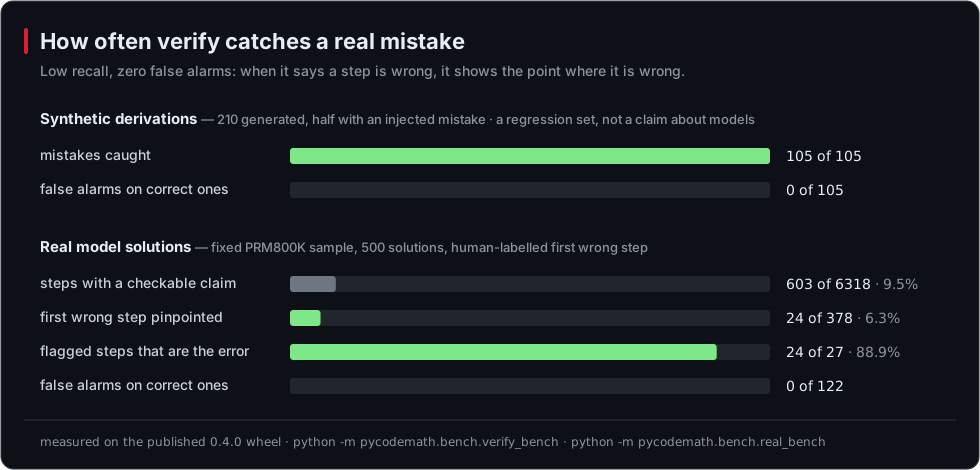
python -m pycodemath.bench.verify_bench,python -m pycodemath.bench.real_bench):- Synthetic: 210 generated derivations, half with an injected typical
model error — 105/105 errors caught, 0 false positives. These are
synthetic, and the verifier was fixed against misses found on this set. - Real model errors (PRM800K, MIT-licensed sample): the verifier can
extract a checkable claim from 9.5% of steps; it pinpoints the labelled
first wrong step in 24 of 378 flawed solutions (6.3%) and raised 0 false
alarms on 122 correct ones. Low recall, zero false alarms: when it says
a step is wrong, it shows why.
- Synthetic: 210 generated derivations, half with an injected typical
hypothesisjoins thedevextra (property-based tests of the verifier).
Changed
- A call to an unknown function is now a
ParseError("unknown
function"), not a product of symbols. Previouslyzeta(2)parsed as
2*zeta, which letverify zeta(2) == pi^2/6"refute" a true identity. - A bare function name (
sin,log,(sqrt)) and stray brackets (),
x)) raiseParseErrorinstead of a rawTypeError/IndexError. Expr.to_source()round-trip contract is now stated and tested as
mathematical equivalence:parse(e.to_source())is always equivalent to
e(or the parser refuses), never a different expression; structural
==is not promised, because SymPy re-distributes constants on parse.
Fixed
Expr.evalf()and compiled evaluation no longer leak a bareTypeError;
nestedzoobecomes aDomainError.time_budget: an interrupt could land after the guarded block had
exited and escape as an internal_Deadline; a nested budget poisoned the
outer one. Both fixed (Windows reproduced it most).- A huge literal such as
2^1e10no longer hangs before the budget is armed. certify_solveaccepts real roots of a cubic in the casus irreducibilis
(an imaginary part at 1-bit precision is treated as zero only when the
real part has full precision); quartics take candidates fromnroots
instead of spending the whole budget on Ferrari's formula; decimal
exponents (5^7.5vssqrt(5^15)) no longer yield a false REFUTED.- The MCP server imports on Python 3.11 again.
- Python 3.13: the time-budget interrupt no longer escapes a
with time_budget(...)block. CPython 3.13 (only — gh-139622, open) lets an
asynchronous exception skip every handler of the frame it is raised in, so
a block around code in the caller's own frame let the raw internal
interrupt out and kept re-injecting into whatever ran next (measured: 14 of
18 test runs on Linux 3.13, 5 of 6 on Windows 3.13, 0 on 3.12). On 3.13 the
watchdog now holds back while the interrupted frame sits inside a handler
and waits for a frame where nothing would be skipped; engine calls are
interrupted as before. CI now runs 3.11–3.14.
Known limitations
check_equal("cosh(t1 - log(0))", ...)can raise a bareTypeError,
andtrigsimpa bareRecursionError;sqrt(2)^10^20can still hang in
the parser.solvecan miss periodic solutions;QuadratureResult.error_estimate
can under-estimate.isolatedis not yet wired into the MCP server or the REPL.time_budgeton its own stays best-effort (see 0.3.0 below);isolated
is the hard limit.