Repository navigation
Demos
A visual tour of what the simulation does. See the README for build and run instructions.
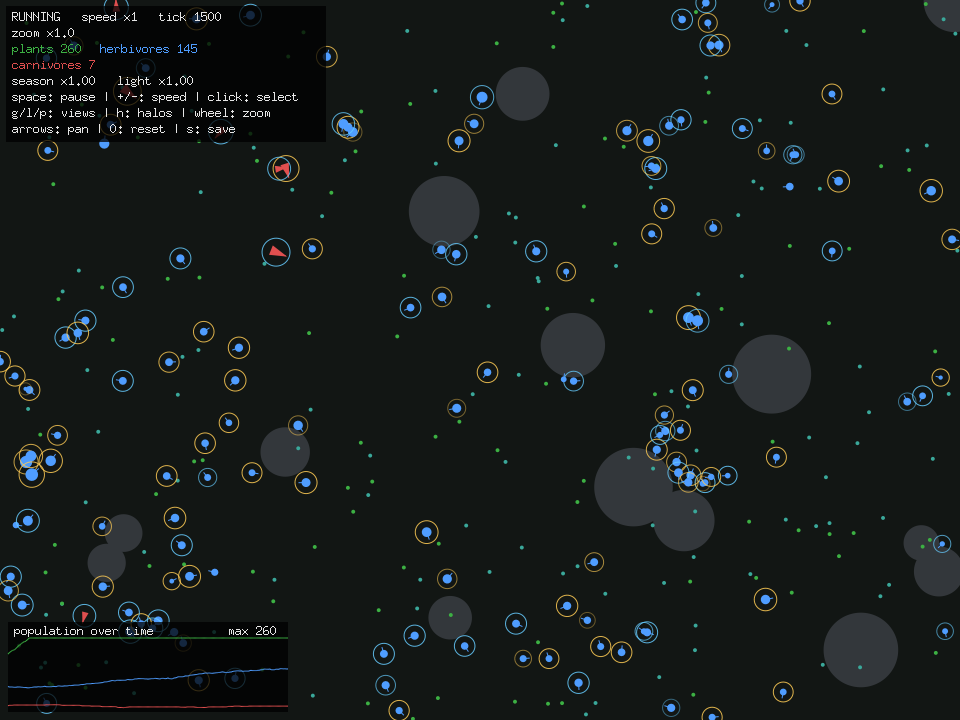
The living world: green/teal dots are two plant types, blue circles are herbivores, red triangles are carnivores. Gray discs are terrain. Coloured rings are agents broadcasting a signal.
A toroidal (wrap-around) plane with three trophic tiers — regenerating plants, herbivores that eat them, and carnivores that hunt herbivores. Every agent spends energy each tick (basal cost + movement) and dies at zero; eating restores it. Predator–prey dynamics are kept from collapsing by predator metabolism, a reproduction cooldown/energy cap, and an optional rescue effect (rare immigrants when a tier nears extinction).
Each agent is driven by a tiny hand-rolled recurrent neural net (19 inputs →
12 hidden → 4 outputs, tanh, no ML libraries). The hidden layer feeds its
previous activations back in (Elman-style memory). Inputs are directional
vision: a ring of 6 sectors, each carrying the proximity of the nearest target
(food/prey), nearest threat (predator), and the voice of the nearest same-kind
neighbour, plus the agent's energy. Outputs are turn, speed, eat, and a broadcast
signal.
- Evolution — reproduction passes on the genome (brain weights) and traits (size, speed, sense radius, learning rate, curiosity, diet) with small mutations. Reproduction is sexual by default: a nearby mate yields a crossover of both parents, otherwise an asexual clone.
-
In-lifetime learning — a reward-modulated Hebbian rule adapts a working
copy of the weights from energy reward during life; the evolved
Plasticitytrait sets the rate. Learning is Baldwinian (offspring inherit the genome, not what a parent learned). -
Curiosity — each agent trains a small forward model (online gradient
descent) predicting its next senses; the prediction error becomes an intrinsic
reward, scaled by the evolved
Curiositytrait — exploration for its own sake.
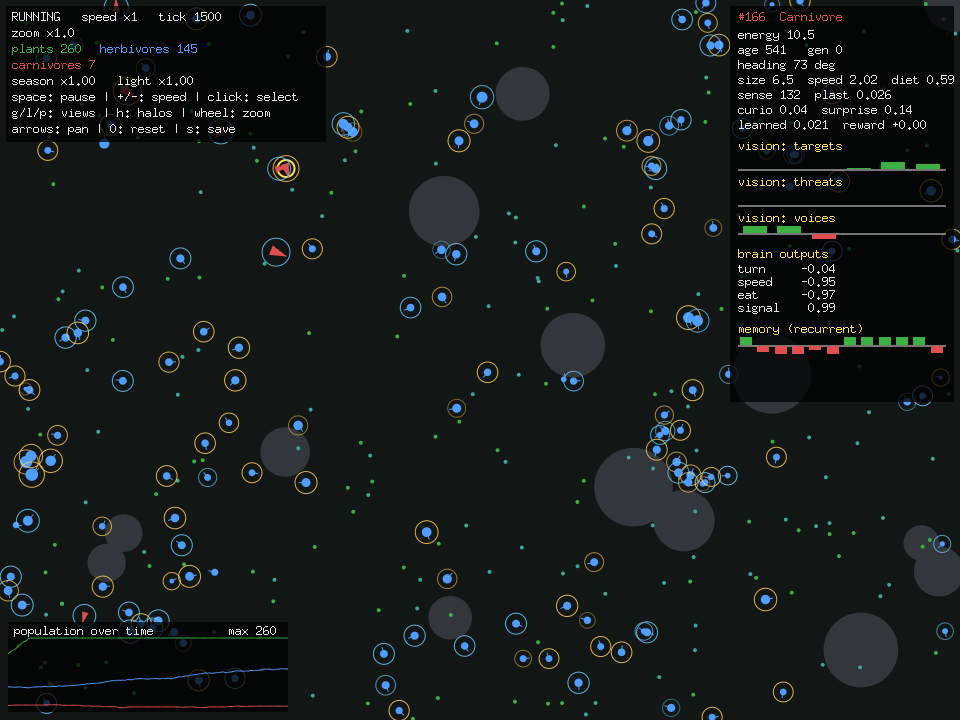
Click any agent to open the inspector: energy, age, generation, traits, live vision channels, brain outputs, and recurrent memory.
Agents broadcast a scalar signal that same-kind neighbours hear through a "voice" vision channel — a substrate for emergent alarm calls / flocking. Active broadcasts show as faint halos (warm = positive, cool = negative).
Four environmental systems add structure and time-varying pressure (all tunable, 0 disables):
- Seasons — a slow cycle scales plant regrowth (boom/bust).
- Day/night — a faster cycle shrinks effective vision at night (the world dims).
- Terrain — impassable rocks block both movement and line of sight.
-
Food types — two plant types; herbivores evolve a
Diettrait and so can specialise into niches.
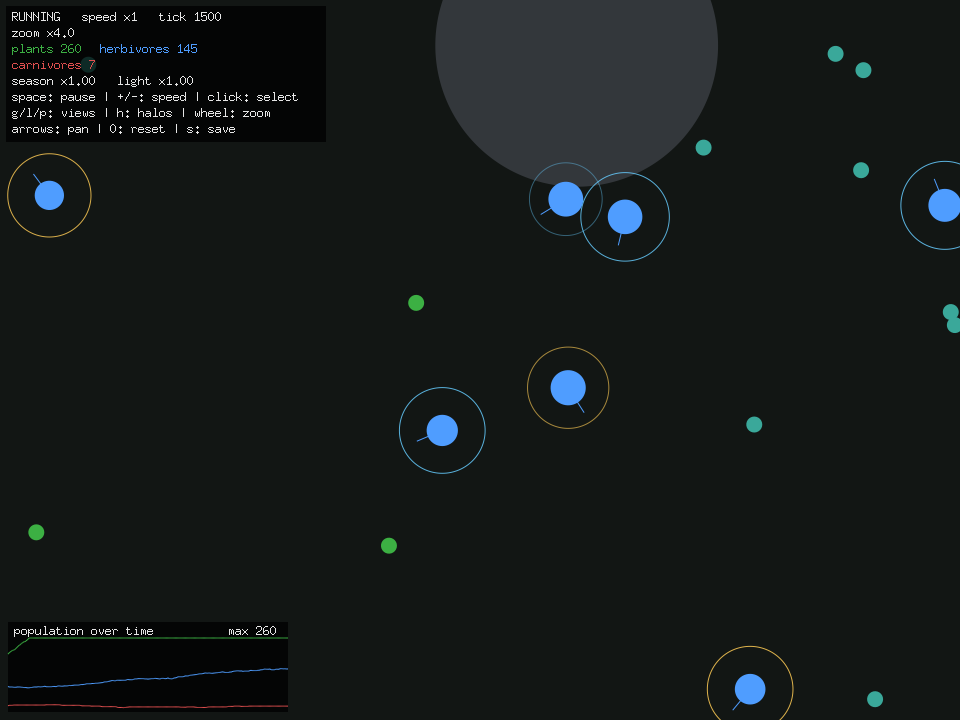
Close-up (zoomed in): terrain rocks, both food colours, signalling halos, and the dimmed night-time tint.
Built-in, hand-rolled machine-learning views of the population (no ML libraries):
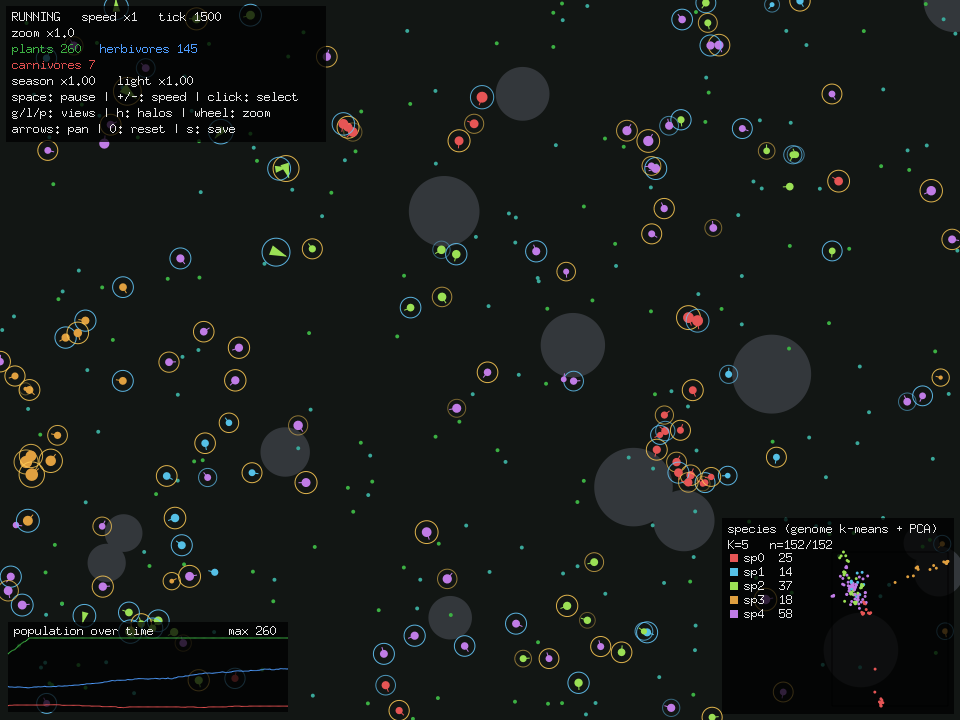
k-means clusters the population in brain-genome space (so it discovers lineages that share a genome), recolours agents, and shows a 2D PCA map.
A stacked abundance-over-time chart of the most prominent lineages, with agents coloured by lineage — watch lineages rise, sweep, and go extinct.
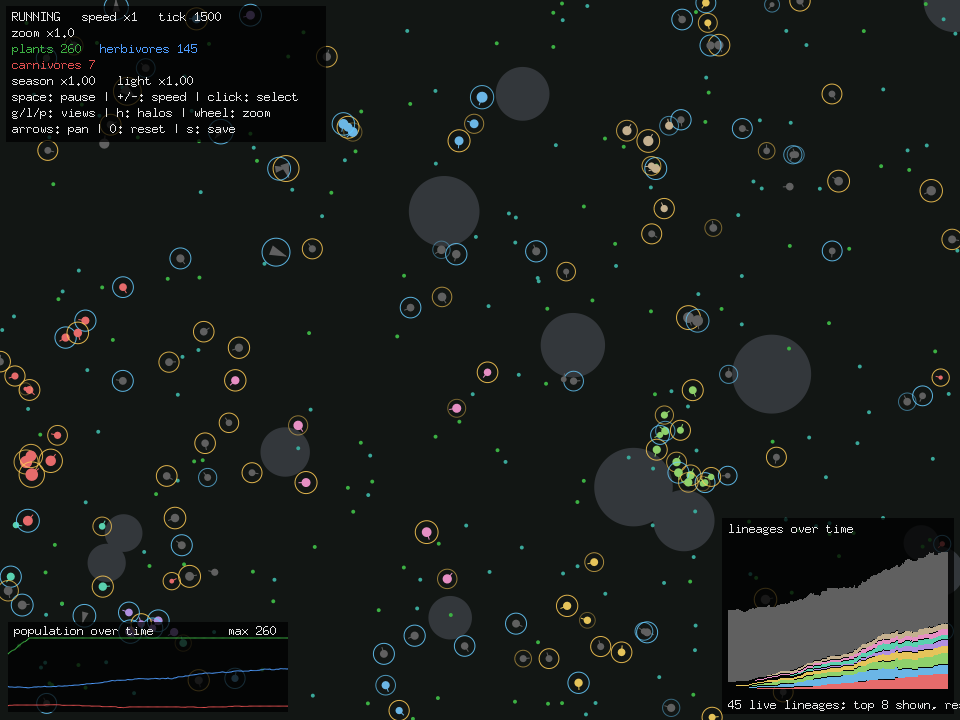
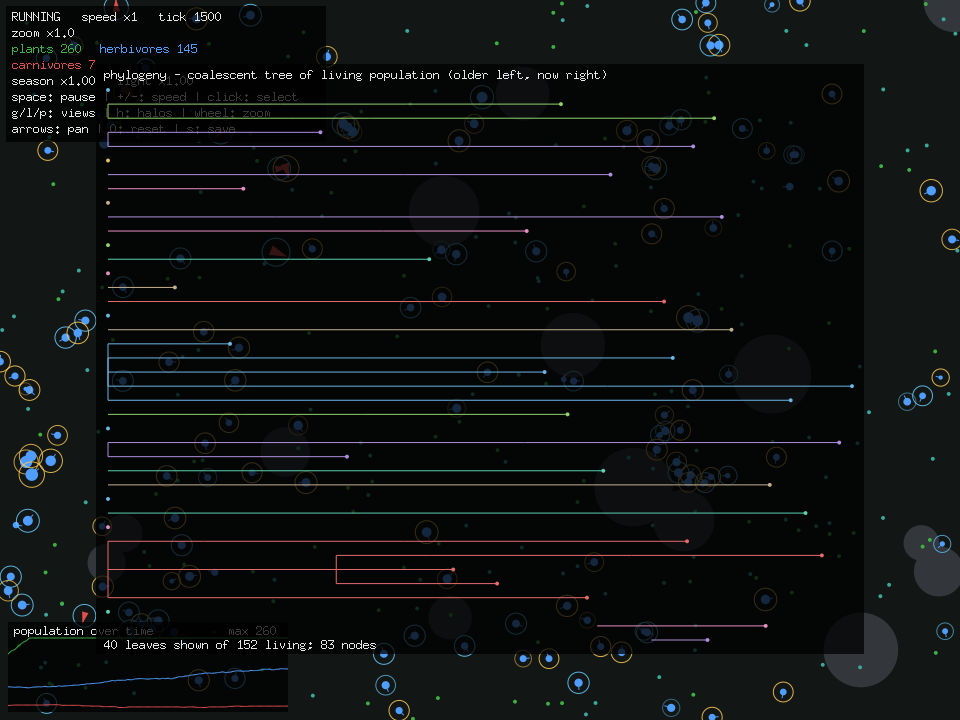
The coalescent genealogy tree of the living population: leaves traced back through shared ancestors, time on the x-axis, branches coloured by lineage.