Repository navigation
Security Issues
In our risk assessment (See This issue), it's clear that there is a risk of malicious tampering to the device. We have made some design decisions within the Open Voice Factory about how we balance the risk of malicious tampering with ease of use. However it's important to make sure users understand the level of risk that they are exposing themselves to.
This page covers potential areas of risk. It is intended to compare the Open Voice Factory with other typical AAC devices - some potential problems are much less likely with the Open Voice Factory, but some are more likely.
Let's imagine there is an AAC user called Alice who wants to talk to Bob. There is also a malicious person called Malory who wants to cause trouble. Malory is interested in causing trouble by altering Alice's AAC device.
Let's look at what Malory can do. She can:
- Try and change the settings on Alice's hardware hosting the Open Voice Factory.
- Try and break into the Open Voice Factory server to disable or alter messages
- Steal Alice's access link to view all the words and utterances in Alice's voice.
- Steal Alice's hardware to read previous conversations
- Steal Alice's templates and replace some messages so that Alice says silly words in public, or, say, CAN'T complain that Malory is stealing from her.
This is a relevent cartoon:
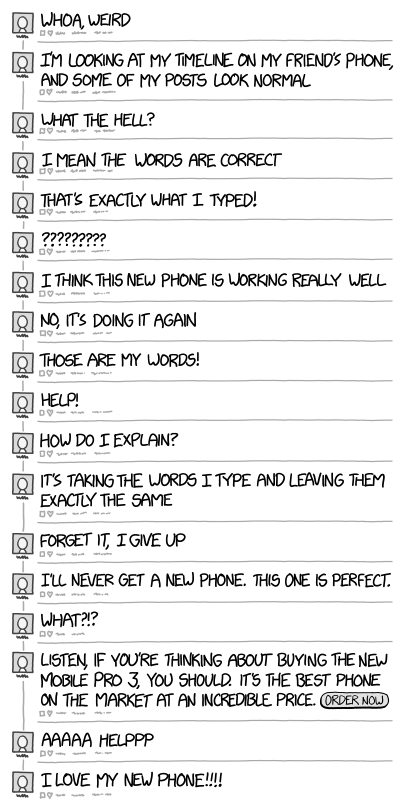
We're NOT going to look at this from the perspective of abuse by care staff and family, althought we think that is a big issue, we're going to look at this by comparing the Open Voice Factory to other communcation aids.
Taking the potential risks one at a time:
This is fairly possible if Malory has physical access to the hardware (a family friend or a care worker). Some AAC devices have passcodes that prevent users altering settings. The Open Voice Factory doesn't have any - however it's local client actaully has very few settings (one can switch on and off scanning and that's about it) so this is fairly low impact, unless it's combined with replacing some messages, as outlined below.
This is hard to do and requires a lot of technical skill. However it doesn't require physical acess to a machine. The main way it presents more of a risk to Alice is in terms of colatoral damage - Alice's service could be effected by someone trying to damage Bob's device (assuming Bob is another AAC-user on the same server). This risk is reduced somewhat by keeping files locally.
This requires physcial access to the hardware, it's definately a crime and mostly importantly - the Open Voice Factory doesn't record any previous conversations, so it's pretty low risk.
This is risk inherent in the Open Voice Factory's design. Because we want to make voices as easy as possible to access, we don't have usernames or passwords - each uploaded template creates a new scrambled url for people to use. The good news is that anyone with that URL can use the voice, the bad news is that anyone with that url can use the voice.
Steal Alice's templates and replace some messages so that Alice says silly words in public, or, say, CAN'T complain that Malory is stealing from her.
This is much harder than the above - this requires that Malory has physical access to the device (or socially engineers a carer into switch language packs) - it is no more likely with the Open Voice Factory than with any other AAC device.
That's a fairly exhaustive list of potential problems. The next stage of this is to ask yourself how much risk there is of someone causing one of those problems to you. Be careful who you let access your device and who is given access to the URL.
We've tried to find a balance in the Open Voice Factory between security and use. For example - we don't require usernames and passwords because we think that puts up a big barrier for some of our users - but we do make sure that there is only one (scrambled) url that lets people access a voice. We also don't let people edit a voice when it's been created - so you are protected from tampering that way.
We don't record any conversations, or even any tracking information, so there is no way that you can be comprised that way. And we've been open about our code, and our process - so you can feel secure that we aren't acting badly, even if Malory is.