Repository navigation
Architecture
mipOS is built around a small cooperative kernel plus a narrow board support package (BSP). The application remains close to the hardware, but it no longer has to encode every activity as a manual state machine inside one global loop.
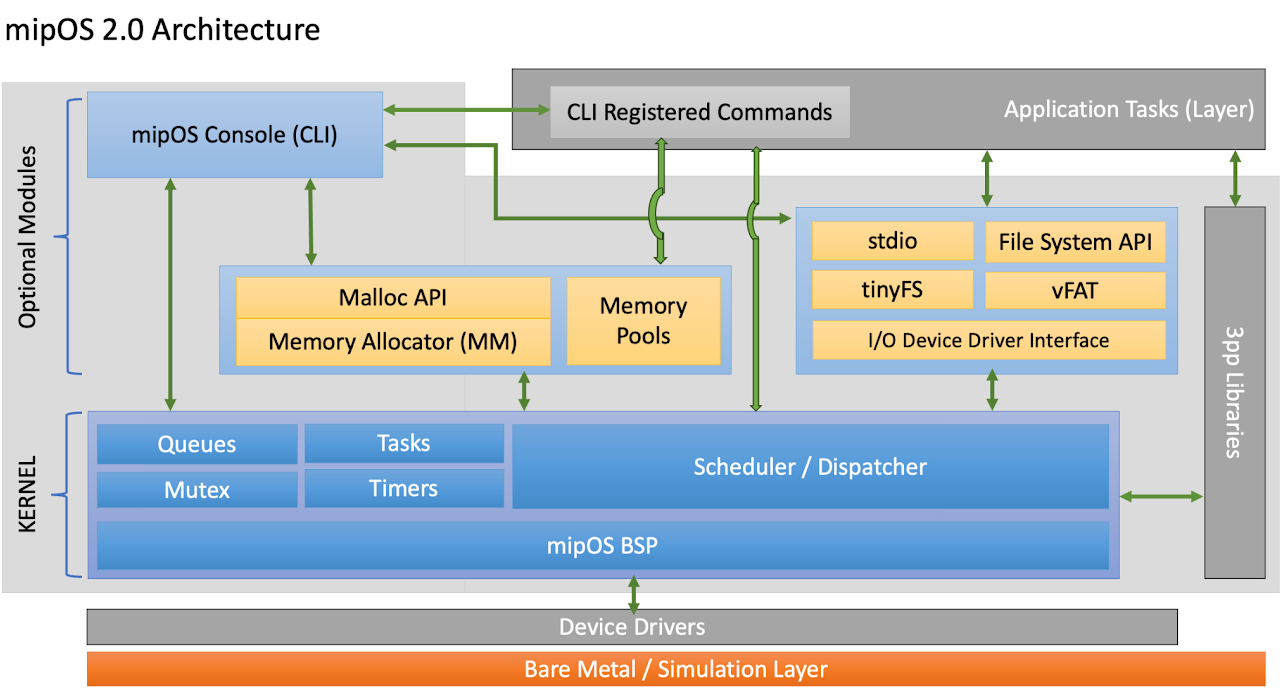
+-------------------------------------------------------------+
| Application tasks                                            |
| Domain logic: protocols, UI, sensors, storage, diagnostics    |
+-------------------------------------------------------------+
| Optional services                                            |
| Console, stdio glue, tiny filesystem, FatFs, lwIP             |
+-------------------------------------------------------------+
| mipOS kernel                                                 |
| Tasks, scheduler, timers, signals, mutexes, queues, memory    |
+-------------------------------------------------------------+
| BSP / architecture port                                      |
| Context save/restore, stack switch, critical sections, tick,  |
| UART and minimal platform services                           |
+-------------------------------------------------------------+
| Host process, QEMU machine, or physical MCU                   |
+-------------------------------------------------------------+
The layers are intentionally thin. The kernel does not know about every device on the board. A port only supplies the primitives needed by the scheduler, critical sections, the tick path, and the optional console/timer services.
The current source tree mirrors this architecture:
| Area | Main files | Role |
|---|---|---|
| Kernel |
mipos_kernel.c, mipos_kernel.h, mipos_task.c, mipos_timer.c
|
task table, cooperative dispatcher, waits, signals, software timers |
| Queues and sync |
mipos_queue.c, mipos_queue.h, mipos_mutex.h
|
producer/consumer communication and cooperative exclusion |
| Memory |
mipos_malloc.c, mipos_mpool.c
|
heap-style allocation and fixed-size block pools |
| Console |
mipos_console.c, mipos_console.h
|
serial shell, command dispatch, TX queue, optional diagnostics |
| Filesystem bridge |
mipos_tfs.c, mipos_diskio.c, FatFs integration |
tiny filesystem and block-device abstraction for FAT storage |
| Networking | mipos/net/lwip/mipos_lwip_netif.c |
lwIP netif adapter, Ethernet frame input/output boundary |
| BSP selection |
mipos_bsp.h, mipos/arch/*
|
context switch, stack switch, tick, UART, critical sections |
| QEMU firmware |
examples/qemu-arm/*, examples/qemu-vexpress-a9/*
|
bare-metal examples and board smoke tests |
This mapping is useful when porting: most new-board work should land under a
new mipos/arch/<target> directory plus a focused example under examples/.
The kernel core should not need board-specific conditionals for every device.
The kernel owns scheduling policy and task state. It provides:
- task descriptors and cooperative dispatch;
- blocking waits and explicit scheduling points;
- software timers and sleep handling;
- signal wait/notify plumbing;
- queues for producer/consumer style communication;
- optional memory helpers such as fixed pools and malloc support.
The public task API exposes this model directly. mipos_t_create starts a task
using an application-supplied stack; mipos_schedule is an explicit yield;
mipos_tm_wkafter, mipos_tm_msleep, and mipos_tm_usleep suspend the current
task until a scheduler or RTC event wakes it.
Because scheduling is cooperative, task-to-task concurrency is simple: a task runs until it yields, sleeps, waits, or exits. Shared state between tasks does not change unexpectedly in the middle of ordinary code. Interrupt-shared state still needs BSP critical sections.
A BSP adapts mipOS to one CPU/toolchain/board combination. It supplies:
-
mipos_save_contextandmipos_context_switch_to; - first-dispatch stack switching;
- critical-section enter/leave primitives;
- a system tick source or scheduler epoch hook;
- serial input/output for the console;
- minimal reset, clock, watchdog, and exception-vector hooks where needed.
The simulator BSP uses host facilities and small assembly stubs. The QEMU
Cortex-M port uses bare-metal startup, SysTick, and UART MMIO. The QEMU
vexpress-a9 port now covers the first ARMv7-A step: startup, PL011 UART,
critical sections, and a root task; GIC/timer integration is the next layer.
mipOS keeps optional services separate from the kernel core:
- the console provides a small command shell and command registration API;
- stdio support connects formatted output to the BSP serial path;
- the tiny filesystem demonstrates compact in-memory file handling;
- FatFs support uses
mipos_diskioas the block-device bridge; see Storage And FatFs; - lwIP integration is optional and currently focused on IPv4/Ethernet tests.
This lets very small targets build only the kernel features they need, while larger simulator or QEMU configurations can enable richer diagnostics.
A central design choice is that the application owns most memory. Task stacks, queue storage, memory-pool backing arrays, and heap arenas are supplied by the application rather than allocated implicitly by the kernel. This keeps mipOS predictable on small devices where every byte matters.
A typical firmware follows this sequence:
- BSP startup initializes CPU state, memory sections, stacks, and serial I/O.
- The application calls
mipos_startwith a root task and stack. - The root task creates other tasks and optional services.
- Tasks run until they yield, sleep, wait for a signal, or terminate.
- The BSP tick or epoch hook feeds timer progress back into the kernel.
- Optional console, filesystem, or network code runs as ordinary cooperative tasks or as polled service logic.
That flow is the core portability contract. A new board port is successful when it can print before the kernel starts, print again from a root task, sleep on a timer, then run the console without disturbing scheduling.