Repository navigation
3.71.0

Added:
- Bone texture animation (GPU skeletal baking), alongside the vertex VAT (#1166). Instead of baking every vertex position per frame, the bake stores every bone's skinning matrix per frame in a small float texture, and the vertex shader skins the bind-pose mesh on the GPU. One mesh and one texture drive a whole instanced crowd; each instance picks its own clip, time offset, speed and crossfade.
- CLI:
qtmesh vat model.fbx --mode bone-texture --target godot -o out/bakes every clip into<name>_bones.exr(float32, or--encoding rgba16ffor half size) +<name>_bones.json+ the rigged<name>.glb. - MCP:
bake_vat {mode: "bone-texture"}. Inspector: VAT section mode "Bone texture (GPU skinning)", with an "All clips" entry. - Godot template:
bone_texture.gdshader+BoneTextureMesh.gd(maps the imported skin's joints to the texture by name). - Accuracy: on baked frames the texture reproduces the source skinning to float precision; in Godot the shader matches Godot's own skeletal skinning of the same mesh to the 1-pixel edge.
- CLI:
- Website demo: a "bone texture" tab next to the VAT and skeletal tabs, and a 100 / 400 / 1,000 / 5,000 instance picker. The overlay now shows draw calls and GPU memory.
- Half-float EXR writing (
rgba16f), used by the bone texture.
Measured on an Apple M5 with Godot 4.7.2 (one machine; full tables in tools/godot-vat-demo/README.md):
| Instances | Skeletal | VAT | Bone texture |
|---|---|---|---|
| 400 | 61 fps | 385 | 384 |
| 1000 | 22 | 206 | 188 |
| 5000 | 3.4 | 51.8 | 42.4 |
The two baked paths are close up to ~1,000 instances; VAT is faster at 5,000. The bone texture's advantage is size and flexibility: 0.24 MB for the Rumba dancer (70 bones × 72 frames) against a 5,828 × 142 vertex texture, and many clips in one texture.
What the textures look like
Vertex VAT (one column per vertex):

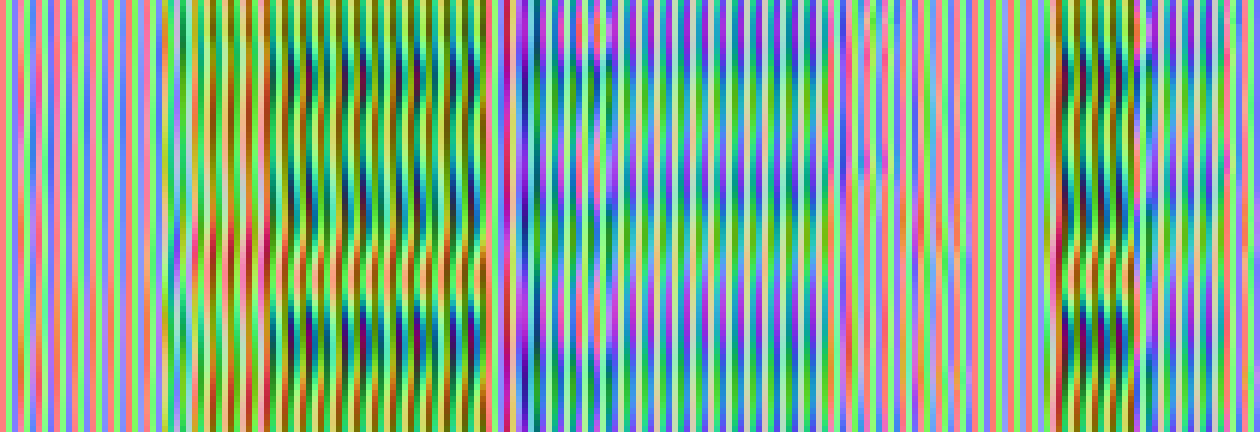
Bone texture (three columns per bone, one row per frame):