Repository navigation
Combining Repeated Pictures
ISS events and SSTV nets send the same picture again and again, and every copy is damaged somewhere else by noise, fading (QSB) or QRM. SSTV Next recognises the copies and merges them into one cleaner picture, which gets better with every reception.
- The last 8 analog receptions of the last 3 hours are kept in memory.
- When a new picture shows the same picture in the same mode, all copies are aligned: a copy started without VIS, or a partial one, may sit some lines or pixels away.
- They are merged row by row: every row is weighted by its own noise in that copy, so a fade in one copy is filled from the others, and FM clicks (coloured specks) are rejected pixel by pixel.
- The result is shown with COMBINED FROM 3 RECEPTIONS and saved as
<first copy>_combined.png. In the gallery it is marked2x,3x... - The single receptions are saved as before.
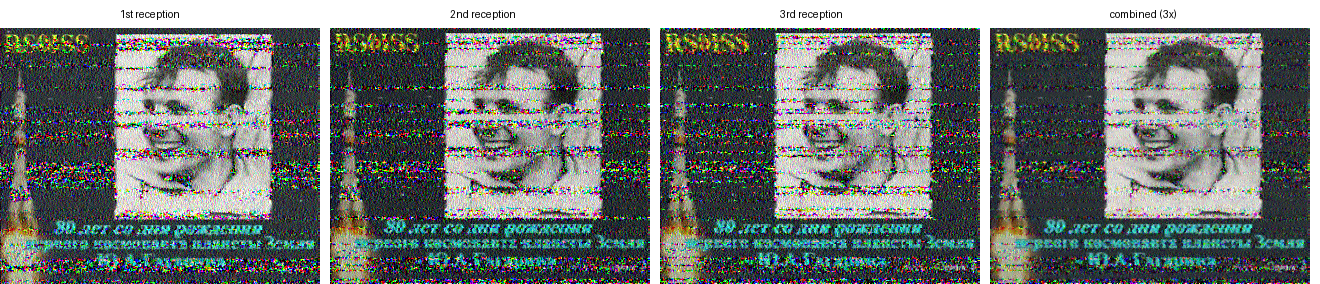
Three weak receptions with fading, and the combined picture on the right.
The program checks the pictures block by block. These are recognised as different:
- pictures of an ISS series (same frame, other photo),
- a template with only another callsign,
- any other picture.
The command line tools can combine recordings, for example several ISS passes recorded on a WebSDR:
sstv_dec -P -o pass1 pass1.wav
sstv_dec -P -o pass2 pass2.wav
sstv_dec -P -o pass3 pass3.wav
sstv_combine -o best.png pass1_1.png pass2_1.png pass3_1.png
-P writes PNG files with the reception data (the SNR of every line), which
sstv_combine uses for the weighting. Pictures saved by SSTV Next itself (~/sstv/rx)
can also be combined this way, even from different sessions.
- Only analog pictures are combined (digital pictures are error-free or repaired with Reed-Solomon).
- Copies kept in memory are lost when the program is closed; use
sstv_combinefor pictures from earlier sessions.