Repository navigation
Releases
Harneo 0.4.1

Harneo 0.4.1 keeps your library in step with its sources. Update all now does three new things:
- it brings in artifacts that appeared at a source;
- it deletes the ones that were removed there, once you confirm the list;
- it follows renames, so a renamed skill keeps its tags, profiles and usage history.
Upgrading: nothing to do. Run Check for updates once. Artifacts you renamed in their repo then show as renames, and new ones as "new at source".
What's new since 0.4.0
Update all follows the source (spec, decisions 8–10)
- New at source is imported (#306). Artifacts that appeared in a source since you imported it come in with Update all. They are audited and keep their source, path and commit. The toolbar and the confirm say "N new at source".
- Claude is never asked. Harneo uses the layout it saved when you first imported that source.
- What you deleted stays deleted. An artifact you removed from the library is never counted or imported as new again. Importing it on purpose from Import brings it back.
- Copies don't count (#309). If a source holds the same artifact at two paths, it counts once. A copy of something you already have is never imported twice.
- Removed at source is deleted after one confirmation (#307).
- The confirm lists them. Each one shows the profiles that use it.
- Only what you confirmed goes. A check that runs after you confirm never adds to the list.
- Cancel changes nothing.
- Some are never deleted. If Harneo can no longer place an artifact's files, it is shown as layout changed and kept.
- Renames carry everything over (#308). A skill, command or agent renamed in its repo shows as Renamed at source: old → new. Applying the rename moves its tags, collections, links, profiles, project installs and usage history to the new name.
- What counts as a rename: the same kind in the same source, with the same content once the name is ignored.
- What doesn't: a rename that also changed the content, or a match that could be one of several, shows as removed + new. MCP servers and plugins are not matched.
- Your edits come first. If you edited the old copy, Update all skips the rename. Update in the drawer applies it after backing up your copy.
CLI
harneo updatefollows the same rules: it imports new artifacts and applies renames.- Deleting needs a flag. Artifacts removed at their source are deleted only with
--remove-deleted. Without it they are listed and kept. harneo update --checkalso reports "N new at source" and "N renamed".
Install
Linux: download the AppImage or the .deb below (attached a few minutes after publishing). They are unsigned, so check them first:
sha256sum -c SHA256SUMS --ignore-missing

chmod +x Harneo_0.4.1_amd64.AppImage && ./Harneo_0.4.1_amd64.AppImage   # any distro; some need libfuse2 / fuse2
sudo apt install ./Harneo_0.4.1_amd64.deb                                # Debian / Ubuntu
The packages hold the desktop app. The harneo CLI, and Harneo on macOS and Windows, build from source; the README has step-by-step instructions per OS.
| Platform | State |
|---|---|
| Linux | Built and tested by the maintainer; AppImage and .deb attached |
| macOS | Source only, untested by the maintainer: please send a platform report |
| Windows | Source only, untested by the maintainer: please send a platform report |
Privacy
No change. Update checks still go only through git to the sources you imported, and nothing in this release sends anything to Claude. No account, no server, no analytics. Error reports go only to a Sentry project of your own, and only if you set HARNEO_SENTRY_DSN. The README's Privacy section has the details.
Thanks
The security audit rules are ported from HarnessKit (Apache 2.0). Packages are built with Tauri's bundler.
License: MIT. Bugs, ideas and platform reports are welcome in Issues; see CONTRIBUTING.md.
Full changelog: release_0.4.0...release_0.4.1
Harneo 0.4.0
Harneo 0.4.0 changes how plugins come into your library and your projects. You can split any plugin and keep only the parts you want. Claude works out which folders each kept part needs, and the parts install as a trimmed copy of the plugin that keeps the author's structure, so namespaced commands and shared references still work. Scaffolds no longer write HARNESS.md, and Harneo now keeps local logs.
Upgrading: plugin parts imported with an earlier version show Re-import to update. Delete them and import the plugin again with Pick parts to get the new behavior.
What's new since 0.3.3
Plugins: pick the parts you want (ADR-008)
- Every plugin starts whole (#301). Taking a plugin whole never calls Claude.
- Pick parts splits any plugin (#295). Each kept skill, command and agent becomes its own item in the Library, in profiles and on the Harnmap. Only a plugin with monitors, MCP servers, LSP servers or
userConfigstays whole, and the screen says why. - Claude finds what each part needs (#294). When you pick parts, Claude lists the folders each one needs, such as
references/, and leaves out docs, tests, evals and CI files. The answer is stored and reused on updates.- No answer, no import (#303). If Claude's answer is missing, failed or leaves out a part, the import stops and names the case. You can Ask Claude again or Take the whole plugin instead.
- Waiting for Claude is clear (#300). A dialog with a spinner shows while Claude works, with Cancel import.
- Claude's suggestions start excluded (#301). A suggestion that copies one of the plugin's own parts (an author's working copy) is dropped.
- Kept parts install as a trimmed plugin (#296). It is written to
.claude/skills/<plugin>/with the plugin's manifest, the parts you kept and the files they need.- The plugin's own names work. Claude Code loads it in place as a plugin, so
/agent-skills:planandagent-skills:spec-driven-developmentresolve. - Other projects are untouched. Nothing is installed machine-wide.
- Trust the project. The project must be trusted in Claude Code for these plugins to load. The Done step says so.
- The plugin's own names work. Claude Code loads it in place as a plugin, so
- "
/buildneedsincremental-implementation" (#297). When a kept part calls a part you dropped, the import and the profile builder show it and let you keep the needed part or drop both.
Library and profiles
- Skills that link each other no longer clash (#299). A skill linking another skill's
SKILL.mdnow pulls that skill into the profile through its bundle. It used to copy the file and report "claimed twice". - Unsaved new profiles are findable (#302). A profile you left without saving shows as a draft card on Profiles, with Continue and Discard. New profile asks before reopening it.
Projects
- No more
HARNESS.md(#305). Scaffold and refit no longer write it or add@HARNESS.mdtoCLAUDE.md, which loaded it into every Claude session.- Older projects: a refit removes the old file and the import line, and backs up the file first if you edited it.
- Where to see it now: the new Artifacts tab on a project shows why each artifact is installed.
Logs
- Local log files (#304) in
~/.local/state/harneo/logs/, one file per day, kept for 14 days.- What a line holds: each Claude call records which feature asked, the paths or artifact names sent, how long it took and how it ended. For plugin parts it also records which parts Claude's answer covered and missed.
- Opening it: Settings → Diagnostics → Open logs folder.
Install
Linux: download the AppImage or the .deb below (attached a few minutes after publishing). They are unsigned, so check them first:
sha256sum -c SHA256SUMS --ignore-missing

chmod +x Harneo_0.4.0_amd64.AppImage && ./Harneo_0.4.0_amd64.AppImage   # any distro; some need libfuse2 / fuse2
sudo apt install ./Harneo_0.4.0_amd64.deb                                # Debian / Ubuntu
The packages hold the desktop app. The harneo CLI, and Harneo on macOS and Windows, build from source; the README has step-by-step instructions per OS.
| Platform | State |
|---|---|
| Linux | Built and tested by the maintainer; AppImage and .deb attached |
| macOS | Source only, untested by the maintainer: please send a platform report |
| Windows | Source only, untested by the maintainer: please send a platform report |
Privacy
Two changes:
- When Claude is asked about a repo: asking Claude what a repo holds now also runs when you pick parts of a plugin, and it is on by default. It sends file paths, manifests and the first 40 lines of the Markdown files concerned. Secret-looking files are named, never read. A plugin taken whole is never sent. You can turn it off in Settings, but then a plugin can only be imported whole.
- Local logs: Harneo now writes logs on your machine (
~/.local/state/harneo/logs/). They hold feature names, paths, timings and outcomes, and Claude's error text when a call fails. They never hold prompts, file contents, secrets or environment values, and they never leave your machine.
Everything else is as before. No account, no server, no analytics. Error reports go only to a Sentry project of your own, and only if you set HARNEO_SENTRY_DSN. The README's Privacy section has the details.
Thanks
The security audit rules are ported from HarnessKit (Apache 2.0). Packages are built with Tauri's bundler.
License: MIT. Bugs, ideas and platform reports are welcome in Issues; see CONTRIBUTING.md.
Full changelog: release_0.3.3...release_0.4.0
Harneo 0.3.3
Harneo 0.3.3 fixes what a review of a real scaffolded project found: skills that link to shared files outside their folder now bring those files along, plugins that can no longer be split are flagged before you install their parts, and a plugin a refit drops is uninstalled. It also keeps a skill's own disable-model-invocation: true when scaffolding.
What's new since 0.3.2
Library and install
- Skills carry the files they link to (#292, ADR-007). A skill, agent, command or output style that links to a file outside its own folder (
../../references/security-checklist.md, as inaddyosmani/agent-skills) now stores that file with it and installs it where the link points (.claude/references/). Two skills sharing a file write it once. A link that would land outside the harness is not carried, and the import says so. - Split plugins that must stay whole are flagged (#292). Every update check, the automatic one included, judges again every source holding parts of a plugin. Scaffold, Refit and the profile builder warn when a profile holds parts of a plugin that must now stay whole, with a way to replace them with the whole plugin.
- Dropped plugins are uninstalled (#292). When a refit removes a plugin Harneo had enabled for the project, Harneo runs
claude plugin uninstall --scope project, so no disabled leftover stays installed. Plugins Harneo never enabled are left alone. - Manual-only skills stay manual only (#288). A skill whose own
SKILL.mdsaysdisable-model-invocation: trueis installed withtrue, unless the profile turns it off.
Import
- New tags are offered on every row (#287). A tag created or suggested during an import shows up in every row's Add tag and in Tag all, with its color.
Projects and Library
- Drift counters count newer library copies (#283), and the sidebar Projects badge counts every project that needs attention.
- The Harnfit in… menu shows the whole profile name (#284).
Dependencies
- npm and cargo dependency updates (#290, #291). picomatch 4.0.7 (GHSA-fc5q-39xc-vjpf) has no fixed release yet; it is used only by build and test tools, not by the app, and is allowed until 2026-12-31 (#293).
Install
Linux: download the AppImage or the .deb below (attached a few minutes after publishing). They are unsigned, so check them first:
sha256sum -c SHA256SUMS --ignore-missing

chmod +x Harneo_0.3.3_amd64.AppImage && ./Harneo_0.3.3_amd64.AppImage   # any distro; some need libfuse2 / fuse2
sudo apt install ./Harneo_0.3.3_amd64.deb                                # Debian / Ubuntu
The packages hold the desktop app. The harneo CLI, and Harneo on macOS and Windows, build from source; the README has step-by-step instructions per OS.
| Platform | State |
|---|---|
| Linux | Built and tested by the maintainer; AppImage and .deb attached |
| macOS | Source only, untested by the maintainer: please send a platform report |
| Windows | Source only, untested by the maintainer: please send a platform report |
Privacy
No change in this release. No account, no server, no analytics. Harnmap's Draw and Harnfit send profile content to Claude only when you press their button, through your own claude CLI on your own plan; confirming audit findings and asking about repo layouts at import also use your claude CLI and can be turned off in Settings. Installing and uninstalling plugins runs your own claude CLI against the plugins' marketplaces. Error reports go only to a Sentry project of your own, and only if you set HARNEO_SENTRY_DSN. The README's Privacy section has the details.
Thanks
The security audit rules are ported from HarnessKit (Apache 2.0). Packages are built with Tauri's bundler.
License: MIT. Bugs, ideas and platform reports are welcome in Issues; see CONTRIBUTING.md.
Full changelog: release_0.3.2...release_0.3.3
Harneo 0.3.2
Harneo 0.3.2 fixes two bugs found while using Harneo on a real project: re-applying a profile now brings in files an artifact gained in your library, and a deleted profile no longer leaves its unsaved changes behind for the next one. The import's review step also shows each artifact's type.
What's new since 0.3.1
Projects
- Re-apply brings new files in (#279). When a library artifact gains a file (a skill that now ships a config file, say), the drift view lists it as newer in the library and Re-apply creates it in the project. Before, re-apply rewrote only the files Harneo had written once, while
HARNESS.mdalready listed the new file as installed. A file of the project's own at that path is never overwritten.
Profiles
- A deleted profile's unsaved changes don't come back (#281). Profile ids can be reused after a delete, and the builder kept unsaved changes by id, so a new profile could open the old one's changes: Unsaved, "No longer in the library: …" and a Save that failed. Deleting a profile now drops its changes, and unsaved changes open only on the profile they were made for, also after a save.
- Remove them: when a profile holds artifacts that left the library, a button next to the "No longer in the library" line takes them out of the profile (items, Settings template and MCP servers), so it saves again.
Import
- Each artifact's type before its name (#280). The tags list and the Harnfit list of the review step start with the type (Skill, Subagent, Settings, MCP server…), with the Library's icons, so two artifacts with the same name are told apart.
Install
Linux: download the AppImage or the .deb below (attached a few minutes after publishing). They are unsigned, so check them first:
sha256sum -c SHA256SUMS --ignore-missing

chmod +x Harneo_0.3.2_amd64.AppImage && ./Harneo_0.3.2_amd64.AppImage   # any distro; some need libfuse2 / fuse2
sudo apt install ./Harneo_0.3.2_amd64.deb                                # Debian / Ubuntu
The packages hold the desktop app. The harneo CLI, and Harneo on macOS and Windows, build from source; the README has step-by-step instructions per OS.
| Platform | State |
|---|---|
| Linux | Built and tested by the maintainer; AppImage and .deb attached |
| macOS | Source only, untested by the maintainer: please send a platform report |
| Windows | Source only, untested by the maintainer: please send a platform report |
Privacy
No change in this release. No account, no server, no analytics. Harnmap's Draw and Harnfit send profile content to Claude only when you press their button, through your own claude CLI on your own plan; confirming audit findings and asking about repo layouts at import also use your claude CLI and can be turned off in Settings. Error reports go only to a Sentry project of your own, and only if you set HARNEO_SENTRY_DSN. The README's Privacy section has the details.
Thanks
The security audit rules are ported from HarnessKit (Apache 2.0). Packages are built with Tauri's bundler.
License: MIT. Bugs, ideas and platform reports are welcome in Issues; see CONTRIBUTING.md.
Full changelog: release_0.3.1...release_0.3.2
Harneo 0.3.1
Harneo 0.3.1 gives the profile builder the Library's filters, and makes importing plugins faithful: a plugin is taken apart only when every part works the same as a copy, so a project scaffolded from your library gets exactly what installing the plugin gives. A repo that ships one skill for several agents is no longer imported once per agent.
What's new since 0.3.0
Plugins: split only when it's safe
- Unpacked only when every part works as a copy (#272, ADR-006). A plugin becomes its skills, agents, commands, output styles and MCP servers only when nothing ties them to the plugin. It stays whole, and installs from its marketplace, when it has hooks, monitors, LSP servers,
bin/, themes, workflows or its ownsettings.json; when its manifest has a key that only means something in a plugin (userConfig,dependencies,channels…) or one Harneo doesn't know; when a part uses${CLAUDE_PLUGIN_ROOT},${CLAUDE_PLUGIN_DATA}or${user_config.…}; when parts call each other asplugin:name; or when an agent setshooks,mcpServersorpermissionMode. Anything unknown keeps a plugin whole. - No more Pick parts for a plugin that must stay whole (#273). The import shows the reason instead. Before, a plugin like
pbakaus/impeccablecould be split, losing its hooks and one of its agents. - Plugins you split before are flagged (#274). After the next update check, parts of a plugin that now has to stay whole carry a Stays whole badge and a notice; Replace with the whole plugin swaps them for the plugin, keeps their tags and collections, and gives every profile that held them the plugin as a new version. It reads the plugin from its source without locking the library, so a slow clone doesn't freeze the app (#277).
Import
- Only Claude's copy of a skill is read (#271). Other agents' folders (
.opencode,.cursor,.gemini,.codex,.kiro…) are skipped and listed as not read, and when a skill is in both.claude/skillsand.agents/skills, the.claudeone is taken.
Profiles
- The Library's Filters column in the profile builder (#269). Pick from your library now has the full column beside it: Type, Trust (minimum score, tiers, has findings), Status, Invocation, Tag and Source, each with its counts and its own Clear, collapsing and expanding like on the Library. Type lists only what a profile can pick (Settings and MCP keep their own cart panels), and with no type ticked every pickable kind shows. On a narrow window the column moves behind a Filters button and opens as a sheet, as on the Library. The type segment above the picker gives way to the column; the search box and All / Added / Not added stay, and Add all shown / Remove all shown act on the filtered list.
Docs and dependencies
- The README and MANUAL cover Harnmap and Harnfit, with screenshots and links to both launch videos (#267).
- A second launch video, on Harnmap and Harnfit;
docs/brag/holds one rebuildable folder per video (#266). lucide-react1.66.0,dependency-cruiser18.7.1,eslint10.14.0 (it requires aminimatchthat avoids a vulnerablebrace-expansion) andglobals17.14.0 (#276, from Dependabot's #268).- The launch-video build folders force
undici7.30.2 over the 7.25.0 thathyperframespins, closing 44 Dependabot alerts there (#278). They only build the videos; nothing in them ships in the app.
Before this release, the dev build was run on Arch Linux (Hyprland) to try the profile builder's filters against a real library, and the new plugin rule was checked against pbakaus/impeccable at the commit that showed the problem: it now comes in whole, with its hooks and all four agents.
Install
Linux: download the AppImage or the .deb below (attached a few minutes after publishing). They are unsigned, so check them first:
sha256sum -c SHA256SUMS --ignore-missing

chmod +x Harneo_0.3.1_amd64.AppImage && ./Harneo_0.3.1_amd64.AppImage   # any distro; some need libfuse2 / fuse2
sudo apt install ./Harneo_0.3.1_amd64.deb                                # Debian / Ubuntu
The packages hold the desktop app. The harneo CLI, and Harneo on macOS and Windows, build from source; the README has step-by-step instructions per OS.
| Platform | State |
|---|---|
| Linux | Built and tested by the maintainer; AppImage and .deb attached |
| macOS | Source only, untested by the maintainer: please send a platform report |
| Windows | Source only, untested by the maintainer: please send a platform report |
Privacy
No change in this release. No account, no server, no analytics. Harnmap's Draw and Harnfit send profile content to Claude only when you press their button, through your own claude CLI on your own plan; confirming audit findings and asking about repo layouts at import also use your claude CLI and can be turned off in Settings. Error reports go only to a Sentry project of your own, and only if you set HARNEO_SENTRY_DSN. The README's Privacy section has the details.
Thanks
The security audit rules are ported from HarnessKit (Apache 2.0). Packages are built with Tauri's bundler.
License: MIT. Bugs, ideas and platform reports are welcome in Issues; see CONTRIBUTING.md.
Full changelog: release_0.3.0...release_0.3.1
Harneo 0.3.0
Harneo 0.3.0 adds Harnmap, a map of how a profile's artifacts work together, and Harnfit, a check of whether a new artifact fits a profile before you add it. Plugins are now unpacked into their parts by default, and a plugin you keep whole now arrives with all its files.
What's new since 0.2.2
Harnmap: see how a profile works
- A map per profile (#225–#232, #234). Pick a category for a profile (software development, research, writing, video, social media, data, design, or your own), press Draw, and Claude places every artifact on the category's line of stages, on the toolbelt (any stage) or on the floor (always on). Return loops, the settings template's hooks and bundles are drawn too. Move, pin, note, hide and re-stage anything by hand; pins stay put on Re-draw, and every drawing is kept in Map history.
- Natural next steps (#250, #255, #263). Selecting an artifact rings what you would reach for right after it, most likely first, and the side panel says why for each one.
- Parent and child (#251, #253). A command that only runs a skill (
/spec→spec-driven-development) draws as one small tree, the skill under its command; a skill only the model can start is marked model only. - The map as designed (#254, #256, #262): the line as a pipe with flowing beams, valves and chutes, the hook rail, right-angled loops with their arrowheads, a side panel you can hide (
]). - Export, import and clone carry the map and its history (#236); the profile file format is now version 2, and version 1 files still import.
Harnfit: will it fit?
- A verdict before you add (#233, #235). From a library card, the detail panel or the import review, Harnfit in… asks Claude whether an artifact fits a profile's map: fits, fits with changes or conflicts, where it would go and why, with quotes checked word for word against the files. A plugin kept whole can't be fitted yet, and the menu now says so (#259).
Plugins
- Unpacked by default (#237–#240, #242, #245, #246, ADR-004). A plugin is imported as its parts (skills, commands, agents, output styles, MCP servers), each an ordinary library item that survives its repo disappearing. It stays whole only when it must (hooks, monitors, LSP servers,
bin/, its own settings). A whole plugin in the library unpacks in one click, keeping its tags and collections. - A whole plugin keeps its files (#261, ADR-005). A plugin in its own folder now keeps its whole folder, like Claude Code installs it: data files its scripts read (
hooks/rules.md,templates/settings.json) were left out before, which broke hooks and setup skills. A plugin that is a whole repo keeps its components, their folders and the folders its code names, not the repo's docs and CI. Plugins imported before this release get the missing files at their next update check.
Import, library and profiles
- Pick parts ticks every part, folds by plugin and kind, shows its levels, and a plugin in that mode can be excluded with its × like any row (#248, #258, #260).
- Checkboxes and radios follow the design system everywhere (#258).
- A private repo's error says what to do for the kind of URL you gave: its SSH form with a key in your agent, or a git credential helper for HTTPS (#264).
- Add or remove everything shown in the profile builder's picker at once (#249).
- Fixes: the sidebar's Import works from the Import done screen (#222); a duplicate React key in the library detail panel (#257).
- Dependencies:
minimatchforced to 11 over eslint's pin; theglibadvisory has no fix while Tauri 2 uses gtk-rs 0.18, and Harneo doesn't call the affected code (#252).
Before this release, the release build was run on Arch Linux (Hyprland) against a copy of a real library: every screen, the Harnmap (drawing, selection, next steps, parent and child, the hideable panel, list view, stages, history, re-draw dialog), Harnfit's entry points, and imports of whole and unpacked plugins.
Install
Linux: download the AppImage or the .deb below (attached a few minutes after publishing). They are unsigned, so check them first:
sha256sum -c SHA256SUMS --ignore-missing

chmod +x Harneo_0.3.0_amd64.AppImage && ./Harneo_0.3.0_amd64.AppImage   # any distro; some need libfuse2 / fuse2
sudo apt install ./Harneo_0.3.0_amd64.deb                                # Debian / Ubuntu
The packages hold the desktop app. The harneo CLI, and Harneo on macOS and Windows, build from source; the README has step-by-step instructions per OS.
| Platform | State |
|---|---|
| Linux | Built and tested by the maintainer; AppImage and .deb attached |
| macOS | Source only, untested by the maintainer: please send a platform report |
| Windows | Source only, untested by the maintainer: please send a platform report |
Privacy
New: Harnmap and Harnfit send profile content to Claude, only when you press their button. Draw / Re-draw send the profile's stages, your pins and description, and for each artifact its name, type, description, what Harneo read from its files and up to 4,000 characters of its main file (artifacts with a secret-looking finding: name, type and description only). Harnfit / Run again send the map, the candidate in full (up to 12,000 characters) and the profile's main files (up to 120,000 characters). Both go through your own claude CLI, on your own plan; nothing is sent until you press, and what is sent is listed next to each button. The README's Privacy section has the details.
Otherwise unchanged: no account, no server, no analytics. Confirming audit findings and asking about repo layouts at import use your claude CLI and can be turned off in Settings. Error reports go only to a Sentry project of your own, and only if you set HARNEO_SENTRY_DSN.
Thanks
The security audit rules are ported from HarnessKit (Apache 2.0). Packages are built with Tauri's bundler.
License: MIT. Bugs, ideas and platform reports are welcome in Issues; see CONTRIBUTING.md.
Full changelog: release_0.2.2...release_0.3.0
Harneo 0.2.2
Harneo 0.2.2 fixes the Linux AppImage on distributions newer than Ubuntu 22.04: importing from a git URL and opening folders and files failed there in 0.2.1. If you use the 0.2.1 AppImage, please replace it.
What's fixed since 0.2.1
- Importing from a git URL works in the AppImage (#217). The AppImage's launcher points the library path at its own bundled libraries, and
gitinherited that: on newer systemsgit-remote-httpscrashed withundefined symbol: nghttp2_option_set_no_rfc9113_leading_and_trailing_ws_validation. Harneo now startsgitandclaudewith your system's own environment. - Open folder, Open file and links work in the AppImage (#218). The file manager and other apps started from Harneo inherited the same bundled libraries and crashed. They now start with your system's environment too.
- Settings → Diagnostics: the BUILDING.md link opens (#218). It was blocked in every build. The window now opens links by name only, so it can no longer open arbitrary URLs.
- Deleted skills are no longer offered for import (#221). Importing
~/.claudeproposed the skills Claude Code keeps inskills/.trash/; no scan enters a.trashfolder now. - Import source cards have their padding and three-column layout back (#216).
- Dependencies (#215, #220): rusqlite 0.41, Sentry, notify, react-router, lucide-react, tauri-plugin-dialog and others updated; GitHub Actions
checkoutandsetup-nodev7. TypeScript stays on 6.0 until typescript-eslint supports 7. Dependabot now proposes weekly grouped updates (#210, #213).
Before this release, an AppImage built the same way as CI (Ubuntu 22.04) was run through the whole workflow on Arch Linux (Hyprland): import from ~/.claude, a git URL and a folder; library and artifact detail; a profile; scaffold; refit with a backup and a restore; drift; Security, Cleanup, the update check; Settings links; and opening folders and links.
Install
Linux: download the AppImage or the .deb below (attached a few minutes after publishing). They are unsigned, so check them first:
sha256sum -c SHA256SUMS --ignore-missing

chmod +x Harneo_0.2.2_amd64.AppImage && ./Harneo_0.2.2_amd64.AppImage   # any distro; some need libfuse2 / fuse2
sudo apt install ./Harneo_0.2.2_amd64.deb                                # Debian / Ubuntu
The packages hold the desktop app. The harneo CLI, and Harneo on macOS and Windows, build from source; the README has step-by-step instructions per OS.
| Platform | State |
|---|---|
| Linux | Built and tested by the maintainer; AppImage and .deb attached |
| macOS | Source only, untested by the maintainer: please send a platform report |
| Windows | Source only, untested by the maintainer: please send a platform report |
Privacy
No behaviour change since 0.2.1. No account, no server, no analytics. Confirming audit findings with Claude and asking Claude about repo layouts at import use your own claude CLI on your own plan; both are on by default and can be turned off in Settings. Error reports go only to a Sentry project of your own, and only if you set HARNEO_SENTRY_DSN.
The README's Privacy section now also spells out what was already true but undocumented: update checks use git to look at your sources, scaffold and refit install plugins through your claude CLI, and usage counts come from reading your Claude Code session logs locally. A new MANUAL.md walks through every screen (#223).
Thanks
The security audit rules are ported from HarnessKit (Apache 2.0). Packages are built with Tauri's bundler.
License: MIT. Bugs, ideas and platform reports are welcome in Issues; see CONTRIBUTING.md.
Full changelog: release_0.2.1...release_0.2.2
Harneo 0.2.1
Harneo 0.2.1 is the first release you can download on Linux: the desktop app comes as an AppImage and a .deb, built by CI from this tag. No app changes since 0.2.0.
What's new since 0.2.0
- Prebuilt Linux packages (#206, ADR-003). Each release now carries
Harneo_<version>_amd64.AppImage,Harneo_<version>_amd64.debandSHA256SUMS, built on Ubuntu 22.04 by thelinux-packagesworkflow after the release's checks passed. macOS and Windows stay source only. - A 24 s launch video in
docs/brag/brag.mp4(#203, #205).
Install
Linux: download the AppImage or the .deb below (attached a few minutes after publishing). They are unsigned, so check them first:
sha256sum -c SHA256SUMS --ignore-missing

chmod +x Harneo_0.2.1_amd64.AppImage && ./Harneo_0.2.1_amd64.AppImage   # any distro; some need libfuse2 / fuse2
sudo apt install ./Harneo_0.2.1_amd64.deb                                # Debian / Ubuntu
The packages hold the desktop app. The harneo CLI, and Harneo on macOS and Windows, build from source; the README has step-by-step instructions per OS.
| Platform | State |
|---|---|
| Linux | Built and tested by the maintainer; AppImage and .deb attached |
| macOS | Source only, untested by the maintainer: please send a platform report |
| Windows | Source only, untested by the maintainer: please send a platform report |
Privacy
No change since 0.2.0. No account, no server, no analytics. Confirming audit findings with Claude and asking Claude about repo layouts at import use your own claude CLI on your own plan; both are on by default and can be turned off in Settings. Error reports go only to a Sentry project of your own, and only if you set HARNEO_SENTRY_DSN. Details in the README.
Thanks
The security audit rules are ported from HarnessKit (Apache 2.0). Packages are built with Tauri's bundler.
License: MIT. Bugs, ideas and platform reports are welcome in Issues; see CONTRIBUTING.md.
Full changelog: release_0.2.0...release_0.2.1
Harneo 0.2.0
Harneo 0.2.0 lets you take a Claude Code plugin apart at import: keep it whole, or pick only the skills, subagents, commands, output styles and MCP servers you want. It also fixes drift promotion and refit for plugin-heavy projects.
What's new since 0.1.0
- Import a plugin whole or pick its parts (#198–#201). A plugin's skills, subagents, commands, output styles and MCP servers can be unpacked into separate library artifacts instead of the whole plugin. Whole and parts stay exclusive across every source, the choice is remembered on the source so updates replay it, and the Library says which plugin a part came from. A plugin with nothing to pick stays whole, with the reason shown.
- Drift: promote
settings.jsonfrom a project back to the library, taking out the plugin keys Harneo merged in (#196). The Drift tab now disables Promote up front, with the reason, whenever a promote would be refused (#197). - Refit: a hook script inside a skill folder now shows as one row, not two (#194).
- Launch video source in
docs/brag/, rebuilt withdocs/brag/build.sh(#203).
Install
Harneo is distributed as source only: there are no binaries attached to this release. Build it for your OS with one setup script and two build commands; the README has step-by-step instructions for Linux, macOS and Windows.
git clone --branch release_0.2.0 https://github.com/ibrahimkobeissy/harneo.git
cd harneo
./scripts/setup.sh            # Windows: scripts\setup.ps1
npm ci
npm run tauri build -- --no-bundle
cargo build --release -p harneo-cli
Already on 0.1.0? git fetch --tags && git checkout release_0.2.0, then the last three commands. Your library and data folder carry over.
| Platform | State |
|---|---|
| Linux | Built and tested by the maintainer |
| macOS | Untested by the maintainer: please send a platform report |
| Windows | Untested by the maintainer: please send a platform report |
Privacy
No change since 0.1.0. No account, no server, no analytics. Confirming audit findings with Claude and asking Claude about repo layouts at import use your own claude CLI on your own plan; both are on by default and can be turned off in Settings. Error reports go only to a Sentry project of your own, and only if you set HARNEO_SENTRY_DSN. Details in the README.
Thanks
The security audit rules are ported from HarnessKit (Apache 2.0). The launch video was built with Hyperframes; its sound effects are CC0 from Kenney.
License: MIT. Bugs, ideas and platform reports are welcome in Issues; see CONTRIBUTING.md.
Full changelog: release_0.1.0...release_0.2.0
Harneo 0.1.0
The first public release of Harneo, a harness manager for Claude Code: one library for every skill, command, subagent, setting and MCP server you trust, composed into profiles and installed into any project, with every write previewed and backed up.
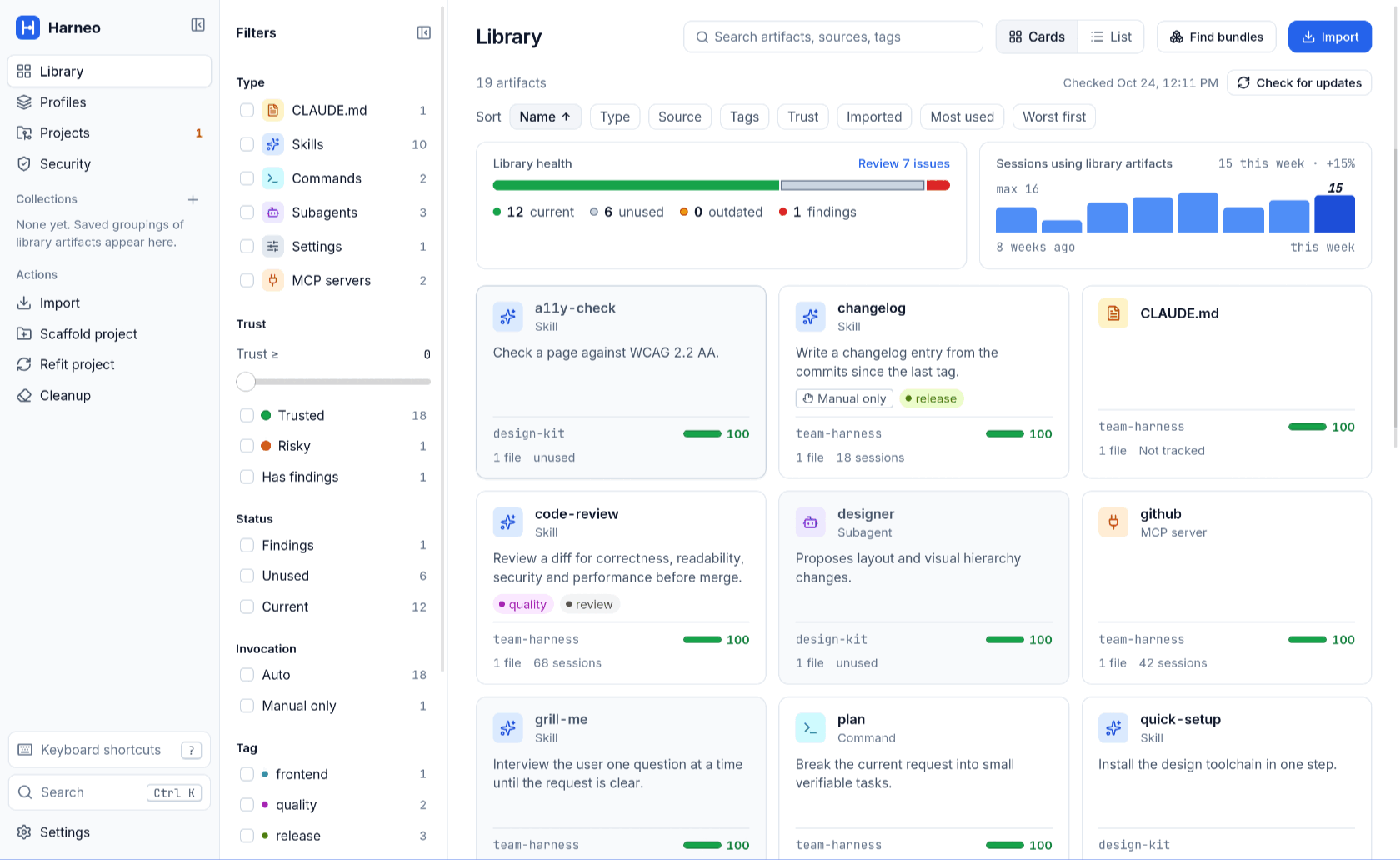
What's in 0.1.0
- Import from a folder (a repo, or
~/.claude/) or a git URL. Every artifact is audited on arrival: a trust score, findings by severity, and what it can reach (network, shell, environment variables, files). Risky ones start excluded. - Library of the whole harness, not only skills: skills, commands, subagents, settings, MCP servers, output styles, workflows, plugins,
CLAUDE.mdand rules, with tags, collections, usage and an outdated flag. - Profiles built from the library: clone one to make a lighter or heavier one, export it as one file.
- Scaffold a new project, or refit an existing one item by item (keep, replace or delete). A dry-run preview comes first, every replaced file is backed up, and lost
CLAUDE.mdorsettings.jsonlines are flagged in red. - Projects, drift and cleanup: see which projects diverged from their profile, re-apply or promote the change, and prune unused or duplicated artifacts. Removing a profile restores the originals.
- CLI on the same engine and library:
harneo scan,audit,profiles,scaffold,status,update,paths.
Install
Harneo is distributed as source only: there are no binaries attached to this release. Build it for your OS with one setup script and two build commands; the README has step-by-step instructions for Linux, macOS and Windows.
git clone --branch release_0.1.0 https://github.com/ibrahimkobeissy/harneo.git
cd harneo
./scripts/setup.sh            # Windows: scripts\setup.ps1
npm ci
npm run tauri build -- --no-bundle
cargo build --release -p harneo-cli| Platform | State |
|---|---|
| Linux | Built and tested by the maintainer |
| macOS | Untested by the maintainer: please send a platform report |
| Windows | Untested by the maintainer: please send a platform report |
Privacy
No account, no server, no analytics. Two features use your own claude CLI on your own plan and are on by default: confirming audit findings with Claude, and asking Claude about repo layouts at import. Both can be turned off in Settings, and each Settings row says exactly what it sends. Error reports go only to a Sentry project of your own, and only if you set HARNEO_SENTRY_DSN. Details in the README.
Thanks
The security audit rules are ported from HarnessKit (Apache 2.0).
License: MIT. Bugs, ideas and platform reports are welcome in Issues; see CONTRIBUTING.md.