Repository navigation
Releases: jamesbraid/origami
Release list
Origami v0.5.1

Big iron graphics. The Onyx 3000 with its V-brick VPro V12 and the Onyx 3400
with G-brick InfiniteReality3 are presets, and the Onyx 3400 takes up to four
pipes, each with a two-head DG5-2 display. IRIX 6.5.30 reaches the 4Dwm
desktop on every pipe, and one pipe's two heads join into a 2560x1024 desktop.
$ hinv -c graphics    # Onyx 3400, four pipes
Graphics board: InfiniteReality3
Graphics board: InfiniteReality3
Graphics board: InfiniteReality3
Graphics board: InfiniteReality3
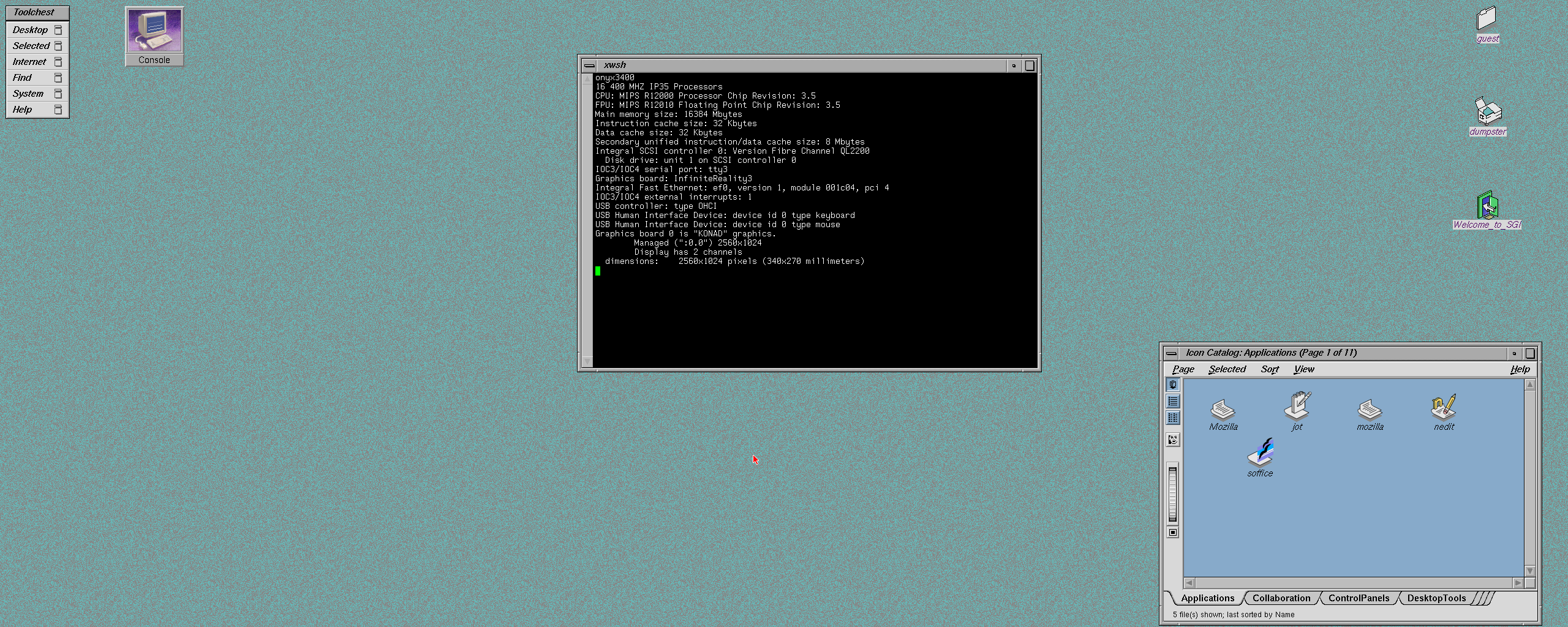
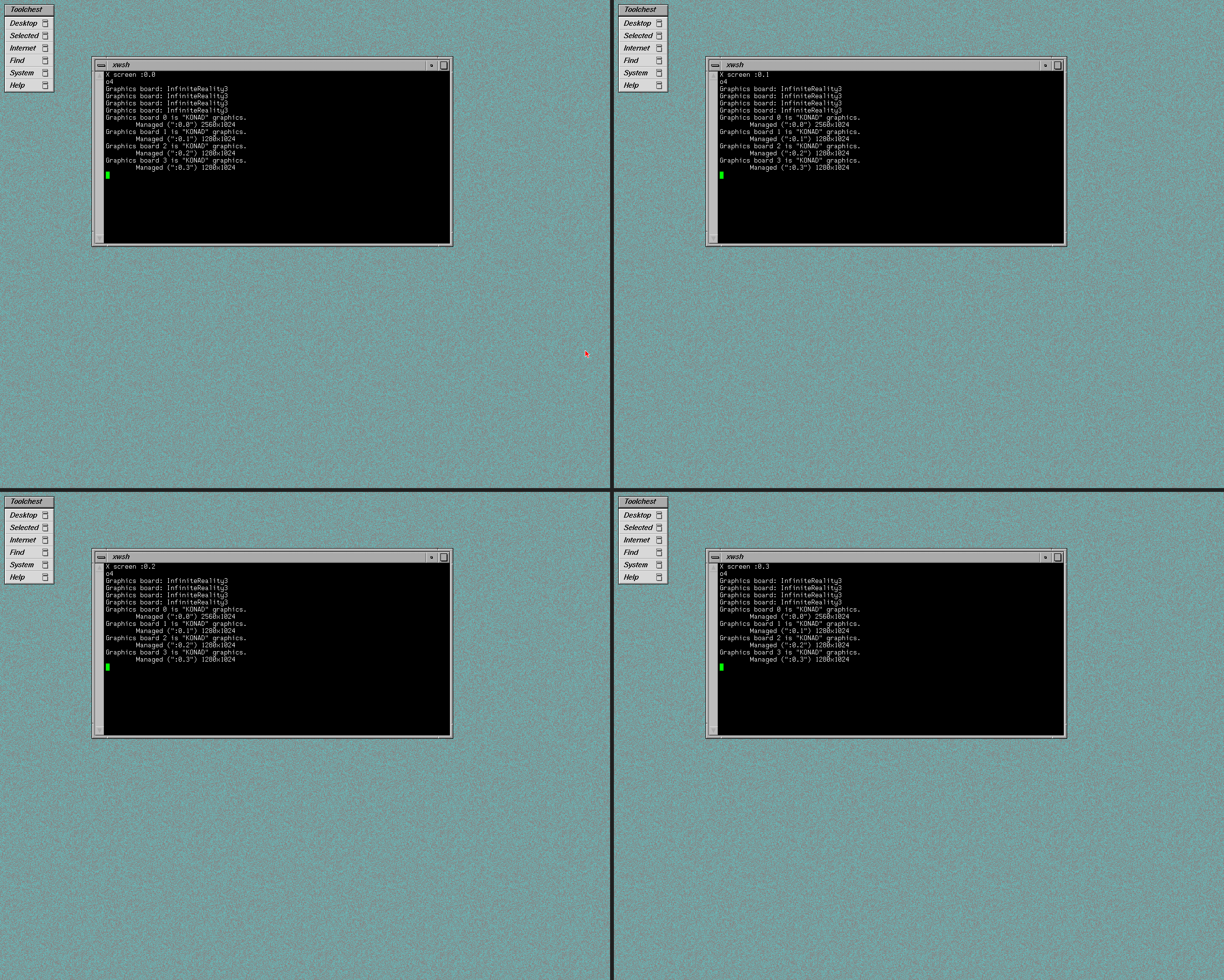
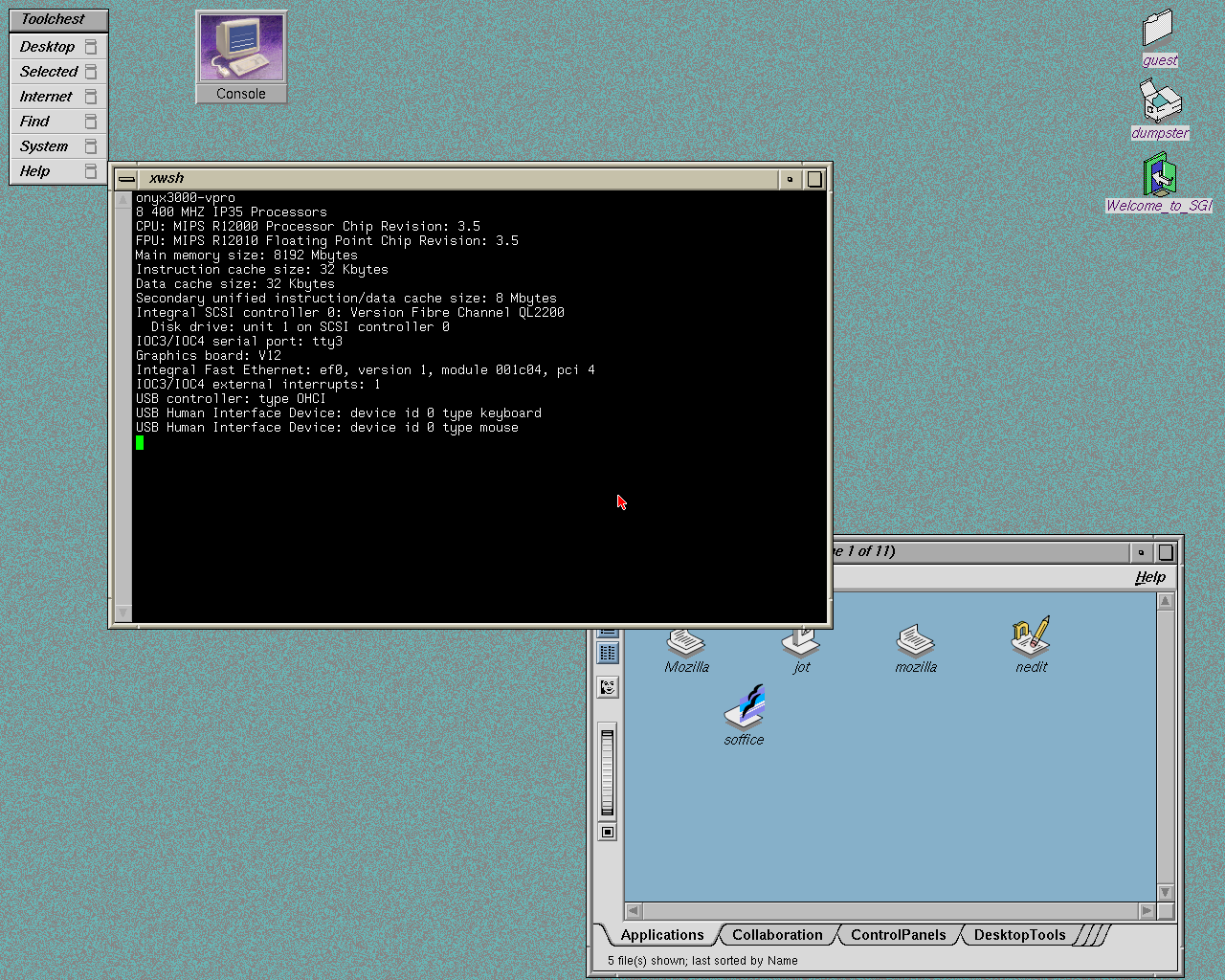
The gallery
has a shot of each pipe and of the dual-head desktop.
- New:
- Presets
onyx3000-vproandonyx3400-infinite-reality. create --graphics-pipes Nfits several pipes: 1 to 4 on the Onyx 3400
and 1 to 2 ononyx2-rack-infinite-reality, whose second pipe gets the
second node it needs.- A pipe's two heads join into one 2560x1024 desktop once
ircombine
stores the shipped2@1280x1024_60in the pipe's flash: the next start
comes up that way. The usage guide has the command. runshows every head of every pipe: a window for each head, or with
--display vnca VNC server for each on consecutive ports from
--vnc-port.
- Presets
- Changed:
- Each InfiniteReality pipe keeps its flash in the machine's state as
SLOT-kona-flash.raw.origami upgradeadds it to machines made
before 0.5.1; without it QEMU refuses to start the machine.
- Each InfiniteReality pipe keeps its flash in the machine's state as
- QEMU updated to 29ffcfb163. The Onyx 3000 boots without brick-type warnings from the PROM.
Origami v0.5.0
Big iron. The Origin 3200, 3400 and 3900 servers install and run IRIX
6.5.30, and any machine can now share a host folder with IRIX over NFS,
with no host NFS server or administrator rights.
$ hinv            # Origin 3900
16 700 MHZ IP35 Processors
CPU: MIPS R16000 Processor Chip Revision: 3.0
Main memory size: 8192 Mbytes
ROUTER in Module 001c07/Slot 0: Revision 1: Active Ports [2,3,4,5,] (enabled)
Integral SCSI controller 0: Version Fibre Channel QL2200, 33 MHz PCI
Integral Fast Ethernet: ef0, version 1, module 001c07, pci 4
Every machine's hinv is in the gallery.
- New:
- Presets
origin3200(8 CPUs),origin3400(16 CPUs) andorigin3900
(16 R16000s). IRIX installs on the Origin 3200's Fibre Channel disk
over its serial console, and the disk boots on the others. origami share DIR NAME HOSTDIRserves a host folder to IRIX.
Mount it withmount 10.98.0.4:/NAME /mnt/NAME.--mode privatewith no install server running gives the guest its
own network:10.98.0.65by DHCP, shares at10.98.0.4.network-set DIR --subnet 10.42.0.0/24moves a machine's networks
onto another private /24.install-init --release 6.5.22installs IRIX 6.5.22, with MIPSpro
and RAD4.
- Presets
- Changed:
- QEMU's user network is now
10.98.0.0/24, the same as the private
network: host10.98.0.2, DNS10.98.0.3, guest10.98.0.65. A
machine that booted in user mode before may keep its old address
once; runrm /var/adm/proclaim.lease_info* /etc/resolv.confas root
and restart it. Leave resolv.conf and IRIX's name service can start
dead, failing every lookup until the next restart. /irix.cmdsinstalls every configured add-on, and
install-apply --addonis gone.- Installs include the NFS client.
- QEMU's user network is now
- Fixed:
- An installed system is named after its machine directory, not IRIS.
- After
network-set, IRIX takes the new network's address. - Remote installs retry transient download errors instead of stopping.
- QEMU updated to cf2948f095. Instigator updated to 0.5.0.
Origami v0.4.1
Install IRIX on any graphics machine from its own console: the user guide
now walks through it with screenshots. This release also fixes what 0.4.0
left broken. Octane with SI shows its console, the Onyx 350 and Tezro
reach the network, and the VPro pointer is visible. VPro and
InfiniteReality are faster.
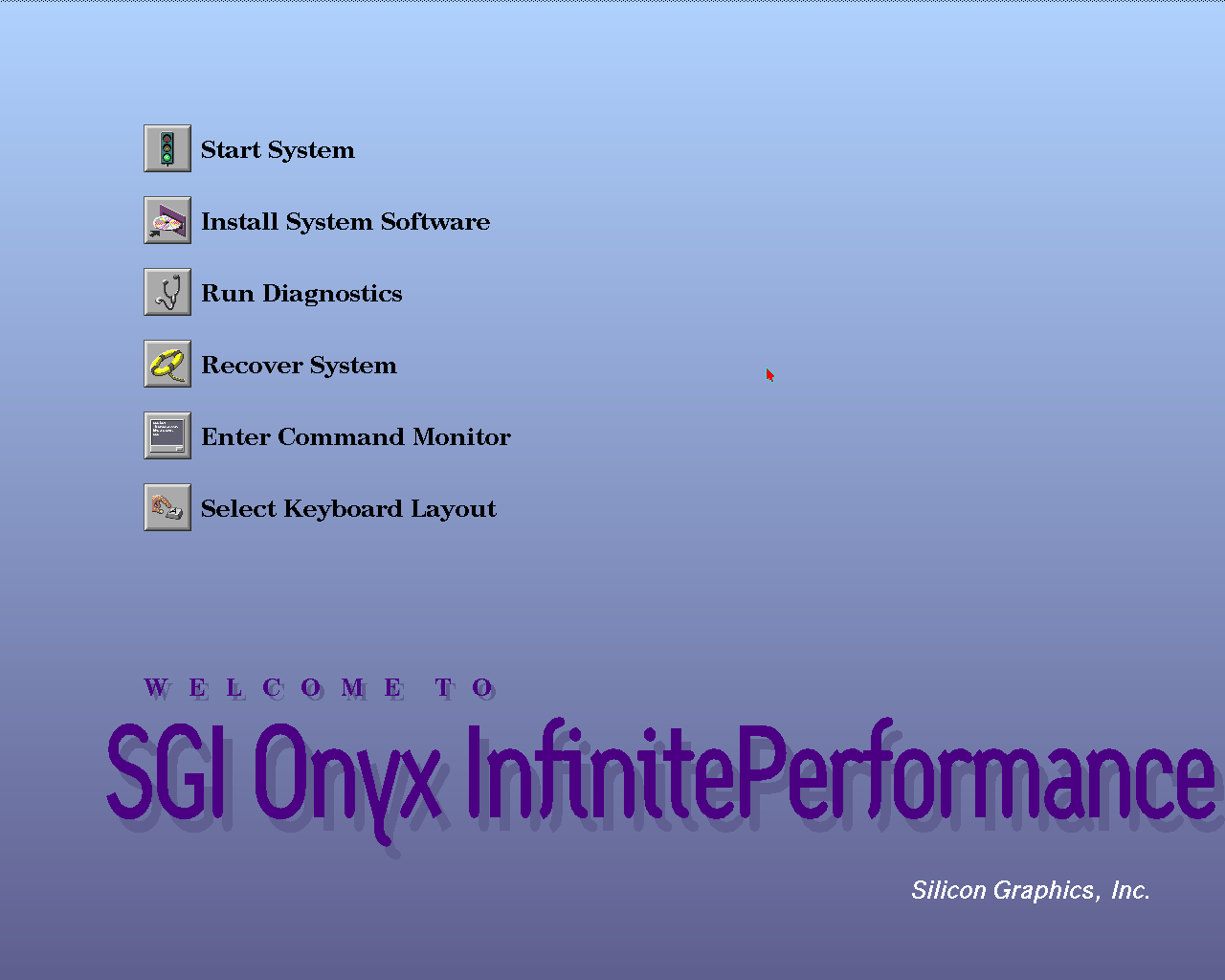
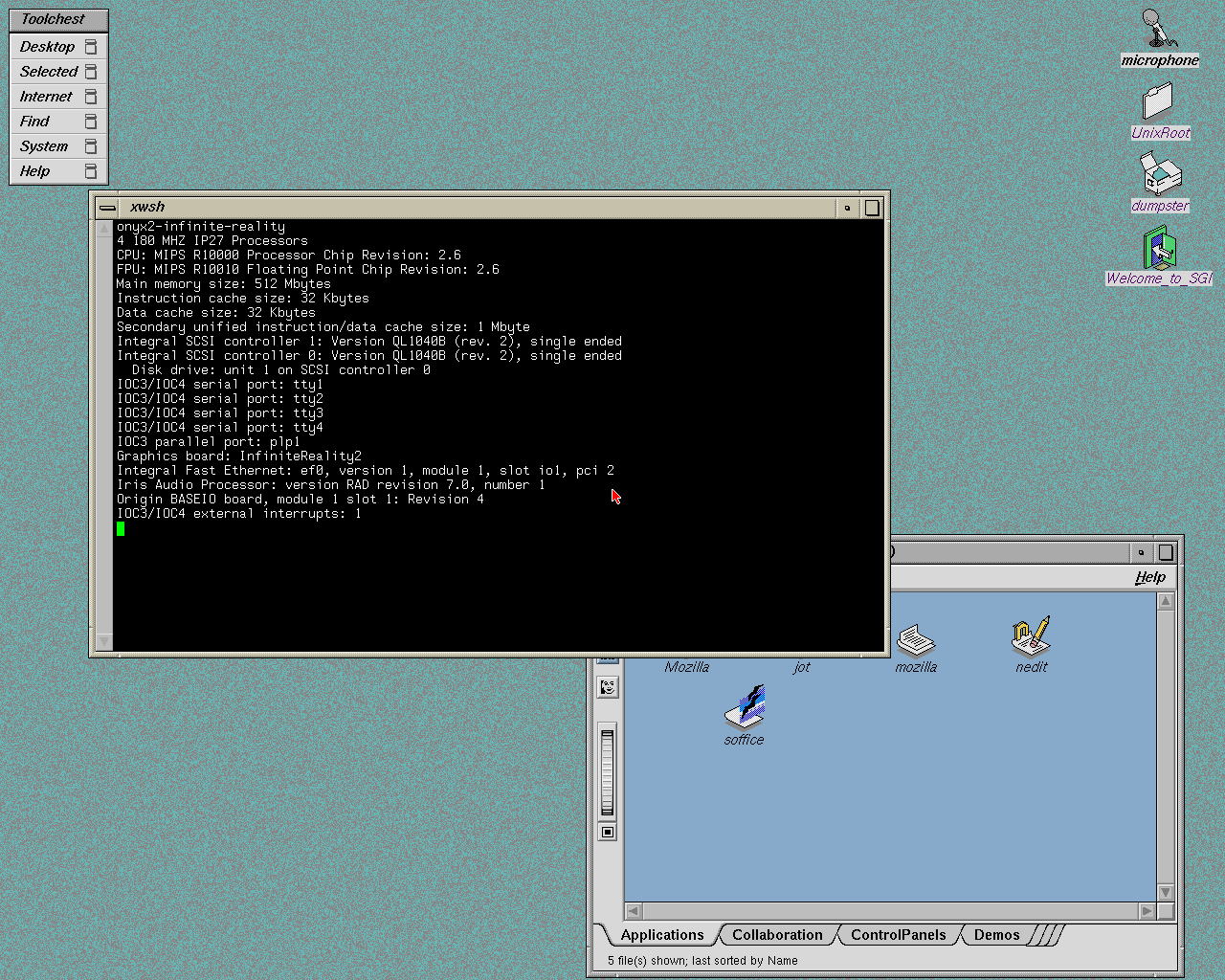
Every machine is in the gallery.
- Fixed:
- Octane and Octane2 with SI no longer start to a black screen.
- An Origin 200 with IMPACT installs X and reaches the 4Dwm desktop.
- The Onyx 350 and Tezro connect their onboard Ethernet.
- A new Onyx 350 starts on its graphics console.
- The VPro pointer shows in the PROM and in X.
- VPro no longer draws lighter squares behind desktop icons.
/irix.cmdsinstalls the machine's add-ons too, so an Origin 200
with RAD4 gets its X server.
- Faster:
- The VPro textport scrolls about 4x faster.
- Fuel, Tezro and Onyx 350 keep normal guest speed under heavy GL.
- InfiniteReality texture loads are about 11x faster.
- New:
origami nvram DIRreads and changes a stopped machine's PROM
environment, such asconsoleandAutoLoad.show-commandprints a QEMU command you can copy, edit and run, and
[qemu] extra-argsor--qemu-argadd your own options.origami machinesprints one table of the presets;origami machines PRESETshows the detail.install-checkprobes remote media instead of downloading it.creategives each machine a unique SGI MAC. Non-SGI MACs are
refused.
- QEMU updated to 49b5ef3757.
Origami v0.4.0
SGI graphics arrive. Nine machines now boot IRIX to a working GL desktop
with their own graphics hardware: Octane with SI, Octane2, Fuel, Tezro and
Onyx 350 with VPro V12, Origin 2000 with SI, Onyx2 with InfiniteReality2 or
InfiniteReality3, and Origin 200 with RAD4. Pick one with a preset, or any
board QEMU models with create --graphics.
Machines created by 0.3.x must be upgraded once: origami upgrade DIR.
An Origin 2000 or Origin 200 with InfiniteReality is refused, because that
hardware is an Onyx2: create an Onyx2 instead.
- New presets:
octane2-vpro,origin2000-impact,
onyx2-rack-infinite-reality,onyx350-vproandtezro-vpro.
fuel-1now comes with its VPro V12. origami machineslists every graphics board each machine takes, and its
known limits.- New Origin 2000 and Onyx2 machines get 256 MiB per node, the smallest
SGI shipped, instead of 64 MiB. Existing machines keep their size. - QEMU updated to 4013f9f84f.
Origami v0.3.1
- An Origin 200 can take any of its processor modules:
create --processor IDpicks a 180 MHz R10000 with 1 MB (the default)
or 2 MB cache, a 225 MHz R10000 or a 270 MHz R12000, andorigami machineslists them. The two faster modules always hold two CPUs and
allow up to 1792 MiB per node. The module is fixed when the machine is
created. Existing machines keep the default module and need no upgrade. - Piping output, as in
origami machines | head, ends quietly instead of
panicking. origami --versionreports Instigator as v0.4.0. The 0.3.0 archives
showed a pseudo-version for the same code.- QEMU updated to 47542527ab.
Origami preview
Experimental SGI emulation. Vibe coded paper silicon, with the usual paper cuts.
The bundle includes the origami CLI, QEMU and Instigator. It covers Origin
200, Origin 2000, Origin 300 and Onyx2, SMP and multiple nodes, plus RAD1/RAD4,
IMPACT/SI, InfiniteReality and VPro graphics. The CLI provides a smaller set
of managed presets. Other configurations use the bundled QEMU directly.
Fuel and Octane remain works in progress.
Archives target Linux x86-64 with glibc 2.39 or newer, Windows 11 x86-64 and
macOS 15 on Apple Silicon. Verify the supplied SHA-256 before extracting.
The binaries are unsigned. There is no package manager or automatic updater.
Firmware, guest disks and installation media are not included. Supply your
own, then start with origami machines and the
user guide.
Some configurations reach an IRIX desktop. Others remain unfinished. Graphics,
input, firmware and guest support vary by machine and revision. Expect broken
things and frequent releases. The user guide records tested paths and limits.
The frontend, build tooling and our original QEMU additions use BSD-3-Clause.
The combined QEMU emulator is GPL. Upstream code and bundled dependencies
retain their own licenses, included under share/origami/licenses.
Origami v0.3.0
Machines created by 0.2.x must be upgraded once: origami upgrade DIR.
Origin 200, Origin 2000 and Onyx2 machines gain a module controller NVRAM
file built from their PROMs, which the upgrade downloads or takes from
--prom FILE and --io-prom FILE. Flash, NVRAM, drives and network
settings are kept.
Install profiles are now minimal and standard; base, desktop and
development are gone. The MIPSpro compiler is an add-on:
--profile standard with install-addon --name mipspro.
Source checkouts: QEMU now comes from github.com/jamesbraid/qemu-sgi-origami.
Run git submodule sync && git submodule update once.
- Origin 200 presets are headless. The new
origin200-rad4preset is the
two-CPU Origin 200 with RAD4 graphics, andinstall-initadds the RAD4
add-on for it. - Add-ons install in a second
instpass after IRIX, andinstall-apply
restarts the guest to its login prompt.install-finishis gone.
Without--addon,install-applyinstalls every configured add-on. - RAD4 keeps the driver's DMA on, which makes window drags and resizes
several times faster. On an existing RAD4 install, set
rad4pci_no_dma = 0in/var/sysgen/master.d/rad4pci, runautoconfig
and reboot. - Guided installs turn on DHCP and
AutoLoad. A cold start boots straight
to IRIX, which gets its address and its hostname (the machine directory's
name) from user networking. minimalinstalls no longer stop at package conflicts.network-set --mode tap(Linux, Windows) and--mode vmnet(macOS, via
socket_vmnet) put the guest on a host network.- Origin 200 accepts more memory sizes, up to 1664 MiB per node.
- QEMU updated to 24b27ce. Instigator updated to v0.4.0.
Origami preview
Experimental SGI emulation. Vibe coded paper silicon, with the usual paper cuts.
The bundle includes the origami CLI, QEMU and Instigator. It covers Origin
200, Origin 2000, Origin 300 and Onyx2, SMP and multiple nodes, plus RAD1/RAD4,
IMPACT/SI, InfiniteReality and VPro graphics. The CLI provides a smaller set
of managed presets. Other configurations use the bundled QEMU directly.
Fuel and Octane remain works in progress.
Archives target Linux x86-64 with glibc 2.39 or newer, Windows 11 x86-64 and
macOS 15 on Apple Silicon. Verify the supplied SHA-256 before extracting.
The binaries are unsigned. There is no package manager or automatic updater.
Firmware, guest disks and installation media are not included. Supply your
own, then start with origami machines and the
user guide.
Some configurations reach an IRIX desktop. Others remain unfinished. Graphics,
input, firmware and guest support vary by machine and revision. Expect broken
things and frequent releases. The user guide records tested paths and limits.
The frontend, build tooling and our original QEMU additions use BSD-3-Clause.
The combined QEMU emulator is GPL. Upstream code and bundled dependencies
retain their own licenses, included under share/origami/licenses.
Origami v0.2.1
- QEMU updated to fa81284.
- The CLI talks to QEMU through the qapi library instead of its own
protocol code.
Origami preview
Experimental SGI emulation. Vibe coded paper silicon, with the usual paper cuts.
The bundle includes the origami CLI, QEMU and Instigator. It covers Origin
200, Origin 2000, Origin 300 and Onyx2, SMP and multiple nodes, plus RAD1/RAD4,
IMPACT/SI, InfiniteReality and VPro graphics. The CLI provides a smaller set
of managed presets. Other configurations use the bundled QEMU directly.
Fuel and Octane remain works in progress.
Archives target Linux x86-64 with glibc 2.39 or newer, Windows 11 x86-64 and
macOS 15 on Apple Silicon. Verify the supplied SHA-256 before extracting.
The binaries are unsigned. There is no package manager or automatic updater.
Firmware, guest disks and installation media are not included. Supply your
own, then start with origami machines and the
user guide.
Some configurations reach an IRIX desktop. Others remain unfinished. Graphics,
input, firmware and guest support vary by machine and revision. Expect broken
things and frequent releases. The user guide records tested paths and limits.
The frontend, build tooling and our original QEMU additions use BSD-3-Clause.
The combined QEMU emulator is GPL. Upstream code and bundled dependencies
retain their own licenses, included under share/origami/licenses.
Origami v0.2.0
Machines created by 0.1.x must be upgraded once before use:
origami upgrade DIR. Origin 2000 and Onyx2 machines may need
--io-prom FILE if the IO PROM cannot be downloaded. PROM settings,
logs, drives and port forwards are kept, and the old files stay in place.
- The machine list now comes from the bundled QEMU, so the CLI and QEMU
always agree on what each machine supports. - QEMU now creates a new machine's flash, NVRAM and clock files.
- Each machine has one MAC address, used for its Ethernet.
- QEMU updated to 370fbb5.
Origami preview
Experimental SGI emulation. Vibe coded paper silicon, with the usual paper cuts.
The bundle includes the origami CLI, QEMU and Instigator. It covers Origin
200, Origin 2000, Origin 300 and Onyx2, SMP and multiple nodes, plus RAD1/RAD4,
IMPACT/SI, InfiniteReality and VPro graphics. The CLI provides a smaller set
of managed presets. Other configurations use the bundled QEMU directly.
Fuel and Octane remain works in progress.
Archives target Linux x86-64 with glibc 2.39 or newer, Windows 11 x86-64 and
macOS 15 on Apple Silicon. Verify the supplied SHA-256 before extracting.
The binaries are unsigned. There is no package manager or automatic updater.
Firmware, guest disks and installation media are not included. Supply your
own, then start with origami machines and the
user guide.
Some configurations reach an IRIX desktop. Others remain unfinished. Graphics,
input, firmware and guest support vary by machine and revision. Expect broken
things and frequent releases. The user guide records tested paths and limits.
The frontend, build tooling and our original QEMU additions use BSD-3-Clause.
The combined QEMU emulator is GPL. Upstream code and bundled dependencies
retain their own licenses, included under share/origami/licenses.
Origami v0.1.2
Origami preview
Experimental SGI emulation. Vibe coded paper silicon, with the usual paper cuts.
The bundle includes the origami CLI, QEMU and Instigator. It covers Origin
200, Origin 2000, Origin 300 and Onyx2, SMP and multiple nodes, plus RAD1/RAD4,
IMPACT/SI, InfiniteReality and VPro graphics. The CLI provides a smaller set
of managed presets. Other configurations use the bundled QEMU directly.
Fuel and Octane remain works in progress.
Archives target Linux x86-64 with glibc 2.39 or newer, Windows 11 x86-64 and
macOS 15 on Apple Silicon. Verify the supplied SHA-256 before extracting.
The binaries are unsigned. There is no package manager or automatic updater.
Firmware, guest disks and installation media are not included. Supply your
own, then start with origami machines and the
user guide.
Some configurations reach an IRIX desktop. Others remain unfinished. Graphics,
input, firmware and guest support vary by machine and revision. Expect broken
things and frequent releases. The user guide records tested paths and limits.
The frontend, build tooling and our original QEMU additions use BSD-3-Clause.
The combined QEMU emulator is GPL. Upstream code and bundled dependencies
retain their own licenses, included under share/origami/licenses.
Origami v0.1.1
Origami preview
Experimental SGI emulation. Vibe coded paper silicon, with the usual paper cuts.
The bundle includes the origami CLI, QEMU and Instigator. It covers Origin
200, Origin 2000, Origin 300 and Onyx2, SMP and multiple nodes, plus RAD1/RAD4,
IMPACT/SI, InfiniteReality and VPro graphics. The CLI provides a smaller set
of managed presets. Other configurations use the bundled QEMU directly.
Fuel and Octane remain works in progress.
Archives target Linux x86-64 with glibc 2.39 or newer, Windows 11 x86-64 and
macOS 15 on Apple Silicon. Verify the supplied SHA-256 before extracting.
The binaries are unsigned. There is no package manager or automatic updater.
Firmware, guest disks and installation media are not included. Supply your
own, then start with origami machines and the
user guide.
Some configurations reach an IRIX desktop. Others remain unfinished. Graphics,
input, firmware and guest support vary by machine and revision. Expect broken
things and frequent releases. The user guide records tested paths and limits.
The frontend, build tooling and our original QEMU additions use BSD-3-Clause.
The combined QEMU emulator is GPL. Upstream code and bundled dependencies
retain their own licenses, included under share/origami/licenses.