Repository navigation
Addendum MyGo
An addendum to One Go App, Served Five Ways. Same spec, same shared core, same harness. Other addenda: Home.
Suggested in r/golang · Stack MyGo v0.9.0 · Compared with Wails (webview mode), Fyne and Cogent (native UI mode) · Measured 2026-11-14, same machine as the article
In webview mode, MyGo is on par with Wails: faster builds, lower memory and no cgo, but no browser target, so reaching both web and desktop means writing the UI in its native UI mode instead. In native UI mode it outperformed Fyne and Cogent on this app, on the desktop and in the browser, and scored highest on style. It is also younger than both (pre-1.0).
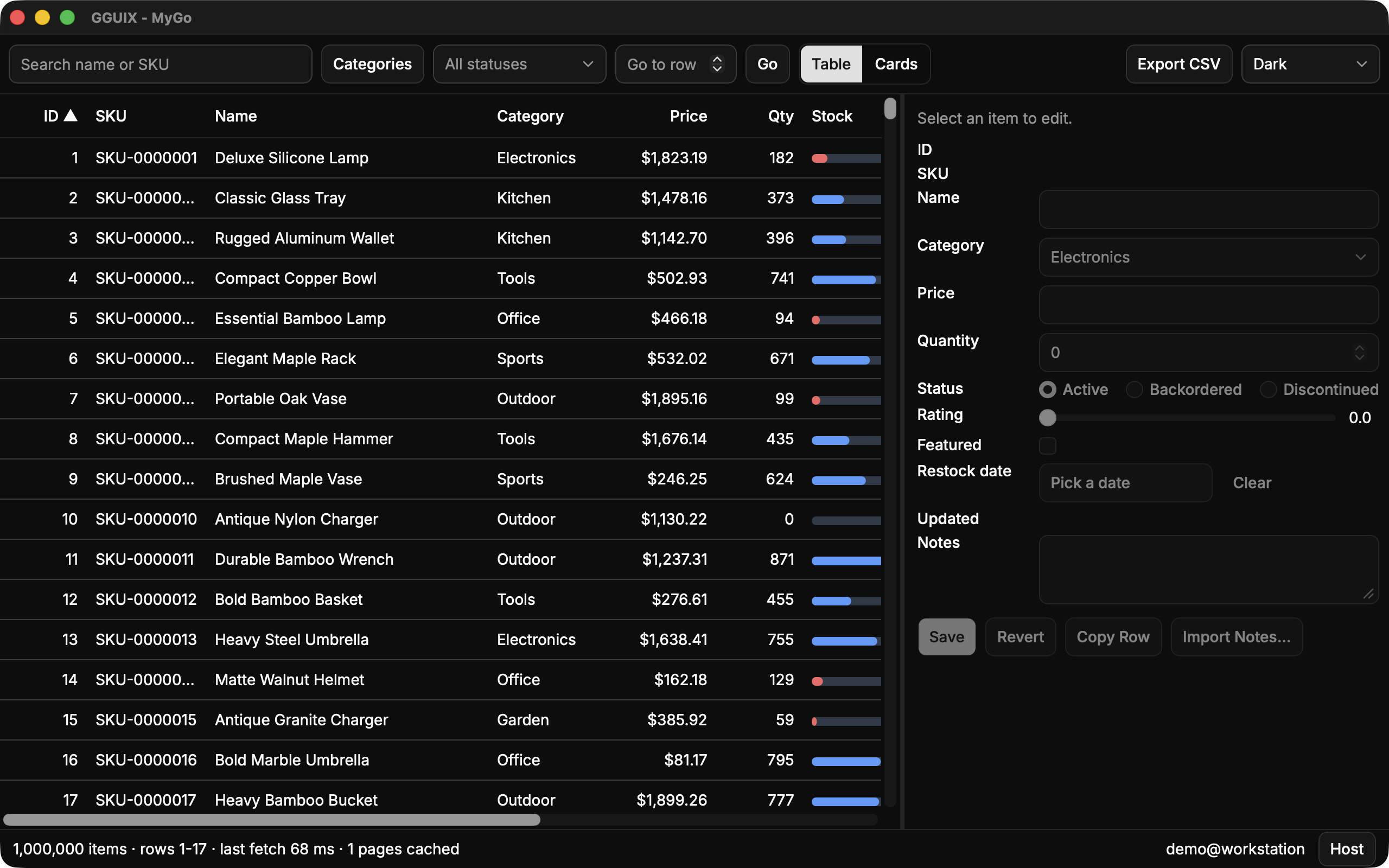
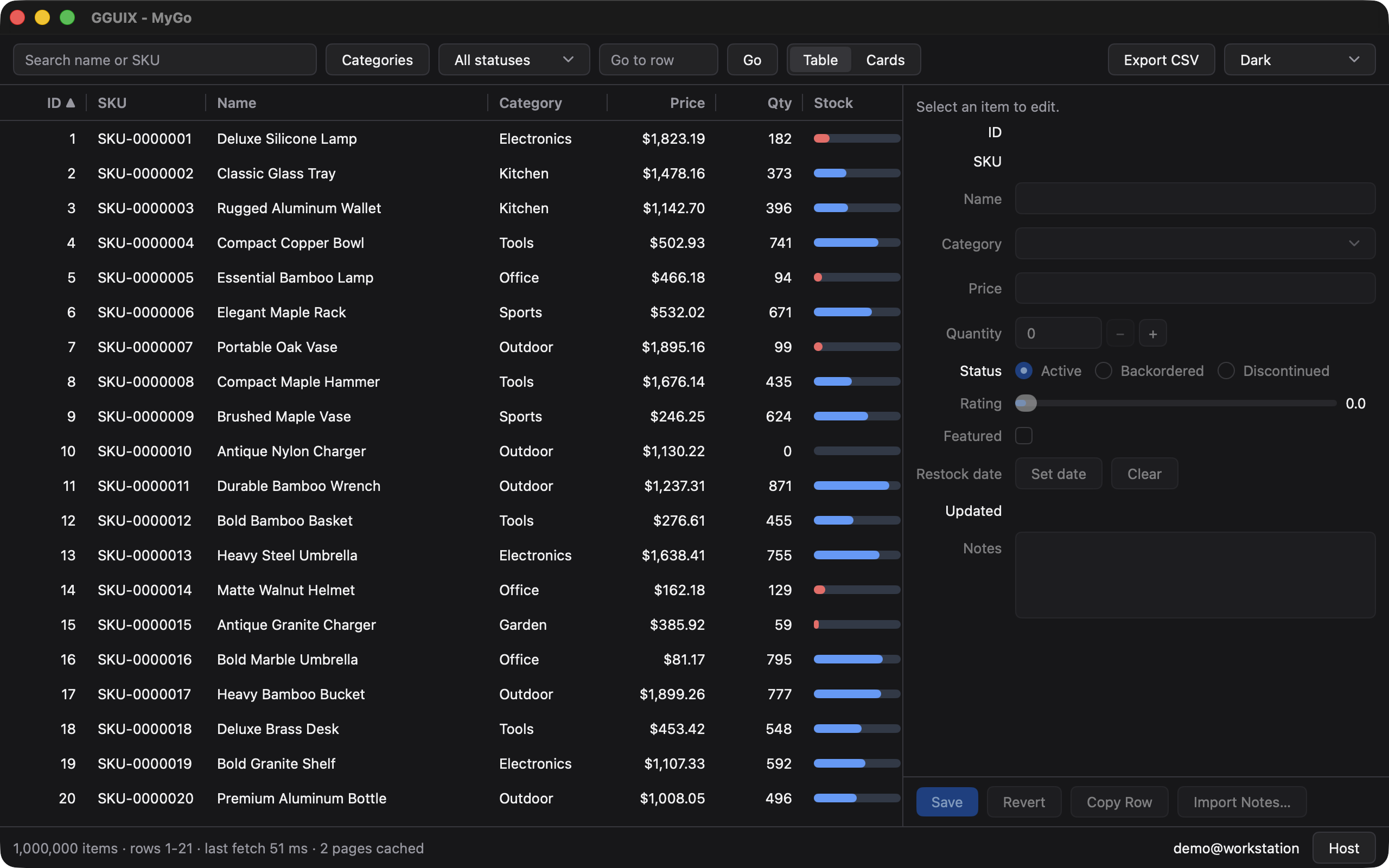
A pure-Go desktop framework with two modes, which one app can mix. Webview mode shows a web page in the system webview, with Go services bound to a generated TypeScript client, like Wails. Native UI mode draws the UI itself on the GPU, like Fyne and Cogent, and also builds to WASM for the browser.
| Mode | What draws the UI | Web target | Built by |
|---|---|---|---|
Webview (mygo) |
the system webview | none | an agent porting the article's Wails app |
Native UI (mygoui) |
MyGo, on the GPU | WASM | an agent working from the spec, like the article's apps |
Webview mode (mygo)
Native UI mode (mygoui)
Desktop, median of 5 runs. Bold is the best figure in the row.
| mygo | wails | mygoui | fyne | cogent | |
|---|---|---|---|---|---|
| Ready (ms) | 628 | 623 | 236 | 572 | 555 |
| Jump to row 500k (ms) | 84 | 90 | 69 | 146 | 113 |
| Table scroll, max frame gap (ms) | 71 | 91 | 13 | 40 | 19 |
| Blank-row steps while scrolling | 54 | 64 | 23 | 0 | 24 |
| Switch to cards (ms) | 191 | 194 | 51 | 104 | 112 |
| Sort (ms) | 280 | 280 | 241 | 254 | 262 |
| Peak memory (MB) | 641 | 824 | 219 | 1412 | 513 |
| Cold build (s) | 15.1 | 39.2 | 13.7 | 19.1 | 23.5 |
| Style, blind (1 to 5) | 4 | 4 | 5 | 3 | 2 |
Browser (Chrome, single run). Frame gaps here are timed by the browser for all three apps, so they compare with each other, not with the article's web table.
| mygoui | fyne | cogent | |
|---|---|---|---|
| Download, gzip (MB) | 4.0 | 12.4 | 6.9 |
| Ready (ms) | 921 | 830 | 1,453 |
| Jump (ms) | 54 | 187 | 138 |
| Table scroll, max frame gap (ms) | 67 | 217 | 317 |
| Cards scroll, max frame gap (ms) | 33 | 135 | 717 |
In a hands-on check, both modes had every native feature working (menus, shortcuts, dialogs, notification, clipboard, Reveal, state restore), and felt the same except scrolling, which was flawless in native UI mode.
A lot of data? Webview mode behaves like Wails, including the WebKit scroll stutter. Native UI mode is the fastest app measured on the desktop so far, and the only Go WASM build that scrolls without visible stutter in the browser.
Need cgo? Neither mode needs it, and a cgo core still runs on the desktop.
In the browser, as with Fyne and Cogent, a cgo core cannot run inside WASM but
works with web-remote, where the core runs on a Go server.
GTK, WebKit and GPU libraries are loaded at launch rather than linked, so they
must be installed on the user's machine, and a missing one fails at launch,
not at build.
Web, native, or both? Webview mode is desktop only: unlike Wails, it has no server mode, so the same UI cannot be served to a browser. Native UI mode reaches both from one Go UI codebase, at a third of Fyne's download size. An app can mix the two modes, but only its native UI windows can go to the browser.
- Linux (the article's container check, X11 and Wayland): both modes start, with native GTK menus and dialogs, notifications and clipboard. Reveal selects the file in the file manager, which no article app did. Real GNOME/KDE sessions and the Linux GPU path were not tested.
- Maturity: v0.9.0, no stated stability policy. Fyne and Cogent have longer release histories.
Code: apps/mygo/, apps/mygoui/ · Full results:
results/mygo/, results/mygoui/ ·
Method changes: results/HARNESS_CHANGES.md (E1 to E4), results/DEVIATIONS.md