Repository navigation
04. Reviewing Pact Anki cards
Anki cards generated with Pact are just audio clips with the transcriptions. If you use the example layouts given on the (Anki page)[./02. Anki.md], you'll have cards like this:
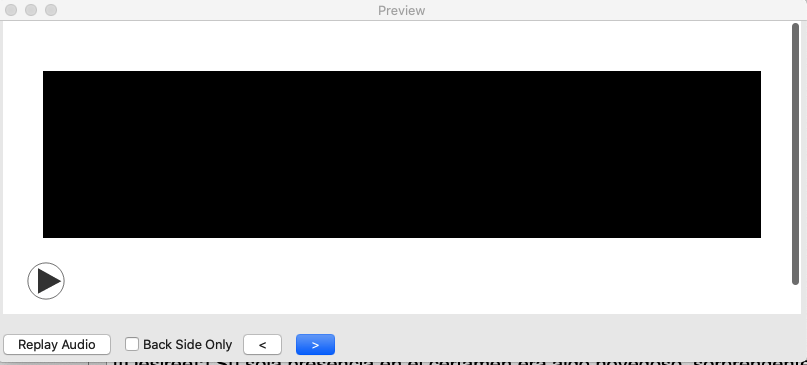
Front (the audio of the clip plays):
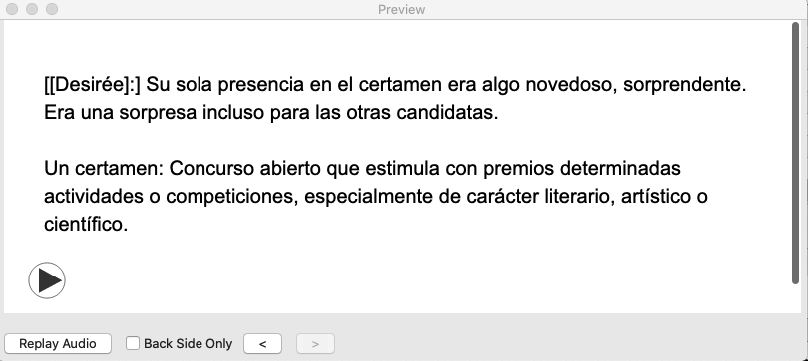
Back:
When doing your Anki reviews, if you just rip through such cards, the review may seem rather passive and useless! Anki is generally used to test "information retrieval" in the form of Question/Answer cards or Cloze ... but that's not what Pact cards are for.
Here's how I use them in my Spanish study, and the value that I feel Pact brings to the language study process. [1]
When learning a language, just spending time with it is important. Listening to things, watching videos, reading, whatever works for you.
While listening to a podcast, there might be a sentence that really exemplifies a concept in your TL. For Spanish, that might be subjunctive. For Deutsch, it might be declensions. Whatever.
Sometimes I hear a sentence in the wild, and it really seems to pull a number of concepts into focus.
Just repeating these nuggets is extremely useful, and can solidify some concepts or grammatical rules for me. Pact helps me pull out these things, and Anki ensures that I keep paying attention.
Shadowing is a great technique (see this long video by Alexander Arguelles, a well-respected linguist). Essentially, while a sentence is being heard, you repeat it back.
It's a good technique, but I find shadowing very tiring, especially with a long video or podcast. Hearing a short clip, and then attempting to shadow that, is much better for me.
For short- and medium-length clips, I try to hear the full sentence in my head after the clip plays (sometimes I'll also try to repeat it verbatim aloud, but not always.)
This does a few things:
- makes me notice the small bits that I might otherwise gloss over.
- gets me past the language, to the real meaning behind the words.
These are very big, nebulous ideas, but I feel they're useful, so some more notes, with an example.
Take this Pact card, which I created from Mónica, la primera, from Radio Ambulante:
[[Desirée]:] Su sola presencia en el certamen era algo novedoso, sorprendente. Era una sorpresa incluso para las otras candidatas.
I clipped this for a few reasons: [2]
- new words: "certamen" and "novedoso". They're obvious in context, but still new.
- interesting structures: "su sola presencia", "una sorpresa incluso para"
- little obvious things: gender agreement of "las otras candidatas"; use of "algo"
There are a million small details that go into a sentence, and doing a mental review of cards helps me focus on them, and really take it apart.
What I mean here is getting past the need to focus on words, grammar rules, etc., and really get to what a sentence is saying.
If a native person hears a sentence, and you ask them to repeat it back, they might not say it word-for-word, but they would absolutely be able to say what the gist of the sentence was, perhaps using other words if needed.
As a non-native, I'd say to myself: good luck with that.
What I can do, however, is try to "hear" the whole sentence again in my head, or say it aloud if needed, and just notice parts where things start to feel rocky:
[[Desirée]:] Su sola presencia en el certamen era algo novedoso, sorprendente. Era una sorpresa incluso para las otras candidatas.
Hack through it:
- "Su sola presencia en ... ¿en qué?" Ah sí, "el certamen."
- "Su sola presencia en el certamen era algo novedoso ..." ok, "algo novedoso", I've never said that before.
- "Era una sorpresa incluso para las otras candidatas." ... "incluso para las otras" feels weird at first, ok. "No es facil, incluso para mí."
- "Su sola presencia en el certamen era algo novedoso, sorprendente. Era una sorpresa incluso para las otras candidatas." OK, bueno.
And as I get better and accumulate more little bits of vocabulary, I might even be able to paraphrase, even if it's simplified:
- "Su sola presencia era una sorpresa, incluso para las otras personas."
Good enough.
Kids do the same thing, I should be able to do that too.
[1]: Your Mileage May Vary.
[2]: This sentence is well within my grasp as a high-intermediate Spanish learner ... but I'd have trouble putting it together myself.