Repository navigation
Releases
FF Power Manager v2.2.0

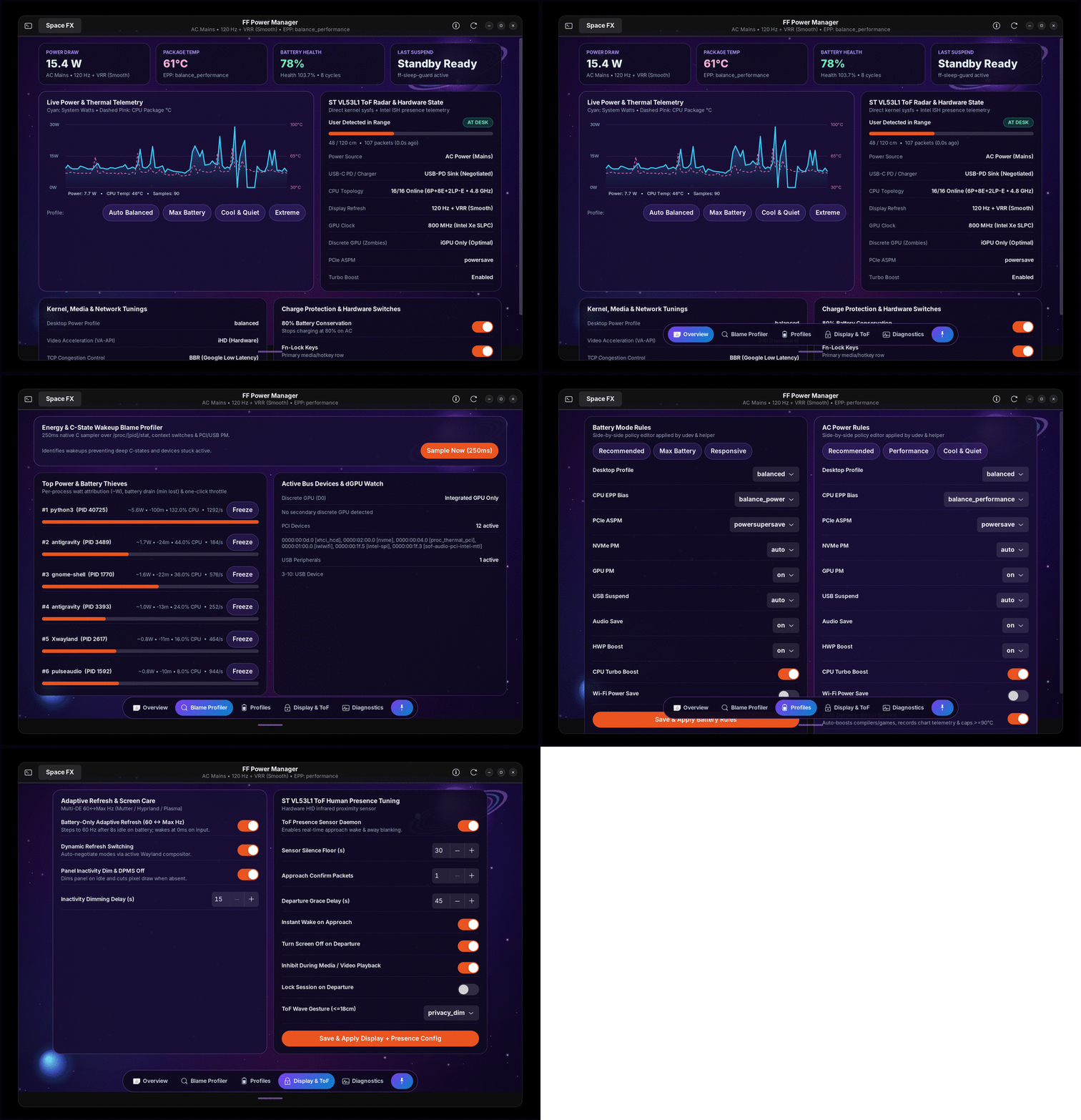
FF Power Manager v2.2.0 — Cosmic Bento Cockpit, Per-Process Blame & Security Hardening
Highlights
- Cosmic Space Bento GTK4 Cockpit (
GSK_RENDERER=gl): Corner-isolated GPU space actors (~5% CPU), auto-hiding bottom hover dock (Ctrl+M), 4-card hero telemetry deck, live power/thermal sparkline, and compact 18x18 dark-glass window controls. - Per-Process Power & Drain Blame + Safe Freeze (
ffctl blame,ffctl throttle): 250ms native C sampler attributes~Wattsand remaining batteryminutes_lostper process with one-click protected backgroundFreeze / Resume(SIGSTOP/SIGCONT). - dGPU Zombie Watch & USB-C PD Inspector: Detects discrete GPUs stuck in
D0(active) with process blockers holding/dev/dri//dev/nvidia*, and inspects negotiated USB-C PD Volts/Amps/Watts (<45Wslow-charger warning). - Hardware Setup Wizard & Privacy-Safe Diagnostics Bundle (
ffctl setup,ffctl bundle): Scans CPU topology, GPU clocks, USB-C PD, ToF HID, and sleep modes, applying optimal settings or exporting scrubbed.tar.gzreports. - ToF Hand-Wave Gestures (
<=18cm): Quick IR wave toggles MPRIS media play/pause, privacy dimming, or instant session lock. - Security Hardening Audit: Removed legacy
exec-scripthelper action, restricted PolicyKit rules to active localsudo/wheeladmins, enforcedO_NOFOLLOWin x86_64 ASM atomic writes, replaced predictable/tmp/.tmppaths, escaped native JSON outputs, and isolated privilegedffctlPython invocations.
Install (Ubuntu / Debian)
sudo apt install ./ff-power-manager_2.2.0_amd64.debFF Power Manager v2.1.0
FF Power Manager v2.1.0
FF Power Manager v2.1.0 hardens security, eliminates hardcoded hardware assumptions, and adds scriptable kernel residency diagnostics for Intel and AMD Linux laptops.
Key Highlights
- Hardware & Residency Diagnostics (
ffctl doctor [--json]): Inspects/sys/power/mem_sleep,/lib/systemd/system-sleep/ff-sleep-guard, armed non-lid ACPI wake triggers (/proc/acpi/wakeup), active P-state/EPP drivers, PCI Runtime PM (suspendedvsactive), and conflicts withtlp/auto-cpufreqin< 2 ms, with--jsonoutput forstatus,health, anddoctor+ integrated live UI in GTK4 Diagnostics tab. - Zero-Setuid Privilege Hardening: Removed
04755setuid-root permissions fromffctl(0755) and replacedsystem()shell invocations inffctl_native.c/ff_tui_native.cwith strictfork()+execv()PolicyKit /sudo -ndelegation. Added bothsudo(Ubuntu/Debian) andwheel(Fedora) support ininstall.sh, Polkit rules, andudevHID rules (TAG+="uaccess"). - True Universal Topology & Sensor Discovery: Replaced remaining 16-core/5.4GHz/Samsung-OLED assumptions across
core.py,ffctl_native.c,ff_tui_native.c, andextension.js. Dynamically discovers P/E/LP-E cores (detect_cpu_topology), clamps frequencies tocpuinfo_min/max_freqand RAPL PL1/PL2 to OEMconstraint_0_max_power_uw, pins IRQs/compositors dynamically to P-cores, discovers PCI SD Host Controllers (0x0805*), and resolves real CPU package temperature (coretemp/k10temp/zenpower/x86_pkg_temp). - Focused Native Linux Identity: Replaced all proprietary/marketing labels with accurate Linux kernel & Mutter subsystems (Adaptive Refresh Rate, Hybrid Topology & C-State Tuning, Interactive QoS).
- Daemon & Packaging Fixes:
auto_boost.pynow preserves user-chosenmax_battery/cool_quietmodes after load spikes and applies thermal guardrails on battery boosts;build-deb.shnow addsprermcleanup, UIRecommends, and only setsLIBVA_DRIVER_NAME=iHDwhen Intel display hardware is present.
v2.0.0 - Universal Linux, Battery-Only ProMotion (60↔120Hz) & s2idle Sleep Guard
FF Power Manager v2.0.0 — Universal Linux & ProMotion Edition
Highlights
- Universal Hardware Auto-Discovery: Works cleanly across Intel & AMD laptops (
Ubuntu,Debian,Fedora) with dynamic CPU topology classification (detect_cpu_topology()), dynamic display resolution/refresh matching, automaticBAT0/BAT1discovery, Lenovoconservation_mode+ standardcharge_control_end_thresholdfallback, Intel Xe / i915 / AMD GPU telemetry, andhwmonNVMe/Wi-Fi thermal monitoring. - Battery-Only ProMotion (
60 ↔ 120/144/165 Hz): Zero-pollingMutter.IdleMonitordrops refresh rate to60 Hzafter 8s idle on battery and wakes instantaneously (0 ms) on input. - App-Aware Cinema & Study/Focus Profiles: Automatically locks ProMotion high refresh & pauses Night Light for
stremio/mpv/vlc; adds 1-click Study/Focus toggle (DND + Night Light +cool_quiet). - One-Shot 100% Charge Watchdog: Re-arms 80% battery conservation automatically at
>=99%with desktop notification. - Thermal Guardrail (
>=90°C) + Zero-Fork Audio Monitor: Prevents sustained thermal throttling inauto_boost.pyand replaces 3spactlsubprocess polling with native/proc/asoundchecks. s2idleBackpack Drain Guard (/lib/systemd/system-sleep/ff-sleep-guard): Suppresses USB/Thunderbolt spurious wakeup sources during suspend and restores them cleanly on resume..debPackaging & GitHub Actions CI: Ships a reproduciblebuild-deb.shand automated test + package workflow.
v1.2.0 - Lenovo Hardware, Battery Health Analytics, GNOME Extension & OLED Care
What's Changed in FF Power Manager v1.2.0
FF Power Manager v1.2.0 brings hardware-level integration for Lenovo laptops, intelligent battery health analytics, an official GNOME Shell top bar extension, smart OLED screen protection, dynamic gaming/compilation boost, and a complete English localization overhaul.
🌟 Key Highlights & New Features
-
Lenovo IdeaPad Hardware Integration
- 80% Battery Conservation Mode: Toggle battery charging threshold to extend Li-ion lifespan (
ffctl conservation on/off, TUI key[K], and dedicated GUI switch). - Fn-Lock Control: Instant software toggle for functional vs. multimedia F1-F12 keys (
ffctl fnlock on/off). - USB Always-On Power: Enable or disable powered USB ports while laptop is suspended or sleeping (
ffctl usbcharge on/off). - Real-time hardware telemetry parsed directly from
ideapad_acpiplatform driver.
- 80% Battery Conservation Mode: Toggle battery charging threshold to extend Li-ion lifespan (
-
Battery Health & Degradation Analytics
- New
ffctl healthCLI command displaying Design vs. Full Charge Capacity (Wh), accurate Wear/Health ratio, cycle count, manufacturer details, and chemistry. - Native Battery Health card in GTK4/Libadwaita GUI and TUI monitor.
- New
-
GNOME Top Bar Quick Power Indicator Extension
- Live power draw wattage (
⚡ 5.2 W) directly in GNOME Shell status bar. - Interactive popover quick menu: instant 1-click power profile switching (Quiet, Balanced, Performance), battery percentage & wattage monitor, and direct shortcut to open FF Power Manager GUI.
- Automatically deployed to
~/.local/share/gnome-shell/extensions/ff-power-indicator@furkan.github.io.
- Live power draw wattage (
-
Samsung 2.8K OLED Screen Care & Anti-Burn-in
- Intelligent inactivity dimming: softly dims the OLED screen after 45s of idle/absence via GNOME D-Bus Brightness API (
org.gnome.Shell.Brightness), without requiring root permissions. - Deep sleep / pure-black 0W pixel blanking when user walks away.
- Integrated into the "Display & Presence" GUI control page.
- Intelligent inactivity dimming: softly dims the OLED screen after 45s of idle/absence via GNOME D-Bus Brightness API (
-
Auto Dynamic Boost & GameMode Engine
- Background daemon (
ff-power-autoboost.service) tracking gaming and compilation workloads (Steam, gamescope, Lutris, Wine, GCC, Clang, Cargo, Blender, OBS). - Dynamically escalates CPU governor and EPP to high performance during demanding tasks, then smoothly restores the user's preferred power profile upon completion.
- Background daemon (
-
Complete English Localization & UI Polish
- 100% of user-facing strings, CLI help, TUI keys, GUI labels, Polkit privilege descriptions, and installation scripts have been overhauled into clean, standard English.
- Fixed Pango XML entity parsing in Libadwaita action rows.
- Fully synchronized with updated documentation and website.
📦 Installation & Upgrade
git clone https://github.com/lwrlock/ff-power-manager.git
cd ff-power-manager
sudo ./install.sh
To enable the GNOME Shell extension:
gnome-extensions enable ff-power-indicator@furkan.github.iov1.1.0 - MacBook-Grade Optimization & Zero-Stutter Architecture
🚀 FF Power Manager v1.1.0 — MacBook-Grade Optimization & Zero-Stutter Architecture
A major milestone release introducing hardware-level latency tuning, video playback zero-stutter fixes, an overhauled GTK4/Libadwaita interface with full real-time telemetry, and Wine/Flowgorithm Hi-DPI integration for Fedora / GNOME Wayland.
🌟 Key Highlights & Improvements
1. 🎬 Zero-Stutter Video & Media Playback
- Intel Arc GPU 800 MHz Floor: Dynamically maintains a minimum 800 MHz frequency floor (
/sys/class/drm/card1/gt_min_freq_mhz) during video playback in balanced mode, completely eliminating dropouts and frame stutters without inflating battery drain. - Native Intel iHD VA-API Acceleration: Configures hardware-accelerated video decoding (
LIBVA_DRIVER_NAME=iHD) across all browsers and media players. - No Forced Power-Saver Stutter on Battery: Re-tuned governor parameters to keep smooth 60 Hz/120 Hz animation frame pacing even on battery power.
2. ⚡ MacBook-Grade Power Efficiency & System Tuning
- PCIe ASPM
powersupersave: Enforces deep active state power management across all PCIe links and bus controllers. - PCI Runtime PM Across 60+ Devices: Automatically suspends idle PCIe root ports, bridges, and peripherals.
- Intel Wi-Fi 7 Power Saving: Enabled
uapsd_disable=0and hardware sleep timers for Intel BE200 / AX wireless chipsets. - NVMe APST Autonomous Transitions: Configured deep autonomous power state transitions (
PS4) with ultra-low latency wake-up. - Modern ZRAM with
zstd: Switched to high-throughputzstdcompression for instantaneous app switching under load. - Google TCP BBR & VFS Tuning: Lower network latency and snappier file system caching.
3. 🎨 GTK4 / Libadwaita GUI Overhaul (ff-power-manager)
- Live Hardware Telemetry Grid: Real-time display of GPU frequency floor, VA-API hardware driver, Google TCP BBR algorithm, and ZRAM compression state.
- Zero Markup & CSS Warnings: Fixed Pango XML character entity encoding and modernized styling for modern Libadwaita themes.
- Native About Dialog: Added Libadwaita
AboutDialogcelebrating the developer's journey, project architecture, and transparent open-source AI collaboration.
4. 🪟 Wine & Flowgorithm Hi-DPI & OLED Suite
- 200% Hi-DPI Auto-Scaler: Dedicated script (
set-dpi.sh 200) providing crystal-clear scaling on 2.8K / 4K displays for Windows applications. - OLED Midnight Slate Theme: High-contrast, glare-free dark theme crafted for Samsung OLED panels.
💻 Installation & Upgrade
git clone https://github.com/lwrlock/ff-power-manager.git
cd ff-power-manager
./install.sh
To launch the GUI:
ff-power-managerOr launch the terminal dashboard:
ff-tuiDeveloped by Furkan (@lwrlock), 17-year-old Computer Engineering student, in collaboration with Google DeepMind Antigravity.
v1.0.0 - Production-Ready Release
🚀 FF Power Manager v1.0.0 - Production Release
Ultra-low-latency Linux power profile manager and Lenovo ToF presence sensor automation engine built in C and x86_64 Assembly for Fedora / GNOME / Wayland.
🌟 Key Highlights
- C & x86_64 Assembly Engine: 0.0% CPU overhead, < 1 MB RAM usage, sub-microsecond sysfs and HID packet parsing.
- ~5W Idle Battery Tuning: Reaches Windows-level battery efficiency on Intel Core Ultra 9 285H (Arrow Lake) through Package C-state (C8/C10) optimization, Intel Arc GPU GuC SLPC power-saving profile, and kernel VM dirty writeback tuning.
- Live ToF Radar: Reverse-engineered ST VL53L1 35-byte HID packets from Intel ISH; measures distance in 16-bit millimeters (e.g. 70 cm / 120 cm), dims OLED when absent (> 1.2m), and wakes instantly upon return.
- Dynamic 60Hz / 120Hz + VRR: Automatically shifts Samsung 2.8K OLED display to 60Hz on battery (~2W direct saving) and restores 120Hz + VRR on AC.
- btop-Style TUI Dashboard (ff-tui): Interactive multi-tabbed dashboard launchable from application grid or CLI.
- Modern GTK4 / Libadwaita GUI (ff-power-manager): Live ToF radar, animated progress bars, and instant hardware profile application.
- Full Boot Autostart: Managed automatically via systemd services and setuid root permissions.
Developed with AI assistance (Google DeepMind Antigravity).