Repository navigation
Releases
Releases · memrohq/memro
Memro v0.1.2

Added
memro init: rules for your agents with no account: adds the hooks to every detected tool and starts.memro/rules.md; the hooks then save stated rules, show them at each prompt and warn on edits, without a Memro account or server.- Edits that break a rule get a warning: a "never…" rule that names something in backticks (never use
Intlin cart code) is checked on every edit and command in Claude Code and Codex; an edit that uses it gets a note with the rule, never a block.memro rulesmarks the rules that are checked. - Rules live in the repo, in
.memro/rules.md, andmemro rulesmanages them: rules the hooks catch ("never…", "always…") are appended to.memro/rules.mdinstead of your Memro account, so you see each one ingit diff, fix it by editing a line and share it by committing the file.npx memro-cli ruleslists them,rules edit <n> <text>andrules delete <n>change one, andrules importmoves rules saved in your account earlier into the file. Rules already in your account keep reaching agents until imported (ADR 0037). - Hooks remember the rules you state, and show them: when a prompt says "never…", "always…", "from now on…" or "as a rule…", the prompt hook saves that sentence and the next one to your Memro account as
Rule for <repo>: …, and every later prompt in that repo, in any tool, is shown the repo's saved rules. The first edit of a file also shows what Memro holds about it (similarity ≥ 0.4). In the relay benchmark with 300 facts in memory, this took Memro from 6/10 to 10/10 traps avoided (a notes file: 9/10). memro land: worktree branches land one at a time: run in a git worktree, it waits its turn on aland/<repo>lease, rebases the branch on the main checkout's branch and fast-forwards it. On a conflict it stops, keeps its turn, and lists the commits that landed on the conflicted files, so the agent knows what the other change was for. In the launch benchmark, 4 of 5 worktree branches conflicted at merge time every run.- Busy files free up sooner, and refused agents retry: each edit holds its file for 45 seconds (renewed by the next edit,
MEMRO_HOOK_HOLD_SECONDS) instead of the whole turn, and a refused agent is told to finish the rest of its task and retry rather than stop and ask the user. In the launch benchmark, turn-long holds doubled run time and every lost task was an agent that gave up. - Coordination hooks for Cursor, Gemini CLI and OpenCode:
memro connectadds the same file claims, git guard, status and handoffs to Cursor (~/.cursor/hooks.json), Gemini CLI (~/.gemini/settings.json) and OpenCode (a plugin in~/.config/opencode/plugins/). What each tool can show its agent differs: Gemini CLI gets briefings and messages but no notes on edits; Cursor and OpenCode get refusals but no briefings or notes; OpenCode can't be woken by a message. - Handoff notes: at the end of each turn the hooks hand the files the agent changed off with a note (its session, task and the start of its last message), and the next agent to edit one of those files is shown the note once. Notes are kept 30 days with the other coordination history.
- Agents see each other's tasks before they start: when a prompt is submitted, the Claude Code and Codex hooks record its first line as the agent's task (
memro agentsshows it) and brief the agent on who else works in the repo, what they're doing and which files they hold, flagging files the prompt names that someone holds. The first ~80 characters of each prompt are stored in the account as the task label. - A window's MCP claims and its hooks' claims are one holder: the coordination MCP tools take an optional
holder_session, which the Memro hooks fill in with the window's session (claude-code:<id>,codex:<id>). Before, every window's MCP calls shared the tool's session, so two windows could claim over each other and a window's own folder claim was refused when its hook held a file inside it. - Shell commands and git are coordinated too: the Claude Code and Codex hooks claim files a shell command writes or deletes (
>,>>,tee,sed -i,rm) like edits, and refusegit stash,reset --hard,checkout,restore,switchandclean -fwhile another agent works in the same checkout, since they would throw away its uncommitted changes. Every wait, refusal and warning is logged to~/.memro/hooks/log.jsonl. Codex asks to trust the changed hook again in/hooks. memro connectmakes Claude Code and Codex claim each file before editing it (ADR 0019 §7): a hook claims the file in Memro before every Edit or Write and refuses the edit when another agent or window holds it, so coordination no longer depends on the model remembering to callclaim_task. Each Claude Code window is its own holder, files are named<repo>/<path>so every worktree agrees, and a window's claims are released when it closes.--no-hooksskips it. Codex gets the same hooks inhooks.json(every file in anapply_patchis claimed); trust them once with/hooksin Codex.memro agentsandmemro send: the same hooks report each Claude Code window's status (working, waiting for you, idle), andagentslists every agent with its status and the files it holds.send <agent> <message>messages an agent; Claude Code reads it at its next prompt, or is woken by it when it stops. An idle agent in a herdr pane on the same machine is prompted through herdr straight away. Files are held for one turn (released when the agent stops), an edit to a busy file waits up to 60 seconds for it, and an agent in another worktree gets a merge-conflict warning instead of a refusal.- MCP
recalltakes atoken_budget: it returns the best-ranked memories that fit in about that many tokens (estimated at ~4 characters per token), skips superseded and duplicate memories, and emits compact JSON. Without it,recallbehaves as before.
Fixed
- MCP
recallshows which memories are out of date: it ranks a memory below a newer one that contradicts it and marks it withsuperseded_by. Before, the tool dropped the flag and did not ask for conflict resolution. The Python SDK'sSearchResultnow keepsis_supersededandsuperseded_by. min_scorenow filters irrelevant results (ADR 0033): search results includesimilarity, the cosine similarity to the query, and the Python, JS and Go SDKs applymin_scoreto it. Before,min_scorefiltered the rank-based fused score, which is above 0.4 for any of the top 16 candidates however unrelated.- Sentiment and negation words match whole words only (ADR 0033): "badge" no longer counts as "bad", nor "likely" or "dislike" as "like", which had marked unrelated memories as contradicting.
- Far fewer false contradictions in search: the negation and sentiment rules now need the two statements to make the same claim (most content words shared), so ordinary chat messages that happen to share a word and contain "not" no longer demote each other (15 → 1 of 153 message pairs on one LongMemEval question). "Never use npm" still replaces "we use npm".
- Fewer stale answers and duplicates in search: contradiction detection now matches "X is Y" with "X: Y", understands "X moved/switched [from A] to B" (only against a where/when value of the same kind, so "Ana moved to the Berlin office" leaves "Ana is in the design team" alone), treats invoice/order/ticket numbers as identifiers rather than changed quantities, and marks near-duplicate restatements as superseded (except for counting questions). The save-time linker (
GRAPH_WRITE_EDGES, still off by default) also finds candidates by shared words, not only entity tags, and links duplicates of non-episodic memories. On the new evolution benchmark (TestEvolutionBench): unresolved updates 4/9 → 0/9, duplicates left 2/2 → 0/2, false updates 0/7. - Memory evolution can be re-run safely:
Evolve(POST /mee/evolve, themee_evolvetool) consolidates each episodic memory once, so repeated runs no longer add duplicate summaries of the same memories. One run folds in at most the 50 newest unconsolidated episodes and compares at most the 300 newest facts for contradictions, so its cost no longer grows with the agent's whole history.
Changed
- Deleting a memory archives it (ADR 0032):
DELETE /memory/{id}and thedelete_memorytool move it out of search and listings, andPOST /memory/restore/{id}brings it back.?purge=trueremoves it for good, together with the content kept in its history.
Added
- Agents can correct their memories (ADR 0032):
PUT /memory/{id}and theupdate_memoryMCP tool save a corrected version and archive the old one, with the reason in both histories;delete_memorytakes areason. The Python, JS and Go SDKs addupdate_memory/updateMemory/UpdateMemory, plus restore and history. - Memory history and provenance (ADR 0032):
GET /memory/history/{id}lists every change to a memory (who, from where, content before and after, why). Memories record theirsource(mcp,dashboard,api,import:pdf…) andauthor_type; the MCP server identifies itself withX-Memro-Source: mcp, and batch writes are audited per memory. - Claude Code plugin (
integrations/claude-code, marketplacememrohq/memro): the Memro MCP server, with the API key asked at install and kept in the keychain, plus a SessionStart hook that recalls the project's memories and adds the Memro note at the start of every session.
Added
- memro-cli
doctor: for each tool, the Memro config it uses (project over global), where its key comes from, whether the server accepts it and lists its tools, and whether the tool has the Memro note. Exits 1 when a tool needs attention. - memro-cli
--env-key: Claude Code and Codex read the key from$MEMRO_API_KEYinstead of storing it, so project config files can be committed. - memro-cli Cursor rule: proj...
Memro v0.1.1

Organisations and per-customer tenant keys, a faster 2D memory graph, batch
ingest, better handling of facts that change, and multi-tool coordination.
The first tagged release.
Added
- Organisations: organisation accounts with verified work-email domains, join requests, plans, trials, limits, usage per member, account suspension and a staff console (ADRs 0026–0030). #50, #51
- Tenant keys: one server key per business customer, with each of their end users isolated. The JS SDK can name and delete an end user. #49
- Batch ingest:
POST /memories/batchsaves up to 500 memories in one transaction;remember_batch/rememberBatch/RememberBatchin the SDKs. #44 - Memory graph:
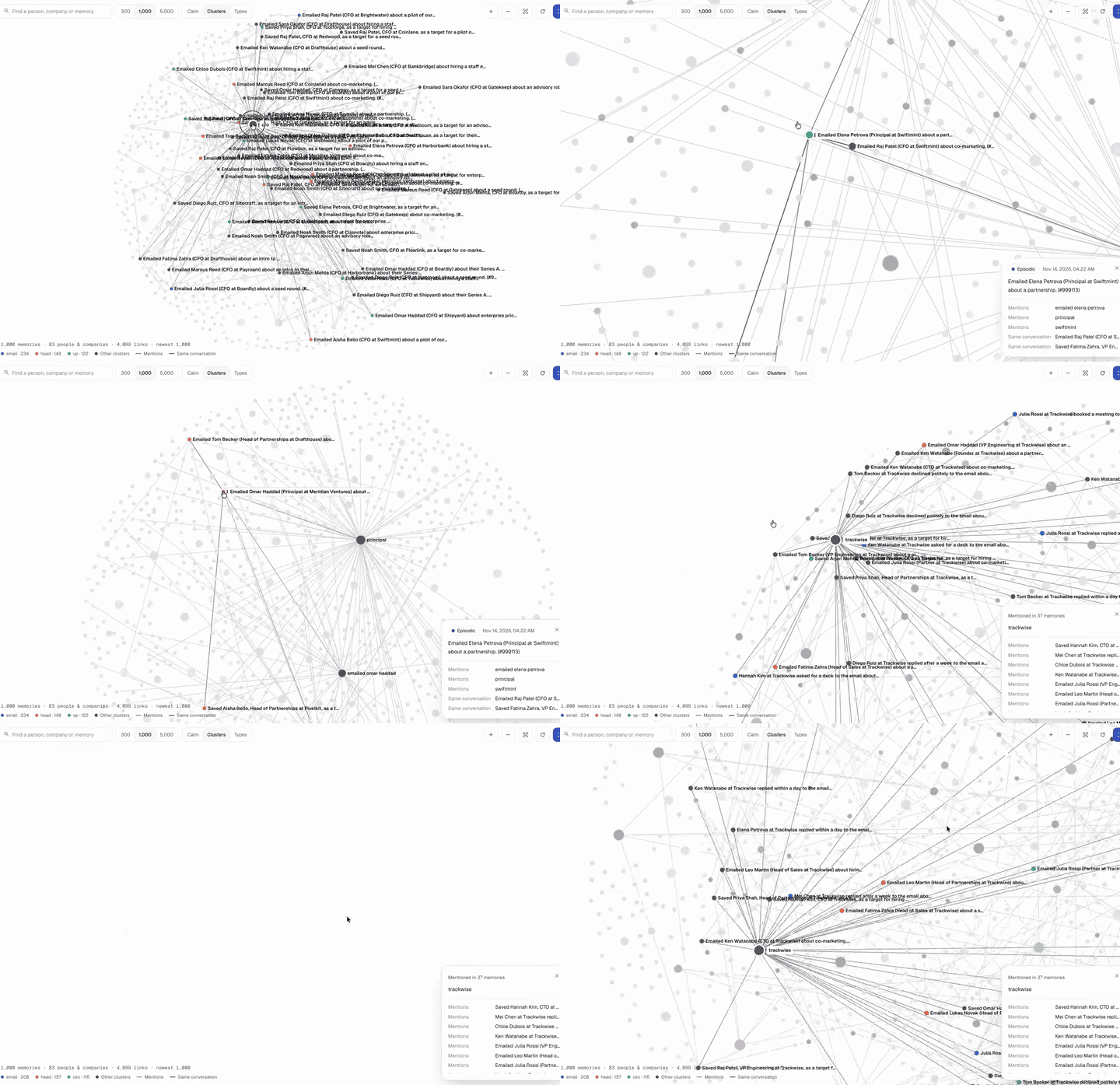
GET /memory/graphand a dashboard graph of memories and the people, companies and conversations linking them, now 2D WebGL with search, clusters and full screen, cached per agent. #46, #47, #51 - Coordination: server-side leases, intents and handoffs so several AI tools on one account don't edit the same files (
claim_task,pre_action_check,handoff_task, …); folder claims cover their files. #35, #39 - Self-hosting: a dashboard image and
docker-compose.release.ymlfor running prebuilt images without cloning. #30 - Benchmarks: reproducible LongMemEval results with costs, and a 100-question measurement subset with a CI gate. #27, #37
Changed
- Changing facts: search recognises when a newer memory supersedes an older one and resolves contradictions by intent and time. #45
- Search: keyword search matches parts of email addresses and domains; aggregate questions draw results from more conversations. #42, #51
- Auth (breaking for old clients): legacy v1 request signatures are disabled by default; replay protection and metrics added. #33
- The sign-in code email was redesigned, and app.memro.co has a clear sign-in title. #31, #48
Fixed
- Migrations are serialised with an advisory lock, so several server replicas can start at once. #36
- Signature hex is normalised for the replay cache and must be 128 hex characters. #32
Security
/metricsand/stats/cacherequire a token. #29- Device approval verification and smaller hardening items. #34
Upgrading
- Self-hosted servers run migrations 0033–0038 on start. 0034 builds a GIN index on
memorieswithoutCONCURRENTLY, which blocks writes while it builds: back up first and upgrade in a quiet window if the table is large.
Install
- Docker:
ghcr.io/memrohq/memro:0.1.1(signed with Sigstore) - Go:
go get github.com/memrohq/memro/sdk/go@v0.1.1 - Connect your AI tools:
npx memro-cli connect