Repository navigation
Optimal interpolation
Optimal interpolation (OI) can be used to create gridded analysis by combining a gridded background field (e.g. from an NWP model) with observations at points. OI weights the background and the observations based on the uncertainty of each data source.
The OI method in gridpp has so far been applied to temperature, precipitation, and cloud ceiling.
The covariance structure for the OI can be specified in two ways. One way is to define a static covariance function that is a function of horizontal distance, vertical distance, and land/sea differences. Gridpp can also use the covariance structure from an ensemble prediction system, which allows the covariance to be weather dependent.
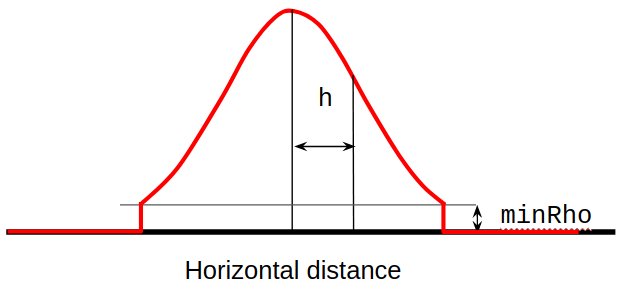
The observations used is limited by three options: h, maxLocations, and minRho. h sets the horizontal decorrelation length (in meters).
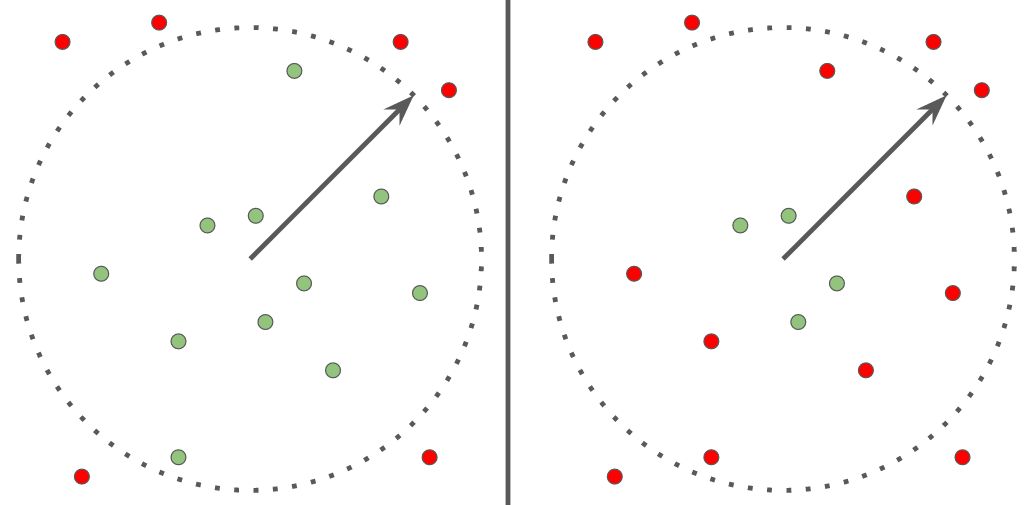
The image below illustrates how stations are selected (green) and discarded (red) for a particular gridpoint. In the left panel, all stations within some radius are selected, which is based on the set values for h and minRho.
Stations can be further limited by setting maxLocations. For example, if maxLocations=4, then only the 4 locations with highest rho value are used (as in the right figure). This reduces computation time significantly in some cases. It also allows for the correction to be localized in dense areas, while still allowing for a large h value such that corrections can be applied in sparse areas.
Observations decorrelate in he vertical too, and is set by the v option.
OI requires information about the uncertainty of observations and uncertainty of the background. sigma sets the standard error of the observation. For example, sigma=1 sets the standard error to 1 degree (for temperature). The uncertainty can be modified on a station-by-station basis (see Parameter Files below).
The uncertainty of the background comes from the ensemble spread. This spread is often too low and can therefore be inflated by setting the delta option. For example, delta=2 doubles the ensemble spread.
A Gaussian assumption is used, however the background and observations can be transformed using a box-cox transformation.
OI is designed for both temperature and precipitation and can be specified using type. When type=precipitation, the background and observations are transformed using a box-cox transformation.
The observations and background can be transformed before the OI is applied by using the transform option. Currently, only transform=boxcox is supported. This transformation can be used for precipitation. The sigma option is set in the transformed space.