Repository navigation


LocalAI 5.1.0 is out!
Pair your phone with your LocalAI server and use its Web UI from Android. On the server, llama.cpp can keep short chats moving while another request reads a long prompt.
Highlights:
- 📱 Android client ( experimental ) : Connect the Android client by URL or scan a one-time pairing invite. Models stay on the server.
- 🌐 p2p: Invite and revoke individual peers instead of sharing one network token across machines.
- 🦙 llama.cpp: Tune concurrent requests, prompt processing, and speculative decoding in the model editor.
- 📅 Add-ons: Let a calendar change move a reminder or cancel it when the event disappears.
- 🕶️ Incognito mode. Start a web chat with long-term memory off, or choose zero retention for the conversation.
📌 TL;DR
| Area | Summary |
|---|---|
| Serving | llama.cpp shares its KV cache across concurrent requests and queues work when the cache is full. |
| Clients and clusters | Use the Android client, pair workers over libp2p, and manage cluster access from the Web UI. |
| Automation | Start a run from a webhook or calendar change, and choose where it reports. |
| Add-ons | Inspect a Kubernetes cluster from a chat and read add-on libraries from OCI registries. |
| Models | New options include Strata's Inkling and Hy4 engines and the experimental Colibri backend for disk-backed inference. |
Before you upgrade
- P2P: Remove the legacy shared-token configuration and pair each machine again. Old settings can prevent startup. Follow the P2P migration guide. #13329
- Distributed clusters: Upgrade frontends and workers together. A shared registration token no longer authorizes worker heartbeats, and mixed versions cannot run the new backend upgrade protocol. #13386, #13447
- Model configuration API:
POST /api/models/config/{id}now returns410 Gone. Check clients that call this endpoint before upgrading. #13330
🚀 New Features & Major Enhancements
🦙 Serve concurrent chats with llama.cpp


With more than one slot, LocalAI's llama.cpp backend now schedules requests against a shared KV cache by default. A request waits if its prompt and output reserve do not fit. Long prompts are processed in chunks so that chats already generating tokens can continue. On a DGX Spark (GB10) serving Ornith-1.5-35B-A3B Q8_0 through LocalAI, we compared the four-slot baseline with 16 slots and paged serving. With about 16 requests in flight, both configurations completed 128 of 128 requests across two runs.
| Metric | 4-slot baseline | 16 slots, paged serving |
|---|---|---|
| Aggregate output tokens/s | 81.0 | 153.3 |
| Median time to first token | 35.5 s | 8.3 s |
The 89% throughput gain is across concurrent requests. In the same workload, keeping four slots and enabling the new defaults changed throughput little.
In a separate Qwen3-8B test on the same GPU, processing an 8k-token prompt in chunks of 256 tokens cut the longest pause in an ongoing chat from 690 ms to 109 ms. The long prompt itself waited 0.5 s longer for its first token at the 99th percentile. Benchmark setup and full results
Automatic prompt caching. When several chats start with the same long system prompt, llama.cpp can reuse the work it has already done, even while the first chat is still generating. With paged serving, requests that share at least 256 leading tokens can reuse that prefix from another active slot. Each request still generates its own answer. No client changes are needed. Set slot_attach:false to disable sharing between active slots.
In the Qwen3-8B benchmark on DGX Spark, 32 requests per run used the same system prompt. With sharing on, llama.cpp processed 3,945 prompt tokens per run instead of 7,989, and median time to first token fell from 220 ms to 110 ms. Both configurations completed all 96 requests across three runs.
Open Runtime tuning in the model editor to choose concurrency settings for unified memory, a discrete GPU, or CPU. The Drafting section shows the controls for the mode you select. MTP is offered for models with a compatible head; n-gram drafting is most useful when the output repeats part of the input.
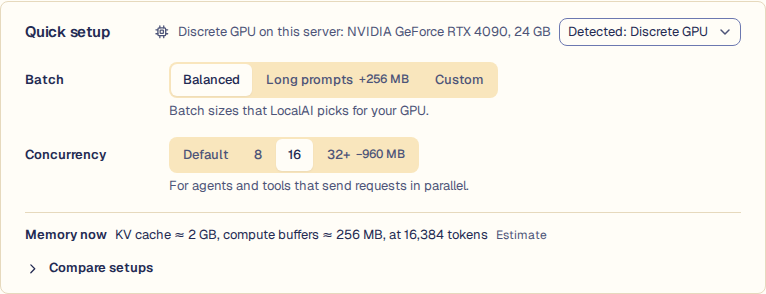
Quick setup estimates memory use for each batch and concurrency preset on a discrete GPU.
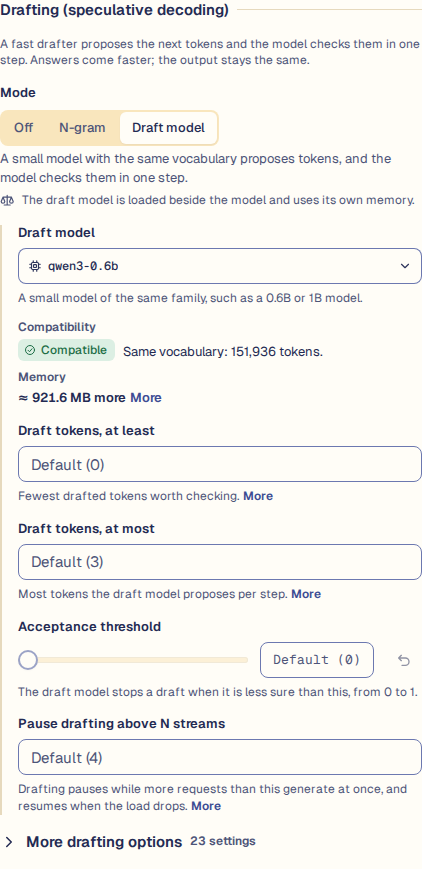
The editor checks the draft model’s vocabulary and estimates how much memory it adds.
📱 Pair an Android phone, worker, or remote server
The Android app opens a remote server's Web UI. Enter a URL or scan an invite QR code, preview the peer, then tap Pair. The phone does not run a model or start a LocalAI server. Password and API-key sign-in are supported; OAuth-only servers are not.
For existing P2P installations: libp2p replaces the shared-token network. Pair each machine with its own one-time invite so you can revoke it without disconnecting everyone else. Peers can connect directly or through a relay you operate. For distributed workers, the WebSocket and PostgreSQL transport is an alternative to NATS. LAN invite links now carry local addresses, and paired remotes can reconnect when the server changes IP.
📅 Start a run when something changes
Give a trigger a webhook, or watch events from an add-on. Calendar is the first watch source: a reminder follows the event when someone reschedules it and is cancelled when the event is deleted. Give it a task, such as preparing material before a call, and choose where the run sends its report. If delivery fails, the reminder falls back to the Inbox.
🕶️ Choose what a web chat remembers
Memory-off prevents a chat from reading or writing long-term memory. Logs and traces remain. Zero-retention also prevents LocalAI from persisting the conversation; it still records usage counters. Admins can disable incognito or cap the permitted level. These controls apply to web sessions, not API-key requests. They do not cover backend process output or worker logs and temporary files.
🔗 PRs: #13496
☸️ Inspect Kubernetes from a chat
Connect the Kubernetes add-on with a kubeconfig to inspect workloads, read logs, and check cluster events. Writes are off until an admin enables them for that cluster. Apply and patch support dry-run diffs. Admins can restrict namespaces and hide Secret values; Secret values are readable by default where the credential permits access.
Add-on libraries can come from OCI artifacts, including private registries. You can pin the signer identity and source repository rather than trusting any signed artifact.
🧩 Bring plugin skills into a chat
Open Plugins to install a Claude Code-format plugin from a marketplace at a pinned revision. Chats can use its skills, slash commands, and HTTP MCP connectors. Refreshing the marketplace does not update installed plugins. Saved agents need an explicit grant. Plugin-defined agents, hooks, and stdio MCP connectors do not run in this release.
🔗 PRs: #13525
🧠 Run more model families
Strata adds engines for Tencent Hy4-Flash and Inkling. The gallery also adds Inkling 2 Mini, Qwen3.8-Flash-Next v3.1 builds, and Oruk Fourier 2B for audio-cpp. The dedicated olala backend loads Olala v1.0 mini 7A1B GGUF models, including on Linux ARM64.
Colibri is experimental. It keeps dense weights in RAM and reads experts from disk, so you can try mixture-of-experts models that would not fit in memory. On large models, disk-backed generation can run at a few tokens per second or less; choose it for capacity rather than interactive speed.
🔗 PRs: #13374, #13377, #13388, #13389, #13410, #13436, #13480, #13509
🔄 Follow updates on the server
Model, backend, and add-on updates run on the server. You can leave the page and check progress later. A failed backend upgrade no longer removes the installed backend. The desktop launcher's dev channel can update from the dev-master feed.
🐛 Bug Fixes (recap)
fix(distributed): A failed replica no longer unloads healthy replicas on other workers. Explicit batch sizes are preserved when routing to a worker. #13448, #13481, #13491fix(voice): Remote voice recognition workers receive the audio file instead of a frontend-only path. Parakeet end-of-utterance detection no longer loses spoken turns in transcription mode. #13495, #13504fix(strata): Streaming clients receive tool calls and reasoning as deltas rather than fragments of tool-call markup. #13392fix(importers): Model imports honor registry names, parameters, and projectors, and verify downloaded blob digests. #13384fix(launcher): Remote OAuth and OIDC sign-in redirects can complete inside the desktop Web UI. #13484fix(packaging): CUDA packages include the cuDNN tensor IR library for versions that ship it, starting with 9.21. #13442, #13512fix(addons): One unavailable library no longer empties the whole catalog. A stale add-on process ID no longer prevents server startup after a container restart. #13348, #13555
👒 Dependencies
The release range includes eight automated updates each for llama.cpp and ik_llama.cpp, seven for audio.cpp, six for CrispASR, and five each for Strata and whisper.cpp. Parakeet and llama-cpp-turboquant each received two; stable-diffusion.cpp and the CTranslate2 ROCm wheel each received one.
📖 Documentation
The README links directly to desktop downloads, and the website lists Windows alongside the other desktop platforms. Turkish translations now cover the React UI and add-ons. #13499, #13519
🙌 New Contributors
Thanks to @fschueller (#13344), @rossigee (#13333), @CodeByZach (#13363), @rajanrawal (#13392), @Kirep-06 (#13417), @shotsan (#13442), @assembledev (#13445), and @ozkanozcan (#13519) for their first merged contributions.
Full Changelog: v5.0.1...v5.1.0


