Repository navigation
Releases: naoufalelbani/opencode-qoder-bridge
Release list
OpenCode Qoder Bridge 0.4.0 - Qoder CN, VPC, and Daily Check-in

OpenCode Qoder Bridge 0.4.0
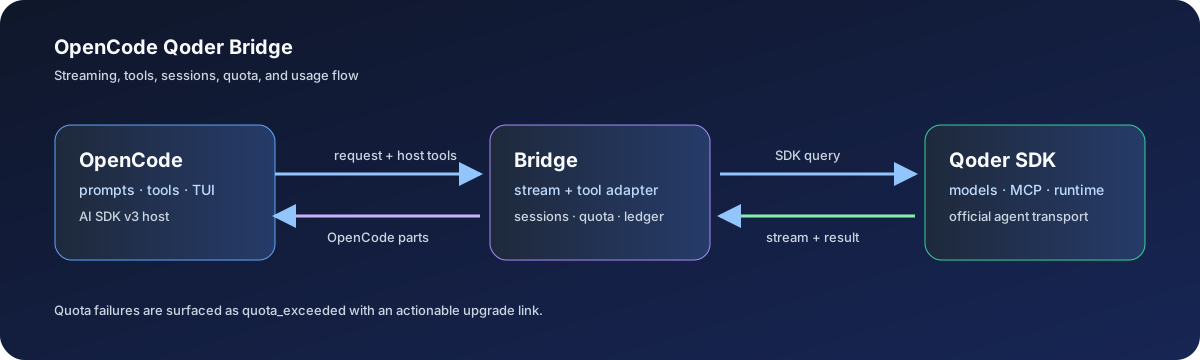
Use Qoder global and Qoder CN accounts in OpenCode 1 and OpenCode 2 through Qoder's regional Agent SDKs. This release adds CN browser sign-in, guided Enterprise VPC setup, and daily credit check-in.
What's new
- Qoder CN browser sign-in: connect a qoder.cn account from OpenCode using the Qoder CN Agent SDK, with device-token refresh support.
- Qoder CN Enterprise VPC: follow a guided sign-in flow, save the account's validated private endpoint, and route model discovery, chat, quota, refresh, and check-in requests through the VPC gateway.
- Daily Qoder credits: run
/qoder_checkinor use theqoder_checkintool with a browser-signed-in account. - Clearer recovery guidance: quota, queued model, rejected request, and expired sign-in responses now provide more actionable guidance.
OpenCode Qoder plugin highlights
- Supports OpenCode 1 and OpenCode 2.
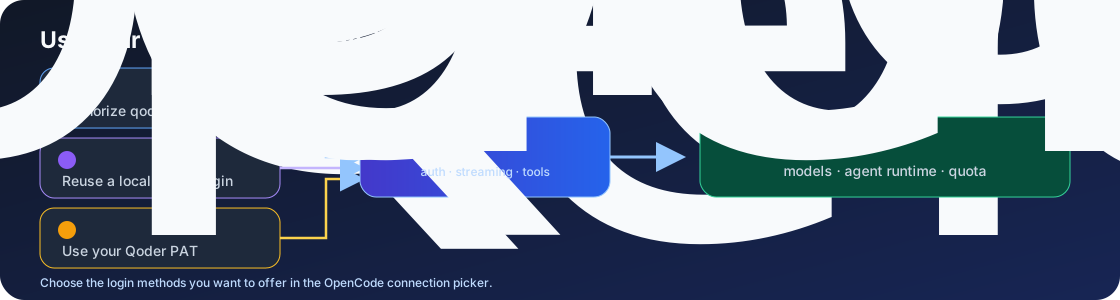
- Sign in through the browser, an existing regional Qoder CLI login, or a Qoder personal access token.
- Uses the official Qoder Agent SDK for model requests and agent features.
- Includes Qoder tools, MCP bridging, live quota, local usage history, and model discovery.
Install and upgrade
Install opencode-qoder-bridge from npm and follow the OpenCode quick start. See the 0.4.0 changelog for the full change list.
This is an independent community plugin and is not affiliated with Qoder or OpenCode.
v0.3.0 - OpenCode 2 and browser sign-in
OpenCode 2 support, browser sign-in, and faster startup
opencode-qoder-bridge 0.3.0 brings the Qoder integration to OpenCode 2 while retaining OpenCode 1 support in the same package. It adds browser authorization for qoder.com accounts, improves startup while models load, and fixes file tool calls that were missing the path field expected by OpenCode 2.
Sign in with the method that fits your setup
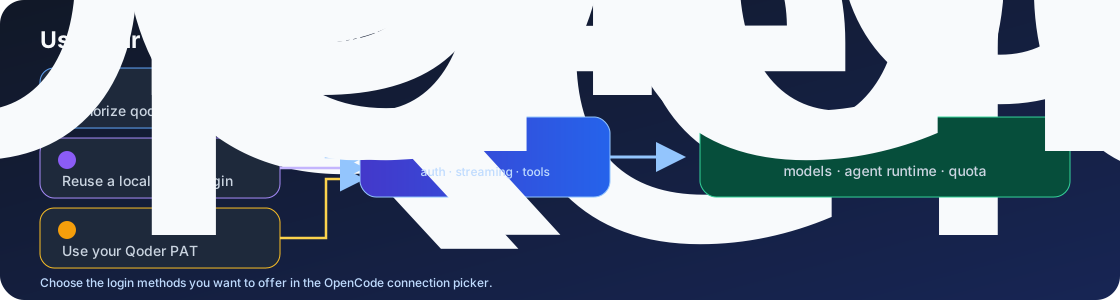
Choose browser authorization for qoder.com, an existing Qoder CLI login, or a personal access token. All three methods feed requests to the official Qoder Agent SDK. Existing Qoder CLI login is preferred by default; set QODER_AUTH_MODE=browser to use the saved browser sign-in when both are available. CN-region users can continue using the CN CLI flow.
What changed
- OpenCode 2 support: The package exposes the OpenCode 2 plugin and TUI interfaces and retains the OpenCode 1 server plugin. OpenCode 2 users can configure plugin options through
plugins: [{ package, options }]orproviders.qoder.settings. - Browser authorization: Sign in to qoder.com through OpenCode's OAuth flow. OpenCode stores the job and refresh tokens; the bridge refreshes credentials before SDK requests.
- Faster model availability: OpenCode 2 registers cached or fallback models first, then discovers the live Qoder catalog in the background.
- Reliable file tools: Forward the file path key expected by OpenCode 2, fixing Qoder
Readcalls that previously failed with a missing-path error. - Authentication improvements: Prefer an existing Qoder CLI login by default, with
QODER_AUTH_MODE=browseravailable to select the saved browser login. - Updated runtime and dependencies: Qoder Agent SDK 1.0.51,
@ai-sdk/openai-compatible3.0.67, refreshed OpenCode and AI SDK dependencies, and updated security pins.
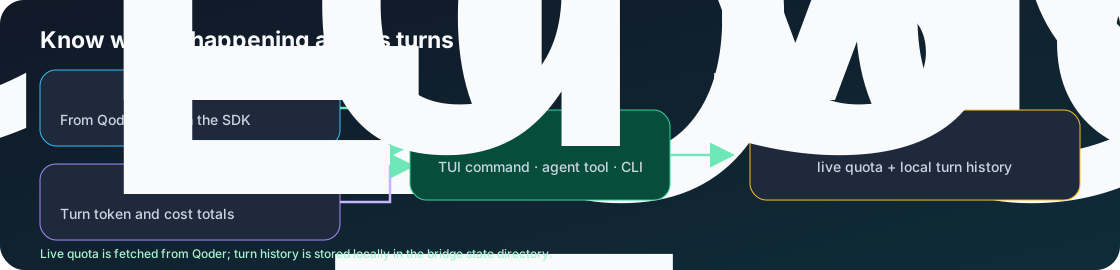
Live quota, per-turn usage history, sessions, MCP support, image inputs, and cost reporting remain available.
Install or upgrade
npm install opencode-qoder-bridge@0.3.0Add the package to your OpenCode plugin configuration. OpenCode 2 uses:
{
  "plugins": ["opencode-qoder-bridge"]
}
OpenCode 1 uses the singular plugin key:
{
  "plugin": ["opencode-qoder-bridge"]
}
Then sign in from OpenCode with opencode auth login qoder --method oauth, or use a Qoder CLI login or QODER_PERSONAL_ACCESS_TOKEN. Browser OAuth in this release is for qoder.com accounts; use the CN CLI login for Qoder CN.
Requirements
- Node.js
^22.22.2,^24.15.0, or>=26.0.0 - OpenCode
>=1.18.29
Validation note
Authenticated SDK E2E completed using an existing Qoder CLI login on Node 24.19.0. Browser account authorization and refresh still need a live OpenCode sign-in check; the SDK's jobToken() callback is marked internal in version 1.0.51.
For configuration details and the full changelog, see the README and CHANGELOG.
v0.2.0 - lockstep release with pi-qoder-bridge
Lockstep 0.2.0 release with pi-qoder-bridge@0.2.0.
Added
initTimeoutMs(default 60s, 10s–5min): aborts wedged runtimes with retry guidancemaxTurns/goalMaxTurnscaps (positive integers, SDK defaults govern otherwise)sdkDebugflag + qodercli stderr capture into the redacting debug logpermission_deniedevents surface as assistant text- Sidebar render hardening against stale host API
- Two-repo sync contract (RELEASING.md)
Full changelog in CHANGELOG.md.
v0.1.26
Added
- Latest stable Qoder/OpenCode integration dependency updates with the Qoder SDK approval entry synchronized.
Changed
- Retained
solid-js@1.9.12as a documented compatibility hold because@opentui/solid@0.5.12requires that exact peer. - Refreshed package metadata and lockfile.
Fixed
- Narrowed the tracked-file credential scan to avoid false positives from command names and test-only dummy credentials.
Validation
- Local typecheck, full check, stress tests, E2E, npm audit, package dry-run, build, and diff checks passed.
- CI passed on Node 22.22.2 and 24.15.0; audit and Snyk passed.
- Authenticated Qoder E2E was skipped because credentials were unavailable.
v0.1.24
What's Changed
- release: v0.1.23 by @naoufalelbani in #2
- release: v0.1.24 by @naoufalelbani in #3
New Contributors
- @naoufalelbani made their first contribution in #2
Full Changelog: v0.1.22...v0.1.24
Contributors

Assets 2
v0.1.22
What changed
- Added clean npm package installation verification.
- Added package-install checks to CI and security workflows.
- Retained SDK stream resource protections and protocol contract tests.
Validation
- 169 tests passed, 2 skipped.
- 13 stress tests passed, 1 skipped.
- Clean package installation passed.
- npm audit: 0 vulnerabilities.
v0.1.21
What changed
- Added a 100,000-event Qoder SDK stream limit.
- Added SDK protocol contract coverage.
- Updated the package changelog and release metadata.
Validation
- 168 tests passed, 2 skipped.
- 13 stress tests passed, 1 skipped.
- npm audit: 0 vulnerabilities.
v0.1.20
What changed
- Added unsafe configuration warnings.
- Added debug diagnostics for unknown future SDK message types.
- Added npm registry visibility verification after trusted publishing.
- Preserved OpenCode ownership of retries, UI, cancellation, and orchestration.
Validation
- 160 tests passed, 2 skipped.
- 13 stress tests passed, 1 skipped.
- npm audit: 0 vulnerabilities.
v0.1.19
What changed
- Updated Qoder Agent SDK to 1.0.46.
- Added an absolute two-hour Qoder turn limit, configurable with
options.maxDurationMsup to seven days. - Added request correlation IDs to opt-in debug logs.
- Classified transport failures as
network_error. - Preserved OpenCode ownership of retries, cancellation UX, and session orchestration.
Validation
- 160 tests passed, 2 skipped.
- 13 stress tests passed, 1 skipped.
- npm audit: 0 vulnerabilities.
- Package dry-run validated.
v0.1.18
Added
- Added explicit quota exhaustion reporting with an actionable Qoder upgrade link.
- Added README badges and an architecture diagram for installation and project orientation.
- Added regression coverage for quota errors and replayed stream frames.
Changed
- Updated the Qoder Agent SDK dependency to
1.0.45. - Reclassified Qoder credit-limit failures as
quota_exceededinstead of the genericerror_during_execution. - Made replayed and late stream frames idempotent after block closure.
Fixed
- Prevented quota data with
total: 0from being rendered as misleading0/0or unavailable account usage. - Preserved structured Qoder errors when a result arrives before all block-stop frames.
- Kept the SDK install-script allowlist aligned with the dependency version.
Validation
- Full tests: 162 passed, 0 failed, 2 skipped.
- Stress tests: 13 passed, 0 failed, 1 skipped.
- Typecheck, package dry run, and npm audit passed.
- Live Qoder generation reached the SDK; account quota exhaustion was reported explicitly by Qoder.