Repository navigation
Architecture
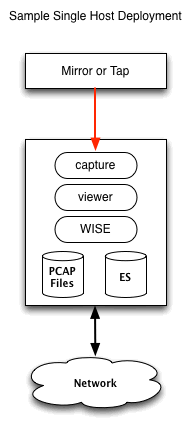
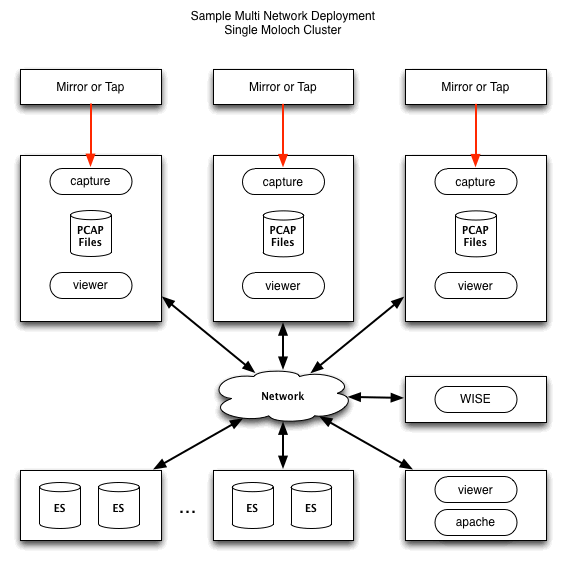
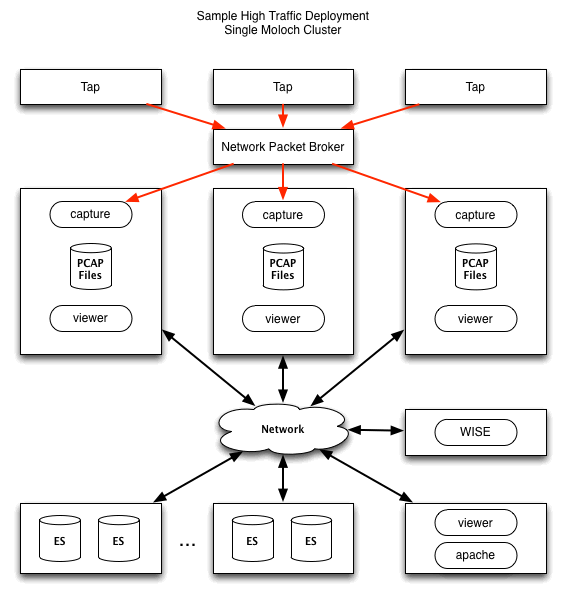
Here are some sample deployments of Moloch for different network architectures. Most folks will probably run a hybrid of the following since no one solution fits all. When planning please take into account that currently a single moloch-capture can only process around 2Gbps with no packet drops. The ability to scale either multiple capture machines or multiple-capture process per machine is needed.
Legend/Info:
- A box represents a physical machine.
- It is possible to run multiple capture processes per machine
- Run multiple Elasticsearch processes per machine since each ES node should be configured at most to 30G
- Except for single host, it is recommended/useful that all operator access flows through a single apache/viewer combination that can provide better authentication, logging, and a single choke point
Security
- All ES instances should have iptables for port 9200-920N and 9300-930N, where N is the number of ES instances per machine, and only allow the other elasticsearch, capture and viewer machines to connect
- All viewer hosts, except the apache/viewer box, should have iptables for port 8005 and only allow other viewer machines to connect. The viewer must listen on OS interface if using multiple machines
- The shared viewer instances can listen on localhost since only apache talks to it
Notes:
- Using a Network Packet Broker allows traffic to be load balanced. This is especially useful in HA or asymmetric routing
- By using a NPB other security devices can see the same traffic moloch sees
- When running multiple moloch-captures on the same host make sure the IO doesn't over whelm the disk and other subsystems.
- Use a TAP with High Traffic Networks since many mirror ports drop traffic under heavy load
- Operator uses an apache fronted viewer and don't hit the other viewers directly. The apache provides authentication.
Notes:
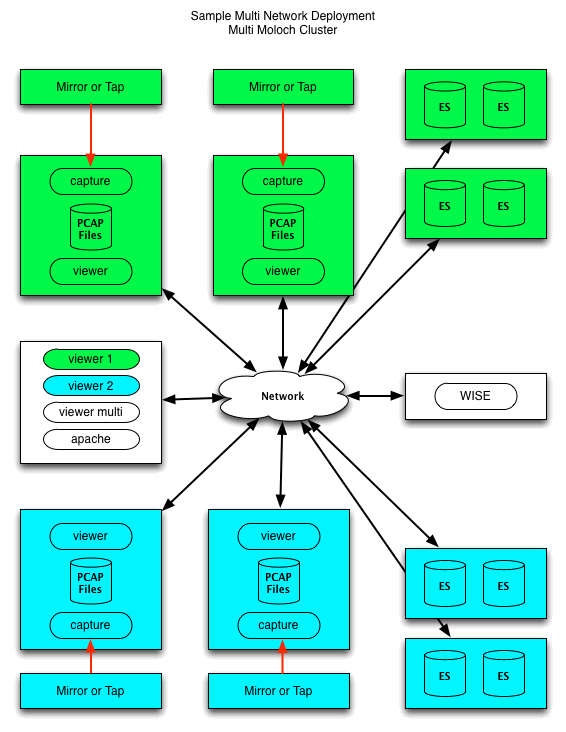
- It is possible to use a single ES cluster using the prefix= ini configuration
- Operator uses apache fronted viewers and doesn't hit the other viewers directly. The apache provides authentication. Can use virtual paths to route to different clusters.