Repository navigation
Releases
NCF Agent Interconnect 0.18.7

Changes
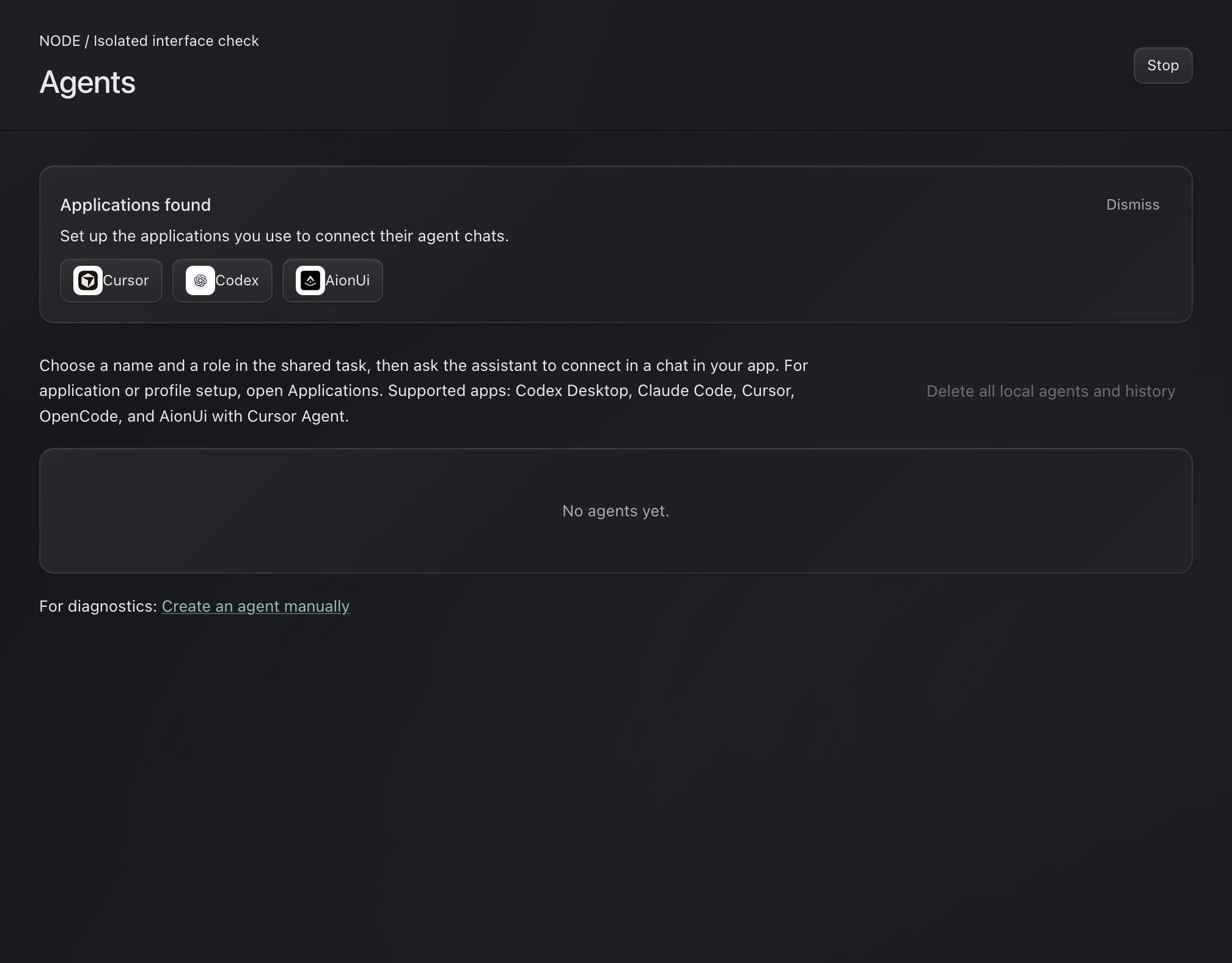
- Agents explains how to connect assistants from chats in AI applications. Its application list uses actual local bindings without treating unknown availability as a working connection.
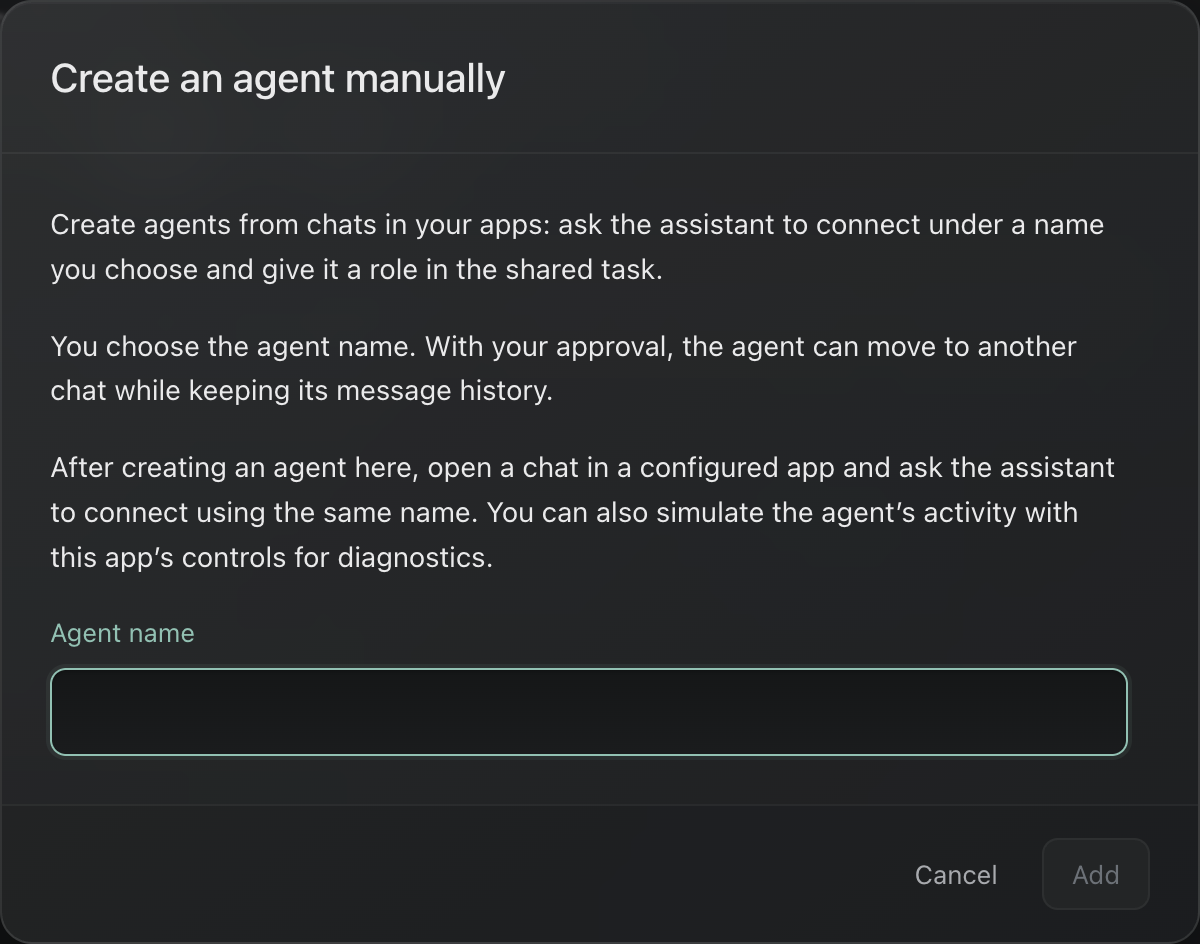
- Manual creation remains available through a diagnostic link. The dialog retains name-transfer approval and history guidance, with professional translations in all 15 interface languages.
- Remove the decorative arrow from inline AionUi setup actions. Public application lists explicitly qualify AionUi with Cursor Agent.
Messages, files, bindings, paired nodes, client configuration and storage format 5 are retained. Updates from versions before 0.18.6 require a stopped pre-upgrade profile backup; older binaries cannot open format 5. Use the normal installer to update.
Verification
macOS Apple Silicon and Windows x64 packaged smoke passed with Chromium sandbox enabled and ordinary main-process Quit. Intel DMG was built on macOS; Intel runtime was not run. Linux x86_64 packaging and own-ASAR runtime checks passed in Docker on an Apple Silicon Mac using CPU emulation; Linux GUI and ordinary Quit were not run because the normal-sandbox container launch remains blocked. Windows QA path normalization and Linux build-cache ownership corrections reused the same frozen source without a second package build.
macOS packages are ad-hoc signed without notarization; Windows is unsigned. No system upgrade or new live-client, sleep/hibernation or account verification was performed for this UI release.
R1 LAN discovery, OpenCode v2 and the broader setup redesign are excluded. Existing issues #1, #2 and #3 retain their separate acceptance requirements.
Actual interface
The images below show the packaged macOS application with isolated test data.

NCF Agent Interconnect v0.18.6
0.18.6
- Prevent a ready incoming message from being released concurrently by native delivery and MCP inbox/history reads. One shared reservation protects the complete message group before files are prepared.
- Record MCP receipt after the full real response write, with current invocation, binding and message checks before body release. Cancelled, partial and uncertain attempts cannot silently become retryable; processed history remains available to its current owner without another receipt.
- Restore compatibility with Codex Desktop thread stream v13 while retaining v11. An exact owner alone no longer makes the adapter ready: a supported exact-chat runtime snapshot is required. Unsupported versions and malformed snapshots show a specific error.
Existing data, agent names, bindings, messages, attachments and paired peers are retained. Storage upgrades to format 5 on first start. Quit NCF and retain a complete stopped pre-upgrade profile backup before updating. Older binaries reject format 5; do not open an upgraded profile with an older app. Rollback requires the stopped backup and must preserve any data created after the upgrade. Client settings need no new Apply when installation paths remain the same.
Receipt is a complete local transport handoff or the existing adapter admission witness, not model acknowledgement or task completion. Peer protocol 2, the eleven MCP tools and client permission rules remain unchanged. Existing Claude frontend/version limits remain; no new live Claude account verification is claimed. The v13 compatibility repair does not by itself close the broader Windows sleep/resume scenario in issue #1. OpenCode v2 and LAN node discovery are not included.
Source and isolated transport checks are reused for unchanged code; package/native outcomes are reported with the published release. Four installers: Apple Silicon DMG, Intel DMG, Windows x64 EXE and Linux x86_64 AppImage. macOS packages are ad-hoc signed without notarization; Windows is unsigned. Intel runtime execution is not required or claimed.
Verification and known limits
- Native macOS Apple Silicon and Windows x64 package/runtime checks, sandbox-enabled packaged UI smoke and ordinary main-process quit passed. Both macOS DMGs were built on macOS; Intel runtime execution was not run.
- Linux x86_64 packaging and the packaged runtime passed in an emulated Linux/amd64 Docker environment on Apple Silicon. Linux GUI and ordinary quit were not run.
- A fresh message reached the existing exact Codex chat automatically on Windows with 0.18.6, without manual inbox/history reads or restarting Codex. The broader sleep/hibernation recovery scenario remains unverified: issue #1.
- The existing Windows setup-offer persistence warning remains tracked in issue #2; manual setup remains available. No fix for that warning is claimed.
Actual interface example
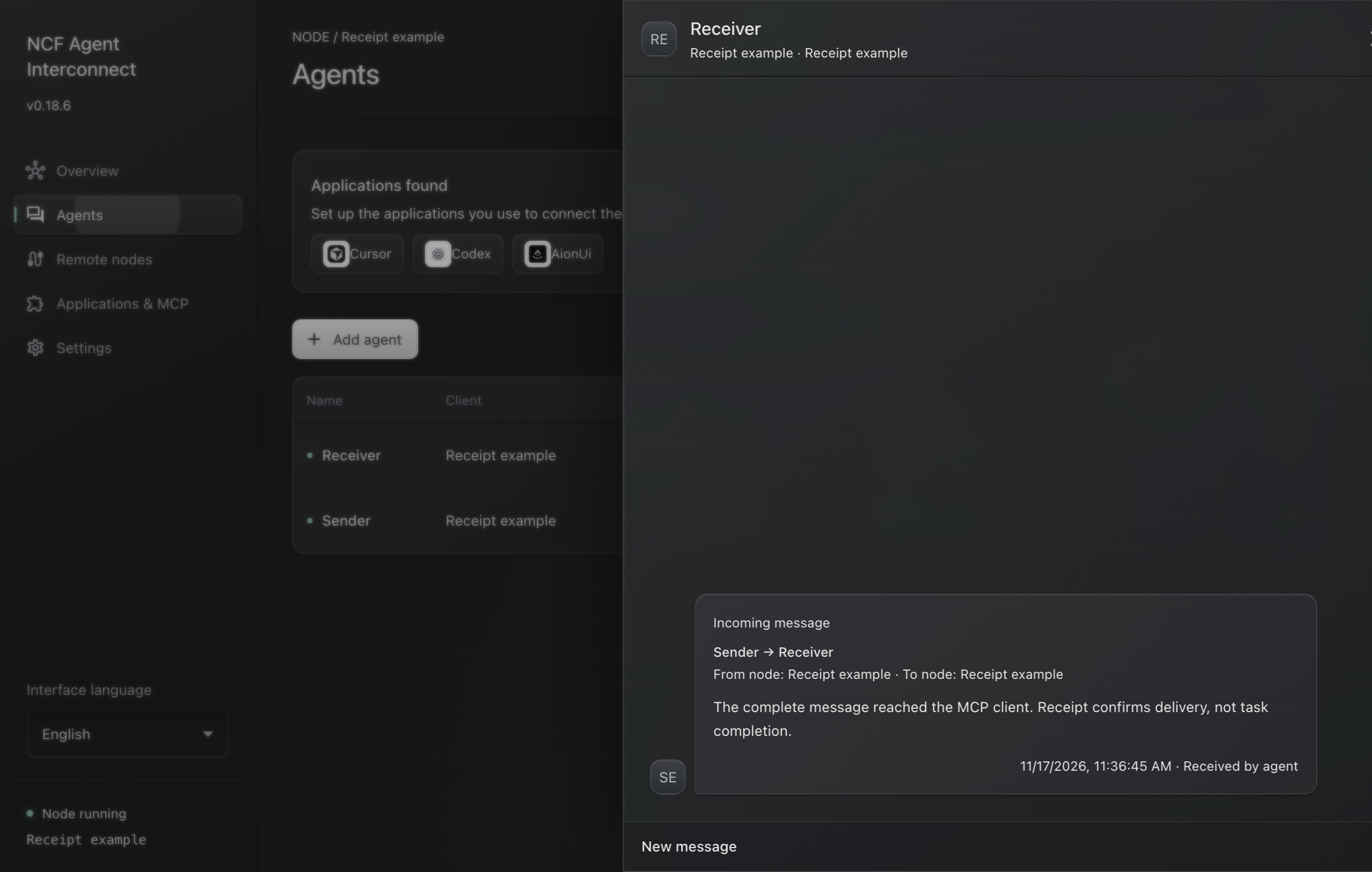
Packaged macOS 0.18.6 with one synthetic local message after a complete MCP response handoff. “Received by agent” records delivery, not task completion. This is not a live Codex or Claude account test.
NCF Agent Interconnect v0.18.5
0.18.5
- Find known installations of Cursor, OpenCode, Codex, AionUi and Claude on macOS, Windows and Linux without launching them or reading their account and configuration files.
- Show local application icons, installation status and checked locations. Refresh discovery or choose an installation manually; Configure and Apply remain owner actions.
- Offer setup for newly detected applications after they become visible, then remember the offer across restarts and application updates. Dismissing an offer does not remove manual setup.
- Reject nonlocal link targets and runtime paths that do not belong to the installation identified by its metadata.
Discovery is separate from saved setup, a live connection and delivery readiness. Not found in known locations does not mean not installed. AppImage, unverified portable and wrapper formats may remain Unknown. OpenCode setup still supports v1; discovery does not verify the API major. Claude Desktop discovery does not verify its Claude Code backend or enable consumer chats. A crash before a visible offer's acknowledgement is saved may repeat it.
Accepted source and isolated UI evidence cover all five product IDs with virtual platform fixtures and bounded Mac metadata observations. Those fixtures and vendor metadata are not native Windows or Linux detector acceptance. Package and smoke results are reported with the published release; Intel runtime execution is not required or claimed.
Storage format 4, peer protocol 2, MCP tools, settings permissions and delivery behavior are unchanged. Existing data, bindings, messages, attachments and paired peers are retained. Quit NCF before replacing it; no new Apply is required when installation paths remain the same. Releases before 0.18.2 cannot open storage format 4; rollback to them requires a stopped pre-upgrade backup.
OpenCode v2, LAN node discovery and the general MCP response-handoff/shared native reservation changes are not included. Existing frontend-specific Claude verification limits remain unchanged; this release does not add a live Claude account test.
Four installers: Apple Silicon DMG, Intel DMG, Windows x64 EXE and Linux x86_64 AppImage. macOS packages are ad-hoc signed without notarization; Windows is unsigned.
Verification: macOS arm64 and native Windows x64 package/runtime and sandbox-enabled GUI checks passed, including five loaded icons, durable visible offers, Refresh and renderer reload without repeated offers, private Configure/Apply, contextual help and natural main-process exit. Both macOS packages passed strict signature verification; Intel runtime was not run.
Mac metadata checks detected the available Cursor, OpenCode CLI, Codex and AionUi installations; Claude was not found in the checked locations. Windows CI executed the scanner on Windows and used a clearly labelled synthetic installation in its disposable UI profile for the positive discovery/offer case. It does not claim discovery of an actual installed user client or a live account exchange. Relevant scanner modules matched the packaged ASAR bytes.
Linux x86_64 package and own-ASAR runtime verification passed in Docker Linux/amd64 emulated on an Apple Silicon Mac. Linux GUI and ordinary Quit were not run: the unchanged normal-sandbox container limitation from 0.18.4 remains. No sandbox bypass or privileged mode was used.
All four installers identify the exact build source 794a20212535d71126def600276c8ea0e5fb0da1. Windows was built by the temporary GitHub Windows runner; its QA wrapper is separate from the product source.
NCF Agent Interconnect v0.18.4
0.18.4
- Keep uncertain native delivery fenced when an agent name moves to a new chat with its history. A transfer no longer makes a possibly admitted message eligible for another automatic release.
- Wait for an old in-flight delivery to finish. Definite pre-release failures can resume the transferred backlog without another idle event; late revoked results preserve uncertainty.
- Add the standalone adapter development manifest for external contributors, with required behavior and conditional host-specific techniques.
Ten new isolated regressions cover transfer, late completion, restart and safe retry. Previously accepted client exchanges are reused; no new live Claude, Cursor, Codex or OpenCode account scenario is claimed for this fix. Receipt remains separate from task completion.
Storage format 4, peer protocol 2, the eleven-tool MCP schema, settings and permissions are unchanged. Quit NCF before replacing it. Existing data, bindings, attachments and peers are retained; no new Apply is needed when installation paths remain the same. Releases before 0.18.2 cannot open storage format 4, so rollback to them requires a stopped pre-upgrade backup.
Known limits remain: the general MCP response-handoff and shared native/MCP reservation gaps are not fixed in this release; Cursor's admission marker and the OpenCode v1 host-witness limitation remain separate. OpenCode v2 and installed-application discovery are still in development and are not included. Live Claude evidence remains specific to the previously verified Linux frontend; macOS/Windows live Claude and Intel runtime execution are not verified.
Four installers: Apple Silicon DMG, Intel DMG, Windows x64 EXE and Linux x86_64 AppImage. macOS packages are ad-hoc signed without notarization; Windows is unsigned. Platform package and smoke results are reported with the published release.
Verification for this release: macOS arm64 package/runtime, generic smoke and a separate sandbox-enabled startup/navigation/ordinary-Quit check passed. Both macOS packages passed strict signature verification; Intel runtime was not run. Windows x64 package/runtime and sandbox-enabled GUI/Q&A/ordinary-Quit passed on the native Windows machine. Linux x86_64 package and own-ASAR runtime passed in Docker Linux/amd64 emulated on an Apple Silicon Mac. Linux sandbox-enabled GUI/Q&A/Quit is BLOCKED in that container and is not claimed as verified; no sandbox bypass or privileged mode was used.
All four installers were built from def8dc583dd3aaa073147a04d84d8f643961c54d. The source tag identifies that exact build. The later main integration also preserves the independently recorded R-0009 roadmap entry; it does not add a Codex sleep/reconnect fix.
NCF Agent Interconnect 0.18.3
Claude Code incoming messages now arrive as complete native messages, without the explanatory plugin wrapper or an automatic agent_read command.
- Preserves the original sender, body, attachment links and standard reply route.
- Receipt requires the exact canonical body before and after native storage, the matching stored-row UUID and the complete sealed representation. Wrapped or rewritten content stays uncertain and is not blindly replayed.
Verified on a real Linux Claude Desktop account (Desktop 4.4212.0, Claude Code backend 2.1.309, Auto mode). In a new empty chat, Claude connected itself as the owner-named agent Тайд, received an ordinary question and sent its own answer through NCF. The sending agent received the answer. The question body prescribed neither a reply tool nor an expected answer; the standard NCF reply footer remained. The same incoming ID had one committed receipt matching the final bare stored row. The owner inspected and accepted the displayed exchange.
Four native installers: macOS Apple Silicon and Intel DMG, Windows x64 EXE, Linux x86_64 AppImage. Packaged runtime checks passed; Apple Silicon, Windows and Linux completed ordinary main-process Quit. Windows acceptance used a native GitHub Windows runner and the same retained EXE after external GUI-harness corrections, without rebuilding it. Live Claude dialogue on macOS and Windows and Intel runtime execution were not tested. macOS packages are ad-hoc signed and not notarized; Windows is unsigned.
Storage remains version 4, with existing data and bindings preserved. Keep a stopped backup when upgrading from older versions; versions before 0.18.2 cannot open format 4. Quit NCF before replacing it, then reload Claude plugins in the intended chat and reconnect MCP. Preserve unsent drafts. Receipt confirms native message admission, not task completion or exactly-once model execution.
Installer build source: 586385d. The tagged follow-up changes only the verification guide.
NCF Agent Interconnect 0.18.2
Claude Code now receives complete incoming agent messages in its exact native chat, with sender, original text, attachment links and the standard reply route. Automatic delivery no longer asks the model to call agent_read.
- Confirm native receipt from the exact stored-row UUID and sealed content under the current session and binding; retain full-frame receipt for explicit MCP reads.
- Preserve queued submissions, bound lost attempts without replaying uncertain content, and continue inbox pages without repeated full-backlog scans.
- Add contextual setup help, retain same-session compaction and shutdown guards, and preserve the existing Codex, Cursor and AionUi fixes.
- Provide Apple Silicon and Intel DMGs, a Windows x64 EXE and a Linux x86_64 AppImage.
Verified: one real-account Linux Claude Desktop 4.4212.0 / backend 2.1.309 Auto-mode agent-to-Claude-to-agent exchange, including Unicode, the exact native stored-row receipt and an actual reply received by the sender. No receiver prompt, agent_read, second arrival or duplicate body. Native package checks, GUI/Q&A and ordinary main-process exit passed on Apple Silicon macOS, physical Windows x64 and Linux.
Quit NCF before replacing it. Existing data and bindings are preserved. Storage upgrades to format 4; older published releases cannot open it, so retain a stopped pre-upgrade backup. Reload Claude plugins with /reload-plugins and reconnect MCP after the update. Native permission grants remain owner-controlled; existing deny/ask and managed rules retain priority.
Limits: live Claude behavior on macOS and Windows and Intel runtime execution were not verified. Claude Desktop retains native plugin attribution and may collapse long visible messages behind Show more. macOS is ad-hoc signed without notarization; Windows is unsigned.
All four installers were built from ff058f0; the v0.18.2 tag adds only test-expectation and verification-documentation follow-ups.
NCF Agent Interconnect 0.17.3
0.17.3
- Fix delivery for large Codex Desktop chat snapshots. The adapter assembles a complete frame before parsing JSON and accepts frames up to a fixed 128 MiB limit instead of the former 32 MiB limit.
- Resume queued delivery when readiness arrives during a failed dispatch. Requests whose admission is uncertain remain pending and are not replayed automatically; receipt still requires confirmed admission.
Quit NCF Agent Interconnect from its tray menu before replacing it, then start the updated app. Updating from 0.17.2 at the same installation path needs no new Apply or agent connection. Existing bindings, history, attachments, peer settings and AionUi authorization are preserved. If the installation path changes, update affected client paths through their setup dialog and Apply.
Codex Desktop integration remains experimental and version dependent. Synthetic source and package checks are separate from live-client validation; delivery to the affected working Codex chat was not tested in this release cycle. Cursor and AionUi verification limits from earlier releases remain unchanged.
Storage format 3, peer protocol 2 and the eleven-tool MCP schema are unchanged. macOS packages are ad-hoc signed without Apple notarization; Windows is unsigned. The Intel package was not run on Intel hardware.
NCF Agent Interconnect 0.17.2
- Restore an existing Cursor chat after a restart with one ordinary message. Its binding is preserved; another
agent_connectoragent_readcall is unnecessary. Delivery stays recovering until the turn completes and its reactive wait is armed. - Show restored Cursor chats as available while their exact wait is active, and withdraw that availability when the wait ends.
- Refresh current node display names on authenticated connection, reconnection and live rename. Compatible peers save the new name without changing node identity, authorization or agent bindings. Older peers without this capability keep their known name.
Quit NCF Agent Interconnect before replacing it, then start the updated app. In each previously connected Cursor chat, send one ordinary message and let its response finish. Keep the tab open. When the installation path is unchanged, updating from 0.17.1 does not require another Apply or reconnect. If the app path changes, use Cursor setup and Apply to update its paths. Earlier Cursor installations still need their setup steps. Existing history, attachments, peer settings and AionUi authorization are preserved.
Source and package checks are separate from native Cursor UI validation. A new full Cursor application Quit/restart check was not run for this release. Earlier direct Cursor and AionUi exchanges do not extend that verification scope.
macOS packages are ad-hoc signed without Apple notarization; Windows is unsigned. The Intel package was not run on Intel hardware.
NCF Agent Interconnect 0.17.1
- Fix Windows Cursor hooks under the PowerShell pipeline, preserving UTF-8 messages and helper exit codes.
- Use one MCP connection for direct Cursor and Cursor Agent in AionUi, with separate plugin, authorization and live-chat states.
- Fix direct Cursor being detected as AionUi when missing runtime values resolve to empty strings. Update all fifteen interface languages and user guides.
Quit NCF Agent Interconnect before replacing it. Apply Cursor setup, then restart Cursor to load the updated bridge and plugin. History and peer settings are preserved.
Owner-led Windows Cursor 3.29.9 direct IDE and AionUi exchanges were confirmed with recipient acknowledgments. The running helper revision was not captured; installed preview.2 files separately matched the tested package. Unselected chats, Agents Window and restart recovery were not repeated in this fix cycle.
macOS packages are ad-hoc signed without notarization; Windows is unsigned. Intel runtime execution was not tested.
NCF Agent Interconnect 0.17.0
- Direct Cursor setup now installs the included reactive local plugin through the existing Apply dialog, using the application runtime without a separate Node.js installation.
- Exact open chats can receive messages in Cursor IDE and Agents Window while unselected. An ordinary message restores delivery after a window reload.
- Updated Cursor activity, setup guidance in all 15 languages, and user documentation.
Verification limits: native Cursor delivery was checked on macOS Cursor 3.28.7 with a temporary workspace plugin. Windows Cursor 3.27.22 source UI Cancel/Apply passed; native delivery was not verified because scoped UI automation was blocked. Full Cursor Quit/restart was not tested. Existing Cursor Agent through AionUi passed on macOS; its Windows native check was not run.
macOS packages are ad-hoc signed without notarization; Windows is unsigned. Intel runtime execution and manual install/uninstall were not tested.
Quit NCF Agent Interconnect before replacing it. To enable direct Cursor, Apply its setup, restart Cursor once, and connect the intended chat. Keep chat tabs open. Existing history and peer protocol remain unchanged.