Repository navigation

Release covering 184 commits since v0.4.0.
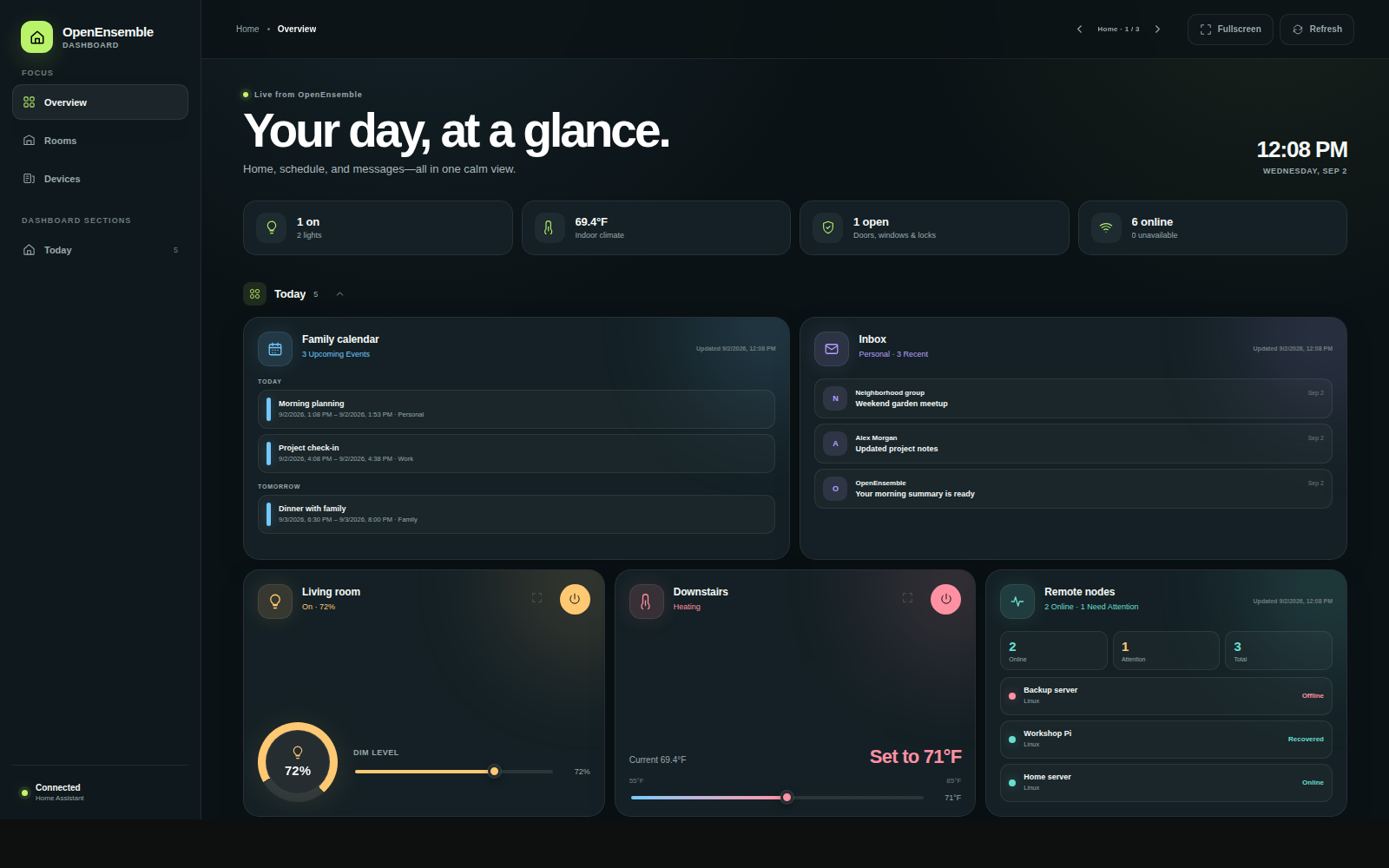
Display dashboards
Turn OpenEnsemble into a wall tablet, room display, TV dashboard, or focused browser view:
- Create up to 32 dashboards per profile, each with a stable address.
- Combine Home Assistant controls with read-only Calendar, Email, Nodes, and custom-skill widgets.
- See which paired remote machines are online, recently recovered, not responding, or offline—without exposing addresses, access settings, or command controls.
- Customize sections, cards, colors, text, navigation, page chrome, and default focus.
- Swipe between dashboards or use Previous and Next controls.
- Let custom skills provide bounded read-only data while OE owns the rendering and prevents injected HTML or JavaScript.
Dashboard addresses use a normal signed-in OE profile rather than a public or dashboard-only session. For shared or unattended tablets, use a dedicated least-privilege profile; normal session expiry still applies.
One assistant or a full team
- Switch between a single primary assistant and an ensemble of specialists without deleting agents, histories, personalities, assignments, or watchers.
- Coordinators can fan suitable work out to explicit or adaptive worker teams, with live progress and completion tied to the actual nested work.
- Choose a model and reasoning effort for each role or custom skill.
- Multiple Coder agents now keep durable roles and separate active projects.
Browser, nodes, and Home Assistant
- OE Bridge can be installed and updated from OpenEnsemble, learn verified browser workflows, and block ads locally with tiered filter lists.
- Node agents support signed self-updates, TLS reverse-proxy pairing, durable health alerts, reliable removal, and the
oenodeCLI. Node identities are profile-scoped, so different profiles can safely pair machines with the same hostname. - Home Assistant commands confirm against live state events, and HA automations can trigger saved OE routines through scoped webhook capabilities.
Voice and reliability
- Voice-device turns now receive the same appropriate tool surface as web chat, with stronger conversation routing, recovery telemetry, and off-event-loop speech transcription.
- ESP32 voice firmware
0.2.93-portalhdrand its supporting images are bundled and verified for fresh or offline flashing. - Completed tool effects survive later provider failures, while uncertain effects are quarantined instead of blindly retried.
- Background cancellation follows delegated work, and durable email and Telegram delivery guards reduce duplicate effects.
- Software updates now reconcile dependencies more safely and restore the previous install when an upgrade fails.
Updating
Existing installations can update with:
oe updateThe remote-node CLI rename from oe to oenode is migrated automatically when node agents update.
Third-party firmware notice
This release bundles the Seeed/XMOS XVF3800 firmware used by supported voice hardware. That binary is third-party software and is not covered by OpenEnsemble’s AGPL license. The cited upstream repositories did not include an explicit license or binary redistribution grant when the bundle was prepared; downstream distributors should confirm the applicable rights. See the firmware provenance notice.