Repository navigation
Releases
Releases · pbathuri/cartograph
2.0.3

Found by auditing a real 7.1M-chunk, 604k-file graph with a 30-question workflow eval. The eval
ships as scripts/workflow_eval.py (with an example question file) so anyone can score Cartograph on
their own files against ripgrep; the README has the results.
- Re-ingest removes files that are gone. Ingest never deleted a file row: deleted files kept being
cited, and when a folder ingested as one project was later split into its repos, every file stayed in
both. On the audited graph that was 233,386 files and 2.3M chunks (a third of the index) stored twice,
so most results came back in pairs. Files deleted from disk, newly ignored, or moved into a sub-project
are now pruned (removed N file(s)in the ingest summary). Unmounted drives are still left alone. - Files at the top of a root folder are ingested. When a root held several projects, its own loose
files (a manuscript, meeting notes) were skipped. On the audited machine that was 979 files. - Keyword search is about 10x faster on large graphs. Question words (how, do, with, where...) no longer
become search terms, and BM25 ranks inside the FTS table before joining. On the 7.1M-chunk graph median
keyword latency fell from 1.8 s to 0.16 s and hybridretrieve_contextfrom 1.9 s to 0.4 s; SciFact nDCG@10 rose (keyword 0.655 -> 0.658,
hybrid 0.709 -> 0.714). - Naming a project finds its code. "Where is causal self-attention defined in nanoGPT" now searches
inside nanoGPT too (with double weight in the fusion), because a repo's own files rarely mention its name. - The same passage is never returned twice. Identical text from a second checkout or copy of a file
collapses to its best-ranked citation. - Mixed answers skip off-topic session logs. Auto-captured session notes are long enough to match any
single word, so they crowdedmode: mixanswers. They now need half the query's keywords; decisions,
rejections, preferences and facts still need only one. - No 10-second first call.
carto mcp-serverloads the embedding model and index on a background
thread at start (CARTOGRAPH_MCP_WARM=0turns this off). CARTOGRAPH_EMBED_CHARSsets how much of each chunk is embedded (default 600). 1200 scores SciFact
hybrid nDCG@10 0.723 instead of 0.714, at about twice the embedding time.- Index builds can no longer destroy each other. A second builder (e.g. the nightly
carto improve
starting whilecarto indexruns) used to delete the first one's folder and start over, while the
first kept writing into the deleted file. Builds now take a single-builder lock;improveskips its
index step while a build is running, andcarto indexsays so. - Resume survives graph changes. If chunks were added or changed since an unfinished build began, its
finished rows are carried over by chunk id instead of thrown away; only new chunks are embedded. improvelogs why a step failed and writesreports/latest.jsonafter every step, so a killed run
still leaves a record.- Apple-GPU builds use batch 128 (about 10% faster than 64 on an M-series Mac).
- Fresh
[semantic]installs work again. transformers 5.17+ removed an API the default nomic-embed
model calls ('NomicBertModel' object has no attribute 'get_extended_attention_mask'); the
semanticandfullextras now requiretransformers<5.17.
2.0.2: cited answers you can see in 30 seconds
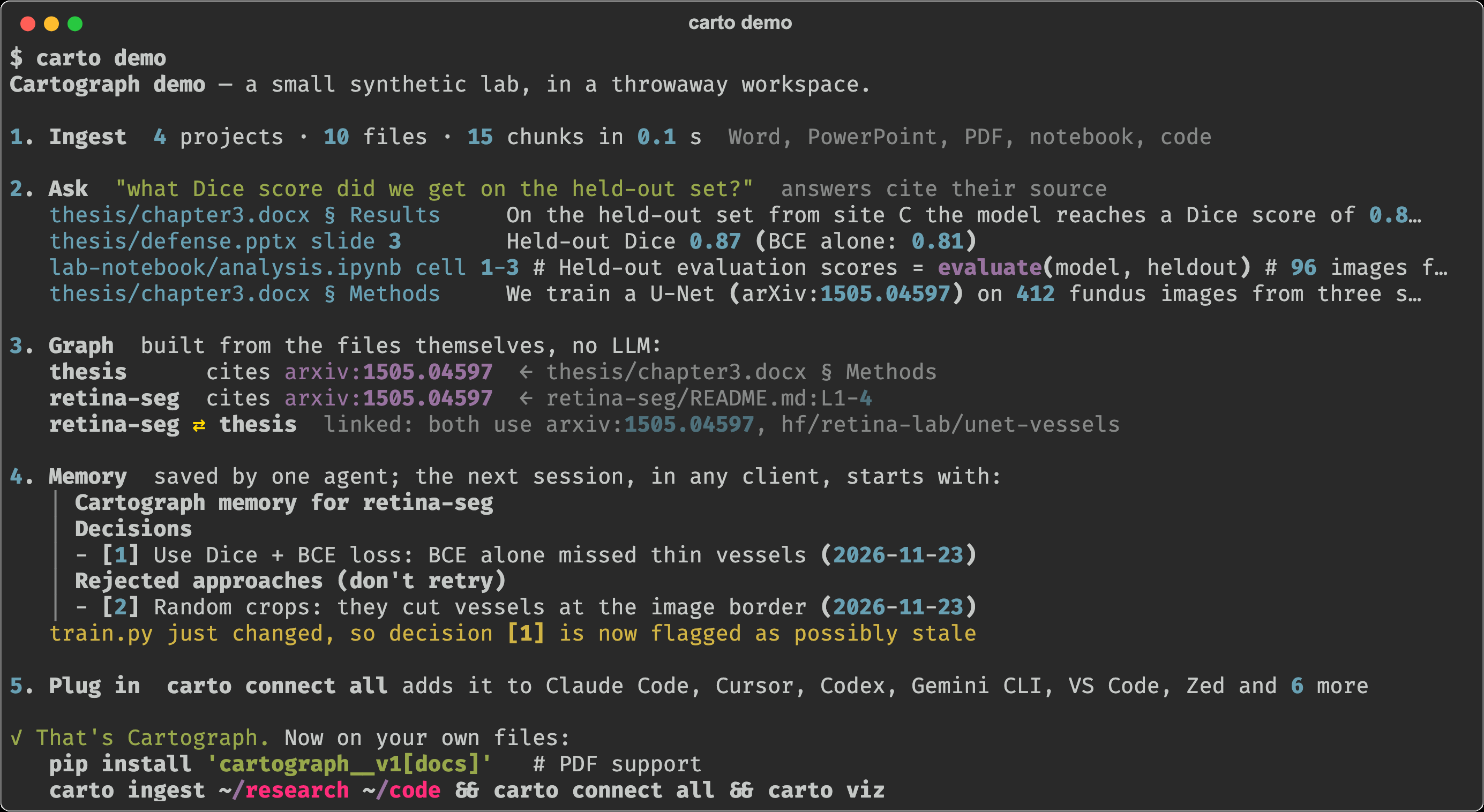
Your AI agents can read your papers, docs and code, and cite the page.
pip install "cartograph__v1[docs]" && carto demo # 30 seconds, throwaway workspaceNew in 2.0.2
carto demoshows the whole product: a cited answer (chapter3.docx § Results,defense.pptx slide 3), a paper that links two projects, a decision every agent remembers, and the stale flag when the code moves on.- Official MCP Registry: listed as
io.github.pbathuri/cartograph; clients can launch it withuvx cartograph__v1 mcp-server. ADockerfileis included too. - Fixes: memories from a symlinked working directory (e.g.
/tmpon macOS) now land in the right project; Hugging Face links at the end of a sentence are recognised. - README: straight answers to "why not CLAUDE.md, built-in memory, or grep?", measured latency, and a Limits section.
- Brand: Moley, Your Local Guide, as crisp SVG across the README, Atlas and the favicon.
Full notes: CHANGELOG.md
Cartograph 2.0.1
carto connect no longer reports Claude Code as installed on every machine: its config lives in $HOME, so detection now requires ~/.claude.json, ~/.claude/ or the claude command. See 2.0.0 for everything new in 2.0.
Cartograph 2.0 — your files, cited; your agents, remembering

pip install -U "cartograph__v1[docs]"
carto connect all
Documents with citations, a graph with provenance, memory every agent shares, and an Atlas to see it.
No LLM is needed to build any of it.
Index you can trust on a big corpus
- Resumable builds. A killed
carto indexcontinues from the rows it already wrote instead of
starting over (it used to wipe a partial build). Partial builds record their chunk ids; one left by an
older version is resumed only when the graph hasn't been written since it began. - Your work first. Chunks are embedded in the order of your configured roots, smaller projects first
within a root, so your own folders become searchable hours before bulk reference clones. - Searchable while building. Retrieval uses the partial index (unfinished rows are zero vectors and
never outrank real matches) instead of silently falling back to keyword-only. carto index --backgroundruns detached from the terminal or agent session that started it;
carto index --status [--watch]shows a live progress panel (count, rate, ETA, resume hint).- An
index/folder missingchunk_ids.npyis no longer treated as a usable index. - fp16 inference on CUDA/MPS (~15% faster on Apple silicon, identical vectors at float16 storage).
Documents, with citations
- PDF, DOCX, PPTX, XLSX, EPUB and HTML are ingested. Office/EPUB/HTML need no extra dependency;
PDF usespypdf(pip install "cartograph__v1[docs]") or PyMuPDF when present, with optional OCR of
text-less pages (ocr: true). Documents get their own size cap,max_doc_mb(default 50). - Every chunk carries a locator and every retrieval result a
cite:src/train.py:L40-88,
paper.pdf p.12,talk.pptx slide 3,doses.xlsx sheet Doses,thesis.docx § Methods,
analysis.ipynb cell 4-6. Chunks never straddle pages or slides. - Chunks from graphs built before 2.0 get line citations by re-reading the source file on demand
(skipped quietly when the file is gone, e.g. on an unplugged drive). - HTML is indexed as text (scripts/styles dropped) instead of raw markup. More source types:
CUDA, Lua, Dart, Haskell, Elixir, Zig, Fortran, Protobuf, GraphQL, Terraform, BibTeX, MDX, Quarto, Typst... - Office lock files (
~$x.docx) are skipped;carto ingestreports how many PDFs were skipped for lack
of a PDF reader.
A graph with provenance (no LLM)
- Deterministic entities and relations: dependencies declared in manifests (requirements, pyproject,
package.json, Cargo.toml, go.mod, environment.yml), Python/JS/TS imports, papers by DOI and arXiv id,
GitHub repos, Hugging Face models and datasets. - Every fact records its evidence chunk (citable), extractor, confidence and first/last seen;
a file edit keeps first_seen for facts it still states and drops the ones it no longer does. - Projects linked through shared entities, weighted by rarity (sharing a paper beats sharing numpy),
with the shared entities listed on the edge. carto entities PROJECT,carto entities --find pydantic,carto entities --backfill(one pass over an
existing graph; 6.5M chunks took ~15 min), and anentitiesMCP tool.
Memory every agent shares
- Temporal memory in the same SQLite file: decisions, rejected approaches, preferences, facts, todos,
notes and session logs. Nothing is overwritten —supersedecloses a memory's validity interval and
points at its replacement; history stays queryable. - Staleness: memories anchored to files are flagged when those files change or disappear (files on an
unmounted drive are reported as unavailable, not missing). - Conflict hints:
rememberreturns similar active memories of the same project so the agent can
supersede instead of piling up contradictions. brief: a session-start digest for the project at the cwd under a hard character budget.- Automatic capture through client hooks —
carto hooks installfor Claude Code, Cursor, Gemini CLI
(hooks) and Codex (notify). Session start injects the brief; the session's goal, edited files and
commands become onesessionmemory anchored to those files;decision: …/rejected: …/todo: …
lines said in chat become memories. Existing hooks are preserved and the config is backed up first. - MCP tools
brief,recall(read-only) andremember,supersede(write; hidden by--read-only). - CLI:
carto memory add | recall | supersede | forget | brief,carto hooks install | uninstall | status.
Retrieval with hard budgets
- Modes:
mix(memories + graph facts + cited chunks),chunks,projects,graph,memory— on
carto retrieve --modeand theretrieve_contextMCP tool. max_tokensis a hard cap: text is trimmed at paragraph/sentence boundaries and the lowest-ranked
items are dropped until the whole payload fits. Near-duplicate chunks of the same file are collapsed.- Fast semantic search on millions of chunks without new dependencies: an IVF-PQ index in pure NumPy
(carto index --ann, built automatically for 100k+ rows) with exact rescoring of the candidates.
On a 6.5M-chunk graph: 7 ms p50 / 11 ms p95 versus 8–10 s for brute force, tie-aware recall@10 0.99.
(FAISS was rejected: on macOS its OpenMP runtime collides with PyTorch's.) - A rebuilt index is picked up by a running MCP server without a restart.
- Identifiers such as
IL-6,KX-417,CVE-2024-1234ortorch.nnare also matched as exact phrases, so
their fragments appearing elsewhere no longer outrank the real thing.
Reproducible benchmarks
carto benchruns in a throwaway home (your graph is never touched) and prints a Markdown table:- BEIR SciFact (5,183 abstracts, 300 labelled queries): nDCG@10, recall@10/100, MRR@10, latency, for
keyword and (--semantic) hybrid retrieval. Downloads from BEIR or, when that host is down, the Hugging
Face mirror. - Citations: a generated library of PDFs, Word files, slide decks, notes and code with planted facts on
known pages, sections, slides and lines; scores whether the top result is the right file and the
citation points at the right place.
- BEIR SciFact (5,183 abstracts, 300 labelled queries): nDCG@10, recall@10/100, MRR@10, latency, for
- Results are kept per day in
~/.cartograph/bench/results-<date>.json.
Plugs into everything
carto connectregisters the MCP server with Claude Code, Claude Desktop, Cursor, Windsurf, VS Code,
Cline, Gemini CLI, Codex, Zed, Continue and LM Studio (Goose: printed snippet). It backs up each file,
is idempotent, and is reversible with--remove. Files with comments are never rewritten; the snippet is
printed instead. With no arguments it shows which clients are installed and connected. The server is
launched with the installing interpreter, so GUI apps without conda or venv on PATH still find it.carto agent-setupprints the same robust config.
The Atlas (carto viz)
- Rebuilt as an offline canvas map (no CDN): a headlamp that lights the map around the cursor, search
that makes matching projects glow and pulse, results with click-to-copy citation chips, a
project panel (dependencies, citations and references with evidence; linked projects and the shared
entities behind each link; memories), and a memory timeline with superseded entries struck through. - Entity hubs (papers, repos, models, datasets shared by several projects) are drawn as diamonds.
- The map payload is cached until the graph file changes: the first load on a 6.5M-chunk graph takes
seconds, later loads 10 ms. If the port is busy, the server moves to the next free one. - Meet Digby, the mole, on the map, in the README and on the social card.
Faster and cleaner
- Keyword-only search no longer imports PyTorch to find out whether semantic search is installed. The first
query without an index went from ~10 s to 30 ms, which also speeds up MCP server cold starts. - Interpreters and tooling (
python,pip,setuptools,ipykernel, ...) are no longer graph entities
or reasons to link two projects.
Change detection
- Files are hashed in full (v1 hashed only the first 1 MB, so edits past it went unnoticed). Files up to
1 MB keep their v1 hash, so upgrading re-chunks only the 1–2 MB files that could have been stale. - Size + mtime are stored per file; unchanged files are skipped without being read.
- Existing graphs are migrated in place (
ALTER TABLE ... ADD COLUMN, no rebuild).
MCP
- Real JSON Schemas: array parameters (
record_use.helped) arearrayofstring, integers are integers. - Tool
annotations(readOnlyHint,destructiveHint, ...) distinguish retrieval from tools that write
local state;carto mcp-server --read-onlyhides the writers. - Tool failures come back as
isErrorresults (spec behaviour) rather than JSON-RPC errors; protocol
version negotiation (2024-11-05 / 2025-03-26 / 2025-06-18);ping. - A long-running server that outlives an upgrade heals stale imports instead of failing every call.
- Clear message when no graph exists yet.
python -m cartographworks.