Repository navigation
Releases
Kintsugi for Inkling 2 Mini v1.0.1

Kintsugi for Inkling 2 Mini v1.0.1: v1.0.1 adds RTX 50 and H100 / H200. It uses the same model file and the same
engine source as v1.0. RTX 20 / 30 / 40 users do not need to update, except to get the licence list of the web chat page.
What changed
- New cards: RTX 50 (Blackwell, desktop) and H100 / H200 (Hopper). The engine is the same source as v1.0 (commit
a20cc419b, build 10944), now built with native code for these cards too. We checked the Linux engine on an RTX 5060
Ti 16 GB and on an H100 PCIe 80 GB (numbers below). The Windows engine has the same code for these cards, but we
did not run it on an RTX 50 or a Hopper card. - Card check at start: a card with no code in this bundle (older than RTX 20, V100 / A100 / A30, and other new
cards such as B200 or GB10) stops with a message. RTX 20 (Turing) gets a note. - Web chat page licences:
licenses/web-ui-THIRD-PARTY.txtlists the npm code in the built-in web chat page, with
each licence and copyright text (202 items: MIT, ISC, BSD-3-Clause, Apache-2.0, MPL-2.0 OR Apache-2.0, Unlicense).
v1.0 did not have this list. - RTX 30 / 40: no change. On an RTX 4070 the v1.0.1 Windows engine gives the same output as v1.0 (KL check, and 50 /
50 identity prompts token-identical). - The model file does not change:
Kintsugi-Inkling-2-Mini-12G.gguf, sha256
7d93d5e8e61f6694776ec8b488751787a7dd3cb745d4f9eaee9f0b78b0e60cec. If you have it, keep it.
Hardware
| Hardware | Status |
|---|---|
| RTX 40 (Ada) | Supported: every release check ran on an RTX 4070 (Windows and Linux). The v1.0.1 Windows engine gives the same output as v1.0 on it (KL check and 50 / 50 identity prompts token-identical). |
| RTX 30 (Ampere) | Supported: the v1.0 release engine (the same source as v1.0.1) was checked on an RTX 3080 Ti (Linux): it starts with the launcher defaults, 24 / 24 needles at 32k, the identity prompts answer, top-1 agreement 97.8 %. Its mean KL is 7.5 % lower than on the RTX 4070; without one near-tie token in the 4070 reference run the two cards differ by 0.6 % (the same kernels; only the order of sums differs). |
| RTX 50 (Blackwell, desktop) | Supported from v1.0.1. The Linux engine was checked on an RTX 5060 Ti 16 GB: it starts with the launcher defaults (all 262,144 cells in VRAM), mean KL 0.0397 and top-1 92.60 % on our 10-document check (RTX 4070: 0.0400 and 92.51 %), 24 / 24 needles at 32k, the 50 identity prompts answer, the same 50 answers with PDL on and off, 0 CUDA errors. The Windows engine has the same code for these cards, but we did not run it on an RTX 50 card. RTX 50 laptop GPUs and RTX PRO Blackwell cards: not checked. |
| H100 / H200 (Hopper) | Supported from v1.0.1. The Linux engine was checked on an H100 PCIe 80 GB: it starts with the launcher defaults (all 262,144 cells in VRAM), mean KL 0.0401 and top-1 92.57 % on the same check, 24 / 24 needles at 32k, the 50 identity prompts answer, the same 50 answers with PDL on and off, 0 CUDA errors. H200 has the same code (compute capability 9.0) but was not checked. The Windows engine has the code too, but we did not run it on a Hopper card. |
| Other Blackwell (B200 / GB200, GB10 / DGX Spark) | Not supported: this engine has no native code for them, and it does not run the portable code yet. The launcher stops with a message. |
| A100, V100 and older cards | Not supported: this engine has no code for them. The launcher stops with a message. |
| RTX 20 (Turing) | Not supported: it fails our exact-output checks and runs 6-14x slower than an RTX 4070. |
| AMD Radeon | Not yet: after Kintsugi-27B's AMD release (test builds exist). |
| Apple Silicon | Not yet: needs its own port; not scheduled. |
| Intel GPUs | Not supported: this engine has no code for them. |
You need 12 GB of VRAM or more, and an NVIDIA driver 580 or newer (Windows) or 570 or newer (Linux). The KL check above
is our 10-document engine check with the 4-bit cache; it is not the 0.0310 fidelity number of the model file (that one
is against the official weights, see the benchmarks page).
Download
- Windows:
Kintsugi-Inkling-2-Mini-v1.0.1-win-x64.zip(NVIDIA driver 580+). - Linux:
Kintsugi-Inkling-2-Mini-v1.0.1-linux-x86_64.tar.gz(NVIDIA driver 570+, glibc 2.34+; nothing else). - The model:
Kintsugi-Inkling-2-Mini-12G.gguf(9.07 GB) from https://huggingface.co/CaryPalmer/Kintsugi-Inkling-2-Mini. - Engine source:
Kintsugi-Inkling-2-Mini-v1.0.1-engine-src-a20cc419b.tar.gz, the same file as the v1.0 source
asset. The CUDA arch list of v1.0.1 is75-real;86-real;89-real;90;120-real. - Each archive has a
.sha256file next to it.
sha256
- Windows zip:
73048398752fcc214c7b99dcb867aac2c8b597ed4f66b5086dac9a465703033a - Linux tar:
68031ebcb913f17db8198cd4e698738953aebcfa83c4b6d3c7229aef5370dba9 - Engine source:
d0d934f5c8f6763477f4d8612000e6770e27b6260b426aa876460725319c6663 - Model:
7d93d5e8e61f6694776ec8b488751787a7dd3cb745d4f9eaee9f0b78b0e60cec
Known limits
- The known limits of v1.0 stay (see the README and
CHANGELOG.md). - RTX 50 and Hopper: the Windows engine was not run on these cards; the checks used the Linux engine. RTX 50 laptop
GPUs, RTX PRO Blackwell and H200 were not checked. - Other Blackwell cards (B200 / GB200, GB10), A100 / V100, RTX 20, AMD, Intel and Apple Silicon: not supported.
Built on the work of many people (Thinking Machines, Unsloth, turboderp, the llama.cpp authors, Project Maya and more):
see CREDITS.md.
Kintsugi for Inkling 2 Mini v1.0
Kintsugi for Inkling 2 Mini v1.0: Thinking Machines' Inkling 2 Mini (26.4B looped mixture of experts) in our own
2-3 bit model file, on one 12 GB NVIDIA card (RTX 30 / 40) with a 262,144-token window. Apache-2.0.
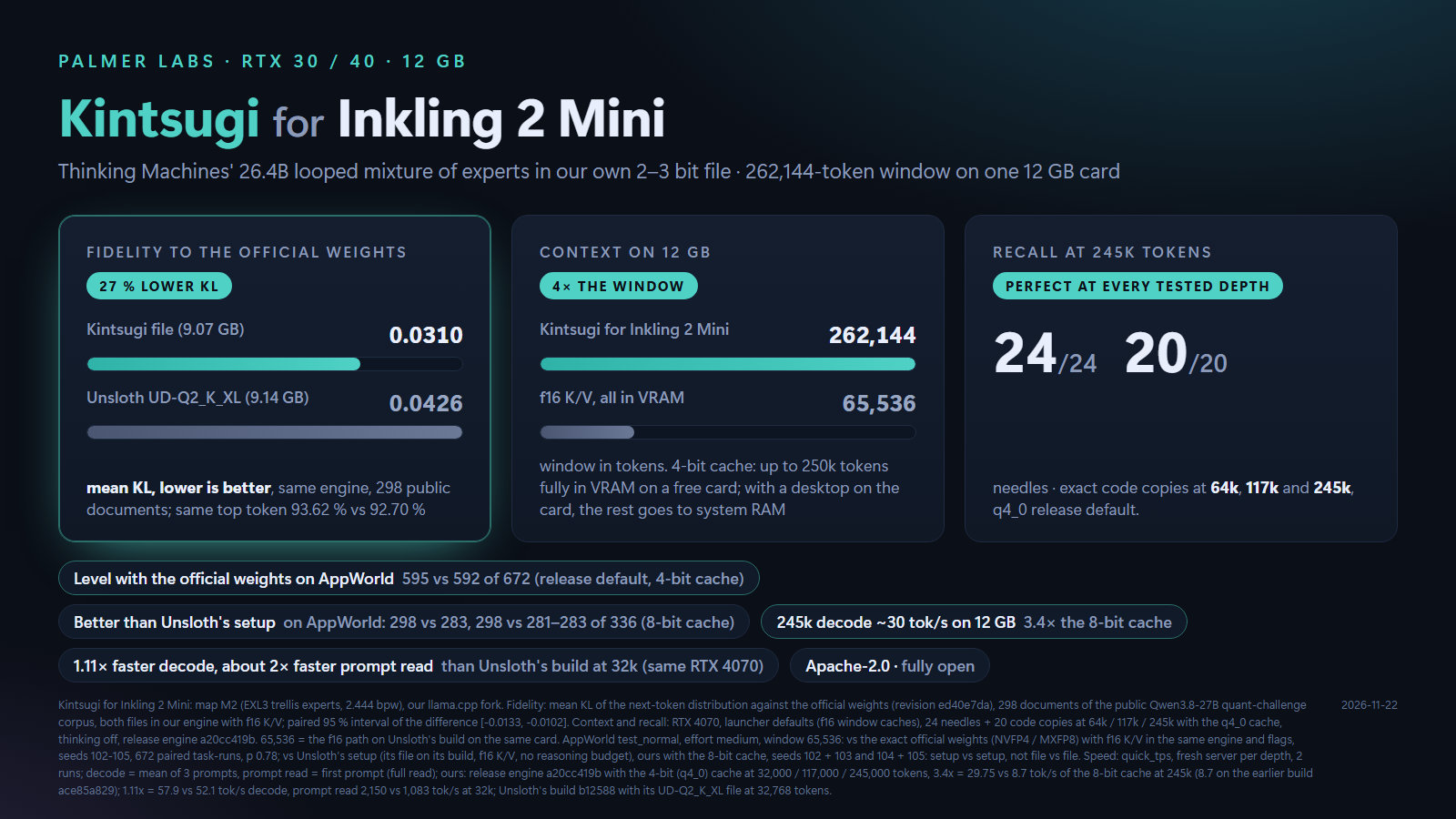
How it was made: the method, the evidence and the tests behind these numbers are in the paper "Kintsugi: Find and Repair Quantization Damage Where Tasks Break, Not Where Averages Look": https://github.com/professorpalmer/kintsugi-method
What it is
- Our own model file: every expert in EXL3 trellis code at 2 or 3 bits (2.444 bits per weight over the experts,
9.07 GB in all), fitted on Thinking Machines' weights. Mean KL 0.0310 against the official weights (27 % lower than
Unsloth's UD-Q2_K_XL in the same engine; see the benchmarks page for the one limit). - Level with the official weights on AppWorld: 595 vs 592 of 672 paired agent task-runs against the exact official weights (NVFP4 / MXFP8)
in the same engine, with the release default (4-bit cache; p = 0.78). Against Unsloth's setup (its file on its build;
measured with the 8-bit cache): better, 298 vs 283 and 298 vs 281-283 of 336 (setup vs setup, not file vs file). - 262,144-token window on 12 GB: 4-bit (q4_0) K/V for the 8 global attention passes; on a free card up to 250k
tokens stay in VRAM, the rest goes to system RAM. Recall: 24 / 24 needles and 20 / 20 exact code copies at 64k, 117k
and 245k. - Speed (RTX 4070): decode 64.5 tok/s at 4k, 57.9 at 32k, 42.4 at 117k and 29.75 at 245k; at 4k and 32k that is
1.09x and 1.11x Unsloth's build with its UD-Q2_K_XL file on the same card, with prompt reads about 2x. - Saved chats through the layer. Coding harnesses: Claude Code, Codex, Pi and OpenCode 5 of 6 test tasks each; no
malformed tool calls, no loops and no server errors. - Repetition guard (on by default): when the model repeats nearly the same tool call with short results, the server
adds one short note to that request only and writes one WARN line. At two stuck points it broke the loop in 6 and 7
of 10 tries, against 0 of 10 without it.LLAMA_ARG_REPEAT_GUARD=0or--no-repeat-guardturns it off. - Two slots (opt-in):
INKLING_SLOTS=2serves two requests at the same time in one shared window.
Hardware
| Hardware | Status |
|---|---|
| RTX 40 (Ada) | Supported: every release check ran on an RTX 4070 (Windows and Linux). |
| RTX 30 (Ampere) | Supported: the release engine was checked on an RTX 3080 Ti (Linux): it starts with the launcher defaults, 24 / 24 needles at 32k, the identity prompts answer, top-1 agreement 97.8 %. Its mean KL is 7.5 % lower than on the RTX 4070; without one near-tie token in the 4070 reference run the two cards differ by 0.6 % (the same kernels; only the order of sums differs). |
| RTX 50 (Blackwell), H100 / H200 (Hopper) | Not yet: this engine has no code for them. Planned for v1.0.1. |
| RTX 20 (Turing) | Not supported: it fails our exact-output checks and runs 6-14x slower than an RTX 4070. |
| AMD Radeon | Not yet: after Kintsugi-27B's AMD release (test builds exist). |
| Apple Silicon | Not yet: needs its own port; not scheduled. |
You need 12 GB of VRAM or more, and an NVIDIA driver 580 or newer (Windows) or 570 or newer (Linux). 32 GB of system
RAM or more is best for very long chats.
Download
- Windows:
Kintsugi-Inkling-2-Mini-v1.0-win-x64.zip(NVIDIA driver 580+). - Linux:
Kintsugi-Inkling-2-Mini-v1.0-linux-x86_64.tar.gz(NVIDIA driver 570+, glibc 2.34+; nothing else). - The model:
Kintsugi-Inkling-2-Mini-12G.gguf(9.07 GB) from https://huggingface.co/CaryPalmer/Kintsugi-Inkling-2-Mini. - Engine source:
Kintsugi-Inkling-2-Mini-v1.0-engine-src-a20cc419b.tar.gz(40,078,993 bytes). The engine source
archive is the same tree as Kintsugi-27B's engine (its README names that project); this release builds it at commit
a20cc419b (build 10944) with the Inkling port and the pinned web UI. Both release engines are built from this exact
archive. - Web chat page licences:
web-ui-THIRD-PARTY.txt: the npm packages in the built-in web chat page, each with
its licence and copyright text (202 items, no GPL). Added 2026-11-23; the zip and tarball do not have it.
sha256
- Windows zip:
85ddccfac0d4434a205b1eb6269f4505da93573ce8801569d46a33869f127c2a - Linux tar:
906ab5cde3964c85723243520b774143b6d2901cd75be8c64db6f1996f76a6d4 - Engine source:
d0d934f5c8f6763477f4d8612000e6770e27b6260b426aa876460725319c6663 - Model:
7d93d5e8e61f6694776ec8b488751787a7dd3cb745d4f9eaee9f0b78b0e60cec
Known limits
- Inkling 2 Mini always runs with flash attention. With
-fa off, the engine turns it on and writes a WARN line in the
normal log. - One chat at a time by default (one slot). Two slots (
INKLING_SLOTS=2) are opt-in: the two chats share one window,
fewer cells fit in VRAM (228,864 in place of 250,112 on an idle RTX 4070 with Windows), saved chats are off, a long
answer at temperature 0 is not bit-equal to one slot, and it is not faster for one user (about 10 % more total
throughput). K/V cache types other than f16, q8_0 and q4_0 refuse at start with a clear message. - The repetition guard does not stop every loop. After it acts, the next request reads about 4,000 tokens of the prompt
again, one time. - RTX 20 (Turing) is not supported. RTX 50 (Blackwell), Hopper, AMD and Apple Silicon: not yet (see "Hardware").
- Memory was tested with a simulated desktop load of 500 / 900 MiB (VRAM held by a separate process); not yet with a
display on the same card. - On Windows, OpenCode runs shell commands in PowerShell; the model sometimes writes bash syntax there and can get stuck
repeating trivial commands; if the guard's note does not help, stop the turn and ask it to use the edit tool. - Text only. No drafting. Use of the model is subject to the Thinking Machines Model Acceptable Use Policy.
Built on the work of many people (Thinking Machines, Unsloth, turboderp, the llama.cpp authors, Project Maya and more):
see CREDITS.md.