 Qodo Hackathon
Day 5: Make your factory self-improve #7

Replies: 33 comments 2 replies

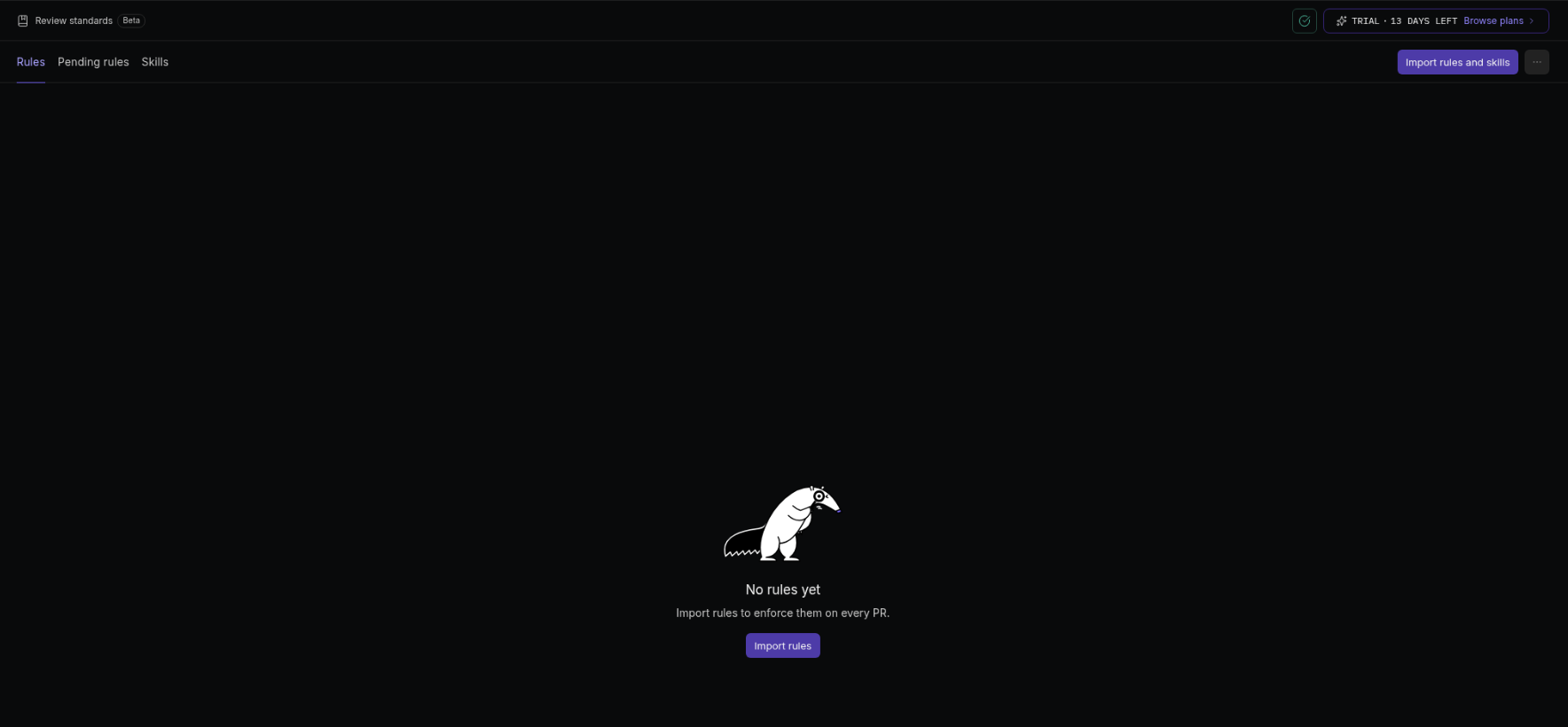
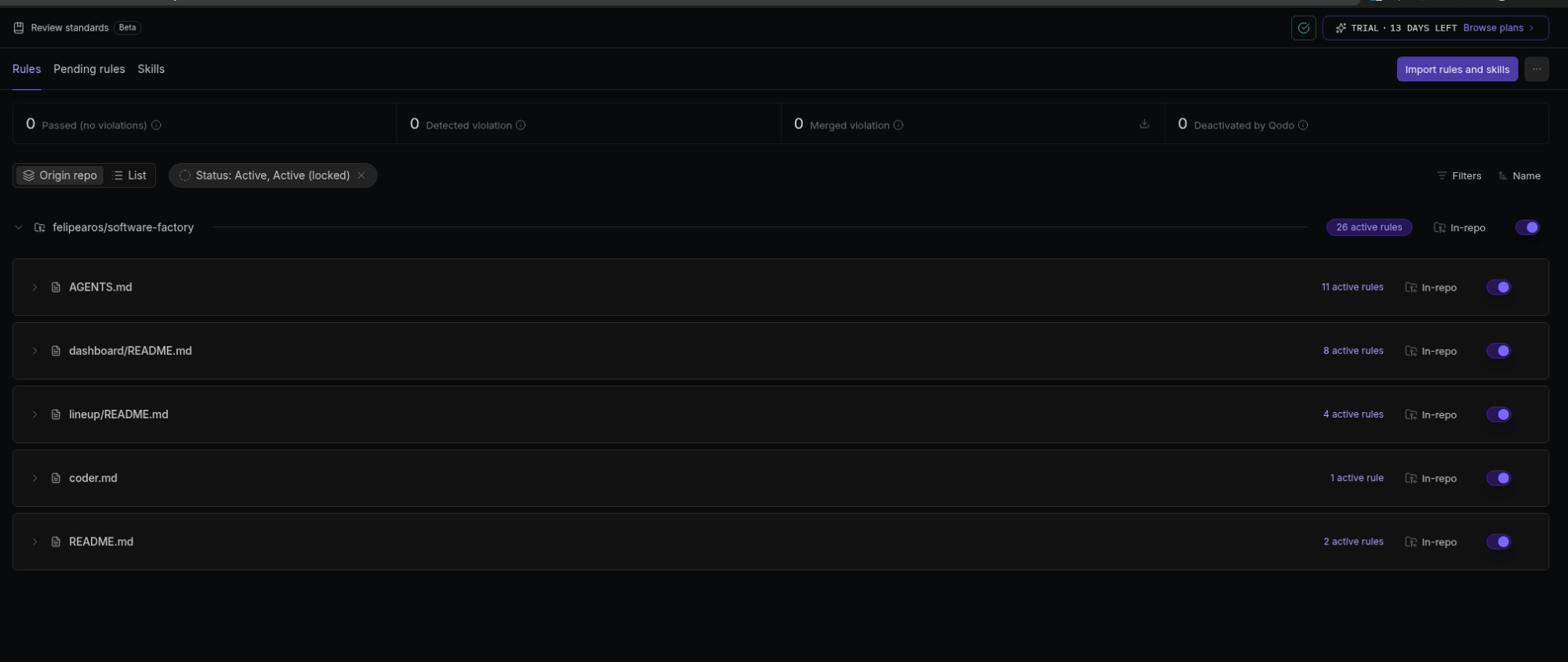
My rulePath: coding-agent proposal. Qodo had nothing to suggest yet: in Review Standards, Pending rules was empty and none of the 17 rules for the repository had source type Mined Pattern; all 17 came from AGENTS.md. Original suggestion and source evidence (review links or files):
Rule I chose to keep or refine: Where it applies and why: My decisionWhat I accepted, changed, or rejected, and why:
PR link or portal screenshot: Status: active (in AGENTS.md, and as 5 active Qodo rules for this repository). What still needs help, if anything:
Everything is in the factory ledger. CI on main is green with 204 tests. |

My rulePath: coding-agent proposal Original suggestion and source evidence (review links or files):
Rule I chose to keep or refine: Where it applies and why:
My decisionWhat I accepted, changed, or rejected, and why:
PR link or portal screenshot: Status: What still needs help, if anything: |

|
Nice way to confirm the rules are enforced. In other projects I have a code-review agent that runs in a clean context, and the agent that implemented the code reads its review back. Then the "coding agent" implements the needed fixes, all before pushing a PR. This way is similar, and the agent work schedule we set up yesterday checks the results automatically once they're posted on GitHub, instead of the coding agent orchestrating it. Basically: same idea, different approach, and the review and results are more visible (due to them being in GitHub and not local workflow). 🧭 My rulePath: 🤖 coding-agent proposal. Qodo's Rule Miner had nothing yet, so I imported the AGENTS.md rules (13 came in ✅) and asked Claude Code to mine the Qodo comments on my 9 PRs. Original suggestion and evidence: 🔍 Most of Qodo's bug findings were real, but its High-Level Assessment kept asking for things the roadmap schedules for later:
Rule I kept: 🗺️ Review against the roadmap. Judge a PR by its own task and the current phase in PLAN.md and docs/decisions.md. A feature planned for later is a finding only on the PR that builds it. Security and data-safety defects are always findings, and "zero cost, local first" applies to every PR. Where and why: 🎯 every PR review, whether by Qodo, an agent or a person. The MVP postpones roadmap work on purpose, so asking for it early is just noise 🔇 ⚖️ My decisionAccepted / changed / rejected:
PR: 🔗 Terhi-L/EatUp#10 (merged ✅) |

My rulePath: coding-agent proposal. Qodo had no candidates yet: Original suggestion and source evidence (review links or files):
Rule I chose to keep or refine: Where it applies and why: My decisionWhat I accepted, changed, or rejected, and why: The review of the rule PR then caught me twice, both times for the pattern I had just rejected as candidate 2: (a) my framing list missed three normalizations PR link or portal screenshot: UBayouski/tracenotes#9 (2 findings, fixed, re-review clean). Rule after import: https://app.qodo.ai/rules/4578695 |

My rulePath: coding-agent proposal. At about 10:08 and 10:55 UTC on 11-06, Pending rules was empty and no rule was a Mined Pattern. Original suggestion and source evidence (review links or files): a fresh agent, given this thread's prompt, proposed three rules (its answer) and named what it couldn't reach, such as live threads, CI and Qodo's settings. I kept "Match findings by stable ID, never by title alone", which cited "Same-titled findings become one record" on pull request 1. Rule I chose to keep or refine: "RP-6: A finding's identity is its ID, not its title. Two findings with different IDs are different findings, even with the same title. Match by title only when at least one side has no ID and exactly one candidate on the other side has that title. With more than one candidate, leave the finding unmatched instead of picking one." Where it applies and why: My decisionWhat I accepted, changed, or rejected, and why: I accepted the first and made it stronger. Qodo had raised the same mistake three times, on pull requests 1 and 19, so I added PR link or portal screenshot: pull request 25, merged 11-06 at 10:29:57 UTC, and the portal reads as text. The repository is private for now; any judge can be added on request. Status: active. Qodo imported RP-6 as two rules, 4567005 "Keep findings with different IDs distinct" and 4567009 "Use title fallback only for a unique finding candidate". On first use, Qodo raised a What still needs help, if anything: nothing on Qodo's side. The three proposals, the imported text, the first finding, and RP-5's narrowingThe three proposalsThe agent ran in a fresh clone with the archived reviews and no network.
The agent's own note on its evidence: "raw archives cover PRs 1, 2, and 11–15. Original review comments for PRs 3, 7, and 9 were unavailable; their feedback is represented by the ledger. With no network, I could not verify live threads, CI results, current Qodo settings, or the ledger’s public-PR survey." Background activity in the portal listed no Rule Miner, so I can't say whether the miner has run. What I accepted, changed or rejected
Qodo then reviewed the rule text itself and made two fair points. "Unambiguous" in my first wording of RP-6 was undefined, so I defined it as exactly one candidate. And scoping RP-5 by a branch prefix leaves other branch names uncovered, so that rule now says rule tests here always run on that prefix. All five I'd run by then had. RP-6 as Qodo imported itPull request 25 merged on 11-06 at 10:29:57 UTC. At the first read, 26 minutes later and with nothing pressed, Qodo had imported RP-6 as two active rules (snapshot). That read gives an upper bound on the sync time, nothing tighter.
Reading the imported text also found a bug in my code. Rule 4567009 says "agreement of their labels is not a substitute for unique identity". My category recovery, merged earlier that day, lent a category when two different findings shared a title and a label, which breaks RP-6 as I'd worded it. I hadn't noticed. I fixed it in pull request 28, with tests that fail without the fix. First useQodo reviewed that fix with the new rule active and raised a RP-6 has fired once on real code, but it hasn't been through a rule test with the rule off, so I don't know what it adds. Since then, on 11-07, the rule test ran: with RP-6 on, both violating runs drew a RP-5, narrowed by its own false firingThe review history also changed that older rule. RP-5 said a rule test's answers stay out of reviewer-visible text until the runs are finished. Qodo fired it on a manifest recording finished runs, and the portal linked the finding to that rule. A reviewer can't tell from a diff that runs have finished, so it was a false firing, and I narrowed the rule to RP-5's existing rule, 4564374, kept its ID and took the new wording. Qodo's docs disagree on this: "Generate and manage rules" says "Changes to or deletions of existing rules in these files aren't reflected", and the import guide says rules stay "in sync on every push". This edit went the second way. It's one edit to one unlocked rule, so I'm not drawing a general conclusion from it. Assistance and third-party materialAI coding agents did the work from my brief: Codex proposed the rules from the thread's prompt, and Claude Code checked the evidence, refined the rule and wrote this post. An agent reading the page in my browser session made the portal readings. Qodo did its own reviews. I chose the project and set the direction, and an agent session merges pull requests on my standing instruction. No collaborators. |

My rulePath: Coding-agent proposal. Qodo's Review Standards had nothing under Pending rules, so I asked the agent to look through the repo, Original suggestion and source evidence (review links or files):
Rule I chose to keep or refine:
Where it applies and why:
My decisionWhat I accepted, changed, or rejected, and why:
PR link or portal screenshot: sksangita/evergreen-agents#14 (merged). Portal screenshot: (add the Review Standards screenshot here) Status: PR merged. Status in Qodo: (fill in after checking Review Standards: active / pending approval / not imported) What still needs help, if anything: The code doesn't follow the new rules yet. Both gaps are listed in |

My rulePath: coding-agent proposal. Qodo had nothing to suggest yet: in Review Standards, none of the 42 rules for the repository had source type Mined Pattern, and the 7 pending rules were all Original suggestion and source evidence (review links or files):
Rule I chose to keep or refine: rule 7 in AGENTS.md: Automation that decides "ready" or "passed" fails closed. A timeout, a missing or unreadable signal, an empty list of checks or a crash must end as "stuck" with a comment, never as "ready". A signal counts only for the exact head commit, and a result is read only from the last line. Where it applies and why: scripts and workflows that move a ticket or PR forward because a check came back (today the poller), not app code. An unattended script has nobody to notice a wrong pass. My decisionWhat I accepted, changed, or rejected, and why:
PR link or portal screenshot: rule PR 23 (merged), poller fix PR 25 (merged), diary cleanup PR 22 (merged). Qodo portal: rule 4592453, scope AI assistance: developer work (code, tests, PRs, ticket handling) was done by Claude Code with me acting as the product owner; I approved each merge and this post. |

Day 5 — Review the Live RevisionProject: pasokh, an explainable Persian answer checker. I used the coding-agent path: an agent examined our existing rules, runner code and accessible Qodo feedback. It proposed three candidates: review freshness, enforced tool scope, and saving results before terminal output. I selected review freshness for this submission because two actual review findings support it and it adds something our five existing rules did not say. The rule
Exact rule, scope and reason: AGENTS.md on main, adopted in merged PR #9. Source evidence and refinementQodo's PR #7 review found two failure paths: an older edited review comment could clear a new commit, and a remote PR could change while the local checkout stayed unchanged. The existing implementation now requires review attribution and checks the live PR. Regression coverage demonstrates that an unexpected remote-head change prevents a ready result. I narrowed the proposal to automated review/fix workflows. An independent wording review caught another ambiguity: “stop whenever the head changes” would also stop the worker's own intended correction. The final wording distinguishes unexpected changes and requires fresh checks/review when continuing with a new revision. Rule 5 already requires verification receipts; this rule explains which revision those receipts must validate. Tool permissions and durable logging are useful deliberate safeguards, but I kept them in the automation implementation/docs instead of adding several rules for one challenge. Checks and statusThis AGENTS-only branch is based on main: its two existing source-hygiene tests and typecheck pass. Separately, all 13 existing runner tests pass at I accepted the refined rule and approved merging PR #9. Qodo reviewed its exact head The portal showed no pending rules and seven active rules, all sourced from AGENTS.md, before the merge. This is an agent-proposed rule supported by accessible review evidence, not a Rule Miner discovery. A pasokh-only rescan completed but still showed the original seven rules; the new rule was absent. I then used Qodo’s manual generator. Its draft added a CI-only requirement and defaulted to Global. I corrected the definition and examples to allow our existing local/host checks, retained the approved review and escalation behavior, and selected only TheNickRubin/pasokh. Verified final status: Active, named Review the Live Revision, source type User, rule ID Assistance: Codex drafted the proposal; a separate Codex agent checked the evidence, duplication and three readiness scenarios. |

My rulePath: Coding-agent proposal. Qodo had no rules at all for this repo (0 pending, no Mined Pattern entries), so I asked my agent to go through the review history. Original suggestion and source evidence (review links or files): Rule I chose to keep or refine: Where it applies and why: My decisionWhat I accepted, changed, or rejected, and why:
PR link or portal screenshot: prophen/side-quest-studio#9 (merged) Status: Active. After merging, I ran Import rules and skills. It pulled 20 rules from AGENTS.md but skipped Rule 6, so I added it directly in Qodo as a User rule (ID 4617361, warning, Security, scoped to What still needs help, if anything: |

|
🧠 My rule Path: coding-agent proposal 🤖. I couldn’t open the Qodo portal, so I had the agent mine Qodo’s review comments on my own PRs. Qodo had plenty to say. 🎉 Evidence: Qodo kept pointing at the same pattern, tests that couldn’t fail, six times across three PRs: 🔗 WiSiHe/WiSiHe---DS#163 (comment): “Constant test only checks its own literals” and “Hydration guard misses lazy window reads in useState” Rule I kept: regression and guard tests run the real component or function, not a copy. Before the PR, break the code on purpose, confirm the test fails, and paste the failing output in the PR description. ✨ Why: green CI alone would have missed all six cases. Now the factory checks its own tests. ✅ My decision PR: WiSiHe/WiSiHe---DS#170 · docs: AGENTS.md rule 6, tests… (merged ✅) |

My rulePath: Coding-agent proposal. Original suggestion and source evidence:My agent suggested “Keep failures diagnosable(spelling?)” after checking Qodo’s review history:
Rule I chose to keep or refine:Preserve the failure stage, a safe error category, and work that already succeeded. Where it applies and why:Action and CI diagnostics go in GitHub Actions job summaries. Then Intake diagnostics use its reporting callback, which writes to stderr by default. Maintainers need enough information to retry safely without posting duplicate comments or repeating completed work. Don't know about you, but I would like to avoid more work when possible :) My decisionWhat I accepted, changed, or rejected, and why:I accepted the expectation, but the first wording needed work. It allowed comment IDs while another rule broadly prohibited API response details. It also named an undefined “internal diagnostic channel.” I clarified that non-secret resource IDs are allowed, named the actual destinations, and aligned the existing rules. The lesson for me:The proposed rule needs review too! PR link: [mellon #24, merged](randoneering/mellon#24). Status: Active in repository instructionsWhat still needs help:I still need to confirm Qodo imports the rule with the intended repository scope and status. I will check the UI after and confirm! |

|
Hey y’all! Thanks for the amazing submissions, I’m blown away by all your work. Sorry for not leaving more comments, I will definitely catch up! posting a video recap of last week day-5-final.mp4and also congrats to @WiSiHe! you’re the first winner, we’ll be sending a little gift to you soon |

|
Posting after the weekend on purpose: half of this measurement had to run while the repository still had no rules, and the other half only exists after the rule was adopted — the before/after couldn't be rushed into Friday. We went one step past "the rule is active": we measured what it changes. The same four diffs, reviewed by Qodo twice — once with no rules, once with the rule active. Headline:
The rule rescued no catches — Qodo caught every planted regression without it. What it changed is the verdict: two findings re-labeled as rule violations and escalated to action_required, with the finding text citing the rule's own success example. Full report with method and limitations: https://github.com/AJBeumer/faultforge/blob/main/docs/rules-before-after.md My rulePath: coding-agent proposal — but the factory proposed it to itself first. After each finished run, Original suggestion and source evidence: a fresh agent session, blind to everything but the challenge prompt and the Day 3 slice of our evidence table (24 findings, 6 PRs), proposed three candidate rules with citations. Every citation was machine-checked against the saved reviews ( Rule I chose to keep: "Evidence capture is fail-safe and complete" — save the raw response before parsing; read every page and every endpoint the claim covers; never record an error as data; never report a step complete unless the evidence save succeeded; a deliberately bounded read must say so and stays out of the evidence. Where it applies and why: My decisionWhat I accepted, changed, or rejected, and why:
PR link: AJBeumer/faultforge#91 (adoption, charter proposal format: evidence, counter-examples, masking risk, held-out score, request for approval — reviewed by Qodo itself, 2 findings, both taken). Measurement PRs: #87–#90 (before), #92–#95 (after). Status: active — verified through the API: 6 derived rules scoped to our harness only, and the benchmark target's 19 rules byte-identical before and after (field-by-field). What still needs help, if anything: nothing blocked. One open question for Qodo folks (@filiphric ): the pagination regression was caught both arms but never linked to the derived "read every page" rule — is per-clause linkage expected to be best-effort? Bonus footnote: while launching the measurement watchers we forgot the API key env var — and our capture tool refused to run rather than record anything. The adopted rule's fail-safe discipline, demonstrating itself on measurement day. |

My rule 1Path: Qodo suggestion / coding-agent proposal Original suggestion and source evidence (review links or files): Rule I chose to keep or refine: Where it applies and why: My rule 2Path: Qodo suggestion / coding-agent proposal Original suggestion and source evidence (review links or files): Rule I chose to keep or refine: Where it applies and why: My decisionWhat I accepted, changed, or rejected, and why:
PR link or portal screenshot: godie/tardis#60 (branch Status: PR awaiting merge. What still needs help, if anything:
|

|
This post is late; the challenge opened on November 6. My rulePath: coding-agent proposal My decisionWhat I accepted, changed, or rejected, and why: We kept the narrower lesson about player-feasible choices and comparing outcomes. The gate reviewer rejected PR #70's proposed bot change because it substantially changed the measured behavior. PR #72 added the lesson to the factory's lessons file; it did not add it to AGENTS.md. Written by this factory's comms agent and posted from the owner's account. How it works. |

Continuous Improvement: Improving the Continuous-ImproverIf you haven't seen my other posts, I'm building Commet, a gamified code-mapper that turns a git repo into a star system, to give you a reason to explore your codebase, and shows all your agents working. Here's a Qodo drone I designed to show when Qodo is hard at work on a part of the codebase! 
My ruleMy AGENTS.md has said "a finding seen twice becomes a proposed rule" since Day 2 but Qodo flagged the same kind of bug 5 times, without my factory creating any new rules. The rule was just a sentence and nothing in the factory counts findings across PRs especially across agent sessions. So today we refined that. Path: Rule Miner had 0 pending, so I used a coding-agent proposal. I had an agent read all 54 Qodo PR findings, plus my local review runs, and cross-check with other findings to find repeats. Original suggestion and source evidence (review links or files):
All three got fixed every time they appeared but the agent had no cross-session memory of them. By my own AGENTS.md line, 1 and 2 should have become rules after their second finding. So the rule I refined is the one that's supposed to catch all of this. Rule I chose to keep or refine: "A finding seen twice becomes a proposed rule." Refined to: Where it applies and why: My decisionWhat I accepted, changed, or rejected, and why:
PR link or portal screenshot: PR #99, the new rule and the runner code behind it Example of a Rule Proposal with our new mechanism! New Rule in ActionStatus: our rule is now ACTIVE Going back to Bug 1: My agents kept splitting the commits on some random empty/new line character: 5 Qodo findings in 3 days (PR #3, three local reviews on #16, PR #20). With the new mechanism, we added Rule 7 which says: split git output only on NUL, and test every new parser with a filename containing a newline, a tab and an invisible character. PR #36: Qodo reviewed the rule text itself and had 3 findings. All fixed, and the re-review was clean. 
Basically straight after the merge Qodo had turned this new AGENTS.md rule into 7 active rules on its own! 
The next night my Day 4 runner fixed #24 under the new rules (PR #69), and Qodo found nothing wrong, successful continuous improvement! BTW @filiphric I have a question! Does Qodo skip art rules? 🎨In the same PR I rewrote my art and design rules (Rules 4–6). It was the same merge but Qodo made rules from Rule 7 and 0 from Rules 4–6. My guess is its extraction skips visual and design rules, @prophen saw the same with UI rules above. Do you know if this is expected? Thanks! I've added them as manual review standards instead. |


|
no, I don’t think it ignores art rules, I think maybe the rule just wasn’t indexed? I’ll double check, but as far as I know, when you make changes on a rule, it first needs to be merged, and only then it starts being enforced. exception would be when you add a rule straight through Qodo platform |

|
Counting repeats across different tickets makes sense. Can you split a group if the agent lumps unrelated findings together? |

My rule needed a review tooI remade the art after Day 3. The faces in the picture below are from the new set, with the alien facing right in a cleaner line style. Claude Code read Qodo's reviews on my 8 PRs and proposed 3 rules. I kept one and rewrote half of it. Qodo still found 4 problems in my version. My rulePath: Coding-agent proposal. Pending rules was empty, nothing mined yet Original suggestion and source evidence: CamDuncalfe/agent-pfp#15 (comment) I picked "keep the docs true". Qodo had caught it twice: rule 4 still banned a request the page had started making (CamDuncalfe/agent-pfp#5 (comment)) and a code comment claimed the preview and the check use identical pixels (CamDuncalfe/agent-pfp#1 (comment)) Rule I chose to keep or refine: If your change makes a sentence untrue in AGENTS.md, the README, docs or a code comment, fix it in the same PR. A numbered rule is different. The PR names it and I decide Where it applies and why: Every PR. The agent reads those files before each ticket and builds on what they say 
My decisionWhat I accepted, changed, or rejected, and why:
PR link or portal screenshot: CamDuncalfe/agent-pfp#17 Status: Active. Qodo imported it as "Reconcile documentation claims invalidated by code changes" What still needs help, if anything: Nothing open. The factory used both fix rounds and stopped for me, so I did the last fix myself Up there: a few of the faces the alien can pull so far. The spiral eyes are me reading 4 findings on my own rule! Try the builder: https://camduncalfe.github.io/agent-pfp/ What I learnt: I review a rule the way I review code. The agent follows it word for word on every ticket. AssistanceA coding agent (Claude Code) writes the code from my tickets and Qodo reviews it. The art starts in Midjourney and I cut it into layers |

Day 5 — Make your factory self-improveMy rule Path: Original suggestion and source evidence: Qodo's Pending rules is empty and nothing in the portal has source Mined Pattern, so this took the second path. The difference is that the mining is now a script in the factory rather than something I did once by hand: It opened #11 from three findings across two pull requests: Long emoji names silently disable create (#1), Family names over 40 emoji graphemes fail to save and Valid profile edits can be rejected (#8). A formatter counting graphemes against a policy counting UTF-16; a policy at 40 graphemes against a rule at 160 code units; a name validated trimmed and written raw. Rule I chose to keep or refine: the policy in Where it applies and why: every length-bounded string a person types, at each layer that checks or writes it. Each disagreement shipped as a name the person could type and not save. My decision What I accepted, changed, or rejected: 26 findings → 9 patterns → one cleared Two groups came back marked already covered, by rules 2 and 3 — pointed at four pull requests of findings, it re-derived two rules the house already had and skipped them. That is the closest thing to a control here. It also argued against me: I expected a refinement of rule 3, and it said no — rule 3 governs which keys a write carries, not how a value is measured, and one finding never reaches the rules at all. Approval is one label. I put Qodo then found 8 bugs in the miner, all real. The sharpest was the pull request's own principle unimplemented: it said bash counts the threshold, and the code summed the model's own What still needs help: reviewing the miner enlarged the corpus from 26 findings to 34, and four more patterns cleared the threshold — all about factory scripts, all qualifying because #9 and #12 are two pull requests. The threshold is working as designed and it is also the factory grading its own homework. Those four want a human before anyone accepts them. |

Day 5: lioramilbaum.comIn short: Qodo had no rule suggestions for my repo yet. So Claude Code mined my review history instead: 79 Qodo findings across six PRs. One problem kept coming back, in different code, on five of them: a check that passed because it couldn't read its input. It's now rule 11. My rulePath: coding-agent proposal
Rule I chose to keep or refine: Rule 11: a check that cannot read its input fails; it never passes. An unread input is a failure or My decisionWhat I accepted, changed, or rejected, and why:
|

My rulePath: coding-agent proposal Qodo's Pending and Mined Pattern lists were empty for this new repo Original suggestion and source evidence (review links or files): Rule I chose to keep or refine: Where it applies and why: My decisionWhat I accepted, changed, or rejected, and why: PR link or portal screenshot: researchsite/hn-radar#11 (merged) + Status: <active / pending approval>, after the merge |


My factory's mistakes became a rule, and the rule found moreQodo had no rule to suggest, so my agent proposed one from my factory's own reviews. I checked it, merged it, then checked what Qodo actually had: the wrong folder and one part switched off. Once fixed, the rule found a real bug. 
The bug Rule 7 found: my factory picks the oldest ticket first, but only ever read the newest 30. Now it reads every page.
My rulePath: coding-agent proposal. Step 1: why Qodo had nothing. Nothing pending, no Mined Pattern. Rule Miner was on and unlocked (21 PRs, 44 findings learned), but it only learns from fixed findings and counts 0 of mine as fixed. I fix with new commits, which it doesn't seem to count, and my only reviewer is a bot.
Original suggestion and source evidence. A subagent with an empty context got the challenge's prompt word for word. Its main point: all six of my rules are about the app in Step 3: I checked the evidence before trusting it. I set the bar first: at least 3 findings across at least 2 PRs. Then I read each finding it cited for B in Qodo's own words. In #48, #51 and #53 it claimed 9 and 5 hold up. The rest had other causes, like a swallowed error. Then a held-out test: written from those 3 PRs, scored on #60, which it hadn't seen. It predicted 3 of 6. The misses have other causes, so it isn't stretched to fit everything. Rule I chose to keep or refine: B, as Rule 7, the Fresh Read Rule (AGENTS.md). My runner keeps notes between runs, like "I already posted this proof". The rule says those are only notes:
Where it applies and why: My decisionWhat I accepted, changed or rejected, and why: I accepted B: the most findings, and it passed the bar once checked. I changed it by cutting a dry-run clause, a different problem. I rejected A: a reviewer can't see from a diff whether red was proven, and my runner already checks that with tests. I rejected C for now: the agent's sandbox is enforced by its settings, not by code a reviewer reads. Step 4: saved, then checked in Qodo. Ticket #62 → PR #63 (Qodo: 0 findings) → merged. Qodo split Rule 7 into 3 standards, and both scope and status were wrong. Scope: every standard from my AGENTS.md was scoped to
Proof it works, 1: a canary. Answer key hash committed first, then a PR that quietly undid one of my runner's fixes: it marked proofs posted before posting them. Unit tests still passed.
The standard that came in switched off caught one of the two. My honest take: Qodo caught the problem both times. The rule changed how it reported it: 📘 against my rule instead of 🐞 as just another bug. That's what a rule is for: "this breaks something I decided". Proof it works, 2: real work, and a control. Planting the canary showed me
PR link or portal screenshot: #63 (the rule), #67 (the rule on real work). 
Status: active. 3 standards, whole repo. They caught the canary and passed the real fix. What still needs help: why doesn't What I learnedA rule can look right in the portal and still never fire. |


My rulePath: coding-agent proposal. Qodo had no pending or mined rules yet (the repo's only a few PRs old), so I had my agent go through the Qodo reviews and suggest rules. Original suggestion and source evidence:
Rule I chose to keep or refine: "Per-request state is bounded and cheap to trim." Anything that grows with each request gets a configurable limit, trimming stops at the first live entry instead of scanning everything, and tests cover a full store, expired entries and a backwards clock. Where it applies and why: the in-memory store and its options. One client sending a new key on every write could otherwise eat memory or slow every write down. My decisionWhat I accepted, changed, or rejected, and why: kept the limit rule but narrowed it. The first draft said "all state", but records and collections are meant to be unbounded. Folded the clock idea in as one line since it only came up once. Rejected the delete/recreate rule because my AGENTS.md already says basically the same thing. PR link or portal screenshot: omerts/LamedDB#11 (Qodo had no comments, merged) Status: active. Qodo picked up AGENTS.md and the rule shows as active. |


My rulePath: Coding-agent proposal. We could not inspect the Qodo portal’s Pending rules or Mined Pattern list in the available browser session, so Codex asked a delegated GPT-6.1 Terra reviewer to inspect the public repository and review evidence. Original suggestion and source evidence: The agent proposed, “An unusable quota window must not erase a valid reading in another window or an already selected slot.” Qodo found that an out-of-range Claude reset could hide the valid 41% weekly reading, the kind of reading issue #7 required us to preserve. The first Sonnet review on PR #10 preserves that original Qodo finding. The agent also traced the same failure mode to Codex slot selection, where a later unusable window could replace a valid reading in the same slot. Rule I chose to refine: “When parsing or selecting quota windows, retain valid readings if another window is unusable, including when both map to the same display slot. This keeps known quota visible when a provider sends partial data.” My decisionI kept the existing Day 2 rule for genuine zero and added the window-isolation clause there. A separate zero rule would duplicate existing guidance. The refinement covers parsing and selection, including colliding slots, and preserves each provider’s documented reset behavior. PR: Merged PR #15 · Merged rule · Acceptance decision Status: I used the coding-agent fallback when the portal could not be inspected. A later Quotaline-only Qodo Review Standards import confirmed the rule is active. Qodo standard |

My rulePath: coding-agent proposal. Qodo had nothing to offer: in Review Standards, Pending rules was empty and no rule had the source type Mined Pattern. There were no rules at all. My Day 2 rules were in Original suggestion and source evidence (review links or files):
Rule I chose to keep or refine:
Where it applies and why: My decisionWhat I accepted, changed, or rejected, and why:
PR link or portal screenshot: Status: active. Getting there took two steps:

The last one is rule 7 with its carve-out kept: a security defect, a failing test, or a long line is always reported. Three rules came out with Mixed scope. The chapter-order rule came out scoped to the whole Org, which would apply this book's chapter numbers to every repository, so I narrowed it to this one. What still needs help, if anything:


|

|
Day 5, on Keynes (the project I moved to; see Day 1). PathAgent-proposed, checked against Qodo. Qodo had no pending rules and no Mined Pattern rules for this repo, so I took the review history instead. I pulled every finding with
The ruleExamples from the 19: "Broken journal transport passes the gate" (#32), "A requested runtime check can be skipped" (#31), "Unknown finding levels appear harmless" (#1).
I scoped it to the factory and to code that decides whether something proceeds, so it stays checkable. A test lists eleven gates with 39 refused inputs; an AST scan fails when a gate-named function has no entry. Weakening What Qodo said about the rule's PRPR #46: three findings, all accepted and fixed in
Qodo's review of the final head shows all three Resolved.
StatusActive, scope
AssistanceCode and this draft: Claude Code, under my direction. Review: Qodo. Keynes is a pre-existing project with a collaborator, who agreed to this use; only my and the factory's commits are entered. |


Polson's factory proposed its own rulePath taken: Qodo first, then the coding agent. Qodo's Pending rules had no mined patterns yet (8 merged PRs is thin history), so I asked Claude Code to propose rules grounded in our PR reviews and issue history, with a source for every claim. What the factory proposed (3 rules)
My decision
The rule
Evidence: Qodo flagged this pattern on PR #7 (a dangling symlink read as "absent"), PR #8 (EPERM read as "no hard links"), PR #10 (a failed comment treated as success) and PR #14 (
Status in Qodo
Active, synced from AGENTS.md. The agent also audited the existing code against the new rule and found two places that still guess. They're tracked in #16, which will be my ticket for the next few days. Built with Claude Code; reviewed by Qodo. |

My ruleProject: Lichtprobe Path: Coding-agent proposal, grounded in Qodo’s nested-failure finding on PR #1 and the regression shipped in the fix. Rule: When My decisionThe existing rule already explains which results must survive collection. I kept that and narrowed the addition to measurable evidence at the CLI boundary. The existing collector fixtures already demonstrate both checks. All seven tests on the rule branch passed. Rule PR: Lichtprobe #3 Status: PR awaiting merge. The rule has not been verified as active in Qodo. Codex assisted with reviewing the evidence and drafting the rule. |

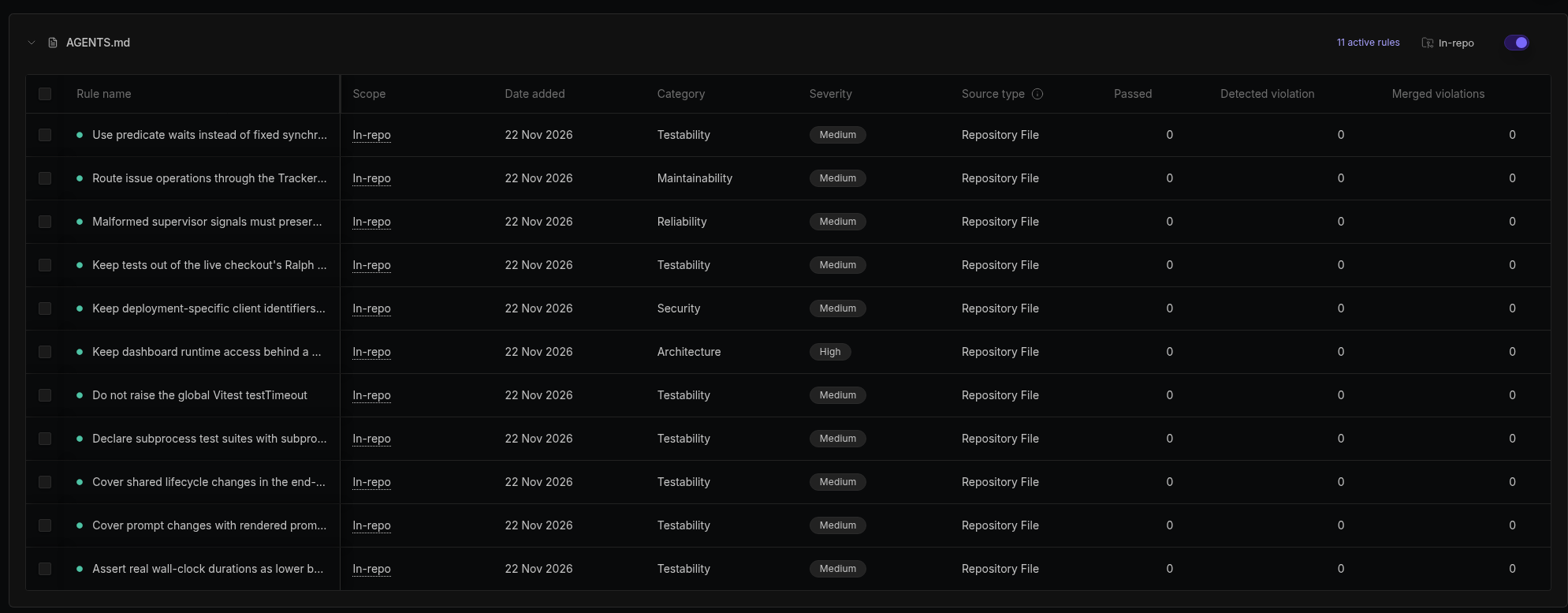
My rulePath: coding-agent proposal. I checked Qodo first: in Review Standards for software-factory, Rules said "No rules yet", Pending rules was empty, and there were 0 Mined Pattern rules. The public repo is new and its first Qodo reviews found 0 issues, so Rule Miner had no review feedback to learn from.
Original suggestion and source evidence (review links or files):
The agent's suggestion: "Tests must not assert exact wall-clock durations." Rule I chose to keep or refine: Where it applies and why: My decisionWhat I accepted, changed, or rejected, and why:
PR link or portal screenshot:
Status: active. PR #13 is merged, and the rule was imported into Qodo and is enforced on software-factory PRs. |

ChallengeDay 5 (2026-11-06): Make your factory self-improve. Project
What I completedTook the coding-agent path (since the Qodo portal trial is paused pending extension) by examining Hearth’s previous Qodo PR review feedback and refining Rule 1 in
Evidence
What I learned / what is blocked
|

My rulePath: coding-agent proposal. Qodo had no mined or pending rules for this repo yet ( Original suggestion and source evidence (review links or files):
Rule I chose to keep or refine: AGENTS.md rule 6, "Every spelling a format accepts is tested": list the spellings a detector accepts and test each one. Mixed case goes in the generator, wherever the reader ignores case (Windows paths, URL schemes, host names). JSON escapes ( Where it applies and why: any detector whose target can be written more than one way, and its tests ( My decisionWhat I accepted, changed, or rejected, and why:
PR link or portal screenshot: Abdul-Jimoh/scrubline#20 (merged). Screenshot below: after re-importing AGENTS.md, the repo went from 11 to 14 active rules. Status: active. Qodo imported rule 6 as five narrower rules: three active (case variants in the generator; Unicode escapes, ASCII letters included; JSON inside JSON) and two imported as inactive ( What still needs help, if anything: rule 5 ("the README states only what a test proves") still isn't imported after two imports. My guess is that Qodo skips rules about documentation rather than code. I'll check the import settings later. Assistance: AI-assisted, human-led. Claude Code mined the candidates and drafted the rule and this post. I chose the rule and approved the narrowing. |


 and others
Uh oh!
There was an error while loading. Please reload this page.
Day 5: Make your factory self-improve
Friday, November 6, 2026 · Week 1: Lay your factory’s foundations
On Day 2, you gave your factory some house rules. Today, have it help improve them. Use Qodo or your coding agent to look back at the code and review feedback, find an expectation worth capturing, and propose a rule for future work. You’ll check the evidence and refine the suggestion before deciding what belongs in your factory.
Today’s challenge
A prompt to start with
Use this if Qodo hasn’t surfaced a useful candidate yet:
For example, imagine a review of your reading list app asked for a test that rejects an empty book title. Your agent might propose, “Changes to book creation must include a test for an empty title.” Check the review and validation code, then decide whether that expectation is worth keeping and whether your existing rules already cover it.
After merging a rule-file PR, check that the rule appears in Qodo with the intended scope and status. If it’s missing, use Import rules and skills or ask your admin for help. Import depends on the workspace’s configured rule sources; a pushed file alone doesn’t confirm the reviewer has the rule. See the import guide.
Show what your factory learned
Copy this template into a comment below. Include the evidence you used to judge the rule, even if you decided to reject or rewrite the original suggestion. If import or approval is blocked, share the proposed rule and what still needs help.
All reactions