Repository navigation
Construct v1.0.0

Construct v1.0.0
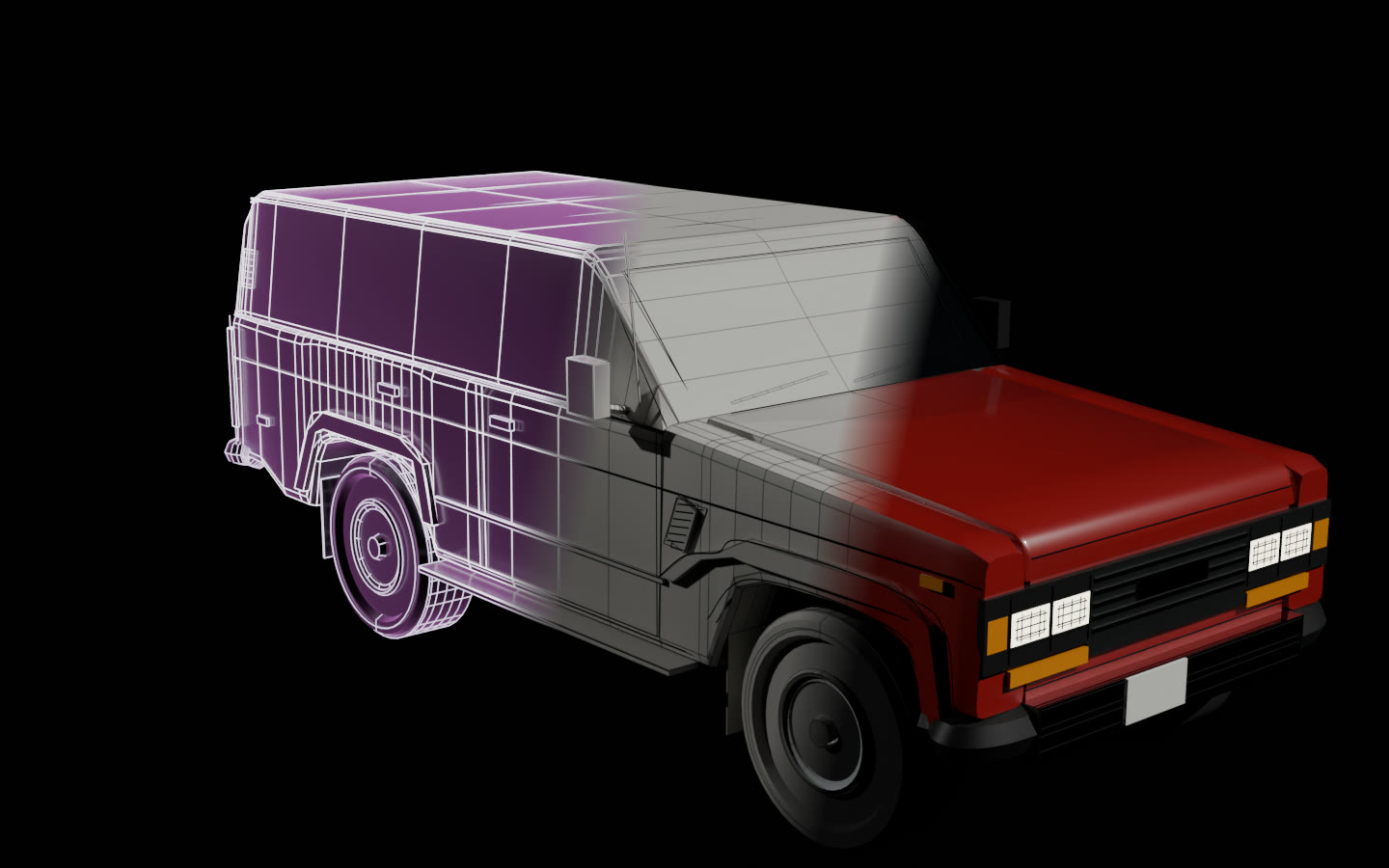
Describe a thing. Get a hologram, a 3D model and its parts. Construct 1.0 takes a construct beyond
the hologram: the same scene an AI agent writes now exports as a 3D model with named parts,
working joints and its build order, for Blender, game engines and the web, plain or finished in
paint, chrome, glass and wood. And for a NetLogo model, Construct records a run and draws it in
time, so the construct's assembly replays the run.
What's new
- 3D export.
construct export scene.json --out model.glbwrites glTF 2.0: every part a named
object under its stage, with its role and how it is known; the joints as theopenanimation,
periodic motion asidle, and each vertex's build phase. OBJ too. See
3D export. - Finished models. A material map, kept beside the scene, finishes parts by id: paint, brushed
metal, chrome, wood, rubber, plastic, glass and light, in standard glTF extensions. A part named
for its glazing gets glass on its own. - Game-ready.
--mergeputs every part that does not move into one mesh per material (the
FJ62 goes from about 300 draw calls to 27, its tailgate still opening),--wire seamskeeps only
the design lines, as dark seams, and surfaces carry texture coordinates. Checked in Godot 4.7.2,
and every export option passes the Khronos glTF Validator with no errors or warnings. - Construct for Blender. An add-on that imports a construct with three controls, Build,
Open and Light ↔ Metal, plus Plain ↔ Finished and the line thickness. They are custom
properties, so a .blend works without the add-on. The add-on is GPL-3.0-or-later, as Blender's
extensions platform requires; the rest of Construct is Apache-2.0. See the
Blender add-on. - From light to a finished model. An interactive 3D page with four gallery constructs (the FJ62, the James
Webb Space Telescope, the Revox A77 and the MiniFreak) as their exported files: from the
hologram to the plain model to the finished one, with each file to download:
https://rtmandreyev.github.io/construct/examples/light-to-metal/ - The NetLogo bridge.
construct netlogo-instrumentmakes a copy of a model record its run;
construct netlogo run.jsonl --view space-time | network-time | phase | fielddraws the run as a
construct, computed from the recording, never drawn by a model. It reproduces the Simple Viral
Marketing example's run exactly. See the
NetLogo bridge. - Art direction, with the data locked. An optional
art.jsonlayer adds views, labels and
milestones on top of a recorded run; adata_lockfact makesconstruct checkrefuse any change
to the data under it. Three new examples, Flocking, Wolf Sheep Predation and Fire, were
art-directed by Claude Opus 5.5, every milestone computed from the run. - A gallery in three parts: the constructs and films first, then the full pipeline, then the
models that come alive: https://rtmandreyev.github.io/construct/ - Who it is for. The README now opens on what people make with Construct: game developers, 3D
artists, film and motion, educators and researchers, and museums.
Nothing breaks
The contract stays construct/0.2: 1.0 adds a shape (paths, up to 4,000 polylines in one part)
and changes nothing else. A scene written for 0.3.0 builds the same hologram in 1.0; the export
reads a separate, solid compile, so the hologram's own compile is unchanged. Film mode works as
in 0.3.0.
A new licence: Apache-2.0
From 1.0, Construct is under the Apache License 2.0 instead of MIT. It is just as open (use it,
change it, sell it, in closed products too), and adds three things: copies keep the NOTICE file
that says who made Construct, a copy gets no right to the name or to present itself as the
official Construct, and contributors grant users a licence to any patents their code covers. The
Blender add-on is GPL-3.0-or-later, as Blender's extensions platform requires. Versions up to
0.3.0 stay MIT.
Install
git clone https://github.com/rtmandreyev/construct.git
cd construct
python3 construct_hologram/package.py --out dist             # the Claude Code and Hermes skills
python3 scripts/build_blender_extension.py                    # the Blender add-on, in dist/
Then add dist/claude-code/construct to Claude Code (claude --plugin-dir dist/claude-code/construct)
or copy dist/hermes/construct into ~/.hermes/skills/, and ask in plain words. In Blender:
Edit → Preferences → Get Extensions → Install from Disk with the zip, built as above or
downloaded from this release (construct-blender-1.0.0.zip). See the
README and USING.md.
Requirements
Python 3.10 or newer, with no third-party packages. Review stills and films need a
Chromium-family browser you already have; videos and films need ffmpeg. The add-on needs Blender
4.2 or newer; the bridge, desktop NetLogo 6 or 7.
Known limitations
- An exported model is a blockout, a prop or a starting point, not a finished hero asset: it is
built from Construct's own shapes, overlapping parts are not merged (so it is not watertight
for 3D printing), its texture coordinates are a simple box projection, and its joints are
mechanical, with no skinned rig. It is not CAD. - Godot ignores glTF's clear coat and transmission, so glass there is a plain translucent
material. - The NetLogo bridge needs desktop NetLogo (NetLogo Web does not support include files) and does
not record NetLogo 3D's third coordinate. A long run of many agents is sampled; the construct's
facts say how. A construct shows a quantity by position, not by colour. - No imported meshes, CAD or photogrammetry; one periodic motion per part.
- Masterpiece mode in Hermes needs a higher helper-agent limit; see
Troubleshooting. - Tested on macOS; review capture on Linux and Windows is untested.
License: Apache-2.0 — Copyright (c) 2026 Artyom Andreyev
(see NOTICE).
The Blender add-on (hosts/blender/) is under GPL-3.0-or-later. The four NetLogo example folders
derive from Uri Wilensky's NetLogo models and are under CC BY-NC-SA 3.0.