Repository navigation
Releases
v2.2.0 — Built-in MCP + Tailscale


v2.2.0 — Built-in MCP + Tailscale
Your working tree on every machine. Structured sync tools for your coding agent.
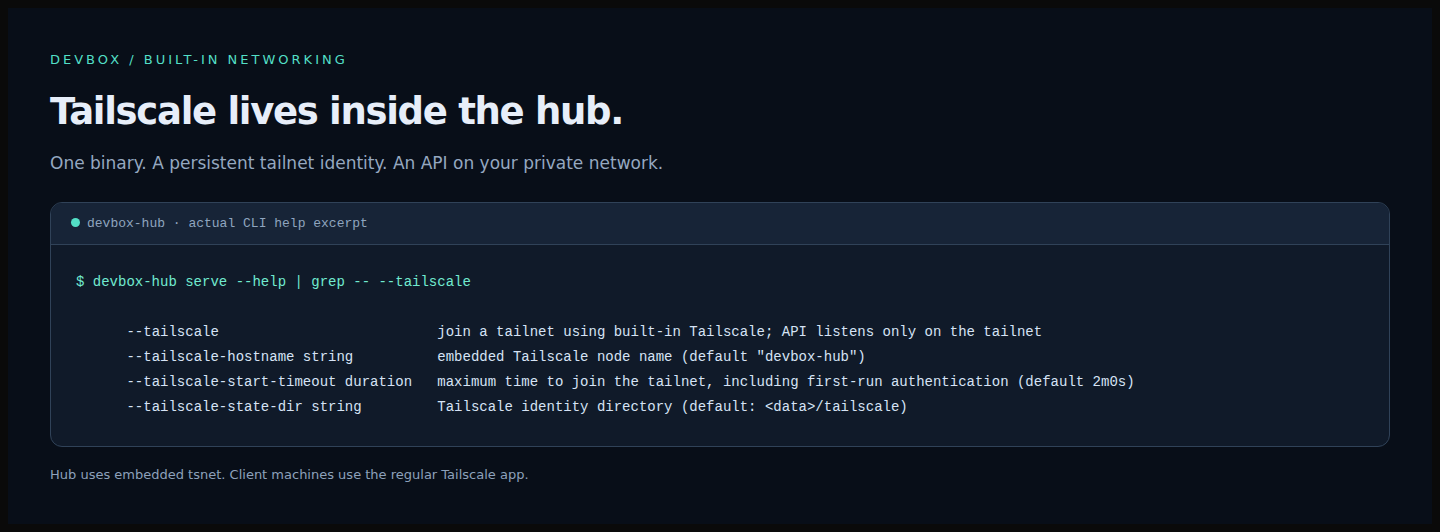
Tailscale is built into the hub
devbox-hub serve --data ./hub-data --tailscale --tailscale-hostname devbox-hubThe hub joins your tailnet itself, without a separate Tailscale installation,
root privileges, TUN device, router port forwarding, or reverse proxy. Enroll
using the first-run login URL or a securely supplied TS_AUTHKEY; preserve
<data>/tailscale across upgrades. Clients use the regular Tailscale app and
the private endpoint printed by the hub. Devbox join tokens remain required.
MCP is built into the client
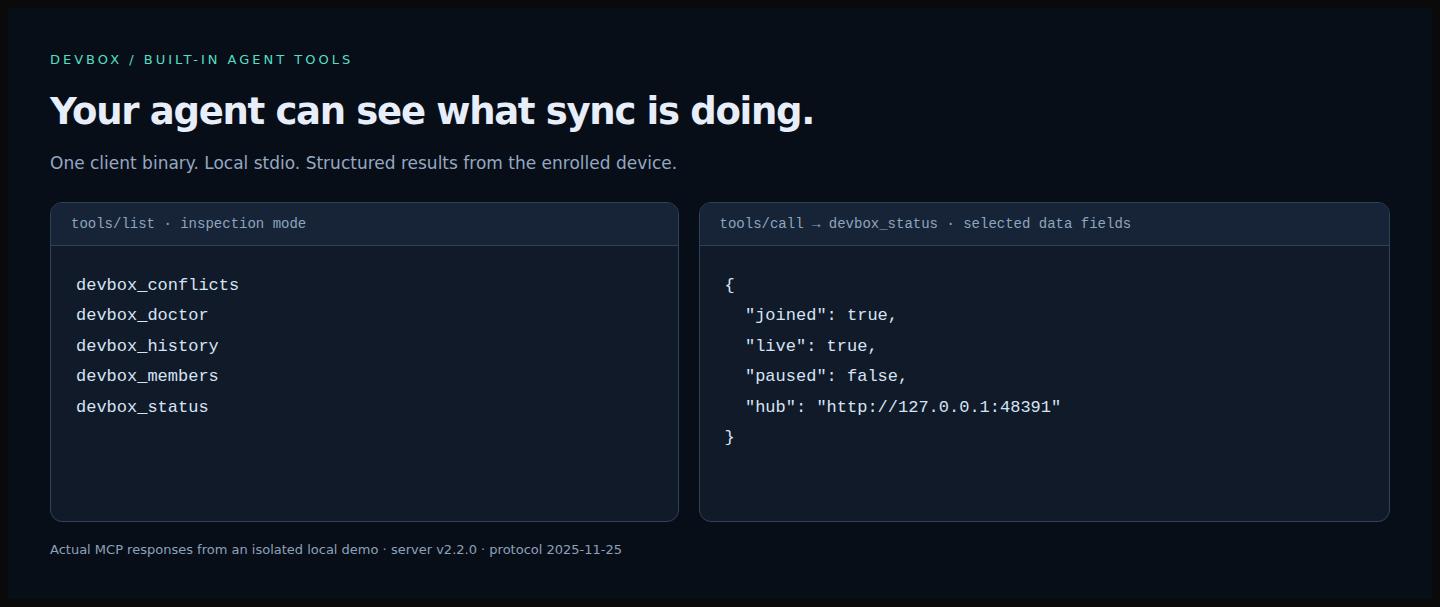
codex mcp add devbox -- /absolute/path/to/devbox mcpThe new devbox mcp command serves tools over local stdio. Inspect status,
diagnostics, conflicts, history, and memberships by default. Enable pause,
resume, publish, and mount with --allow-writes. Restore, deploy, and unmount
also require --allow-destructive. The server uses the enrolled device's
existing config and connection, including access to Tailscale hubs.
See the MCP guide
for configuration examples and tool details. No separate MCP package or Node
runtime is needed. Start the sync daemon separately with devbox start.
Install
curl -fsSL https://git.shoemoney.ai/shoemoney/devbox-dist/releases/download/latest/install.sh | shFor the hub too, download the installer and run sh install.sh --hub --no-service.
Both binaries ship for Linux amd64/arm64/arm, macOS amd64/arm64, and Windows amd64.
SHA256SUMS covers the 12 binaries and both installers. Public downloads are
available on GitHub and Forgejo. Source builds require Go 1.27.4+.
Validation
Passed vet, 189 race tests across 19 packages, and real SDK stdio tests for
initialization, discovery, calls, permissions, authenticated hub operations,
input validation, cancellation, timeouts, and output caps. The embedded Tailscale
regression uses real nodes against an isolated local control/DERP plane; no
production-tailnet enrollment is claimed.
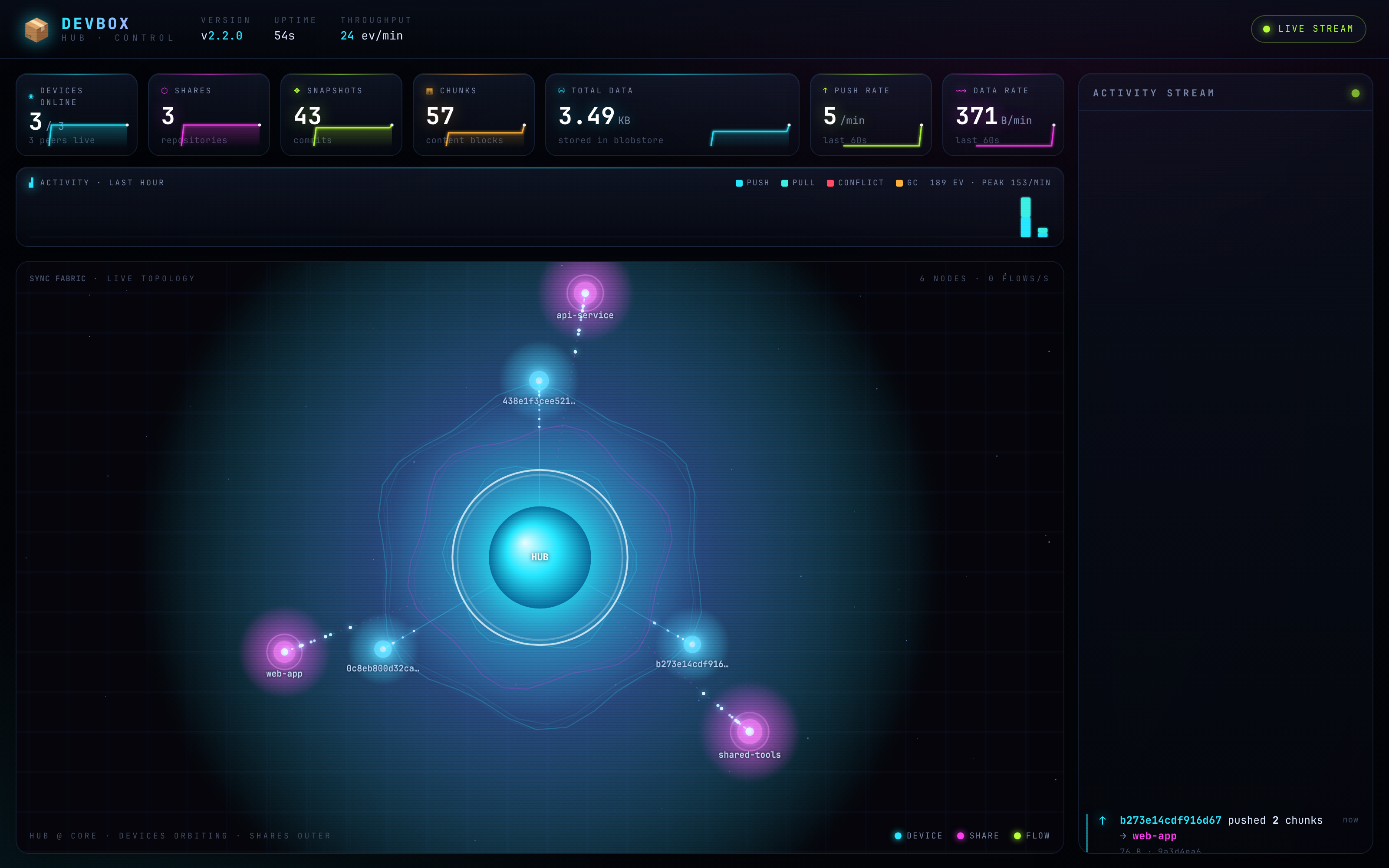
The dashboard capture uses a local demo hub and real sync daemons. It is not a
production-tailnet capture.
v2.1.0 — Built-in Tailscale
Built-in Tailscale for the self-hosted hub
Run a private sync hub with one binary:
devbox-hub serve --data ./hub-data --tailscale --tailscale-hostname devbox-hubThe hub joins your tailnet using embedded Tailscale (tsnet); no separate Tailscale installation, root privileges, TUN device, router port forwarding, or reverse proxy is required in this mode. Authenticate using the first-run login URL or a securely supplied TS_AUTHKEY. Node identity persists under <data>/tailscale.
Clients use the regular Tailscale app and the private endpoint printed by the hub. Devbox join tokens and bearer authentication remain required. Embedded client networking is not included in this release. Existing HTTP/HTTPS deployments remain supported. The README has been rewritten around the Tailscale quick start.
Install
curl -fsSL https://git.shoemoney.ai/shoemoney/devbox-dist/releases/download/latest/install.sh | shTo install the hub too, download the installer and run sh install.sh --hub --no-service.
Binaries are also attached here for Linux amd64/arm64/arm, macOS amd64/arm64, and Windows amd64. SHA256SUMS covers both installers and all 12 binaries. To download binaries from GitHub instead, pass --release-url https://github.com/shoemoney/devbox/releases/download/v2.1.0 to the shell installer or set DEVBOX_RELEASE_URL before the PowerShell installer.
Built from source commit ea3bdd4874e38cd27c0489e33e4fe400ec9fd63c, with Tailscale v1.106.1. Source builds require Go 1.27.4+; prebuilt binaries require no Go toolchain.
Validation
Passed vet, the full race suite, all 12 release builds and checksums, Linux CLI checks, and hub auth smoke. An integration test using real tsnet nodes against an isolated local control/DERP server passed with an empty PATH. It checks private HTTP connectivity, authentication enforcement, host-port isolation, and persistent identity after restart. Production-tailnet authentication was not exercised.
Latest build — v2.2.0
v2.2.0 — Built-in MCP + Tailscale
Your working tree on every machine. Structured sync tools for your coding agent.
Tailscale is built into the hub
devbox-hub serve --data ./hub-data --tailscale --tailscale-hostname devbox-hubThe hub joins your tailnet itself, without a separate Tailscale installation,
root privileges, TUN device, router port forwarding, or reverse proxy. Enroll
using the first-run login URL or a securely supplied TS_AUTHKEY; preserve
<data>/tailscale across upgrades. Clients use the regular Tailscale app and
the private endpoint printed by the hub. Devbox join tokens remain required.
MCP is built into the client
codex mcp add devbox -- /absolute/path/to/devbox mcpThe new devbox mcp command serves tools over local stdio. Inspect status,
diagnostics, conflicts, history, and memberships by default. Enable pause,
resume, publish, and mount with --allow-writes. Restore, deploy, and unmount
also require --allow-destructive. The server uses the enrolled device's
existing config and connection, including access to Tailscale hubs.
See the MCP guide
for configuration examples and tool details. No separate MCP package or Node
runtime is needed. Start the sync daemon separately with devbox start.
Install
curl -fsSL https://git.shoemoney.ai/shoemoney/devbox-dist/releases/download/latest/install.sh | shFor the hub too, download the installer and run sh install.sh --hub --no-service.
Both binaries ship for Linux amd64/arm64/arm, macOS amd64/arm64, and Windows amd64.
SHA256SUMS covers the 12 binaries and both installers. Public downloads are
available on GitHub and Forgejo. Source builds require Go 1.27.4+.
Validation
Passed vet, 189 race tests across 19 packages, and real SDK stdio tests for
initialization, discovery, calls, permissions, authenticated hub operations,
input validation, cancellation, timeouts, and output caps. The embedded Tailscale
regression uses real nodes against an isolated local control/DERP plane; no
production-tailnet enrollment is claimed.
The dashboard capture uses a local demo hub and real sync daemons. It is not a
production-tailnet capture.