Repository navigation
Home
Six slides, two minutes. Each slide is a 1600×900 image you can save and drop into your own deck. The bullets beneath each one are the talking points. Click a slide to open the detail behind it.
Status (November 2026): the first study is done. 120 reviews of 15 real pull requests. Slide 6 has the answer, the Results page has every chart, and the paper has the full account. Read it as a first look.

- Coding agents are extended with plugins, and a plugin is a set of written instructions.
- Those instructions are written for the models of the day. Then a new model ships.
- FrontierEval checks whether the plugin still helps. Its first subject is the official code-review plugin for Claude Code.
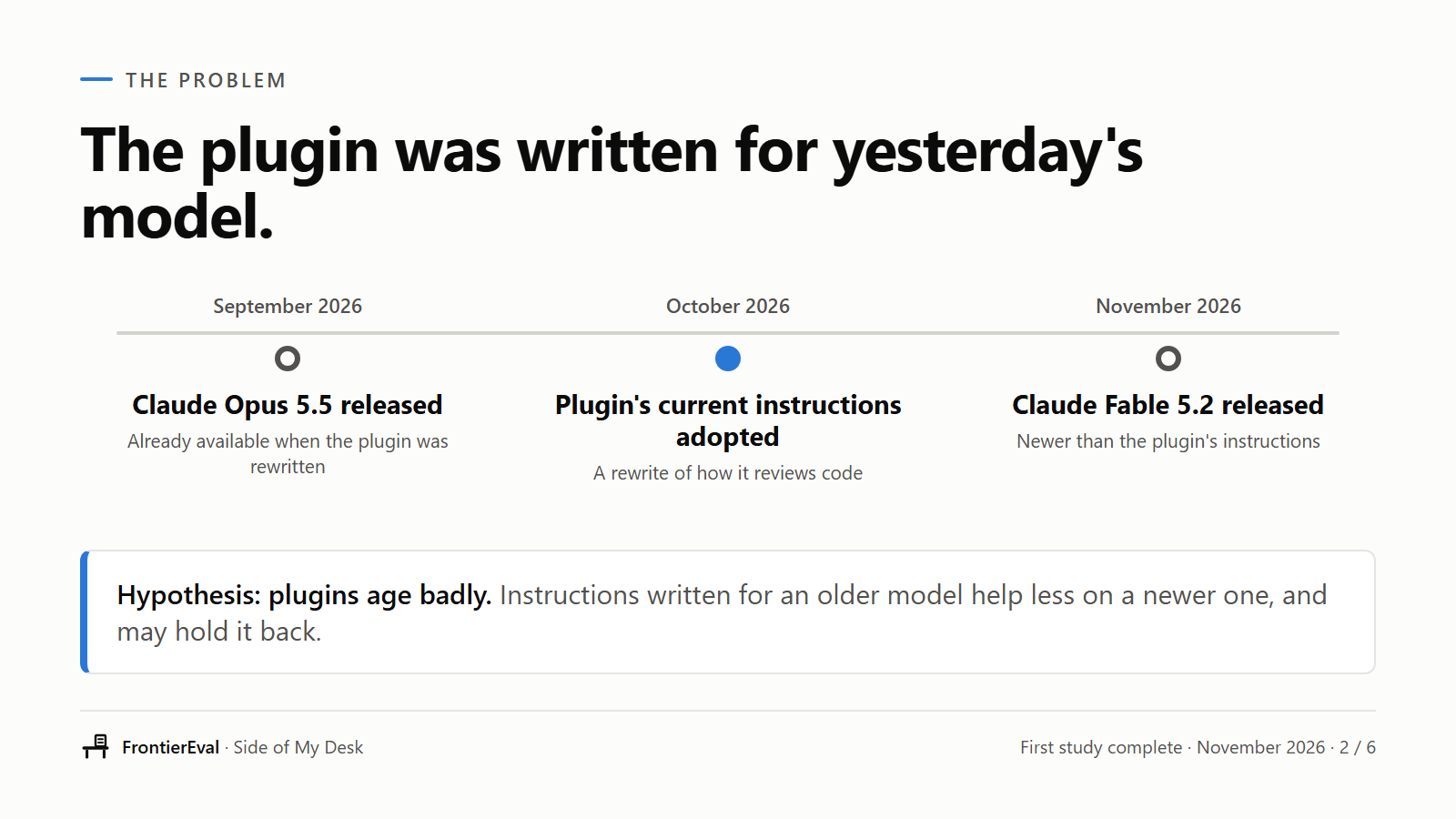
- Hypothesis: plugins age badly. Instructions written for an older model help less on a newer one, and may hold it back.
- Teams rarely re-check. A plugin gets installed, seems to work, and stays through several model generations.
- We have a natural test. One of our two models was released after the plugin's current instructions were adopted.
Detail: Experimental Design
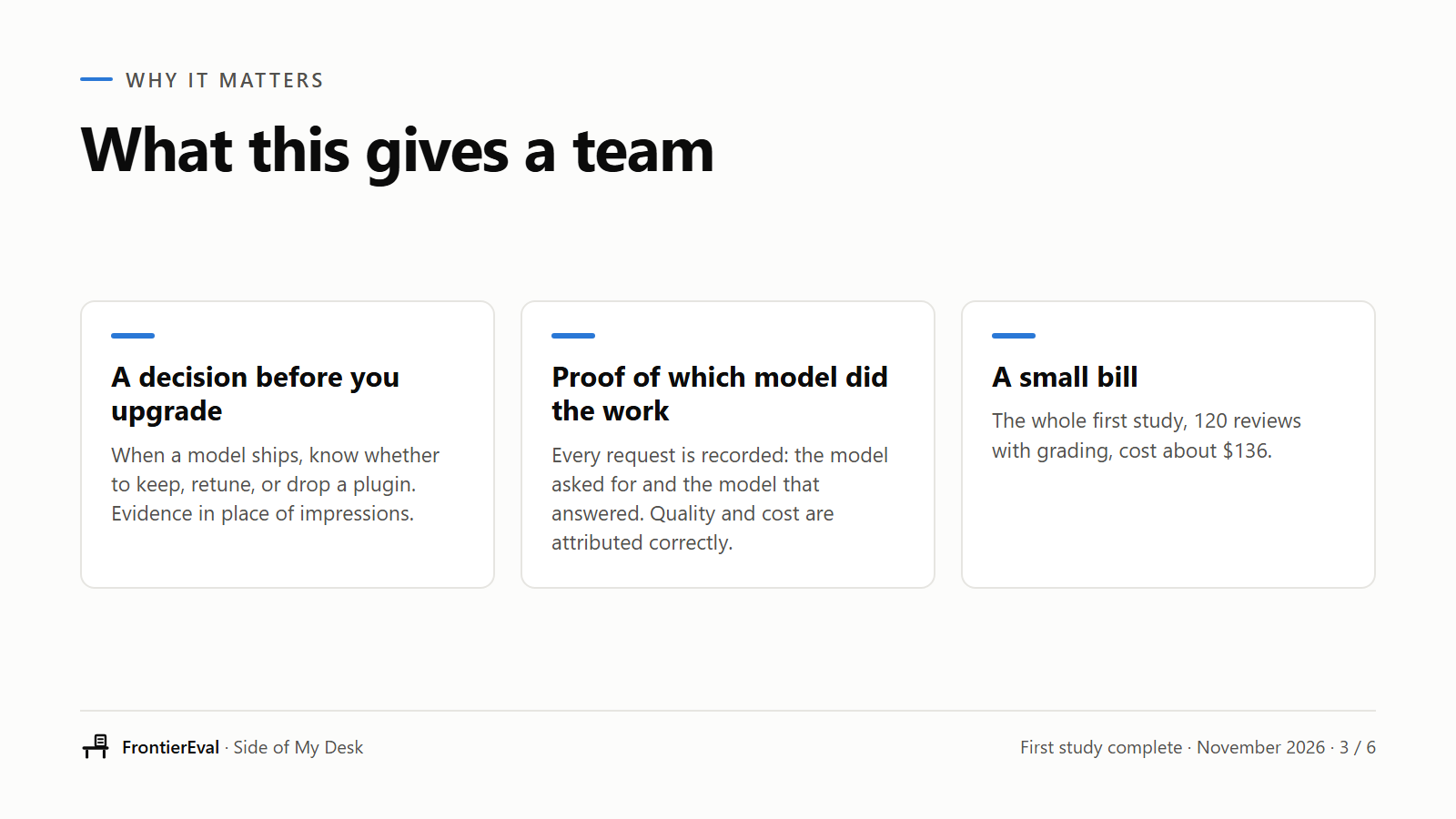
- A decision before you upgrade. When a model ships, know whether to keep, retune, or drop a plugin.
- Proof of which model did the work. Quality and cost are attributed to the model that actually answered.
- A small bill. The whole first study, 120 reviews with grading, cost about $136.
Detail: Learnings and Next Steps

- Pin. Fix the exact model, the plugin version, and the tool version.
- Run twice. The same real pull requests, once with the plugin and once with a plain request to review.
- Record. Log every request: which model answered, how many tokens, any switch to another model.
- Compare. Score both against issues that human reviewers already found.
Detail: Architecture

- The plugin picks its own models. We chose one model for a review. The plugin sent the work to three.
- The plugin is selective; a plain prompt is thorough. On one pull request with 6 known issues, the plugin reported 1 and the plain prompt reported 12.
- The tool did not flag a model switch. In testing, its own summary credited the model we asked for when a different one answered.
- The plugin costs more. About 2.6 times a plain review on the same pull request.
These are observations from set-up runs on one pull request. The scored results are on slide 6.
Detail: Early Findings

- Without the plugin, each model found about twice as many of the known issues. 31% against 66% on Opus 5.5, and 32% against 73% on Fable 5.2.
- The plugin says little, and is right more often. About 2 findings per review against about 10, and more of them matched a known issue.
- The plugin cost about 1.5 times as much per review.
- Plugins age badly? Partly supported. The plugin's one advantage was clearly smaller on the newer model. The gap in issues found could be chance.
- A first look. 15 pull requests, one plugin, two models, graded by an AI.
Detail: Results
- Which plugins or custom instructions do our engineers rely on, and when were they last checked against the model we use now?
- When we upgrade a model, do our plugins use it, or do they name their own?
- If a request were answered by a different model than the one we selected, would we know?
- Do we want an AI reviewer that says little and is usually right, or one that says a lot and needs filtering?
- What would it cost us to answer these with a measurement? Here it was about $136.
| If you are | Start at | You will find |
|---|---|---|
| An engineer using AI coding tools | Deep Dive: For Engineers | How the harness drives Claude Code, how every request is logged, what the plugin does, where the cost goes |
| An AI evaluation practitioner | Deep Dive: For AI Evaluators | The experimental design, the benchmark and its limits, grading, threats to validity |
All pages: Deep Dive index.