Repository navigation
Hardware and Benchmarks
Unlike setups locked strictly to Qualcomm Turnip/Zink drivers, this stack runs across both Qualcomm Adreno and ARM Mali/Immortalis architectures via our optimized Android EGL/VirGL bridge.
| Metric | Qualcomm Snapdragon 8 Elite | MediaTek Dimensity 9300+ |
|---|---|---|
| GPU Architecture | Adreno 840 | ARM Immortalis-G720 MC12 |
| Validated Device | Samsung Galaxy S25/S26 Ultra | Samsung Galaxy Tab S10 Ultra |
| glmark2 Score | 186 FPS (Uncapped) | 112 FPS (120Hz Surface Sync) |
| Average FrameTime | ~5.0 ms | ~8.3 ms |
| 3D Engine Test | Native 3D / Neverball / 1440p MPV | Native 3D / Stable TBDR Pipeline |
To verify real-world thermal and memory stability without root or active cooling, the stack ran an unmanaged 31.8-minute continuous build workload on a Samsung Galaxy S26 Ultra (unplugged, running on battery).
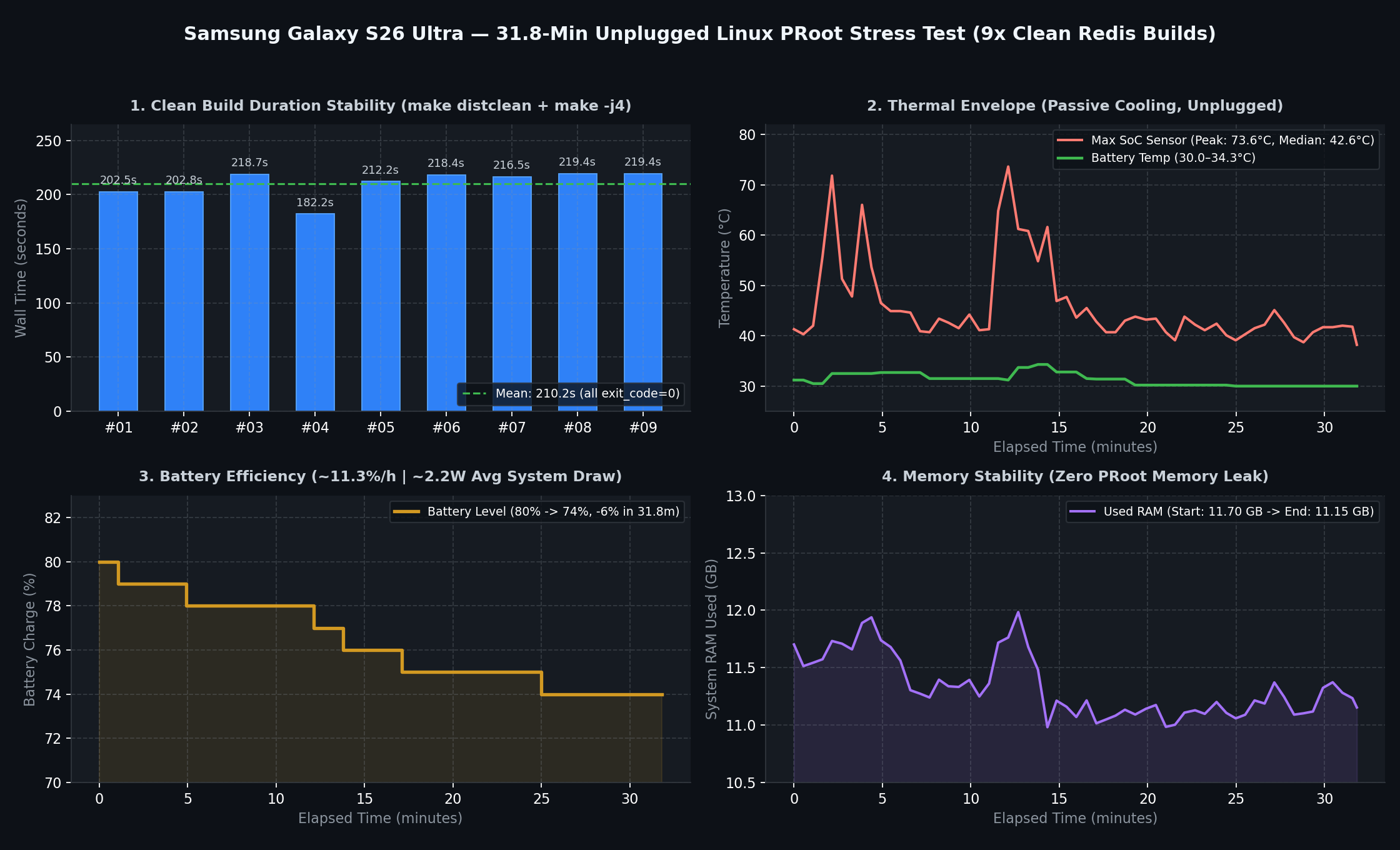
| Metric | Result | Notes |
|---|---|---|
| Test Duration | 31.8 min |
Continuous, unmanaged load in Debian 13 PRoot |
| Build Consistency | 9 / 9 |
Clean Redis compilations from source (0 failures) |
| Battery Temperature | 30.0 °C – 34.3 °C |
Zero thermal throttling observed |
| System Power Draw | ~2.2 W |
Measured on battery (unplugged) |
| Memory & Stability | 0 LMK kills |
No Android Low Memory Killer events, no memory leaks |
bash benchmarks/soak_30m.shTo validate true multi-hour workstation reliability, a Samsung Galaxy S26 Ultra (16 GB RAM) was docked via USB-C to a 32" external monitor (65W Power Delivery) with Samsung's Light Performance Profile (70%) and 80% Battery Protection (USB-C PD Bypass) enabled. Over 4.26 hours (255.9 minutes / 473 samples), the system ran a continuous 4-core stress-ng (matrixprod) workload inside Debian 13 PRoot without active cooling or root access.
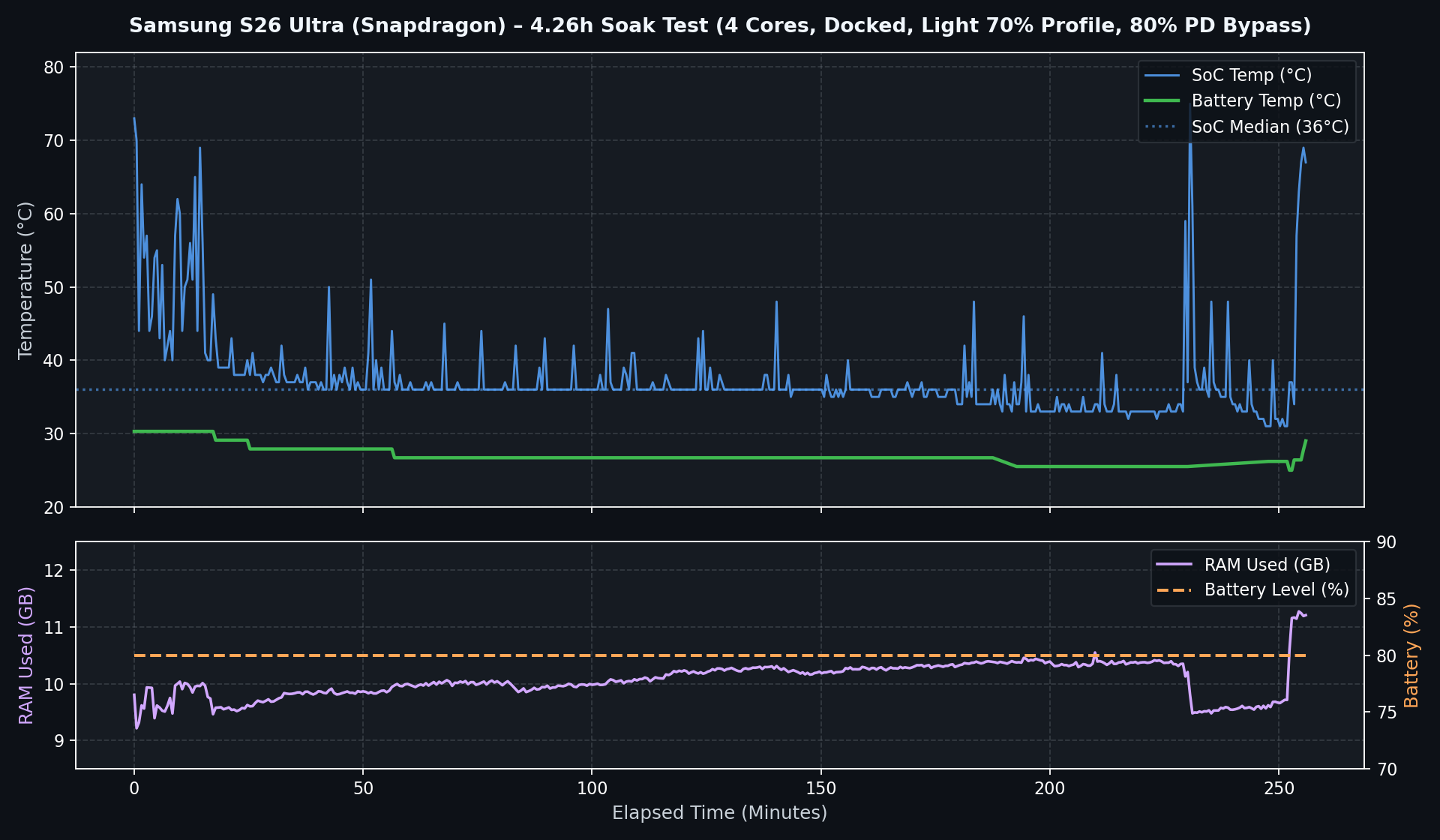
| Metric | Result | Verified Details |
|---|---|---|
| Test Duration / Samples |
4.26 h (15,353 s) |
473 telemetry points logged at ~32s intervals |
| SoC Temperature (Median / Mean) |
36.0 °C / 37.6 °C
|
Range 31 °C – 75 °C (40–55 °C active 4-core, 36 °C steady plateau) |
| Battery Temperature (Median / Mean) |
26.7 °C / 27.2 °C
|
Range 25.0 °C – 30.3 °C (cooler than ambient under continuous load) |
| Battery Level Drift |
0.0 % (80% → 80%) |
100% USB-C Power Delivery bypass confirmed across all valid samples |
| RAM Footprint / LMK Events |
~10.1 GB / 0 Kills
|
Median 10,319 MB (9,436–11,542 MB), zero Android LMK kills |
| Raw Telemetry Dataset | CSV Log | benchmarks/results/snapdragon_s26u_4core_4h_docked_light70.csv |
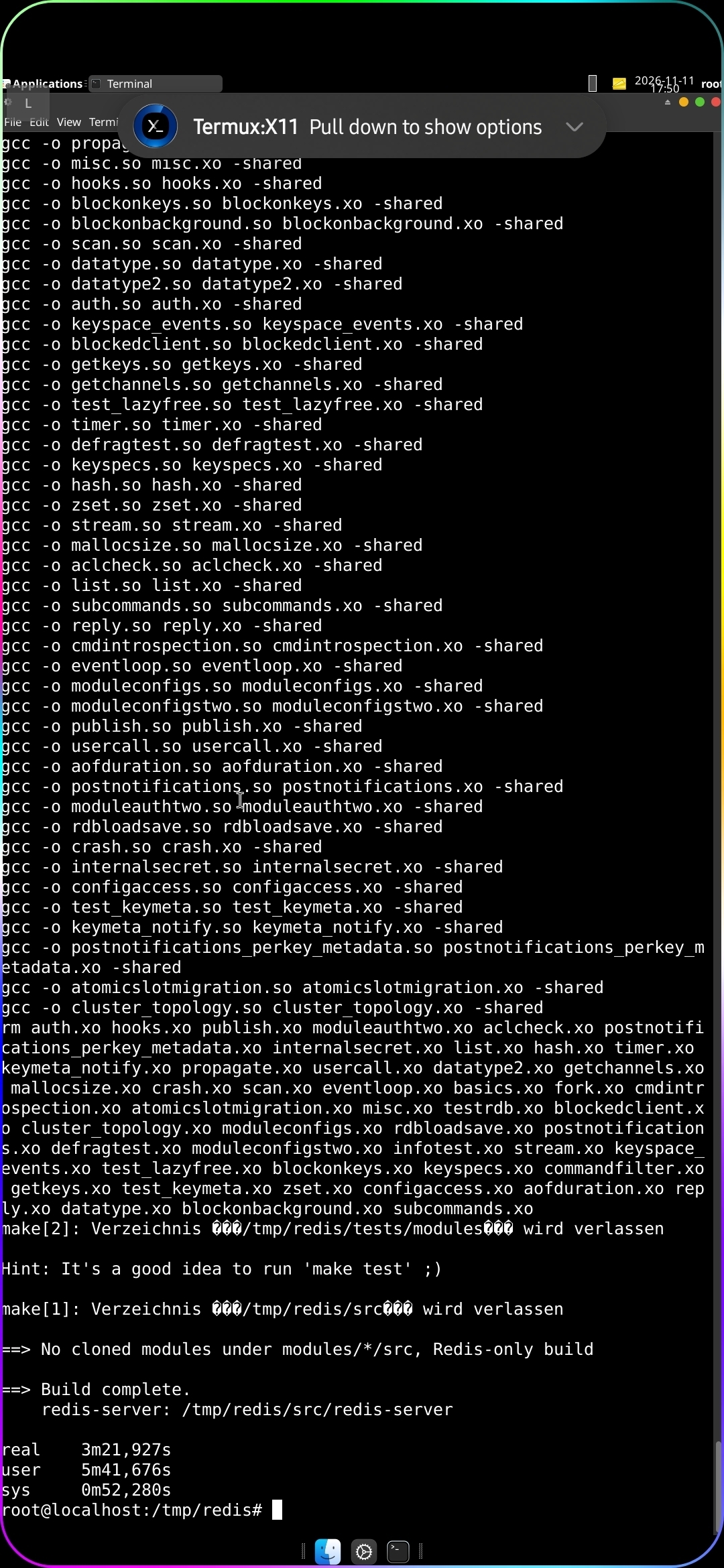
bash benchmarks/scripts/soak_snapdragon_4core.shTo prove POSIX compliance, dynamic linking, and multi-core scaling under sustained load, the full Redis codebase was compiled directly on-device using standard GNU toolchains.
| Metric | Result | Note |
|---|---|---|
| Real (Wall Clock) | 3m 21.927s | Complete build + link time |
| User (CPU Time) | 5m 41.676s | Multi-core scaling across performance cores |
| Sys (Kernel Overhead) | 0m 52.280s | ~13% syscall translation overhead |
| Memory Integrity Test | PASSED | 256 MB pattern allocation (--test-memory 256) |
apt update && apt install -y git build-essential make gcc
cd /tmp && rm -rf redis && git clone --depth 1 [https://github.com/redis/redis.git](https://github.com/redis/redis.git) && cd redis && echo "=== BUILD START ($(nproc) Cores) ===" && time make -j$(nproc) MALLOC=libc && ./src/redis-server --version && ./src/redis-server --test-memory 256 && echo "=== REDIS SUCCESSFULLY BUILT & VERIFIED ==="