Repository navigation
Releases
v4.0.0 — Capital Strategy Studio

Capital Strategy Studio
A financing decision from explicit business objectives to a reproducible analytical record.
Open the live studio · Explore Charles Dai’s fintech portfolio · Read the case study
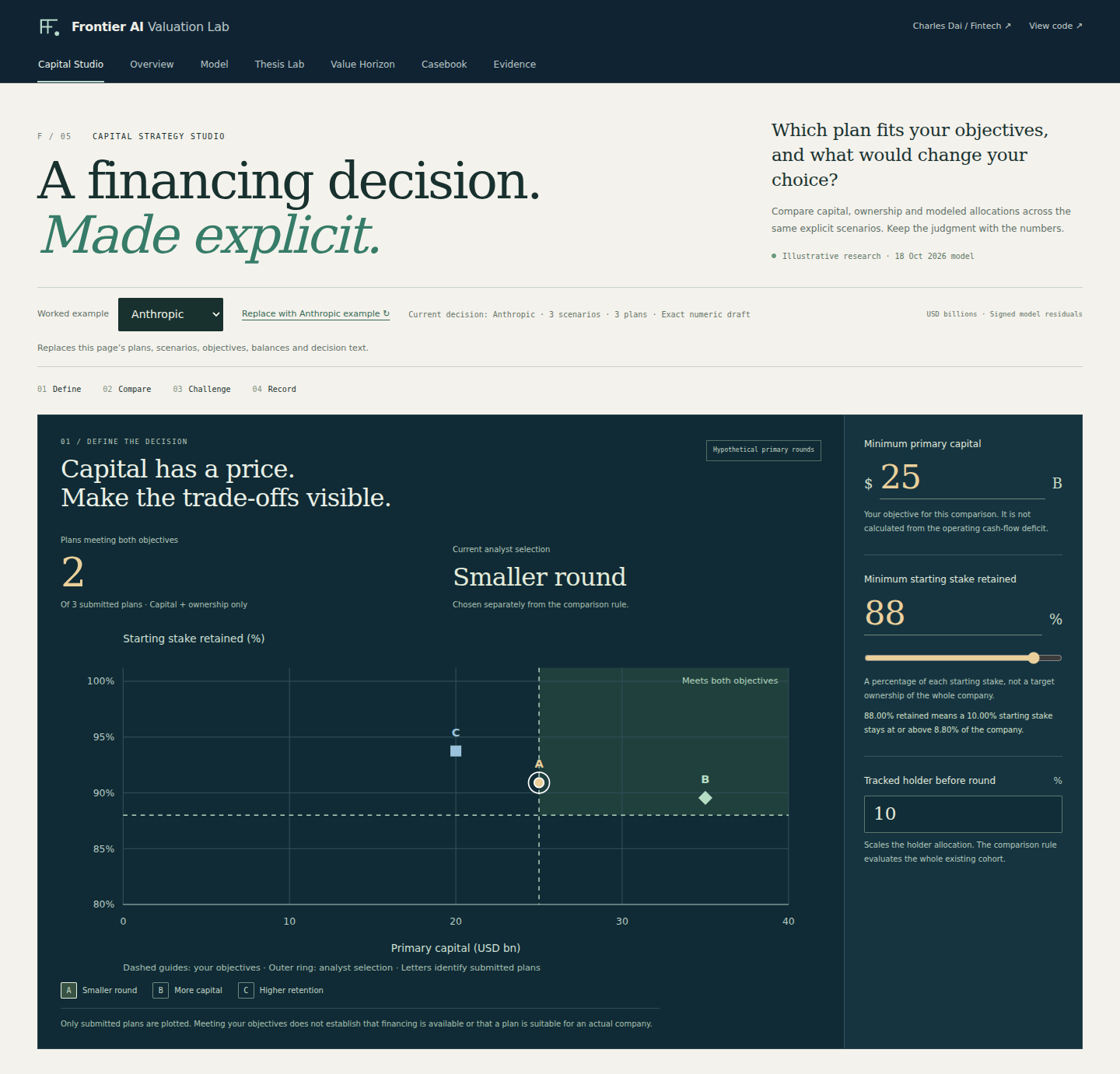
Four disciplines, one complete demonstration
| Discipline | Demonstration |
|---|---|
| Business | Set a capital objective and ownership constraint, compare submitted alternatives, and document the analyst’s choice and what would change it. |
| Fintech | Translate hypothetical primary financing terms into retained ownership and signed modeled residual allocations, using an explicit equity bridge. |
| Quant | Evaluate up to nine operating scenarios and six financing plans; inspect dominance, finite-scenario minimax regret, switching values and incompatible price constraints. |
| Engineering | Use the same validated calculation contract in a responsive browser, real stateless API, versioned records, share links and a standalone printable brief. |
The portfolio and application now share a coherent journey: Define → Compare → Challenge → Record. The case study includes actual interface captures, inspectable engineering evidence and a clear account of the AI-assisted project work. Earlier research workspaces and other portfolio projects remain available.
Try the worked decision
The Anthropic example is hypothetical. All amounts below are USD billions; the operating assumptions retain the existing dated model snapshot.
| Plan | Pre-money quote | Primary capital | Starting stake retained | Meets 25B capital and 88% retention objectives? |
|---|---|---|---|---|
| A — Smaller round | 250 | 25 | 90.9091% | Yes |
| B — More capital | 300 | 35 | 89.5522% | Yes |
| C — Higher retention | 300 | 20 | 93.7500% | No; 5 below the capital objective |
- Raise the retention floor to 90%: only A qualifies.
- Raise the capital objective to 30B: no submitted plan qualifies.
- Restore 88% retention while keeping 30B: only B qualifies.
- Restore 25B and 88% before comparing the two eligible plans across operating scenarios.
- Inspect the switching values and price constraints, record reasoning, select Verify complete analysis, then export and reopen the decision.
At the original objectives, A has lower worst regret across the three listed scenarios: 8.591070B, versus B’s 17.154800B. Neither dominates the other. Their existing-cohort allocations cross at a signed pre-money model residual of 635B, where both allocate 600B to that cohort. The Bear case limits the all-scenario pre-money price ceiling to 1.838122B, leaving the submitted financing price intervals empty under the stated coverage and retention constraints. Eligibility and this separate valuation challenge remain visible together.
These are conditional results under a simplified primary round, not reported financing offers, expected investor returns or probabilities. The analyst’s selection remains separate from the comparison rule. The method excludes preferences, option-pool changes, convertibles, secondary sales and transaction costs.
Calculation and record integrity
- Full operating assumptions, continuation horizons, financing terms, objectives and reasoning travel with the decision. Imported analysis is recomputed from validated inputs.
- Missing bridges, signed negative residuals, no eligible plans, ties and unresolved arithmetic have distinct states.
- Editing a decision invalidates its earlier API verification. Late responses cannot verify a newer revision.
- Strict schemas, bounded streamed requests, UTF-8 checks, safe HTML rendering and bounded imports/share links cover the input boundaries. Larger decisions retain a JSON export route.
- Pairwise financing coefficients use exact rational arithmetic derived from the entered binary64 quote and raise. The general DCF and allocation model remain floating-point calculations with documented limits.
The complete formulas, examples, sources and numerical conventions are in CAPITAL_STRATEGY.md. The scenario framing draws on RAND’s RDM guide and Damodaran’s scenario-analysis discussion; this bounded comparison is not a complete RDM study or a probability model.
Verification before publication
- 314 Node tests and 842 assertions across 11 local Chromium workflows passed, with zero uncaught page errors.
- Six independent numerical references passed. The Capital reference covers 74 valid fixtures, 38 invalid JSON fixtures and 11 JavaScript-only rejection cases, with 16,635 numeric comparisons, 134,357 structural comparisons and 510 exact rounded crossover comparisons.
- The original Capital portfolio integration passed 34 structural tests and 56 navigation-resilience assertions.
- All 19 pages across five current PDF briefs were rendered and visually reviewed.
- The desktop package passed seven creation and tamper-detection checks. It contains 47 members: 46 listed files and the manifest.
These results are source-bound in the application’s local verification record and the original portfolio integration record. Subsequent portfolio changes and production observations are identified separately below.
Published application, portfolio and desktop handoff
- The production application passed 144/144 ordinary HTTPS checks, covering all 82 public files plus the root alias, health, complete API responses and rejection behavior.
- The current portfolio passed 29/29 required HTTPS requests and 27/27 semantic checks. Its separate deployment-marker request returned HTTP 404 and is excluded from the required visitor pass count.
- The actual portfolio-to-Studio journey passed 40 browser assertions, including constraint transitions, complete API parity, verification invalidation, exact JSON/HTML exports, fresh-context restoration, phone layout and keyboard interaction. There were zero uncaught page errors.
- Exact-commit GitHub workflows completed successfully: application verification and portfolio verification and Pages deployment.
- The latest portfolio preserves the concurrent LineageGuard Studio showcase. Its deployment verifier now accepts legitimate growth of the reviewed public inventory while retaining the explicit allowlist and commit/file checks. 43 current structural tests passed; the two observed verifier compatibility findings are closed by the published correction and production checks.
- The new versioned desktop folder contains 47 files on each Mac. Delivery preserved 167 prior Air files and 42 prior Pro files, including their bytes and modification times. Air ran the actual creation and read-only verification commands and recomputed the complete Capital record. Pro verified the immutable-commit archive and all delivered file hashes; no local model recomputation is claimed there.
- The GitHub project description, topics and demo homepage now identify Capital Strategy Studio; existing topics were preserved.
Browser TLS scope: strict Chromium navigation in this verification environment failed with ERR_CERT_AUTHORITY_INVALID at both public domains, before UI assertions. Those attempts are retained separately. The 40 functional browser checks used an isolated certificate override only after both ordinary HTTPS proofs passed with normal certificate and hostname verification. The functional result does not certify strict Chromium certificate trust.
Current portfolio commit: 59f0f4c91bd352b3ee81a89871a66f72befb3080. Original Capital integration: 6ce5dcb9a5e5200e609ddae81f6838fdcb950db4. Preserved concurrent LineageGuard update: f2d1cb41340b32816526ad598a877f5338b6bd86.
Downloads and reproduction
Start with Frontier_AI_Capital_Strategy_Package.zip for the complete handoff. It includes the original workbook and review, five current analytical briefs, exact-input records, methodology, an opening guide, a review walkthrough and live-workspace shortcuts. The Capital Decision PDF, HTML and JSON are also individual assets.
Local and published verification records accompany SHA256SUMS.txt, which binds each listed release asset without including its own hash. The published evidence record explicitly precedes GitHub release-asset creation; final download verification is recorded separately.
Application commit: a47661d28662348c5f586473f9372ed7d90a8497. Application 4.0.0, capital method 1.0.0, financial model 3.0.0. Financial research retains the 18 October 2026 snapshot. The original workbook, review, operating model, earlier financing and ownership engines, presets and research data are preserved byte-for-byte. Native Excel recalculation is not claimed. The scoped AI-assisted engineering and numerical reviews are documented; they are not an external financial audit.
v3.6.0 — Ownership Frontier
Ownership Frontier
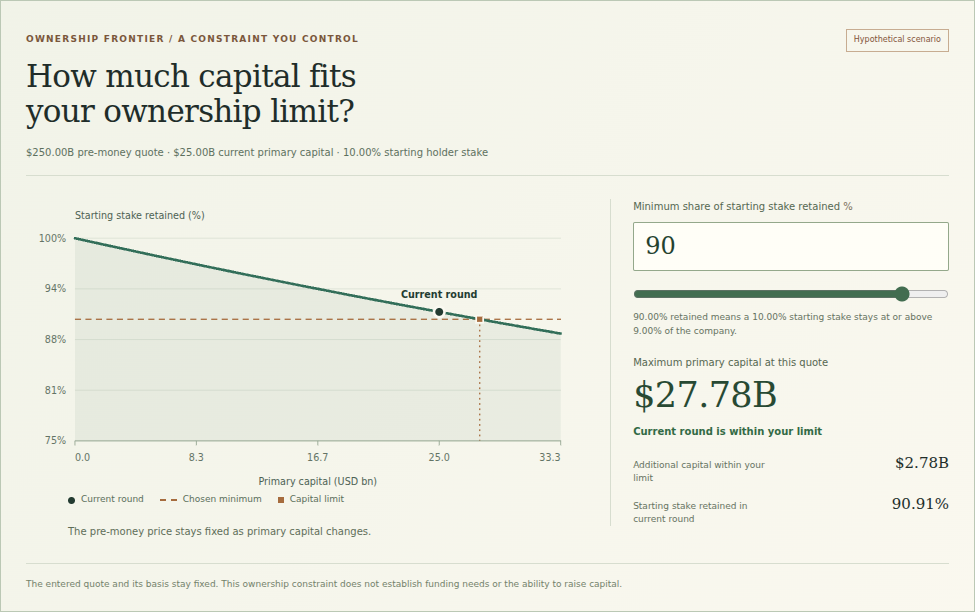
Financing terms now answer a practical question: how much primary capital fits within a chosen ownership limit?
Open the live example · Explore the fintech portfolio · Read the project case study
What changed
- Added a precise retention constraint, interactive ownership curve, capital ceiling, current-round status and headroom to Financing Lens.
- Kept the entered valuation quote fixed when switching between pre-money and post-money interpretation, with an explicit explanation of the resulting financing terms.
- Added strict ownership validation to the calculation API. Requests without the optional ownership constraint retain their existing response contract.
- Preserved the exact ownership floor, valuation assumptions, equity bridge and round inputs in share links and JSON exports. Older financing links remain supported.
- Expanded the printable Financing Lens brief to three pages, including the ownership curve, exact assumptions and a link that reopens the same calculation.
- Refined the portfolio's existing fourth research card and case-study section, using a capture of the actual application and a direct path into the worked example.
A worked example
The floor measures the fraction of a holder's starting stake retained after the round. A 90% floor for a holder who starts with 10% requires at least 9% ownership afterward.
| Fixed quote | Primary capital in the example | Retention floor | Capital ceiling | Remaining headroom |
|---|---|---|---|---|
| $250B pre-money | $25B | 90% | $27.78B | $2.78B |
| $250B post-money | $25B | 90% | $25.00B | $0.00B |
Displayed values are rounded; the model, API and saved inputs retain numeric precision. The method covers a simplified priced primary round. It excludes option pools, convertibles, secondary sales, preferences and transaction costs. The ceiling does not establish funding needs or the amount a company could actually raise.
The arithmetic follows the share-issuance framework described by Y Combinator and the ownership-denominator discussion in Carta's dilution guide. The complete formulas, bounds and numerical conventions are documented in Ownership Frontier methodology.
Verification
- 248 local Node tests and 320 local browser assertions passed.
- An independent 100-digit Python reference checked 25 valid scenarios, 23 malformed JSON scenarios and eight JavaScript-only rejection cases, with 2,514 numeric comparisons and 10,418 structural or invariant comparisons.
- All 12 pages across four current PDF briefs were rendered and visually reviewed.
- Production application verification passed 98/98 ordinary HTTPS checks, covering every public asset, health, complete API responses and exact rejection behavior.
- Production portfolio verification passed 26/26 visitor requests and 8/8 semantic checks. The empty deployment marker is recorded separately from visitor counts.
- The production Ownership Frontier workflow passed 48 browser checks; the live portfolio-to-application journey passed 20, both with zero uncaught page errors.
- Both GitHub workflows completed successfully for the exact published commits: application checks and portfolio deployment.
- The native desktop handoff created 39 files in a new versioned folder and preserved all 128 prior files byte-for-byte.
Browser testing scope: strict Chromium in the verification environment encountered ERR_CERT_AUTHORITY_INVALID before loading the UI. Those failed attempts are preserved. Functional browser checks used an isolated certificate override only after both separate ordinary HTTPS proofs passed with normal certificate and hostname verification. The browser functional passes do not certify strict Chromium certificate trust.
Downloads and reproducibility
The release includes the Financing Lens PDF, HTML and exact-input JSON; the complete Ownership Frontier desktop package; local and production verification records; and SHA256SUMS.txt. The desktop package contains the original valuation workbook, original review PDF, current analytical briefs, methodology, evidence and opening shortcuts.
Application commit: 099bc47578d48f342dbf5947a1b4dcb7a1029f18
Portfolio commit: a2793e117d32c4f1d123e2699fe854c6b694ef74
Application 3.6.0, financial model 3.0.0, ownership method 1.0.0. Financial research retains its explicit 18 October 2026 snapshot; the financing examples are hypothetical. Engineering verification and the scoped AI-assisted review do not constitute an external financial audit.
v3.5.0 — Financing Lens
From value to ownership
Financing Lens extends the existing Model with a complete hypothetical primary-round analysis: reconcile operating enterprise value to modeled equity, enter a separate pre-money or post-money round quote, and trace new capital into cash and ownership.
Open the worked financing example · Fintech portfolio · Engineering case study
What changes
- A price reconciliation, before/after ownership bars, tracked-holder dilution and signed operating-EV-to-equity bridge within the existing Model.
- Complete financing links, JSON and script-free HTML briefs preserve all thirteen operating assumptions, the explicit bridge and the exact round.
- The
financingAPI action returns the same complete analysis, with strict request validation and explicit precision limits. The interface detects non-headline response mismatches and rejects stale verification responses. - The portfolio gains a fourth research journey, an actual Financing Lens screenshot, clear methodology and a worked PDF.
- A two-page financing brief and a 36-file portable desktop package accompany the existing workbook and research outputs.
Worked hypothetical example
A $250B pre-money quote plus $25B primary capital gives a $275B post-money price. New investors own 9.09%; a non-participating holder with 10% before the round retains 9.09%, a 0.91 percentage-point reduction. At the assumed issue price the tracked holder's quoted mark stays $25B. Under the fixed forecast and retained-proceeds assumption, operating EV remains approximately $367.77B.
Assumed cash of $20B and debt of $5B give approximately $382.77B modeled equity before and $407.77B after the proceeds. These balances and transaction terms are hypothetical; they are not disclosed company facts or a reconstructed capitalization table.
Verification
- 227 Node model, API, snapshot, presentation and release tests passed.
- 243 current local browser assertions passed across Financing Lens, the connected research journey and the Model regression suite; zero page errors.
- Independent Python share-ledger/80-digit Decimal reference: 19 valid scenarios, 31 invalid and boundary rejections, 3,591 numerical comparisons and 596 structural comparisons passed.
- 82 local HTTP checks passed, including every current public asset and complete API response/rejection comparisons.
- Portfolio: 14 tests, four generated case studies, 25 exact staged public files, responsive/browser review and zero page errors.
- All eleven pages of the four current worked PDFs were rendered and visually reviewed. The original five-sheet workbook and nine-page financial-review PDF retain their reviewed bytes.
- All 36 files in the new native MacBook Air handoff verified; all 92 existing desktop files remained byte-identical.
The attached local and published receipts bind this evidence to source hashes and the exact application/portfolio commits. The published receipt records hosted CI, deployment identity, ordinary HTTPS content/API checks, the observed browser trust configuration and native delivery. These are scoped engineering checks, not an external financial audit.
Method and boundaries
Application 3.5.0 retains financial engine 3.0.0, the 18 October 2026 financial snapshot and its original company research cutoff. The financing method uses one primary priced round with equal participating economic rights, retained cash and zero fees. It excludes secondary sales, SAFE/note conversion, option-pool expansion, liquidation preferences, debt repayment and future rounds. Financial deficits already included in FCFF are not deducted again or converted into a recommended raise.
Method references were reviewed separately from the frozen company snapshot: NYU Stern / Aswath Damodaran on current claims and equity and Y Combinator / Geoff Ralston on priced equity rounds. Complete calculation and precision policy.
Downloads
The Financing Lens PDF, HTML and JSON contain the complete worked example. Extract Frontier_AI_Financing_Lens_Package.zip and open START_HERE.html for the guided handoff. It includes the new financing files, original workbook, existing worked briefs, evidence, methodology and live project shortcuts. SHA256SUMS.txt identifies all six companion asset files; the release publication process independently downloads and verifies all seven uploaded assets.
The new desktop folder is Desktop/Anthropic-vs-OpenAI-Valuation/Financing_Lens_V3_5_2026-10-19. Earlier handoffs remain intact. No native Excel recalculation or automatic cross-device Casebook synchronization is claimed.
v3.4.0 — Value Horizon
Value Horizon: how much future is in the value?
Version 3.4.0 turns the Anthropic versus OpenAI valuation project into a connected fintech research demo: a clear portfolio entry, an interactive valuation question, reproducible calculations, a full API, and portable research briefs.
Explore: Fintech portfolio · Value Horizon · Engineering case study
What changed
- Value Horizon: Retain a chosen number of annual cash flows after the explicit forecast and see the resulting operating enterprise value, the retained terminal contribution, and the excluded tail. Compare both companies and all six presets, or carry all thirteen custom model inputs into the analysis.
- Target and capture analysis: Solve for the first whole year needed to support a target operating value, and show the horizons that retain 50%, 75%, 90%, and 95% of terminal present value. Precision-limited and unreachable results are explicit.
- Connected research workflow: Consistent navigation across Overview, Model, Thesis Lab, Value Horizon, Casebook, and Evidence; exact scenario links; complete JSON exports; and script-free HTML research briefs.
- Professional presentation: A dedicated fintech gateway, an actual application screenshot, a reviewer guide, a mobile layout, keyboard-accessible controls, and a balanced two-page Value Horizon PDF. Existing portfolio case studies and the concurrent reviewer-guide update are preserved.
- Full-stack verification: Complete API-response comparison, strict input validation, stale-request protection, independent Python calculations, high-precision boundary fixtures, and reproducible delivery manifests.
A worked example
With the preserved Anthropic Base assumptions, perpetual operating enterprise value is $367.8B. Retaining ten continuation years after 2036 produces $248.5B: approximately $79.5B of explicit-period present value plus $169.0B of retained continuation value. The excluded tail is $119.3B. The default $250B target requires eleven whole continuation years, through 2047.
These are conditional model outputs. The finite-horizon analysis assumes zero cash flow and zero residual value after the cutoff. It does not estimate a company's lifespan or a probability of survival. The financial engine remains version 3.0.0, with valuation date 2026-10-18 and research cutoff 2026-10-18T09:22:26-07:00; this release does not refresh company underwriting.
Method references: NYU Stern — Valuing Young, Start-up and Growth Companies, including finite-life valuation; CFA Institute — Free Cash Flow Valuation.
Verification and delivery
- 198 passing Node tests; 384 passing assertions across four local browser suites, with no reported page errors.
- Independent Horizon reference: 39 ordinary scenarios, 3,939 curve points, and 19,974 numerical comparisons; six additional precision fixtures provide eight 100-digit Decimal boundary checks.
- Published app: all 73 certificate-verified HTTPS checks passed, covering assets, release metadata, valid API responses, and rejected invalid requests. The published Horizon interaction suite passed 148 checks with no reported page errors.
- Published portfolio: exact reviewed bytes for 23 served files plus the homepage alias, and 23 working source/demo destinations. GitHub Actions verification and deployment succeeded for the exact published commits.
- The production browser runtime initially reported
ERR_CERT_AUTHORITY_INVALID. Browser interaction verification used an explicitly recorded certificate override only after ordinary system TLS checks passed; it is not a strict browser-TLS pass. See the separate publication receipt for scope and limitations. - The desktop package contains 29 manifest-listed files plus its manifest. A fresh native desktop delivery was verified while all 62 pre-existing files remained byte-for-byte unchanged. Original workbook and review PDF bytes are preserved; no fresh native Excel recalculation is claimed.
Application commit: cd149df64b33d9efc822513511255f444b4f5731
Portfolio commit: d65e226bd3e07097331ffdf6249090e31b712d9d
The attached local and published verification records have separate scopes and dates. Numerical agreement verifies implementation consistency; it is not an external financial audit or a validation of future business outcomes.
Research Workspace 3.3 — keep the reasoning
Research Workspace 3.3
Follow a valuation from its assumptions to a complete research record. This release connects the company comparison, Thesis Lab, forecast model, contextual evidence and new Research Casebook into one continuous workflow.
Open the workspace · Research Casebook · Thesis Lab · Portfolio case study
What is new
- Research Casebook. Capture complete scenarios and comparisons with their exact inputs, optional equity bridges, analysis window and target. Add a rationale, key assumption, observable review trigger and selected sources. Search and filter analyses, compare two saved cases, preview imports, preserve conflicting records and undo deletion.
- A complete inspection and return journey. Open either Thesis Lab case in the Model, edit it and return to the original comparison. The other case, both bridge settings, exact landscape axes and target travel with the analysis.
- Exact target requirements. Apply the full-precision solved operating margin at the selected cost of capital. The sampled grid point remains a separate explicit action.
- Evidence beside every input. Inspect the current assumption or both comparison values with related context from 21 recorded facts and 19 sources. Observation periods, publication qualifiers and modeling limitations remain visible. Related evidence does not certify a forecast assumption.
- A connected comparison experience. Open the exact baseline and stressed scenario directly in Thesis Lab to explain their signed change in enterprise value. Consistent five-link navigation connects the workspace.
- Portable research. Export complete JSON records or script-free research briefs with exact reopening links. The release includes three explicitly labeled illustrative analyses, a four-page worked research brief and the existing three-page comparison example.
Verification
| Scope | Result |
|---|---|
| Financial, API, snapshot, storage, migration, import, evidence and brief tests | 172 passed |
| Local Chromium interaction checks across nine harnesses | 527 passed |
| Local HTTP routes, exact assets, complete API responses and rejection cases | 53 passed |
| Independent Python forward-model cases | 36 valid and 73 invalid passed |
| Independent attribution, grid and target-frontier numerical comparisons | 1,002 passed |
| Portfolio structural checks | 13 passed |
Independent review closed source-date qualification, published-Base context, evidence-dialog close behavior, delayed-save feedback, migration idempotence and print-layout findings. Browser checks include exact handoffs, invalid and stale states, complete-result API mismatch detection, storage failures, hostile import text, keyboard interaction and responsive layouts. The four-page research brief and three-page comparison example were visually reviewed.
The attached verification records state their source hashes, coverage and limits. Chromium checks do not claim universal browser or assistive-technology coverage. The original workbook's documented native-Excel verification limitation still applies.
Published verification
The application is published from commit 24f9372. Its GitHub Actions run passed, and Vercel deployment dpl_ABuf7RRhTTi5uRVtaMi4BkFNnK3a reached READY with that exact commit and the public demo alias.
Production verification passed 53 HTTP checks with normal TLS and 109 browser assertions, including actual example import, saved-note persistence, complete API result agreement, exact comparison inspection and return, evidence dialogs, PDF bytes and three responsive widths. The temporary Chromium QA browser used an execution-proxy certificate override after its strict attempt failed; the separate HTTP run verified normal HTTPS. Both conditions are explicit in the attached production records.
The portfolio update is published from commit e5d0ae7, with a successful checks and Pages deployment run.
The public portfolio passed 72 checks across 390, 768 and 1440px, with three exact deployed-file hashes and all five project destinations verified using normal TLS. Its browser run records the same bounded QA certificate condition in portfolio-production.json.
The complete portable handoff is available as Research_Workspace_V3_3_2026-10-19.zip. SHA256SUMS.txt records the hashes of the release deliverables.
All 18 published release assets were downloaded again and matched the reviewed SHA-256 hashes; all 17 entries in SHA256SUMS.txt verified.
Financial scope and storage
Application 3.3.0 uses financial engine 3.0.0, the six published presets and the frozen 18 October 2026 research snapshot. The original formula-based workbook and nine-page financial review retain their reviewed bytes. The release improves the research workflow without refreshing company disclosures.
The Casebook is stored in the current browser origin and profile. Export JSON to move calculations, notes and source selections across devices. Calculation links carry the numerical snapshot; analyst notes and source selections are not sent to the stateless valuation API. The illustrative example casebook is imported only by an explicit user action.
The output is conditional operating enterprise value. It does not establish a security-specific price, scenario probability, business causality or investment return. Hypothetical equity bridges remain separately labeled.
Reproduce the project
Use Node.js 24 for npm test, npm start and npm run build. The repository includes the separate Python reference checks and optional browser harnesses. See the Research Workspace guide, evidence method and verification record.
Developed by Charles Dai as an independent, AI-assisted fintech portfolio project.
v3.2.0 · Thesis Lab
Thesis Lab
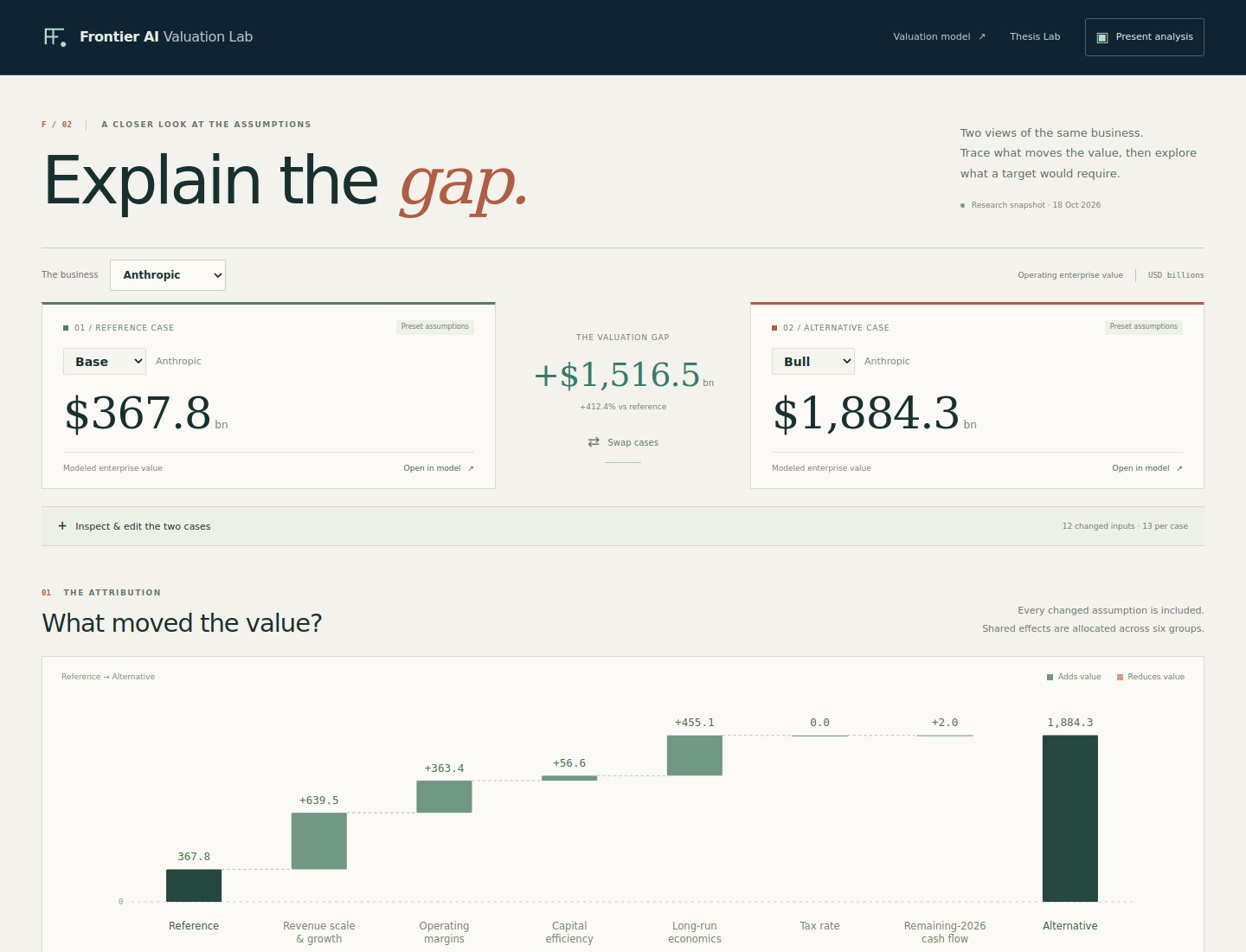
Compare two valuation cases, explain the complete change, and investigate the operating assumptions required to support a target value.
Open Thesis Lab · Full valuation model · Portfolio case study
What this release adds
- Two complete, editable cases. Compare reference and alternative assumptions for Anthropic or OpenAI. Inspect or edit all 13 inputs in each case, swap the comparison, and reopen either case in the original workbench.
- Exact attribution of the valuation gap. A signed waterfall allocates the difference across six declared assumption groups. The calculation evaluates all 64 group combinations, equivalent to averaging all 720 orders of change, and exposes its reconciliation and inputs.
- A target-value landscape. Explore operating enterprise value across WACC and 2036 EBIT margin. A required-margin frontier shows what the target would require at each displayed WACC, holding the alternative case's other eleven assumptions fixed. Select a point and explicitly apply it to the alternative case.
- Portable comparisons. Versioned links retain both exact cases, their origins, optional hypothetical equity bridges, landscape points and target. Existing single-case links can enter the comparison workflow and return to the workbench without losing their assumptions.
- Presentation and export. A focused presenter view, responsive desktop and mobile layouts, and a script-free comparison brief make the analysis easier to demonstrate. The release includes a visually reviewed three-page A4 example PDF and its standalone HTML source.
- A complete backend path. The shared Node API adds strict
attributeandlandscapeactions. The browser verifies the complete current results against the actual service and rejects stale responses after edits.
Method and snapshot
Application 3.2.0 retains financial engine 3.0.0 and the 18 October 2026 research snapshot. This release advances the analytical experience; it does not refresh company financial evidence. Outputs are illustrative operating enterprise values, with private financing equity references separately identified.
Attribution uses a declared grouped baseline Shapley method. The reference case and grouping affect the allocation; it is a decomposition of this model, not causal evidence. The target frontier is a deterministic conditional result, not an estimated probability or a comparison to a funding-round equity price. The method is documented in Thesis Lab, with primary references including Sundararajan and Najmi, Moehle, Boyd and Ang, and NIST's contour-plot guidance.
Verification
| Layer | Recorded result |
|---|---|
| Model, real HTTP API and release tests | 119 passed; build passed |
| Local browser journeys | 299 checks passed across the calculator, guided experience, sharing, Thesis Lab and entry/return workflow |
| Independent Thesis calculations | 1,002 numerical checks passed, including full permutation attribution and a separate target-frontier solver |
| Production HTTPS | 23 checks passed, including 16 exact asset matches, release metadata, two complete API comparisons and four input rejections |
| Production browser workflow | 14 checks passed, including actual backend verification and exported comparison contents |
| Portfolio | 13 local tests; successful Pages deployment; four public responses matched the committed files exactly |
| Desktop delivery | Both Mac handoffs verified; 14 delivered files per package; original files and earlier handoff folders preserved |
The local browser checks cover widths from 360 to 1440 pixels, native keyboard controls, reduced motion and a 200% Thesis Lab zoom check. These checks do not certify every browser or assistive technology. Production Chromium required a temporary browser-only certificate workaround in the execution environment; the independent system-curl HTTPS checks verified TLS normally. That distinction is retained in the attached evidence.
The original Excel model, nine-page valuation review, financial engine and six presets retain their reviewed SHA-256 hashes. No production runtime dependencies were added.
Downloads and reproducibility
The attached comparison PDF/HTML, editable workbook, valuation review and actual UI preview are ready to inspect. The JSON records contain local review, independent numerical verification, production checks and release metadata. SHA256SUMS.txt covers every attached deliverable other than the checksum file itself.
See the README for the one-minute walkthrough and local run instructions, and the API contract for all eight actions.
3.1.0 · Interactive valuation story
Frontier AI Valuation Lab 3.1.0
A guided comparison, paired stress testing and portable scenarios make the valuation model easier to explore and demonstrate. The full financial workbench remains available below the new introduction.
Open the live application · Read the portfolio case study
What changed
- A new visual introduction asks “How much future is in the price?” Three chapters compare revenue, annual free cash flow and value after 2036 on common scales, with direct labels, keyboard controls and accessible data tables.
- Bear/Base/Bull comparisons and four explicit stress controls show the effect of early revenue growth, final EBIT margin, WACC and capital efficiency on both companies. The real API verifies the complete current result. Either stressed case opens directly in the detailed workbench.
- Share links restore the exact company, scenario, all 13 financial assumptions and optional hypothetical cash/debt/claims bridge. Versioned, bounded URL fragments need no account or server-side scenario record. Invalid projections are rejected before they replace the current case.
- A standalone, script-free HTML scenario brief contains the current valuation, assumptions, signed value bridge, full annual forecast and evidence links. It includes the exact reopening link and prints to PDF from the browser.
- The portfolio card and case study now show an actual capture of the upgraded interface. A new social preview, README walkthrough, API documentation and desktop handoff accompany the release.
A one-minute demonstration
Open the Base comparison and choose Value after 2036. Then add 2 percentage points to WACC, keeping the other shocks at zero. Under the published assumptions, Anthropic's modeled enterprise value changes from $367.8B to $265.3B and OpenAI's from $258.9B to $172.0B, with operating cash flows unchanged. Open either result in the workbench, share the case, and download its scenario brief.
These are conditional model outputs in USD billions, not company disclosures, trading prices or return forecasts. Financing reference values in the model are separately labeled post-money equity values.
Version and research boundary
- Application: 3.1.0; shared analytics: 1.0.0; financial engine: 3.0.0.
- Valuation and research snapshot: 18 October 2026. This release advances the application experience; it does not introduce a new financial-data refresh.
- The engine, six presets, research JSON, workbook and nine-page PDF review retain their previously reviewed bytes. Signed negative values and undefined ratios remain explicit.
- Source commit:
f7ea007f4b93e05338ef1979eab00eb8b1fc2226. - Portfolio commit:
9dcce949d9ad4f5c36e689d2b05a73d4077bb0e1.
Verification
- 63 Node/model/analytics/real HTTP/share/brief/release tests passed.
- Independent Python parity passed 36 valid and 73 invalid cases.
- Chromium passed 75 experience checks, 75 sharing and briefing checks, and 57 original workbench regression checks, with no JavaScript runtime errors. Layouts from 360 to 1440 pixels, reduced motion and keyboard interaction were checked. All three printed pages of a custom scenario brief were visually inspected.
- On the public deployment, 30 browser checks passed. Real
compare,stressanddriversresponses matched the reviewed local engine across 1,811 numeric fields with zero numerical difference. Three malformed or invalid stress requests returned HTTP 400. - 15 deployed assets matched the reviewed source byte for byte. Both portfolio pages matched the published portfolio commit. All 24 recorded ordinary curl requests completed certificate verification successfully without an insecure flag.
- Application CI and portfolio CI/deployment completed successfully for these exact commits. Vercel deployment
dpl_6guLpp6yxCyqtyDPMzC5ZFhQkpcnreached READY in production and serves the canonical application URL.
The production browser's first connection encountered a certificate trust error in its test environment. A temporary browser-context override was used for functional checks; ordinary curl separately verified TLS. The attached evidence records this condition and a resolved request-client DNS failure. This is Chromium verification, not a claim of universal browser or assistive-technology certification. Native Excel recalculation remains outside the workbook's previously documented verification scope.
Release files
The source ZIP is exported from the exact application commit. The attachments also include the reviewed Excel model, PDF review, production verification JSON, an experience preview and a SHA-256 manifest. The verification JSON retains the initial browser transport failure as well as the final successful checks.
See the experience and design research notes, verification details and API contract.
Frontier AI Valuation Lab v3.0.0 — reviewed fintech demo
Frontier AI Valuation Lab · v3.0.0
Live full stack demo · Portfolio case study · Research review
An independent, AI-assisted fintech portfolio project by Charles Dai. The release includes the complete source archive, a five-sheet editable Excel model and a nine-page research/audit PDF.
What changed
- Reviewed economic FCFF engine with explicit growth reinvestment, actual-date discounting, visible negative continuation EV and a separate hypothetical equity bridge.
- Reverse DCF that enumerates multiple admissible roots and tangent solutions.
- Workbook controls that suppress invalid inputs at the owning assumptions; fixed 2036 horizon and one shared scenario selector.
- Responsive browser workstation, signed cash-flow charts, sensitivity analysis, portable JSON/CSV, local scenarios and a real Node/Vercel JSON API.
- Nineteen dated source records, explicit analyst assumptions, model lineage and documented limits.
Verification
22 Node/model/API/release tests; 36 valid and 73 invalid independent Python cases; 57 browser checks; 2,058 workbook numerical comparisons and 169 invalid-input/selector cases. Production API, edited scenarios, downloads, responsive behavior and source hashes were verified. GitHub Actions and the existing portfolio deployment passed.
Recalculation used the artifact authoring runtime; native Microsoft Excel was not available. The workbook has 435 populated, error-free formula caches. Native chart references and rendered values were checked; separate chart point caches are not included by the exporter. Source URLs remain readable text.
Use
Requires Node.js 24: npm test, then npm start. No runtime API keys or database are needed. Python 3.11+ runs the independent reference check. See the README and verification record for reproduction instructions.
Valuation date: 18 October 2026. Amounts: USD billions. Forecasts are illustrative analyst scenarios. This release does not establish verified current equity values, price targets or investment recommendations.