Repository navigation
Releases
verfy 0.23.1

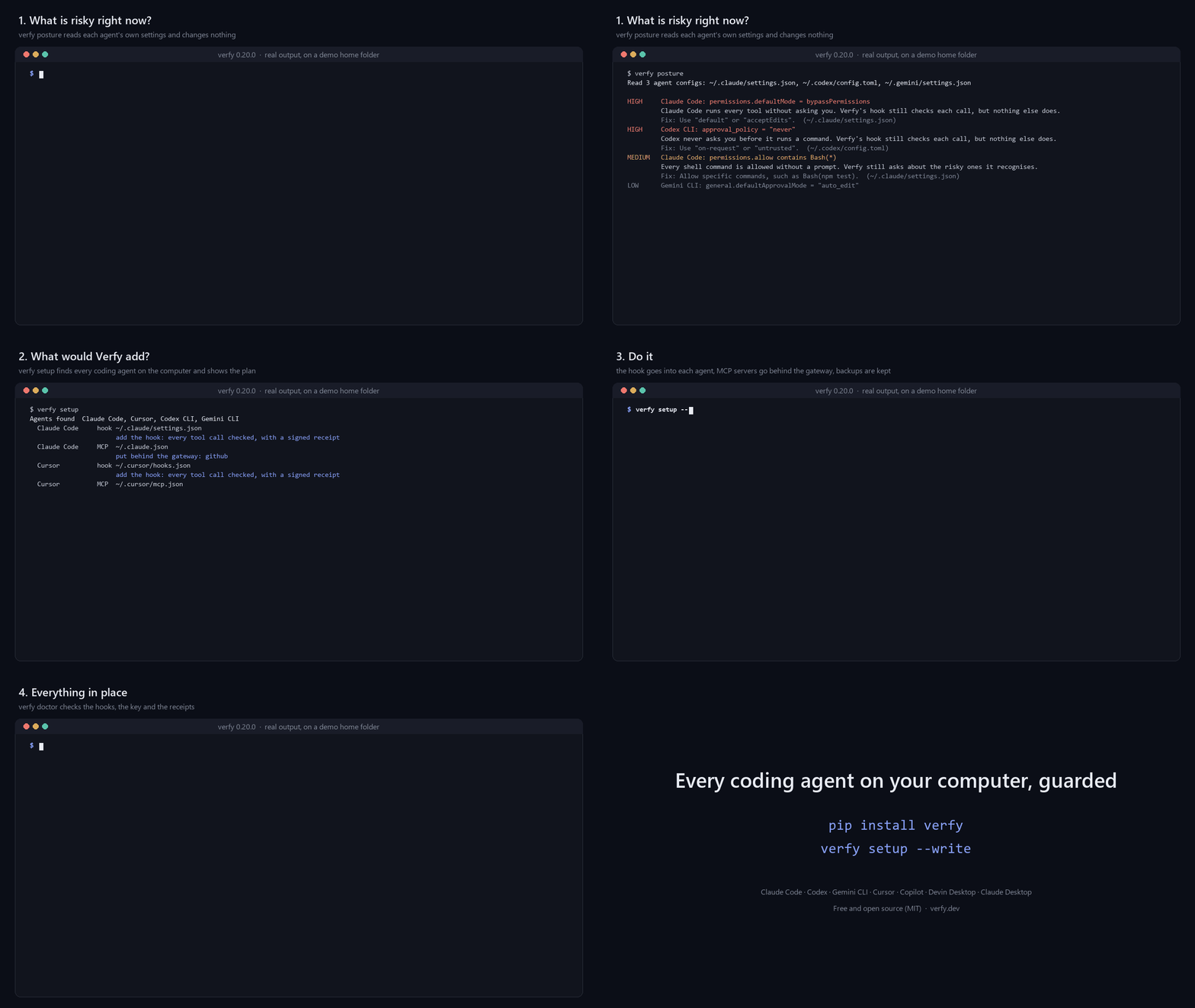
Try it in a minute
pip install "verfy==0.23.1"      # or a standalone build below, which carries its own Python
verfy posture                     # risky settings in the coding agents on this computer; changes nothing
verfy setup                       # what Verfy would add to each agent; --write does it, keeping backups
What verfy posture reports on a computer where agents were left wide open (real output):
HIGH     Claude Code: permissions.defaultMode = bypassPermissions
         Claude Code runs every tool without asking you. Verfy's hook still checks each call, but nothing else does.
         Fix: Use "default" or "acceptEdits".  (~/.claude/settings.json)
HIGH     Codex CLI: approval_policy = "never"
         Codex never asks you before it runs a command. Verfy's hook still checks each call, but nothing else does.
         Fix: Use "on-request" or "untrusted".  (~/.codex/config.toml)
MEDIUM   Claude Code: permissions.allow contains Bash(*)
         Every shell command is allowed without a prompt. Verfy still asks about the risky ones it recognises.
         Fix: Allow specific commands, such as Bash(npm test).  (~/.claude/settings.json)
Fail a pull request when an MCP tool changes
Copy examples/ci/verfy.yml to .github/workflows/verfy.yml, after verfy lock check --update and committing verfy.lock:
name: Verfy MCP Lock
on: [pull_request, push]
permissions:
  contents: read
jobs:
  lock:
    runs-on: ubuntu-latest
    steps:
      - uses: actions/checkout@v7
      - uses: verfy-dev/verfy-action@v1
What changed
- Verfy moved to the verfy-dev organization on GitHub. The repositories are now
verfy-dev/verfy,verfy-dev/verfy-releasesandverfy-dev/verfy-action; the old addresses redirect. Every link, the install scripts, the release checks (build attestations and Sigstore identities), the Homebrew tap (brew tap verfy-dev/verfy https://github.com/verfy-dev/verfy-releases), the Scoop bucket, the pre-commitrepo:, the Claude Code plugin marketplace (claude plugin marketplace add verfy-dev/verfy-releases) and the GitHub Action (verfy-dev/verfy-action@v1; the old name keeps working) use the new name. The container image is nowghcr.io/verfy-dev/verfy, and the MCP Registry nameio.github.verfy-dev/verfy. - This release is built and signed from the new repositories, so
gh attestation verify ... -R verfy-dev/verfy-releasesand the install scripts check it under the new name.
The downloads
Standalone builds of verfy 0.23.1 from PyPI, with Python included, built and tested by this repository's workflow, and verfy-vscode.vsix, the extension for VS Code, Cursor and Devin Desktop (in the editor: Extensions > ... > Install from VSIX). Install: https://verfy.dev/install
Check a download: sha256sum -c SHA256SUMS --ignore-missing, and that this workflow built it: gh attestation verify verfy-linux-x64.tar.gz -R verfy-dev/verfy-releases, or with cosign as SECURITY.md shows.
verfy 0.23.0
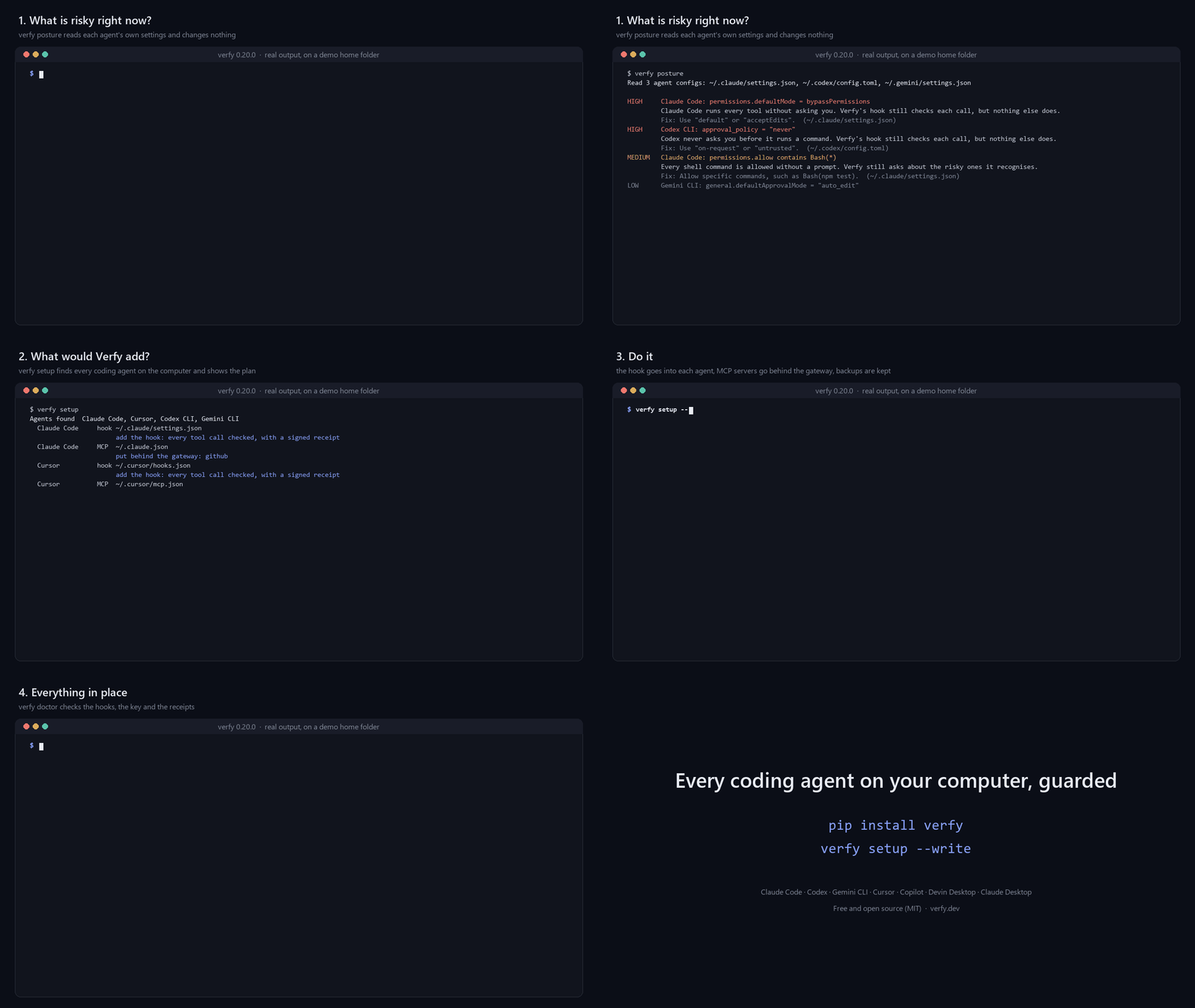
Try it in a minute
pip install "verfy==0.23.0"      # or a standalone build below, which carries its own Python
verfy posture                     # risky settings in the coding agents on this computer; changes nothing
verfy setup                       # what Verfy would add to each agent; --write does it, keeping backups
What verfy posture reports on a computer where agents were left wide open (real output):
HIGH     Claude Code: permissions.defaultMode = bypassPermissions
         Claude Code runs every tool without asking you. Verfy's hook still checks each call, but nothing else does.
         Fix: Use "default" or "acceptEdits".  (~/.claude/settings.json)
HIGH     Codex CLI: approval_policy = "never"
         Codex never asks you before it runs a command. Verfy's hook still checks each call, but nothing else does.
         Fix: Use "on-request" or "untrusted".  (~/.codex/config.toml)
MEDIUM   Claude Code: permissions.allow contains Bash(*)
         Every shell command is allowed without a prompt. Verfy still asks about the risky ones it recognises.
         Fix: Allow specific commands, such as Bash(npm test).  (~/.claude/settings.json)
Fail a pull request when an MCP tool changes
Copy examples/ci/verfy.yml to .github/workflows/verfy.yml, after verfy lock check --update and committing verfy.lock:
name: Verfy MCP Lock
on: [pull_request, push]
permissions:
  contents: read
jobs:
  lock:
    runs-on: ubuntu-latest
    steps:
      - uses: actions/checkout@v7
      - uses: anvarbekovjavohir277-dot/verfy-action@v1
What changed
-
verfy mcp: Verfy as an MCP server. Add it to any agent ({"command": "verfy", "args": ["mcp"]}) and the agent can ask Verfy before it acts. Six read-only tools:check_lineandcheck_tool_call: would Verfy's rules allow, ask about or deny this terminal line or this tool call, and which rule decides;scan_mcp_config: how the MCP servers in a config are started (the VFY-CFG rules), for a config you give or the ones on this computer;scan_tools: warning signs in tool definitions, with a grade;agent_settings: whatverfy posturereports;recent_receipts: the latest signed receipts and whether the chain verifies.
It changes nothing, starts no server and makes no network call. Its answers are advice to the agent; the hook and the gateway are what stop a call. Its own tool definitions pass Verfy's scanner.
-
verfy reportwrites one HTML page about this computer: which agents are guarded, risky agent settings, how MCP servers are started, what is locked, and the receipts (counts by verdict, the rules that fired most, receipts per day, the latest ones, and whether the chain verifies). It is a single file with no script and nothing loaded from outside, and it holds no secret.--jsonprints the same data. -
pre-commit hooks. In
.pre-commit-config.yaml, add this repository atrev: cli-v0.23.0withverfy-mcp-config(a static check of the MCP configs in the commit: a package with no pinned version,curl | sh, plain http, a key in the file; it starts nothing) and, if you want it,verfy-lock(runsverfy lock check, which starts the servers). -
A GitLab CI job,
examples/ci/gitlab-ci.yml: the same lock check as the GitHub Action, for merge requests. It is run in its container image by this repository's CI, not yet on GitLab itself. -
The research covers 99 MCP servers, up from 46: every added server has at least 2,000 downloads a week on npm or PyPI.
-
The JavaScript engine has
packageOf: the package a server is started from, also behind a gateway. verfy.dev/check uses it to show how often that server changed its tools. -
verfy posture --jsonsays for each finding whether--fixcan fix it (fixable). -
In the MCP Registry:
server.jsondescribesverfy mcpfor the official registry (io.github.anvarbekovjavohir277-dot/verfy, the PyPI package started withmcp), and the PyPI description carries the ownership line it checks. -
Homebrew, Scoop and a container image. verfy-releases is also a Homebrew tap and a Scoop bucket, refreshed by each release build with that release's files and checksums, and each release publishes
ghcr.io/anvarbekovjavohir277-dot/verfywith Node.js and uv for CI. A workflow installs all three on clean machines.
The downloads
Standalone builds of verfy 0.23.0 from PyPI, with Python included, built and tested by this repository's workflow, and verfy-vscode.vsix, the extension for VS Code, Cursor and Devin Desktop (in the editor: Extensions > ... > Install from VSIX). Install: https://verfy.dev/install
Check a download: sha256sum -c SHA256SUMS --ignore-missing, and that this workflow built it: gh attestation verify verfy-linux-x64.tar.gz -R anvarbekovjavohir277-dot/verfy-releases, or with cosign as SECURITY.md shows.
verfy 0.22.0
Try it in a minute
pip install "verfy==0.22.0"      # or a standalone build below, which carries its own Python
verfy posture                     # risky settings in the coding agents on this computer; changes nothing
verfy setup                       # what Verfy would add to each agent; --write does it, keeping backups
What verfy posture reports on a computer where agents were left wide open (real output):
HIGH     Claude Code: permissions.defaultMode = bypassPermissions
         Claude Code runs every tool without asking you. Verfy's hook still checks each call, but nothing else does.
         Fix: Use "default" or "acceptEdits".  (~/.claude/settings.json)
HIGH     Codex CLI: approval_policy = "never"
         Codex never asks you before it runs a command. Verfy's hook still checks each call, but nothing else does.
         Fix: Use "on-request" or "untrusted".  (~/.codex/config.toml)
MEDIUM   Claude Code: permissions.allow contains Bash(*)
         Every shell command is allowed without a prompt. Verfy still asks about the risky ones it recognises.
         Fix: Allow specific commands, such as Bash(npm test).  (~/.claude/settings.json)
Fail a pull request when an MCP tool changes
Copy examples/ci/verfy.yml to .github/workflows/verfy.yml, after verfy lock check --update and committing verfy.lock:
name: Verfy MCP Lock
on: [pull_request, push]
permissions:
  contents: read
jobs:
  lock:
    runs-on: ubuntu-latest
    steps:
      - uses: actions/checkout@v7
      - uses: anvarbekovjavohir277-dot/verfy-action@v1
What changed
-
verfy posturesays when an agent's own sandbox is off, and--fixturns it on. Verfy checks the command that starts a script the agent wrote, not what the script then does; the operating system sandbox each agent has holds that. Now:- Claude Code (
sandbox.enabled, medium): the fix turns the sandbox on, keeps commands inside it (allowUnsandboxedCommands: false) and closes the credential folders, asverfy sandbox syncdoes. On native Windows, where Claude Code's sandbox does not run, posture says so and points to WSL2 instead of editing anything. - Gemini CLI (
security.toolSandboxing, medium; the oldertools.sandboxcounts too): the fix sets it to true. - Copilot in VS Code (
chat.agent.sandbox.enabled, low): the fix sets it to"on", also in a settings file with comments, which is kept as it was.
A sandbox turned on in the project's settings counts. The fix creates a settings file the agent has not written yet. Codex's
danger-full-accesswas already reported; Cursor and Devin Desktop keep their sandbox setting in the app, where Verfy does not read it. - Claude Code (
The downloads
Standalone builds of verfy 0.22.0 from PyPI, with Python included, built and tested by this repository's workflow, and verfy-vscode.vsix, the extension for VS Code, Cursor and Devin Desktop (in the editor: Extensions > ... > Install from VSIX). Install: https://verfy.dev/install
Check a download: sha256sum -c SHA256SUMS --ignore-missing, and that this workflow built it: gh attestation verify verfy-linux-x64.tar.gz -R anvarbekovjavohir277-dot/verfy-releases, or with cosign as SECURITY.md shows.
verfy 0.21.0
Try it in a minute
pip install "verfy==0.21.0"      # or a standalone build below, which carries its own Python
verfy posture                     # risky settings in the coding agents on this computer; changes nothing
verfy setup                       # what Verfy would add to each agent; --write does it, keeping backups
What verfy posture reports on a computer where agents were left wide open (real output):
HIGH     Claude Code: permissions.defaultMode = bypassPermissions
         Claude Code runs every tool without asking you. Verfy's hook still checks each call, but nothing else does.
         Fix: Use "default" or "acceptEdits".  (~/.claude/settings.json)
HIGH     Codex CLI: approval_policy = "never"
         Codex never asks you before it runs a command. Verfy's hook still checks each call, but nothing else does.
         Fix: Use "on-request" or "untrusted".  (~/.codex/config.toml)
MEDIUM   Claude Code: permissions.allow contains Bash(*)
         Every shell command is allowed without a prompt. Verfy still asks about the risky ones it recognises.
         Fix: Allow specific commands, such as Bash(npm test).  (~/.claude/settings.json)
Fail a pull request when an MCP tool changes
Copy examples/ci/verfy.yml to .github/workflows/verfy.yml, after verfy lock check --update and committing verfy.lock:
name: Verfy MCP Lock
on: [pull_request, push]
permissions:
  contents: read
jobs:
  lock:
    runs-on: ubuntu-latest
    steps:
      - uses: actions/checkout@v7
      - uses: anvarbekovjavohir277-dot/verfy-action@v1
What changed
verfy setup --undotakes Verfy out again. It shows what it would change, and--writedoes it. Verfy's hook is taken out of every agent's file (Claude Code, Cursor, Codex CLI, Gemini CLI, Copilot, Devin, Windsurf), the MCP servers are taken out from behind the gateway, and the sandboxed terminal is removed. Everything else in those files stays, also what you changed after setup. A file that held nothing but Verfy's hook is removed. A backup of every changed file is kept, and your key, receipts and policy are not touched.verfy setup --writeputs it all back.- A remote server is put back from the backup file that setup made. Without that file it stays behind the gateway and is named, so nothing is left broken.
- Codex's
config.tomlis edited in place, with its comments kept. --agent,--projectand--hooks-onlywork as they do for setup.verfy setup --system --undo --write(as administrator, or with sudo) takes out the machine-wide hooks.
verfy posture --fixshows the edit that takes each finding away, and--writemakes it. Each fix is the smallest one: a key set or removed, or one entry taken out of a list. For examplebypassPermissionsbecomesdefault,disableAllHooksis removed, and Codex'sapproval_policy = "never"becomes"on-request". The old file is kept next to each changed one (*.verfy-posture-backup).--min highfixes only the high findings.- A JSON file with comments is not rewritten, because the comments would be lost. Codex's
config.tomlis edited line by line and only written when the edited file says exactly what was meant. In both cases the finding is shown for you to change by hand.
- A JSON file with comments is not rewritten, because the comments would be lost. Codex's
verfy posturereads GitHub Copilot's and Devin's settings too:- Copilot in VS Code (
settings.json, also with comments):chat.tools.global.autoApprove, andchat.permissions.defaultset toautoApproveorautopilot; - Copilot CLI (
~/.copilot/settings.json):disableAllHooks; - Devin CLI (
config.json):permission_modeset todangerous, and a blanketexecallow rule.
- Copilot in VS Code (
- The config rules run in the browser. The JavaScript engine has
checkServerandcheckConfig: how an MCP server is launched (no pinned version,curl | sh, a privileged container, plain http, a key written into the config), the same rules asverfy scan(VFY-CFG-001 to 007). Both engines are tested against one fixture,tests/fixtures/config.json. verfy.dev/check uses it: paste a config and see the findings, with nothing sent anywhere. - The editor extension has two new commands: Fix risky agent settings (
verfy posture --fix) and Take Verfy out of every agent (verfy setup --undo). Both show the changes first and make them only after you agree. - The research runs every week. The workflow that records what popular MCP servers serve now runs every Monday, and each result says what its pins cover, so verfy.dev/servers can keep one history per server across runs.
The downloads
Standalone builds of verfy 0.21.0 from PyPI, with Python included, built and tested by this repository's workflow, and verfy-vscode.vsix, the extension for VS Code, Cursor and Devin Desktop (in the editor: Extensions > ... > Install from VSIX). Install: https://verfy.dev/install
Check a download: sha256sum -c SHA256SUMS --ignore-missing, and that this workflow built it: gh attestation verify verfy-linux-x64.tar.gz -R anvarbekovjavohir277-dot/verfy-releases, or with cosign as SECURITY.md shows.
verfy 0.20.0
Try it in a minute
pip install "verfy==0.20.0"      # or a standalone build below, which carries its own Python
verfy posture                     # risky settings in the coding agents on this computer; changes nothing
verfy setup                       # what Verfy would add to each agent; --write does it, keeping backups
What verfy posture reports on a computer where agents were left wide open (real output):
HIGH     Claude Code: permissions.defaultMode = bypassPermissions
         Claude Code runs every tool without asking you. Verfy's hook still checks each call, but nothing else does.
         Fix: Use "default" or "acceptEdits".  (~/.claude/settings.json)
HIGH     Codex CLI: approval_policy = "never"
         Codex never asks you before it runs a command. Verfy's hook still checks each call, but nothing else does.
         Fix: Use "on-request" or "untrusted".  (~/.codex/config.toml)
MEDIUM   Claude Code: permissions.allow contains Bash(*)
         Every shell command is allowed without a prompt. Verfy still asks about the risky ones it recognises.
         Fix: Allow specific commands, such as Bash(npm test).  (~/.claude/settings.json)
Fail a pull request when an MCP tool changes
Copy examples/ci/verfy.yml to .github/workflows/verfy.yml, after verfy lock check --update and committing verfy.lock:
name: Verfy MCP Lock
on: [pull_request, push]
permissions:
  contents: read
jobs:
  lock:
    runs-on: ubuntu-latest
    steps:
      - uses: actions/checkout@v7
      - uses: anvarbekovjavohir277-dot/verfy-action@v1
What changed
-
Start in a minute.
verfy postureshows what is risky in your agents before you change anything. A ready workflow,examples/ci/verfy.yml, fails a pull request when an MCP tool changes; copy it to.github/workflows/. The Verfy GitHub Action now installs 0.20.0 and has therequire-pinnedandsarifinputs that 0.19.0 announced but the published action did not have yet. -
Machine-wide hooks:
verfy setup --system --write(run as administrator, or with sudo). It puts the Claude Code and Cursor hooks in the files an administrator deploys for the whole computer:managed-settings.d/50-verfy.jsonnext to Claude Code's managed settings, and Cursor's enterprisehooks.json. An agent runs as you and cannot change those files, so even a script the agent writes and runs can no longer take Verfy's hook out. That was a known limit until now. Claude Code does not let user or project settings override a managed value. Verfy's own user-level hook is then taken out, so no call is checked twice; a backup of each file is kept. Verfy writes a drop-in file of its own, so an organisation'smanaged-settings.jsonis left as it is. Changes to these files are denied to the agent too. -
Secrets in prompts are stopped before they are sent. In Claude Code, Codex (UserPromptSubmit) and Cursor (beforeSubmitPrompt), a prompt that contains what looks like an API key, token or private key is blocked with the rule and a short reason, and gets a signed receipt (VFY-PROMPT-001). The secret itself is not shown or stored. Turn it off with
"prompt_secrets": "off"in your policy. -
Cursor: file writes, deletes and every other tool are checked. Cursor's preToolUse hook now goes to Verfy too. File edits, which were the main gap in Cursor, get the same rules as Claude Code: for example, writing to
~/.bashrcor deleting a hook file is denied. Terminal commands, file reads and MCP calls stay with their own hooks, so nothing is checked twice. MCP results are also cleaned of keys and tokens before the agent reads them (postToolUse), including those from remote servers that sign in with OAuth and so cannot go behind the gateway.verfy setup --writeadds the new hooks to an existing install. -
verfy postureshows risky settings in each agent's own config and changes nothing. It covers:- Claude Code:
bypassPermissions,disableAllHooks, a blanketBashallow rule,enableAllProjectMcpServers; - Codex:
approval_policy = "never"andsandbox_mode = "danger-full-access", also in profiles, andhooks = false; - Gemini CLI: hooks switched off or Verfy's hook disabled,
auto_edit; - Cursor: a Verfy hook that does not fail closed.
It exits 2 when something high is found.
verfy doctorshows the summary, and counts a setting that switches Verfy's hook off as a problem. - Claude Code:
-
verfy setupsets Verfy up for every coding agent on the machine at once. It finds Claude Code, Cursor, Codex CLI, Gemini CLI, GitHub Copilot (CLI and VS Code), Devin Desktop (Windsurf) and Claude Desktop by their folders and commands, then shows what it would change. For each agent that has hooks, it adds Verfy's hook. It puts the MCP servers in that agent's own config behind the gateway, which gives them scan, lock, pre-check, receipts and secrets taken out of answers.verfy setup --writemakes the changes and keeps a backup of every file. Run it again after installing another agent.--agent NAMEpicks agents,--projectworks on this folder's files, and--hooks-onlyleaves the MCP configs alone. A remote server that signs in with OAuth is left as it is, because the gateway cannot sign in yet. In a terminal,verfy initnow offers the same setup for every agent it finds;--hookstill means yes. -
Verfy for VS Code, Cursor and Windsurf (beta): an editor extension. Each release now has
verfy-vscode.vsix. Install it in the editor with Extensions > ... > Install from VSIX. It finds the Verfy CLI, or offers to install it in a terminal you can see. It shows whatverfy setupwould change and runs it after you agree. It shows in the status bar whether the agents here are guarded, and runsdoctorandledger show. The extension changes no file itself and makes no network call. -
The editor's terminal inside the sandbox (beta). The editor itself cannot run inside the sandbox, but its AI agent runs commands in the editor's terminal.
verfy setup --sandbox-terminal on(or the extension) makes that terminal open insideverfy run --sandboxin VS Code, Cursor and Windsurf, so the agent's commands can write only in the project and reach only the hosts your policy allows. On Windows it goes through WSL2.offtakes it away. A settings file with comments is not rewritten; Verfy prints the profile to add by hand. -
verfy wrapedits Codex CLI'sconfig.toml(Python 3.11 or newer) in place. Comments and everything else in the file stay as they were, and the result is read back and compared before anything is written. Remote servers in it are left forverfy proxy --url. -
verfy run --sandbox --agent -- codex(orgemini,copilot) gives that agent its own key, service and folder inside the sandbox. It used to get Claude Code's. A command that is none of these still gets Claude Code's, as before. The new hook files in a project are closed to sandboxed commands. -
verfy lock filesalso watches the new hook files, Copilot CLI's MCP config and Windsurf's global rules, andverfy scan --discoverreads~/.copilot/mcp-config.json. -
Hooks for Codex CLI, Gemini CLI, GitHub Copilot, Devin Desktop (Windsurf) and Devin CLI.
verfy hook install --codex,--gemini,--copilot,--devinor--windsurf(orverfy setup) addsverfy hook codex|gemini|copilot|devin|windsurf. It checks each tool call with the same rules as the Claude Code hook and signs a receipt tagged with the agent. Codex'sapply_patchis checked file by file. Input a hook cannot read is never allowed. Changes to these hook files are denied to the agent, and changes to~/.codex/config.tomlneed approval. How far each one was checked:- Gemini CLI: run through Gemini CLI 0.68.0's own hook runner on Windows, where Gemini runs hooks through PowerShell (
scripts/e2e_gemini_hooks.mjs). Where Verfy would ask, Gemini asks you. - Codex CLI: checked against Codex's source: the hook input, the output schema,
apply_patchand MCP tool names, hooks on by default, and trust in/hooks. Codex does not support "ask" from a hook (it would run the tool), so there Verfy blocks and tells the agent to ask you. - Copilot (CLI and VS Code), Devin Desktop and Devin CLI (beta): written from their documentation; their code is closed. Copilot asks you where Verfy would ask, and treats that as deny where nobody can answer. Devin has no "ask", so Verfy blocks with exit code 2. Windsurf has been called Devin Desktop since 2 June 2026.
--windsurfremains for older Windsurf releases, andverfy setupadds both. Devin also reads Claude Code's settings, so a Devin call that reachesverfy hook pre-tool-usegets Devin's answer, or is left toverfy hook devinwhen that is installed.
- Gemini CLI: run through Gemini CLI 0.68.0's own hook runner on Windows, where Gemini runs hooks through PowerShell (
-
verfy doctorshows these hooks too. -
--pubtakes a public key that starts with-. argparse used to read it as a flag.
The downloads
Standalone builds of verfy 0.20.0 from PyPI, with Python included, built and tested by this repository's workflow, and verfy-vscode.vsix, the extension for VS Code, Cursor and Devin Desktop (in the editor: Extensions > ... > Install from VSIX). Install: https://verfy.dev/install
Check a download: sha256sum -c SHA256SUMS --ignore-missing, and that this workflow built it: gh attestation verify verfy-linux-x64.tar.gz -R anvarbekovjavohir277-dot/verfy-releases, or with cosign as SECURITY.md shows.
verfy 0.19.0
Standalone builds of verfy 0.19.0 from PyPI, with Python included. Built and tested by this repository's workflow. Install: https://verfy.dev/docs#install
Check a download: sha256sum -c SHA256SUMS --ignore-missing, and that this workflow built it: gh attestation verify verfy-linux-x64.tar.gz -R anvarbekovjavohir277-dot/verfy-releases, or with cosign as SECURITY.md shows.
verfy 0.18.0
Standalone builds of verfy 0.18.0 from PyPI, with Python included. Built and tested by this repository's workflow. Install: https://verfy.dev/docs#install
Check a download: sha256sum -c SHA256SUMS --ignore-missing, and that this workflow built it: gh attestation verify verfy-linux-x64.tar.gz -R anvarbekovjavohir277-dot/verfy-releases, or with cosign as SECURITY.md shows.
verfy 0.17.0
Standalone builds of verfy 0.17.0 from PyPI, with Python included. Built and tested by this repository's workflow. Install: https://verfy.dev/docs#install
Check a download: sha256sum -c SHA256SUMS --ignore-missing, and that this workflow built it: gh attestation verify verfy-linux-x64.tar.gz -R anvarbekovjavohir277-dot/verfy-releases, or with cosign as SECURITY.md shows.
verfy 0.16.1
Standalone builds of verfy 0.16.1 from PyPI, with Python included. Built and tested by this repository's workflow. Install: https://verfy.dev/docs#install
Check a download: sha256sum -c SHA256SUMS --ignore-missing, and that this workflow built it: gh attestation verify verfy-linux-x64.tar.gz -R anvarbekovjavohir277-dot/verfy-releases
verfy 0.16.0
Standalone builds of verfy 0.16.0 from PyPI, with Python included. Built and tested by this repository's workflow. Install: https://verfy.dev/docs#install
Check a download: sha256sum -c SHA256SUMS --ignore-missing, and that this workflow built it: gh attestation verify verfy-linux-x64.tar.gz -R anvarbekovjavohir277-dot/verfy-releases