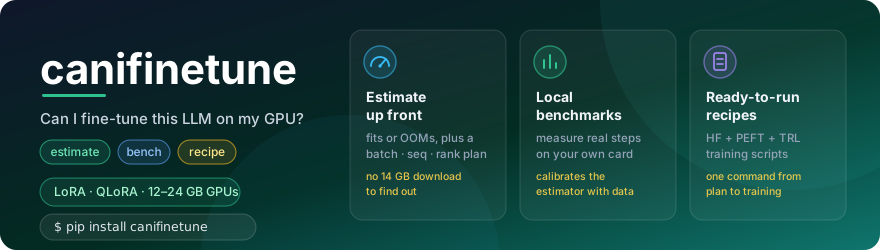


Estimate, benchmark, and generate fine-tuning recipes for LLMs on consumer GPUs.
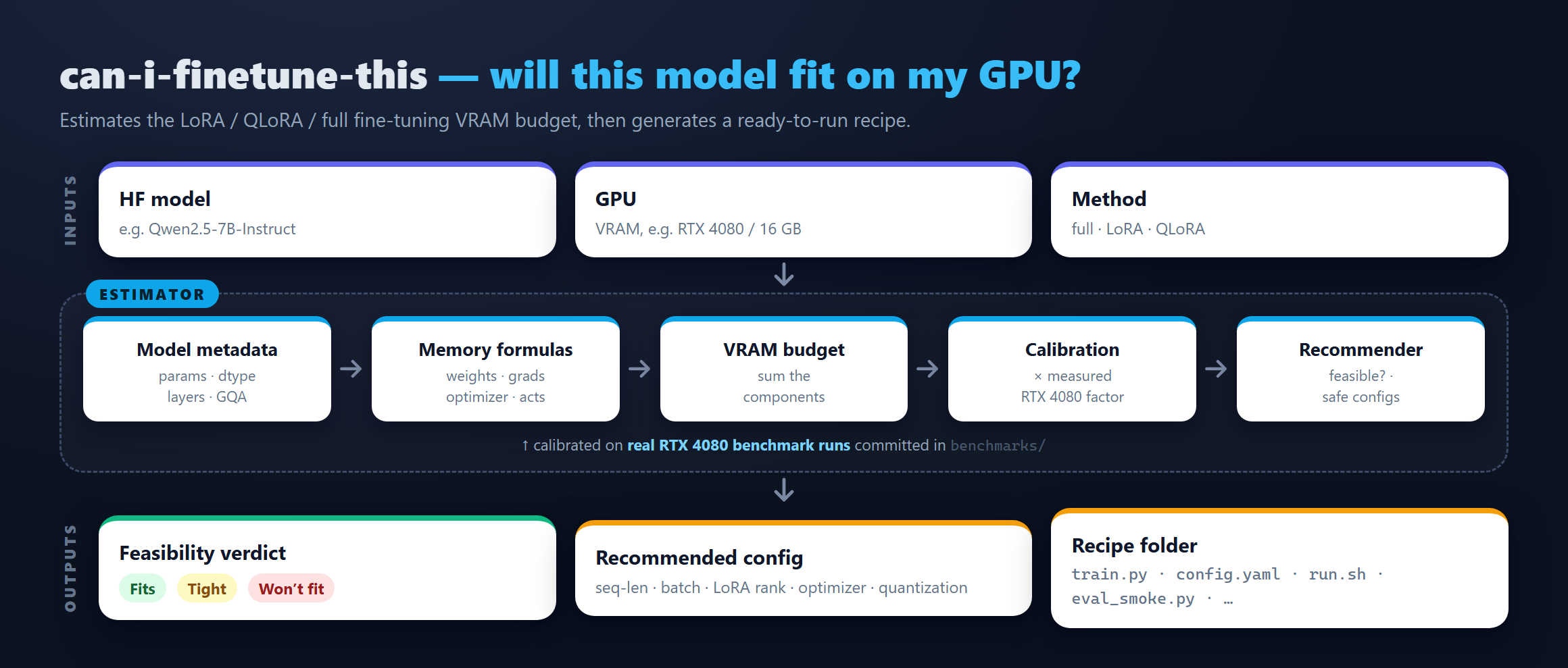
You have one consumer-grade NVIDIA GPU. You want to fine-tune an open-weight LLM with LoRA or QLoRA, but you do not want to download 14 GB of weights just to discover that your 12 GB / 16 GB / 24 GB card OOMs on step 1.
canifinetune answers, before you spend the disk and the time:
- Can I fine-tune this model?
- About how much VRAM will it use?
- What batch size / sequence length / LoRA rank / quantization should I use?
- If I can't, how should I downsize?
- Is there local benchmark evidence for that answer?
- Can I get a ready-to-run Hugging Face + PEFT + TRL training script for that config?
It is a single Python package with a CLI:
canifinetune doctor
canifinetune estimate --model Qwen/Qwen2.5-1.5B-Instruct --method qlora --gpu-vram-gb 16 --seq-len 2048 --micro-batch-size 1 --lora-rank 16
canifinetune recommend --model Qwen/Qwen2.5-1.5B-Instruct --gpu-vram-gb 16
canifinetune bench    --model sshleifer/tiny-gpt2 --method lora --steps 3
canifinetune calibrate --benchmarks benchmarks/results
canifinetune recipe   --model Qwen/Qwen2.5-1.5B-Instruct --method qlora --output recipes/qwen2.5-1.5b-qlora-4080
canifinetune report   --benchmarks benchmarks/results --out report.md
canifinetune compare  --benchmarks benchmarks/results --out compare.md
What canifinetune estimate actually prints:
+-------- Qwen/Qwen2.5-1.5B-Instruct  (qlora) --------+
| feasible: YES    ratio = 0.20    confidence = medium |
+------------------------------------------------------+
       Memory breakdown (GB)
+---------------------------------+
| Component             |   Value |
|-----------------------+---------|
| static model          |   0.737 |
| quantization overhead |   0.018 |
| trainable params      |  4.4 MB |
| gradients             |   0.008 |
| optimizer states      |   0.010 |
| activations           |   0.328 |
| CUDA / fragmentation  |   1.280 |
| safety margin         |   0.800 |
| total                 |   3.163 |
+---------------------------------+
Static estimate says 3.16 GB; on a real RTX 4080 the same config measures
7.10 GB (heavy bitsandbytes unpacking buffers at seq_len=2048). canifinetune bench and canifinetune calibrate close that gap on your machine —
that is the point of the project.
canifinetune runs in two layers:
| Layer | Install | What you get |
|---|---|---|
| Core (estimate / recommend / recipe / report) | pip install canifinetune |
All CLI commands. No PyTorch required. |
| Training (bench / real fine-tuning) | pip install canifinetune[train] |
Adds torch, transformers, peft, bitsandbytes, trl, datasets. |
| Reporting extras | pip install canifinetune[report] |
Pandas/tabulate for prettier tables. |
| Development | pip install canifinetune[dev] |
pytest, ruff, mypy. |
If you use uv:
uv venv
uv pip install -e ".[dev,report]"
# Add training deps when you want to run benchmarks:
uv pip install -e ".[dev,train,report]"
PyTorch should generally be installed with the CUDA wheel that matches your driver, e.g.
uv pip install torch --index-url https://download.pytorch.org/whl/cu121See docs/troubleshooting.md for Windows / WSL / bitsandbytes specifics.
# 1. See what your machine looks like
canifinetune doctor

# 2. Ask if a model fits on your card
canifinetune estimate \
  --model Qwen/Qwen2.5-1.5B-Instruct \
  --method qlora \
  --gpu-vram-gb 16 \
  --seq-len 2048 \
  --micro-batch-size 1 \
  --lora-rank 16

# 3. Have it search for a feasible config
canifinetune recommend --model Qwen/Qwen2.5-1.5B-Instruct --gpu-vram-gb 16

# 4. Run a tiny real benchmark (downloads sshleifer/tiny-gpt2, ~5 MB)
canifinetune bench --model sshleifer/tiny-gpt2 --method lora --steps 3

# 5. Generate a ready-to-run training recipe
canifinetune recipe \
  --model Qwen/Qwen2.5-1.5B-Instruct \
  --method qlora \
  --seq-len 2048 \
--output recipes/qwen2.5-1.5b-qlora-4080accelerate estimate-memory tells you how much memory loading a model takes.
That is not enough to know whether you can train it.
This project tries to answer the harder question. It models:
- Model weights, in fp32 / fp16 / bf16 / int8 / NF4 + double-quant
- LoRA / QLoRA trainable parameter count for typical
target_modules - Gradients only for trainable parameters
- AdamW vs 8-bit / paged AdamW optimizer states
- Activations as a function of
seq_len,batch_size,hidden_size,num_layers, with and without gradient checkpointing - A fragmentation / CUDA / buffer safety margin
- A feasibility decision against your actual GPU
- Concrete degradation suggestions when not feasible
Estimates are always marked with an assumptions block and a confidence
level, because activation memory in particular is hard to predict statically.
Run canifinetune bench and canifinetune calibrate to ground them in real
measurements on your machine.
docs/rtx4080_baselines.md contains real measurements collected on a single
RTX 4080 (16 GB). These are not synthetic. If a configuration was not run, the
table says "not run", not a guessed number.
Highlights (more in the doc):
| model | method | seq_len | measured peak | tok/sec |
|---|---|---|---|---|
Qwen/Qwen2.5-0.5B-Instruct |
qlora | 1024 | 3.30 GB | 1995 |
Qwen/Qwen2.5-1.5B-Instruct |
qlora | 1024 | 4.36 GB | 1352 |
Qwen/Qwen2.5-1.5B-Instruct |
qlora | 2048 | 7.10 GB | 1470 |
Qwen/Qwen2.5-3B-Instruct |
qlora | 1024 | 5.54 GB | 1158 |
sshleifer/tiny-gpt2 (smoke) |
lora | 128 | 0.12 GB | 1735 |
src/canifinetune/        # package code (estimator, bench, recipes, reports, cli)
benchmarks/              # configs/, results/ (JSON), calibration/
docs/                    # design, memory model, troubleshooting
examples/                # end-to-end recipe folders
tests/                   # pytest tests (CPU-only, no large downloads)
scripts/                 # helper scripts for collecting baselines
.github/workflows/       # CI (ruff + pytest on CPU)
The current scope is "single consumer GPU, single node, LoRA / QLoRA, causal LM, Hugging Face stack". Possible directions, none committed:
- DeepSpeed ZeRO and FSDP estimation for multi-GPU setups
- Heuristics for sequence-classification / encoder-decoder training
- Throughput modeling (tokens / sec), not just feasibility
- Auto-tuning of
gradient_accumulation_stepsfor a target effective batch size - A web UI on top of the CLI
Contributions welcome.
MIT. See LICENSE.