
Download Dear PyGui, a fast Python framework for building native-style desktop interfaces with immediate-mode tools, plots, tables, themes, and rich controls. Follow a Dear PyGui tutorial to prototype data apps, visual tools, and developer utilities quickly with clear docs and examples.
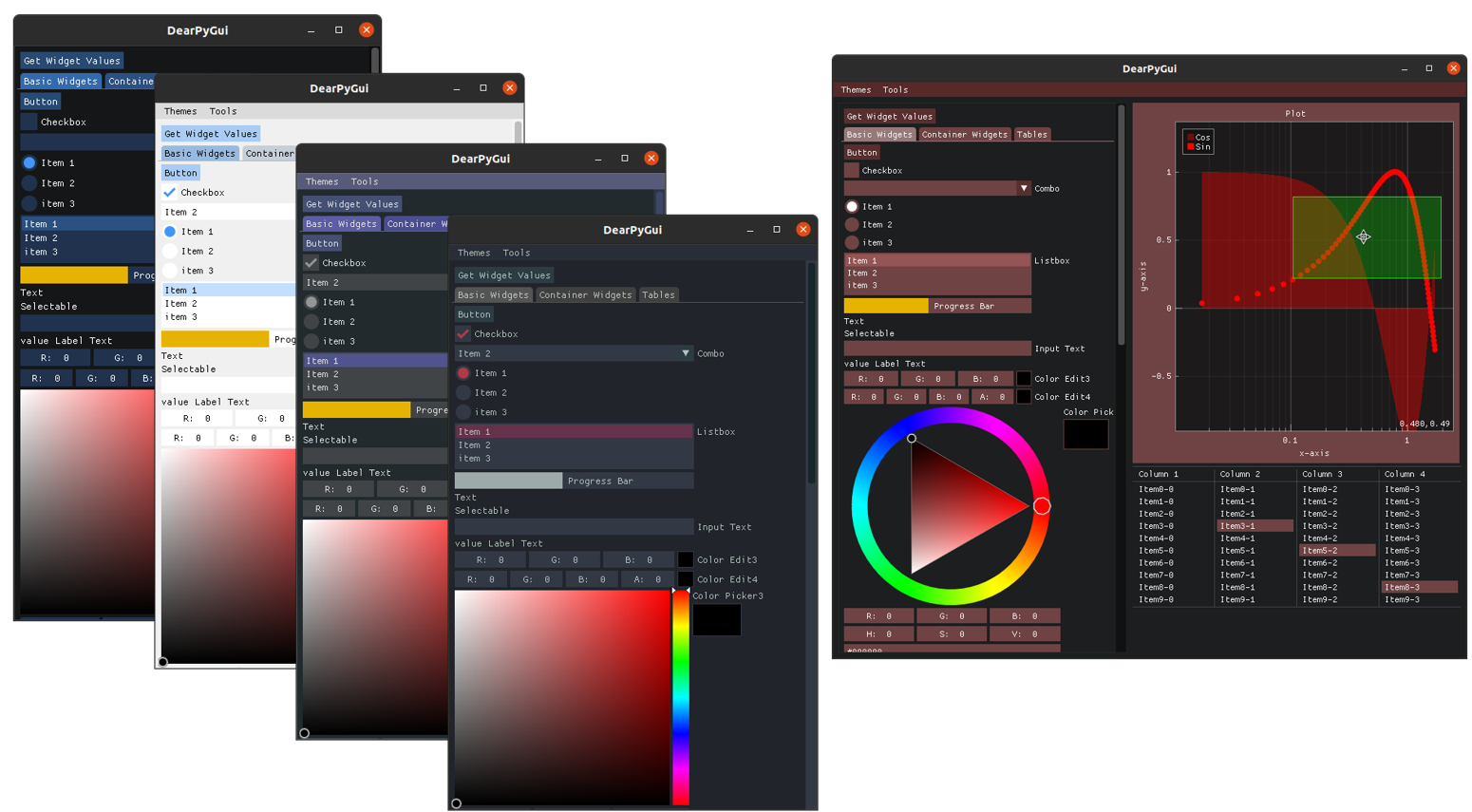
Dear PyGui is a Python GUI toolkit for fast desktop tools, data apps, dashboards, and interactive interfaces with immediate-mode controls.
Dear PyGui helps Python developers build responsive desktop interfaces without leaving the language they already use for automation, visualization, and data processing. Instead of designing every window through complex platform-specific layers, Dear PyGui provides an immediate mode GUI approach that keeps interface state close to application logic. That makes Dear PyGui Python GUI development practical for prototypes, internal tools, scientific utilities, and polished desktop applications.
A strong Dear PyGui tutorial usually starts with a window, a viewport, and a few widgets, then expands into menus, tables, plotting, themes, and event callbacks. The same pattern scales well for larger applications because Dear PyGui widgets are organized through simple Python code. Developers searching for Dear PyGui examples can quickly see how to connect sliders, buttons, text fields, plots, and tables to live data.
Dear PyGui documentation is especially useful when learning how containers, handlers, themes, fonts, and drawing commands fit together. For teams comparing Dear PyGui vs tkinter or Dear PyGui vs PyQt, the main appeal is speed of iteration: Dear PyGui immediate mode GUI patterns make it simple to create tools that feel interactive from the first prototype.
- Immediate GUI Construction: Build windows, panels, menus, and controls with Dear PyGui immediate mode GUI patterns that keep layout and behavior in straightforward Python code.
- Rich Widget Collection: Use Dear PyGui widgets for buttons, inputs, trees, tabs, child windows, node editors, color pickers, and custom controls for practical desktop software.
- Integrated Data Visualization: Add a Dear PyGui plot to display signals, measurements, simulation output, financial data, or scientific results without sending users to a separate charting tool.
- Structured Data Views: Create a Dear PyGui table for logs, records, configuration grids, dashboards, or inspection panels where users need to scan and compare values.
- Custom Visual Styling: Apply Dear PyGui themes to change colors, spacing, fonts, and component styles so prototypes can evolve into branded internal applications.
- Learning-Friendly Resources: Combine Dear PyGui documentation with Dear PyGui examples and a Dear PyGui tutorial to move from installation to interactive tools quickly.
- Start with a small Dear PyGui demo that proves the viewport, event callbacks, and main controls before expanding into a full application.
- Use Dear PyGui documentation Python references when working with container hierarchy, item aliases, callback signatures, and theme components.
- Keep Dear PyGui widgets grouped by purpose so control panels, plots, tables, and status areas remain easy to maintain as the interface grows.
- When reviewing Dear PyGui vs tkinter, consider whether the project needs modern visuals, high interactivity, and fast GUI iteration more than native platform conventions.
- When reviewing Dear PyGui vs PyQt, compare licensing, ecosystem needs, deployment expectations, and how much custom drawing or plotting your interface requires.
- Check Dear PyGui GitHub for release notes, issue discussions, source examples, and active project details before locking an application to a specific version.
| Component | Minimum | Recommended |
|---|---|---|
| Operating System | Windows, macOS, or Linux supported by Python | Current 64-bit Windows, macOS, or Linux desktop |
| Python Version | Compatible Python 3 environment | Recent Python 3 release with virtual environments |
| Processor (CPU) | Dual-core desktop or laptop CPU | Modern multi-core CPU for complex interfaces |
| Memory (RAM) | 4 GB for basic tools | 8 GB or more for dashboards and data-heavy apps |
| Graphics Support | Standard desktop graphics capability | Dedicated or modern integrated GPU for rich views |
| Project Type | Scripts, prototypes, and utilities | Data apps, visual tools, dashboards, and developer software |
Prerequisites: A working Python installation, a code editor, and a project folder where you can run Dear PyGui install commands in a clean environment.

- Install the Package: Run the recommended Dear PyGui install command in a virtual environment so dependencies stay isolated from other Python projects.
- Open a First Window: Create a viewport, add a simple window, and launch the event loop to confirm that Dear PyGui is rendering correctly.
- Add Interface Elements: Build with Dear PyGui widgets such as buttons, inputs, sliders, text fields, tabs, and menus until the workflow is visible.
- Connect Data and Events: Use callbacks to update a Dear PyGui plot, refresh a Dear PyGui table, or change interface state when users interact with controls.
- Refine the Presentation: Apply Dear PyGui themes, adjust spacing, and organize containers so the final tool feels clear, stable, and ready for daily use.
- Python Tool Builders: Developers who want Dear PyGui Python GUI workflows for file utilities, configuration panels, automation dashboards, and technical desktop tools.
- Data and Science Teams: Analysts and engineers who need a Dear PyGui plot beside controls, filters, and live values for experiments or operational review.
- Prototype Designers: Builders who use Dear PyGui examples to create working interface concepts before deciding whether a larger framework is necessary.
- Internal Software Teams: Groups that want Dear PyGui GitHub visibility, approachable source code, and practical Dear PyGui documentation for maintainable internal apps.
- GUI Framework Evaluators: Developers comparing Dear PyGui vs tkinter, Dear PyGui vs PyQt, and other Python desktop options for speed, style, and usability.
- Interactive App Creators: Makers who need Dear PyGui viewport control, custom drawing, themes, widgets, tables, and event-driven behavior in one Python-centered workflow.
- Dear PyGui install fails? Update Python, confirm the virtual environment is active, and review the package instructions in Dear PyGui documentation.
- Window opens but nothing appears? Check the Dear PyGui viewport setup, verify the event loop is started, and compare your script with a known Dear PyGui demo.
- Widget callbacks do not run? Inspect callback arguments, item tags, and handler registration using Dear PyGui documentation Python examples.
- Table or plot output looks wrong? Simplify the data first, then rebuild the Dear PyGui table or Dear PyGui plot with a smaller test case.
- Interface styling is inconsistent? Revisit Dear PyGui themes and confirm each theme component is bound to the correct item or container.
- Choosing between frameworks? Test the same small screen in Dear PyGui vs tkinter and Dear PyGui vs PyQt to compare code clarity, visual behavior, and iteration speed.
Dear PyGui, Dear PyGui tutorial, Dear PyGui examples, Dear PyGui documentation, Dear PyGui Python GUI, Dear PyGui GitHub, Dear PyGui install, Dear PyGui widgets, Dear PyGui themes, Dear PyGui demo, Dear PyGui vs tkinter, Dear PyGui vs PyQt, Dear PyGui plot, Dear PyGui table, Dear PyGui viewport, Dear PyGui documentation Python, Dear PyGui immediate mode GUI