Repository navigation
nextime 0.1.0

The first release of nextime: a self-hosted calendar for families and small groups. Your own calendars on your own
server, in the browser and through CalDAV on iPhone and Android, next to iCloud, Google and other CalDAV calendars.
What is in it
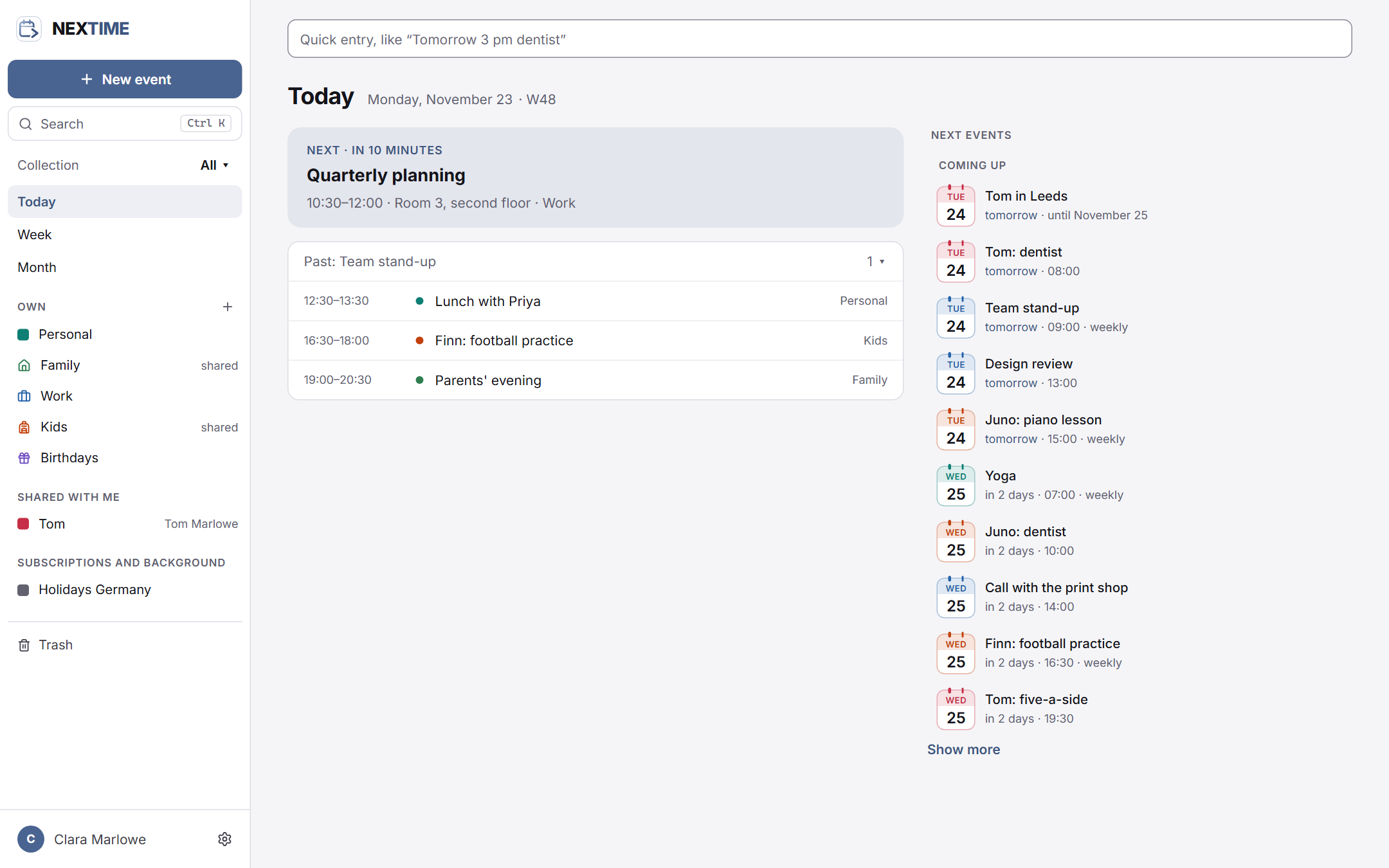
- Today, day, week and month, with "Coming up" beside week and month, dragging events in day and week, and keys
T, W, M and H to switch views. - Own calendars with eleven colors or one of your own and a symbol; events all day or with a time and time zone,
busy or free, series with exceptions. - Sharing with accounts on the same server (busy only, read, edit) and with guests through a read-only link;
web push when others change something. - iCloud, Google and other CalDAV servers read and written, synced every minute; subscriptions to calendar links;
public and school holidays of Germany, Austria and Switzerland built in; answers to invitations. - A calendar account for phones: a CalDAV server under
/dav/for Apple Calendar, DAVx5 and Thunderbird, a
password per device, a QR code and profile for the iPhone. Needs HTTPS. - Everyday: reminders per person and device, a place with suggestions and a small map, attachments, quick entry in
one line, defaults for new events per calendar, search, a trash with undo. - Sister apps: due tasks from nextasks and deadlines from nexpaper in the calendar.
- Take along and move: every calendar as ICS, all as ZIP, ICS files loaded with a preview, a calendar moved over from
iCloud or Google. - For programs: a REST API and an MCP server, each key with its own rights.
- German and English, light and dark, installable as a web app, the next four weeks readable without a connection.
Install
services:
  nextime:
    image: ghcr.io/derkezorm/nextime:0.1.0
    container_name: nextime
    ports:
      - "8585:8000"
    volumes:
      - ./data:/data
    environment:
      TZ: Europe/Berlin
    restart: unless-stopped
The first account is the operator; the setup code is in docker logs nextime. Phones connect only over HTTPS: put
nextime behind a reverse proxy and name it in NEXTIME_TRUSTED_PROXIES. All settings are in the
README.