Repository navigation
Frontline v1.0.12: Mountain battlefields

New
Mountain battlefields
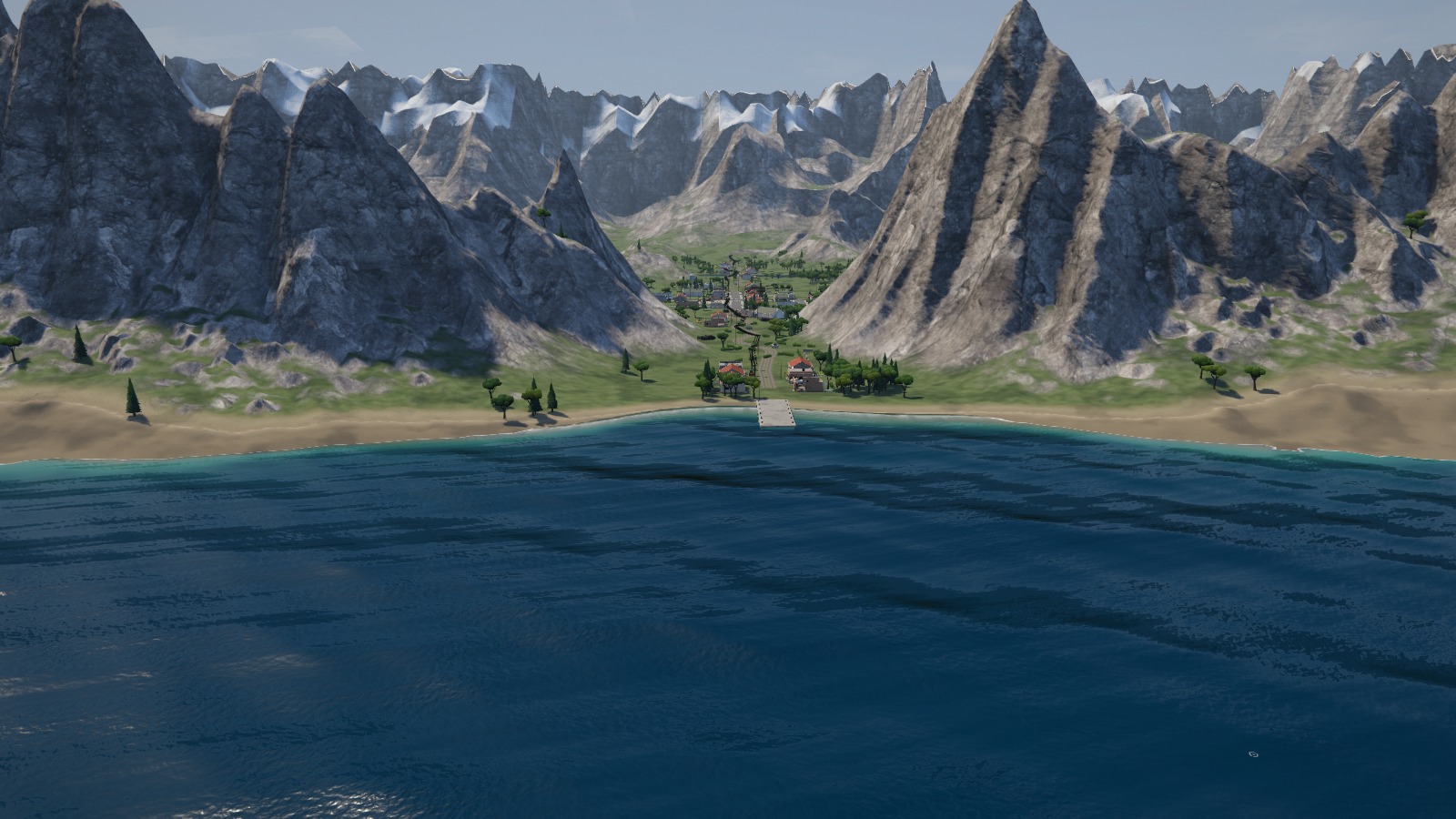
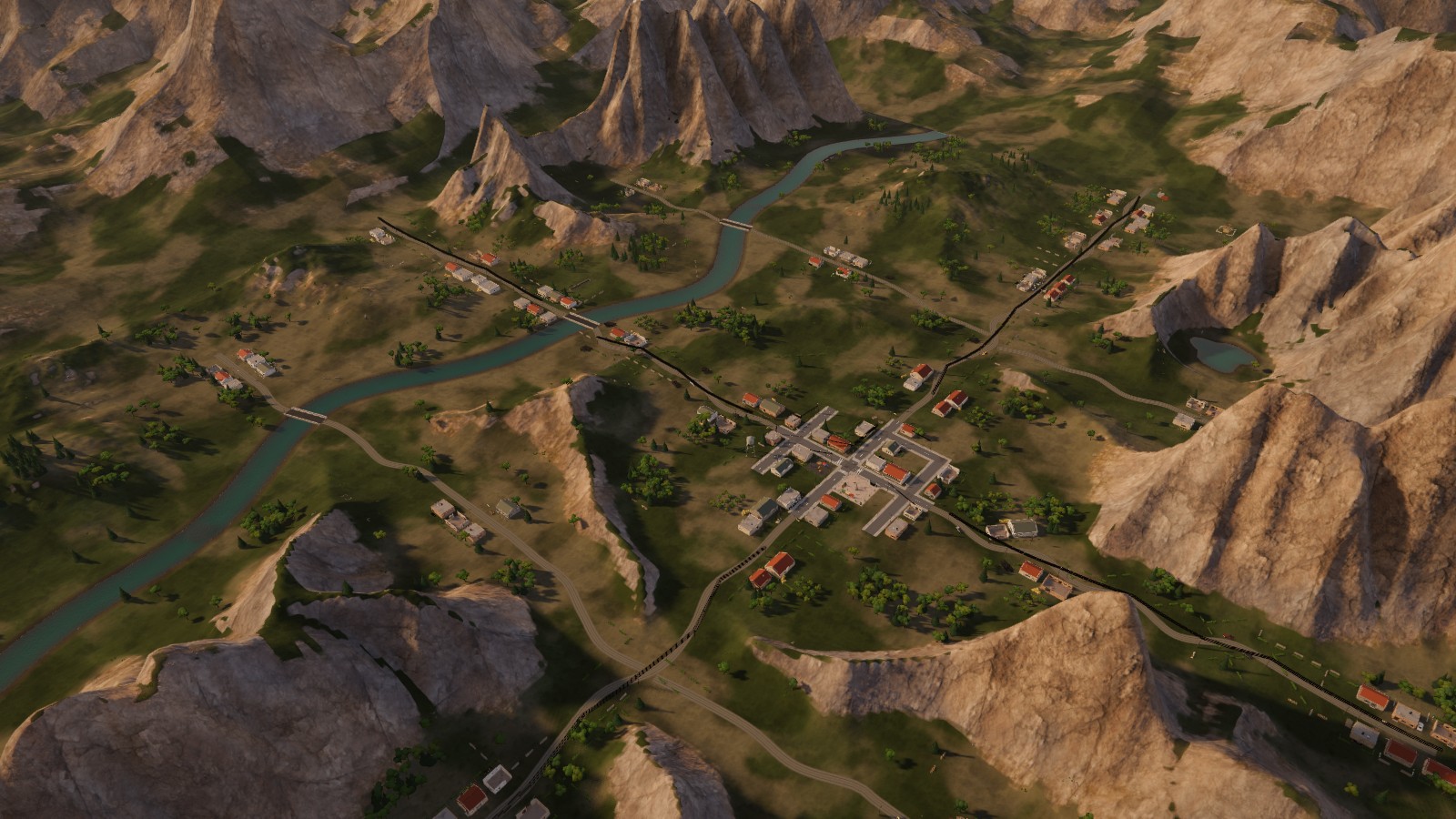
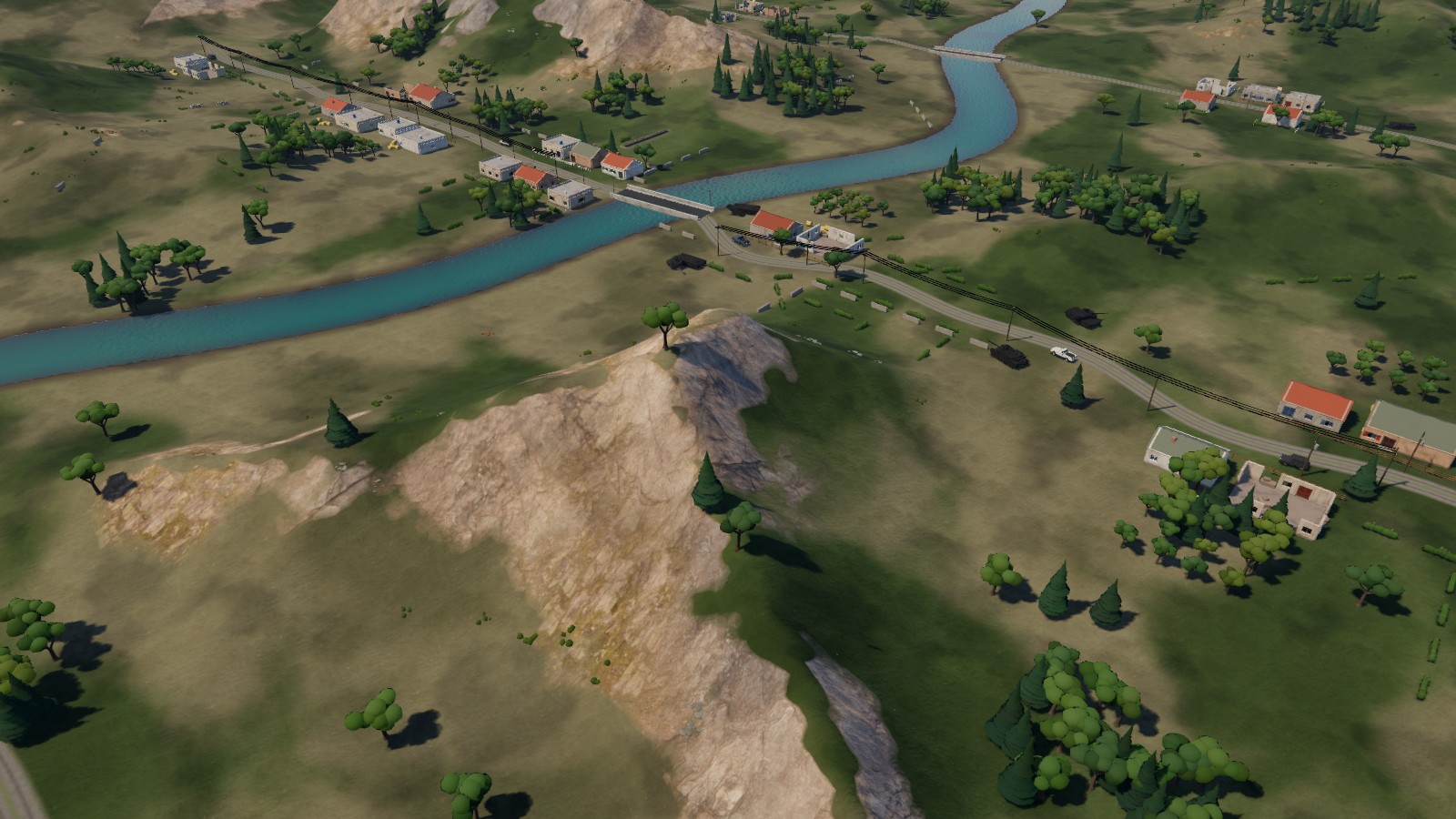
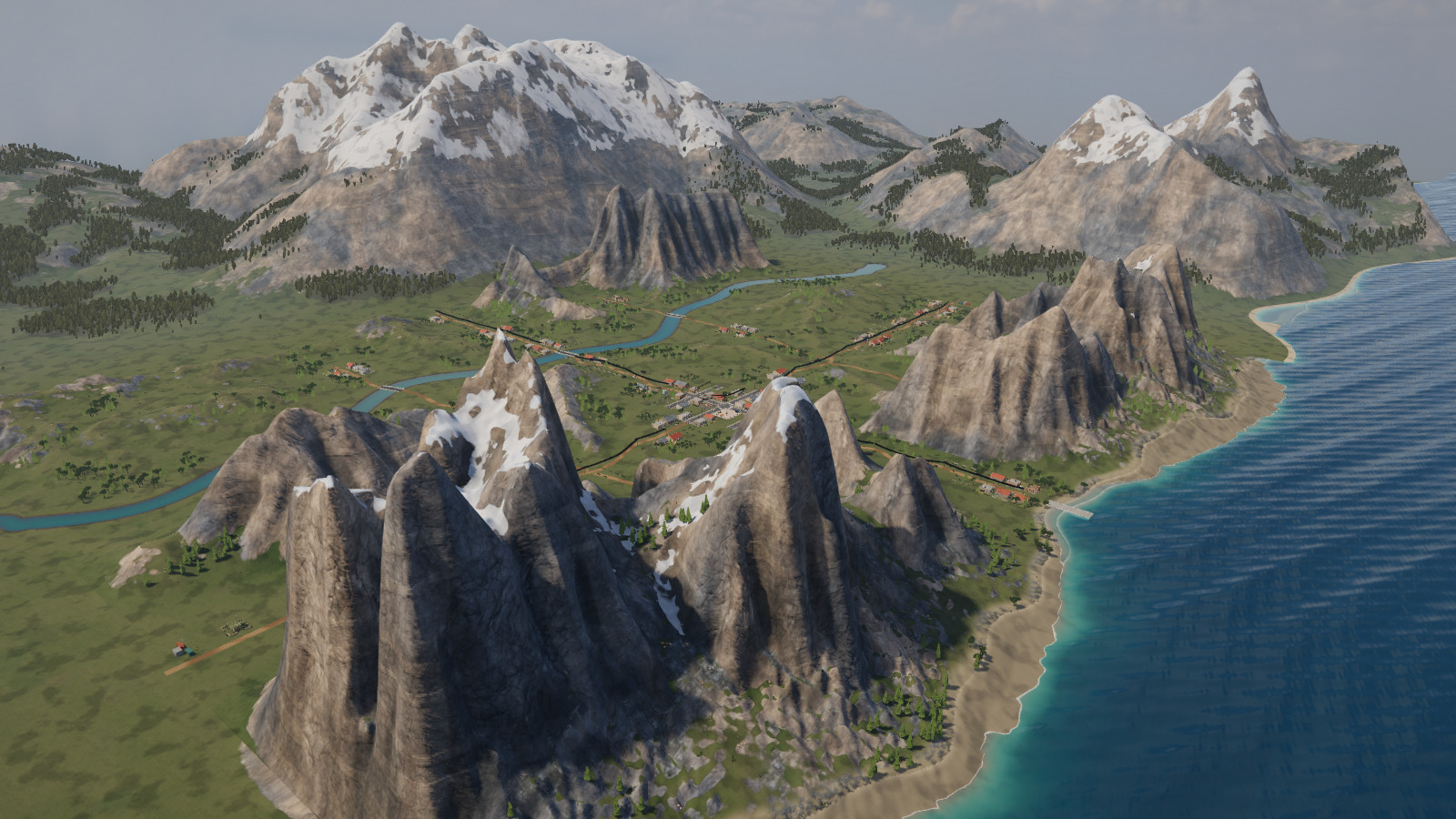
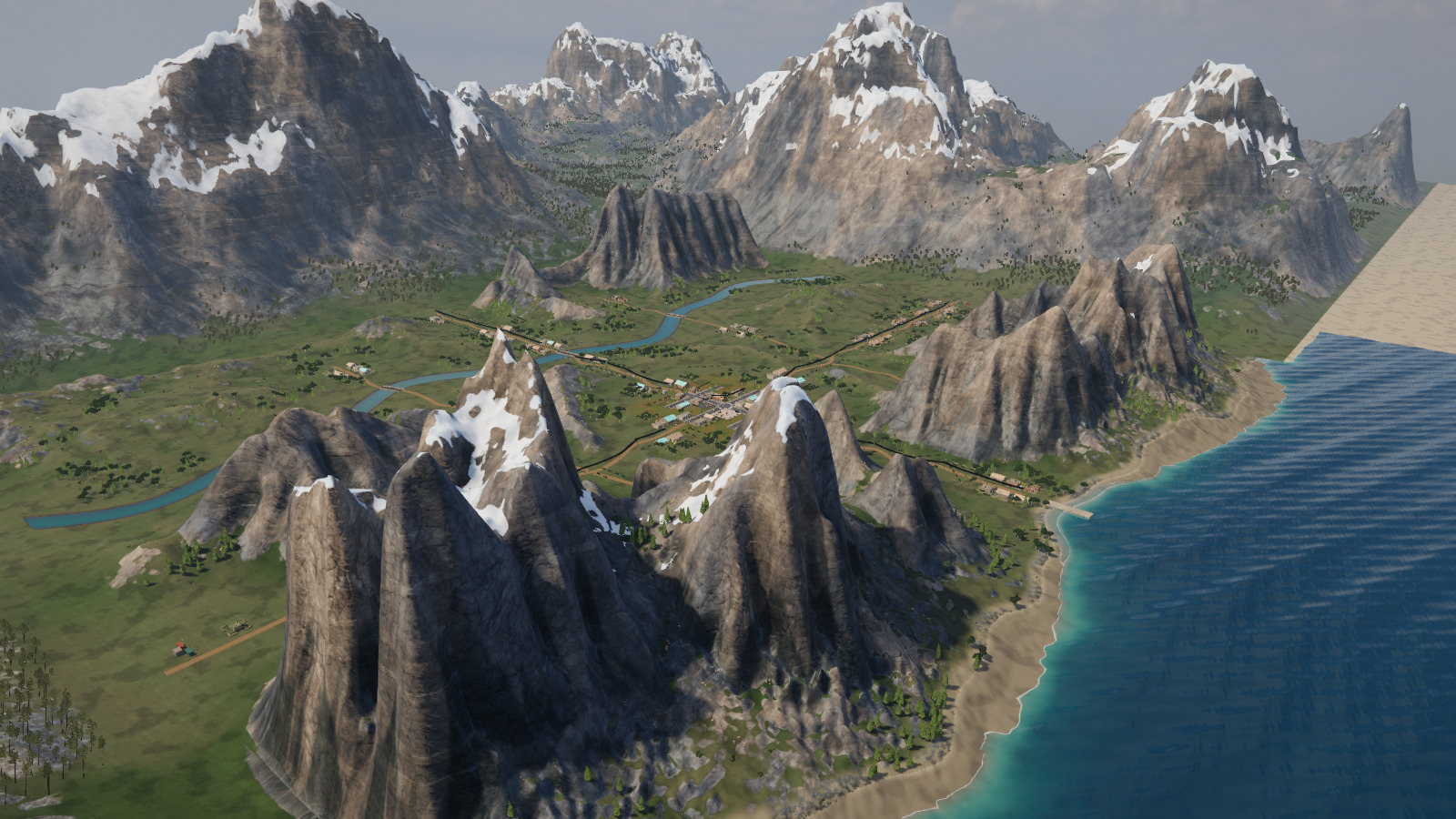
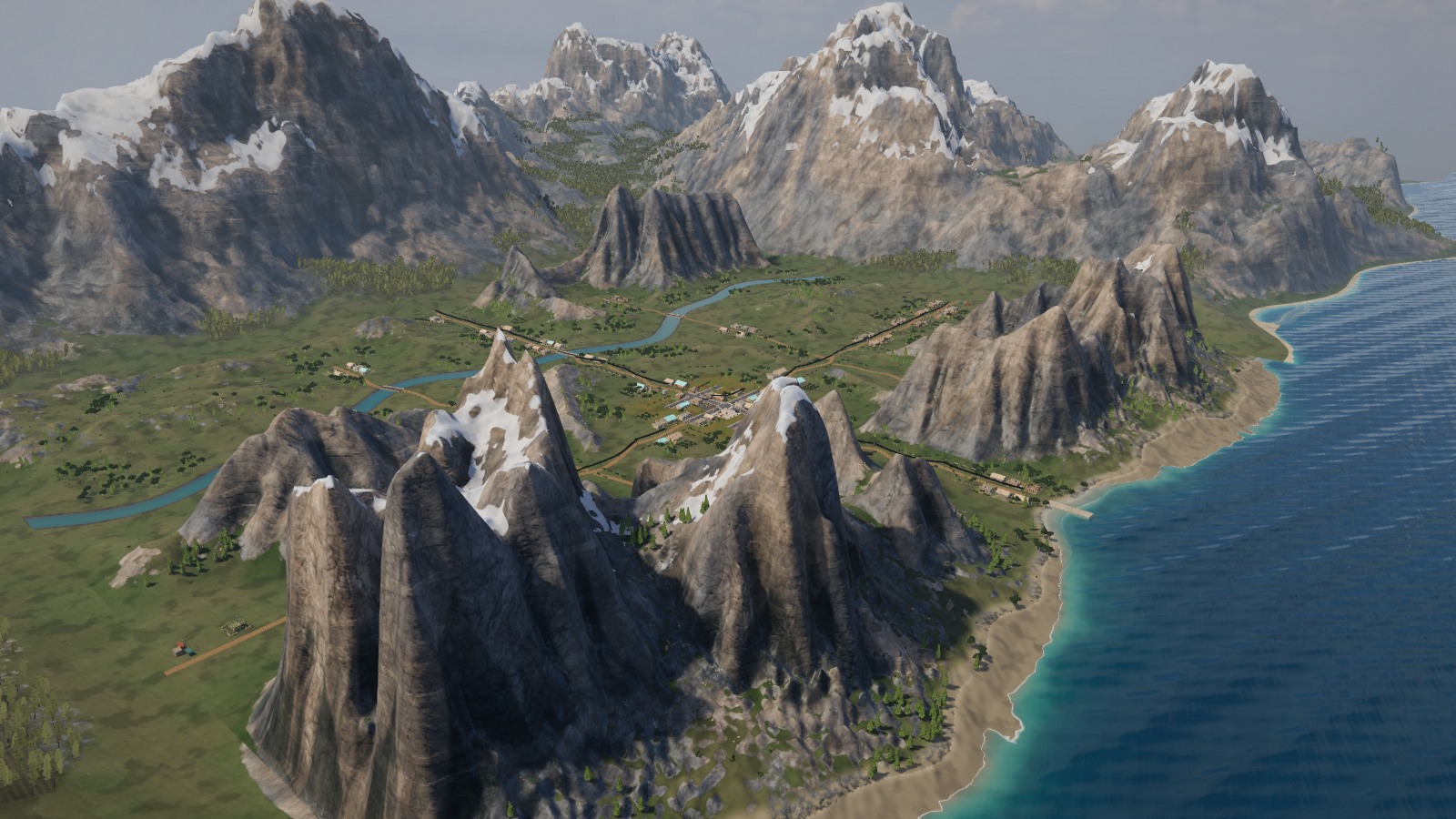
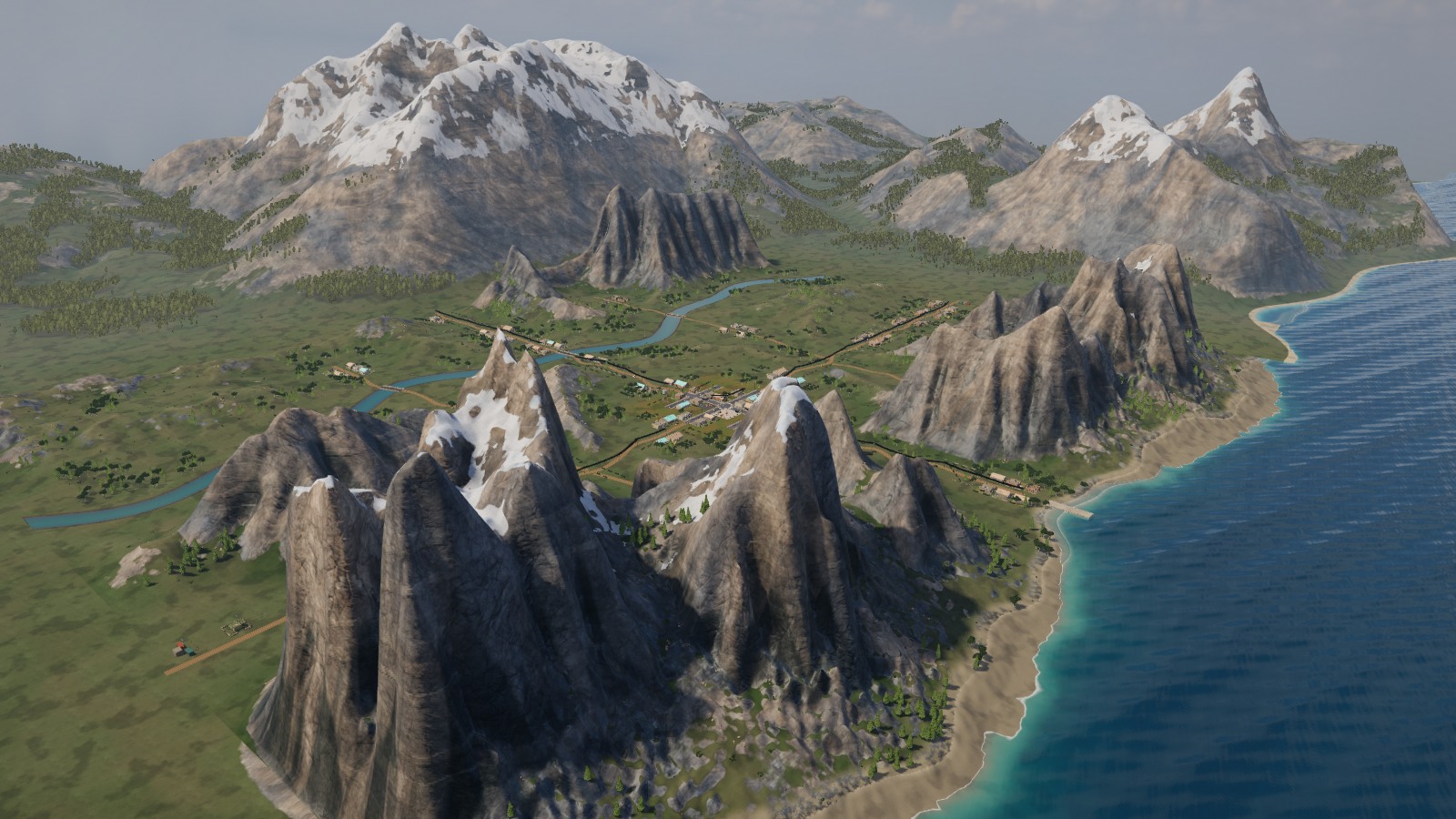
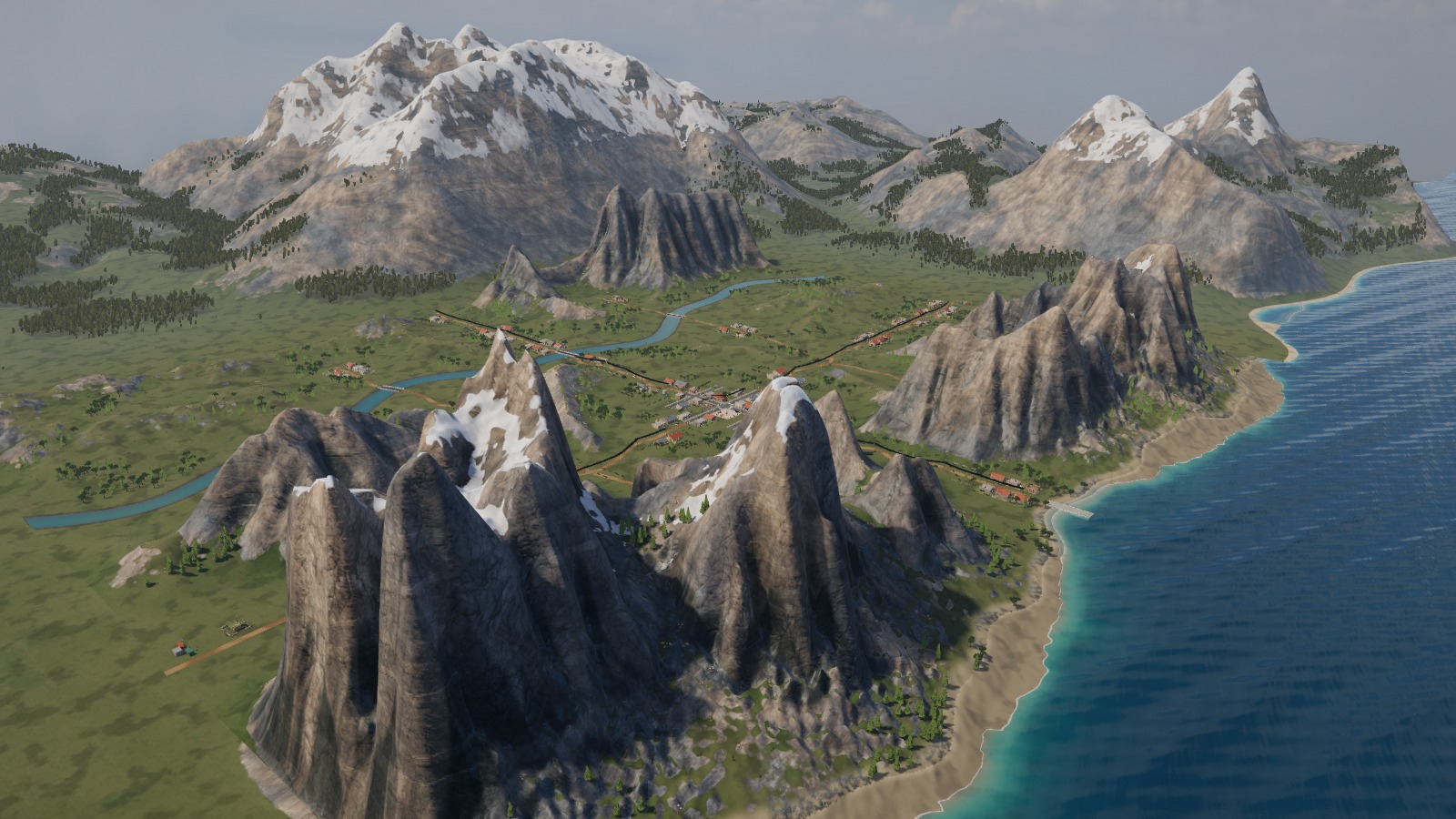
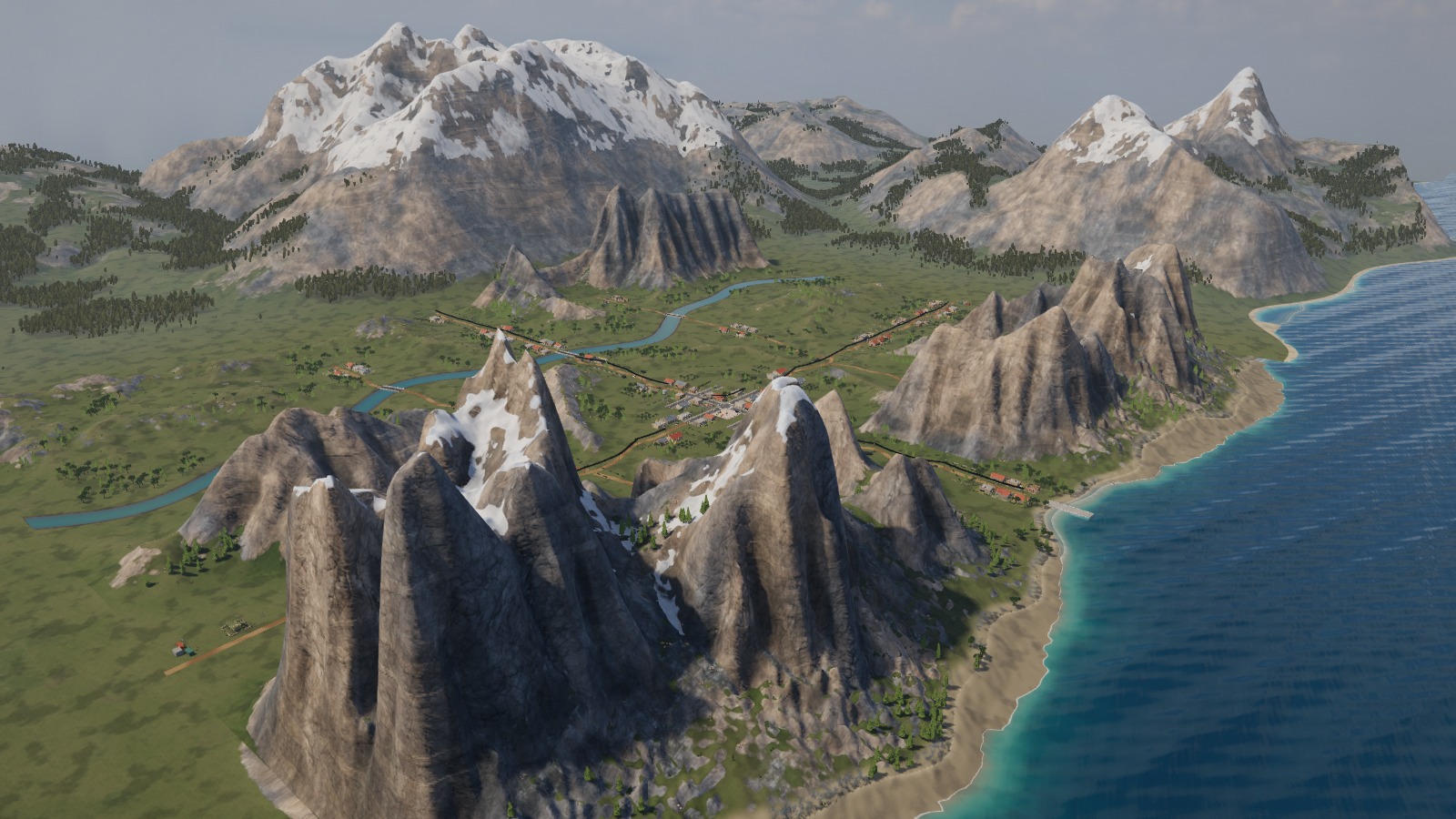
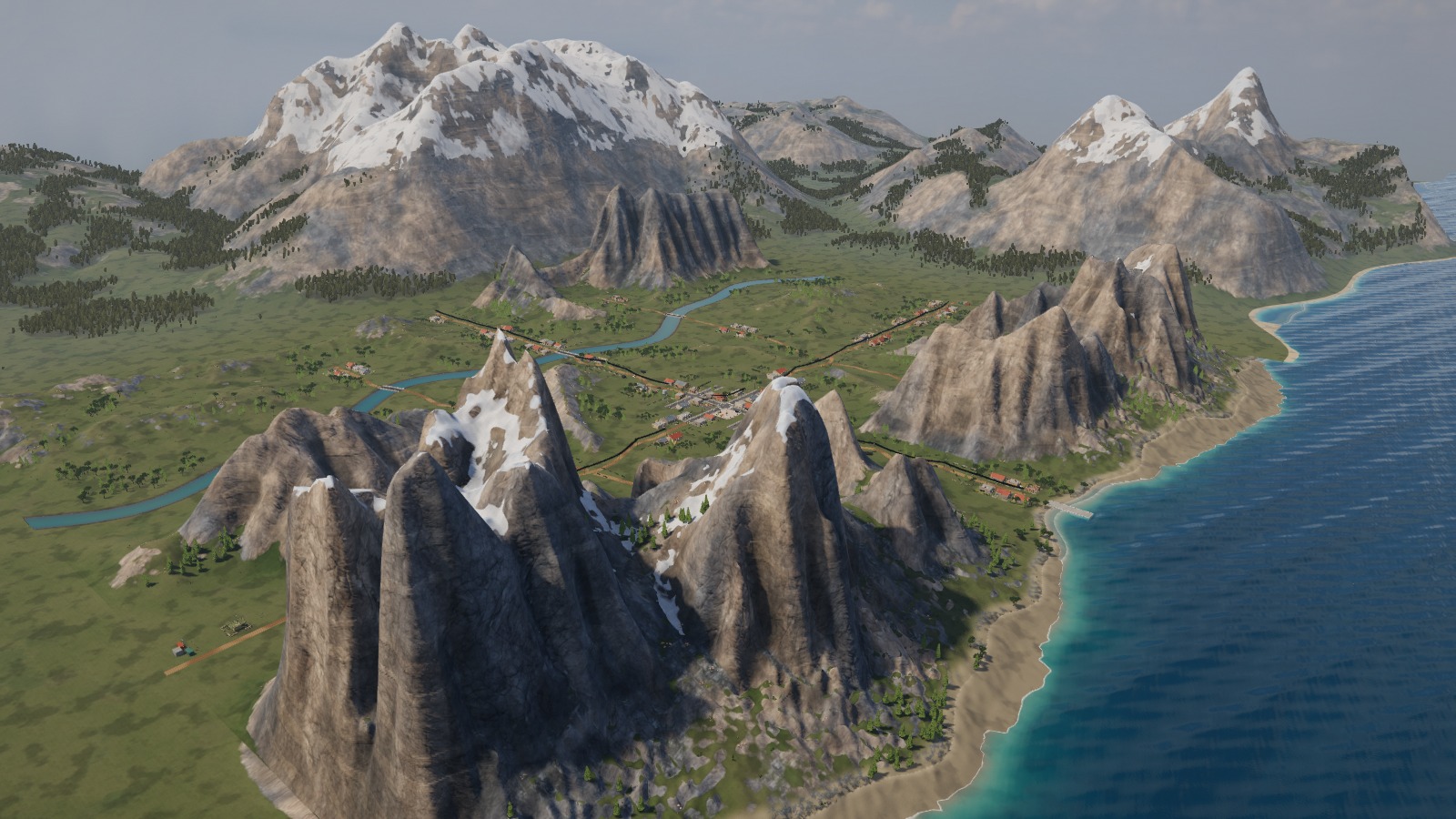
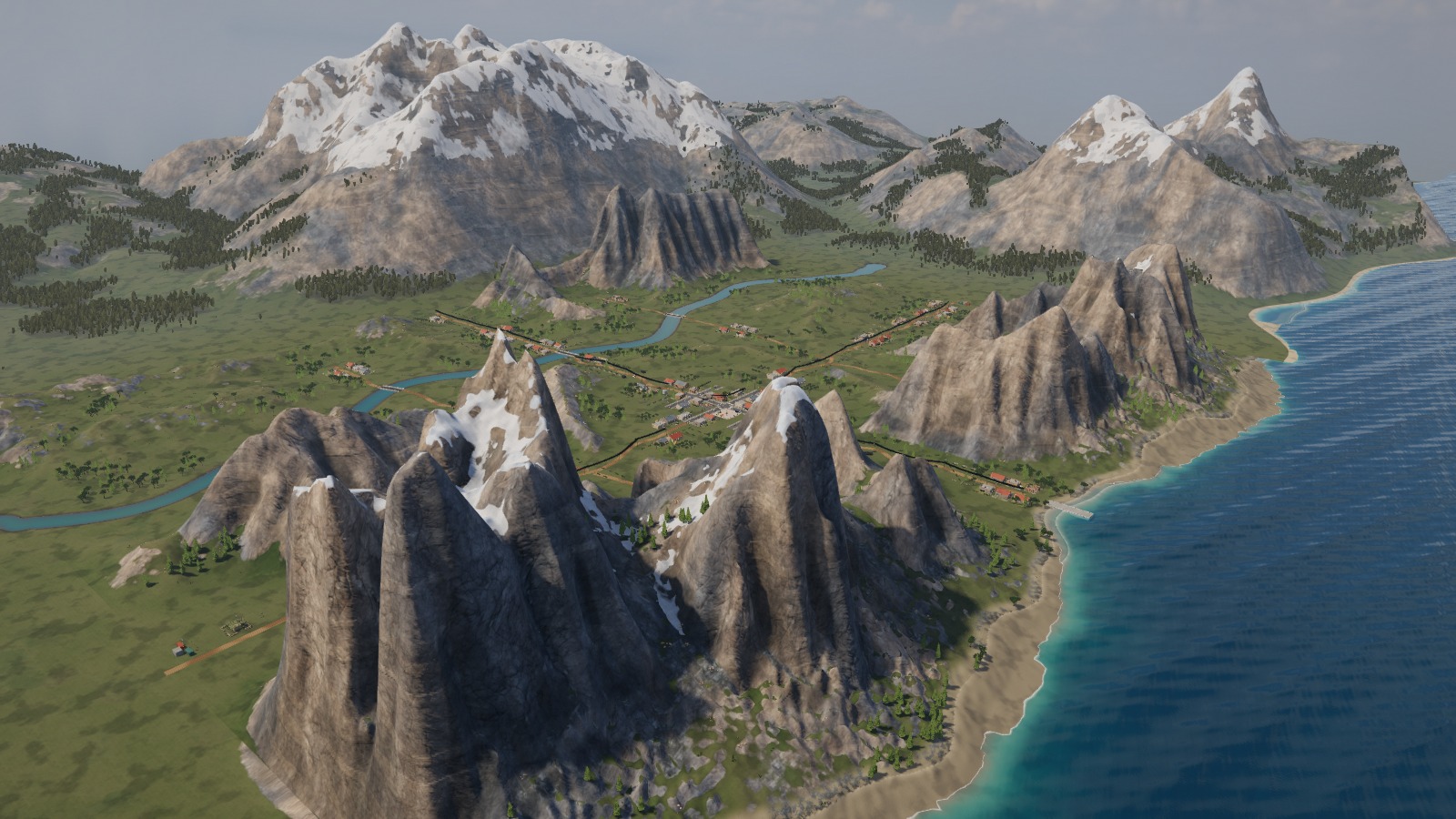
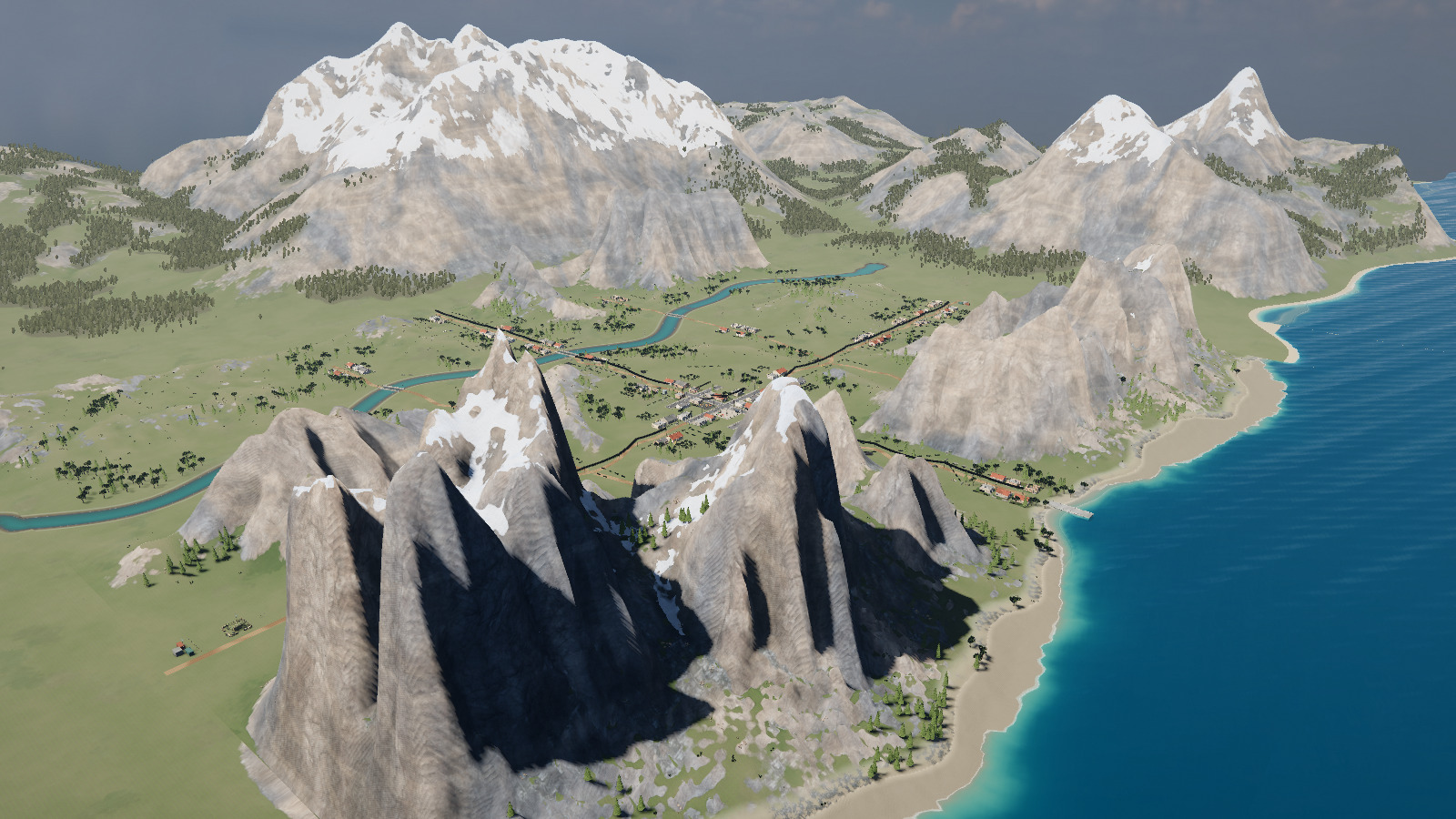
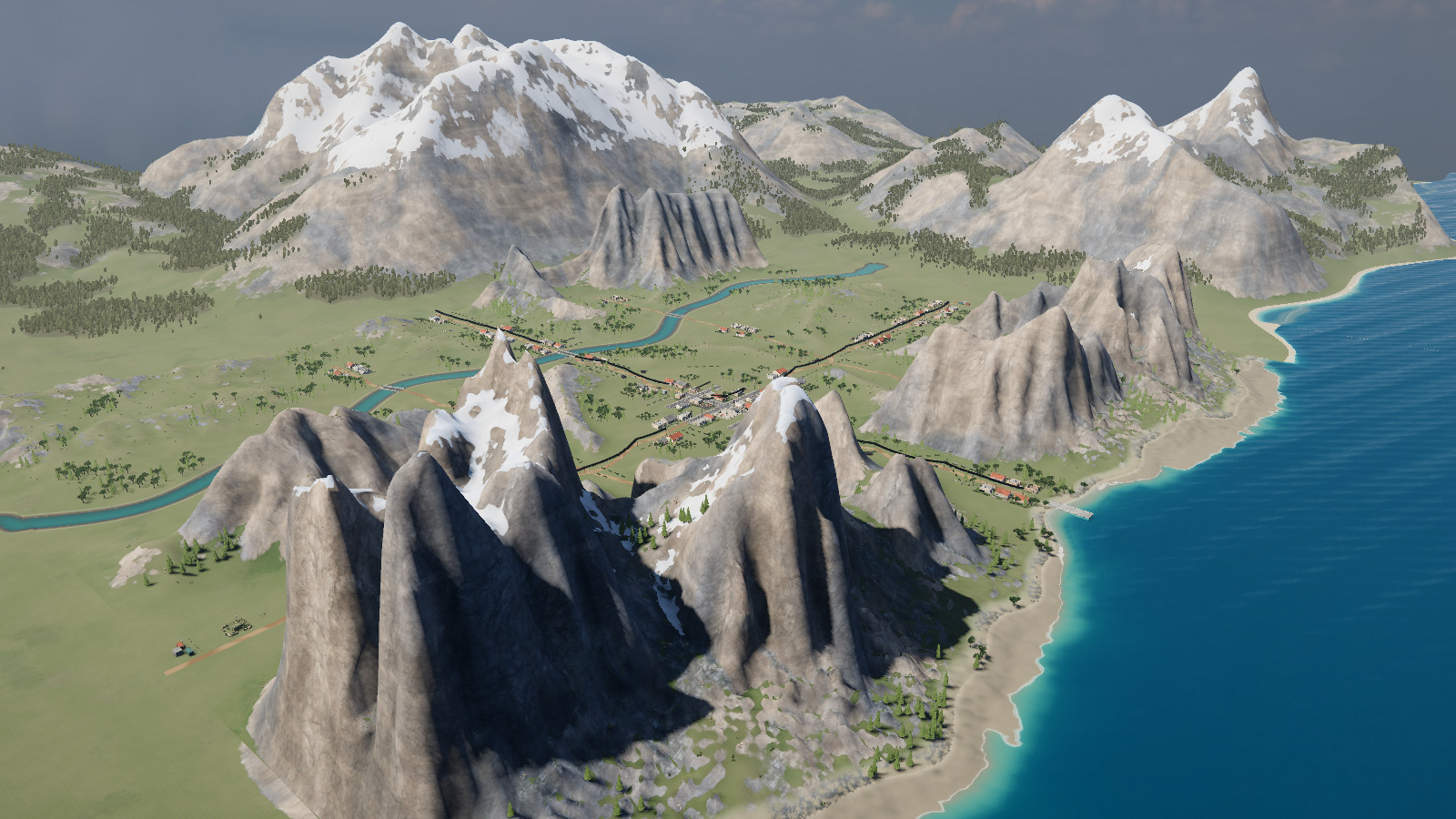
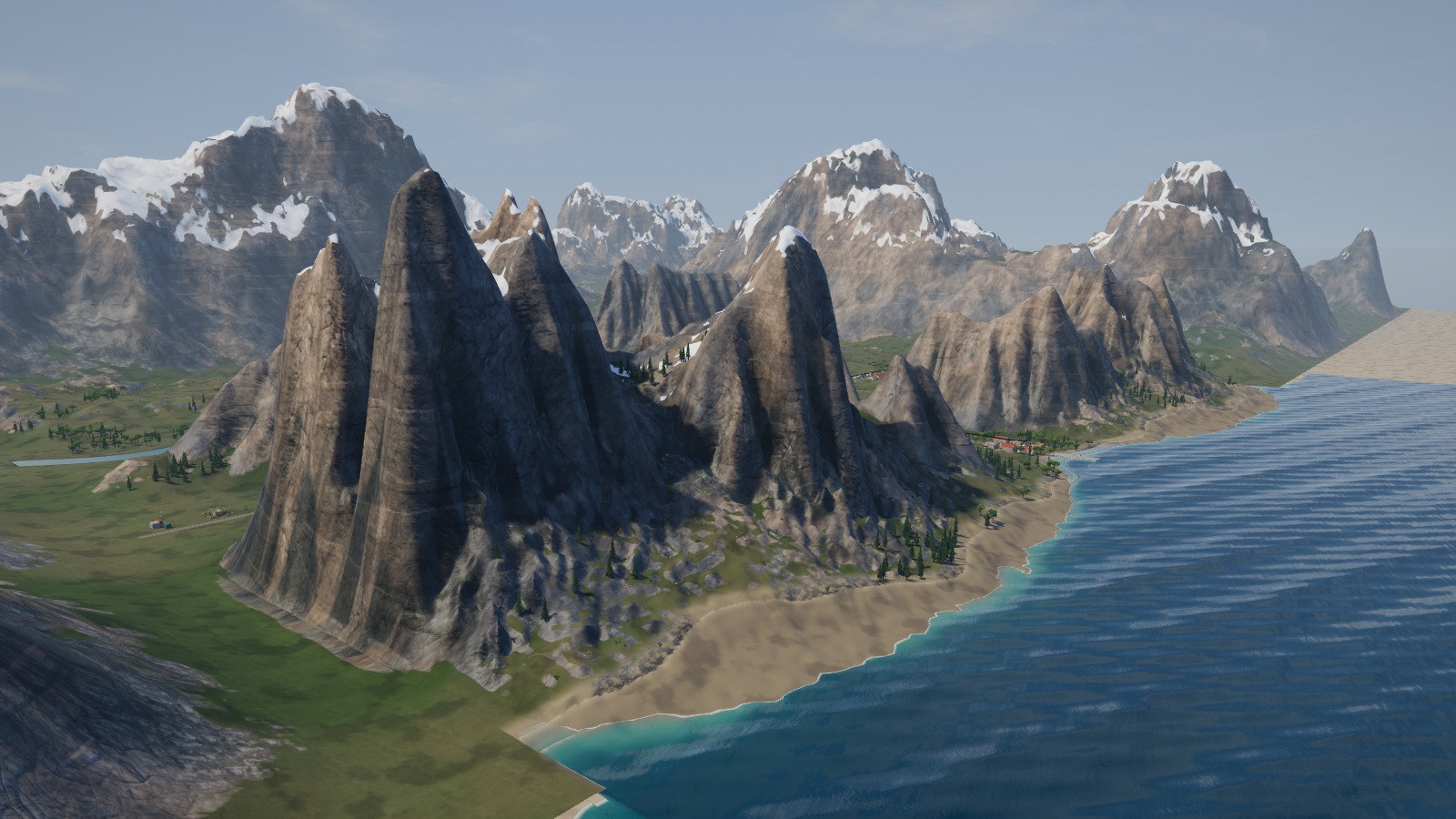
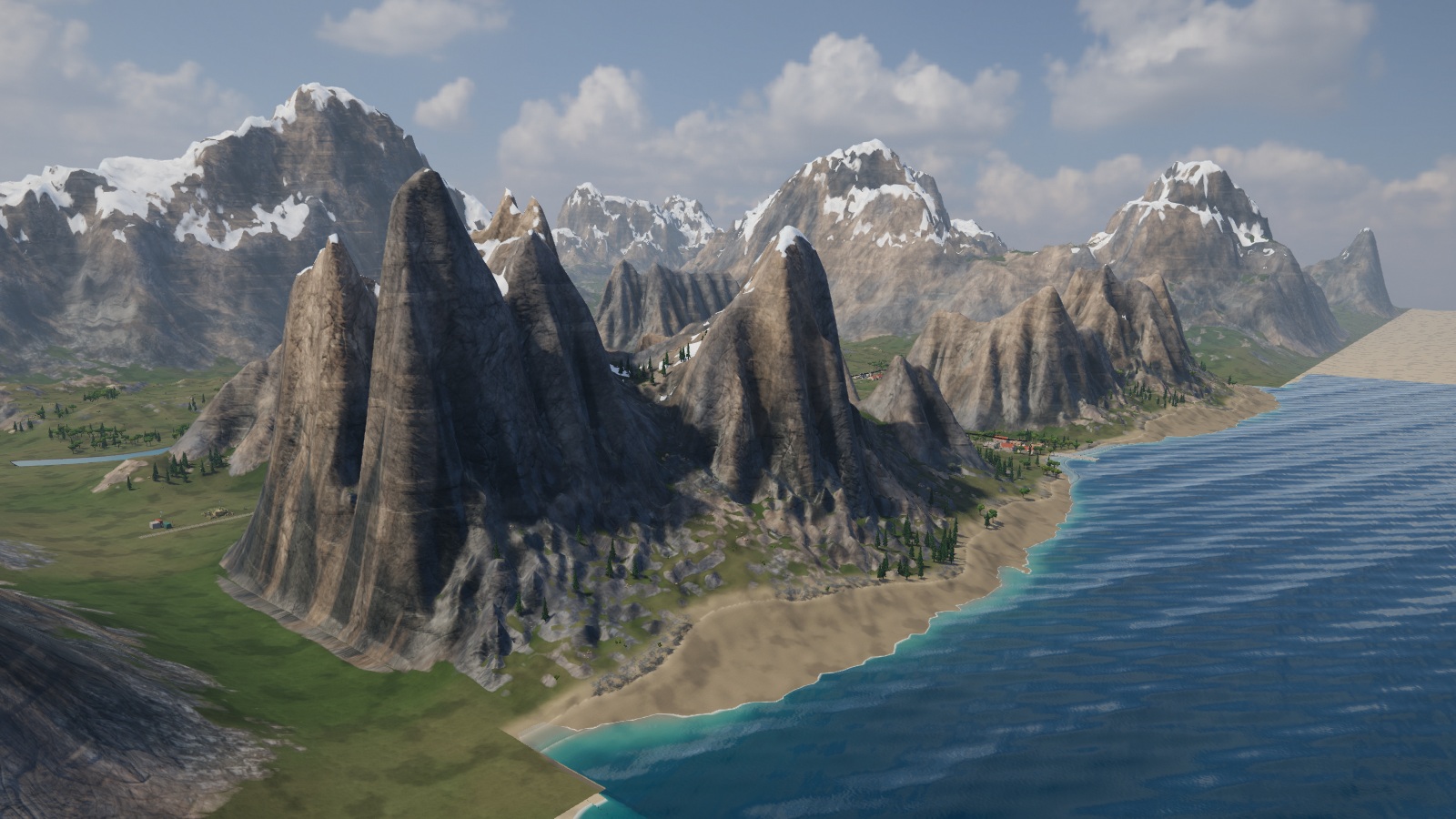
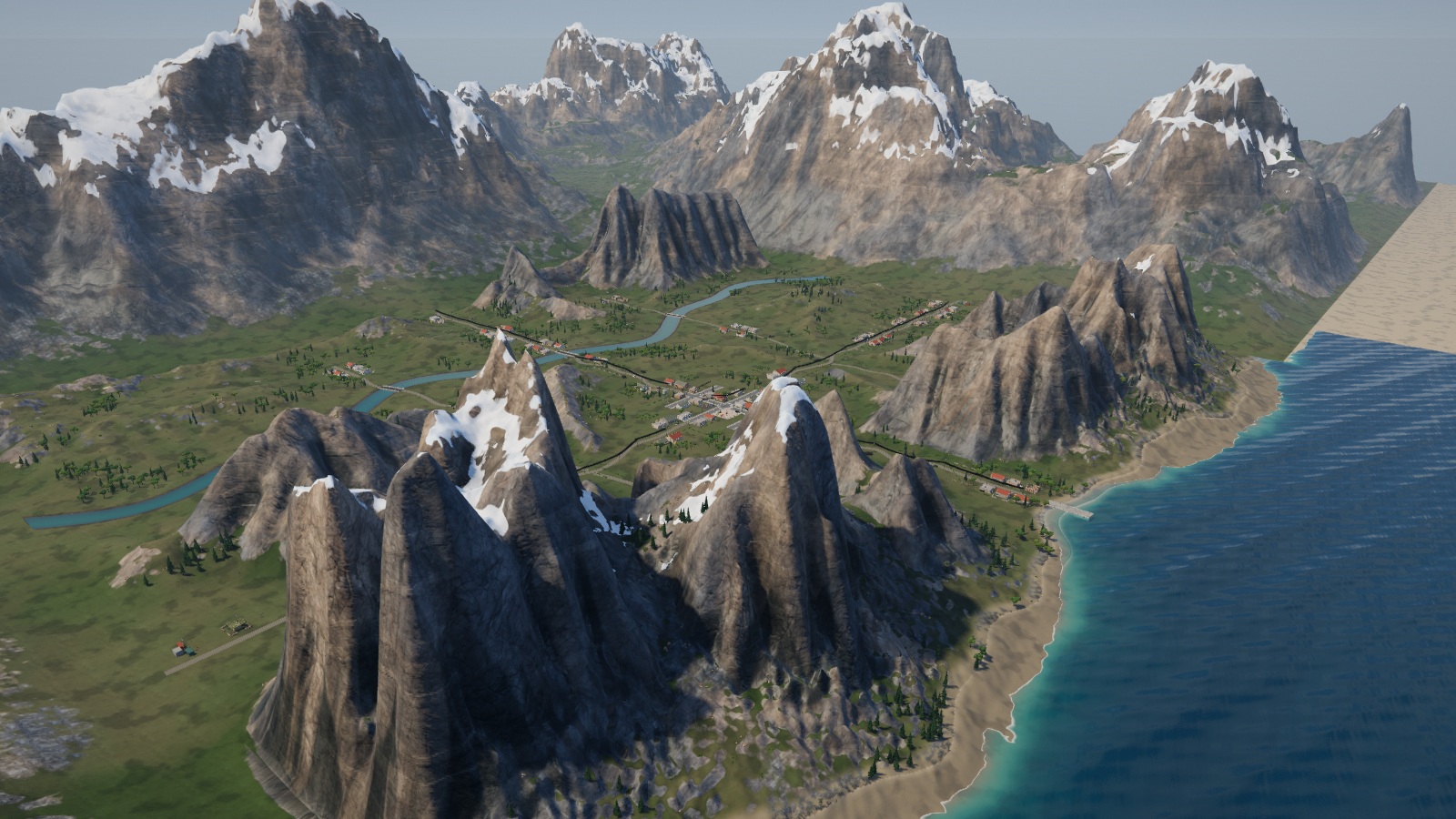
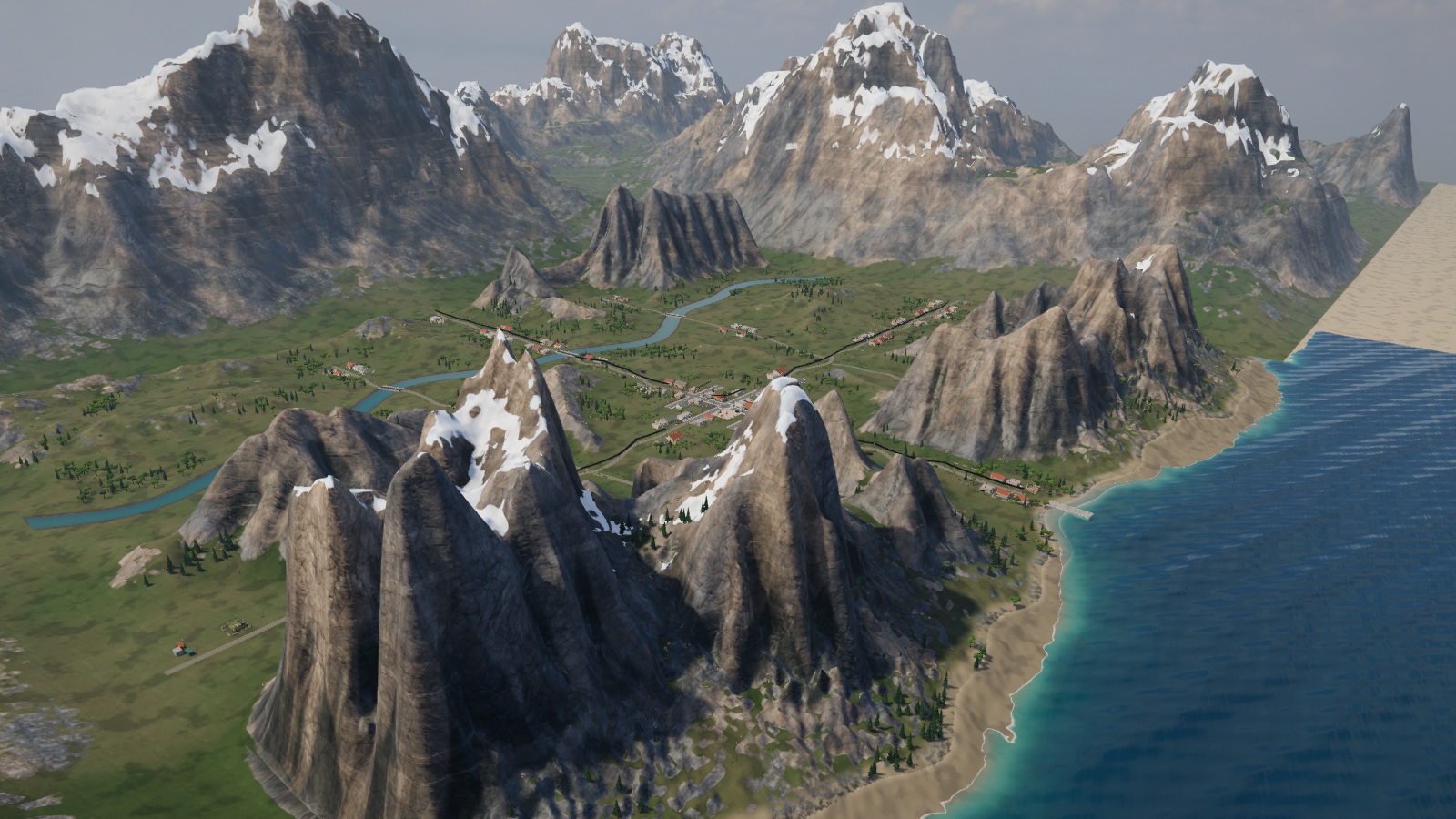
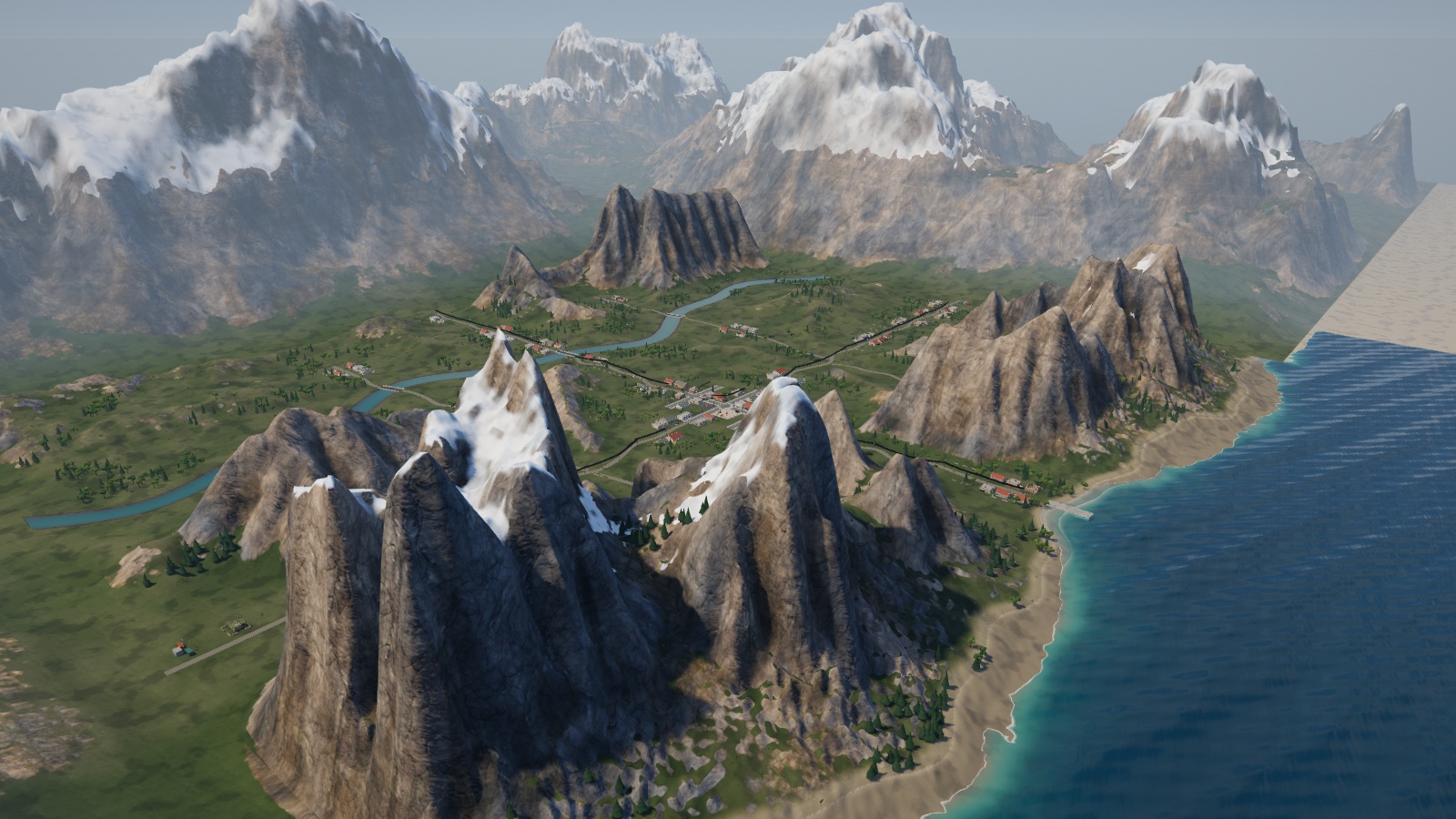
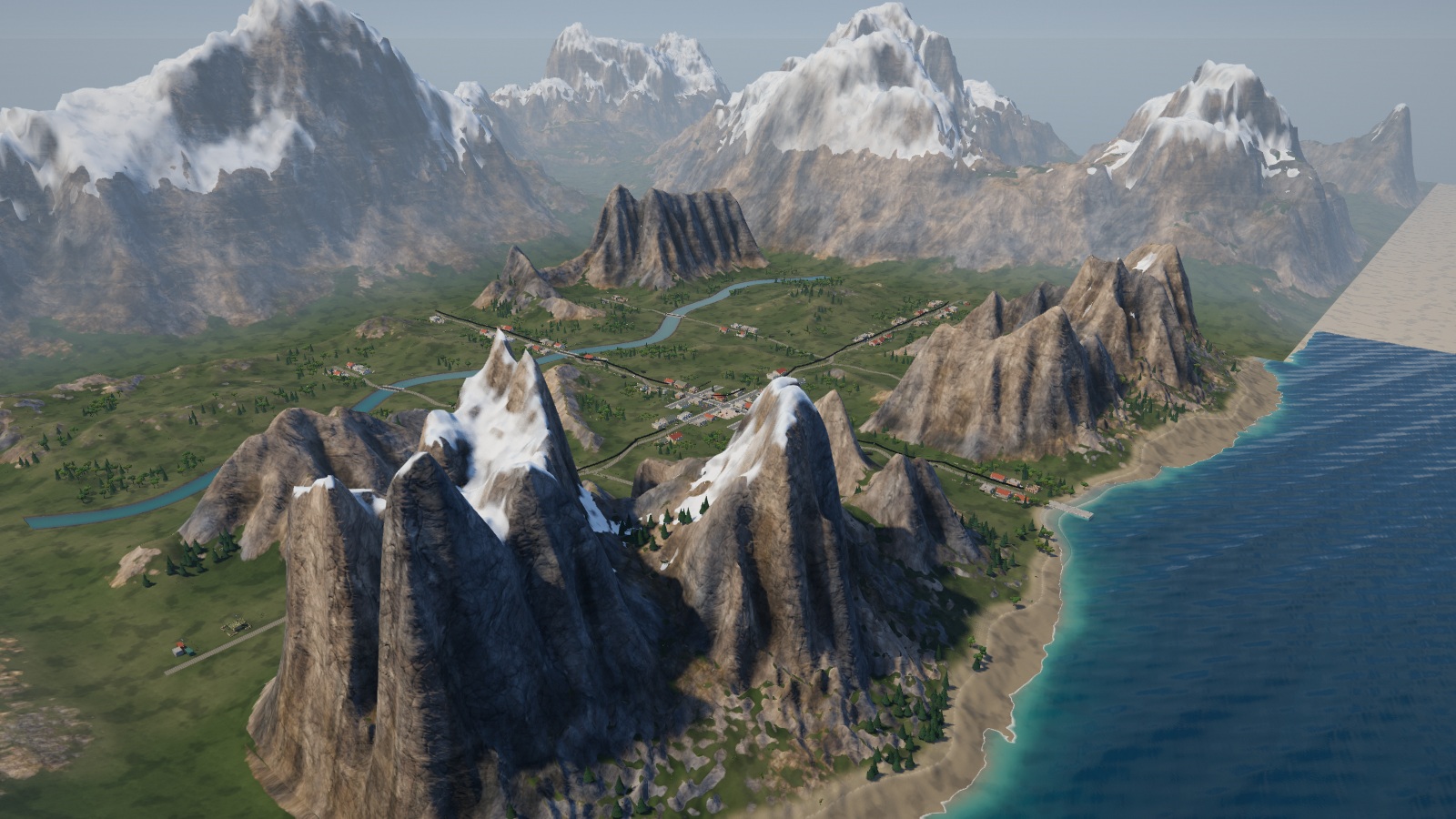
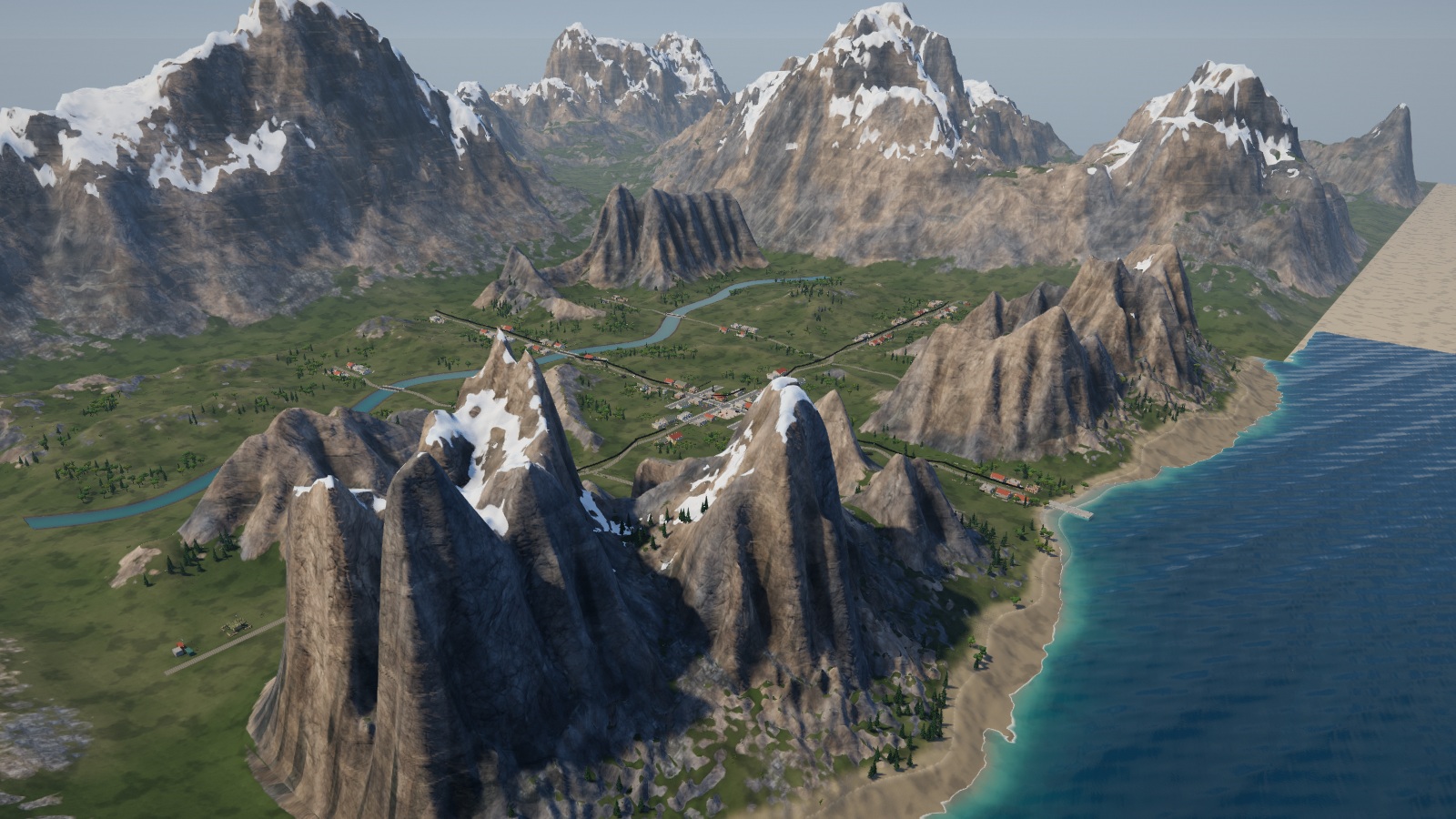
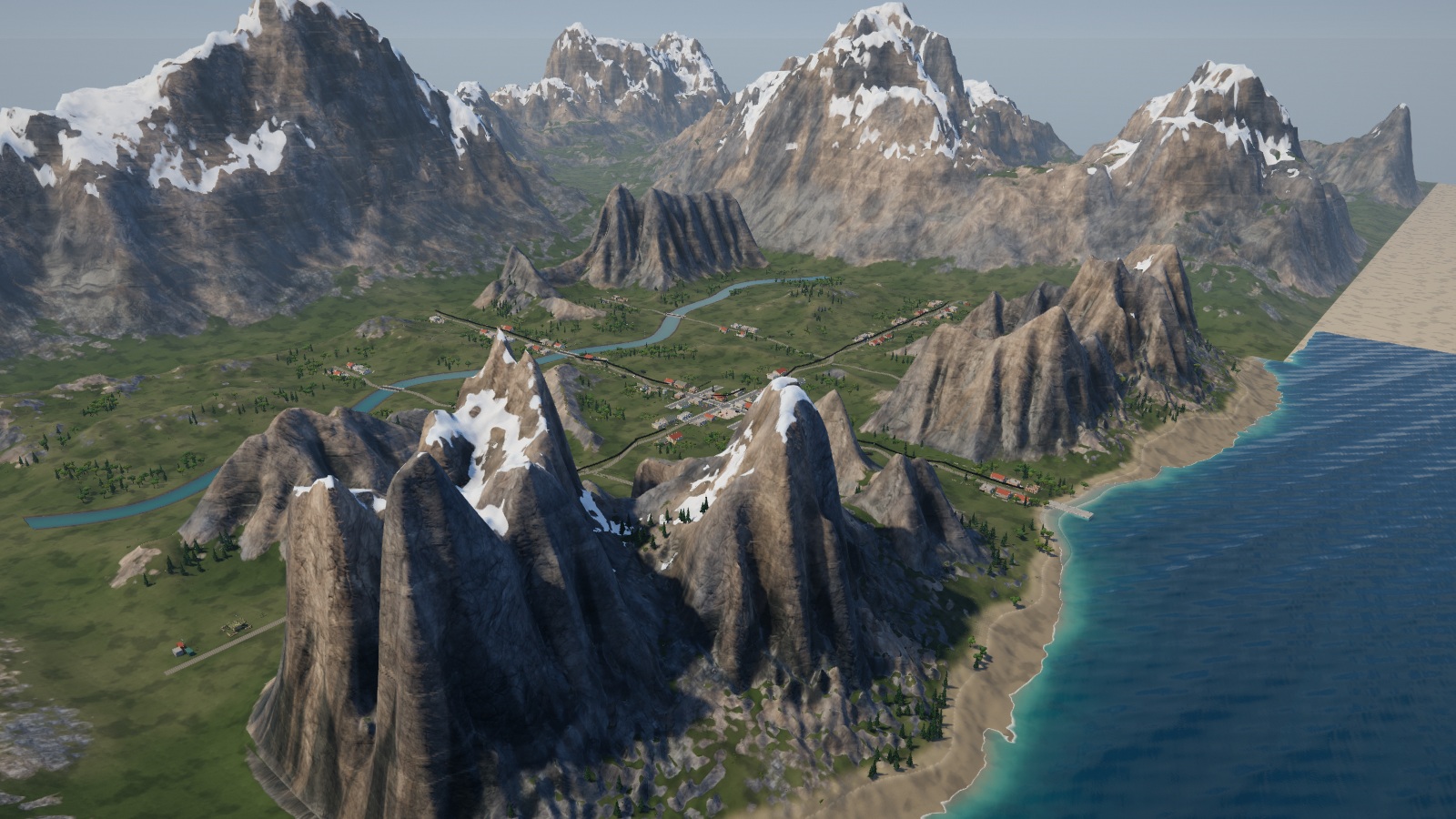
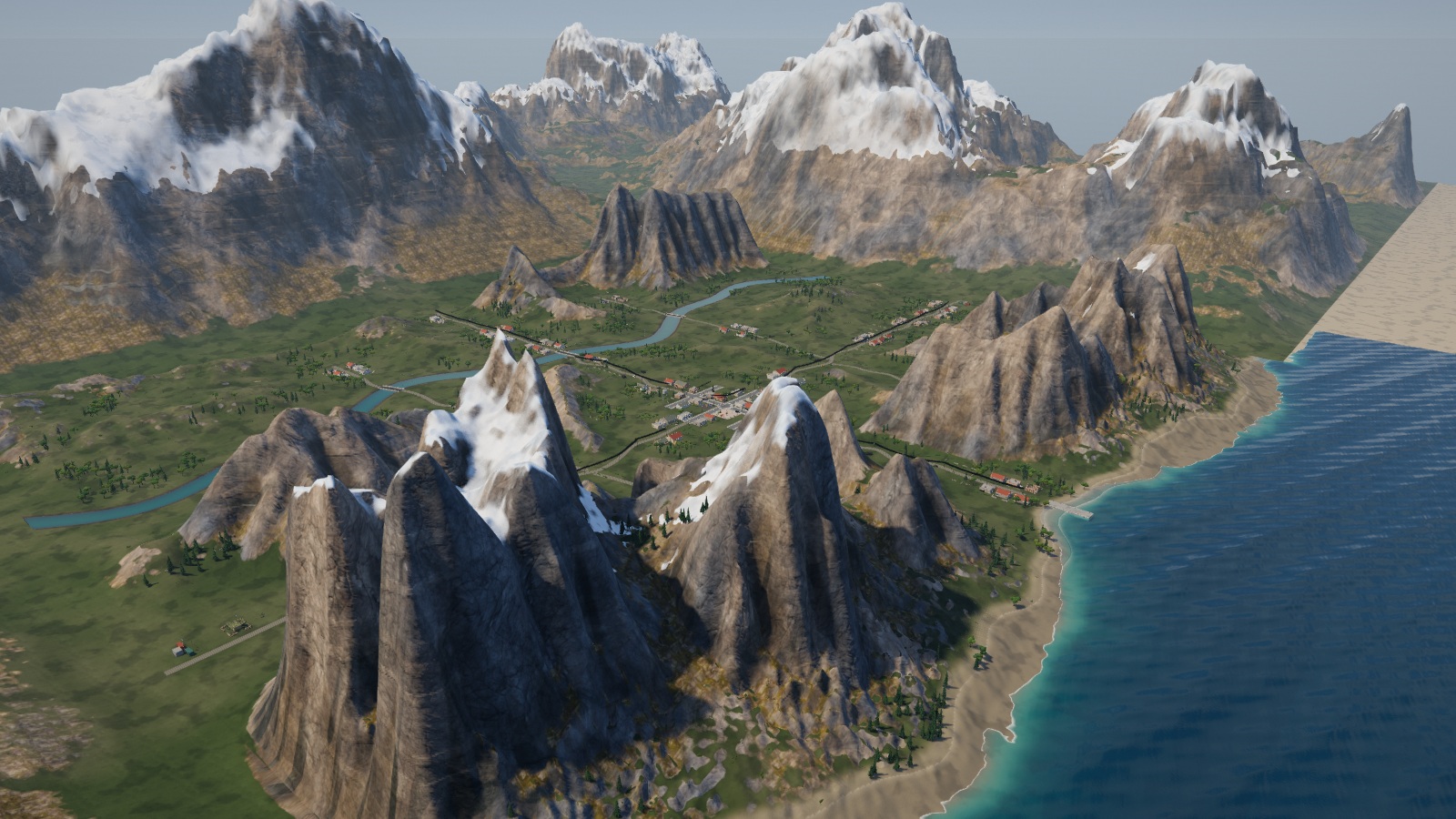
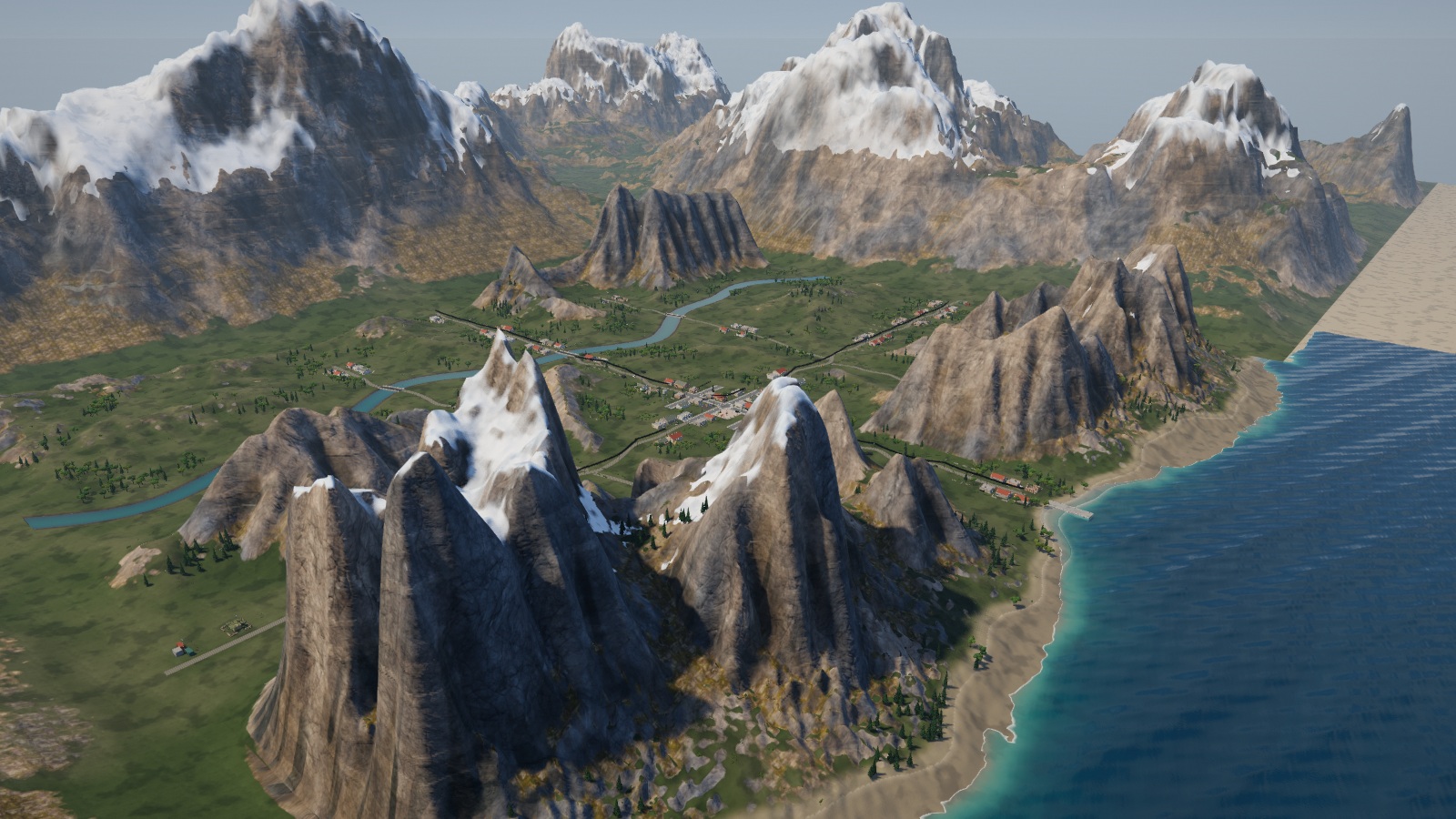
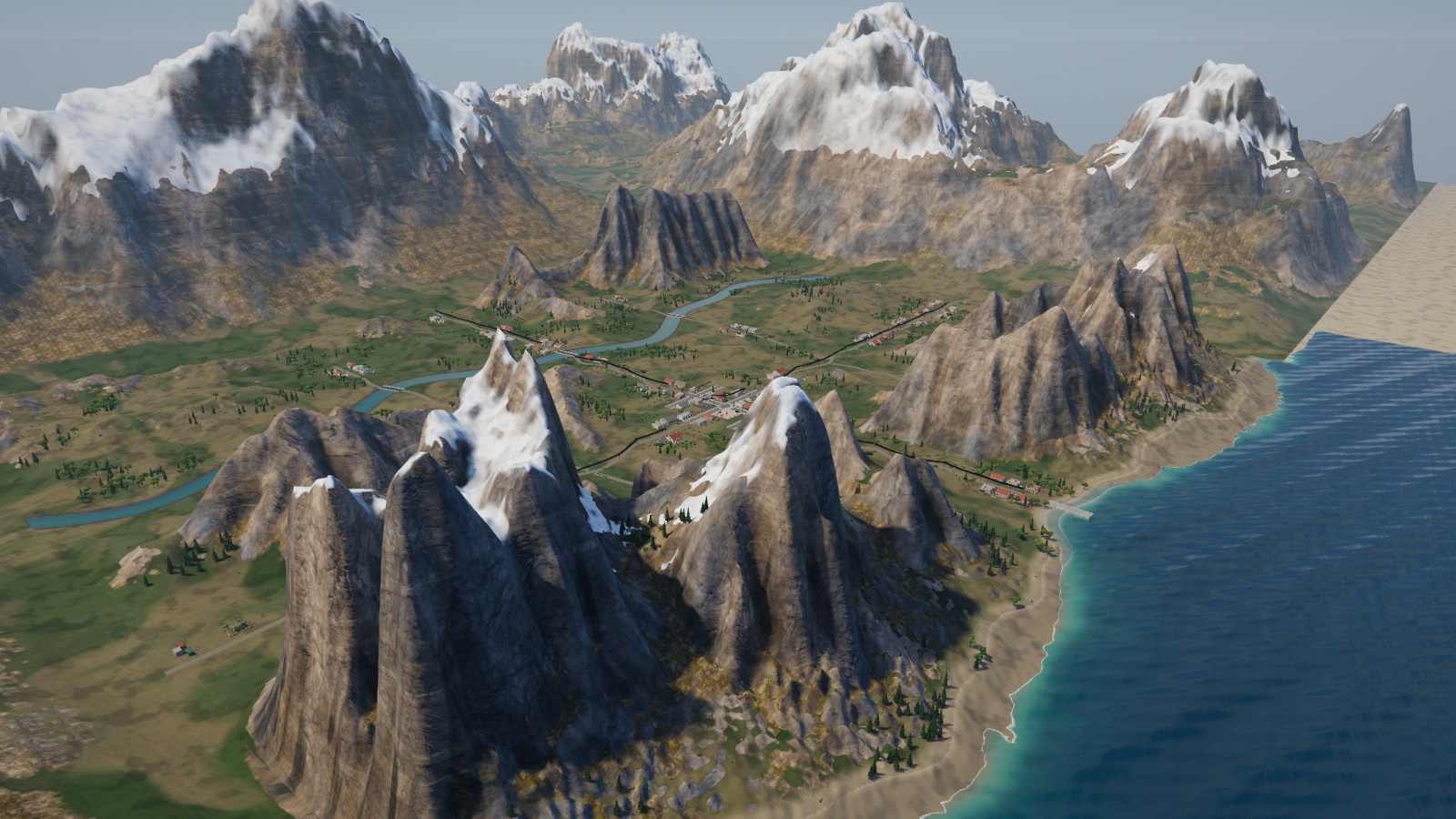
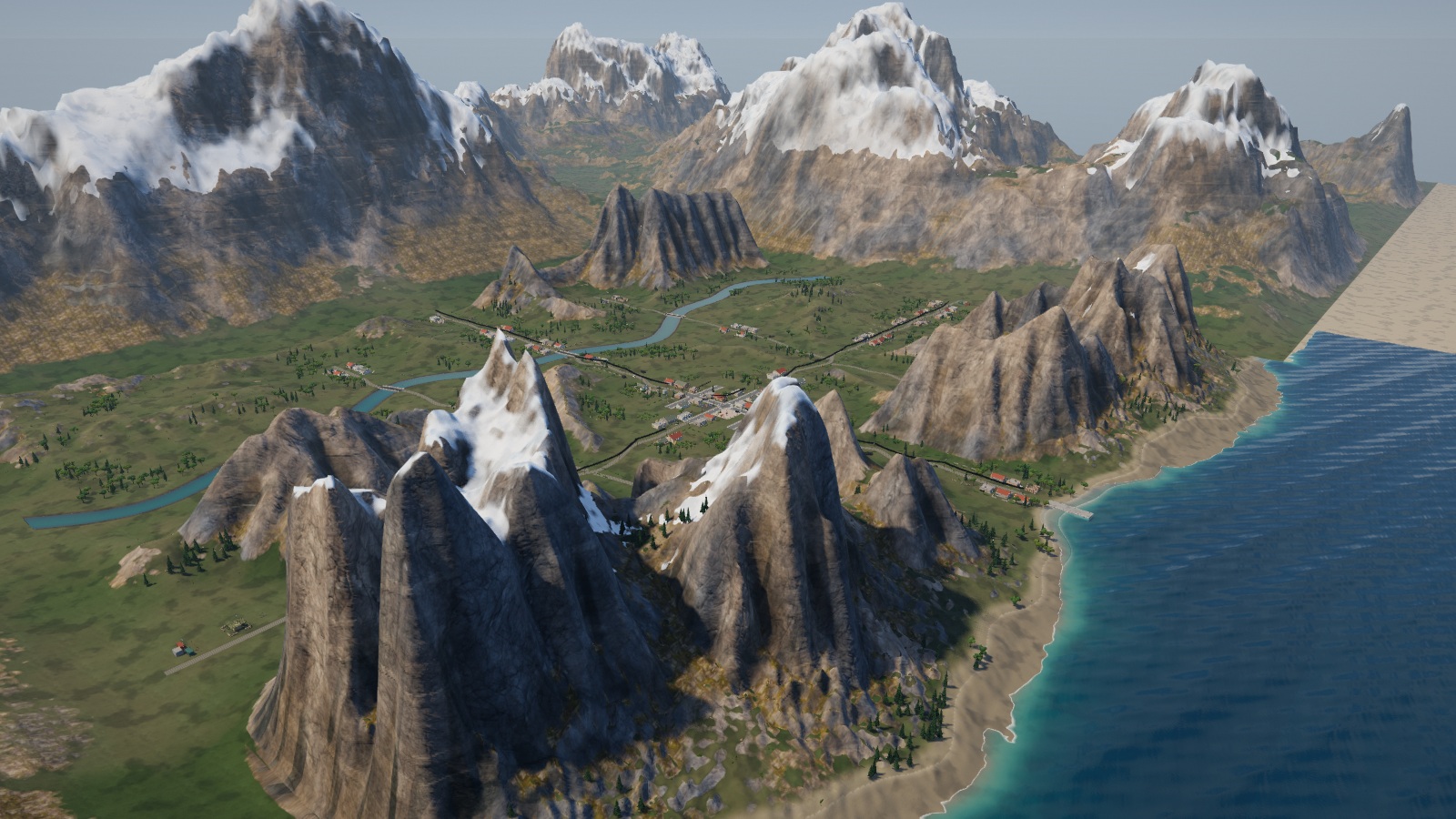
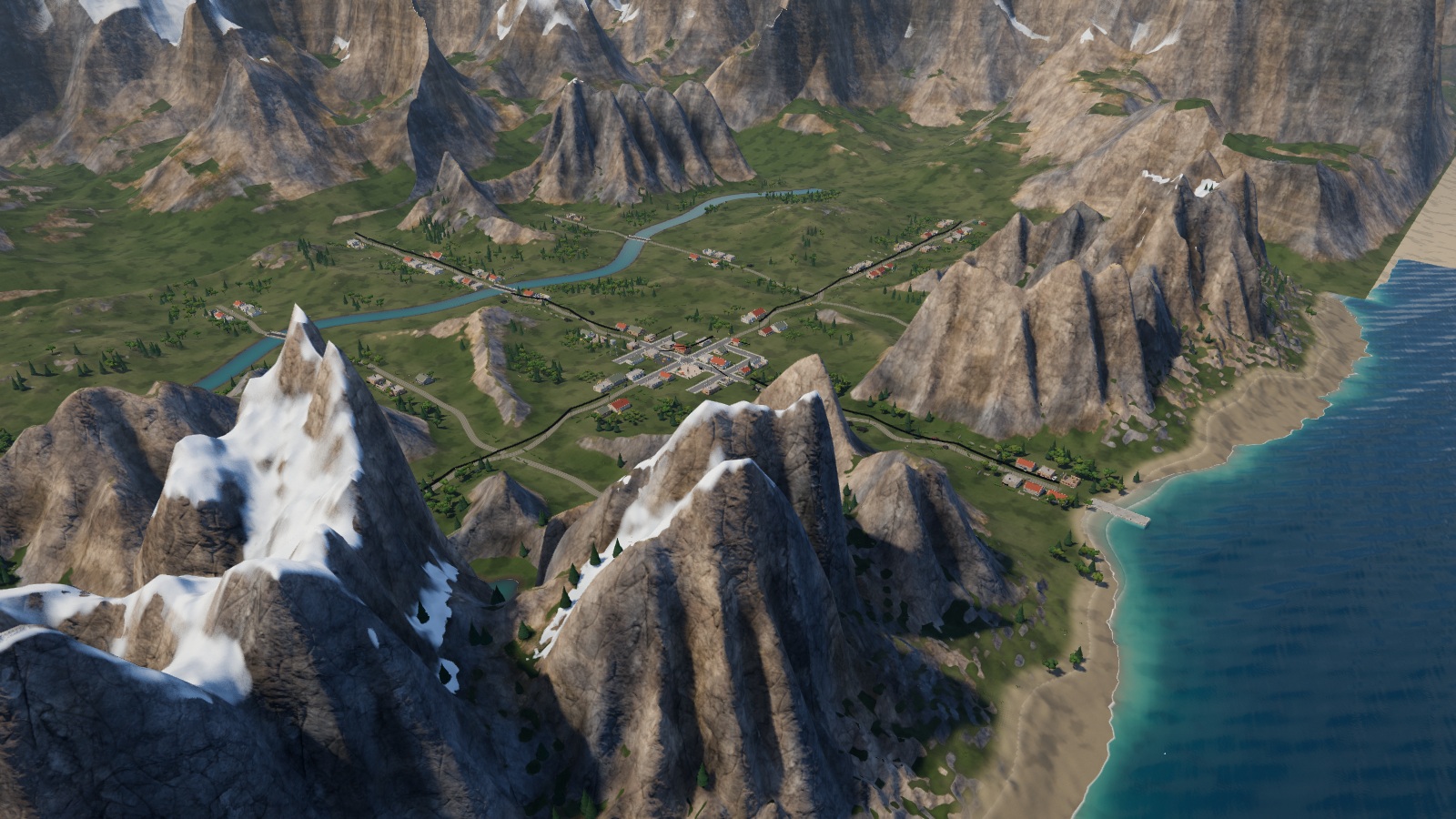
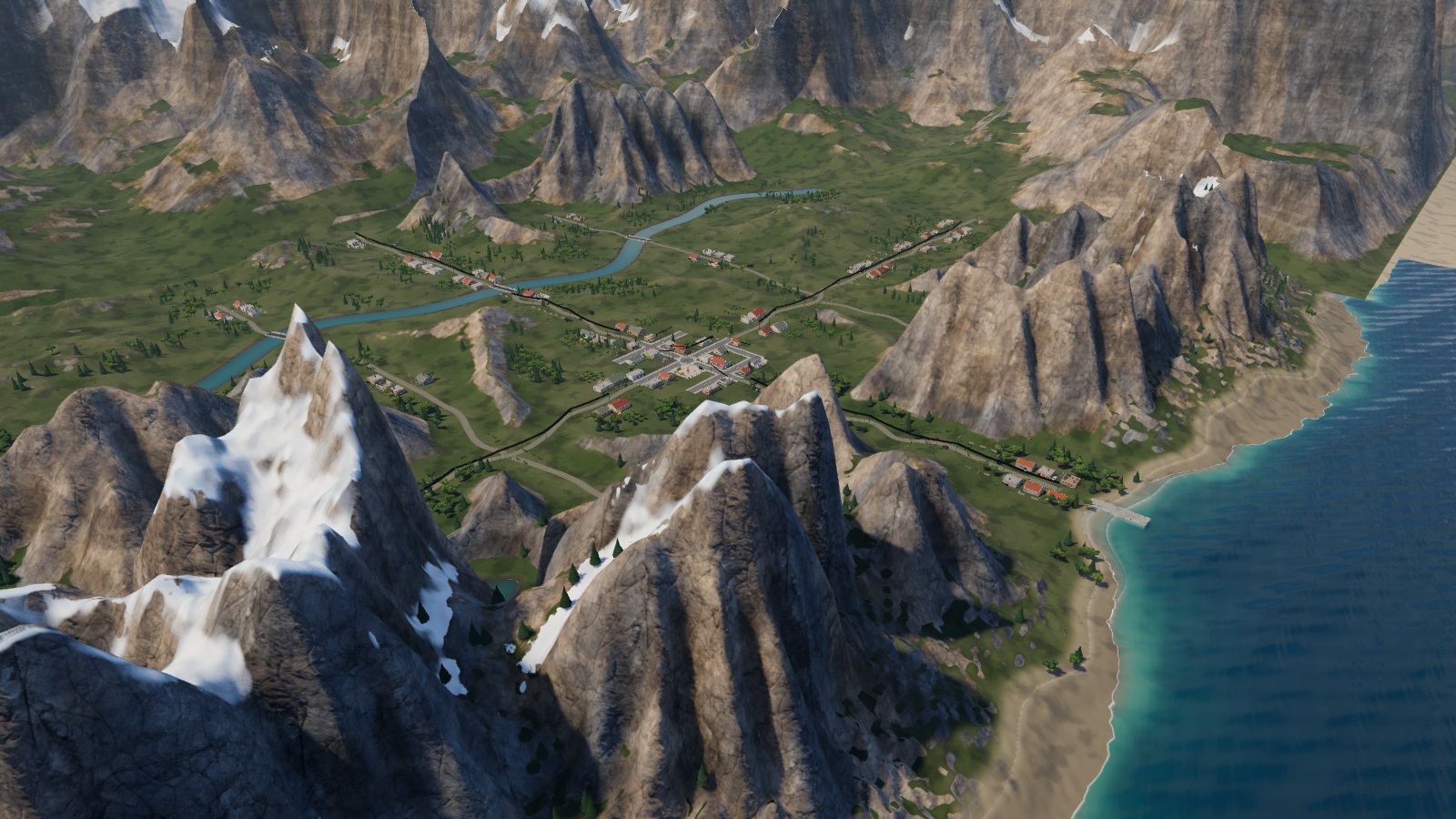
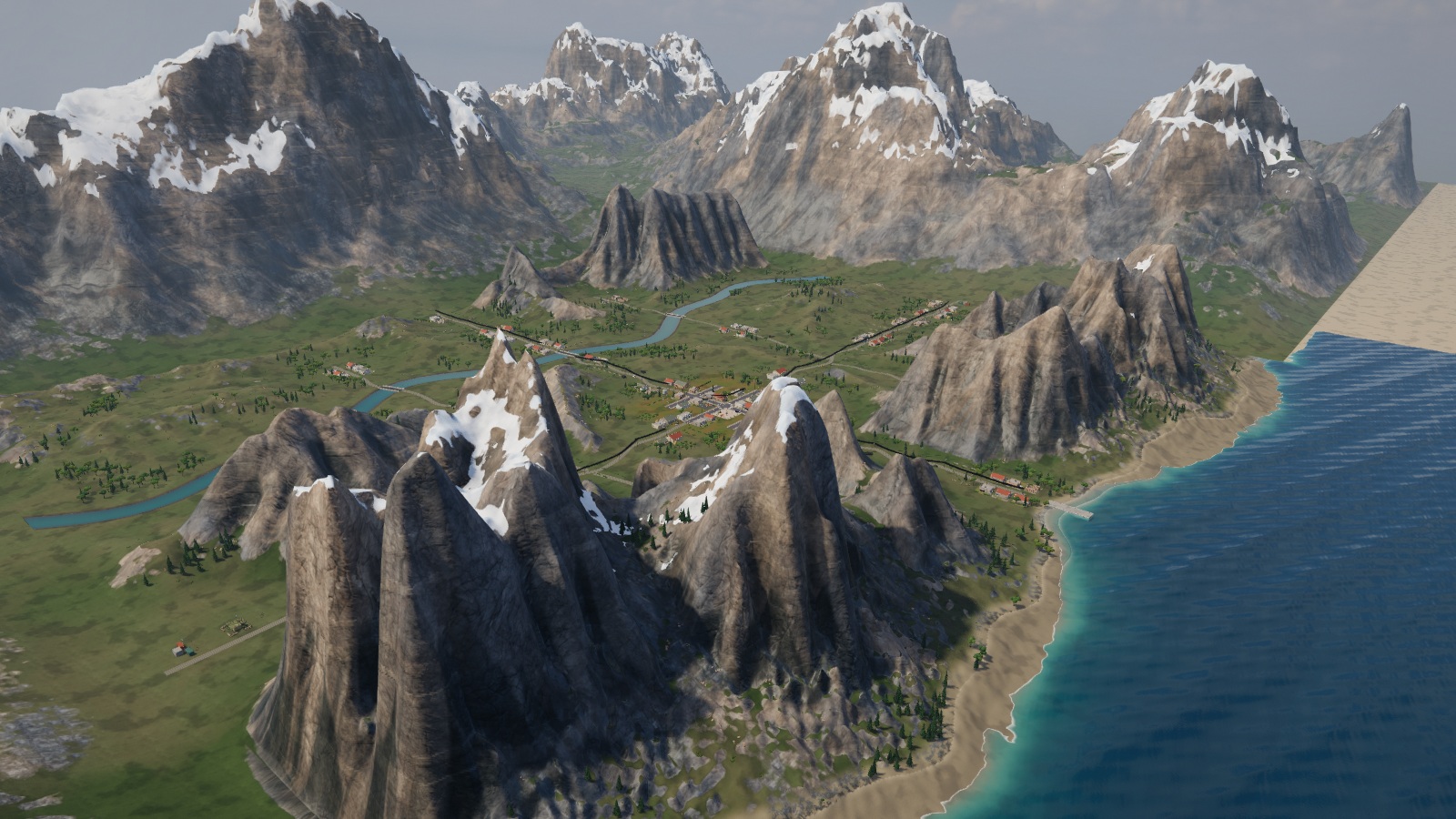
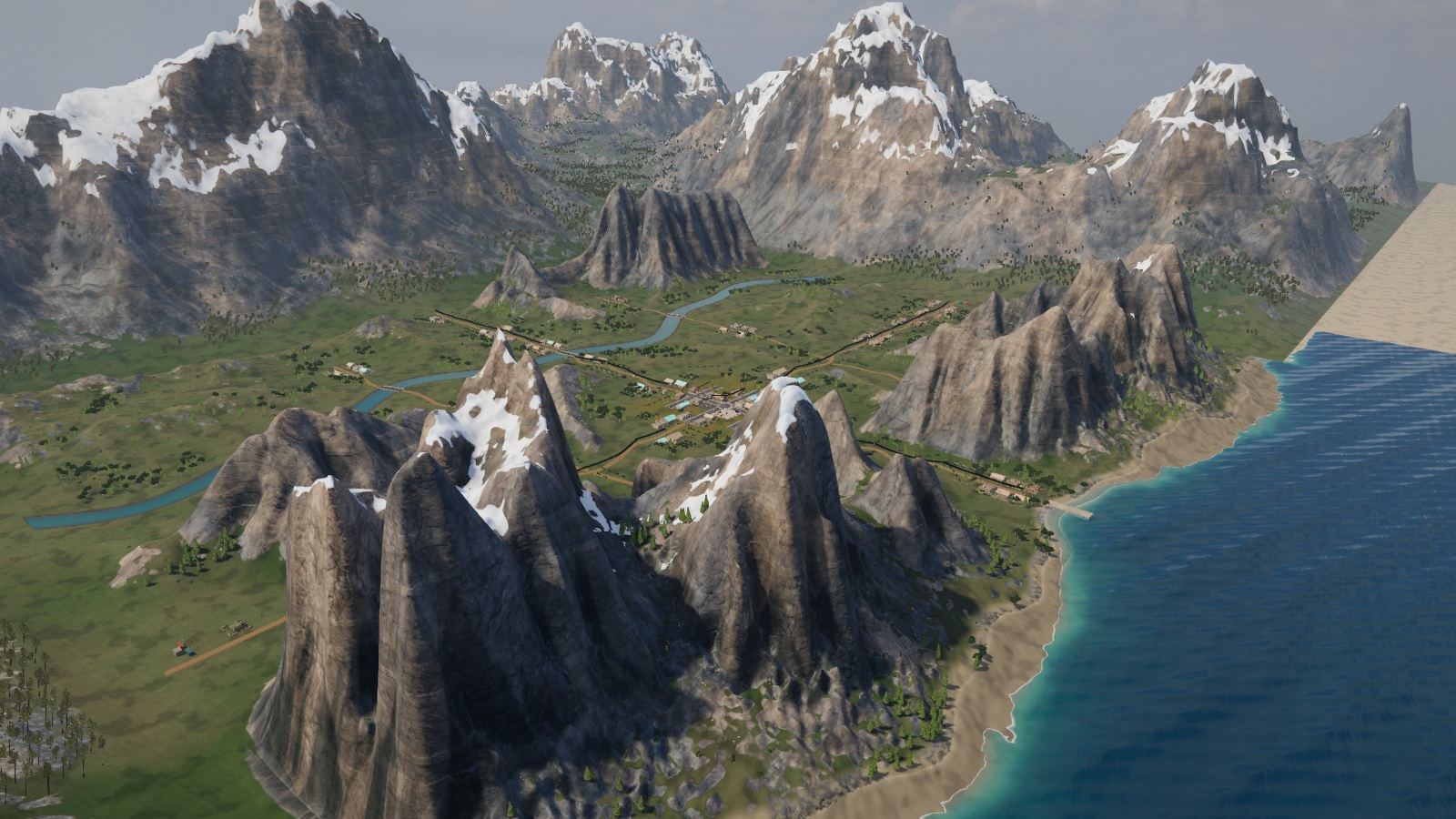
Seeded snowy mountains, mossy hills and river valleys now surround the towns and roads of standard battles.
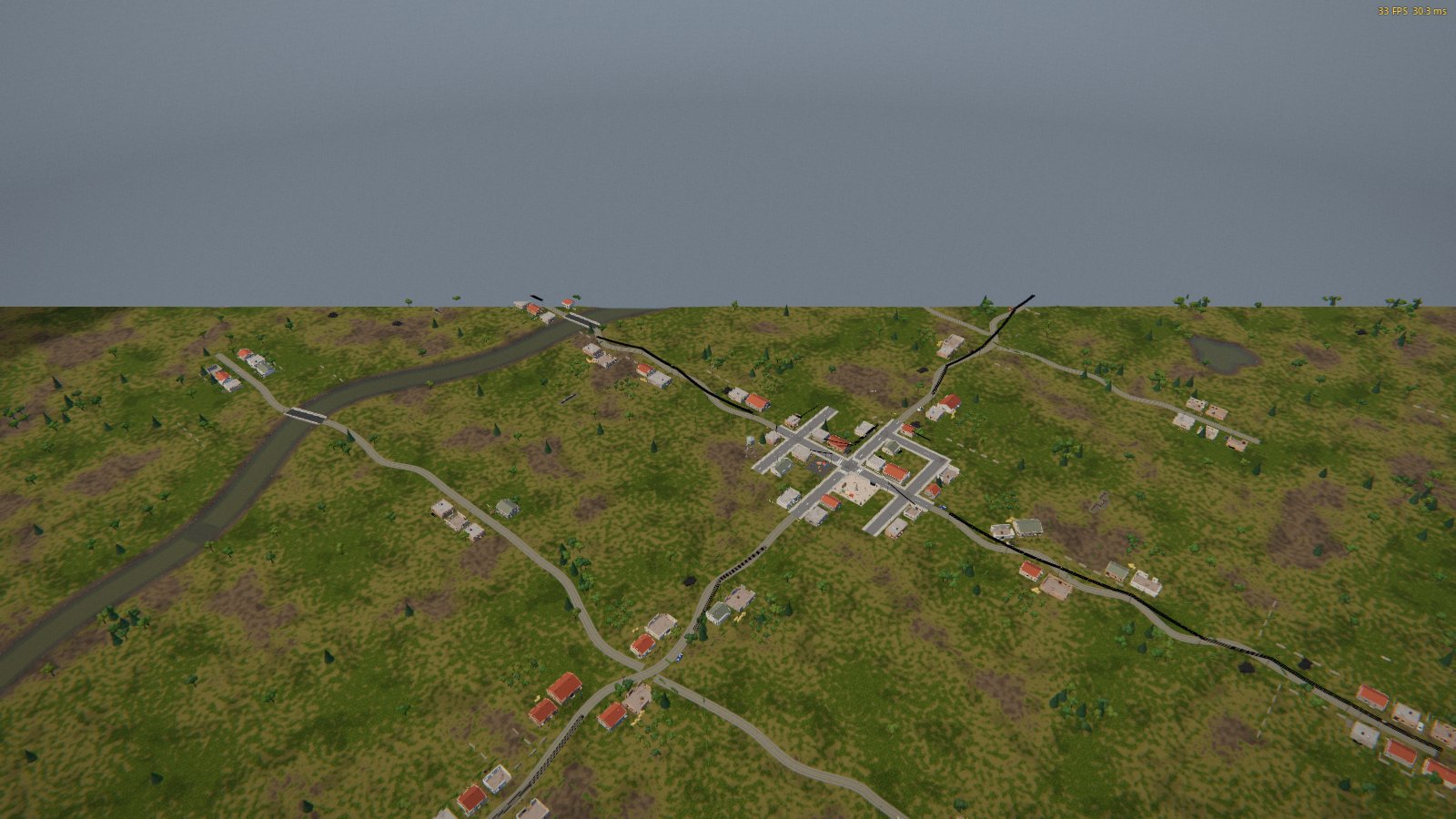
Explore this change
- Mountains, hills and valleys generate from the battle seed. Towns, starting bases, roads and river crossings retain usable valley corridors, with forests on lower ground.
- Layered photographic rock, cool shaded gullies and connected snowfields give the mountains an Alpine appearance. Sky visibility and distant ridge shadows are baked into the terrain, updating when the lighting mood changes.
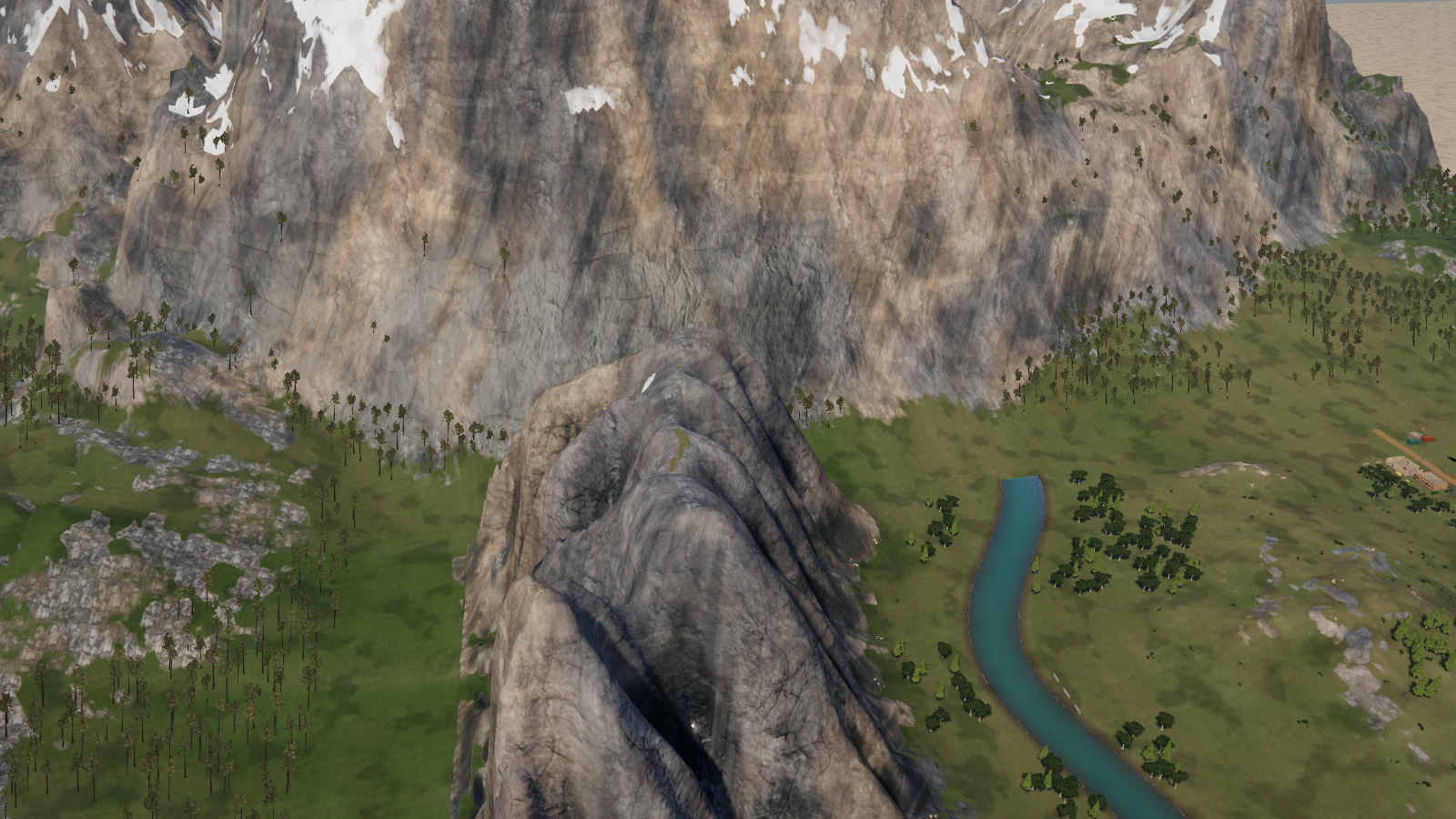
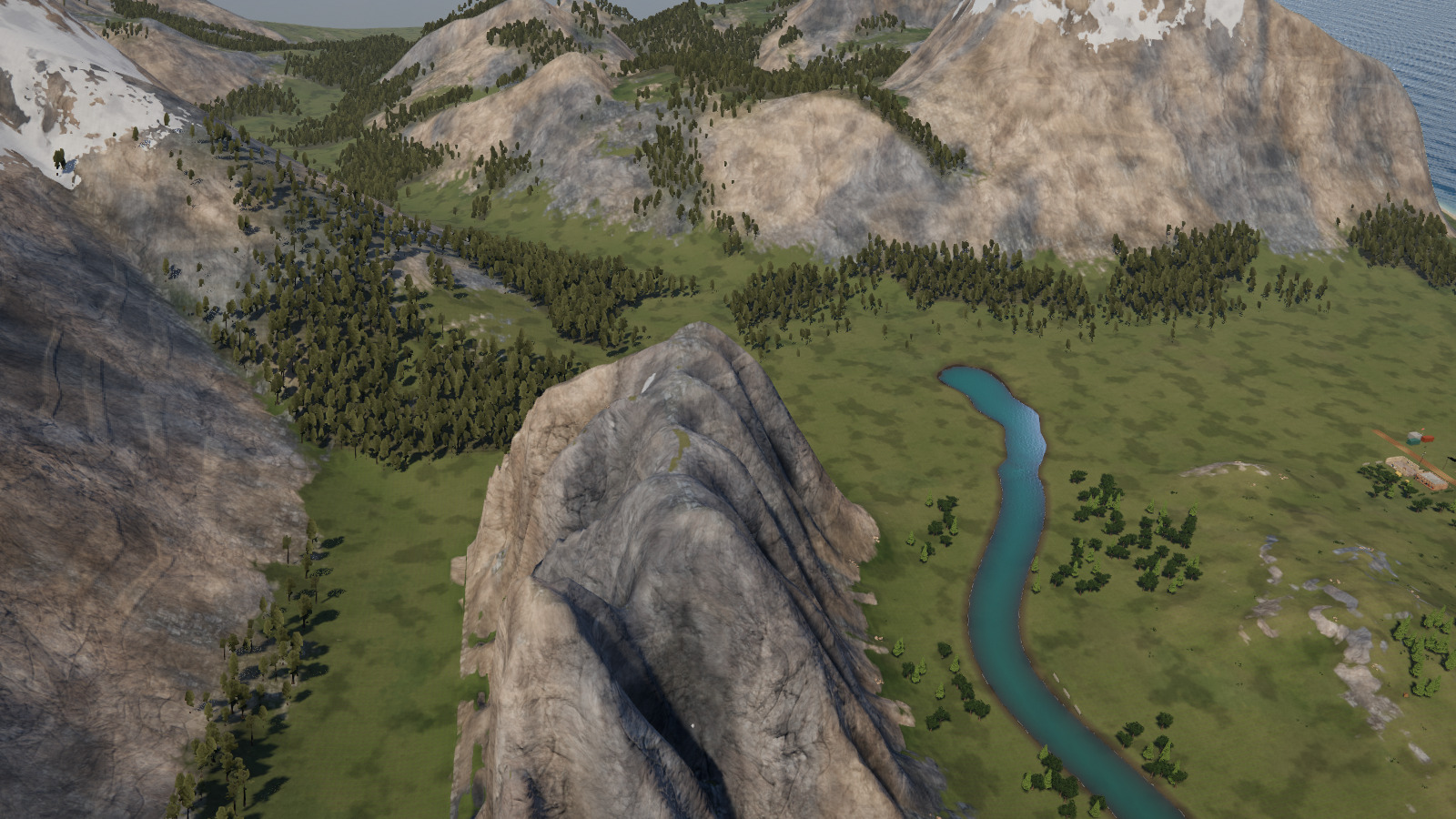
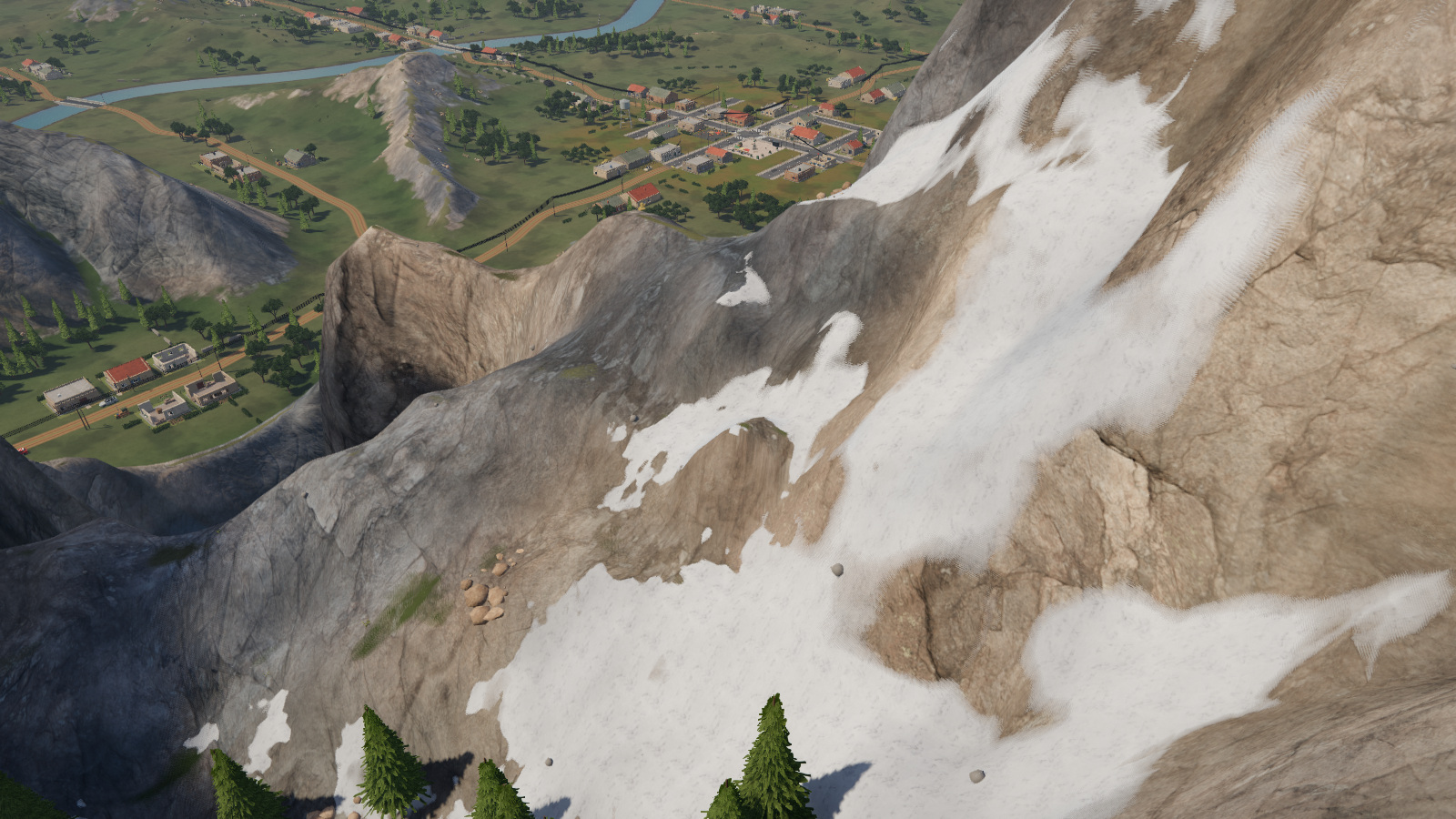
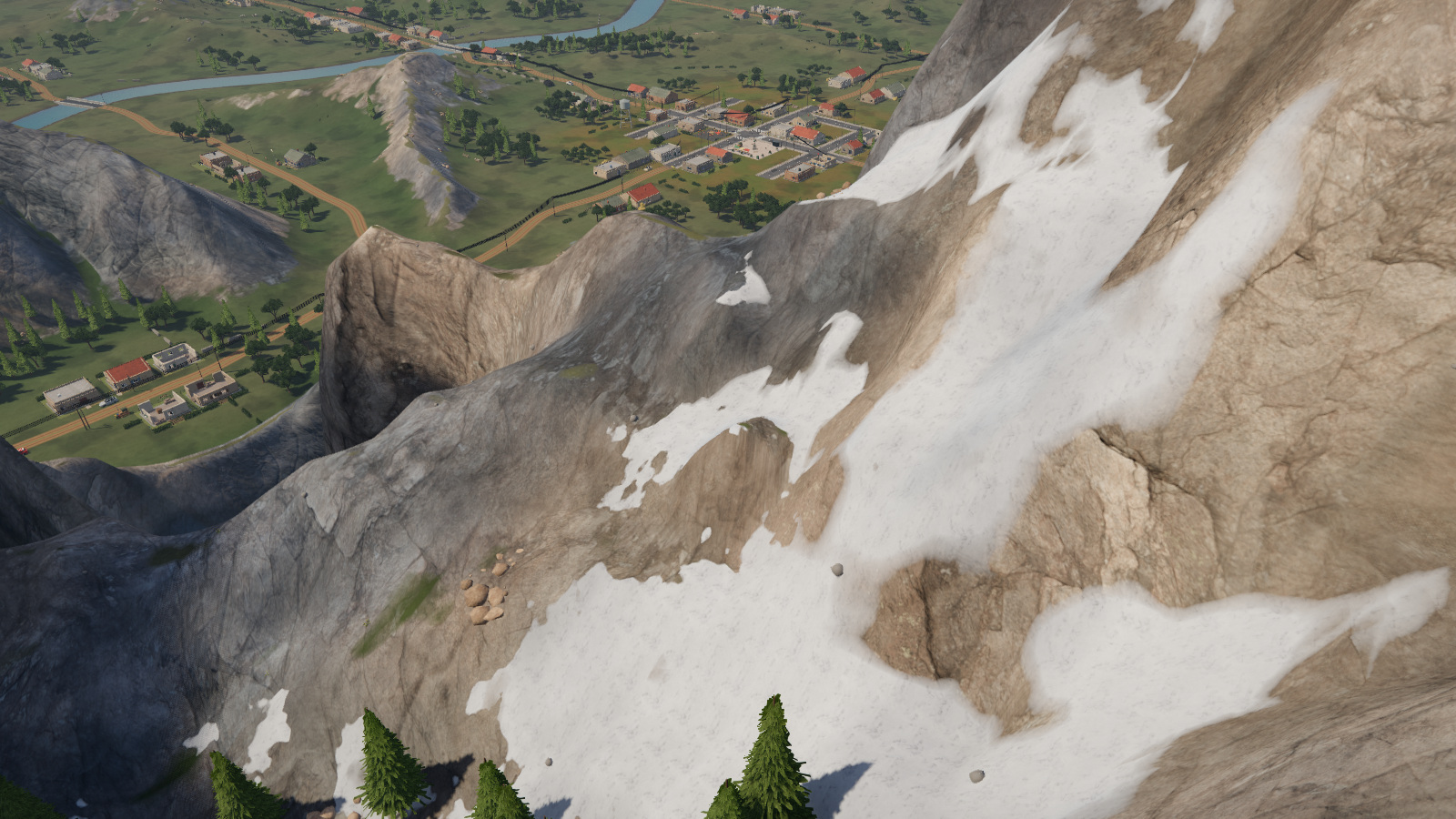
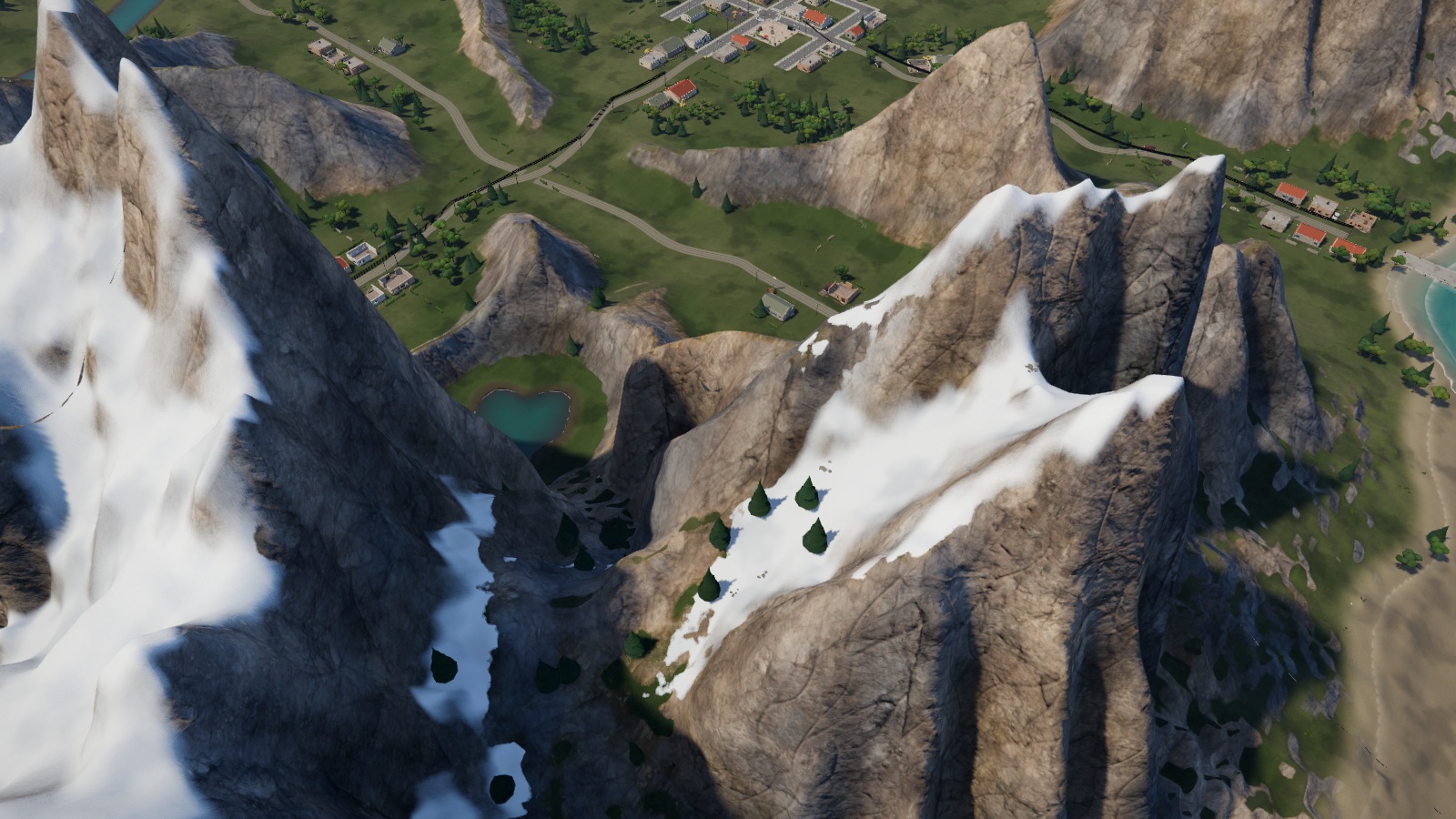
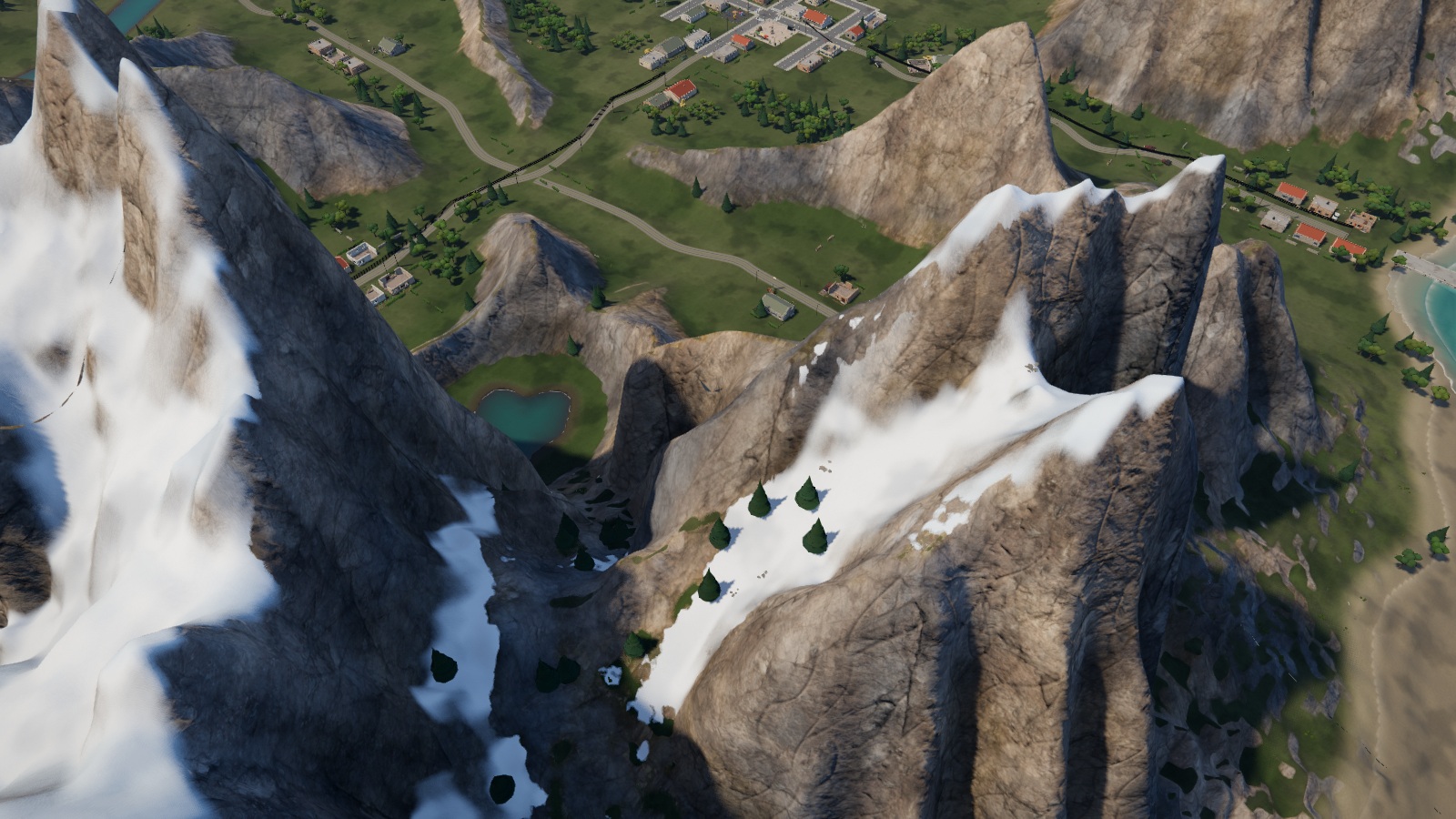
- Fractured bedrock, tilted shelves and weathered ledges break up the mountain faces. Larger photographic slabs catch the light above smaller scree, while snow settles on gentler shelves and leaves steep cliffs exposed. Finer distant silhouettes keep the horizon from looking angular.
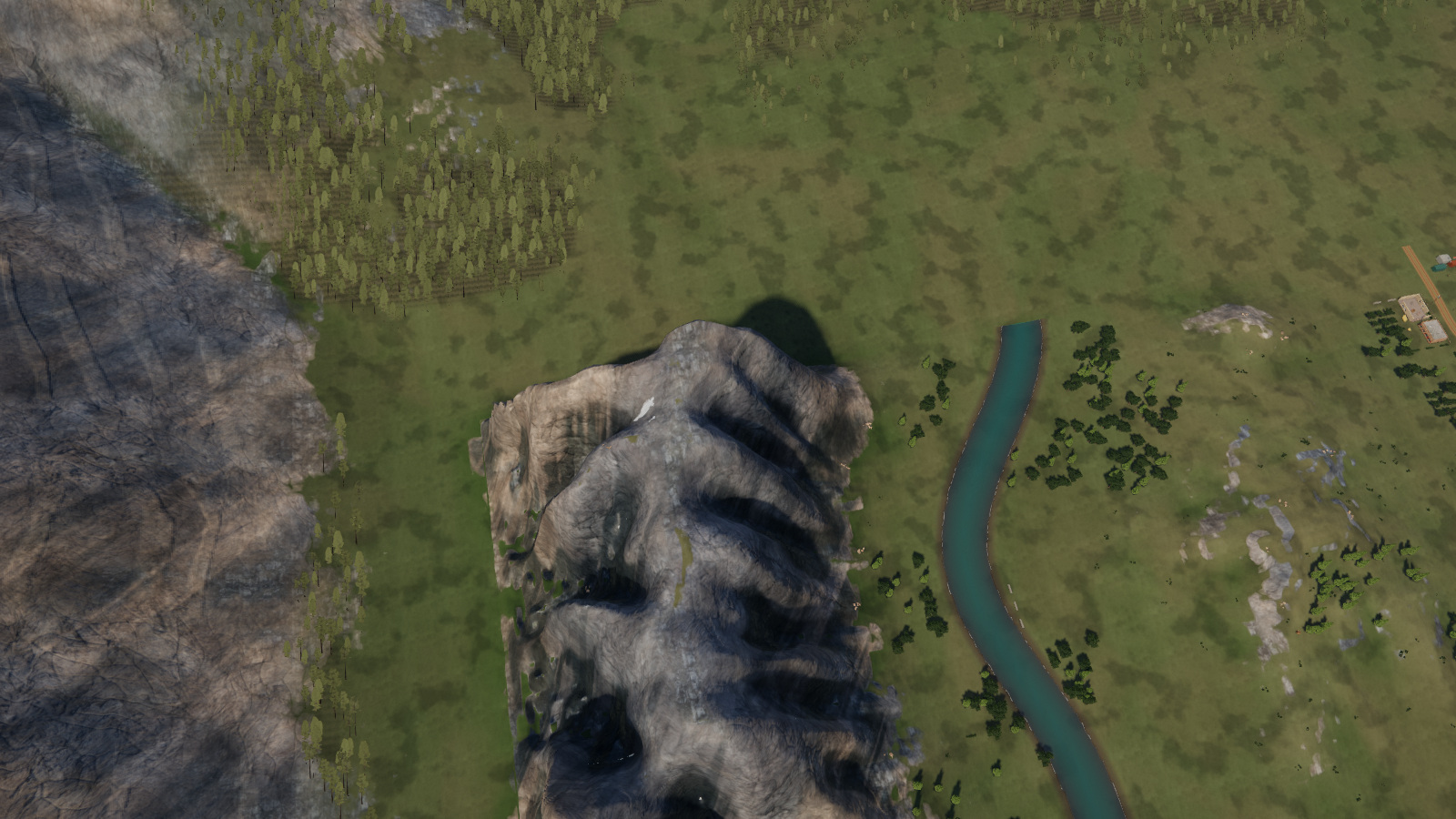
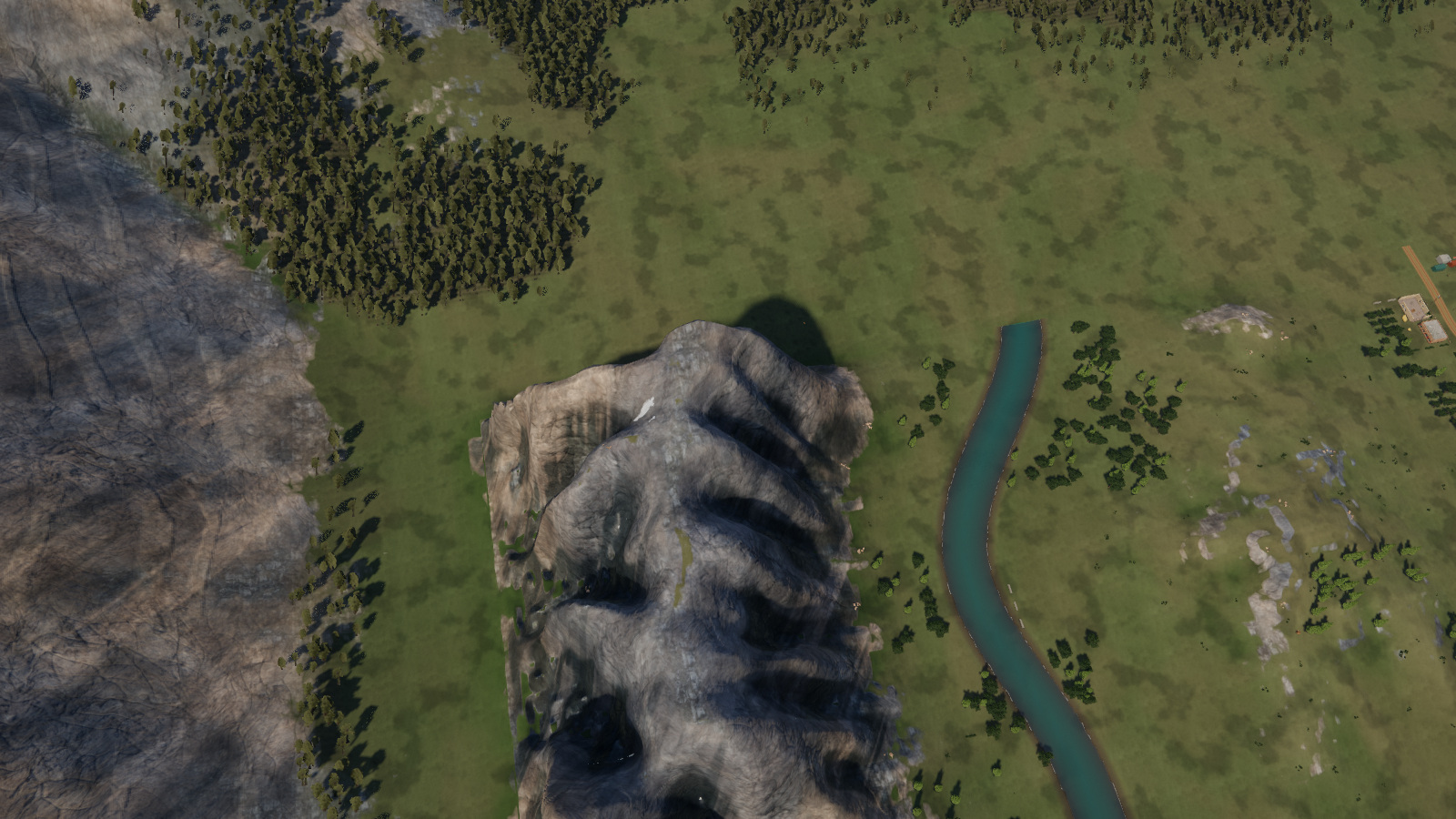
- Standard-battle woods grow in denser clusters. Tree bark and foliage share spatial drawing batches while individual trees still burn and fall.
- Alpine rivers have blue-green water. Optional Alpine distance haze separates the mountain ranges, and optional Mountain reflections capture distant terrain in the water without rendering the whole battle twice.
- Troops and vehicles follow the terrain and avoid slopes they cannot climb. Ridges obstruct shots and observation; helicopters clear rising ground and land at the correct elevation.
- Construction checks the whole footprint. Trenches, craters, fires, targeting and the minimap follow the landscape.
- Multiplayer joiners receive the same terrain as the host, and battle recordings preserve it when seeking forward or backward.
Campaign missions retain their existing terrain layout and woodland density so their authored routes and cover remain intact.
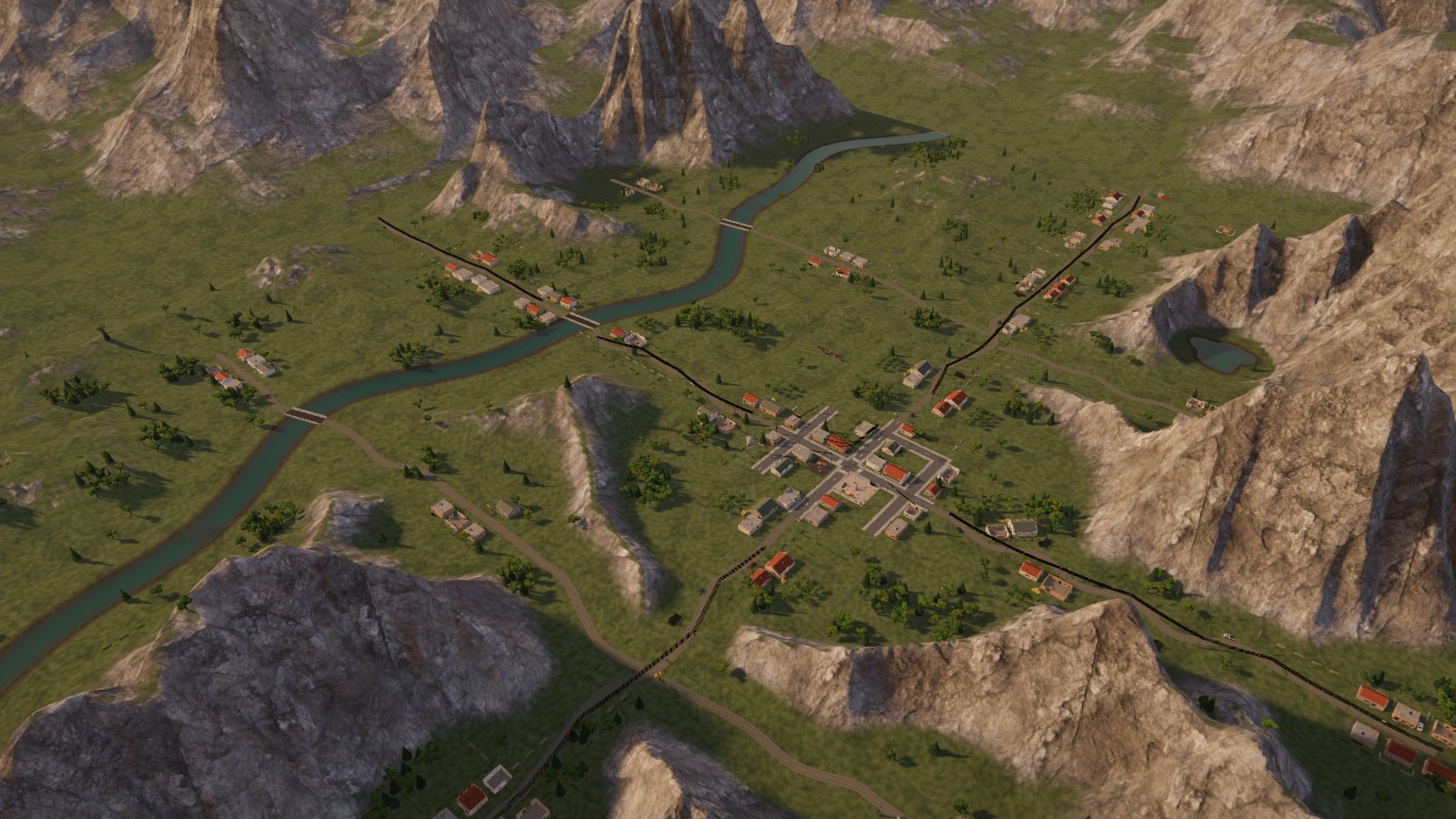
Improved
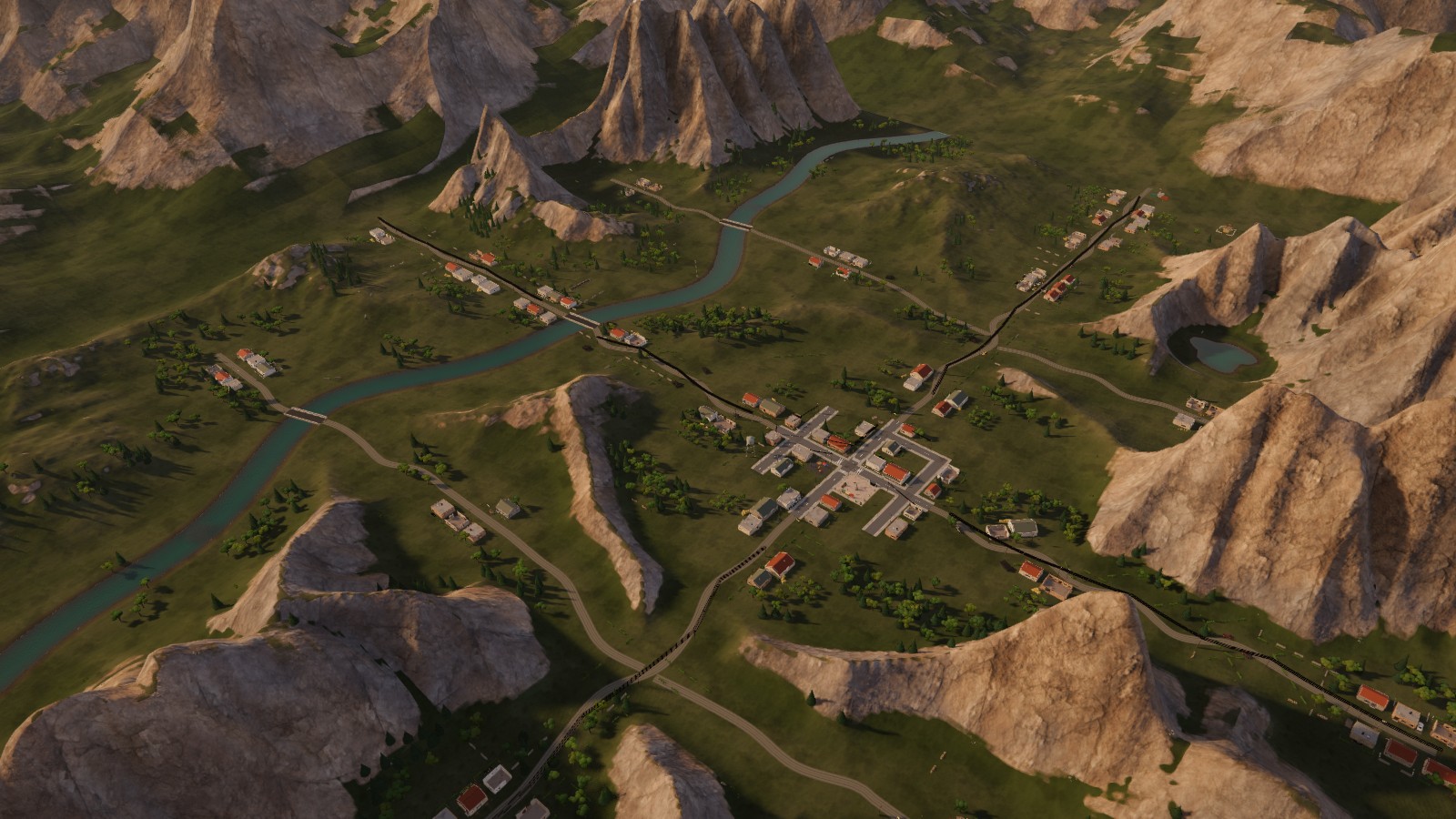
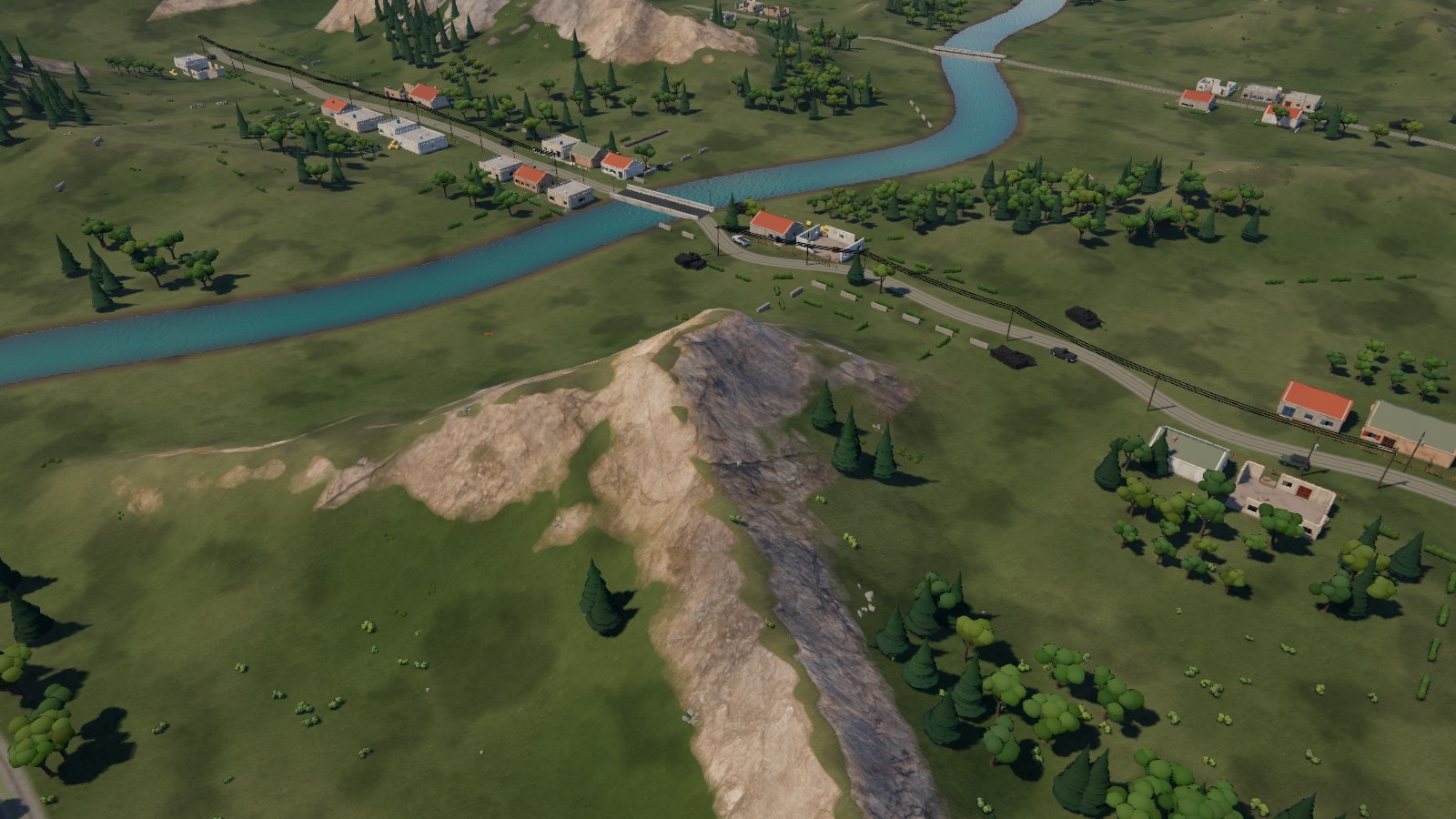
Woodland follows the mountain slopes
Greener gullies, contour-following woods and vegetation on mountain ledges replace randomly scattered greenery.
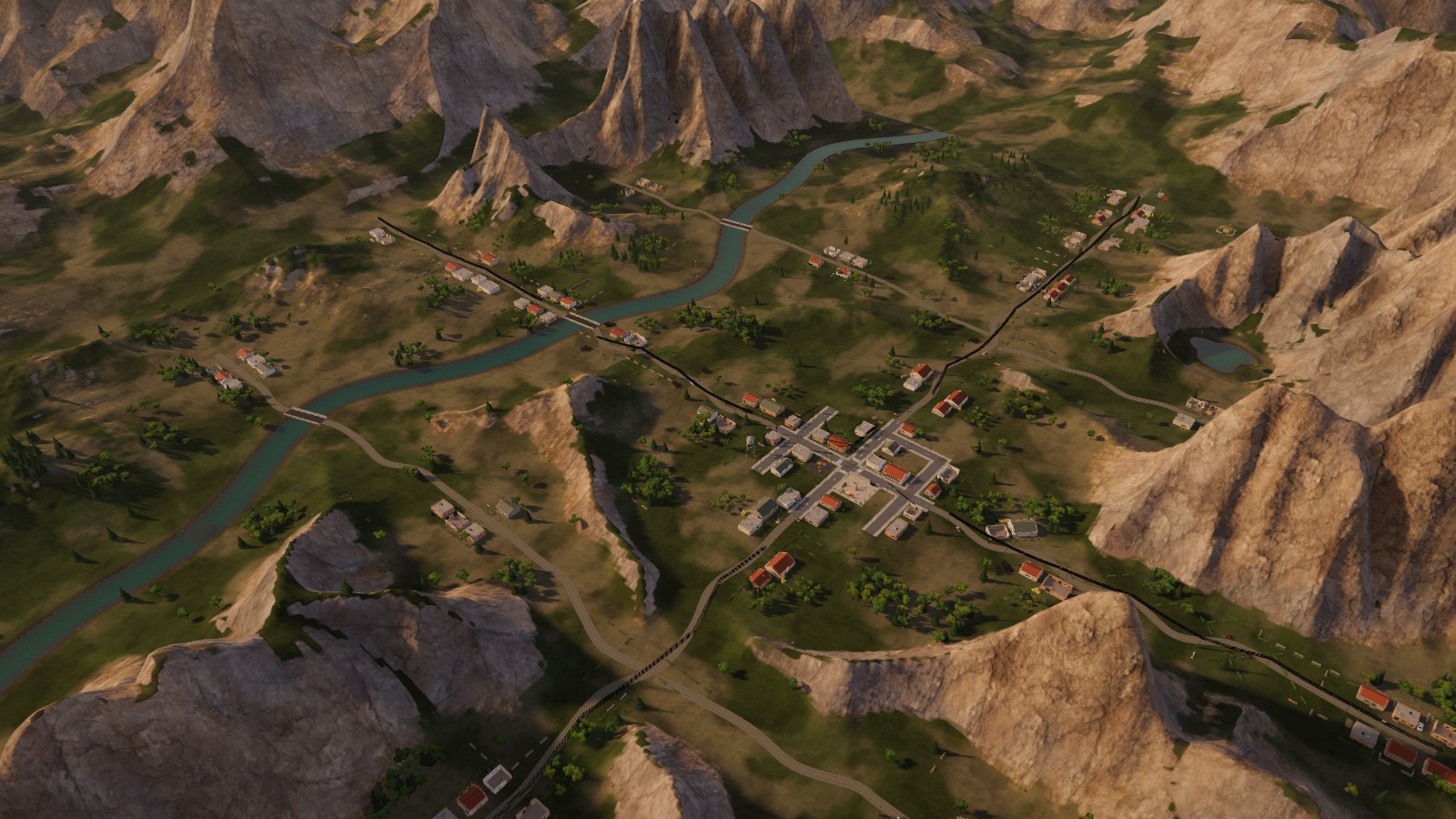
Explore this change
- Soil cover responds to shelter, slope and aspect, with less arbitrary colour variation across the valleys.
- Open valley ground has fewer isolated random trees; planting favours groves and sheltered mountain pockets.
- Woods spread along contours, and conifers can root on suitable mountain ledges. Exposed ribs and high peaks remain largely bare.
- Scrub favours sheltered bowls, while stones occupy drier and steeper ground. Tree limits do not relax building foundation checks.
Break up mountain silhouettes
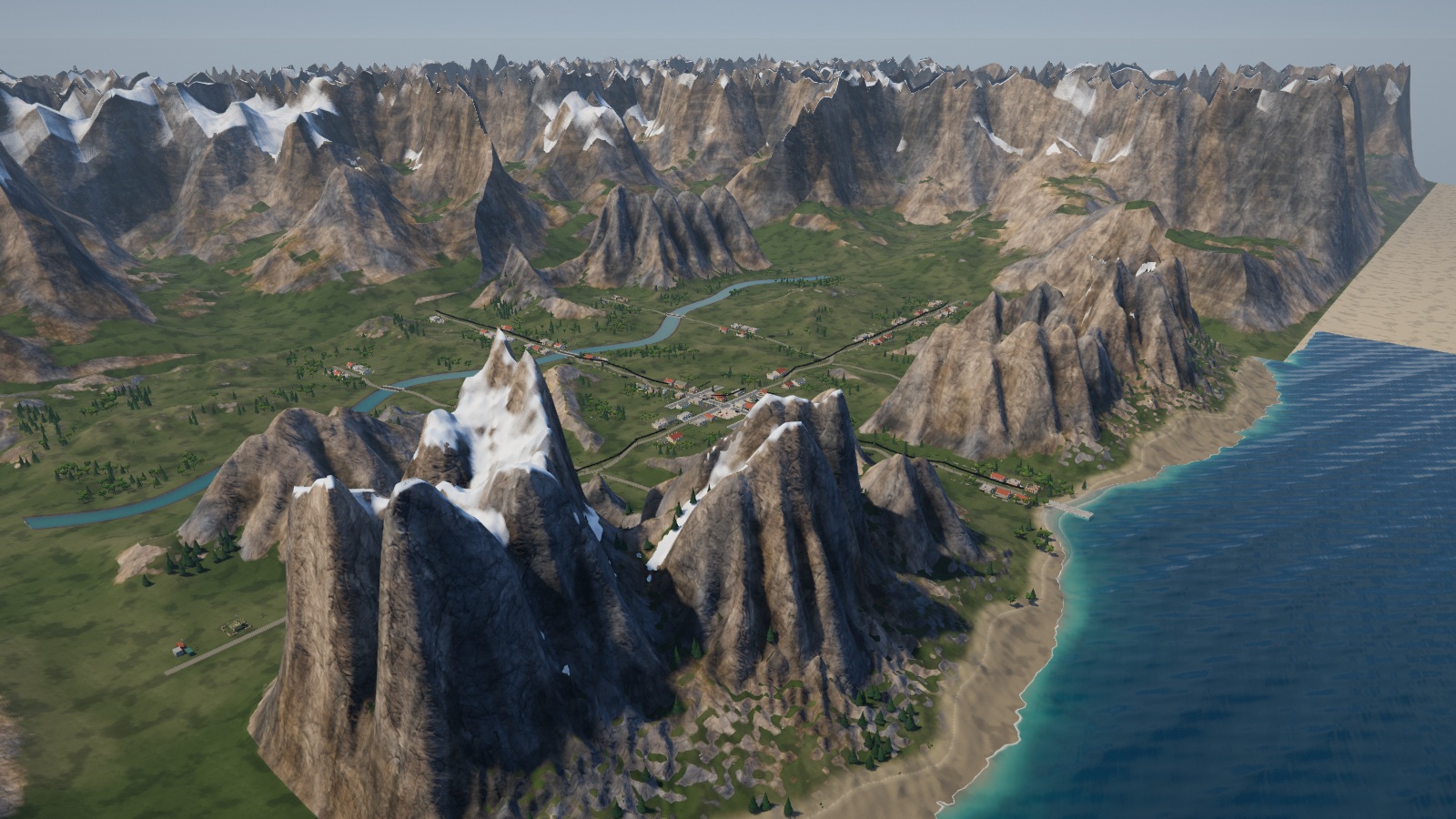
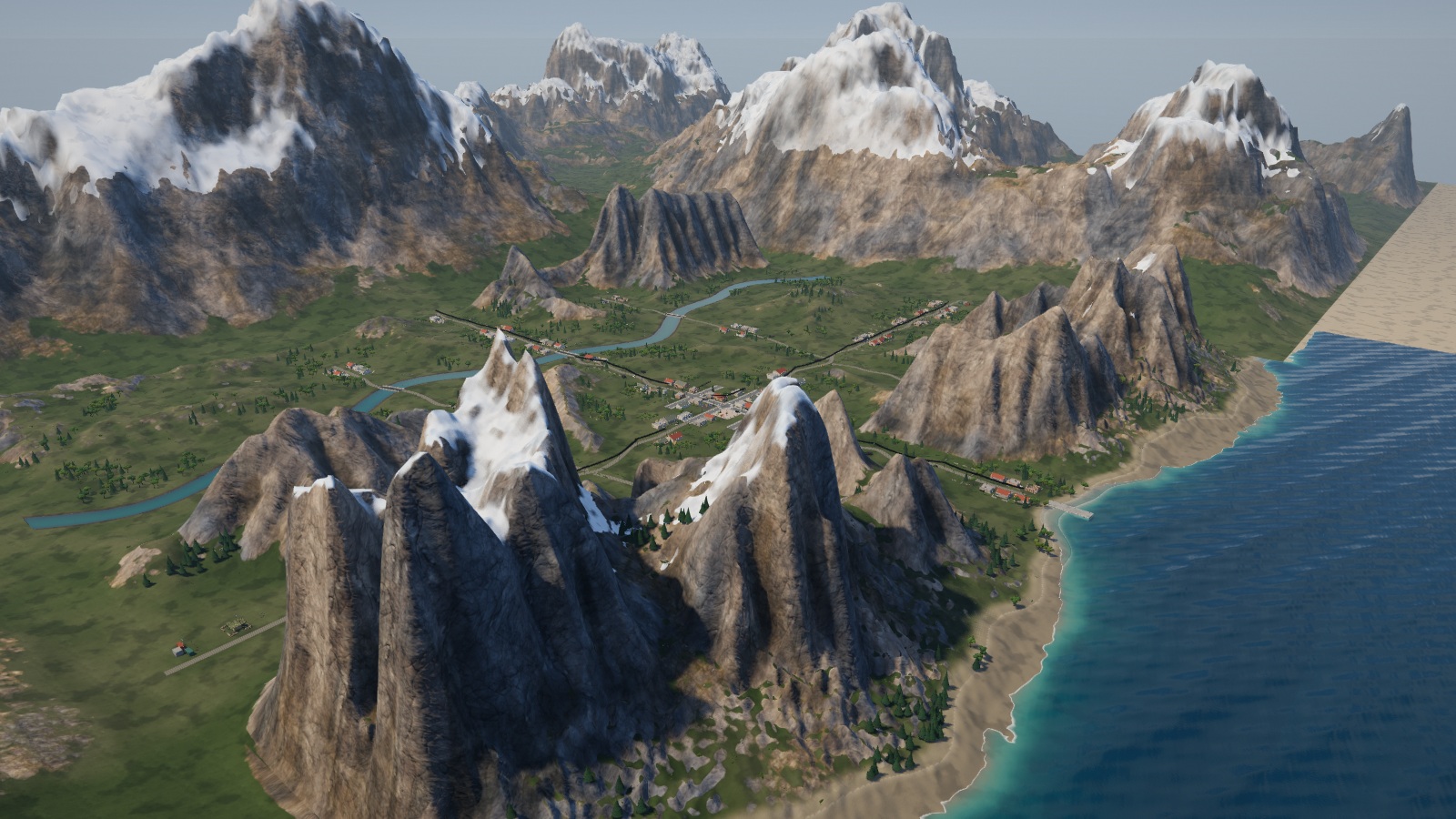
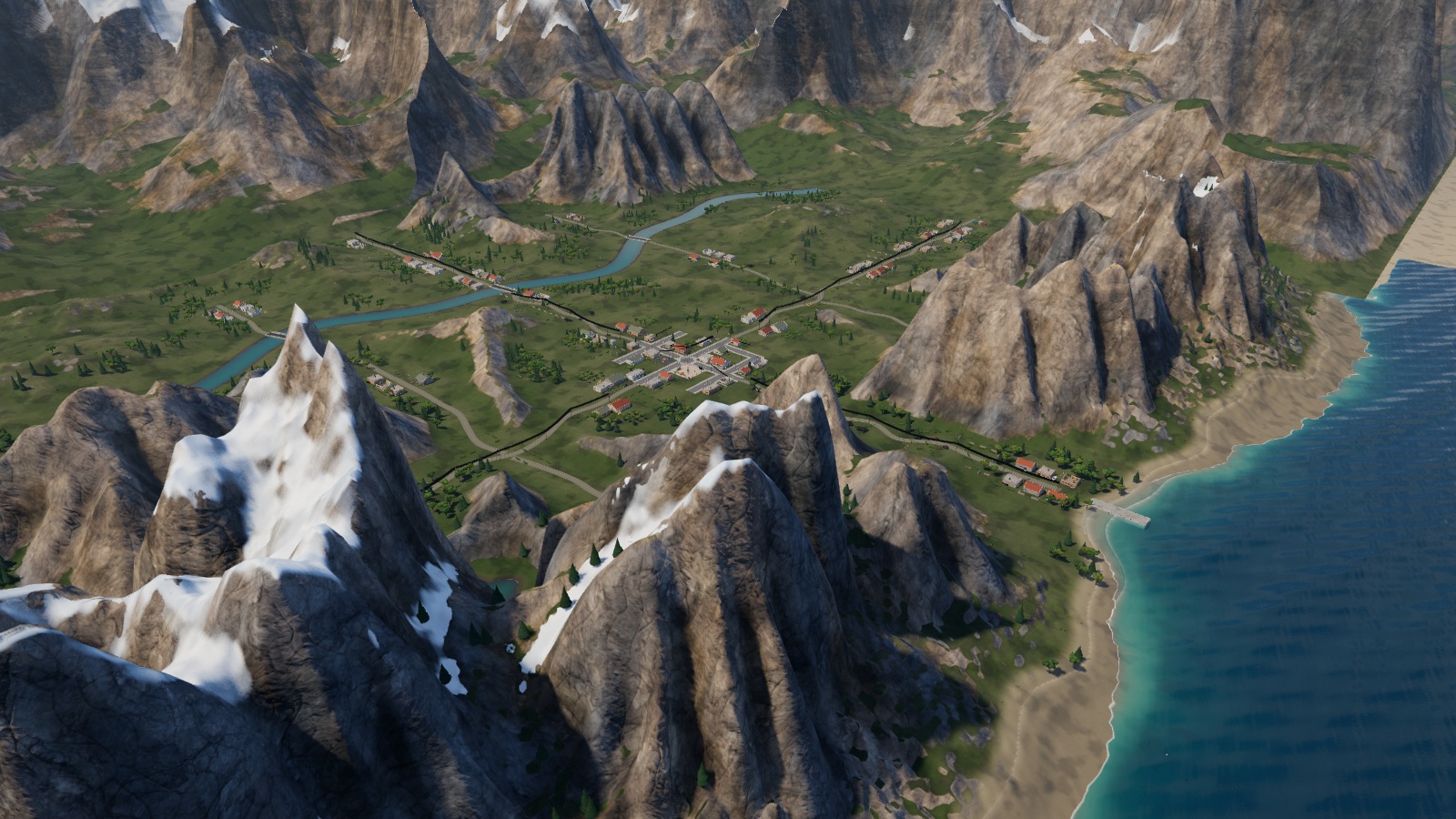
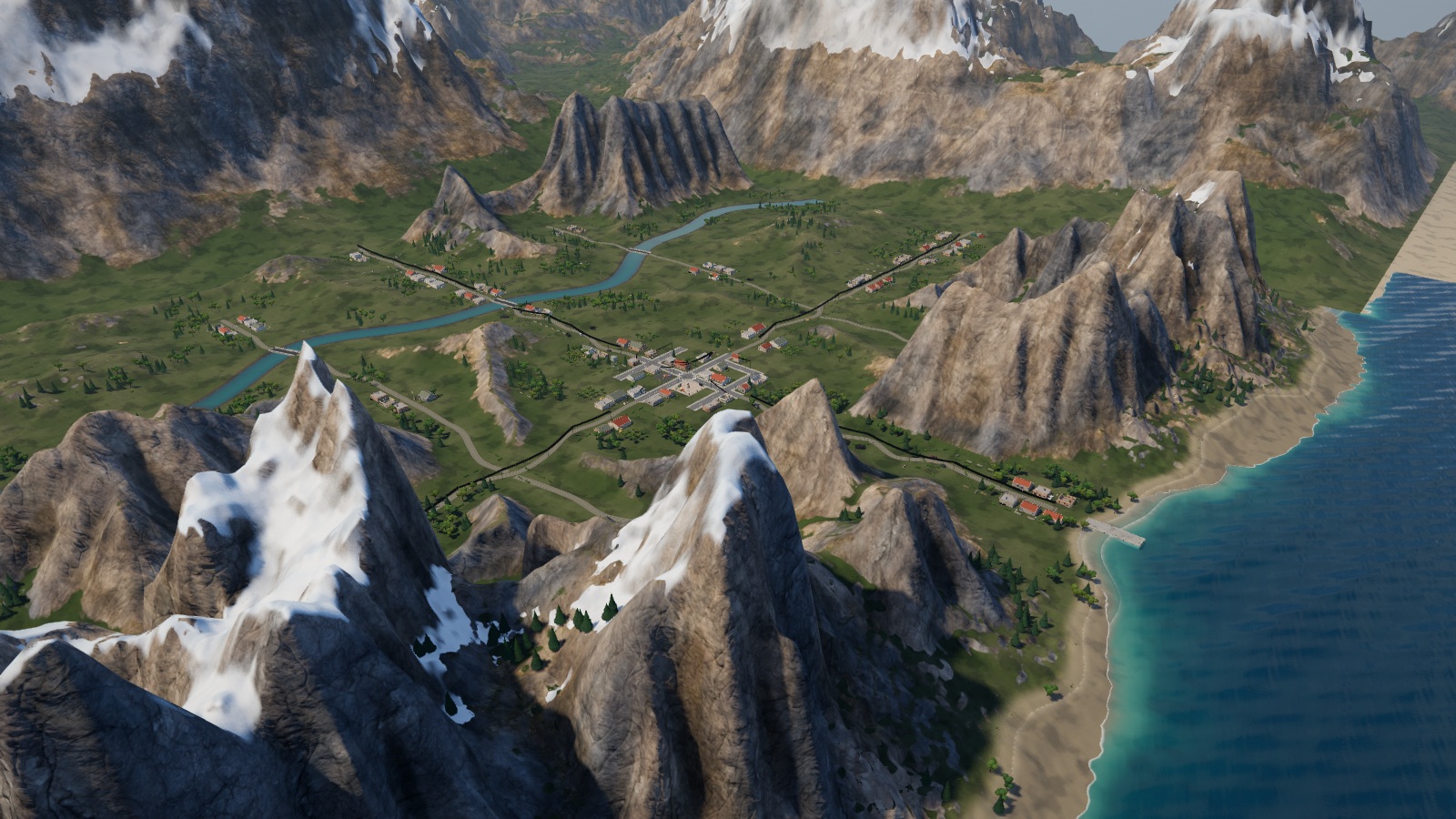
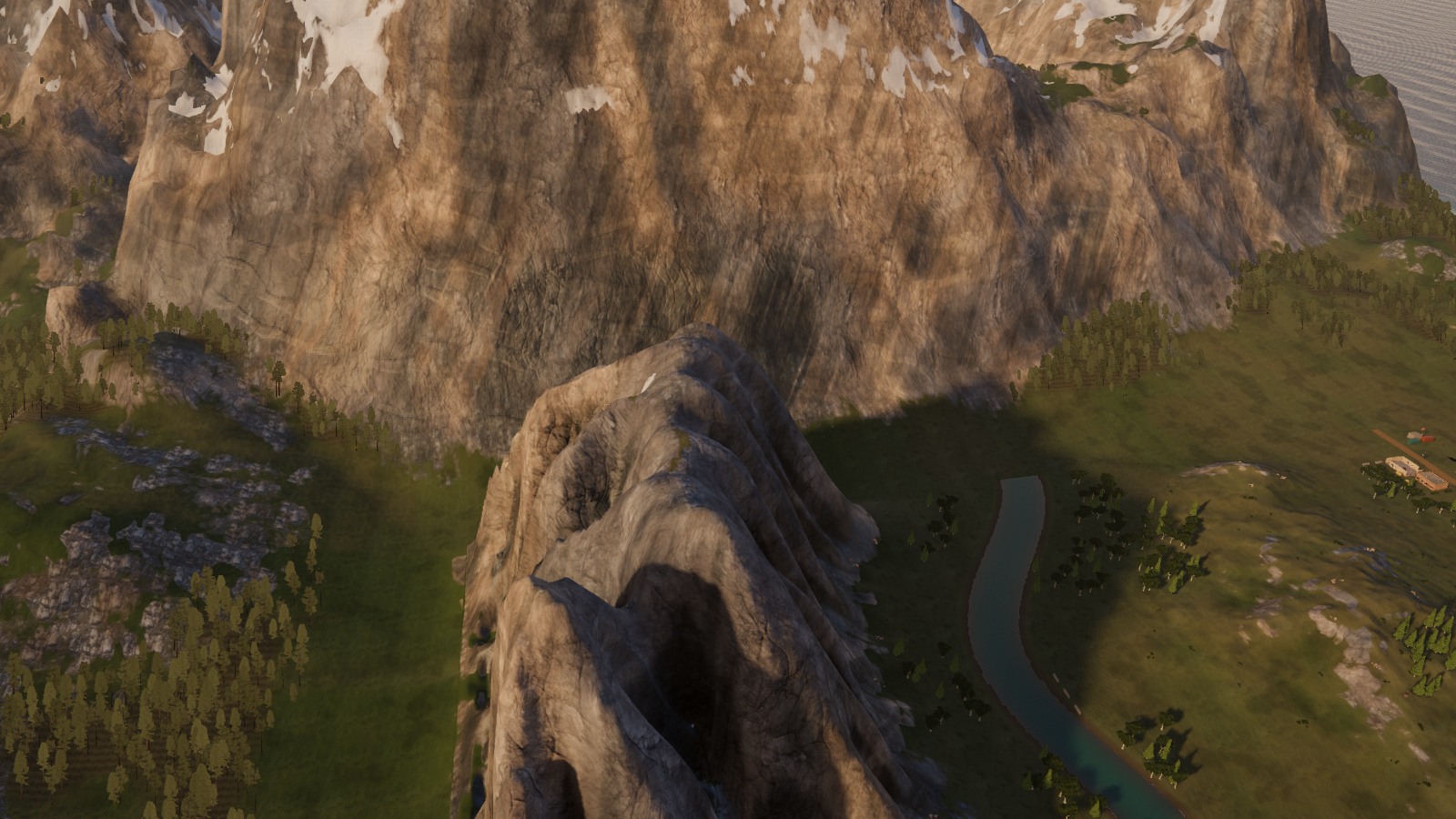
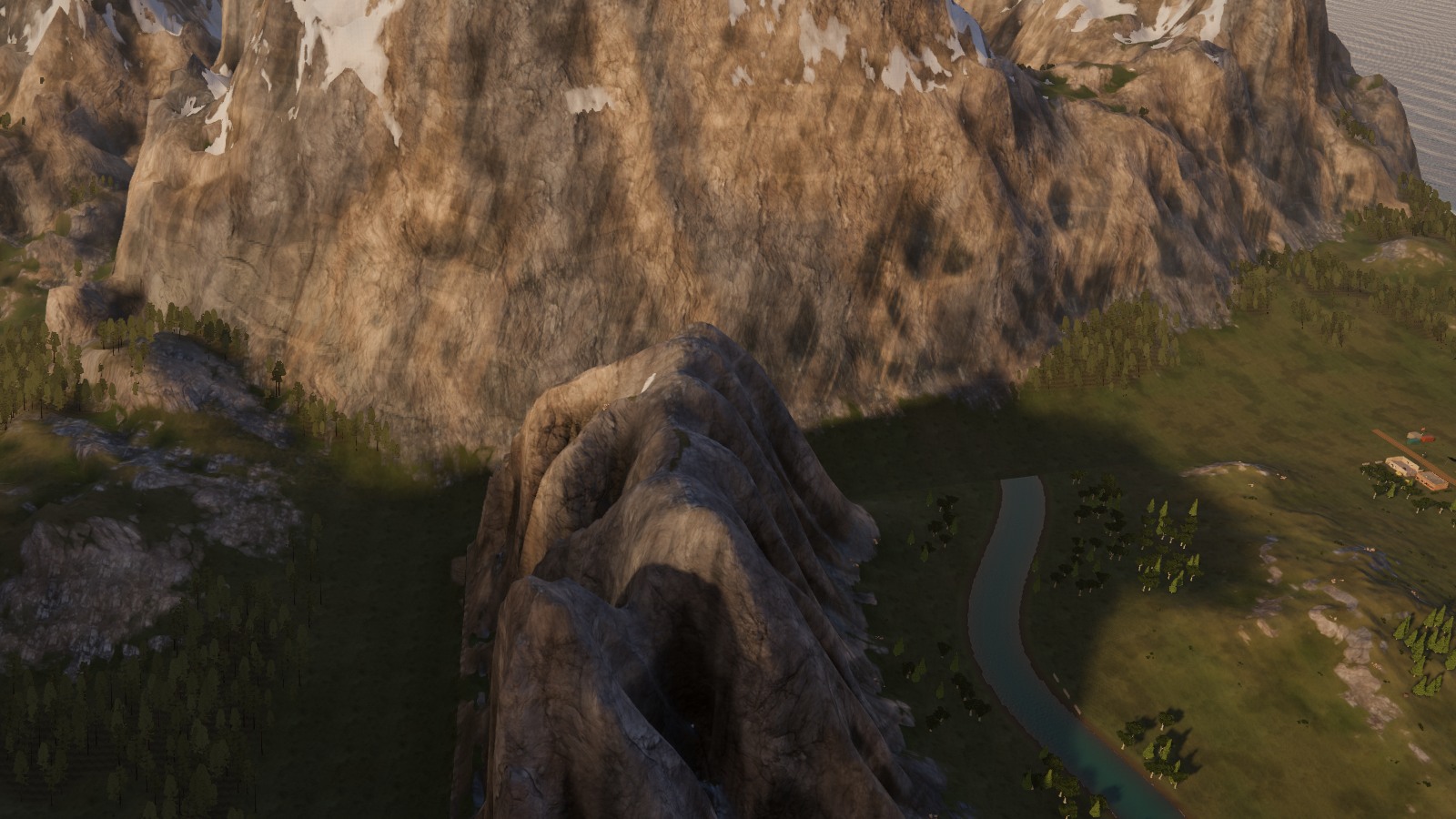
Uneven mountain groups, lower passes and reshaped cliff shoulders replace repetitive ridges, with more varied moss-to-rock transitions.
Explore this change
Distant scenery uses its own seeded height field instead of an equal-height ridge pattern. Floating-point heights and wider slope sampling avoid stepped snow shading. Medium/Far detail uses a finer indexed scenery mesh; Near retains the lighter grid.
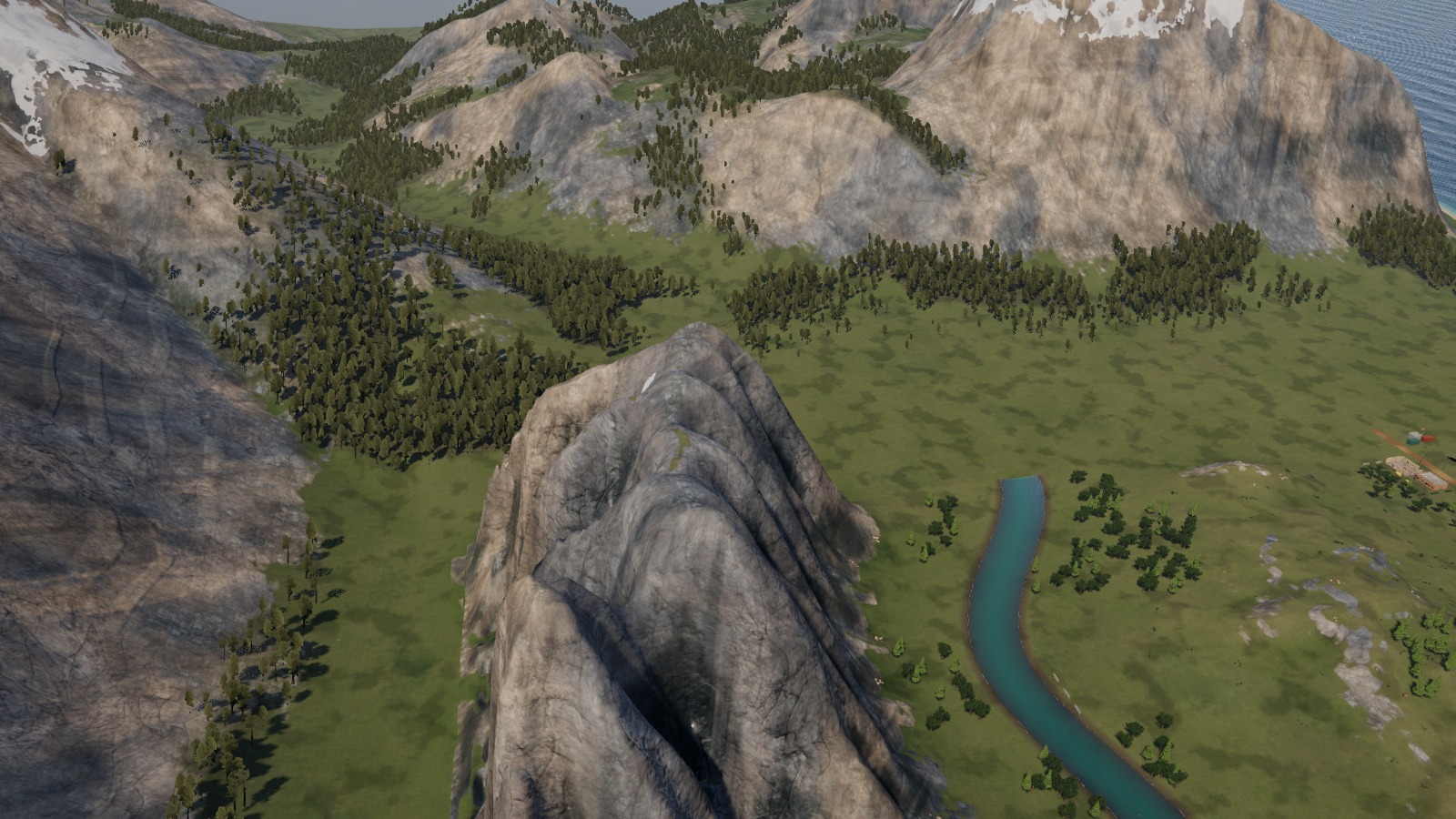
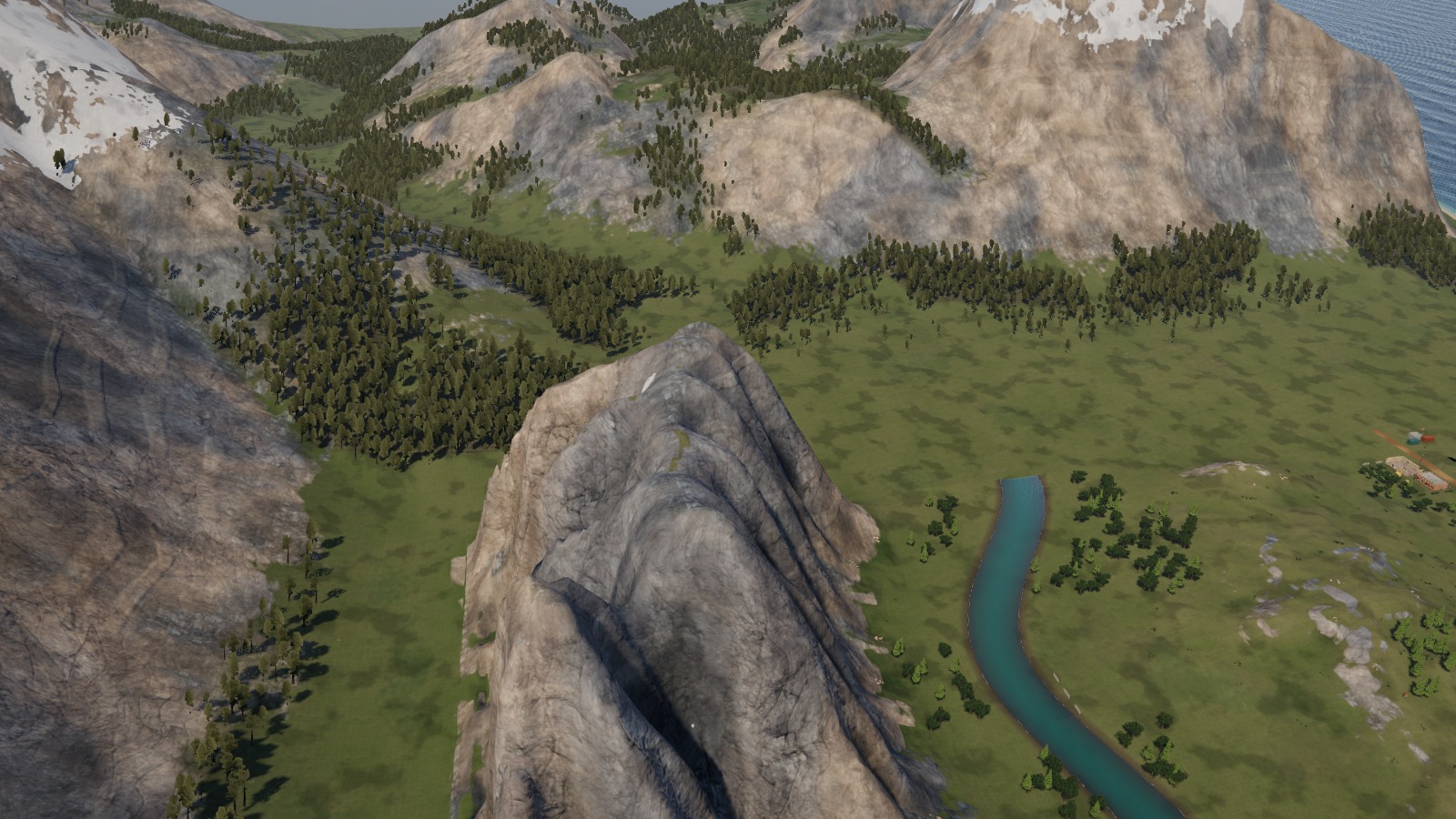
Reusable rock forms now have uneven shoulders and irregular drainage cuts before the existing terrain erosion and road grading. These enter the authoritative terrain used by movement, construction and replay. Material coverage also varies with photographic rock relief.
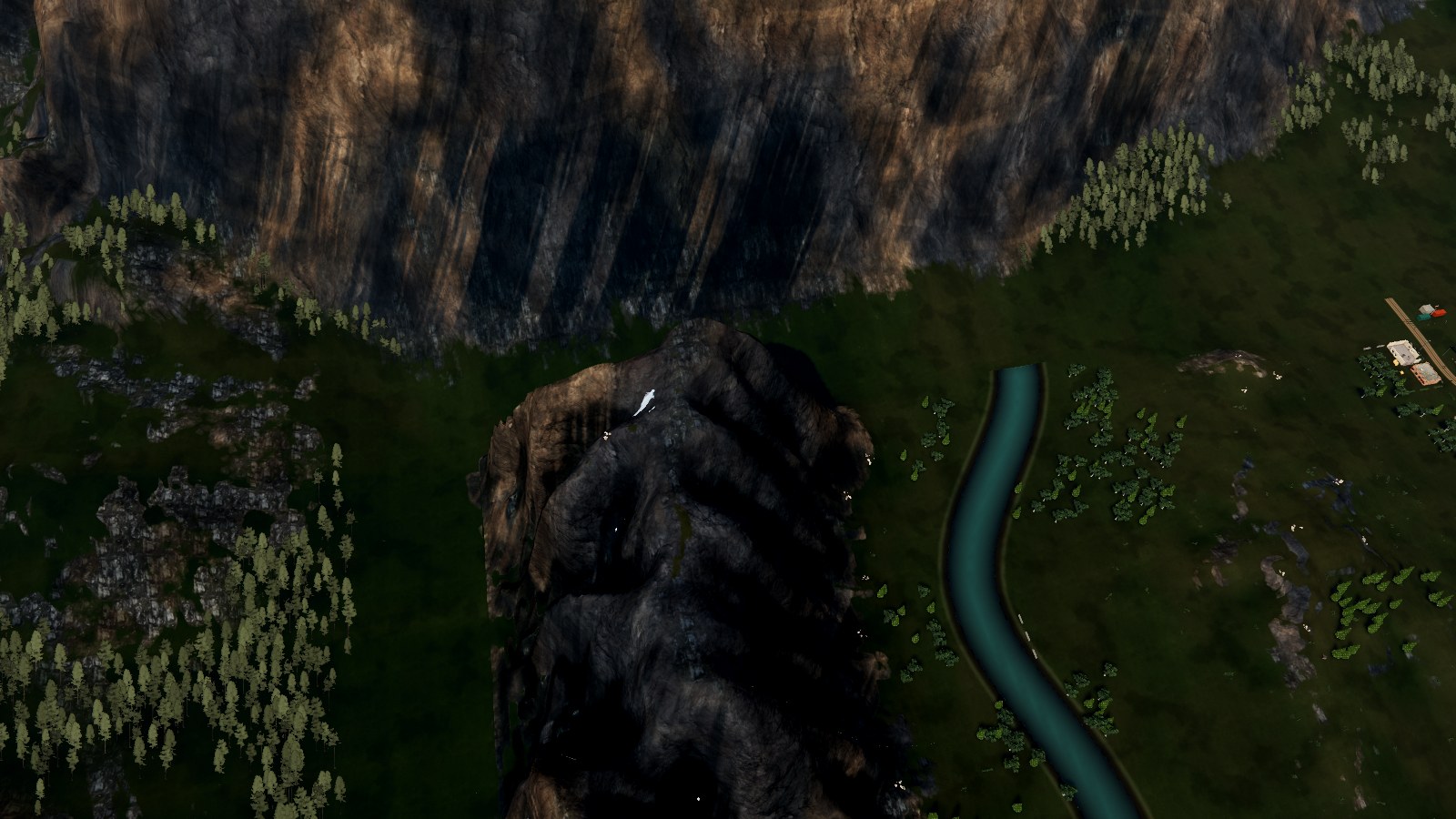
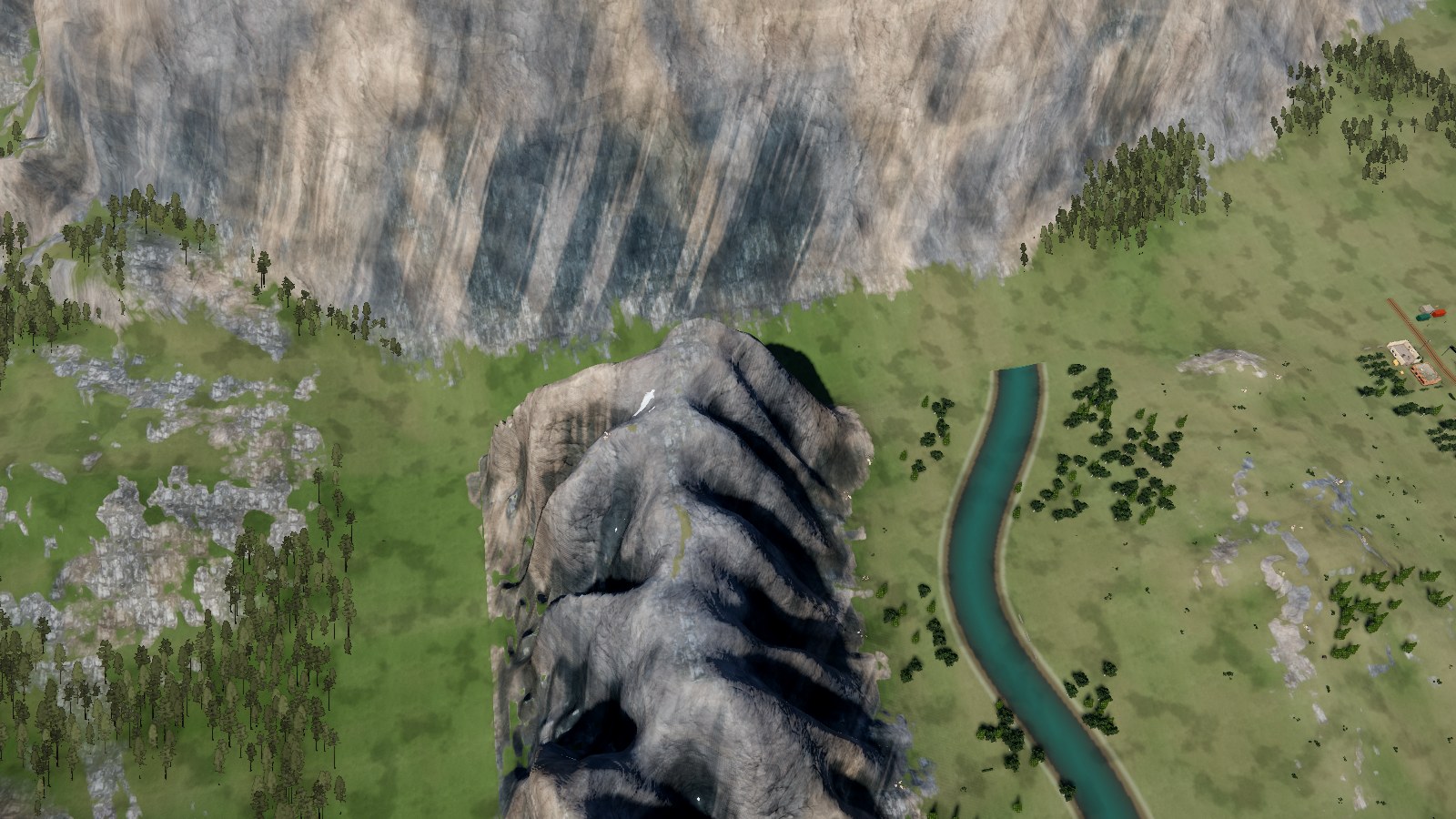
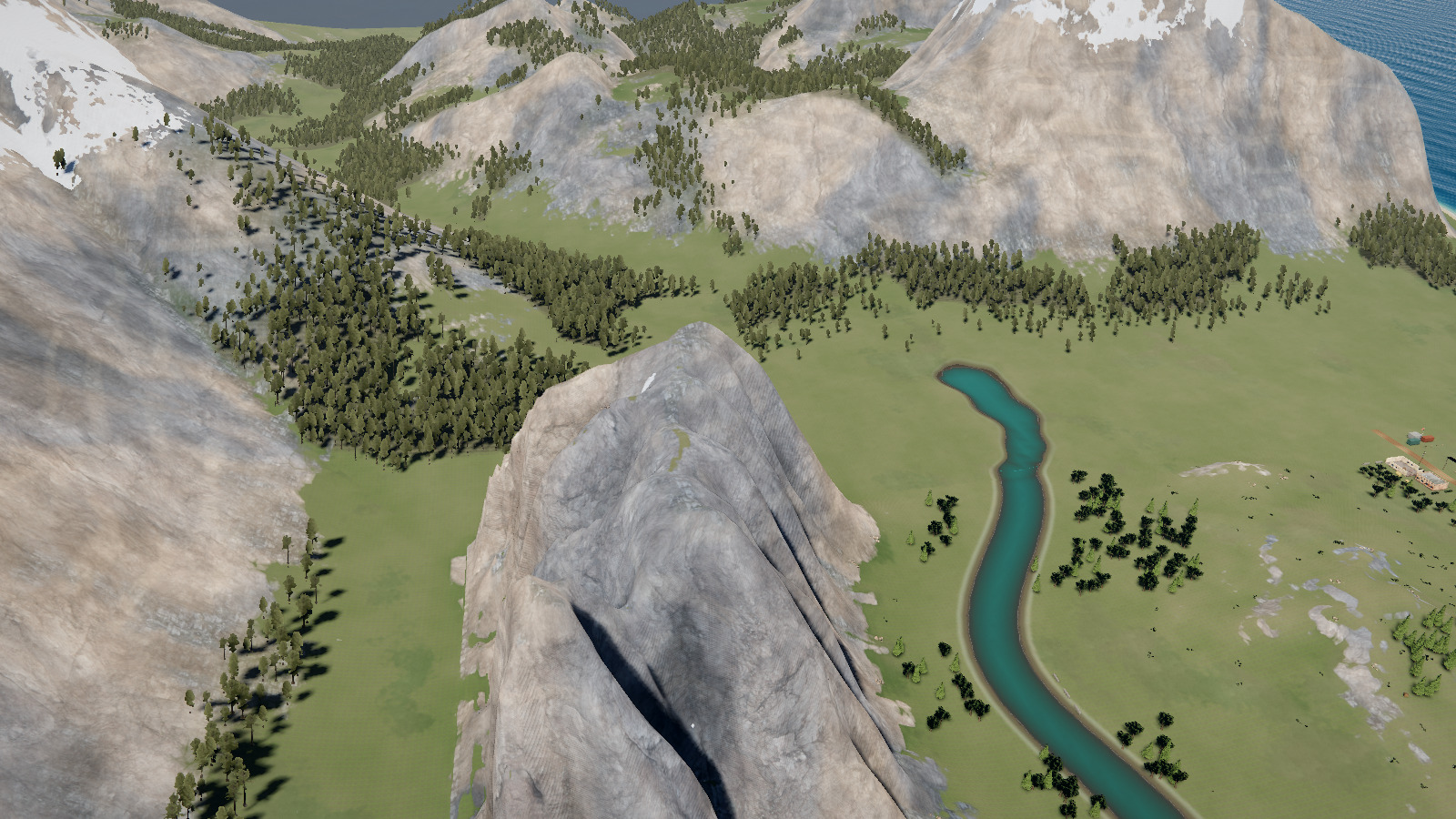
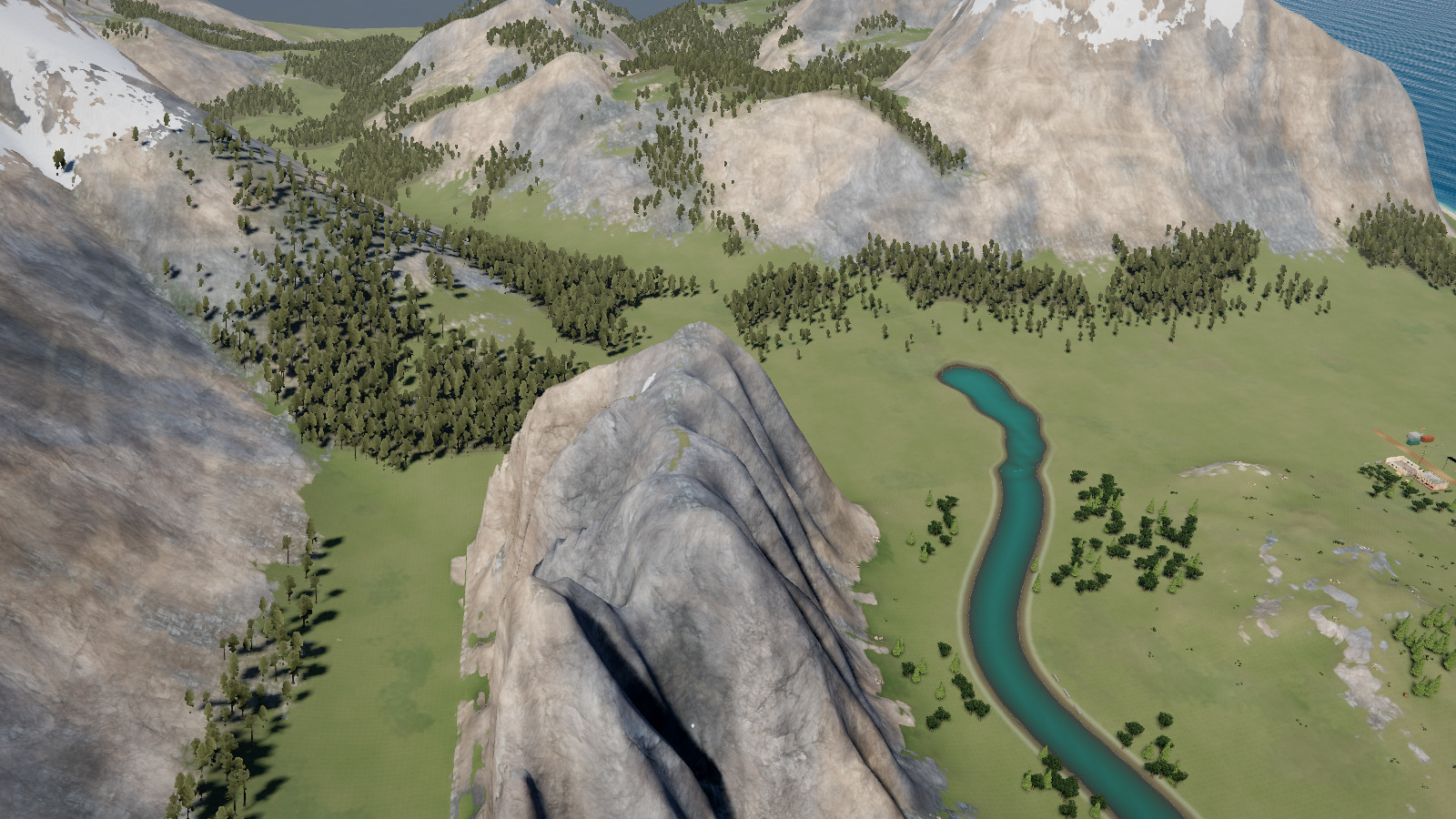
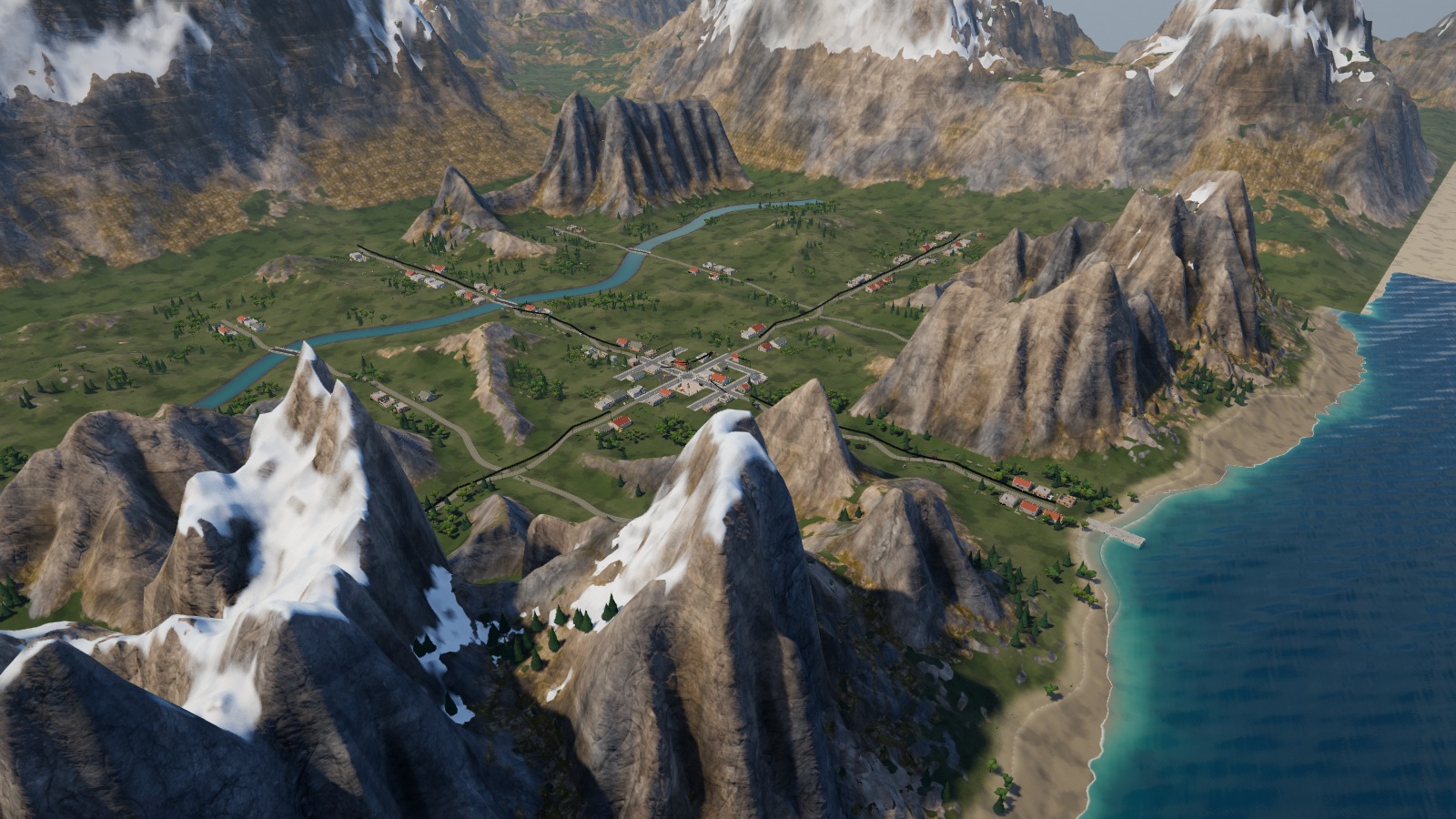
The comparisons use the same seed, lighting and camera controls. The camera follows local ground height, so changed geology can shift its absolute height. Procedural trees and some smooth rock forms still limit realism; these are native game captures, not photographic composites.
Approach informed by Wargaming's environment workflow: establish large landforms before surface detail.
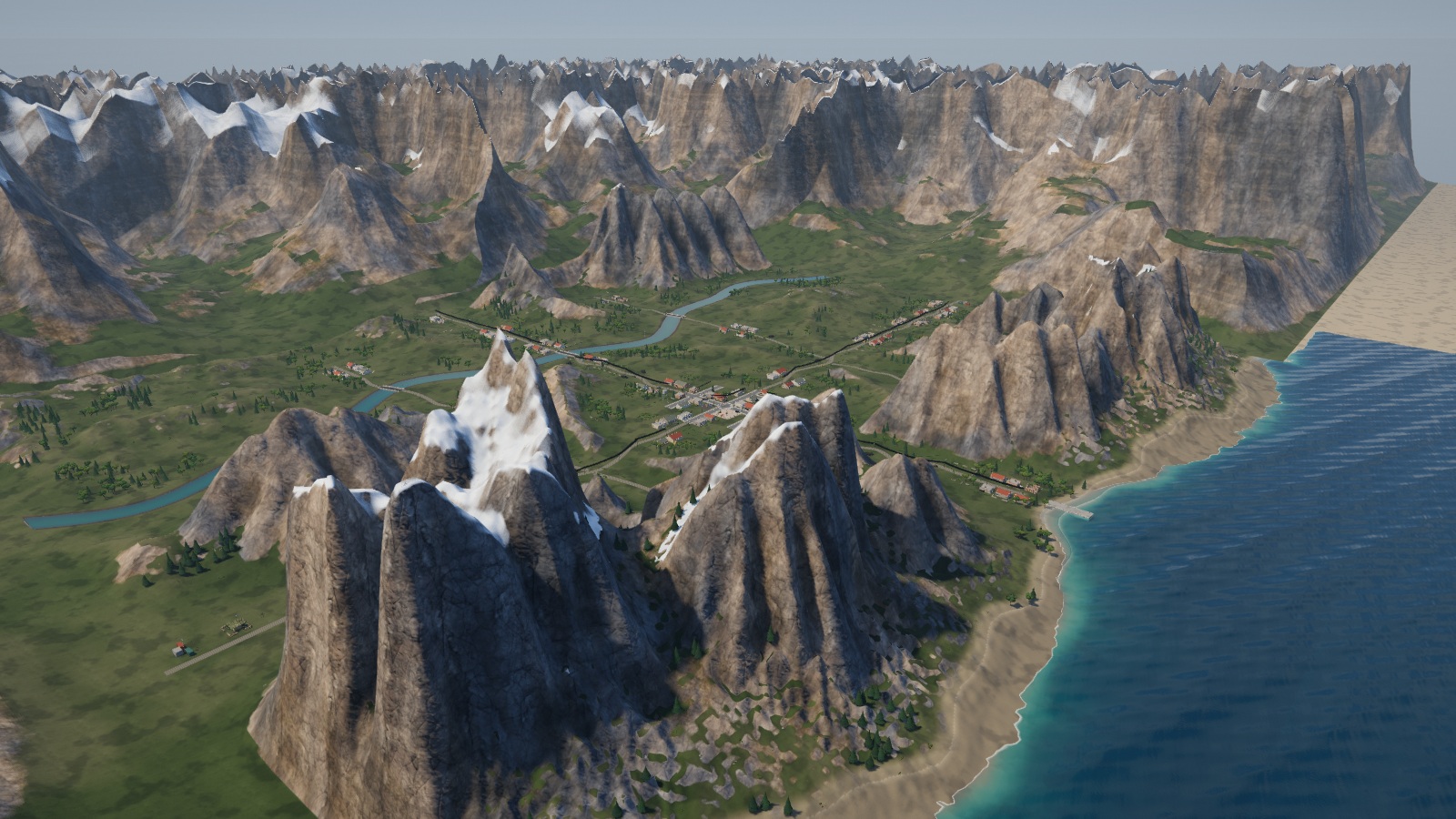
Separate distant mountain ranges with sky haze
Optional alpine haze takes on the sky colour and settles lightly into lower valleys.
Explore this change
Uses existing alpine_haze option and engine fog; no new volumetric pass. Disabled/flat-map paths reset both additions. Compatibility may approximate aerial perspective differently.
Technique reference: research source.
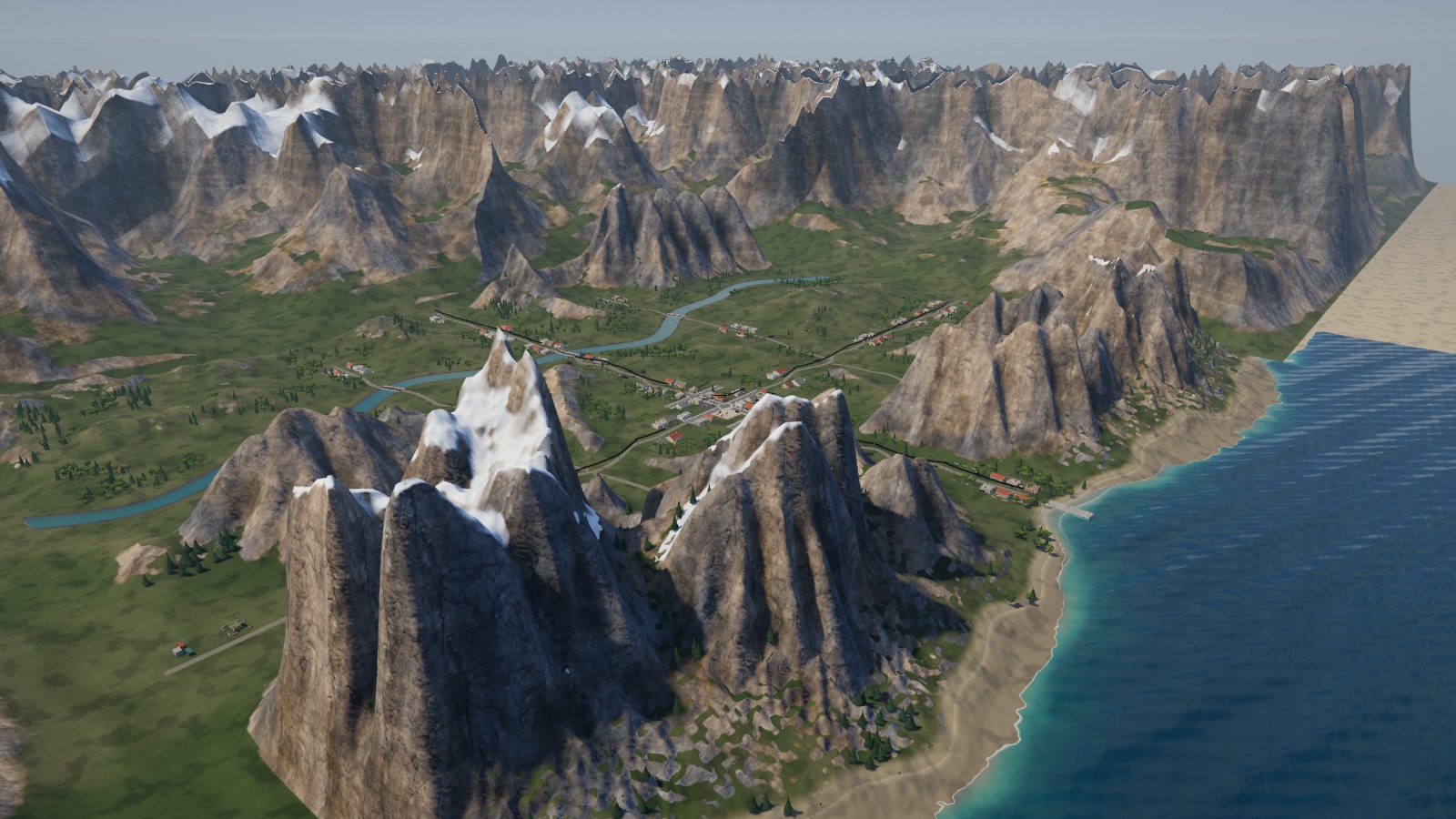
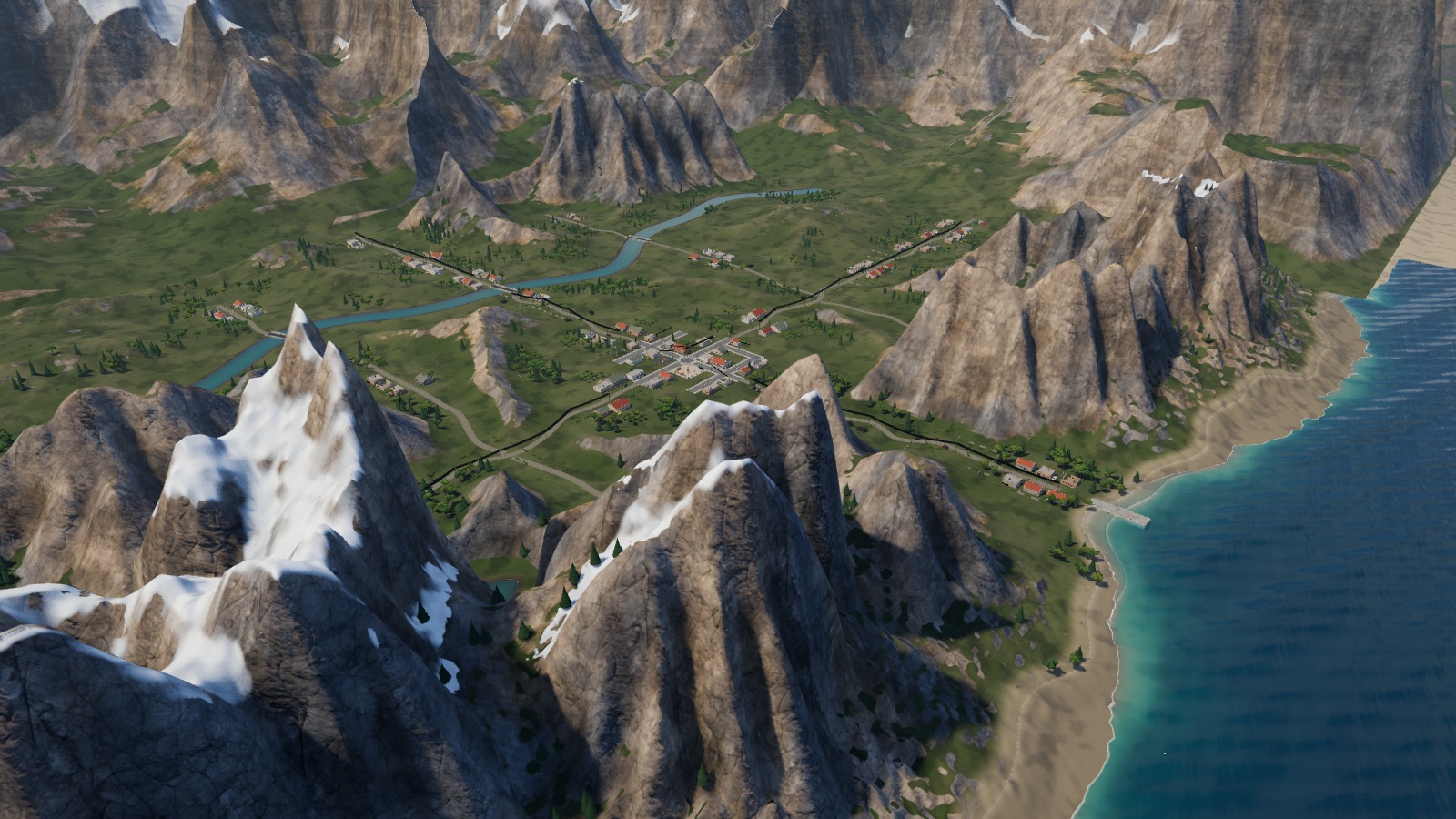
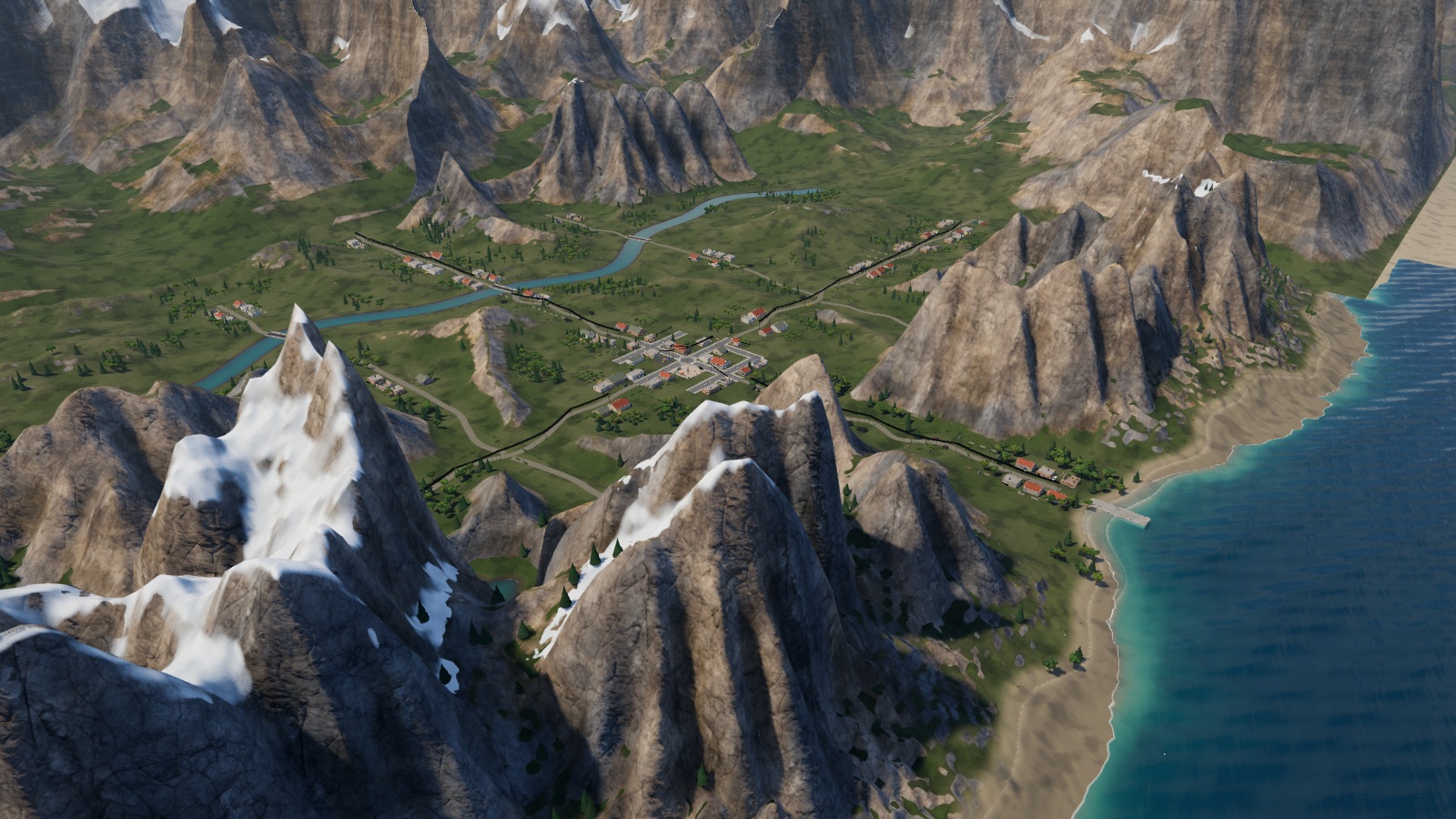
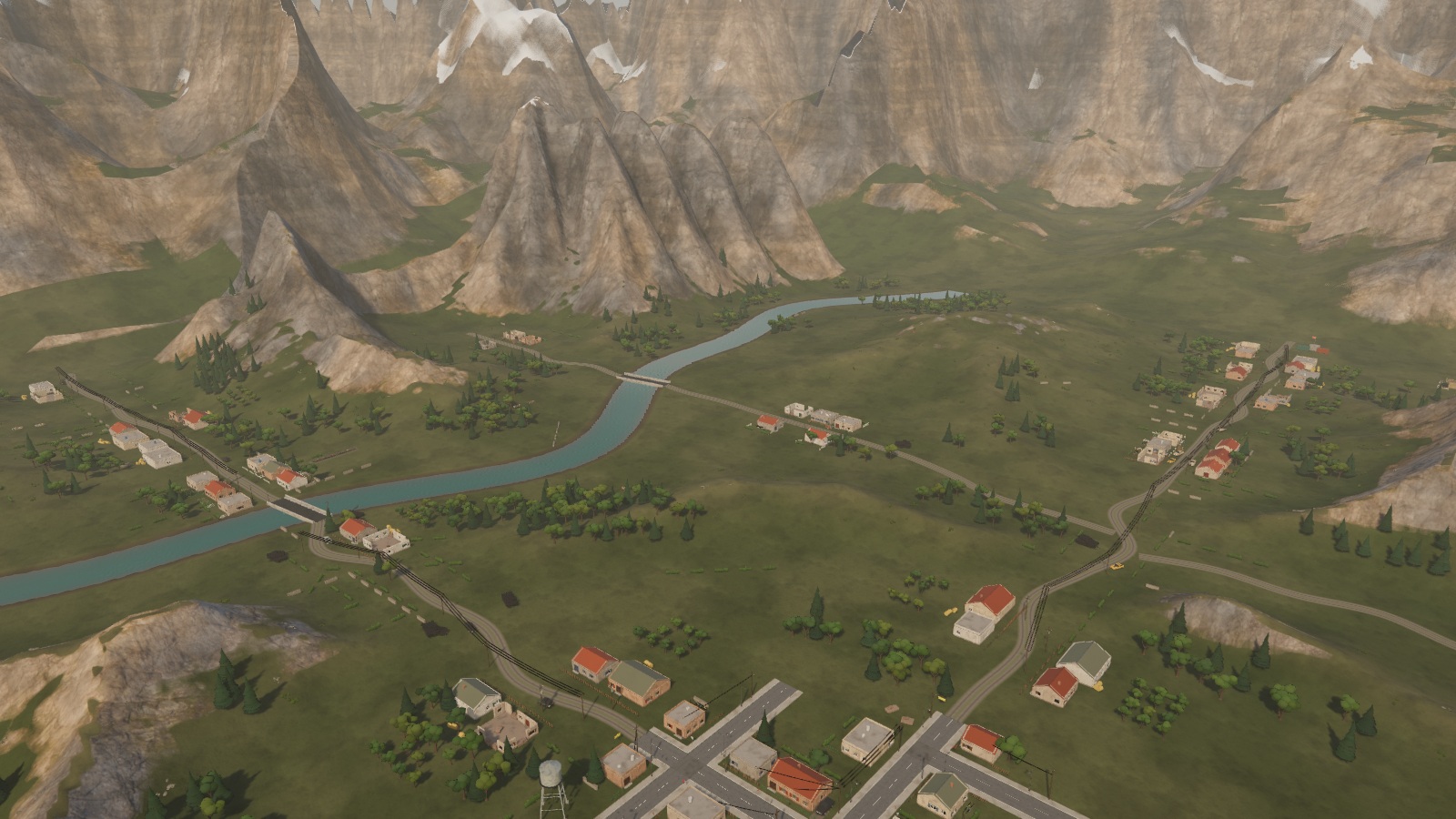
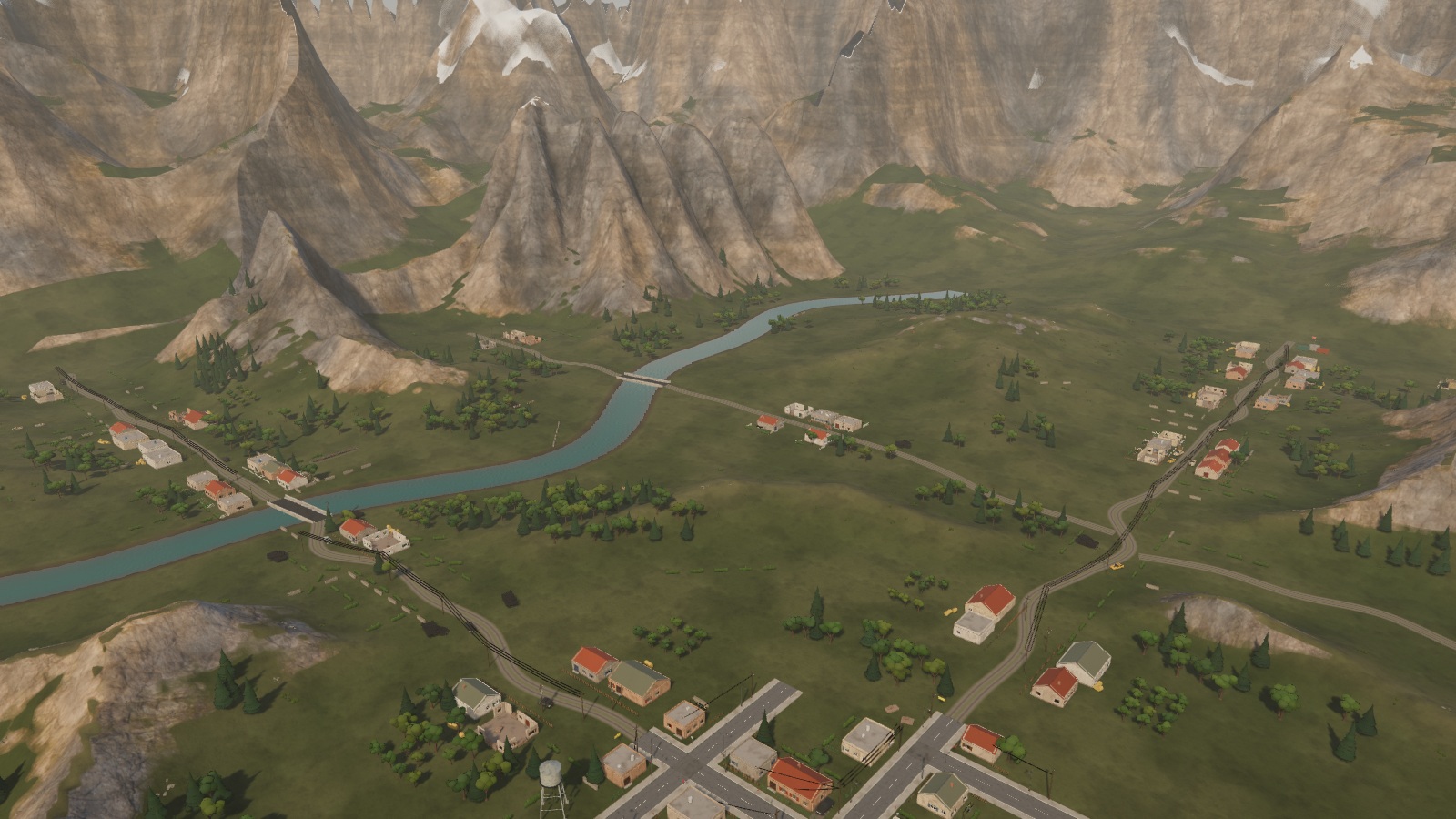
Broken stone across mountain faces
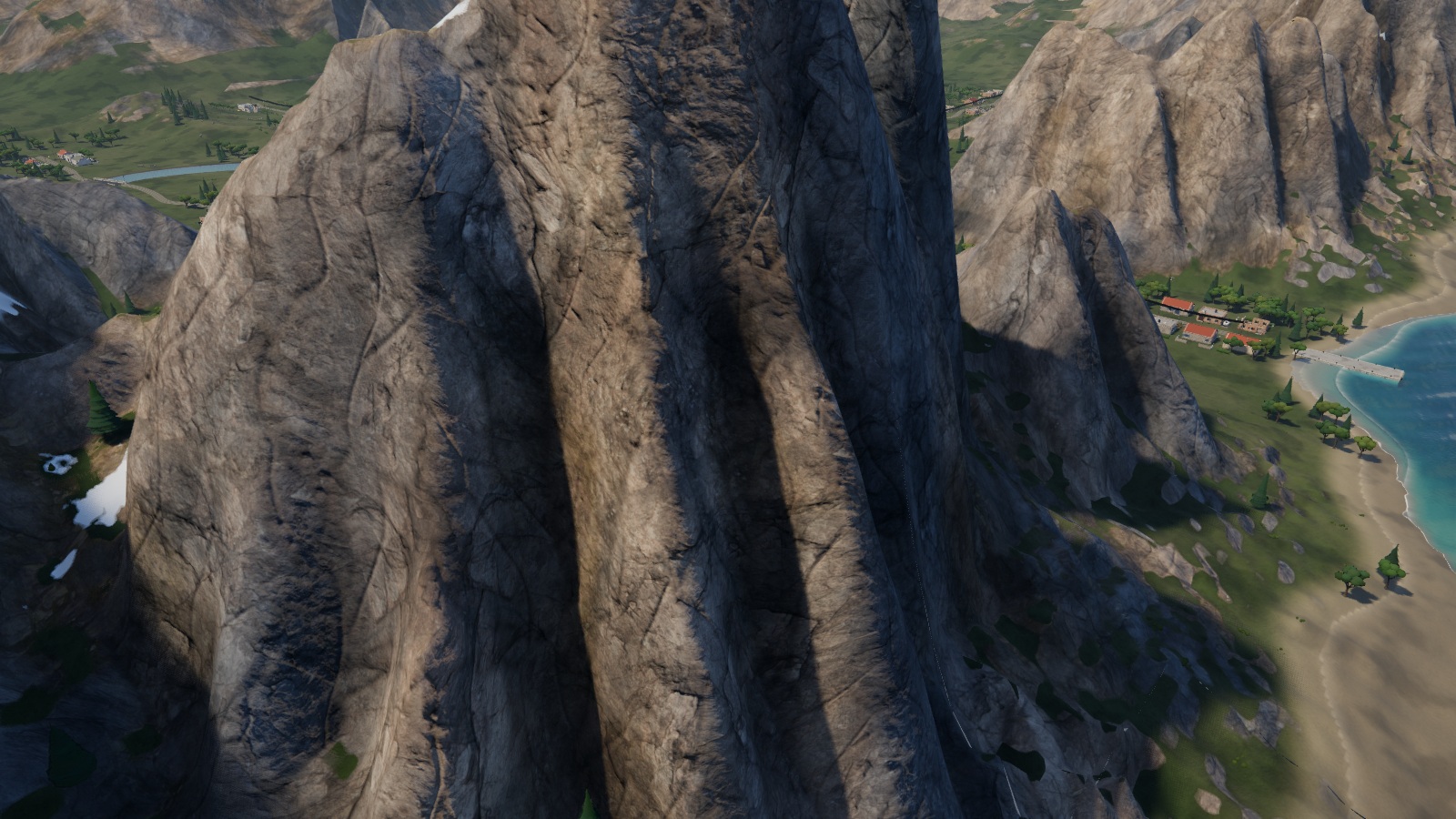
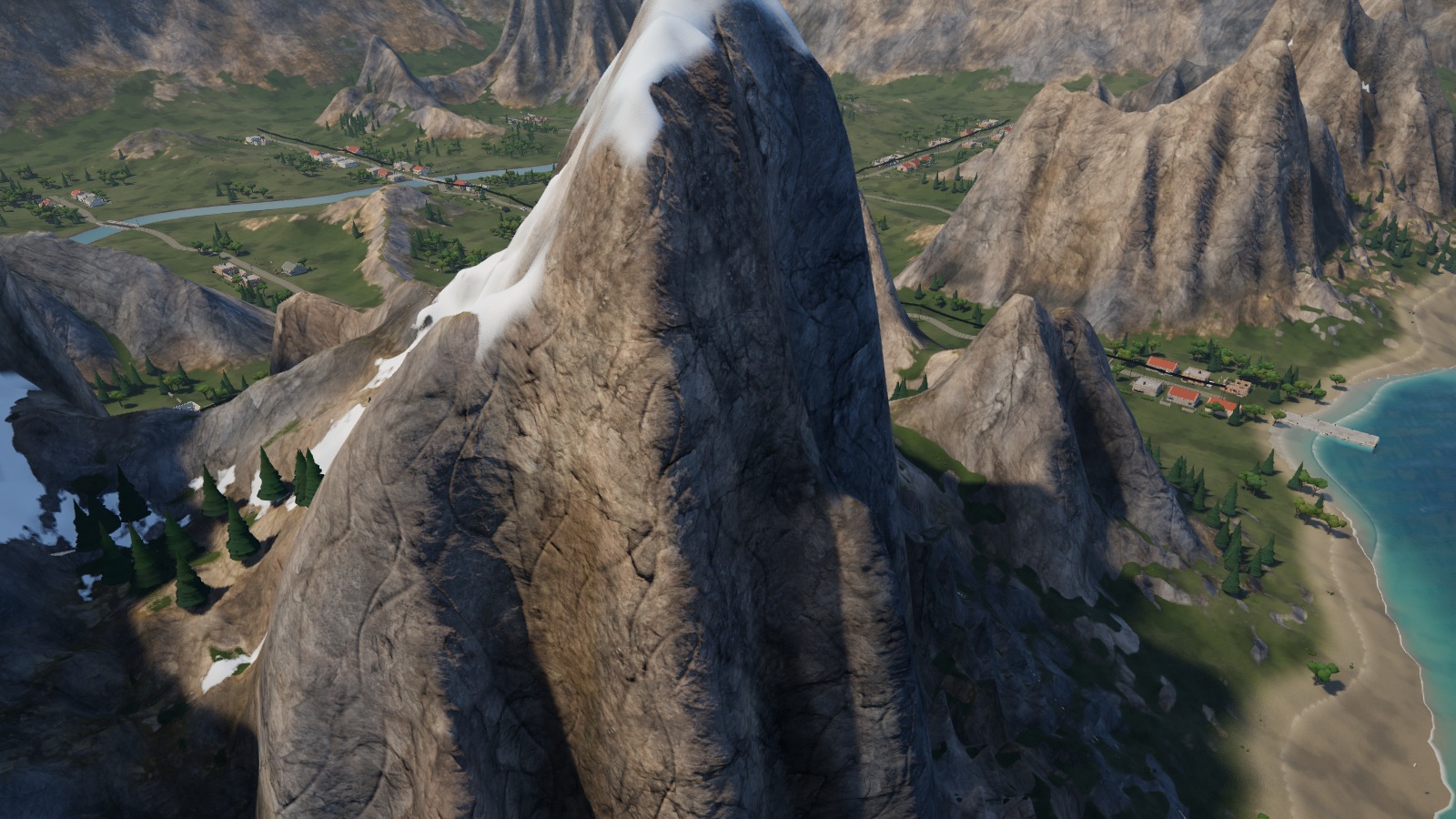
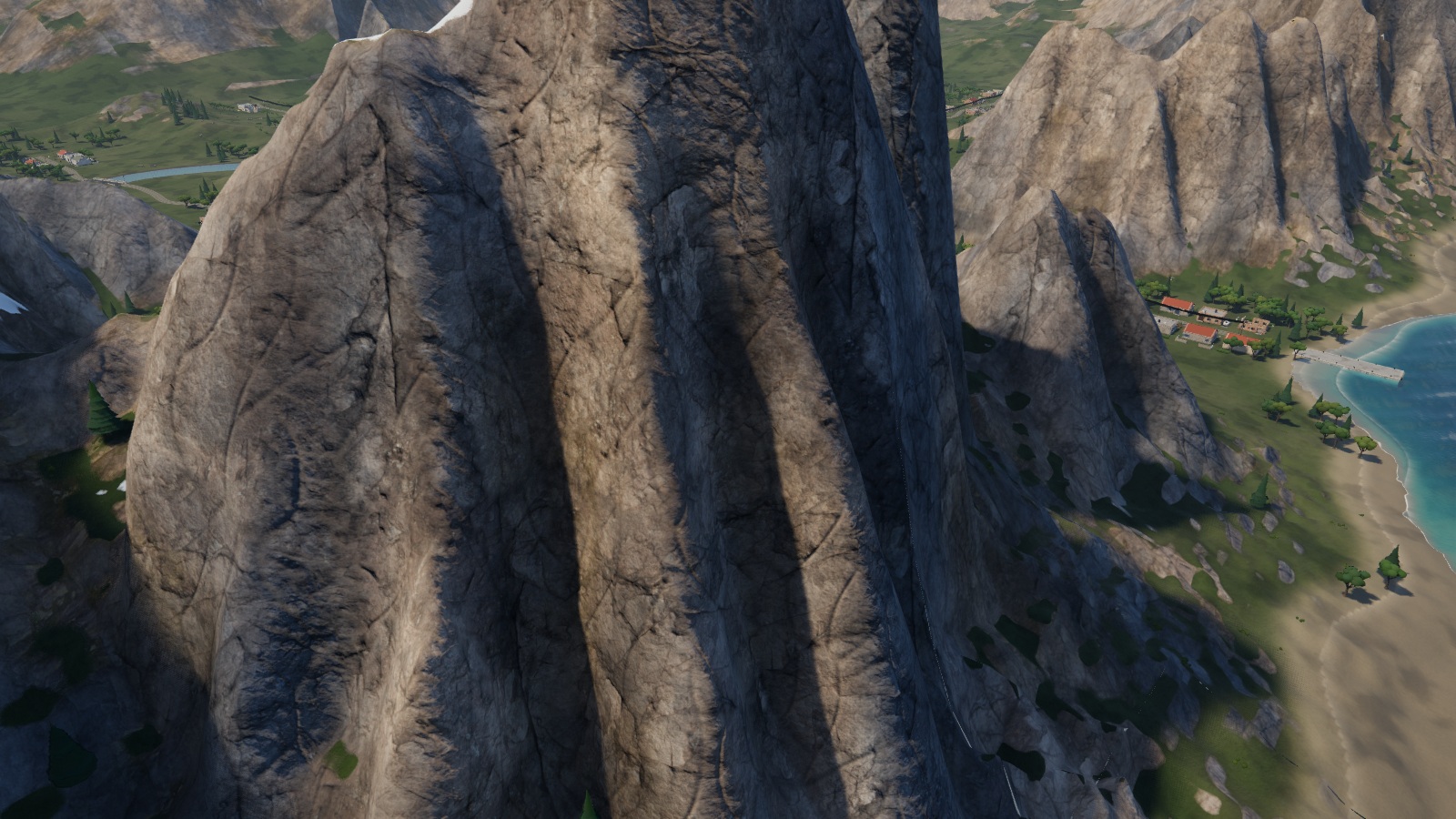
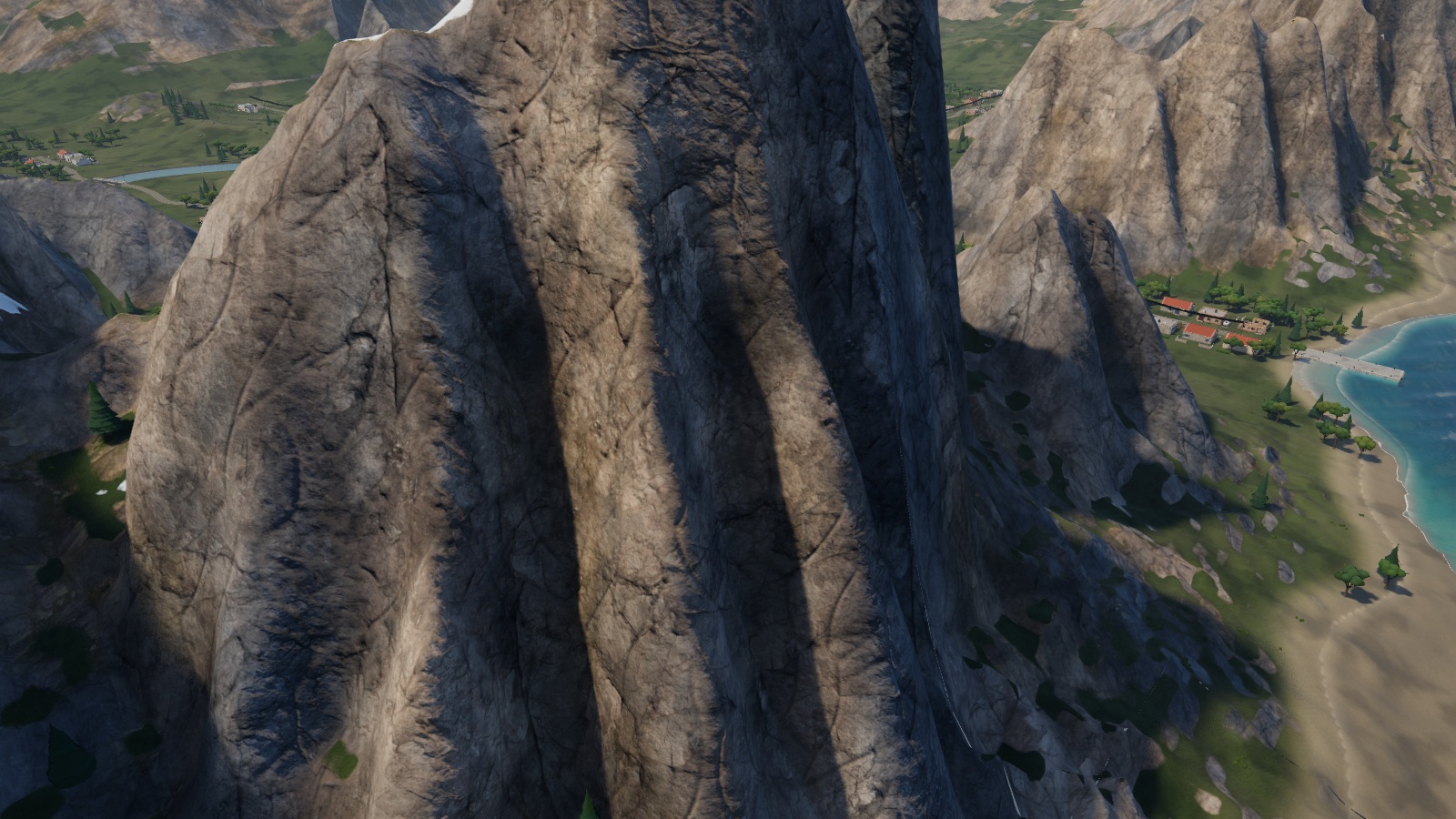
Mountain faces gain broken mineral layers, darker weathered seams and uneven pockets of loose stone.
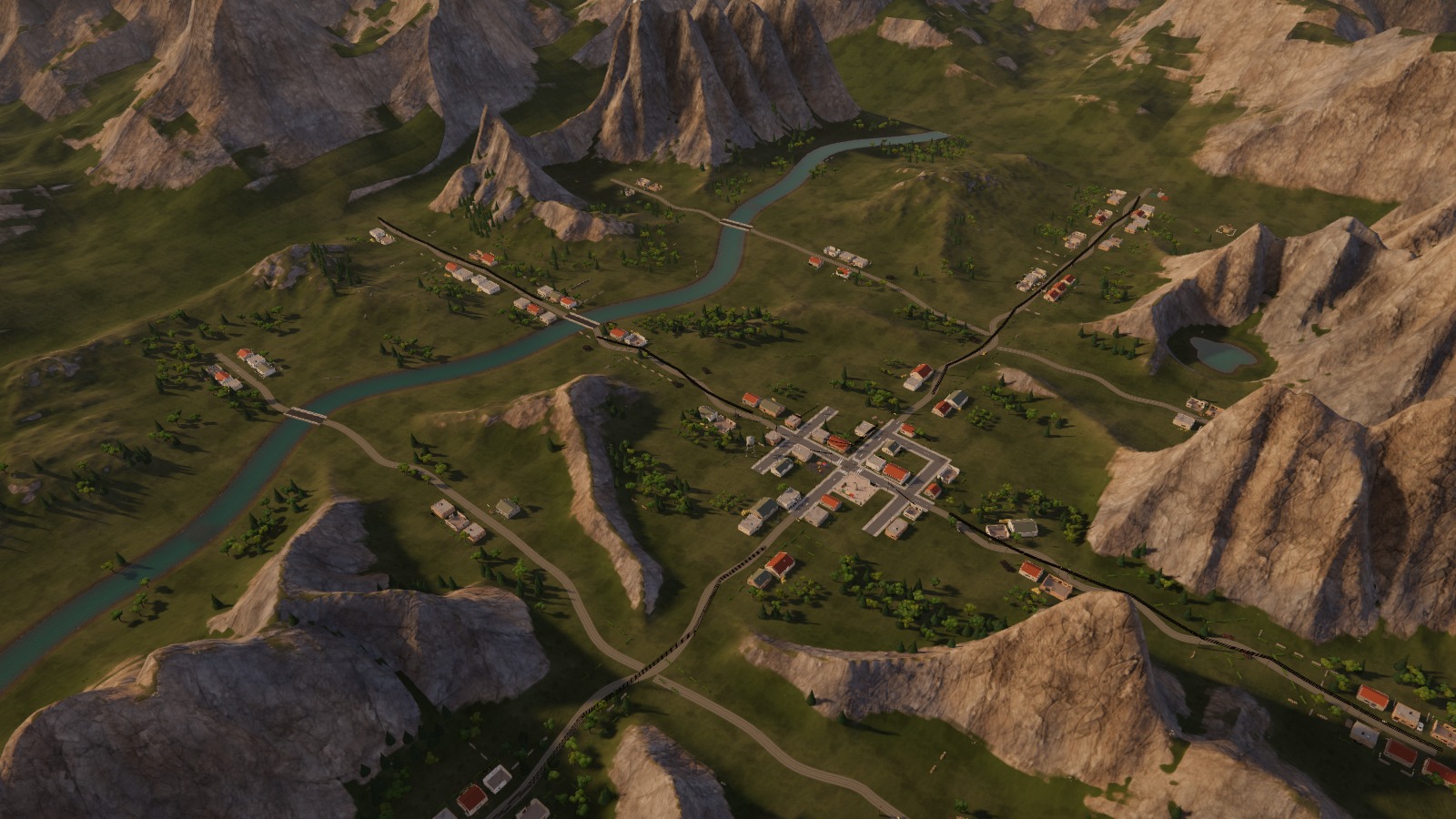
Explore this change
Cliff materials combine larger elongated fractures with smaller photographic grain.
The detail is baked into the existing material textures, including normals and
occlusion, so it uses no additional terrain texture samples. Tilted mineral beds
break across the faces rather than forming continuous stripes.
Sheltered seams weather darker, while loose stone collects unevenly on gentler
ground and in pockets. These masks reuse existing texture reads.
This improves surface shading; mountain silhouettes and movement limits are unchanged.
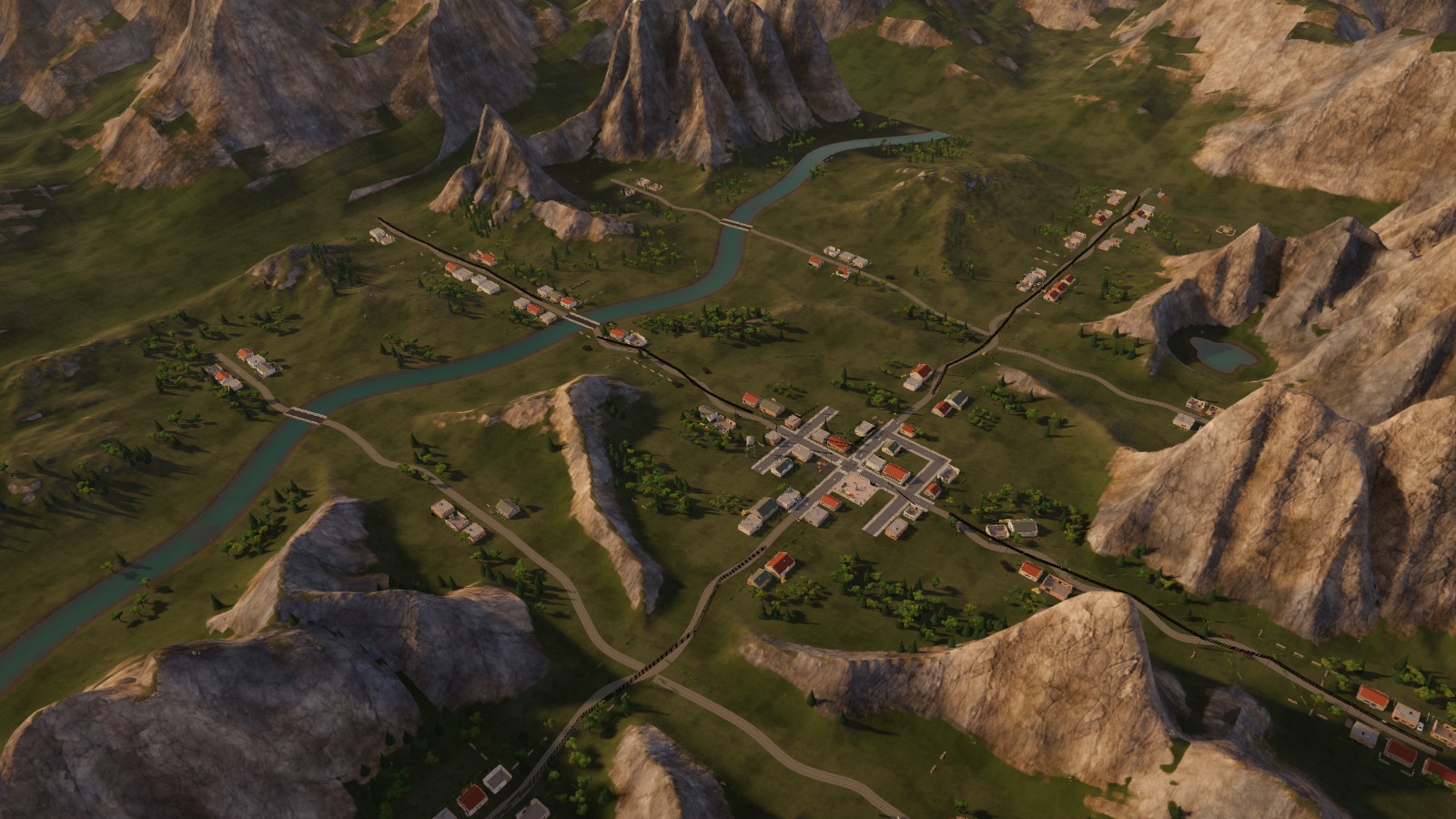
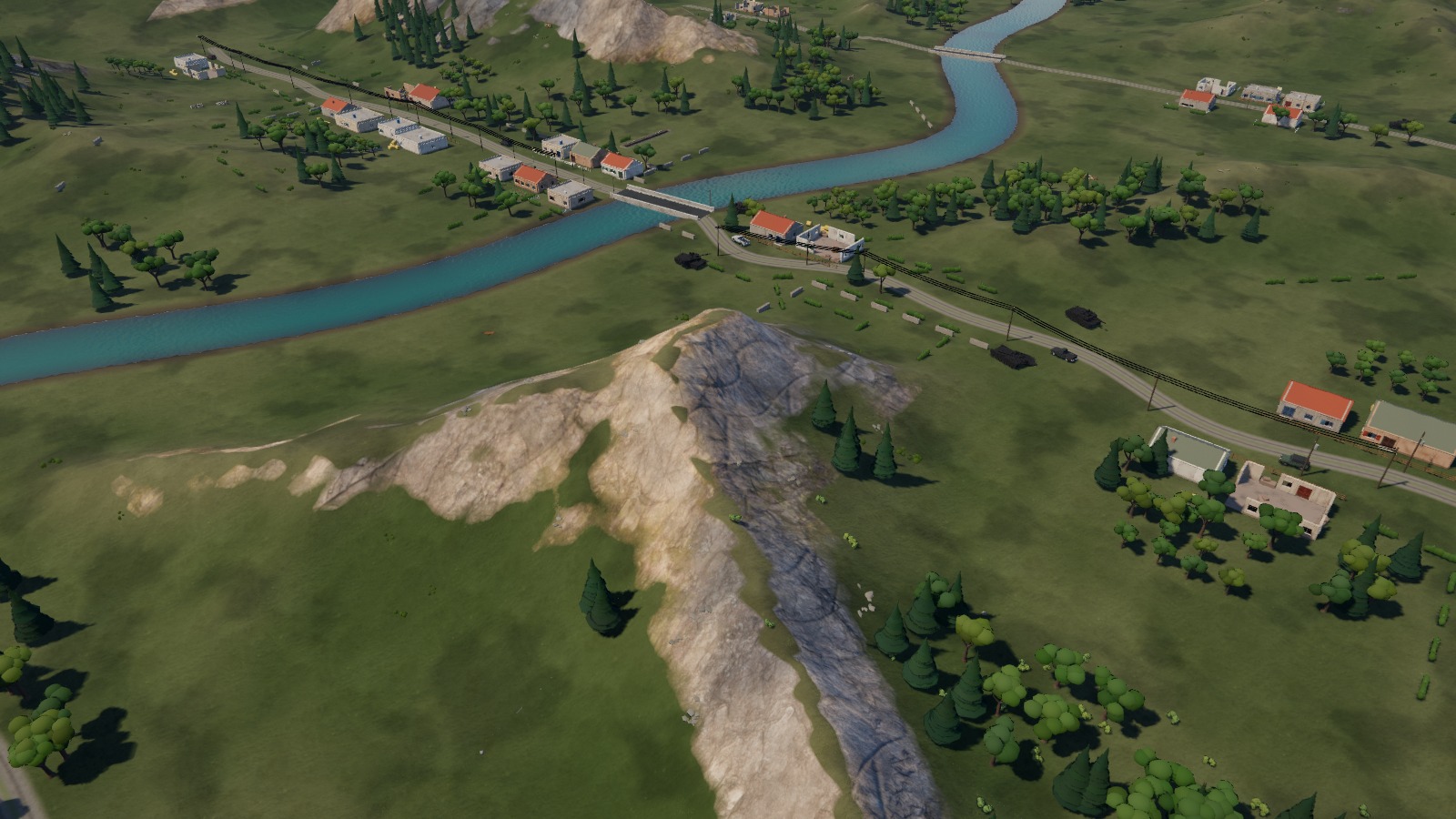
Rock faces with depth and greener foothills
Mountain faces gain distinct rock masses, relief-aware moss and snow, and small conifer stands at their feet.
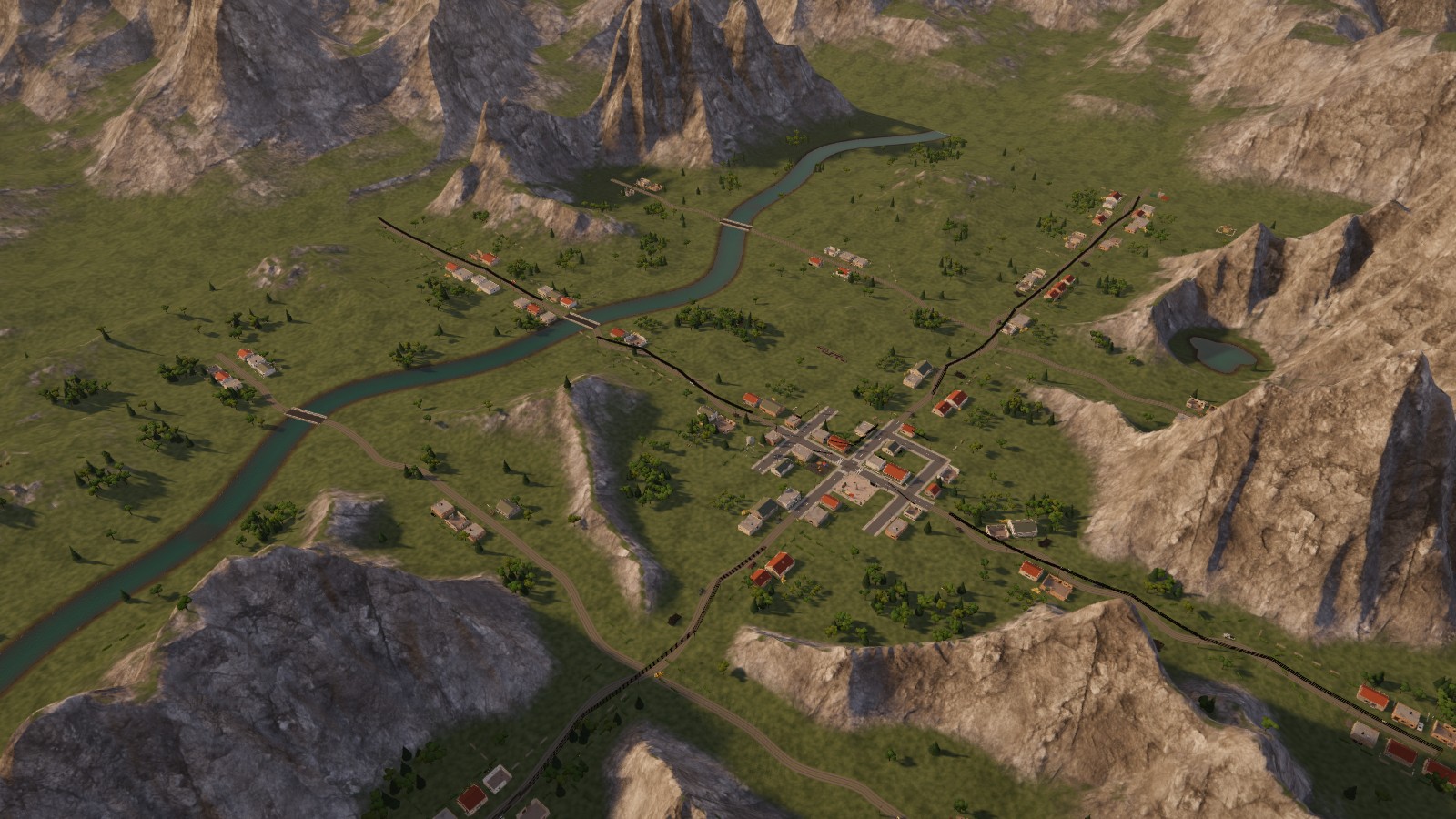
Explore this change
- Rock breaks through moss and snow according to the photographed surface relief. Crevices retain shade and each surface has its own roughness.
- Generated buttresses, bowls and saddles become part of the terrain before weathering and road grading, keeping movement and shots aligned with the landscape.
- Small conifer stands give the foothills a clearer sense of scale while retaining normal tree collision, fire and destruction.
- Offline-packed material maps retain the same texture-sample count; mip filtering reduces distant grain.
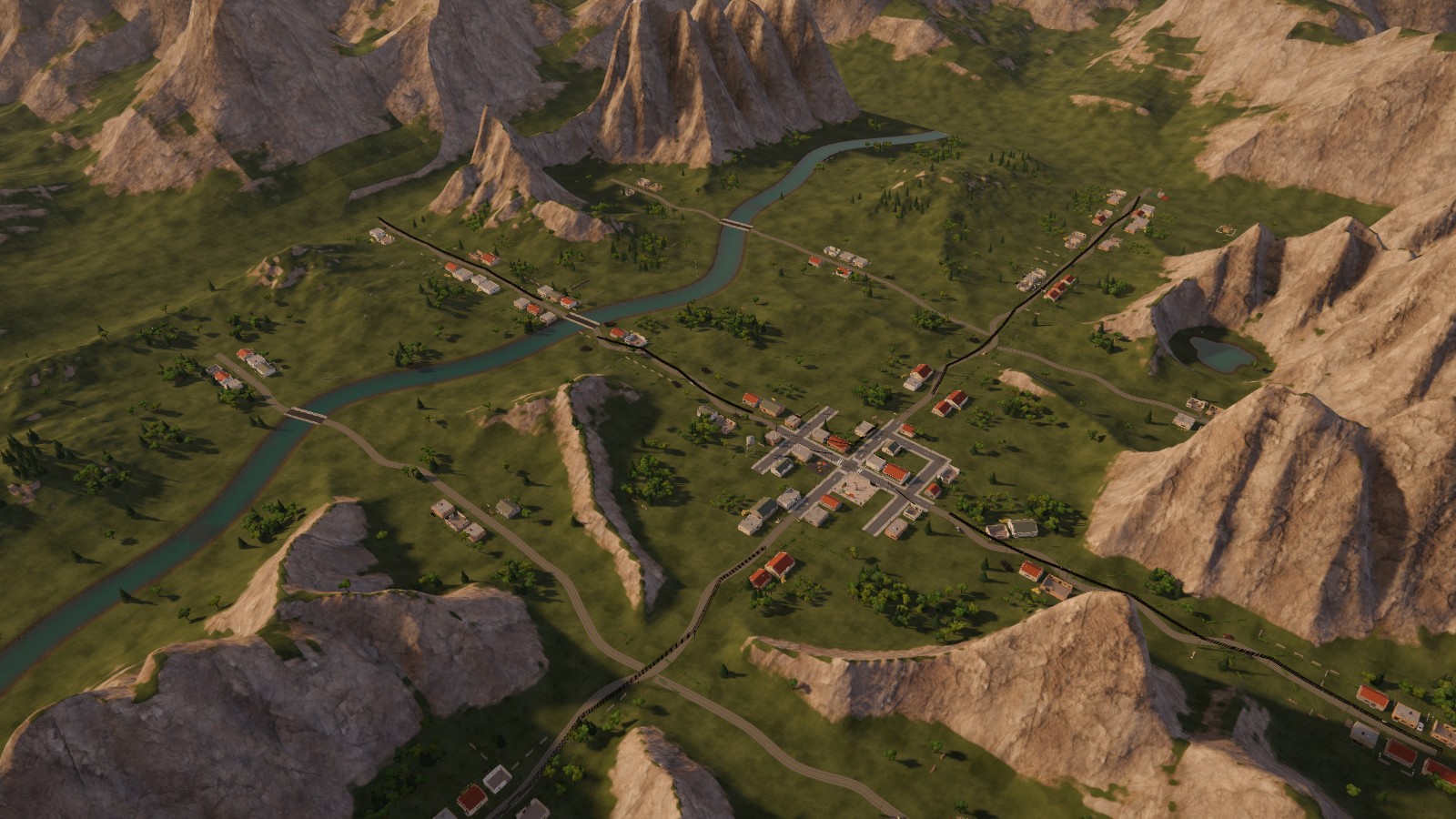
More varied mountain surfaces and vegetation
Mineral bands, dry grass, scrub and scattered stones break up the alpine landscape, with vegetation changing as the ground rises.
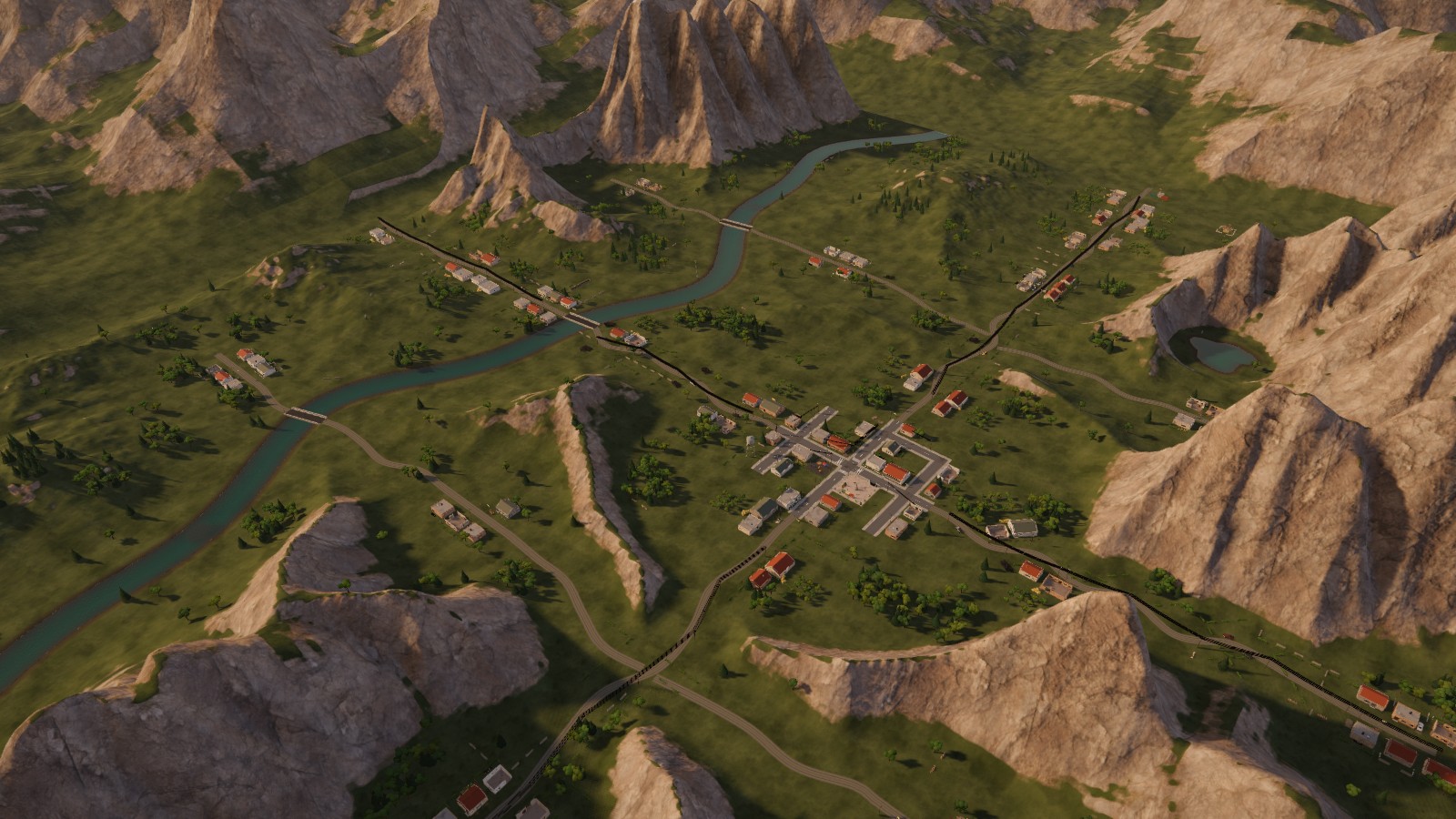
Explore this change
- Rock faces mix broad mineral colours, weathering bands and broken scree. Moss and dry grass vary in smaller patches instead of covering entire slopes evenly.
- Mixed lower woods transition toward conifers and an uneven tree line. Low scrub gives way to scattered stones higher up; snowy summits remain bare.
- Small scrub and stones are passable scenery, grounded individually and batched for rendering. Their seeded placement is shared by multiplayer and recordings.
Release notes you can scan, then explore
See what changed at a glance, with a focused visual and expandable detail. The full release history now uses the same clearer presentation.

Explore this change
All 87 published entries now begin with a concise player-facing summary. Archived
images appear directly in the site’s brass-and-ink layout; existing motion clips keep their
playback controls and attribution. Expand Explore this change for the original
notes, screenshots and supporting clips. Original release dates and feature claims
are preserved.
Motion is shown with video when recorded evidence exists. Interface changes use
stills; invisible fixes and unrecorded sound or performance changes use text.
Historical screenshots remain historical evidence, and current-build demonstrations
are labelled as such.
The same overview/detail structure is used in the generated repository changelog
and future release notes. Reusable capture stages, media-selection guidance and
an evidence audit make this part of preparing each new change.
The page shares the main site’s condensed headings, thin rules and shadcn/Radix
components. Desktop entries place an explanation beside uncropped media; narrow
screens stack the same content. Supporting notes expand beneath each entry.
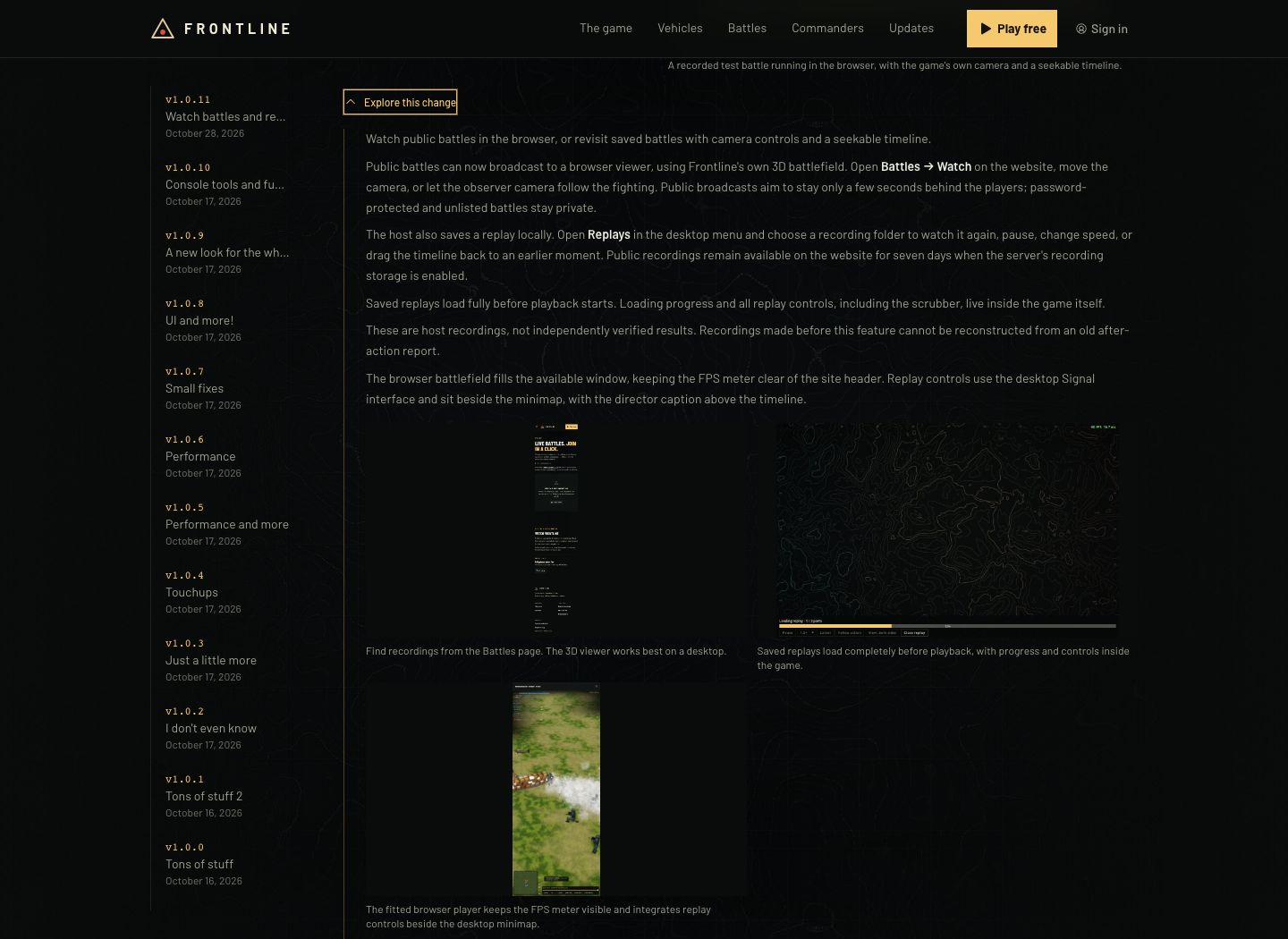
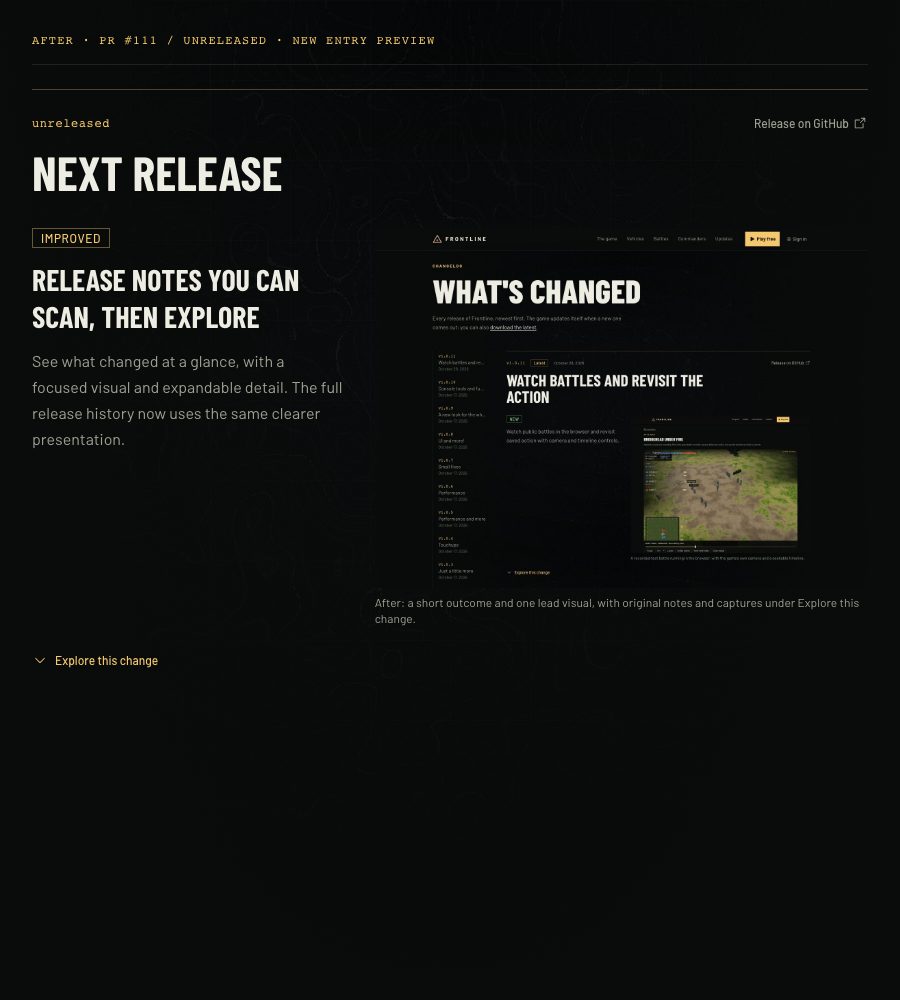
Every existing entry includes Compare changelog layouts: a separate, collapsed
old/new presentation review. Both views use the same viewport and can be enlarged.
These compare the release-note layout itself, independently of the feature media.




Compare changelog layouts
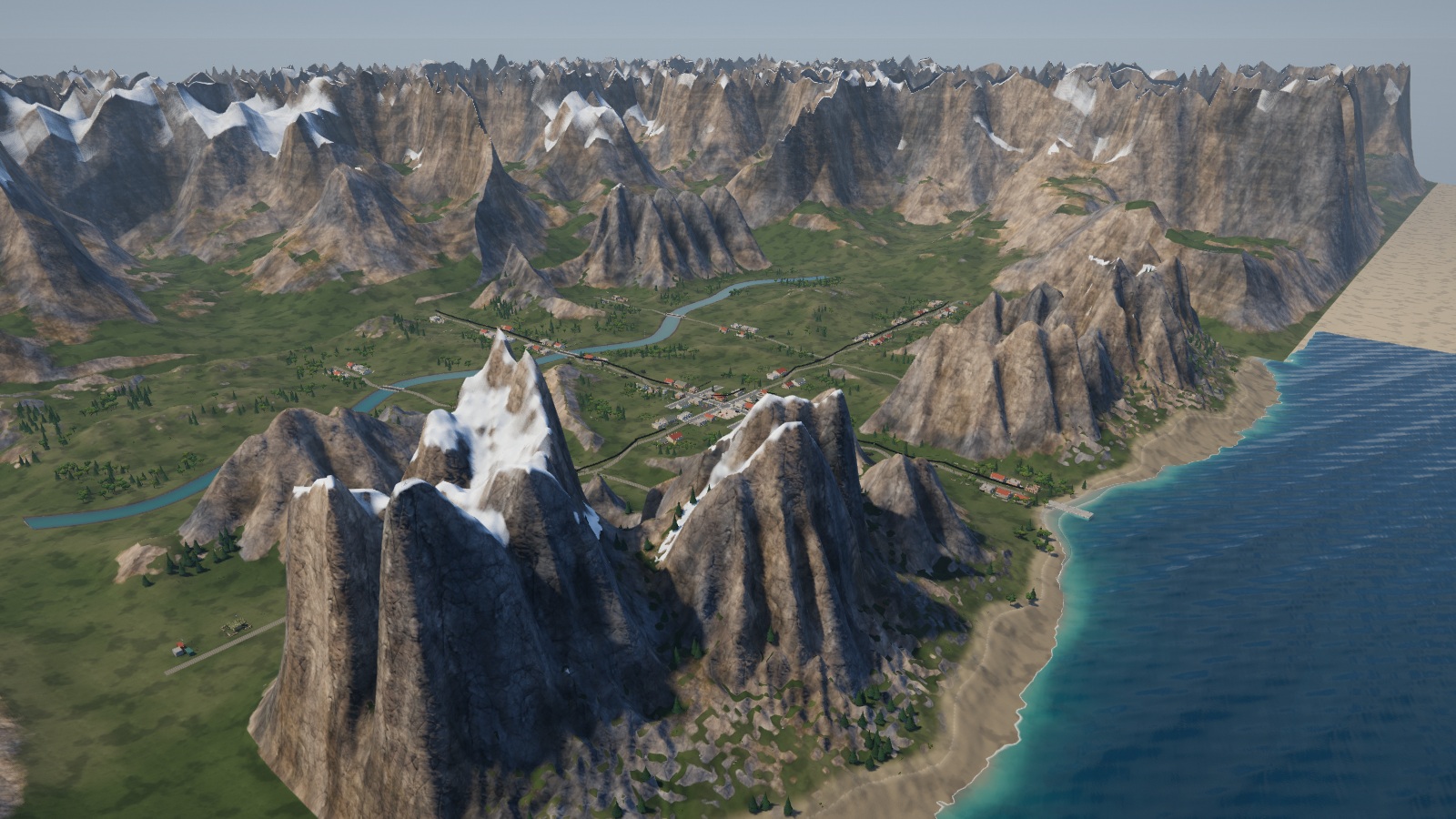
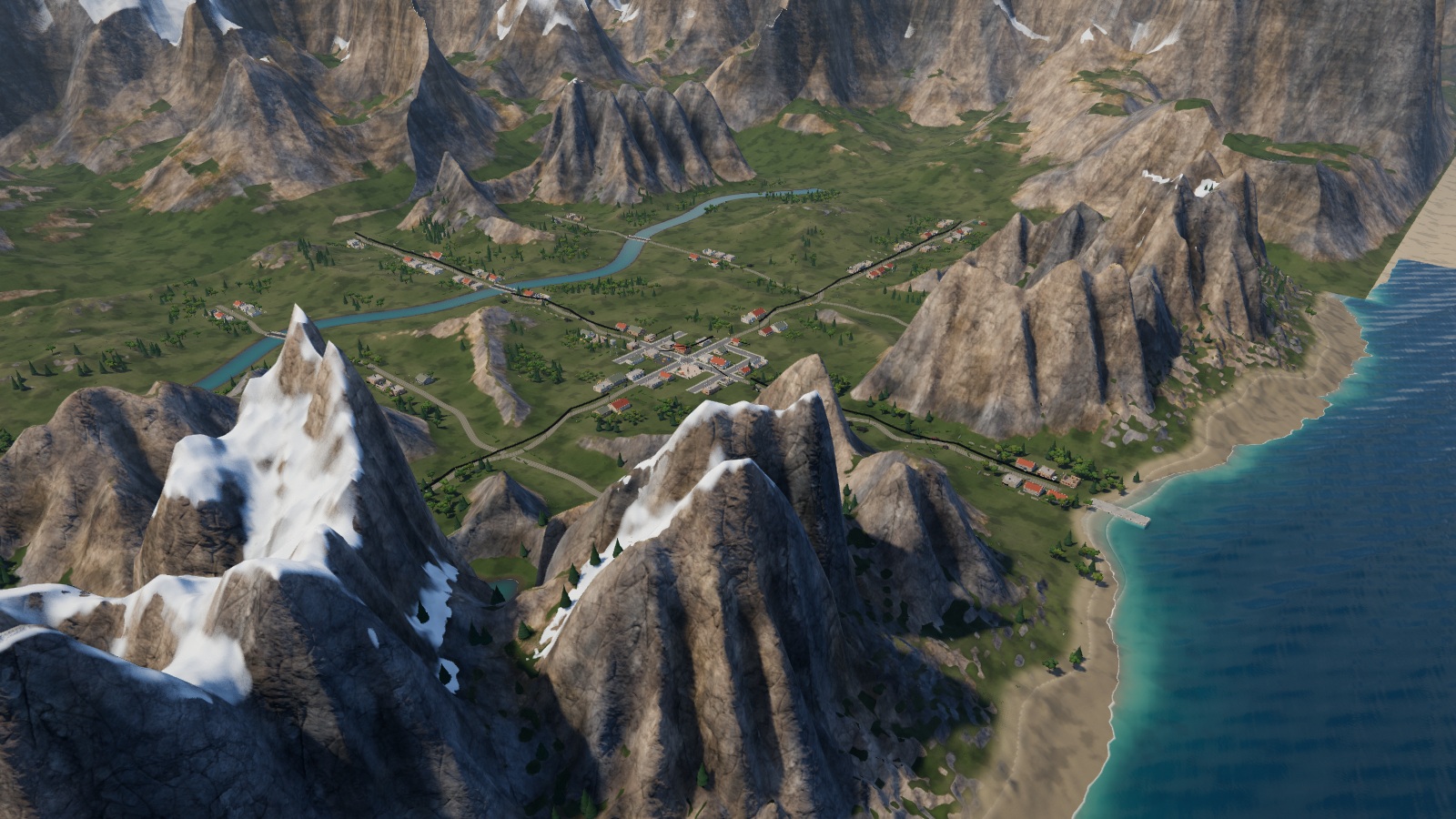
Changelog presentation comparison, not gameplay: the top 1,000 pixels of this entry at the same 900-pixel viewport width. Open either image to inspect it. This entry is new; its content is rendered through both layouts for comparison.

Add directional weathering to cliffs
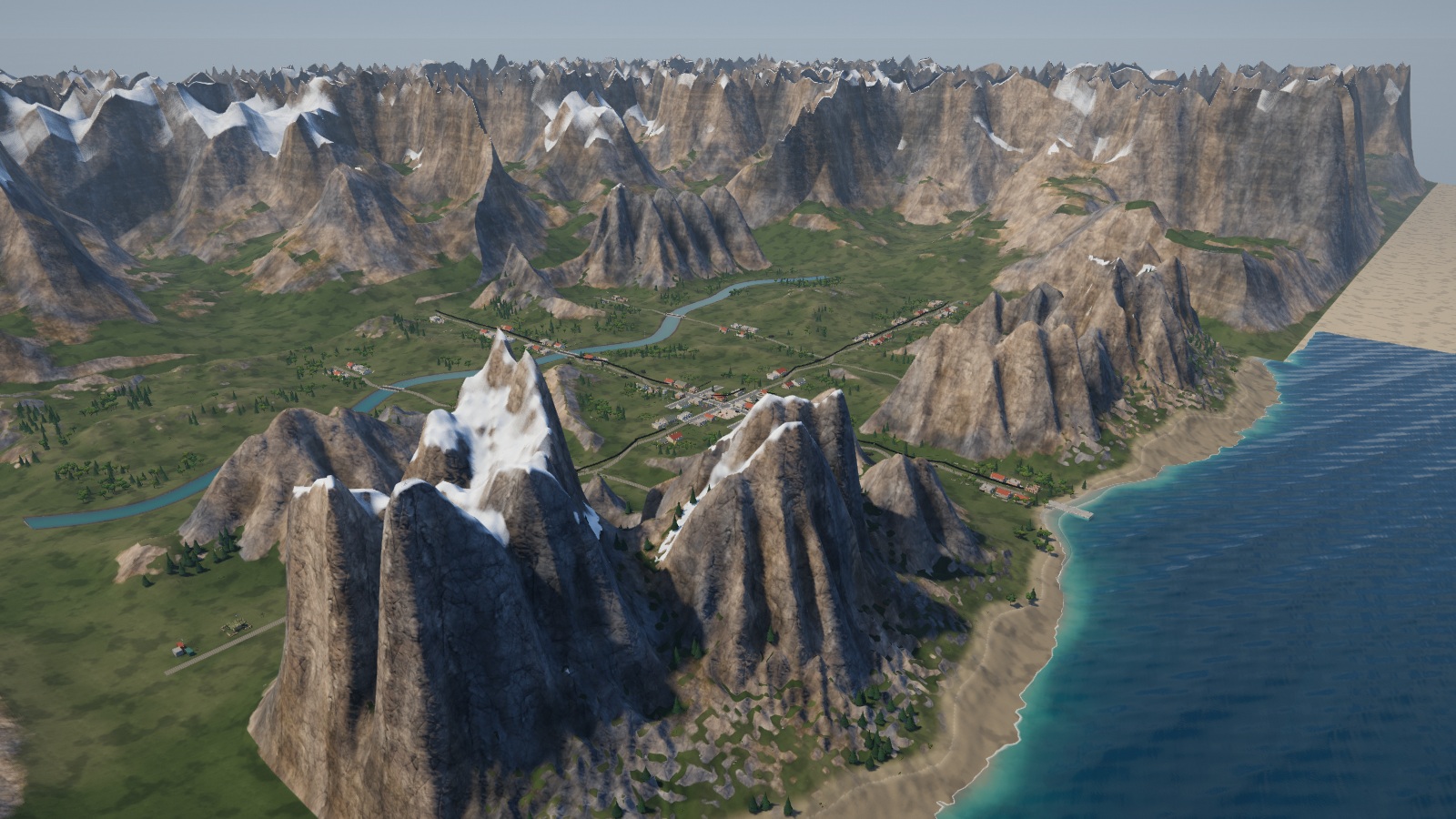
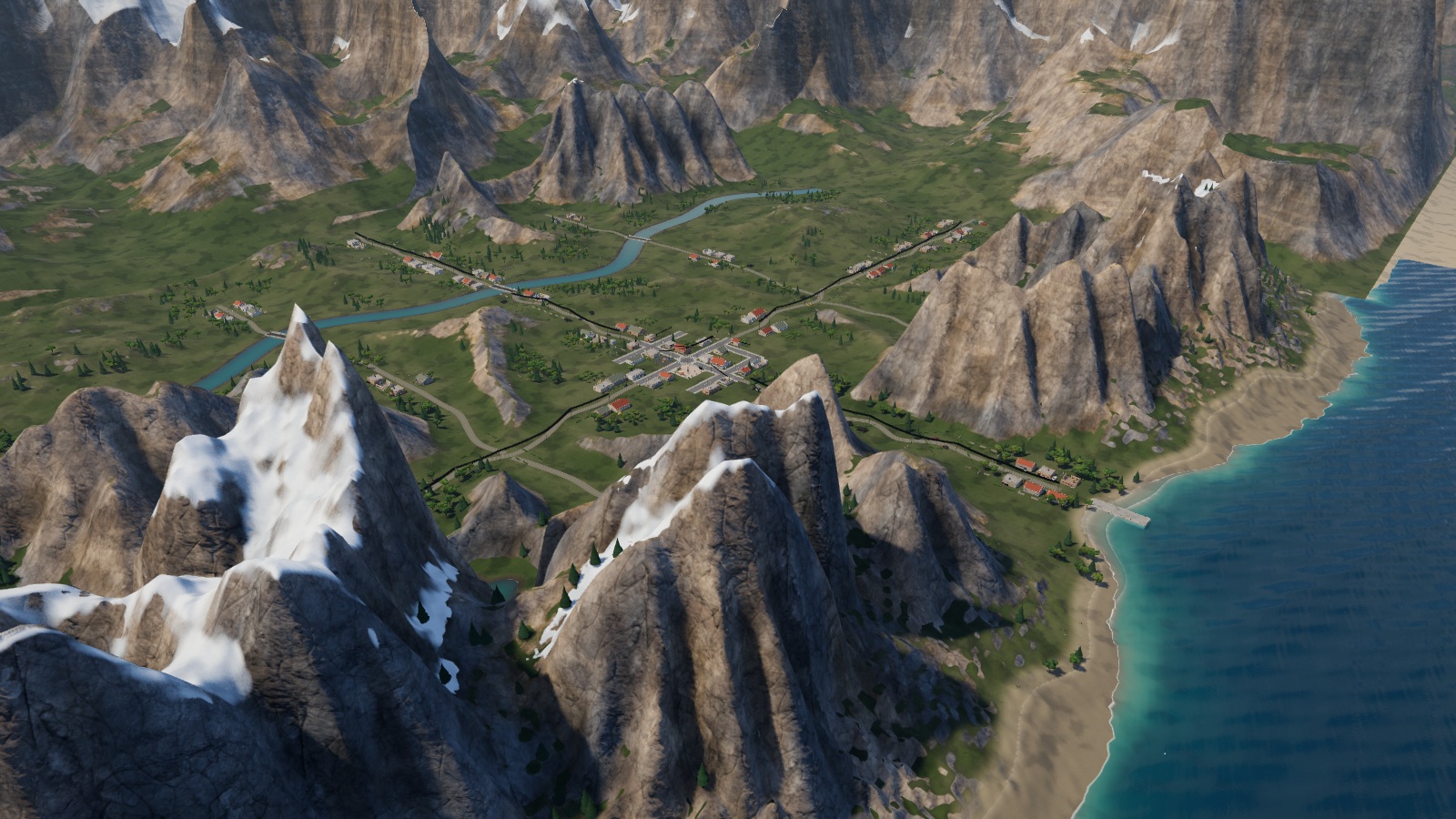
Narrow mineral stains run down exposed cliffs, interrupted by ledges and changes in rock type.
Explore this change
One extra scalar noise read per terrain fragment. This is directional material weathering rather than a hydrology simulation; geometry and traversal do not change.
Technique reference: research source.
Smoother large battles
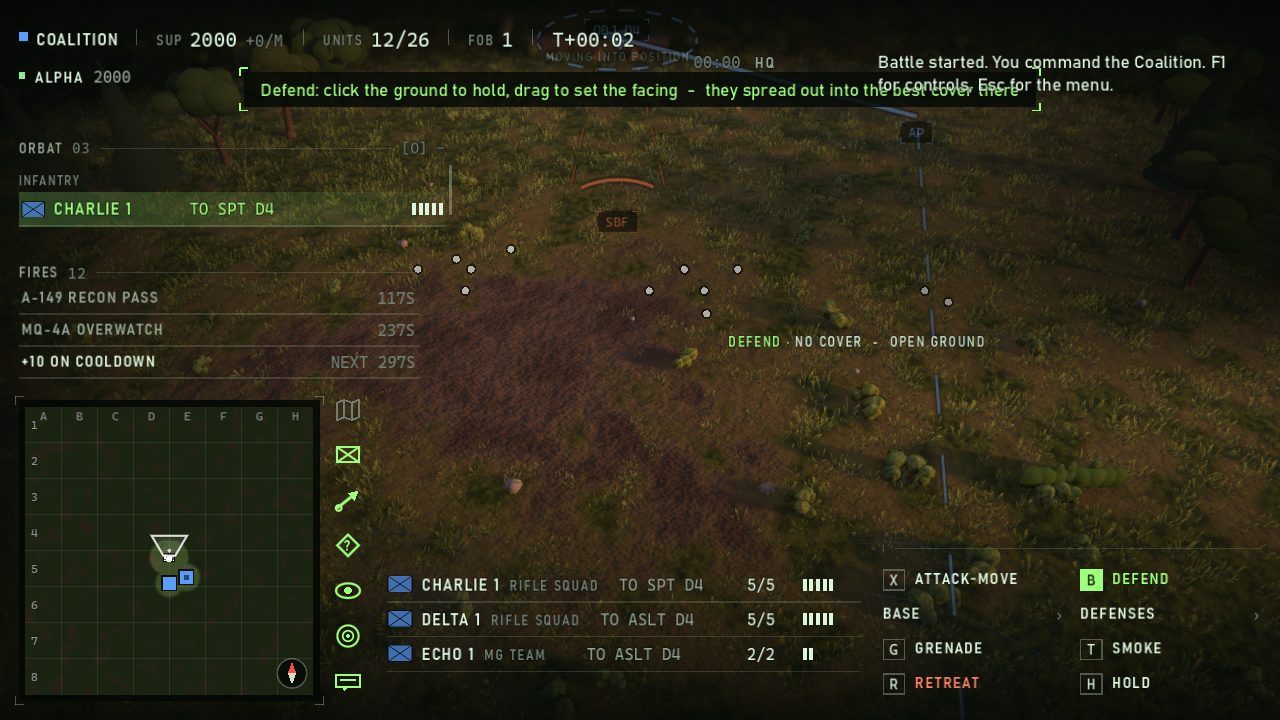
Large formation orders take less work, and pointer feedback updates independently of squad counters.
Explore this change
-
Selection boxes, tooltips and order previews update immediately in their own drawing layer, without rebuilding every squad counter as the pointer moves.
-
Camera shake keeps the existing status refresh rate. Panning, zooming, selection and commands still refresh the counters immediately.
-
Combat and camera shake are unchanged.
-
Large formation orders spend less time choosing ground while keeping the same cover choices, spacing and placement order.
-
Soldiers spend less time checking ground and trench heights in built-up areas. Distant squads draw more efficiently with the same poses.
-
Moving soldiers check visibility more efficiently, preserving the effects of smoke, doors and cover.
Compare changelog layouts
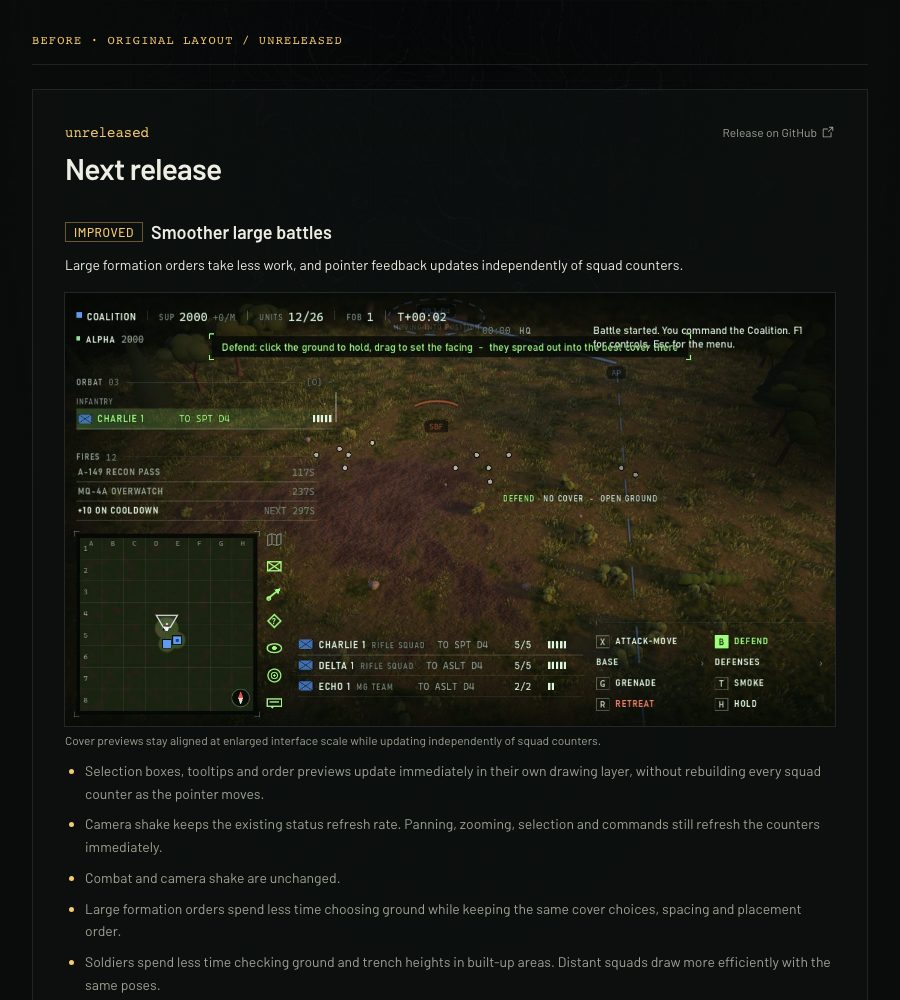
Changelog presentation comparison, not gameplay: the top 1,000 pixels of this entry at the same 900-pixel viewport width. Open either image to inspect it.

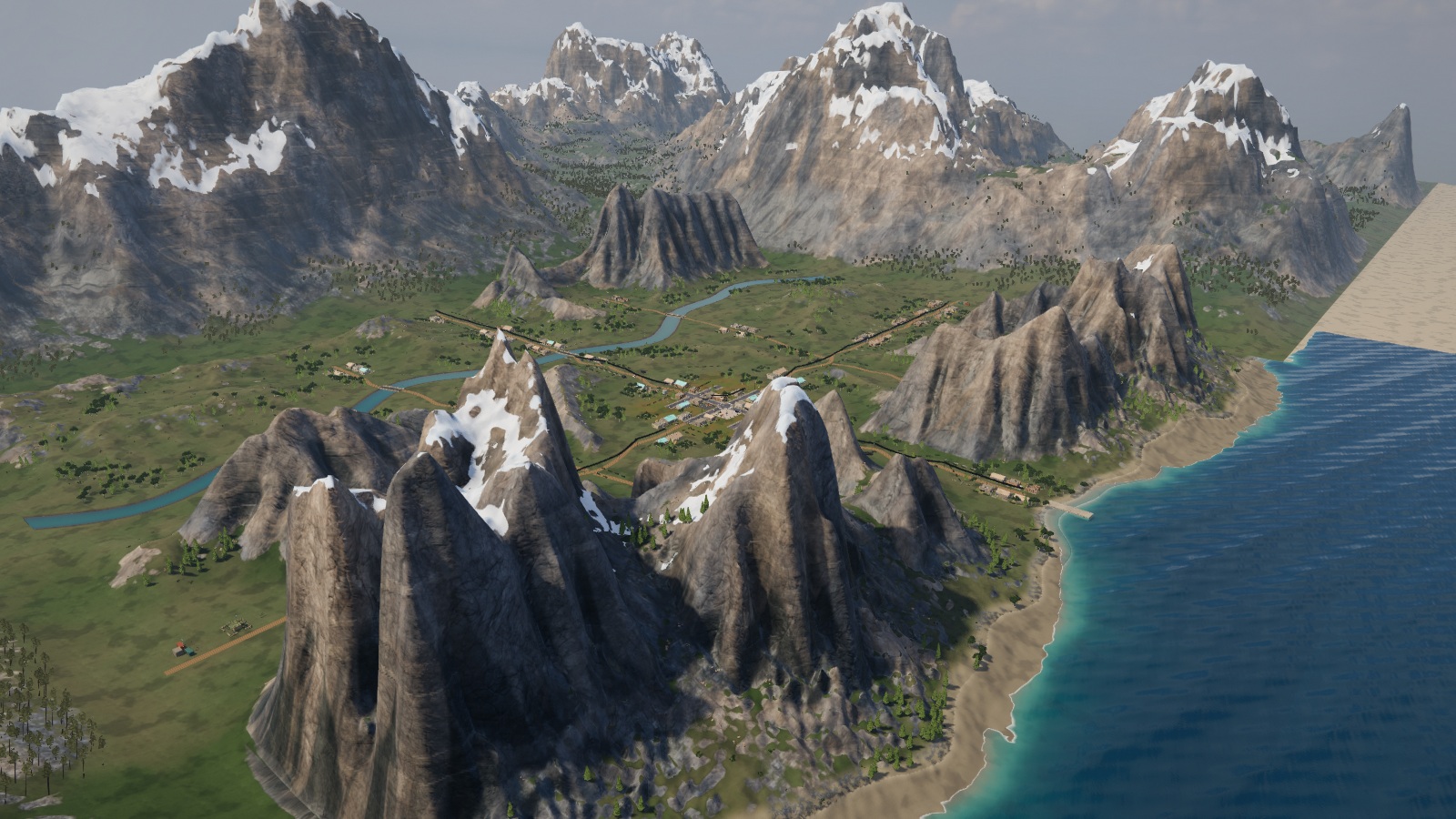
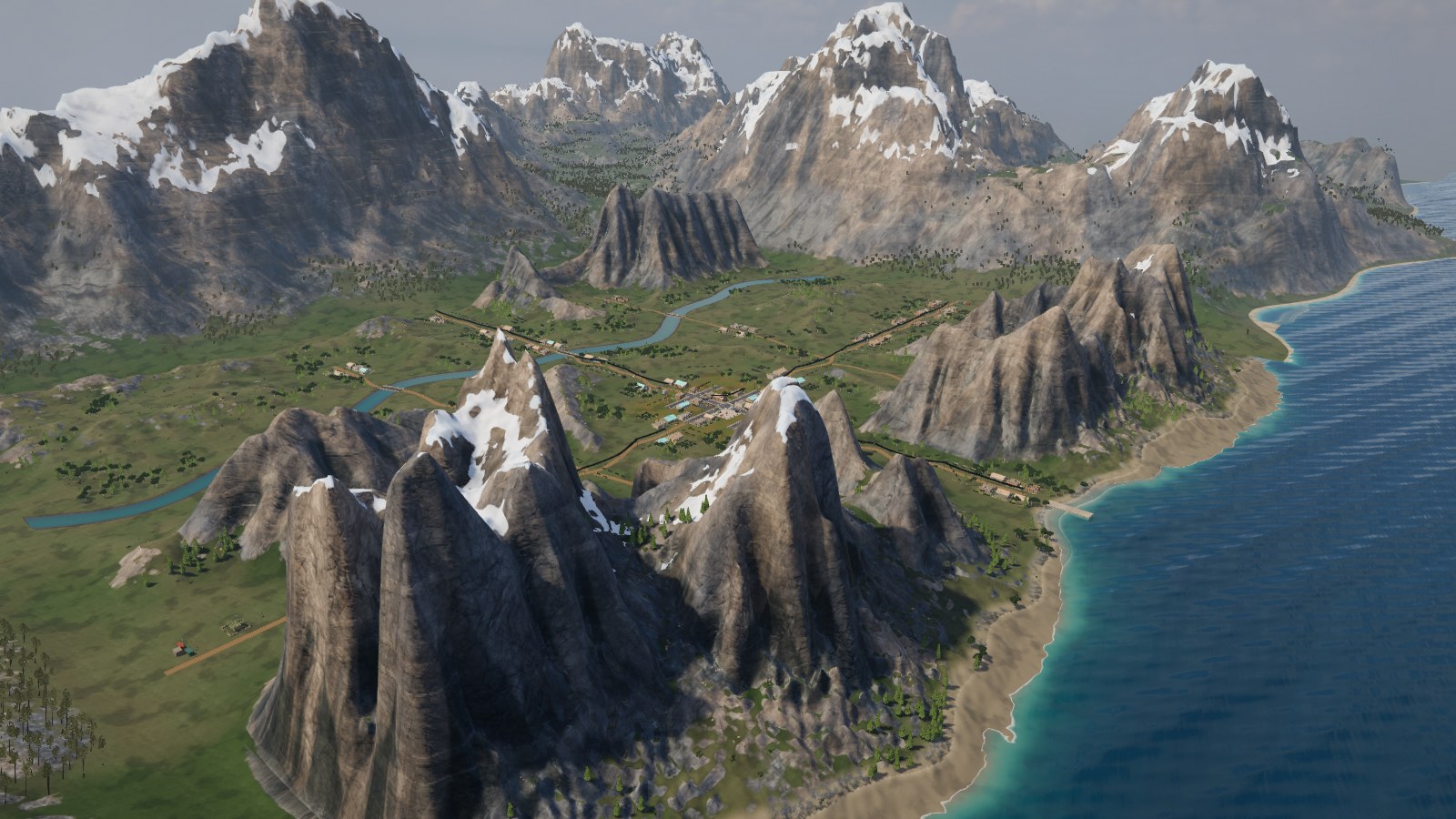
Natural coasts, fuller forests and alpine surfaces
Surveyed Alpine ranges, fuller forests and photographed town surfaces give the generated battlefield more natural detail.
Watch: Native tour of Alpine ranges, coastal forest cover, town surfaces and finer meadow detail. Current PR with animated camera, wind and water; matched before/after stills remain below. (Direct WEBM)
Explore this change
The ocean keeps detailed waves near the battlefield and uses a coarser surface beyond it.
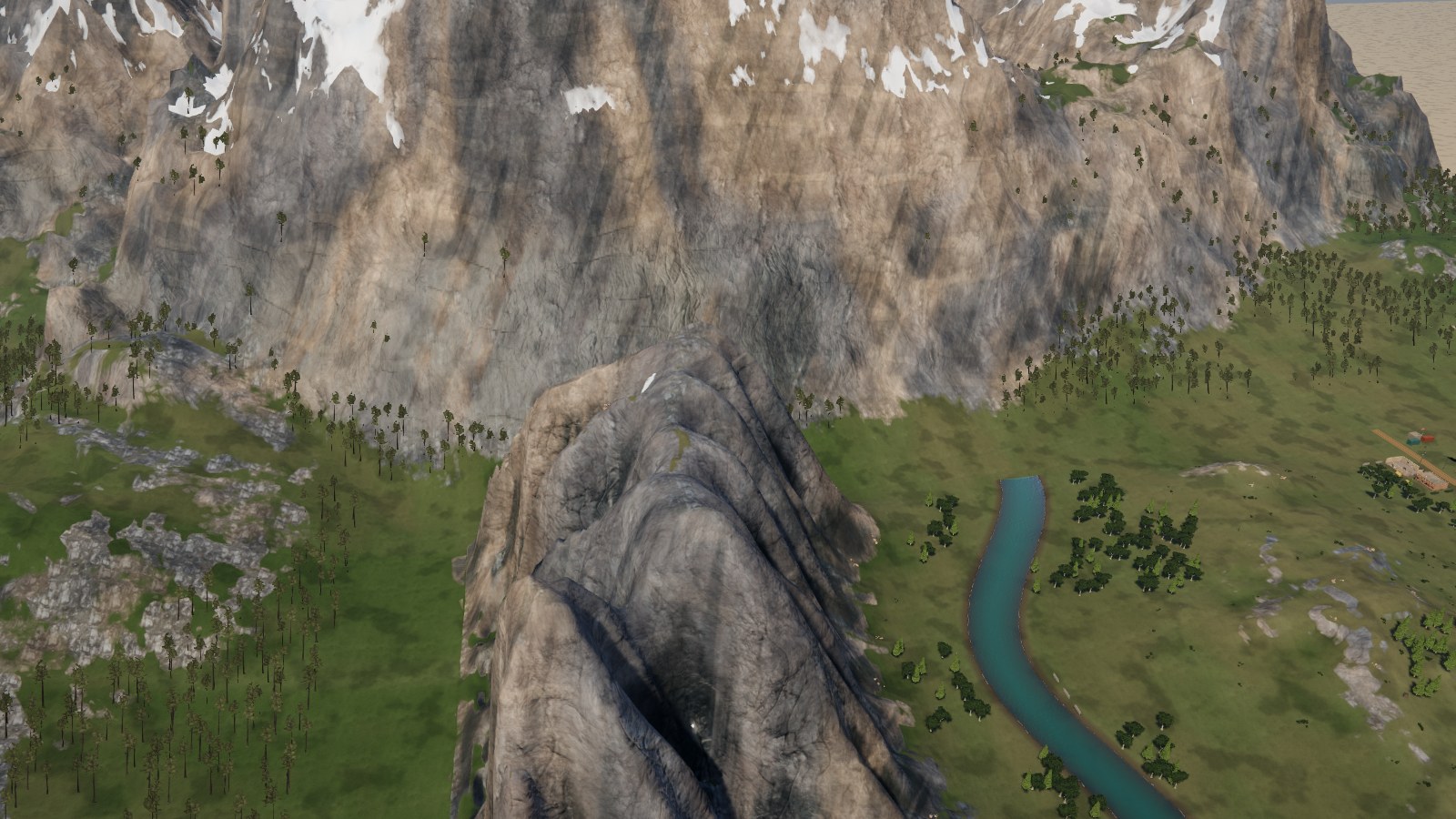
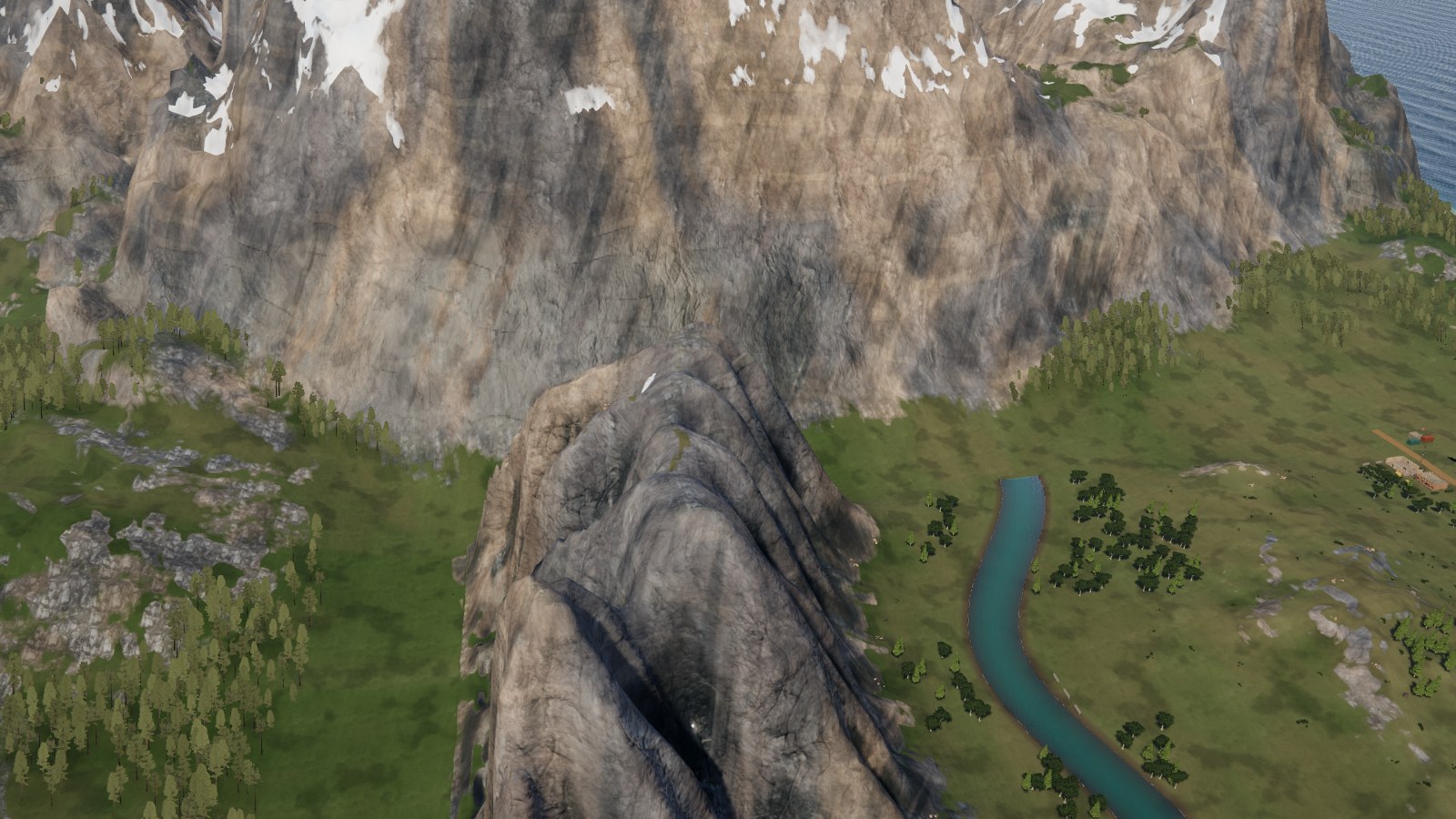
Hillside woods use varied photographed tree silhouettes and a shared placement/ground-cover mask. Five baked elevations blend as the camera tilts, showing crowns from above and full silhouettes near the horizon. High/Ultra shadows also ground these trees against the hillside. Offline edge correction removes the dark fringe from their canopies.
Snow uses photographed powder at its original two-metre scale, with darker melt edges. Forest floors blend moss and leaf litter beneath the same hillside stands. Detailed surfaces follow the terrain-detail setting; texture arrays keep these layers within the browser renderer's sampler budget.
Distant ridges now shade their valleys and forests with cached terrain lighting. Changing the time of day refreshes that lighting without rebuilding the forest. Standing rainwater stays on gentle ground instead of making cliff faces reflect like puddles.
Surrounding ranges now use real Alpine elevation shapes, composed into varied fictional mountain groups. Lower ridges close the horizon between the peaks. The source data is bundled and processed during map creation; no terrain downloads or extra per-frame material samples are needed.
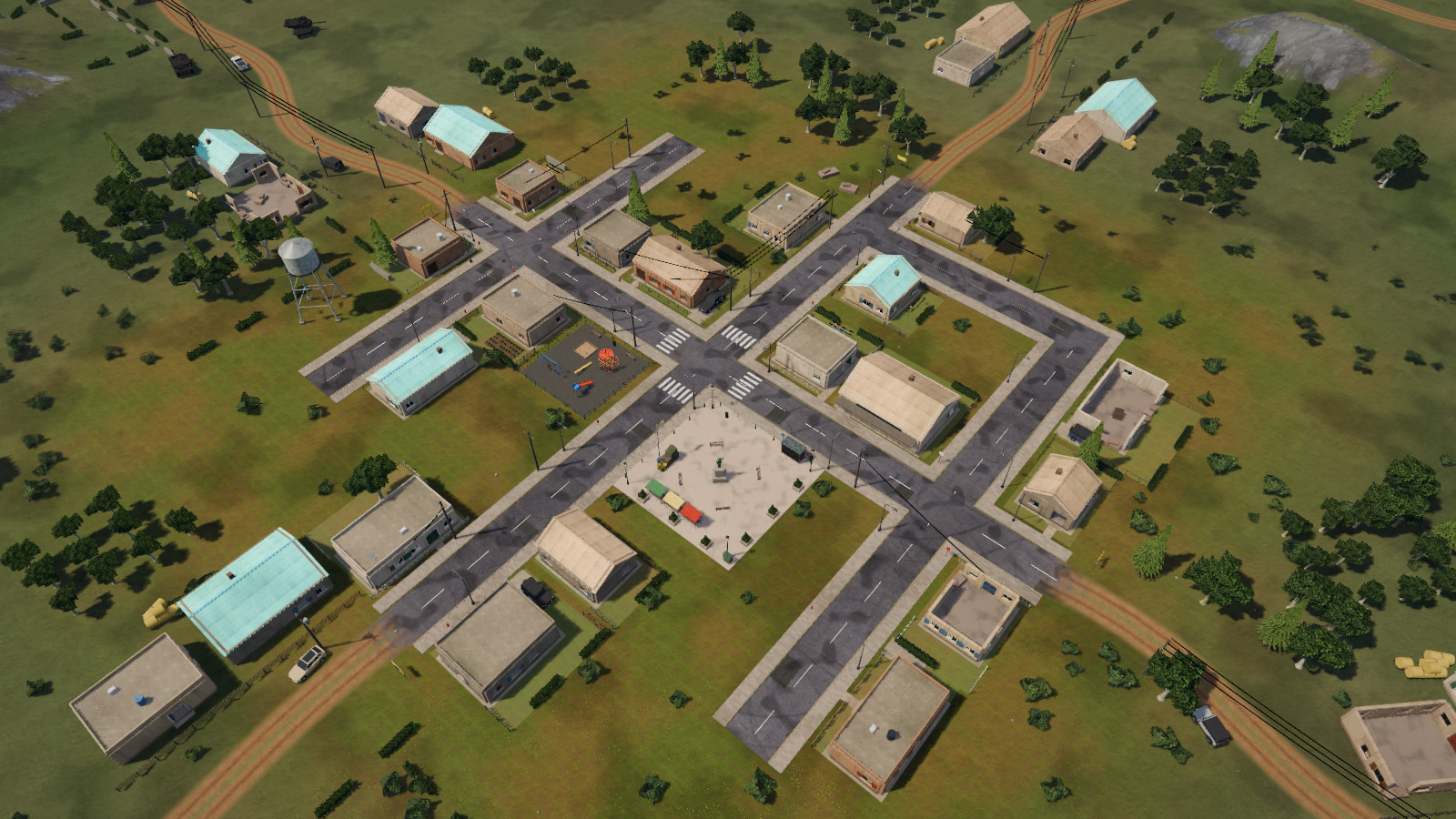
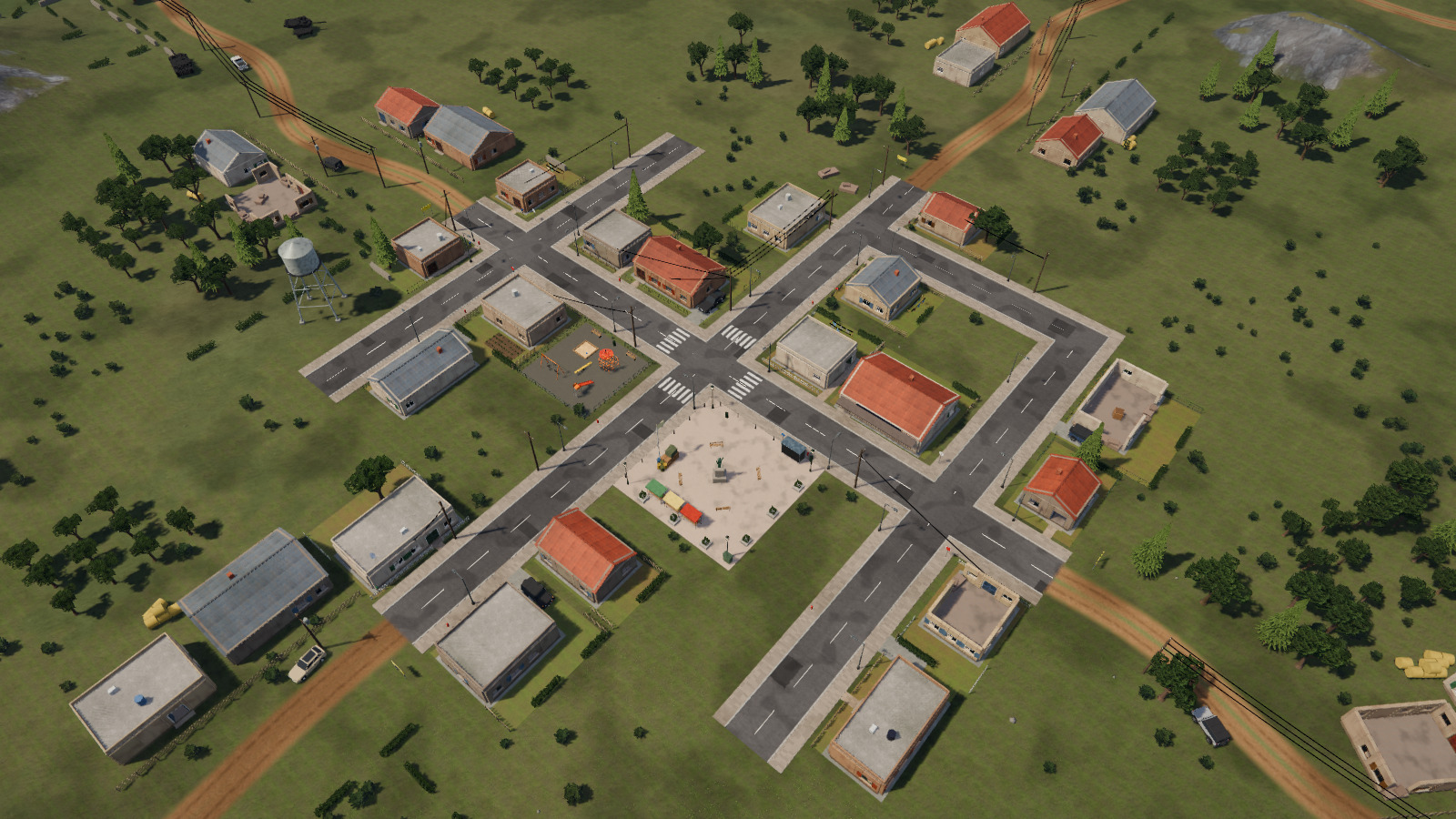
Town asphalt now separates fine aggregate from broad cracks, repairs and stains. Streets and junctions share the same world-space material, blended in linear light in both renderers. Normal maps follow sloping roads and paving instead of lighting every surface as if it were flat.
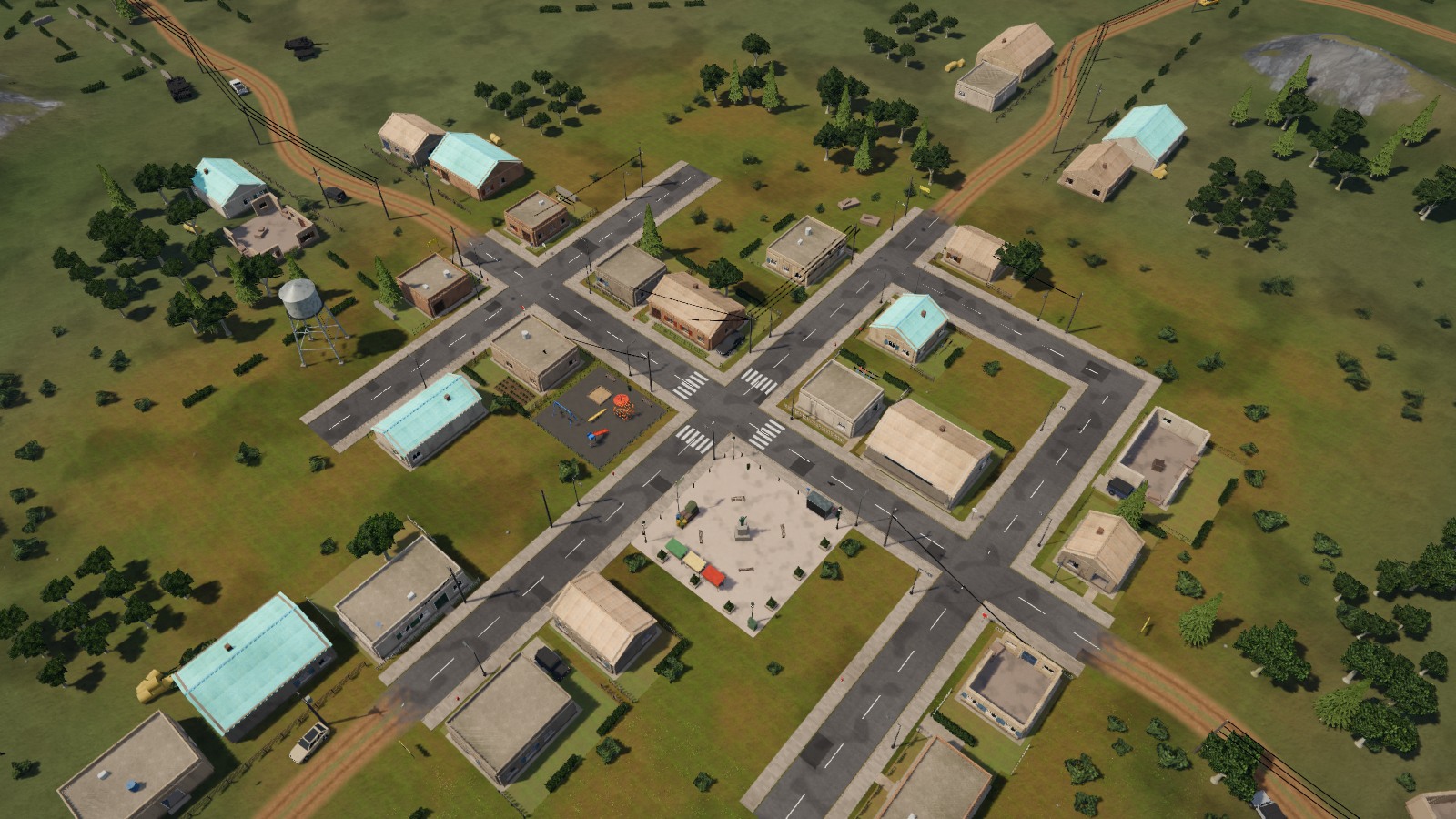
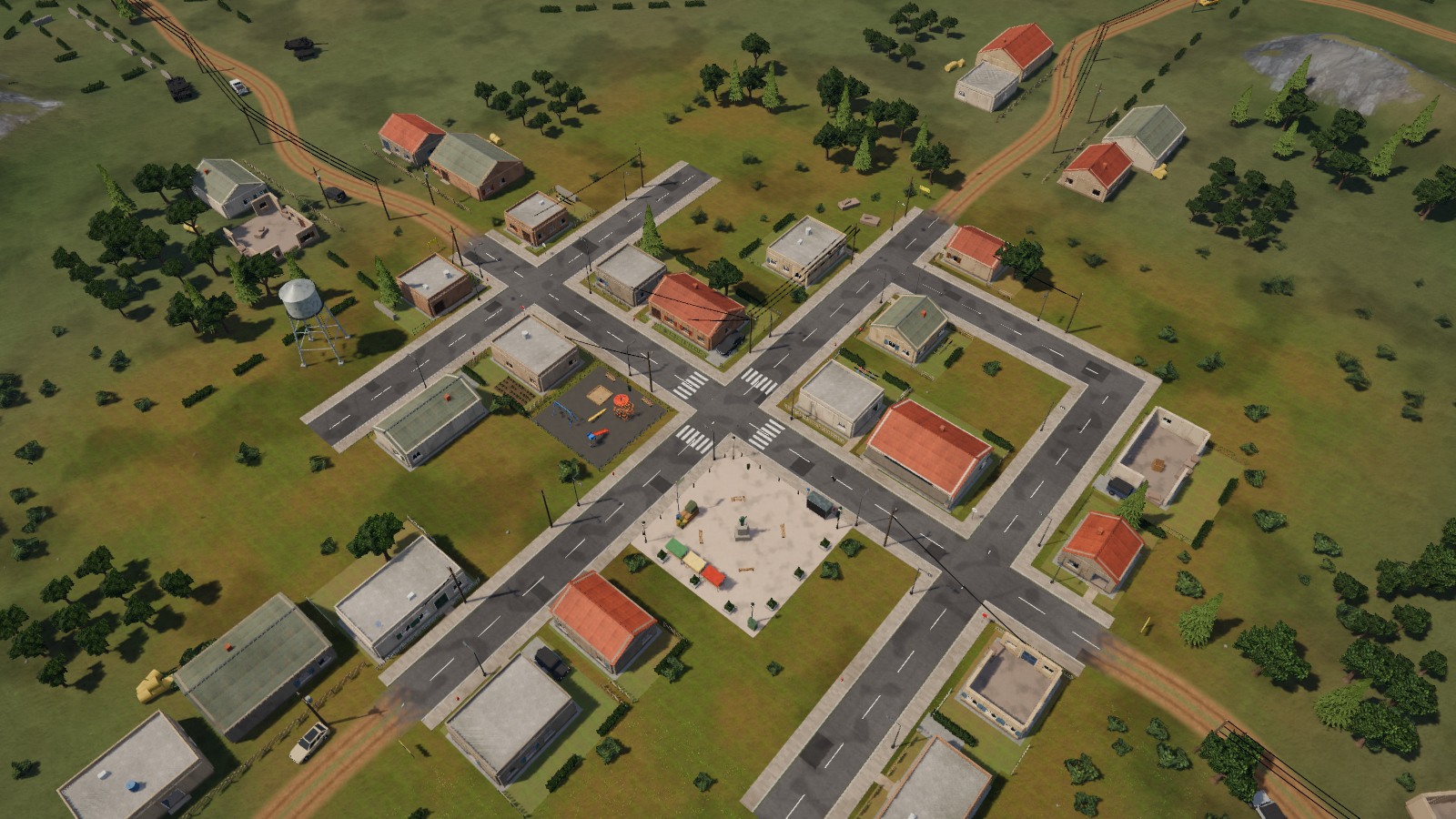
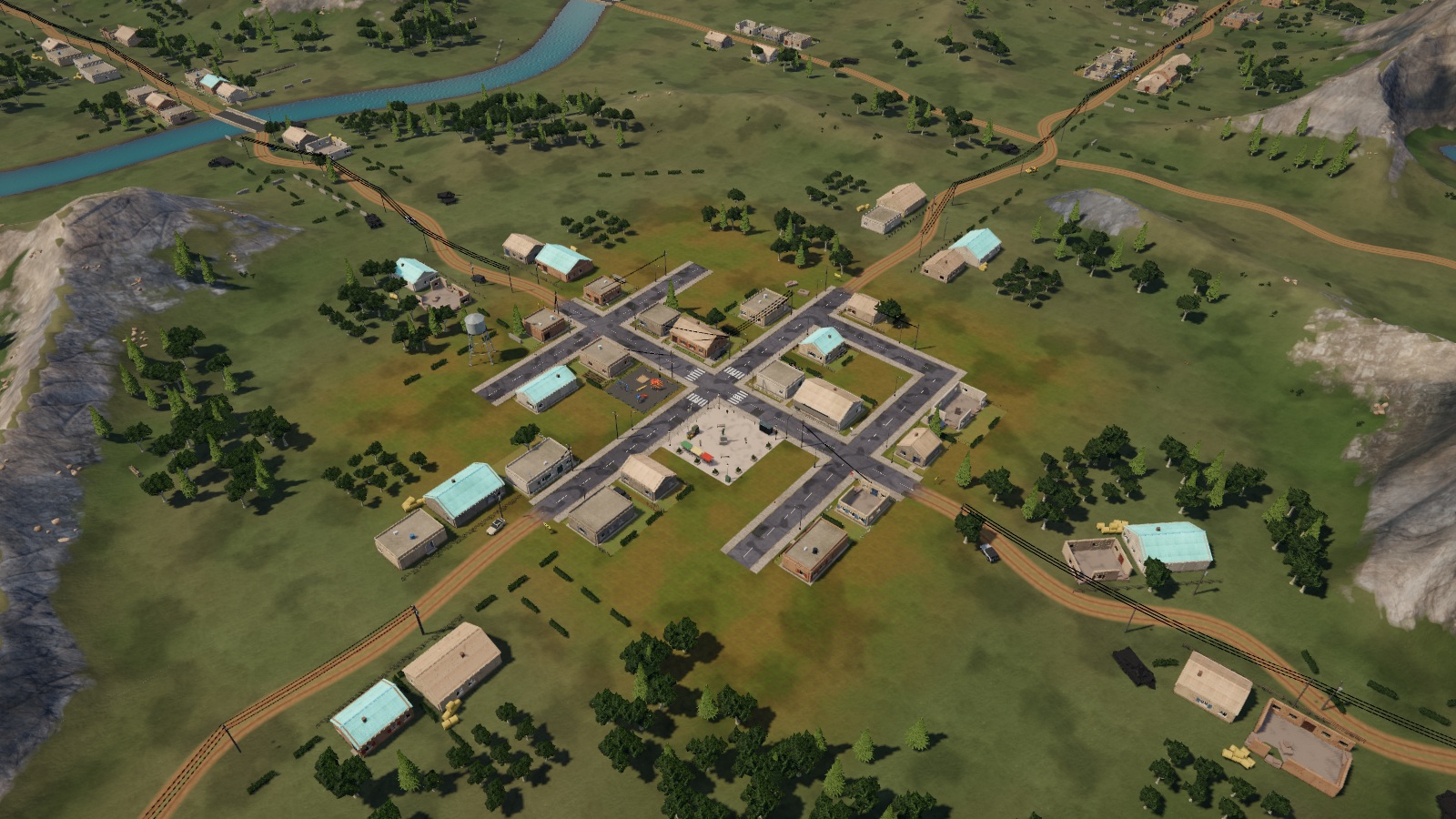
Photographic building materials now respect their intended colours. Calibrated roof tiles, concrete, wood and bark retain the scan detail without turning grey roofs cyan or all tiled roofs pale beige.
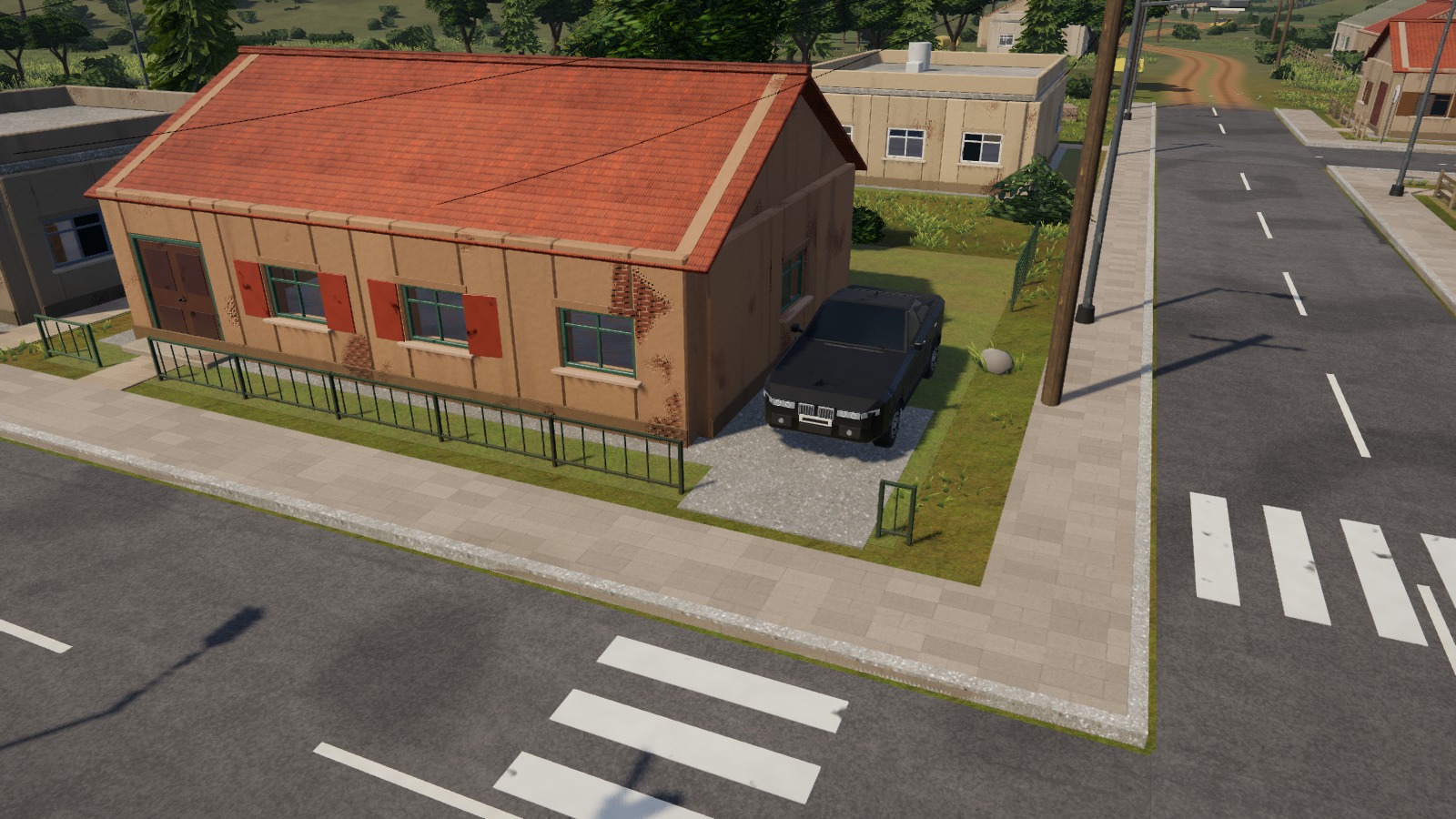
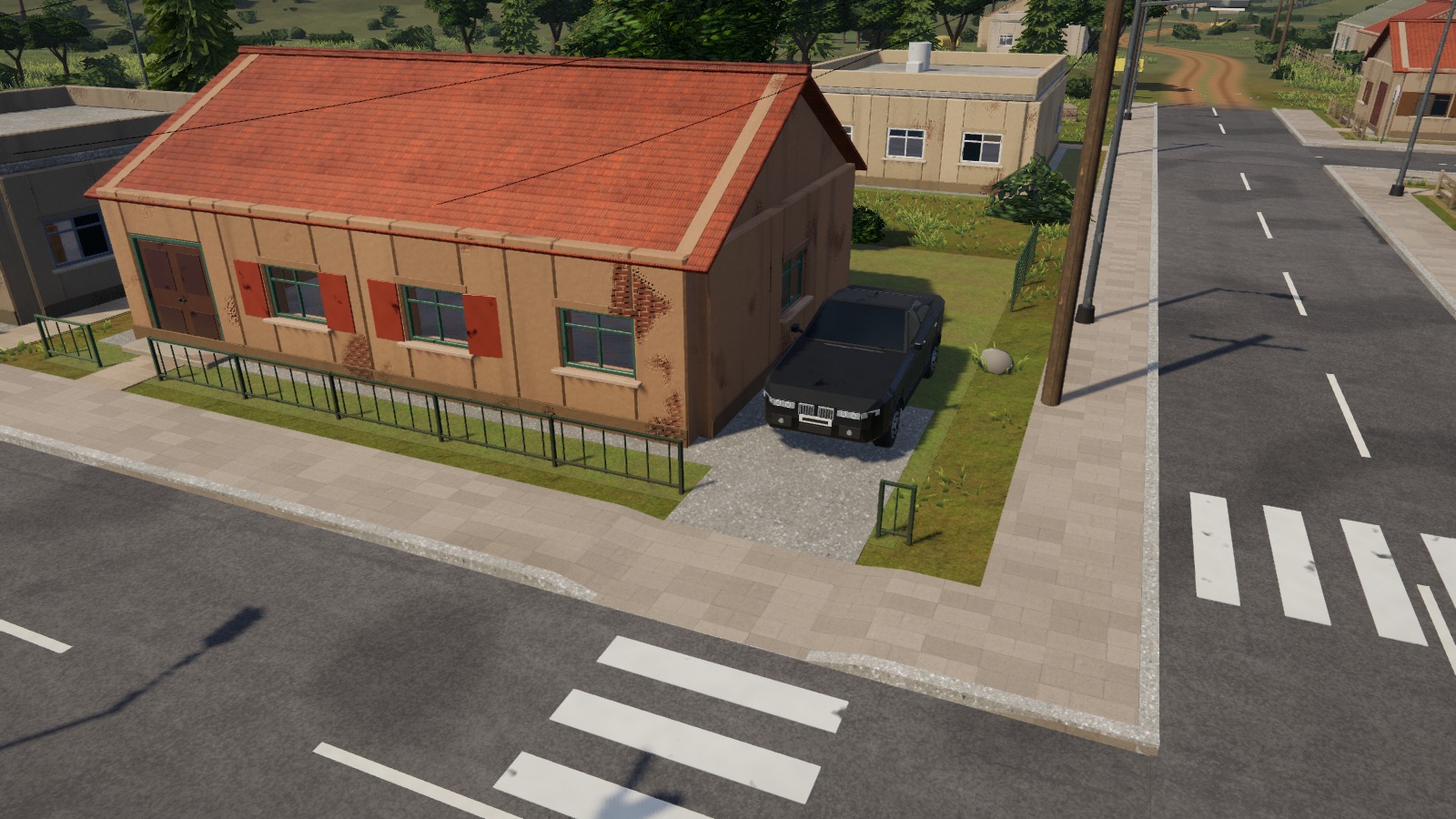
Driveways now connect to the street through lowered sidewalk crossings with sloping shoulders. Curbs meet the asphalt, and grass stays out of the paved entrance.
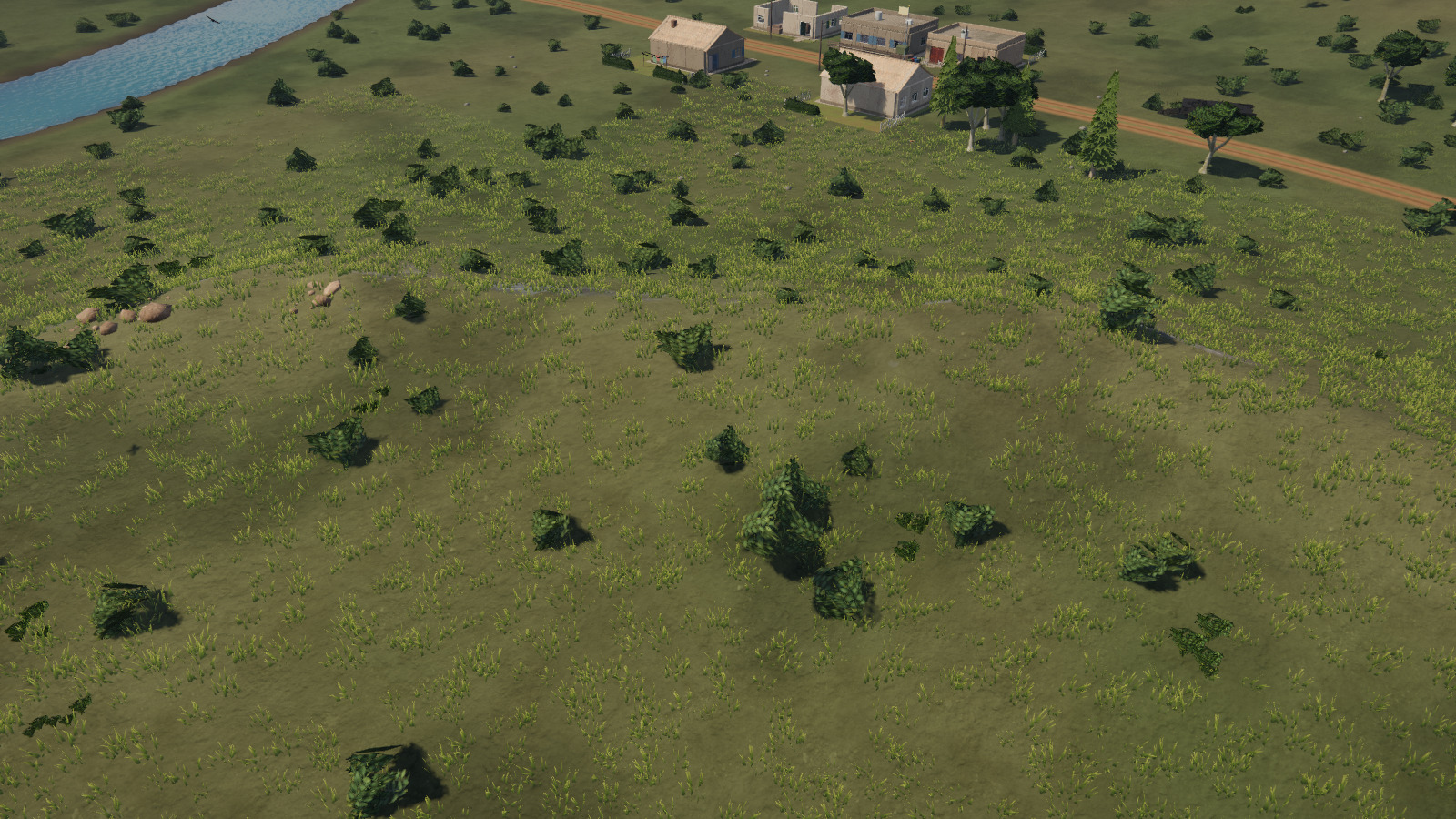
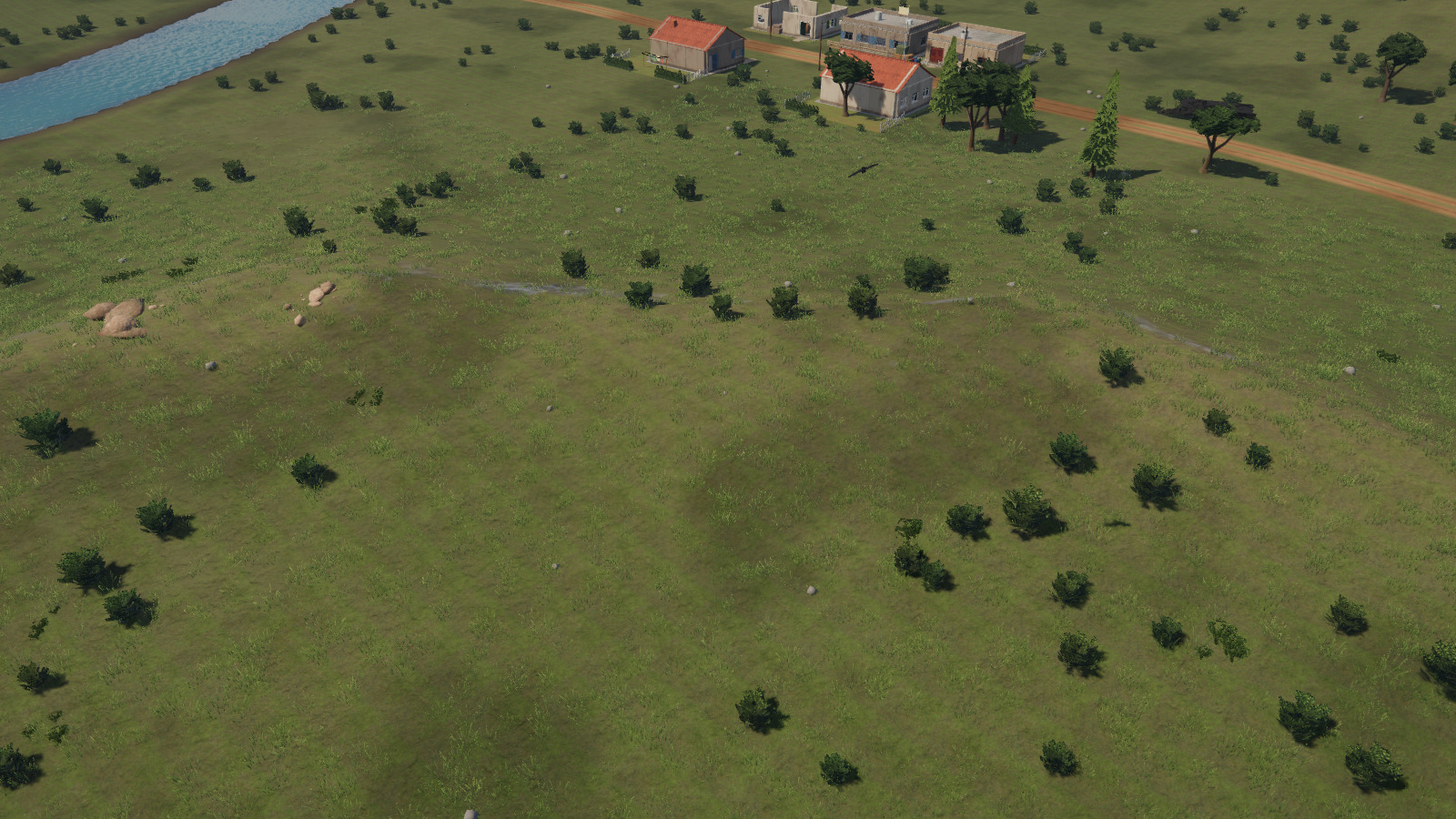
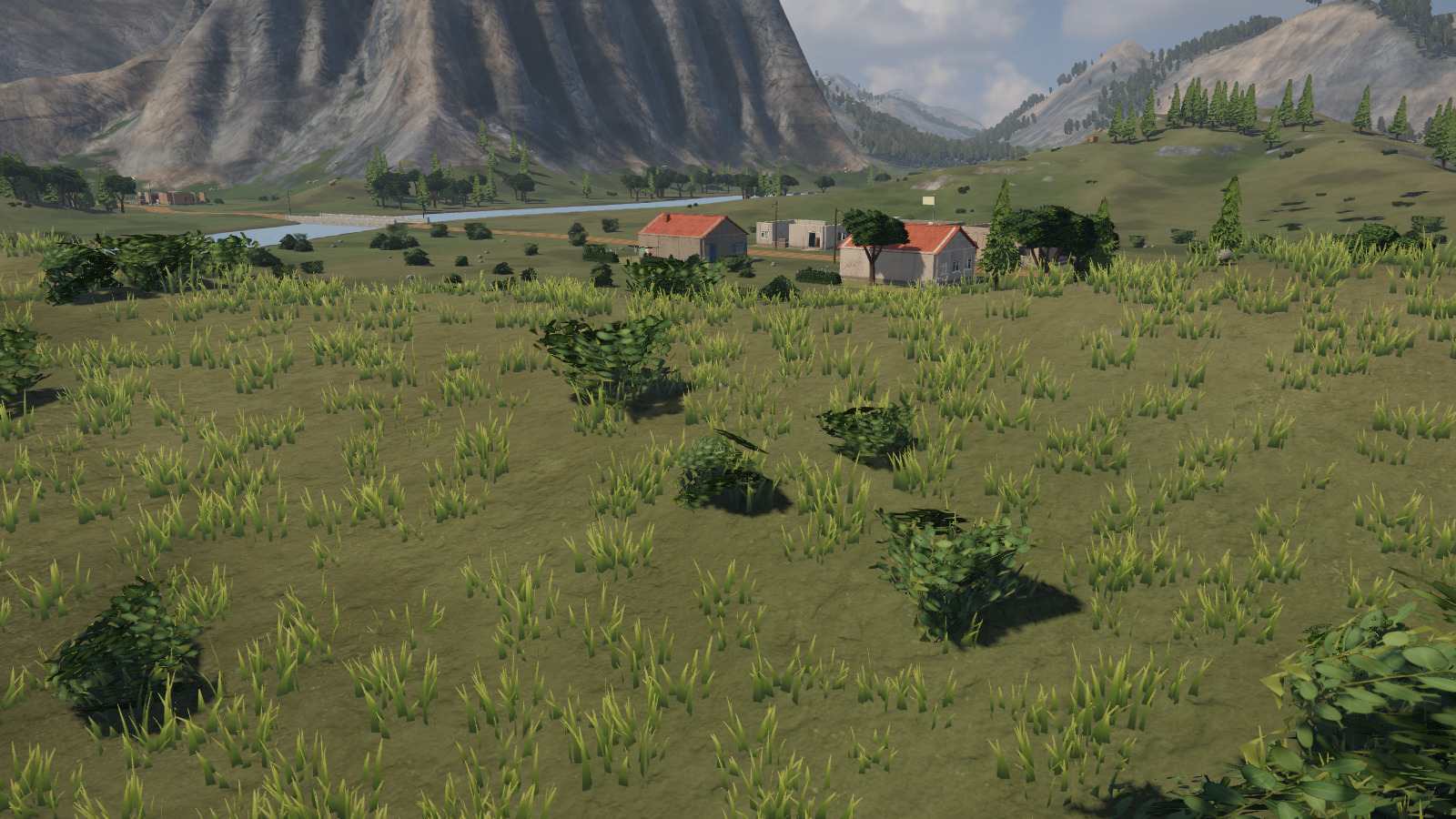
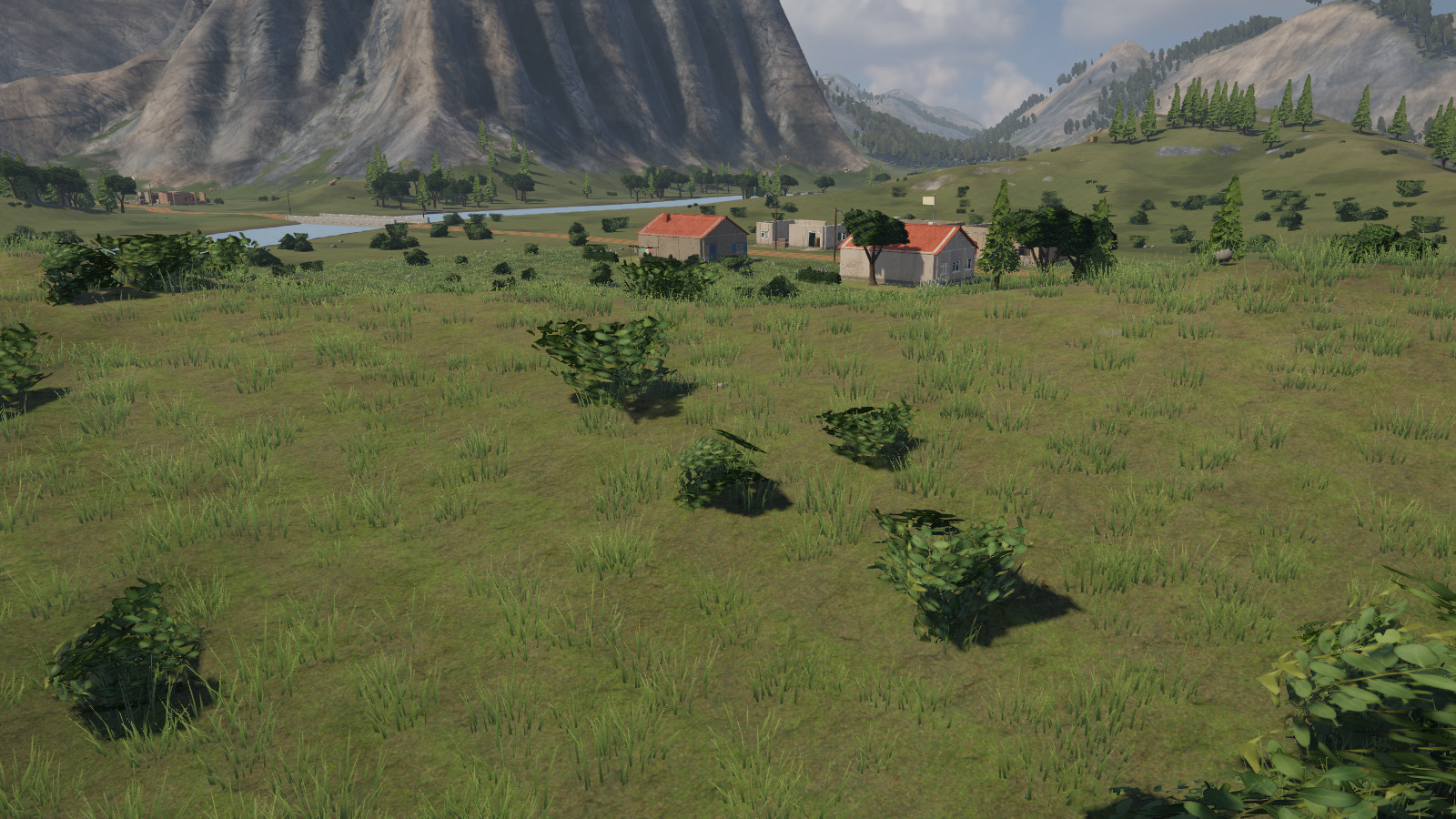
Meadow grass and shrubs remain visible on elevated ground, and small decorative stones rest on the actual hillside. Trees and buildings also stay resident when a low camera looks up a high slope. Grass thins below the snow line and stops on bare steep faces instead of leaving stray clumps in unsuitable terrain.
Elevated surfaces retain full height precision, removing the fine stepping that showed through snow and slope shading. Ground-level staining on walls follows the hillside instead of sea level.
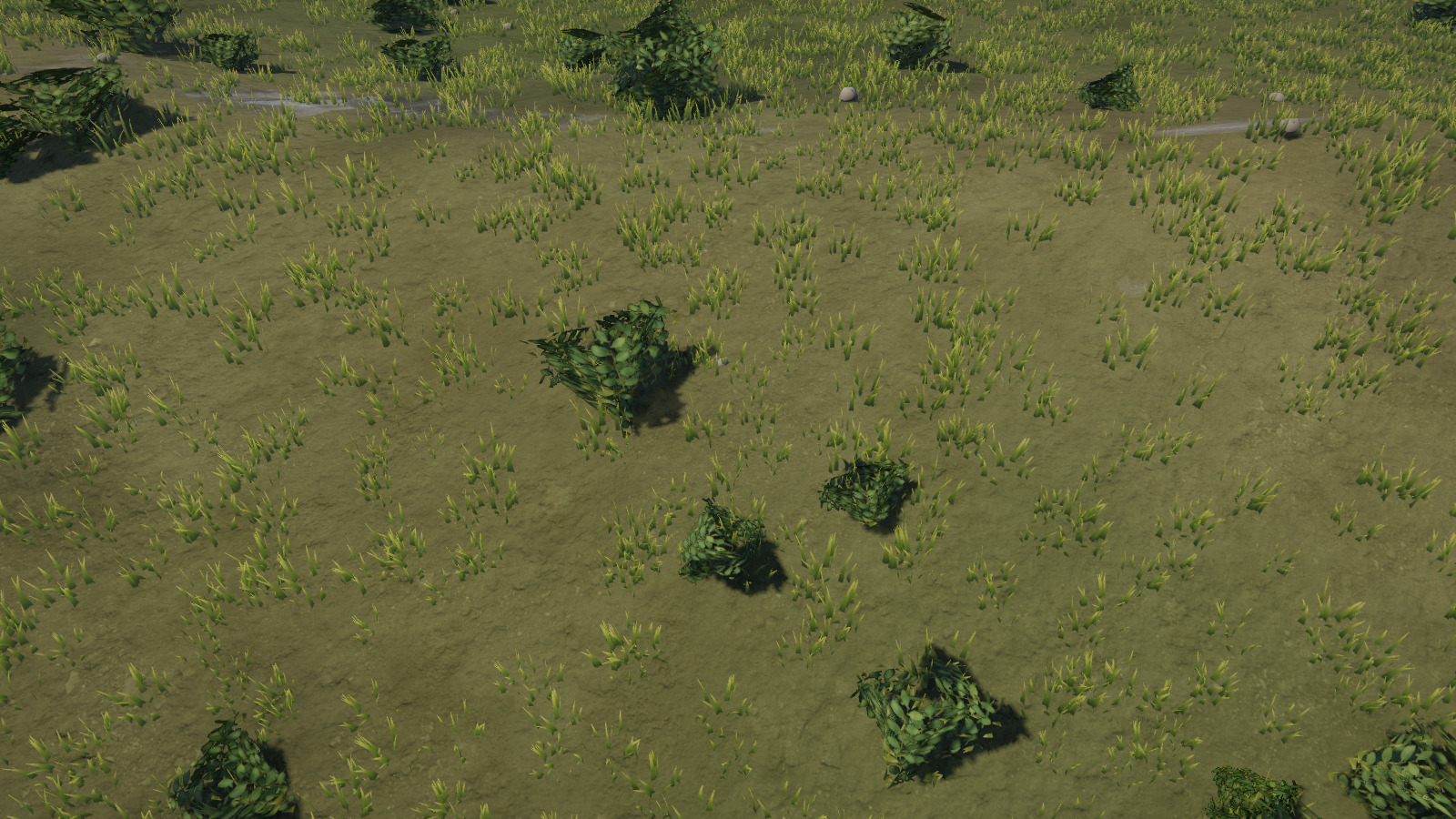
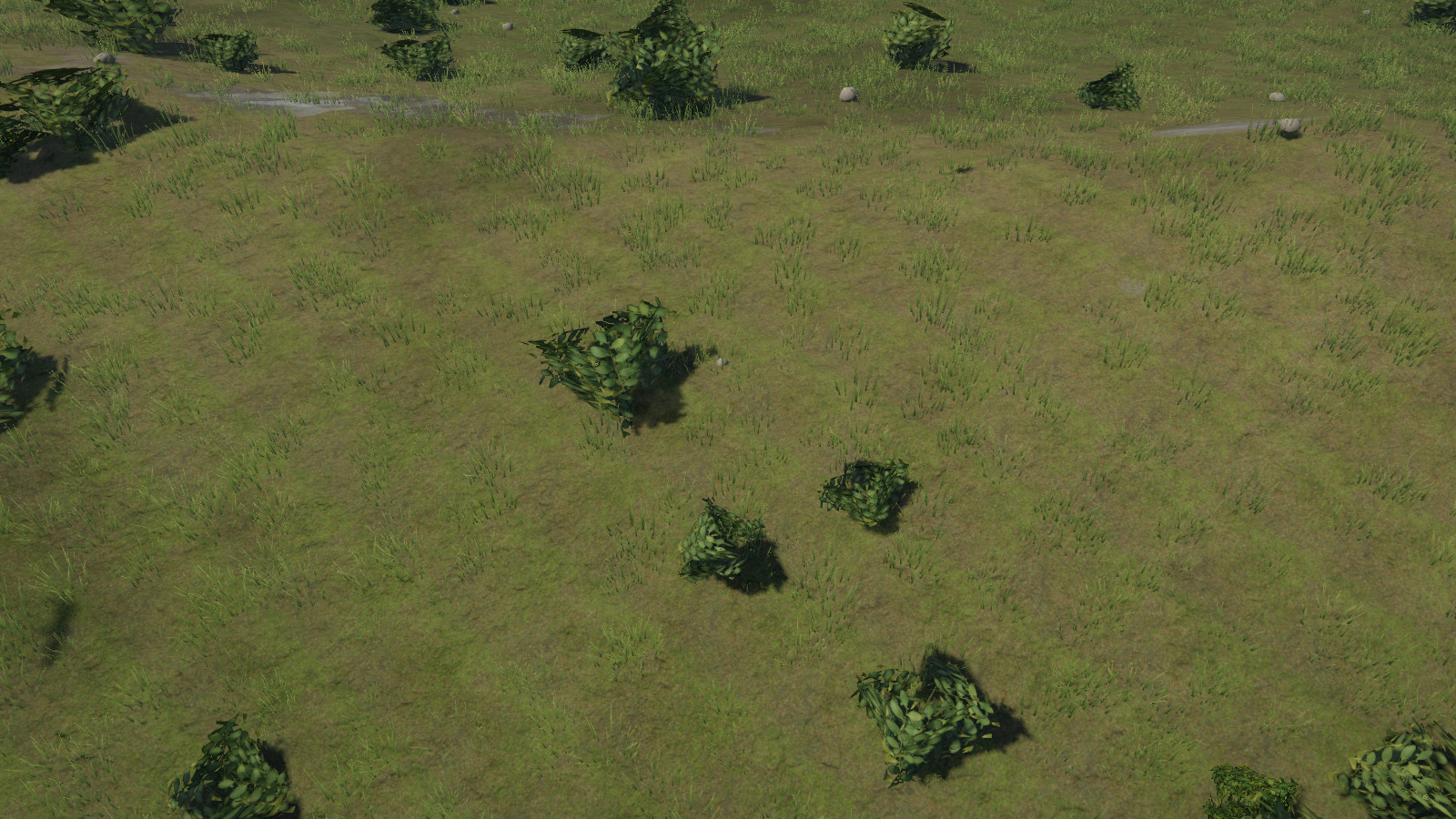
Meadows use fine pointed blades over photographed turf, with wetter sheltered soil and drier exposed patches. The clumps retain their previous triangle count. Local height bounds keep distance fading centred on each patch of vegetation, even when much taller mountains surround it.
Low shrubs use smaller photographed branches and grow in seeded patches with open gaps. Their root shading follows each plant rather than its elevation. Distant forest atlases also load correctly in exported builds.
Local games share the scenery batching used by network clients. Returning to already-built scenery reveals it promptly while off-screen buildings retain their combat collision. Batched roofs and other tinted surfaces keep their colours in both renderers, including grey roofs in the browser.
World-space wood, plaster and weathering stay in place when scenery enters a batch. Shrub leaves receive light from both sides without reversing their back-face normals.
Broadleaf crowns have smaller branches and more open gaps at the same triangle count. Photographed foliage uses its own surface detail, with consistent colour and two-sided lighting instead of an extra layer of procedural leaf noise.
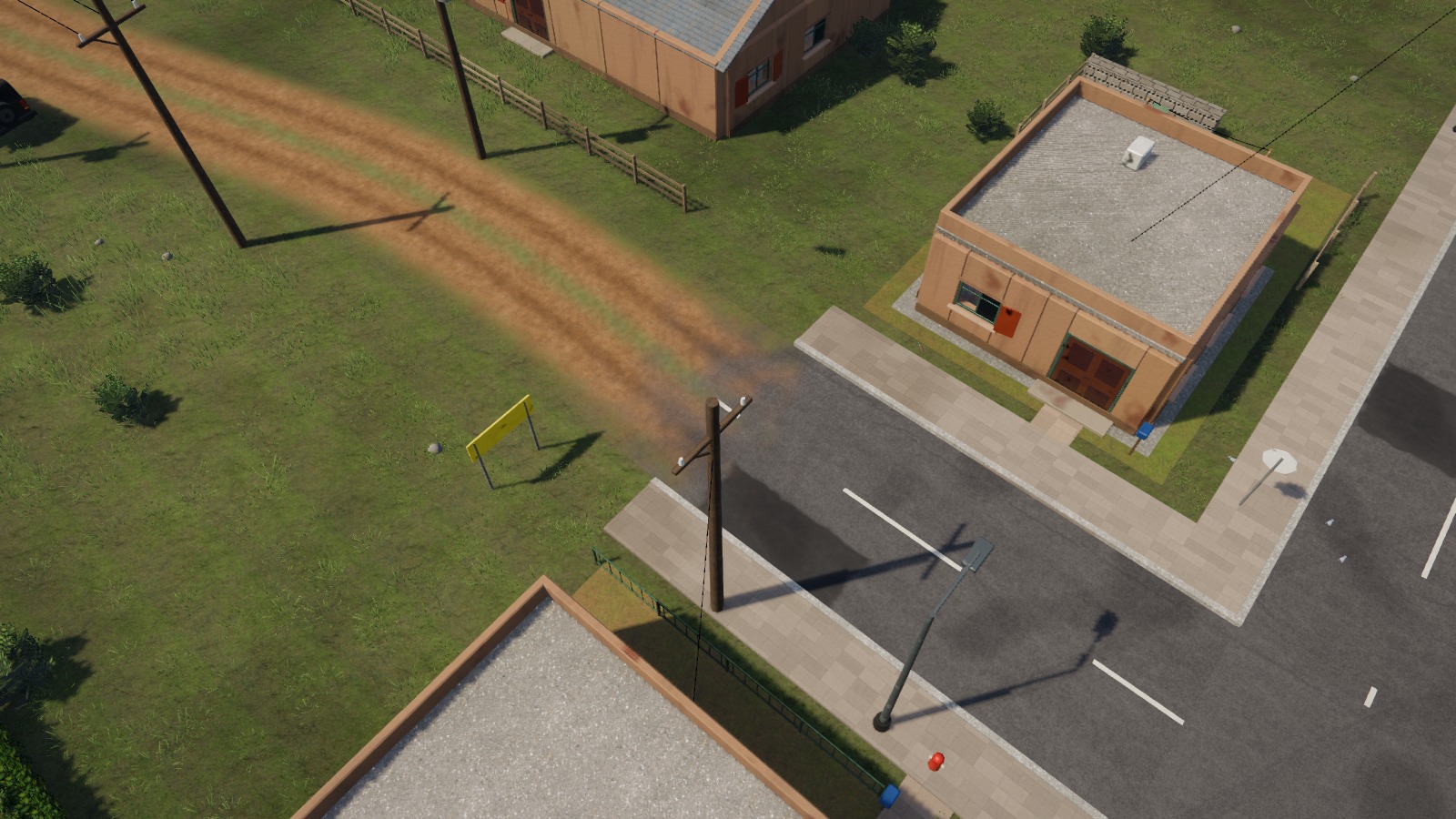
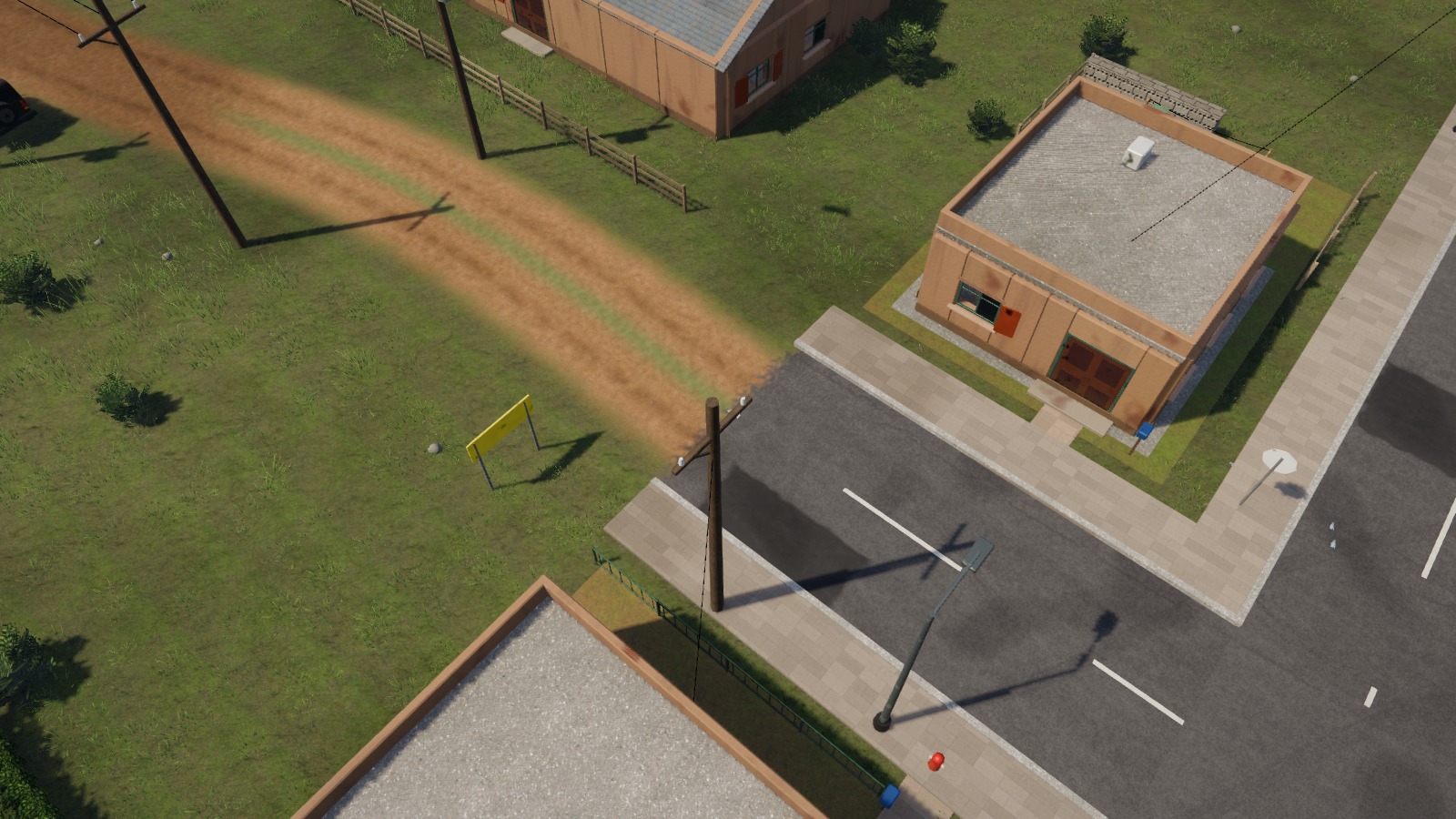
Country tracks have varied rut widths, intermittent centre grass and broader worn patches. Their joins to town asphalt use a short broken edge instead of a wide blurred band.
Mountain weathering follows baked downhill catchments. Snow persists in sheltered drainage channels while exposed ribs remain visible; changing the sunlight reuses the same drainage mask.
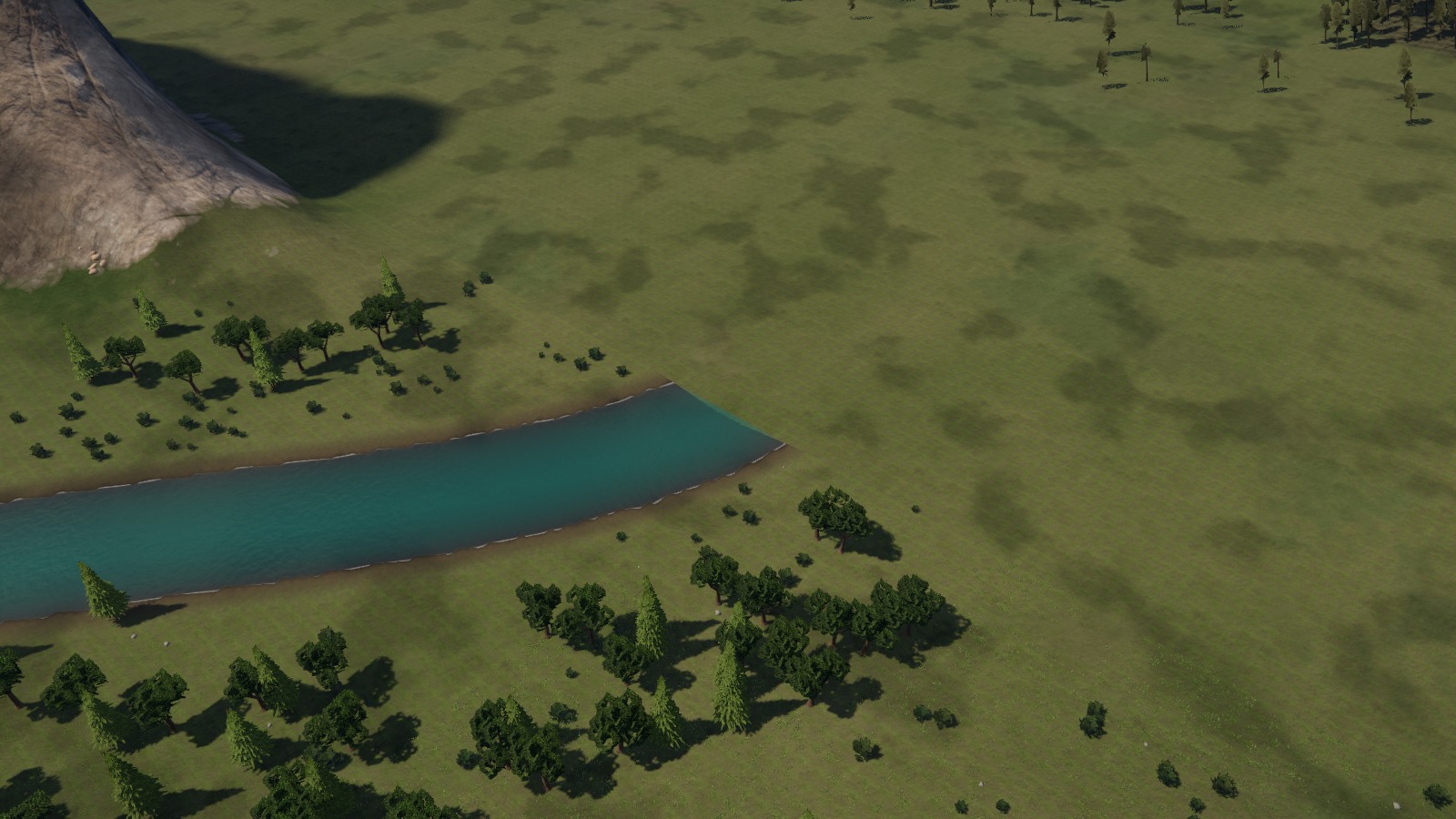
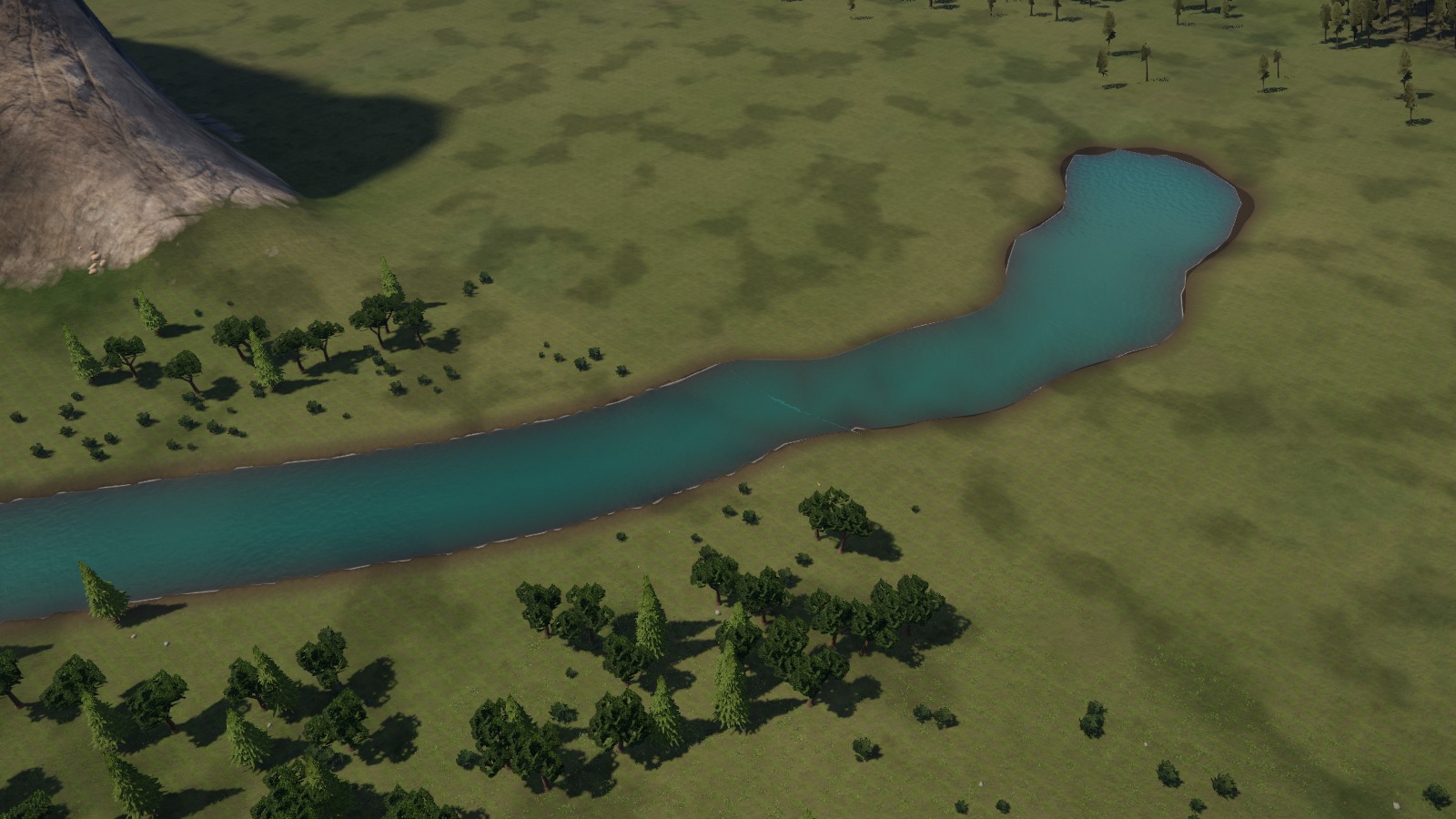
Rivers continue beyond the battlefield into irregular scenery pools, with matching banks and riverbeds. These distant extensions do not change playable water or navigation.
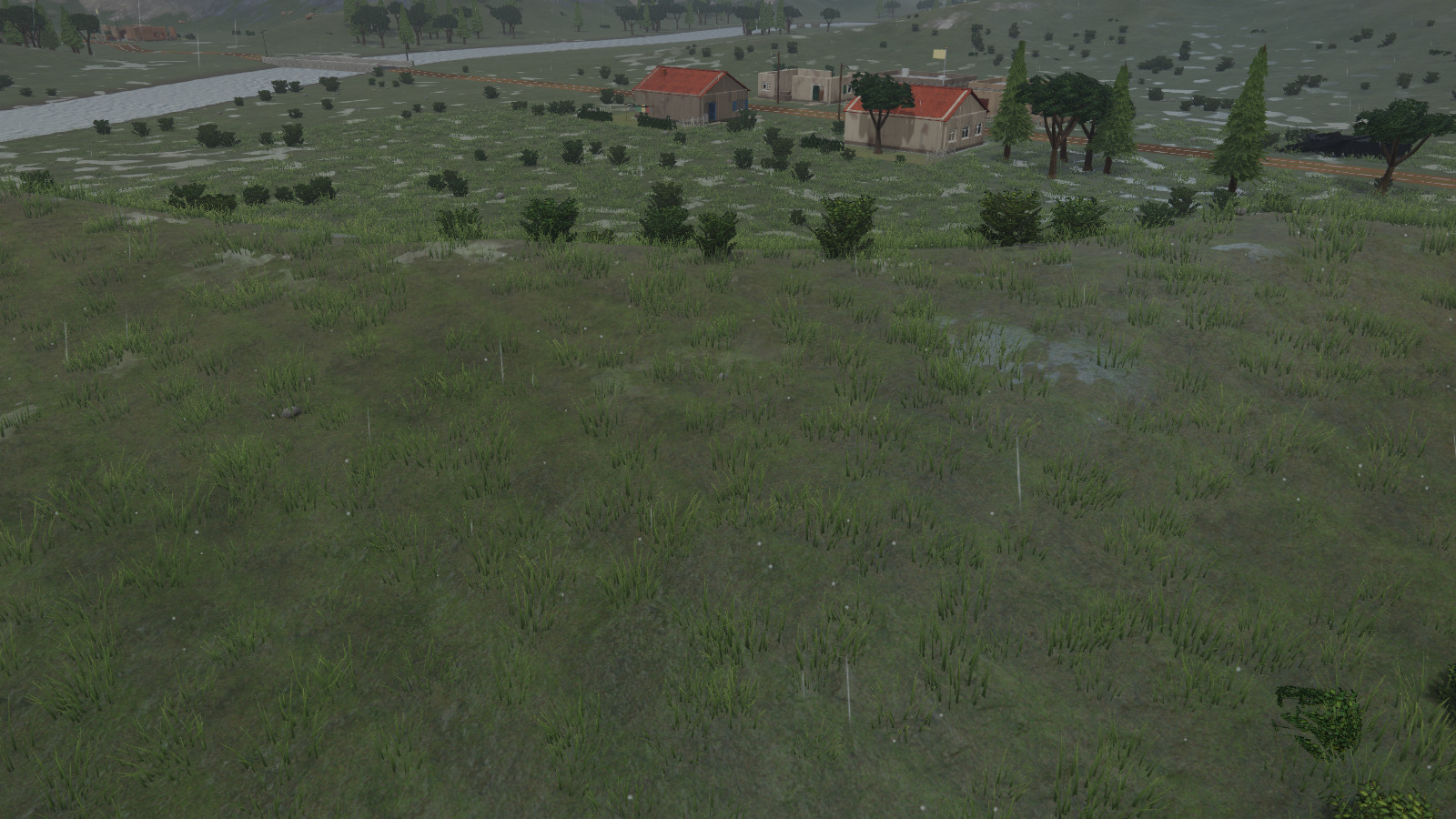
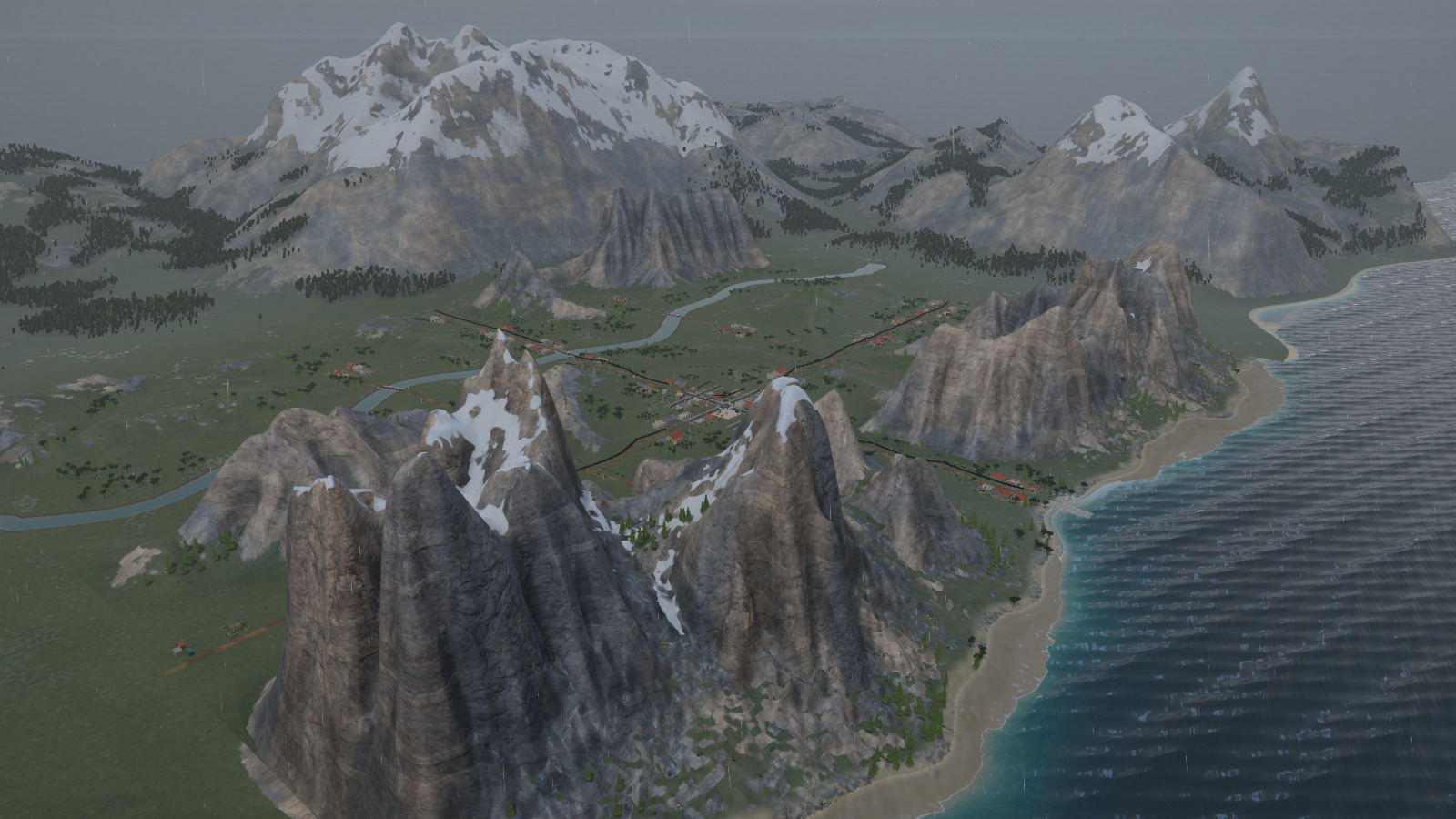
Browser lighting follows the displaced mountain slopes and softly lights photographed tree canopies while keeping the cheaper vertex-lighting renderer. Rain surrounds the camera with finer streaks; soft splashes follow ground and water height and disappear at distance.
Procedural clouds have smooth edges in both renderers, with subdued moonlit shading at night. Reflected clouds on the sea follow that night lighting instead of retaining their daytime brightness.
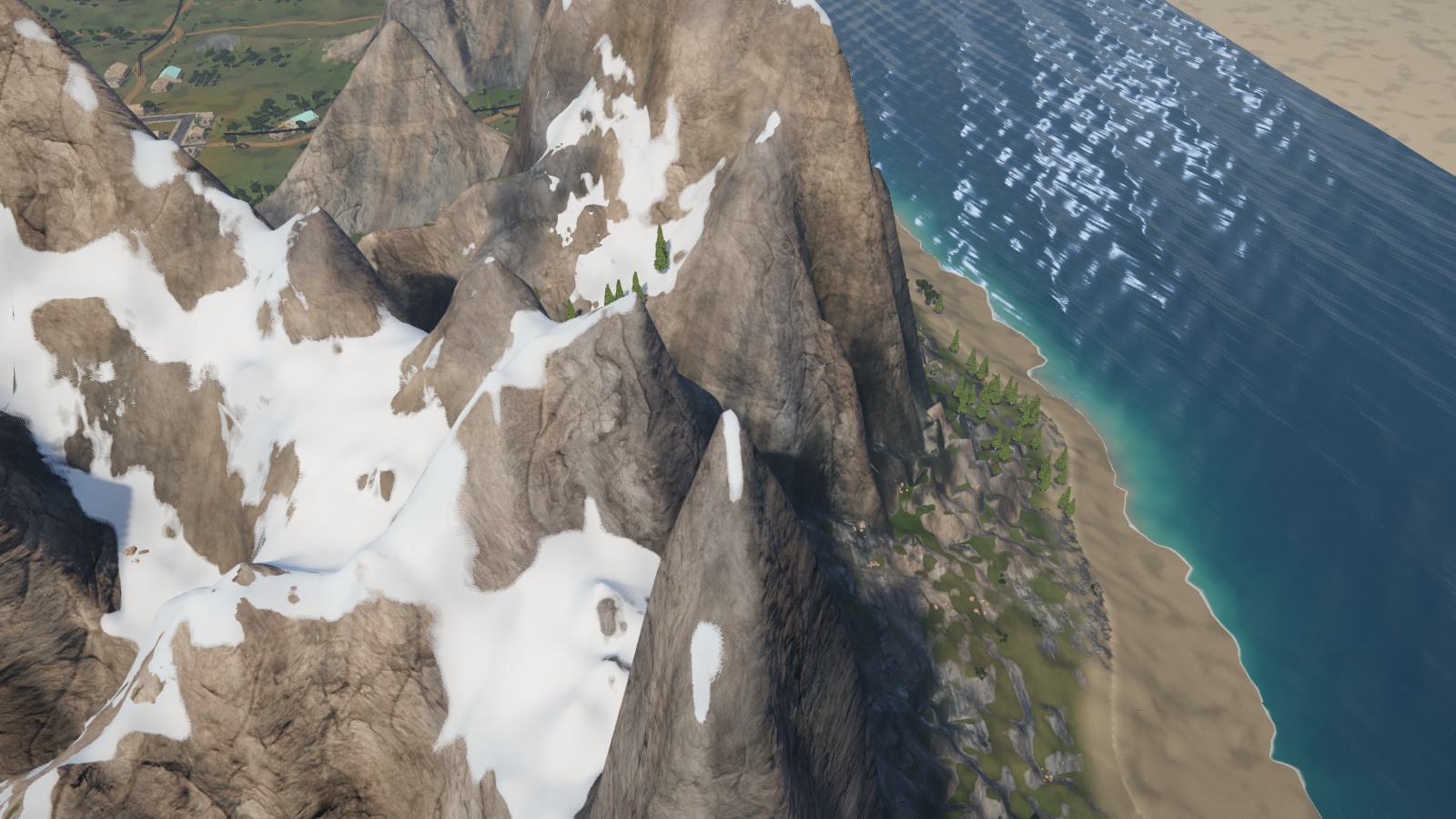
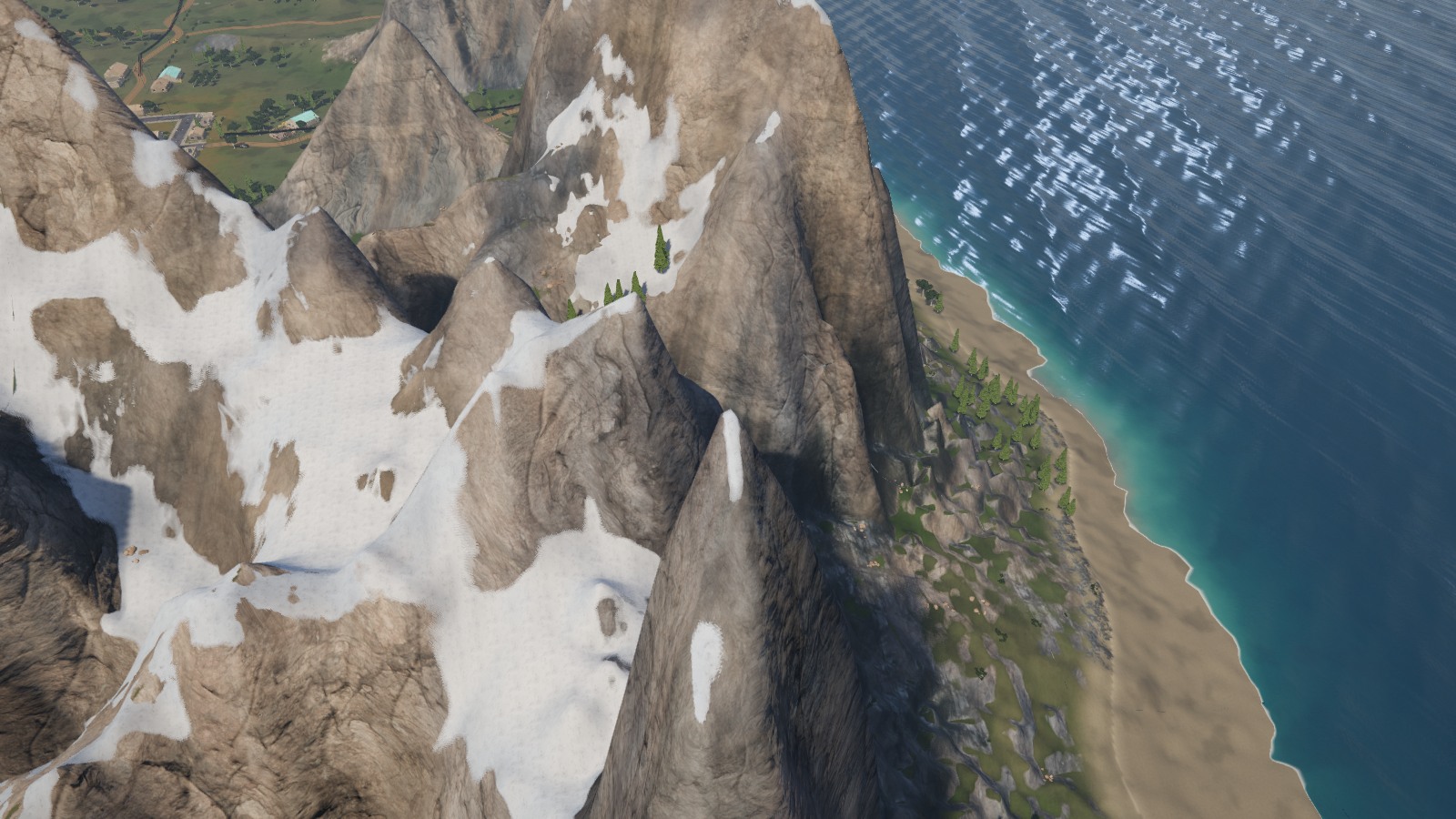
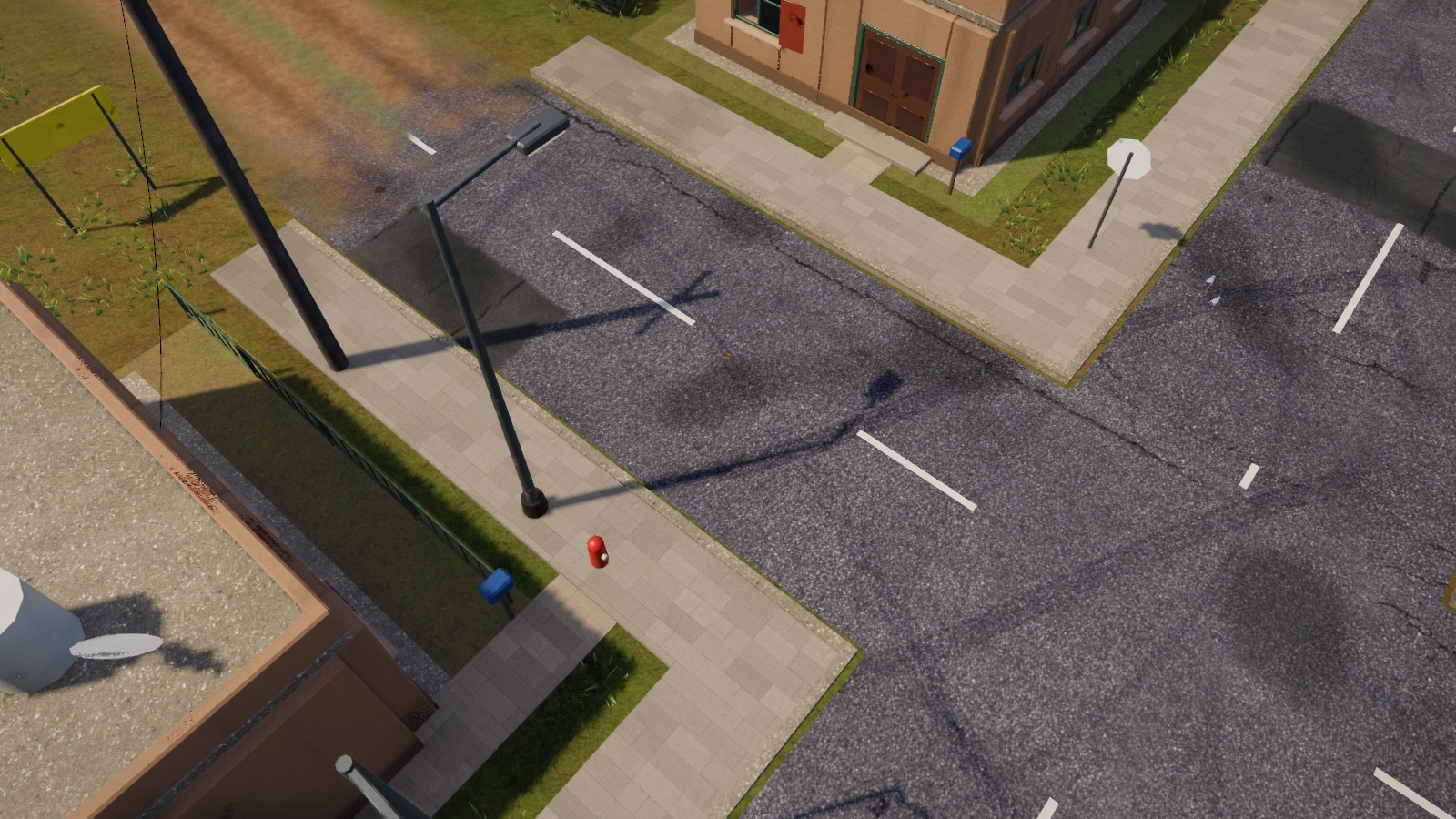
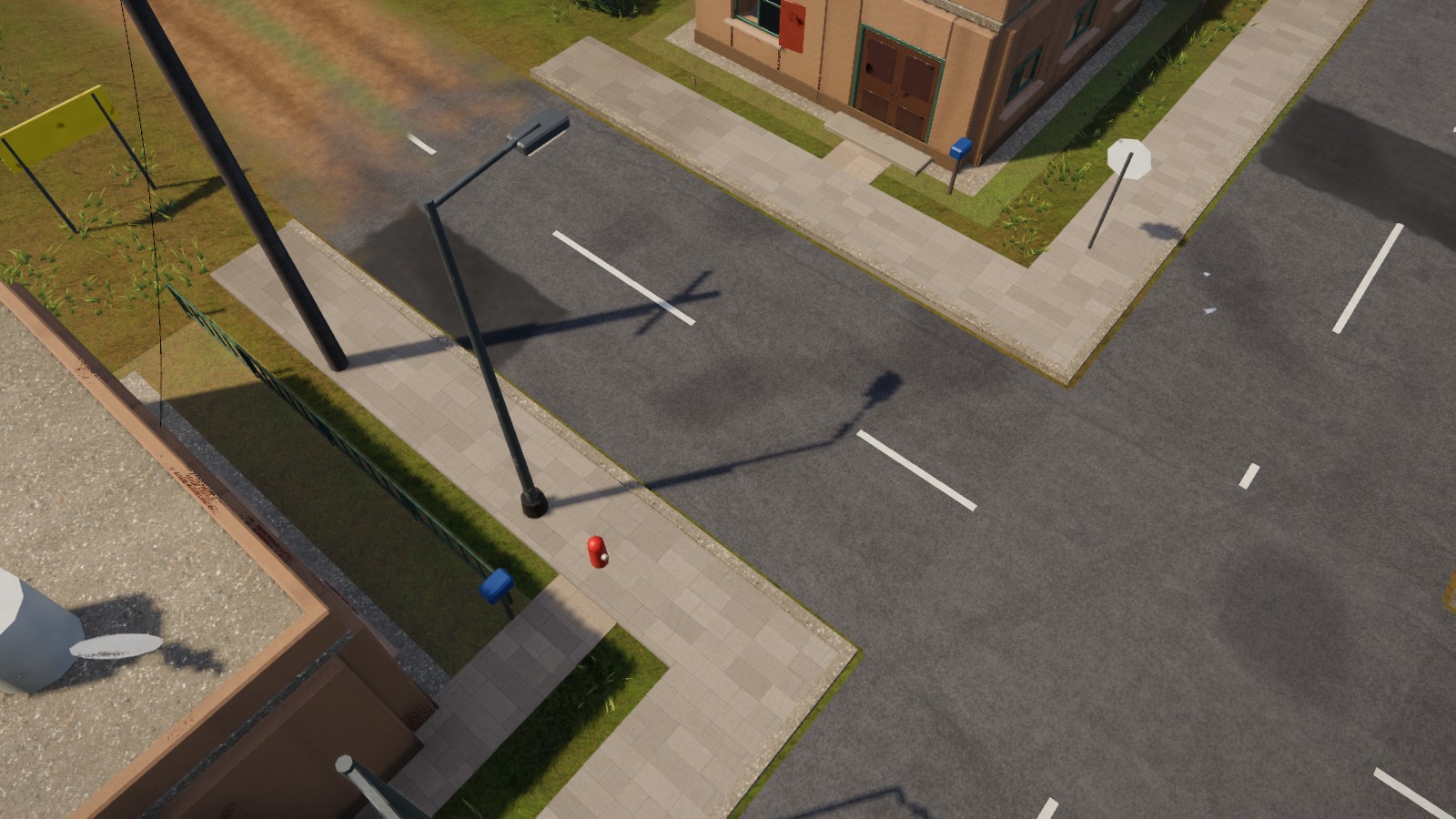
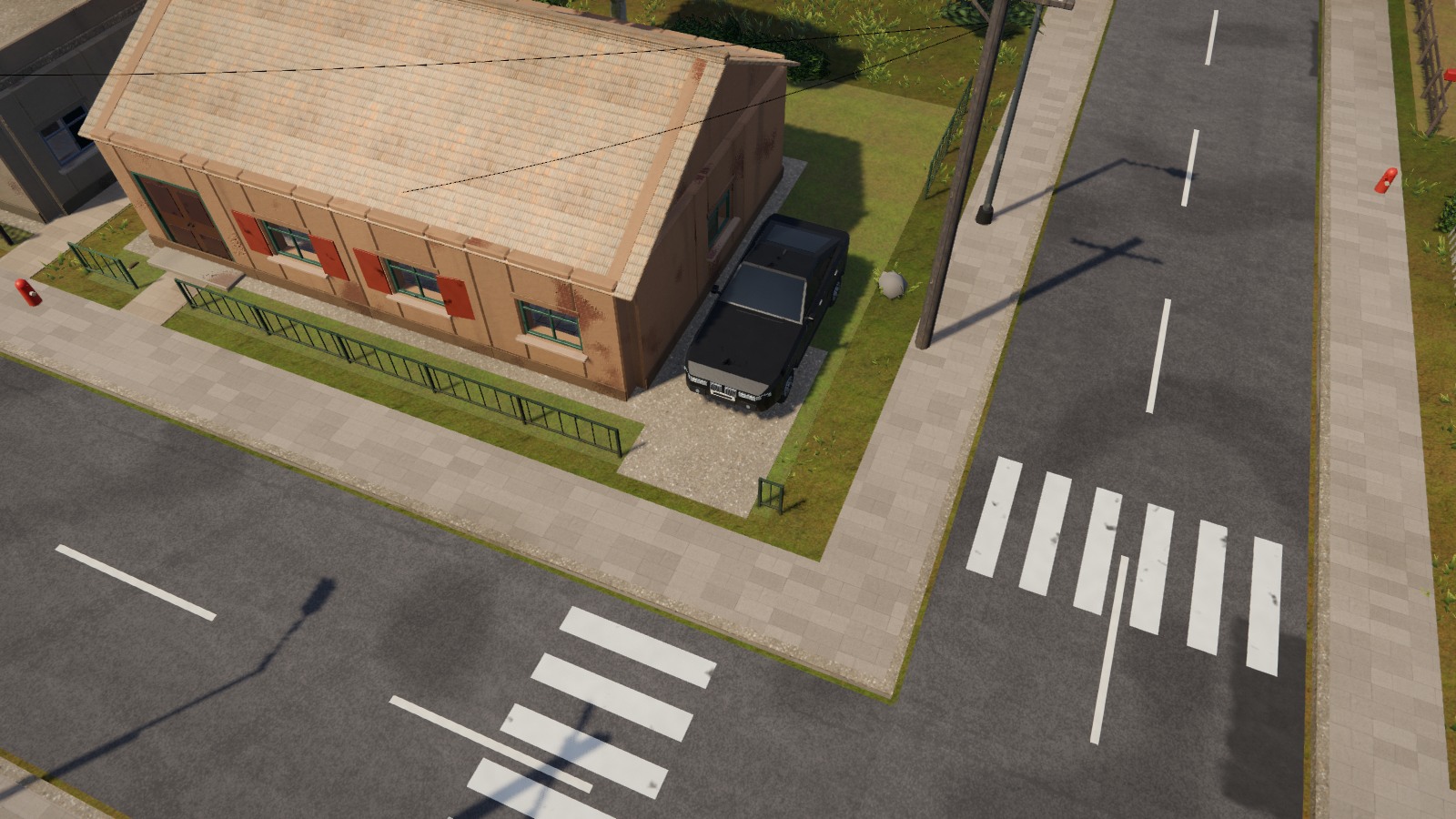
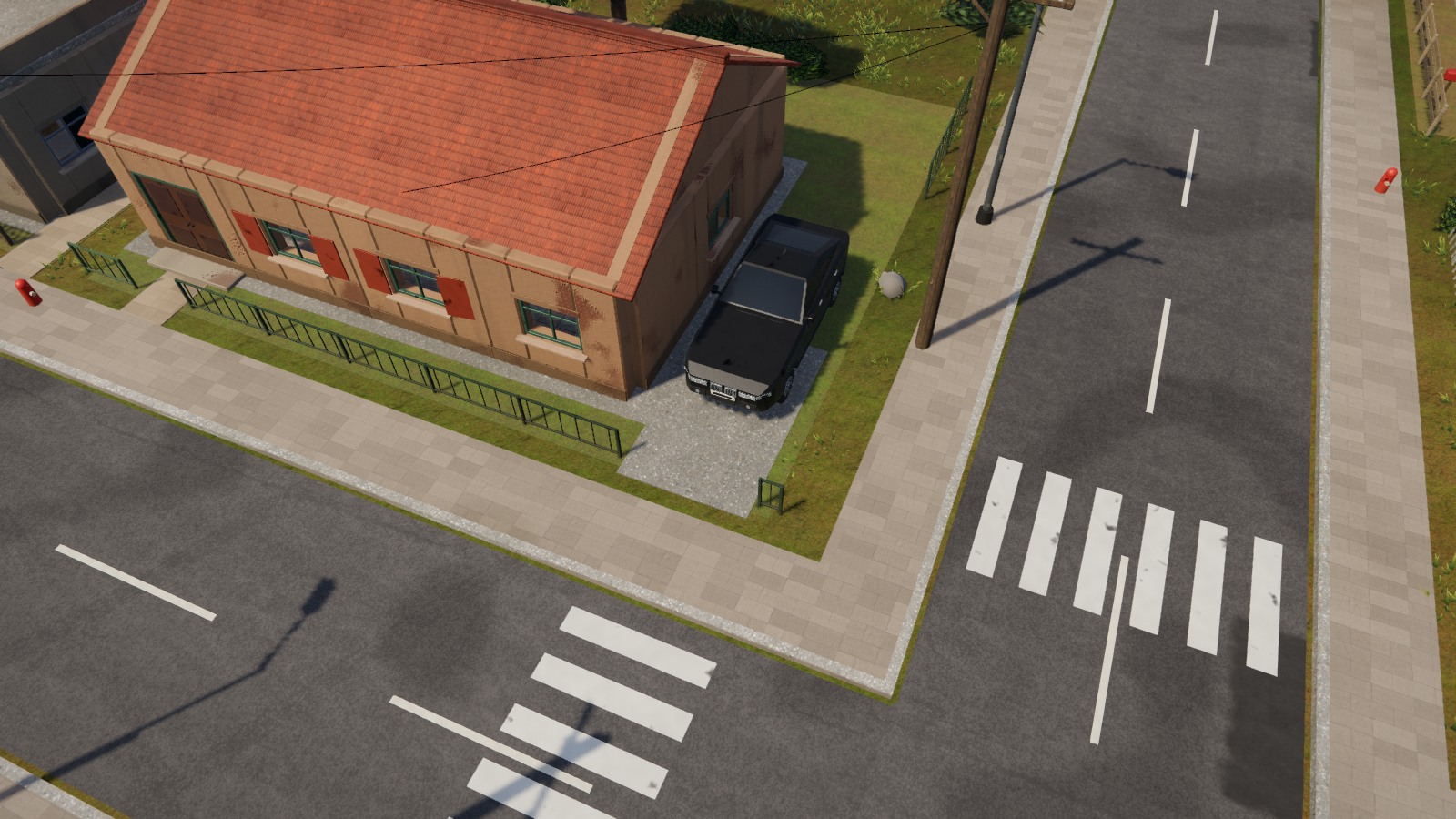
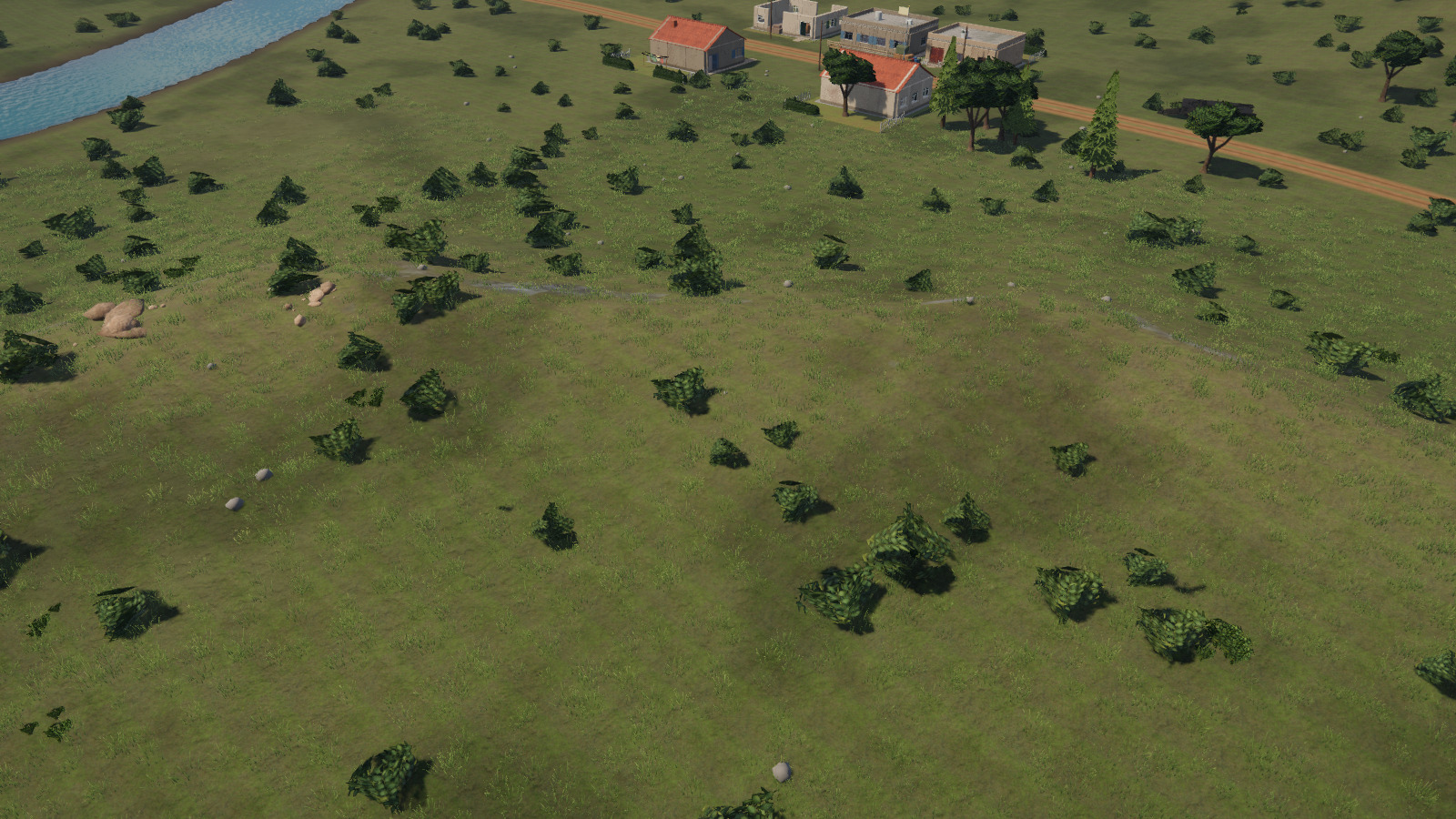
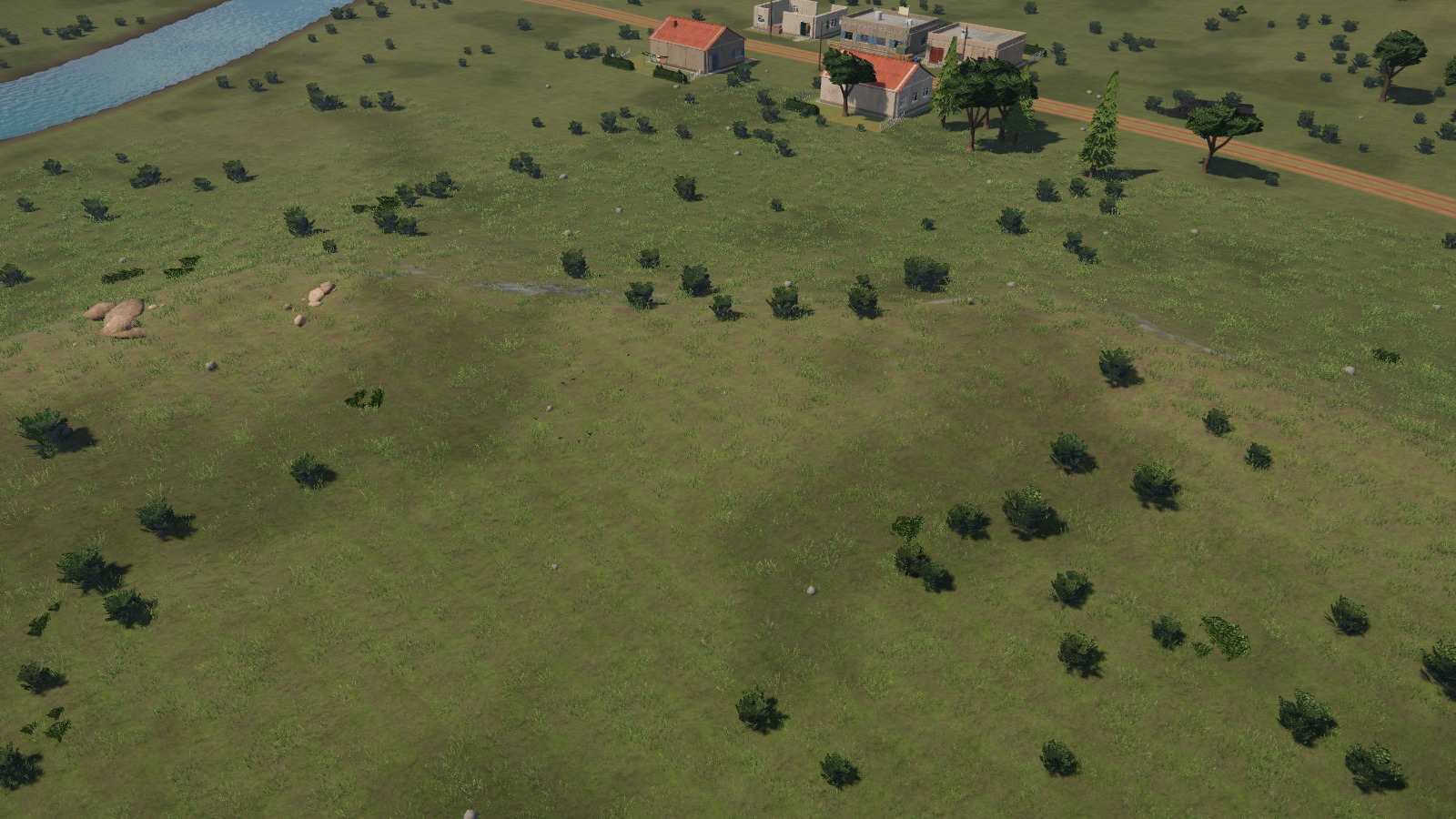
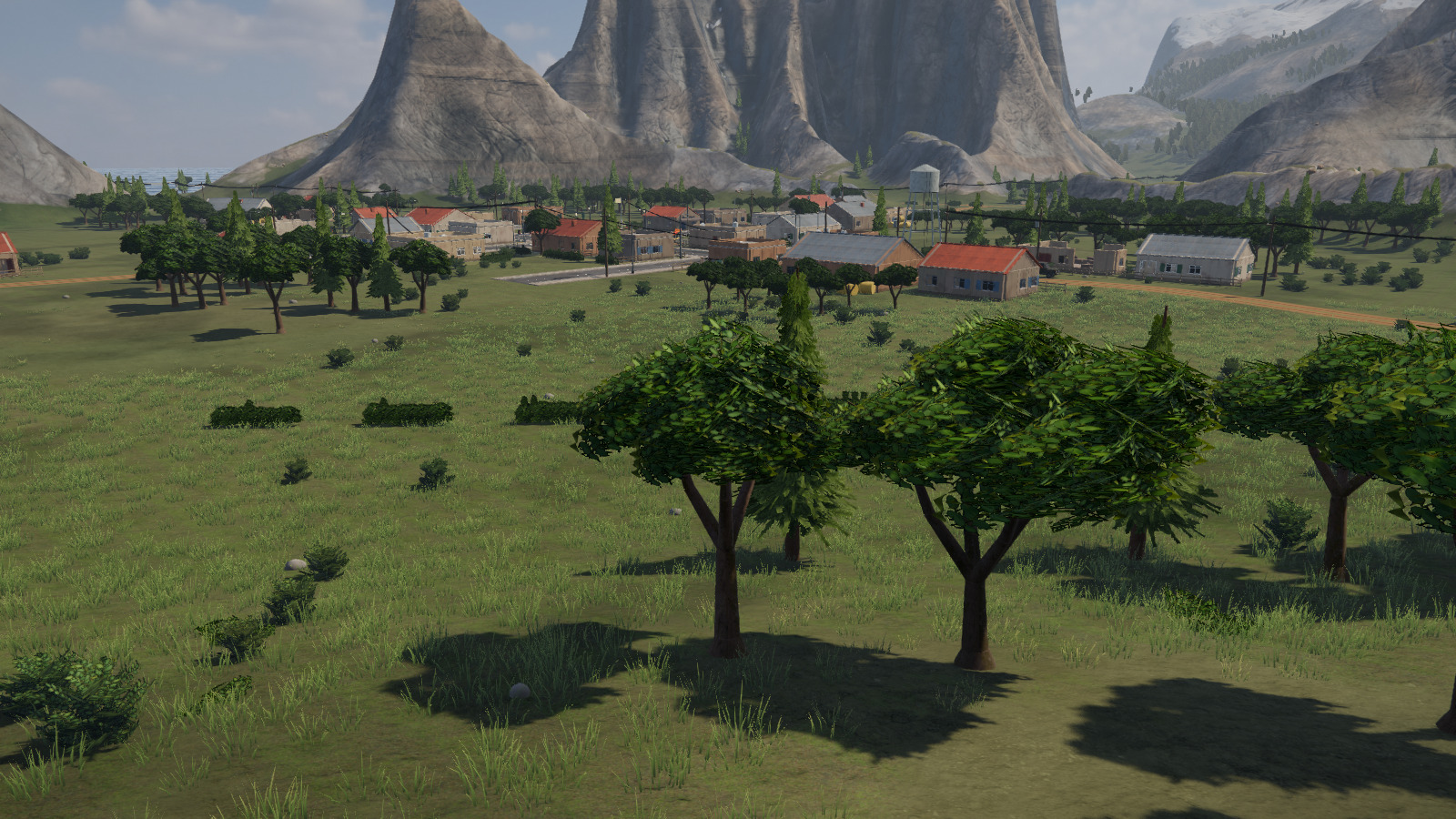
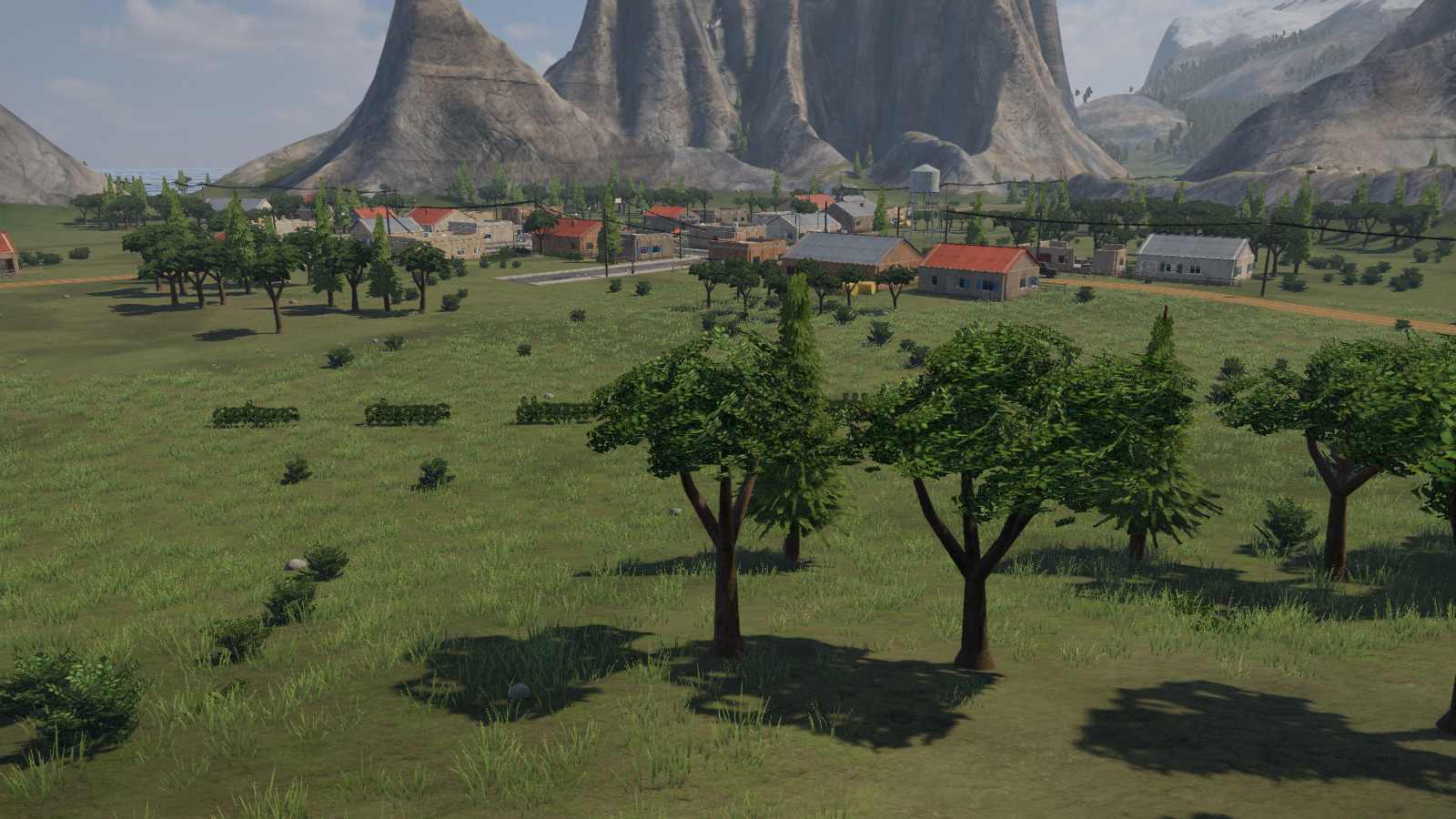
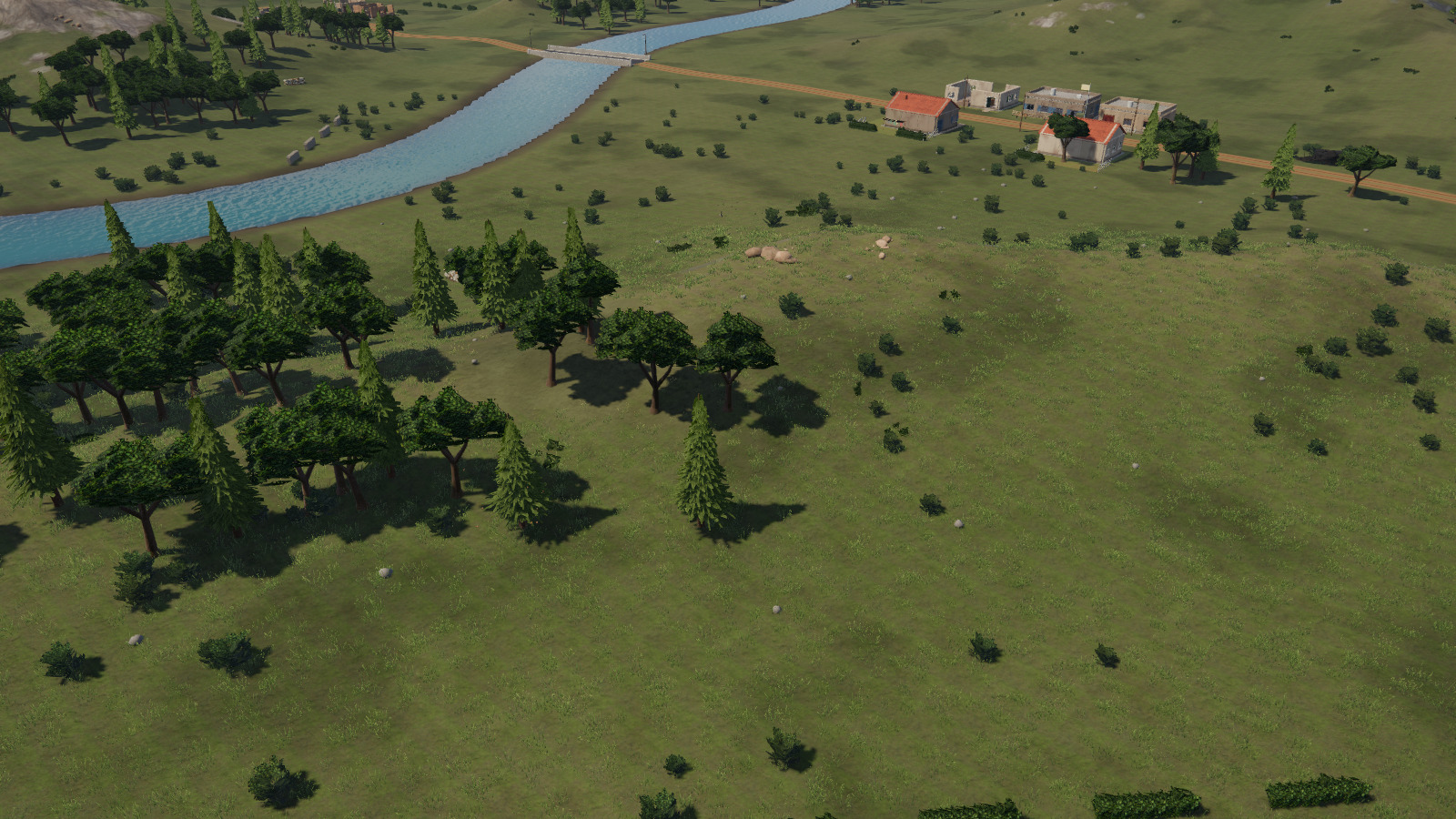
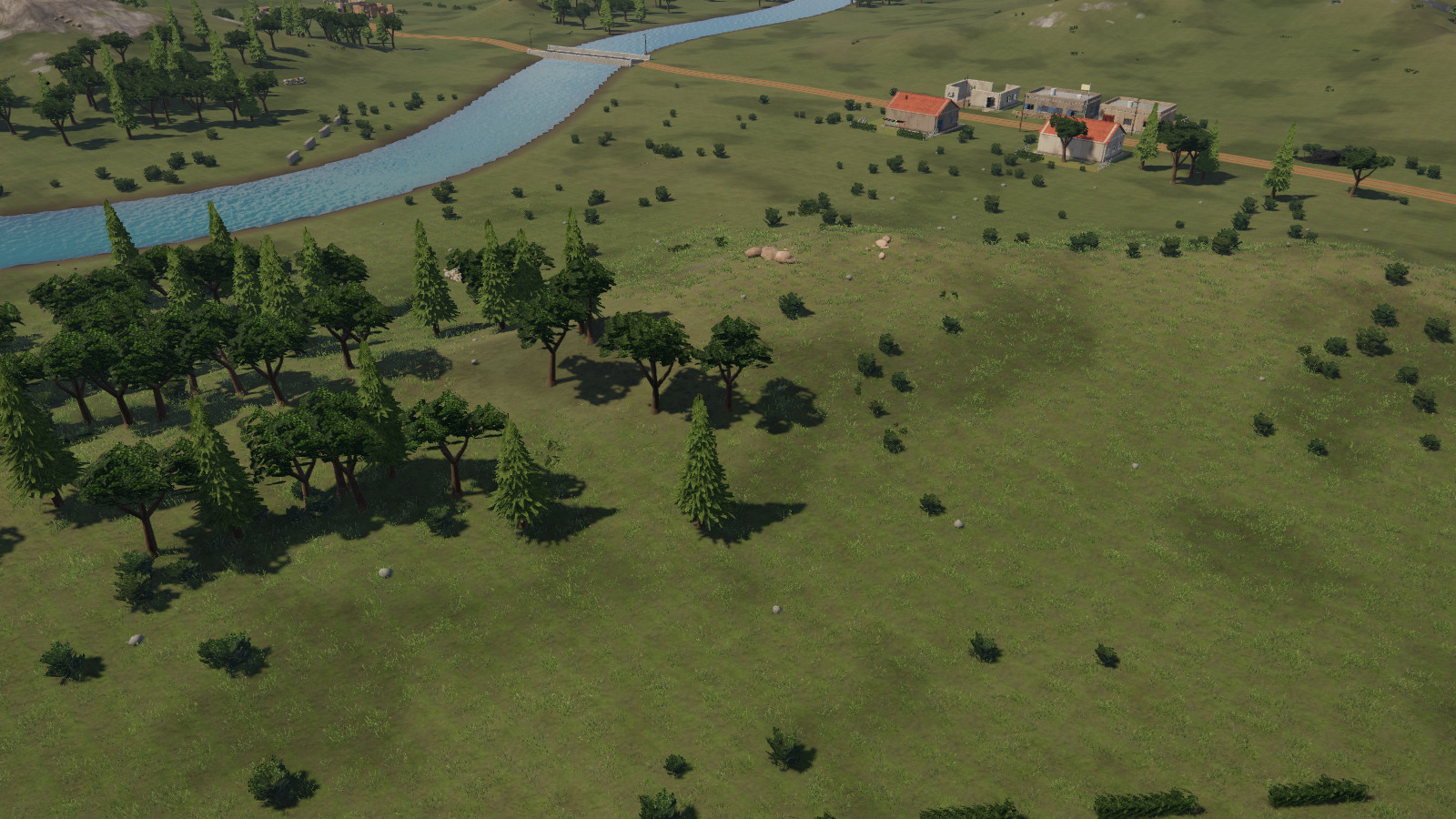
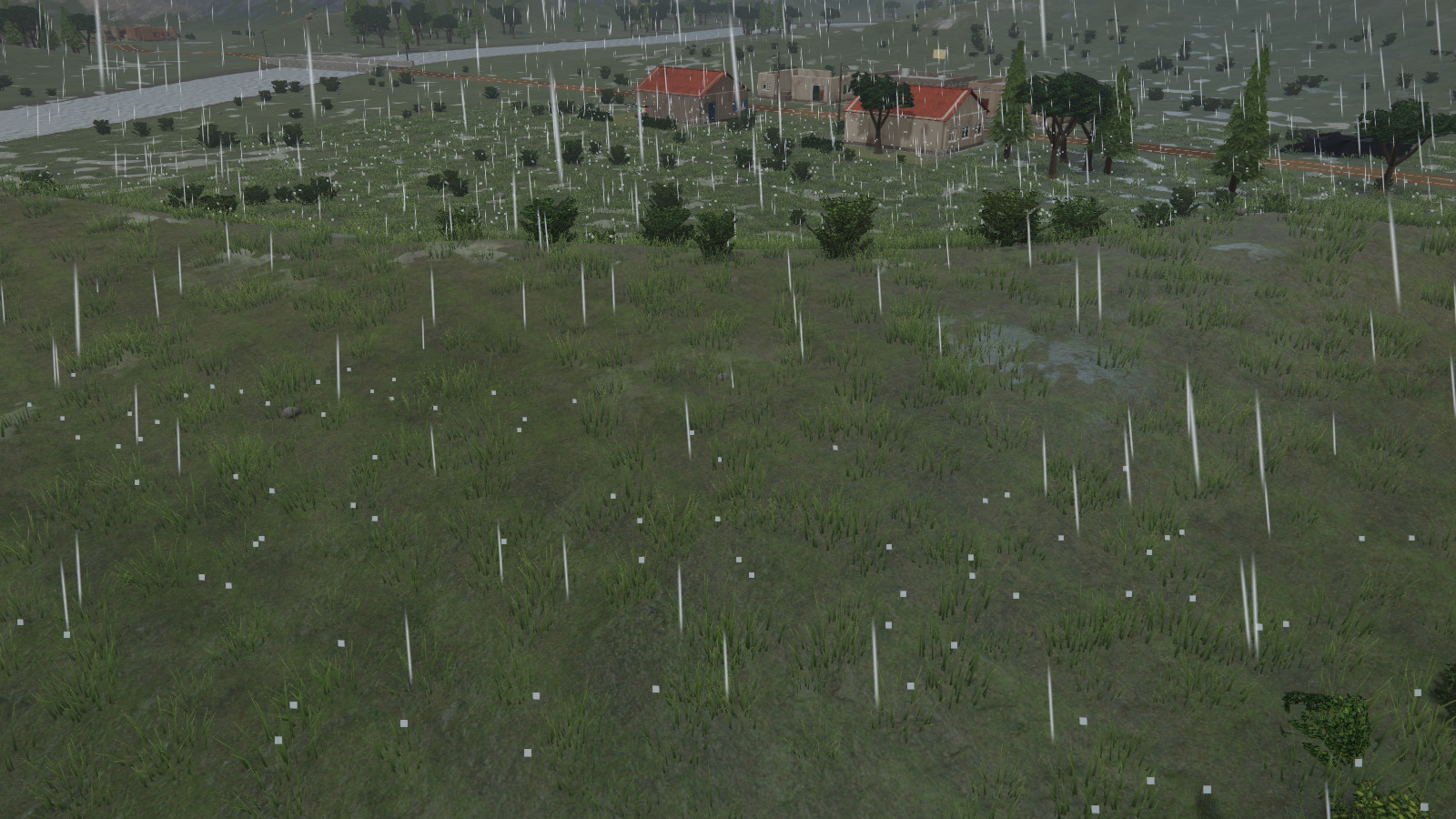
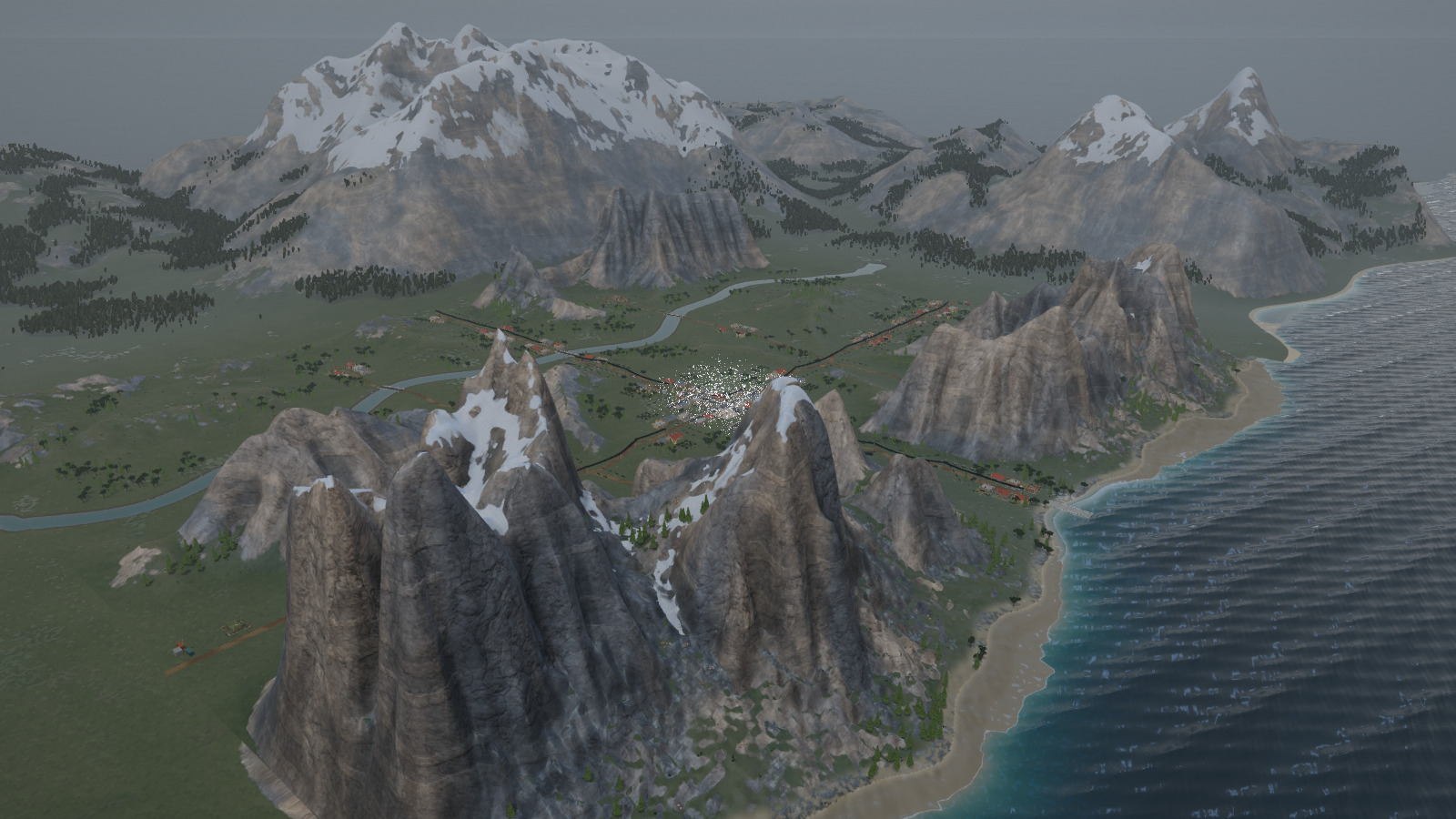
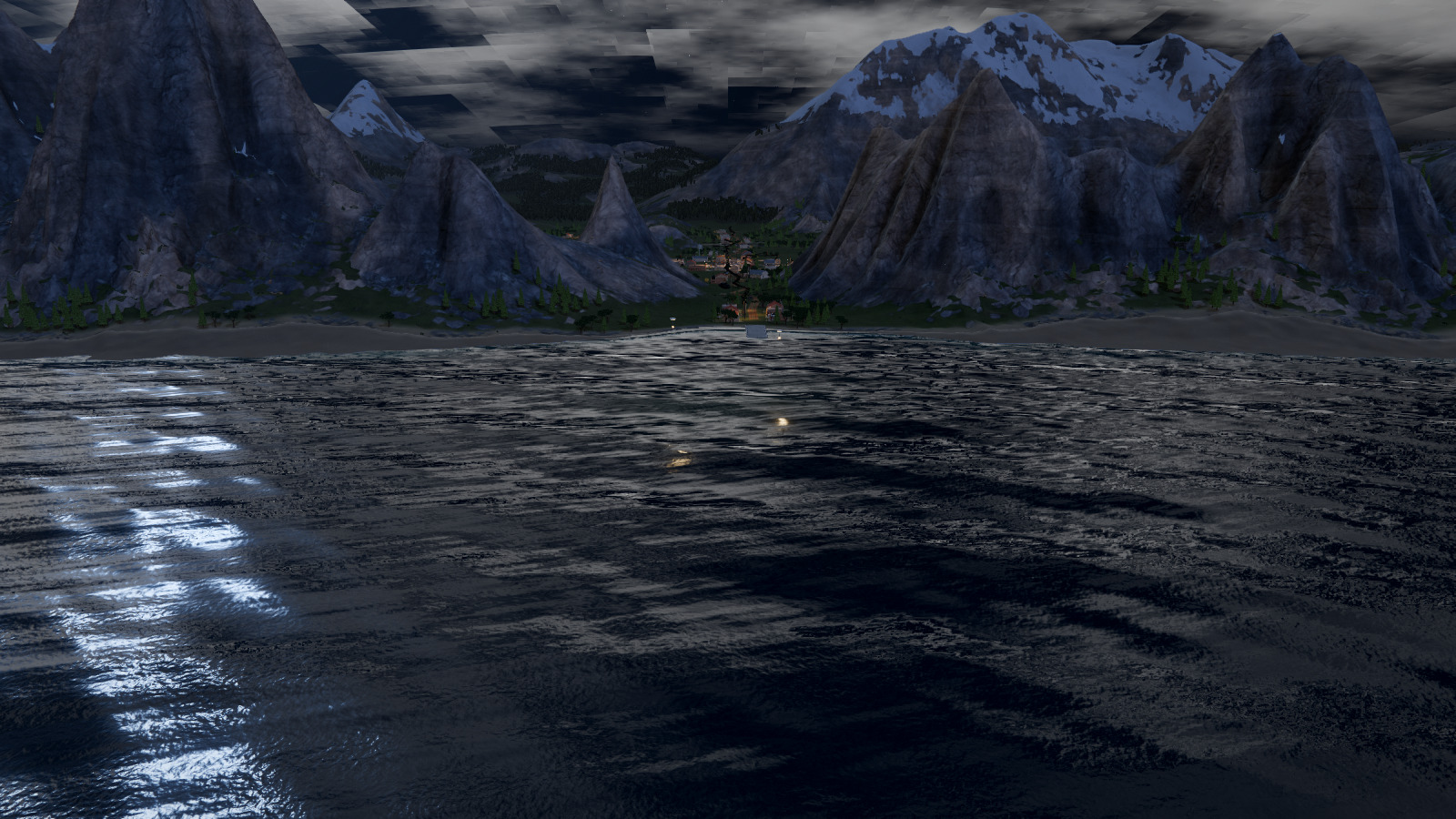
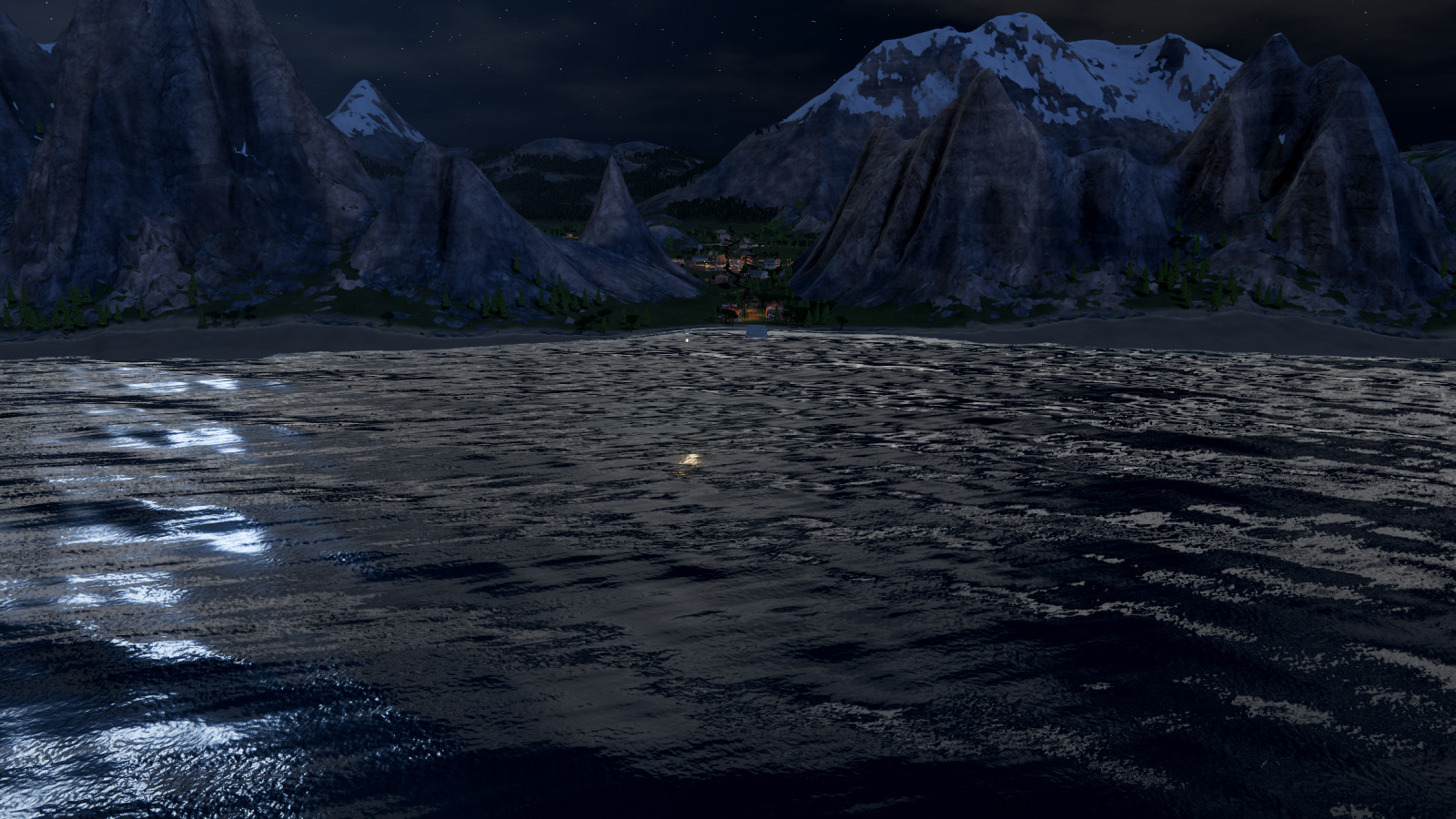
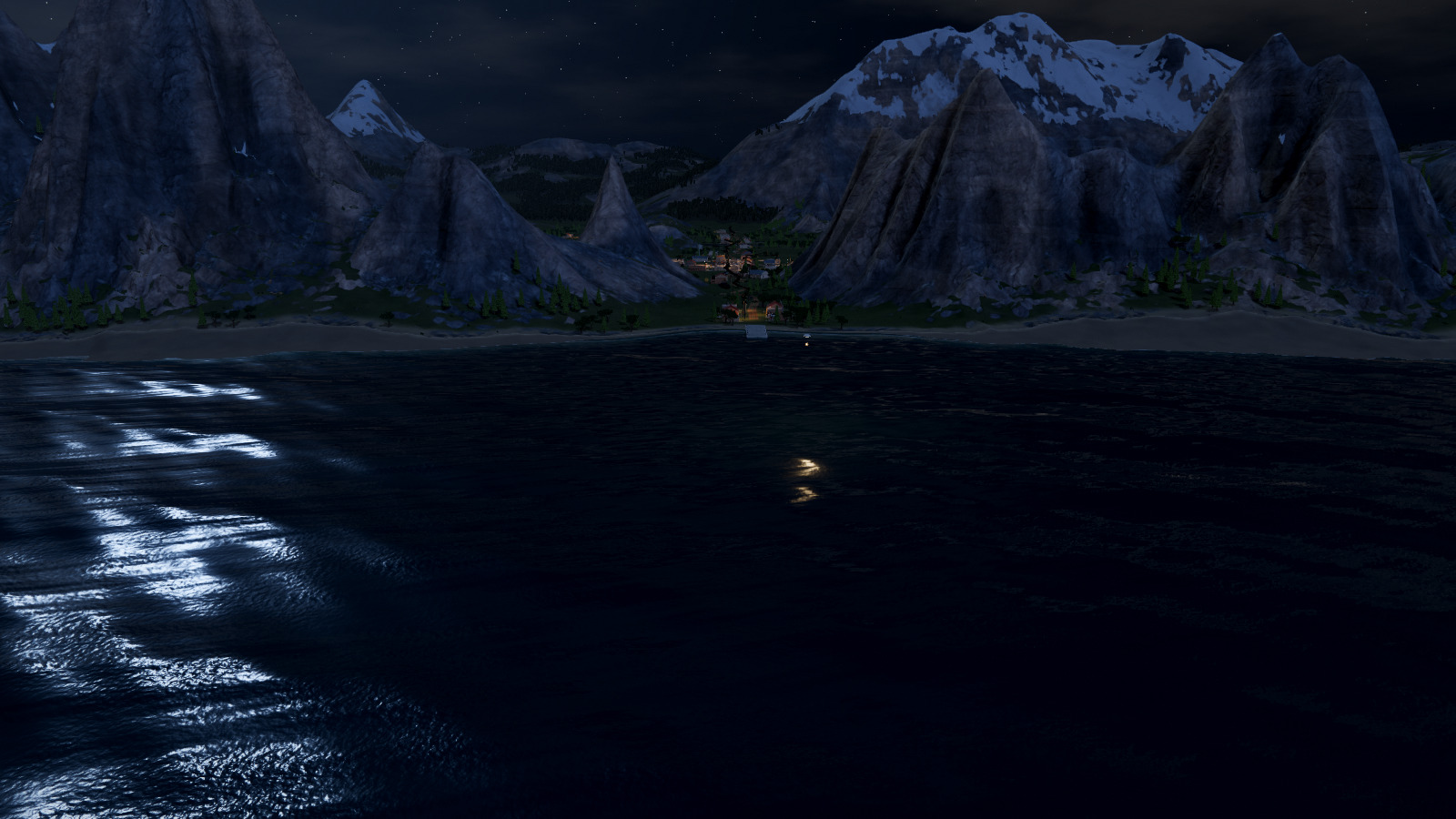
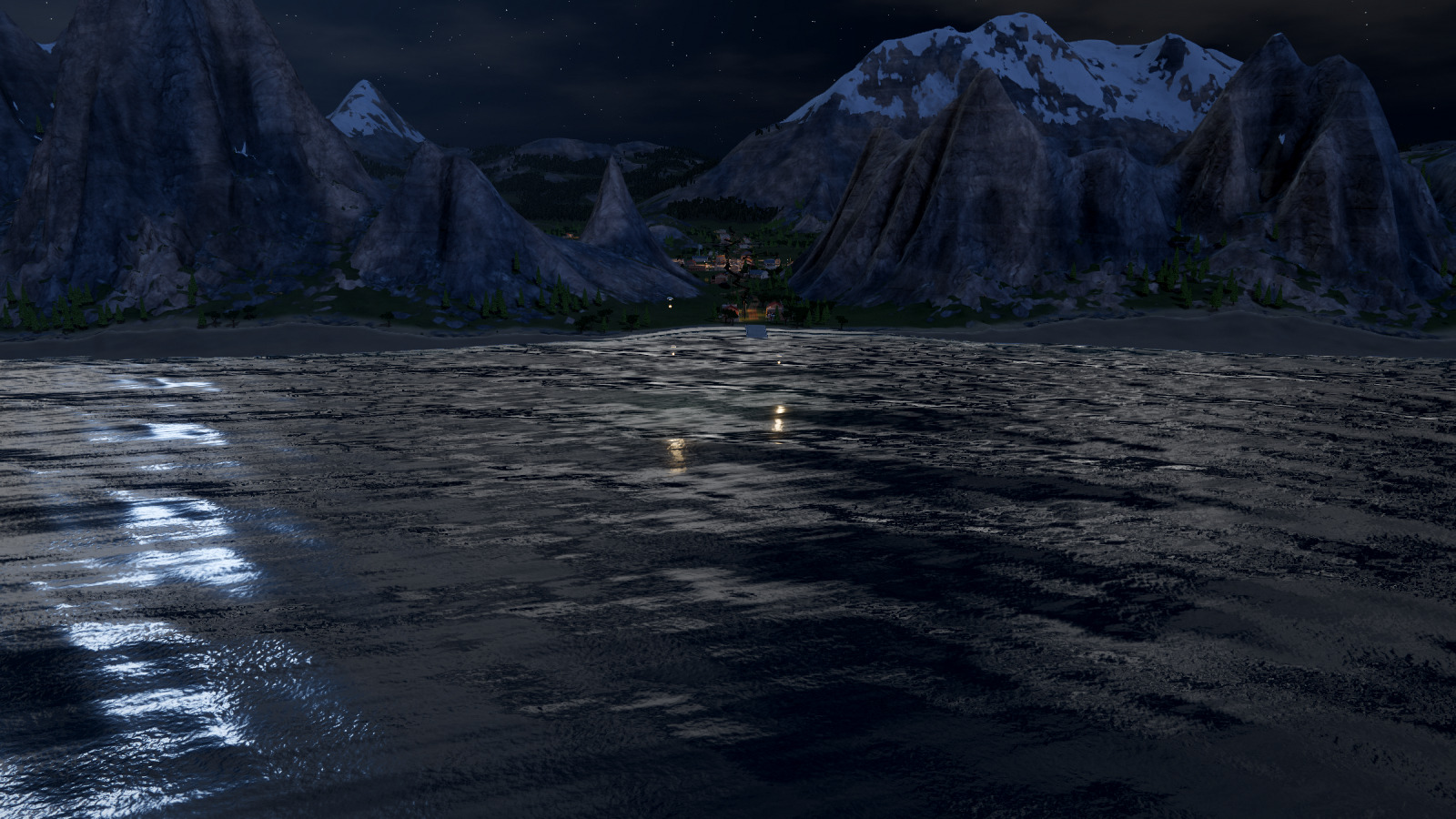
Watch: Before: broad bright streaks and square splashes. Six seconds at fixed 30 fps; silent. (Direct WEBM)
Watch: After: finer streaks and soft splashes on terrain and water. Six seconds at fixed 30 fps; silent. (Direct WEBM)
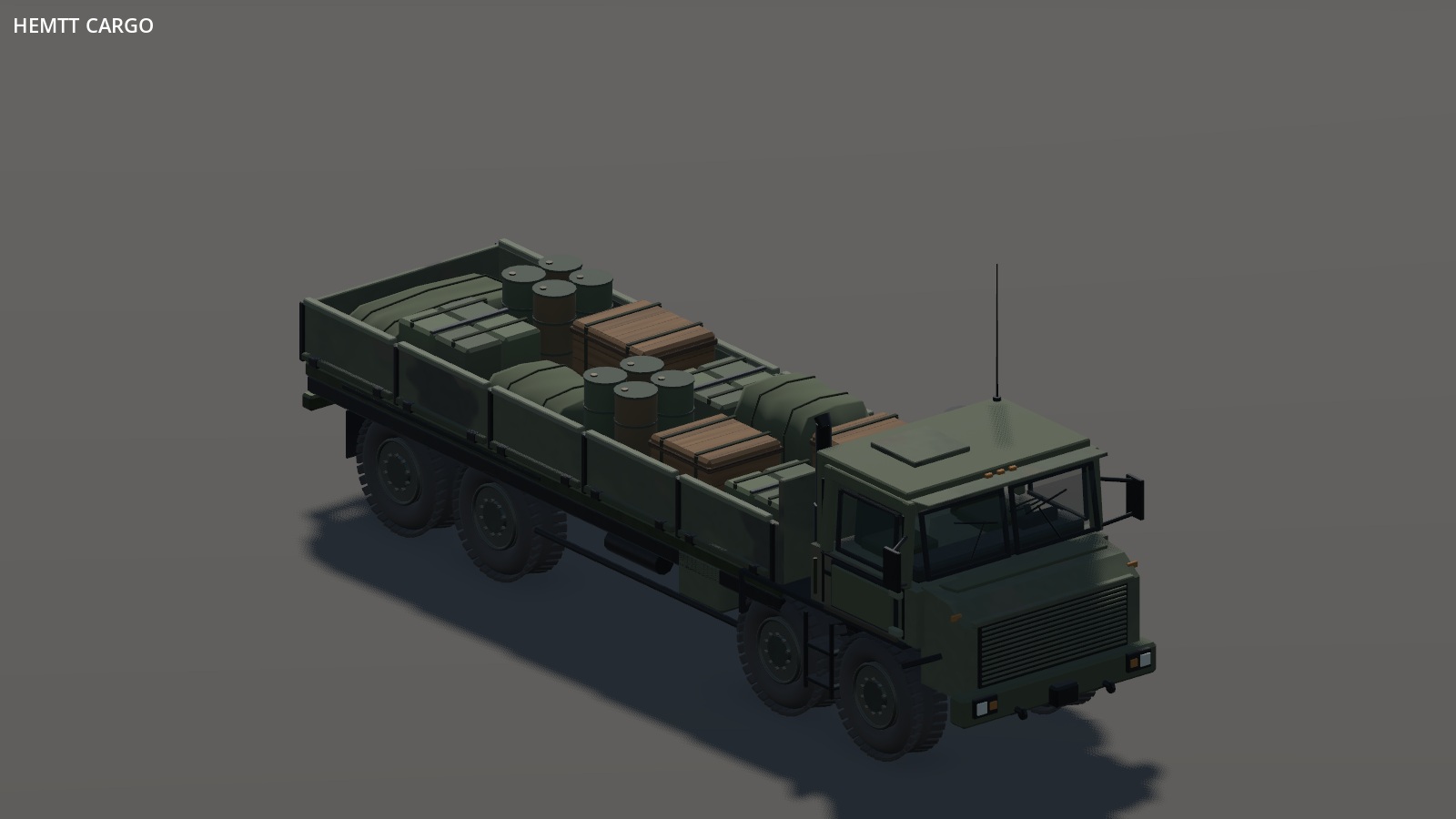
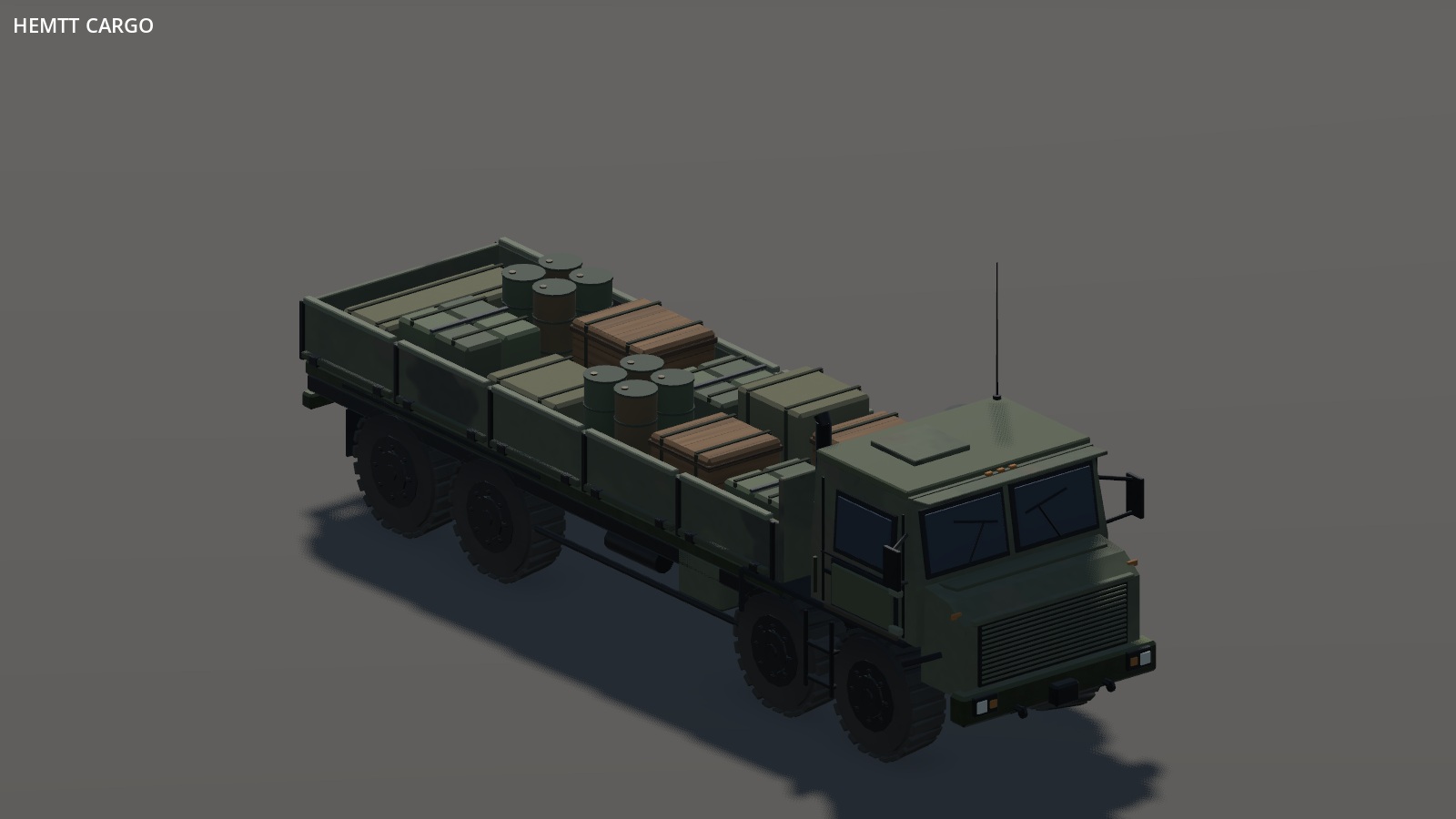
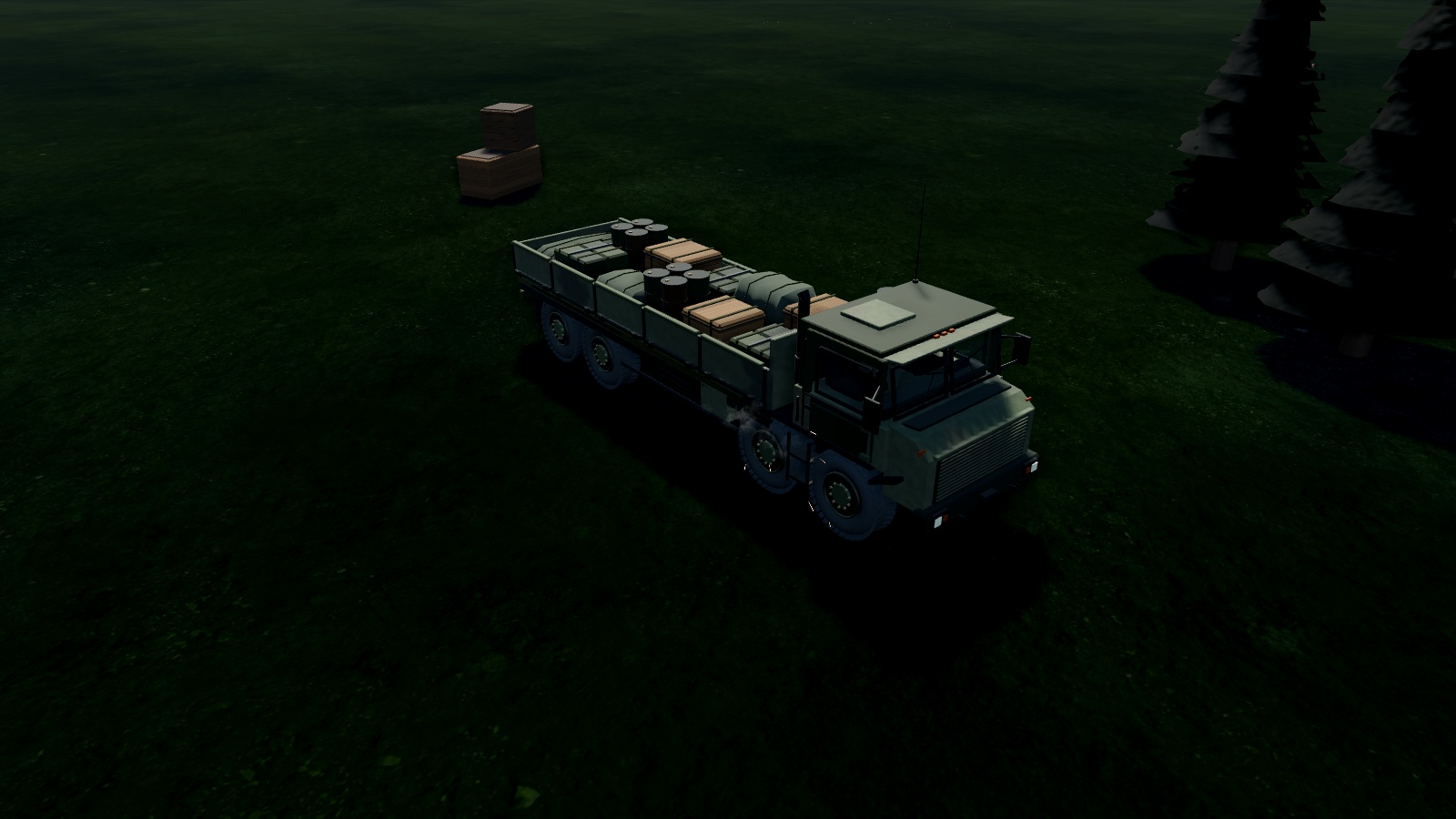
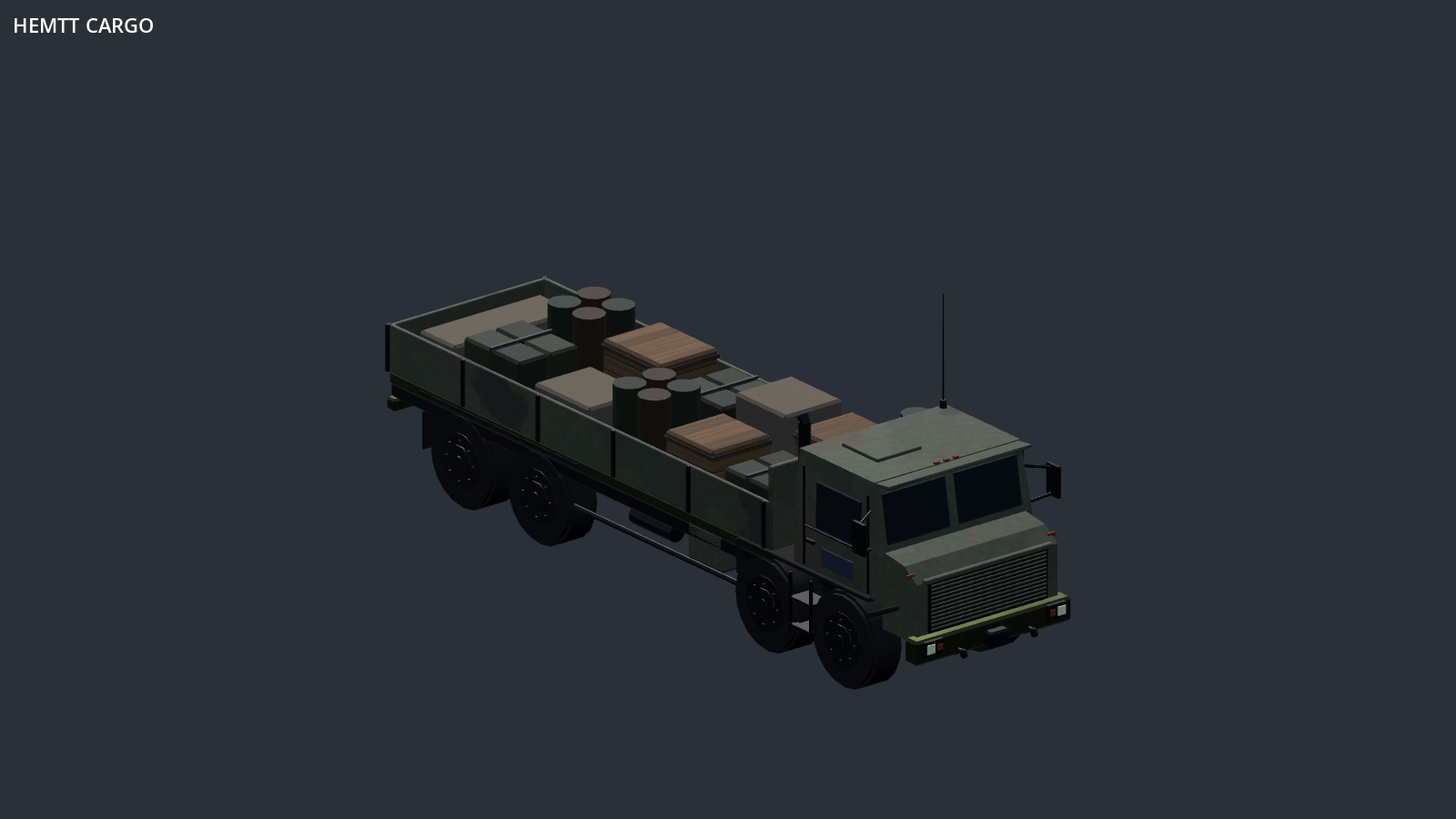
Cab depth and rounded tyres for the cargo truck
The HEMTT cargo truck now has visible cab interiors, transparent glass, rounded tyre shoulders and draped canvas loads.
Explore this change
- The upper cab is open behind its windows, with seats, headrests, dashboard and steering wheel. Transparent panes switch to opaque glass at long distances; wrecks lose the intact panes.
- Rounded rubber sidewalls surround recessed wheel rims. Smaller staggered tread blocks replace the previous broad bars and rotate with the wheels.
- Canvas loads have curved, folded shells and restraints that follow their shape. Painted bumpers and fuel tanks retain a nonmetallic coating.
More readable detail on the HEMTT cargo truck
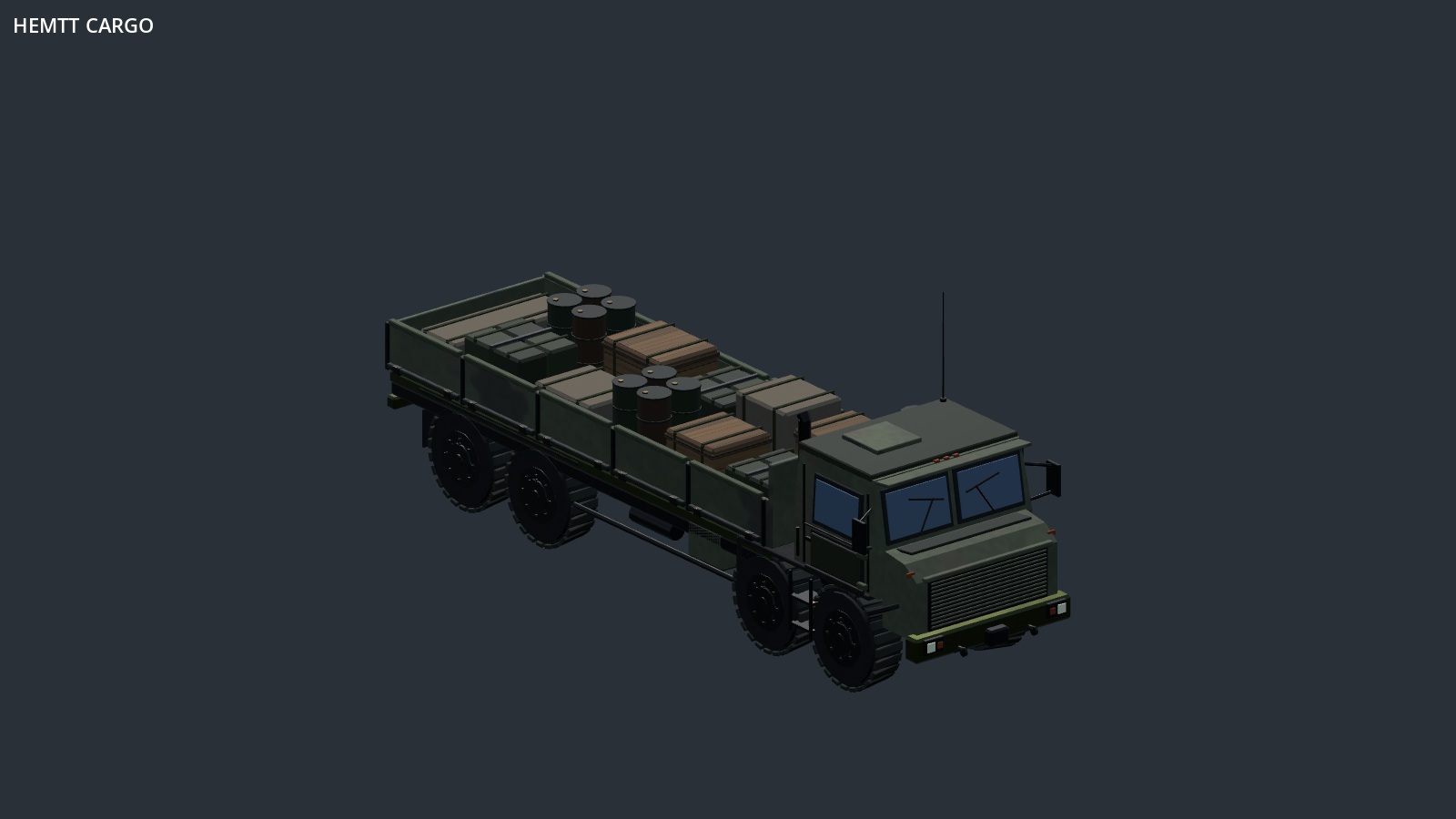
The cargo truck gains framed windows, wipers, tyre tread and distinct load hardware.
Explore this change
- Window gaskets, wipers and raised door panels give the cab more definition.
- Tyre lugs change the wheel silhouette; drum hoops, filler caps and load straps distinguish the cargo.
- Step lips and bed hinges carry localized rub marks. The other HEMTT variants retain their existing models while this art direction is evaluated.
Frame the alpine battlefield with a photographic daylight sky
Natural cloud forms and a sun-aligned photographic sky replace the plain daylight backdrop.
Explore this change
Daylight uses a bundled 2K CC0 HDR panorama from Poly Haven, rotated to match the sunlight. Its static shader lets Godot cache sky lighting and reflections. Other weather and night moods retain their existing skies. No network download is needed.
Asset and authors | CC0 license.
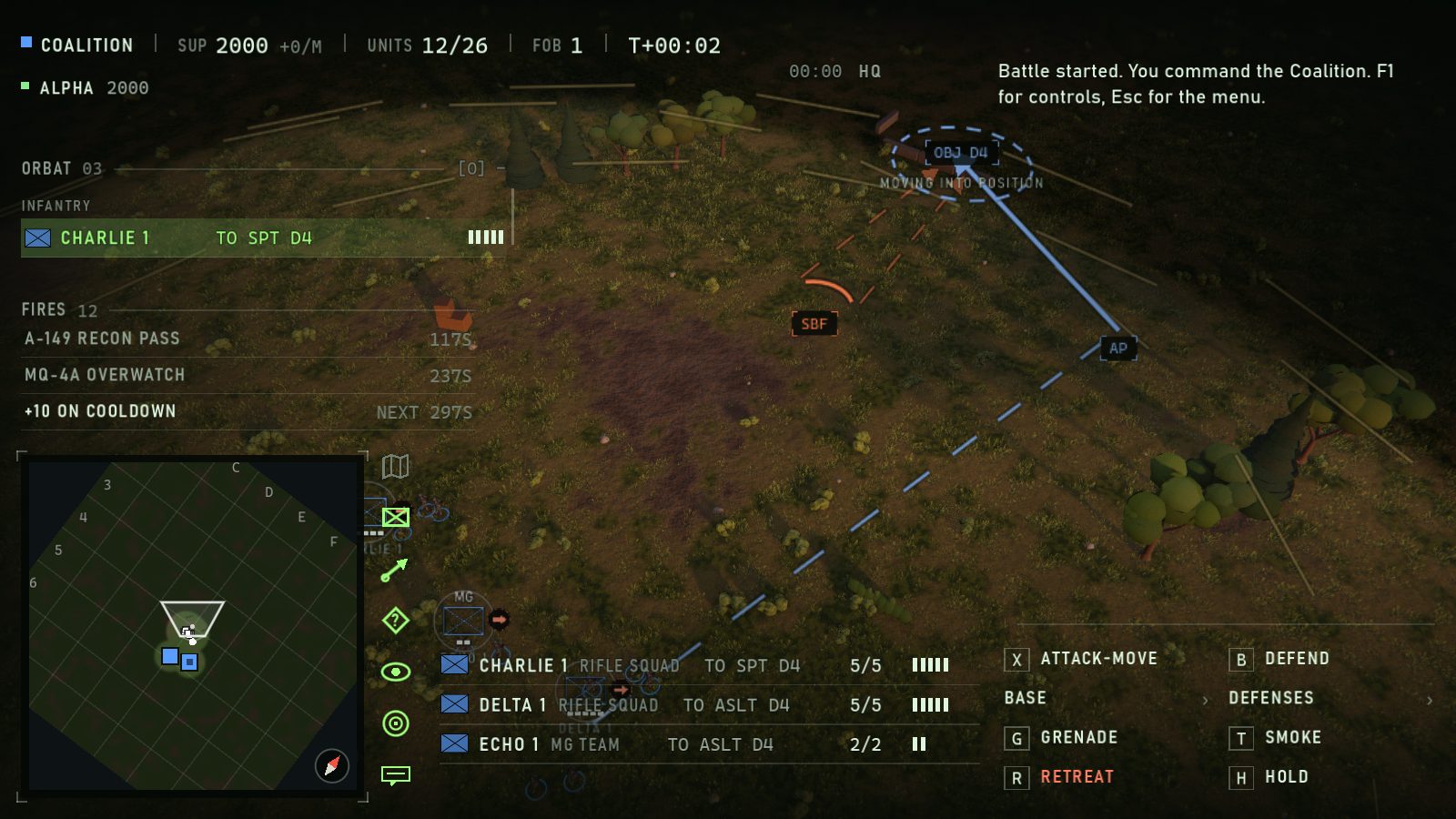
Steadier minimap updates
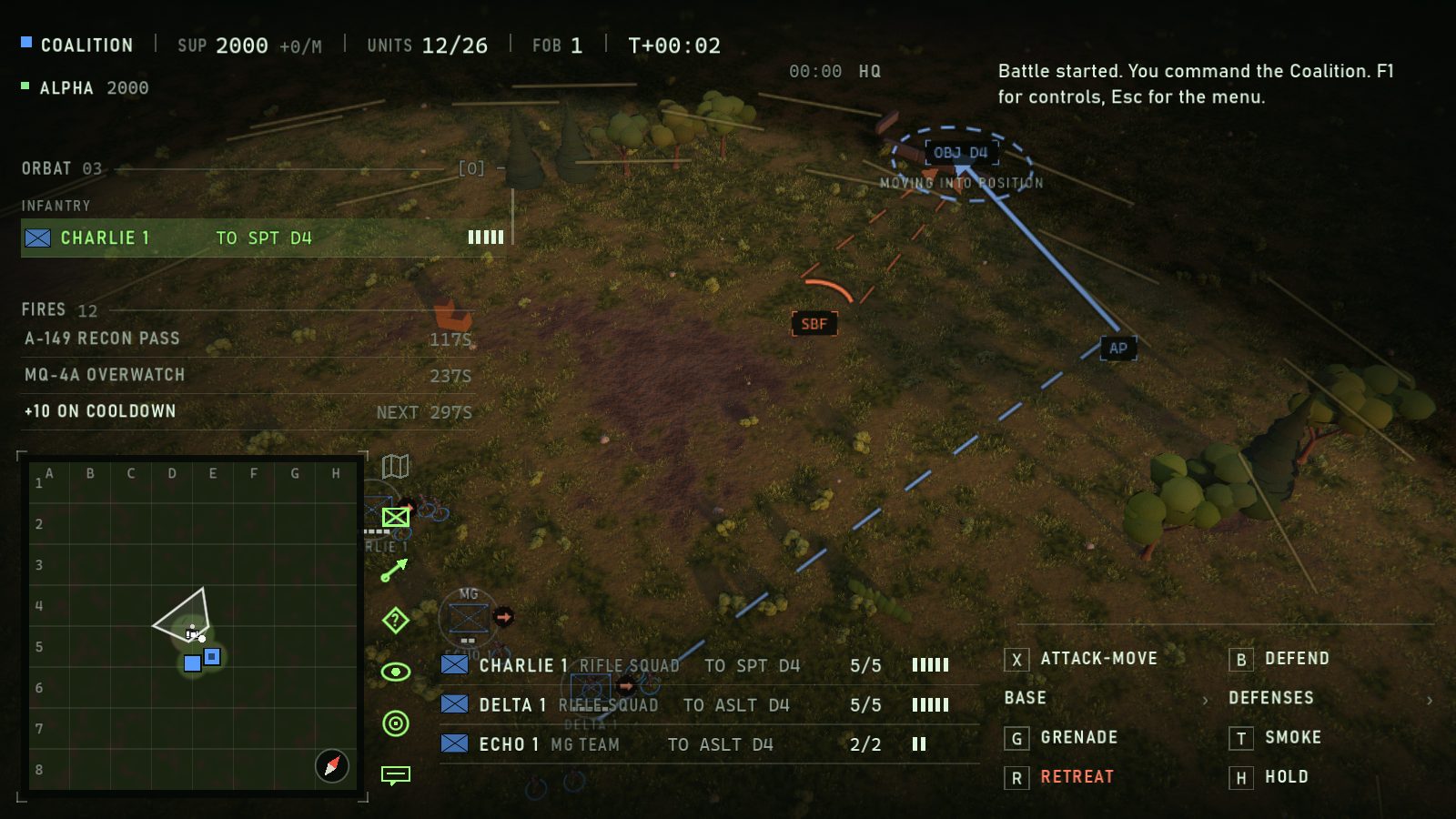
Minimap drawing is spread across frames while camera and pointer feedback stays responsive.
Explore this change
- Map details, combat markers, units and co-op markers take turns updating, reducing the work that lands on any one frame.
- The camera wedge and pointer update every frame. Rotating or resizing the minimap keeps all its layers aligned.
- Large-map building checks run in small slices, and soldiers share repeated smoothing calculations without changing their movement.
Compare changelog layouts
Changelog presentation comparison, not gameplay: the top 1,000 pixels of this entry at the same 900-pixel viewport width. Open either image to inspect it.

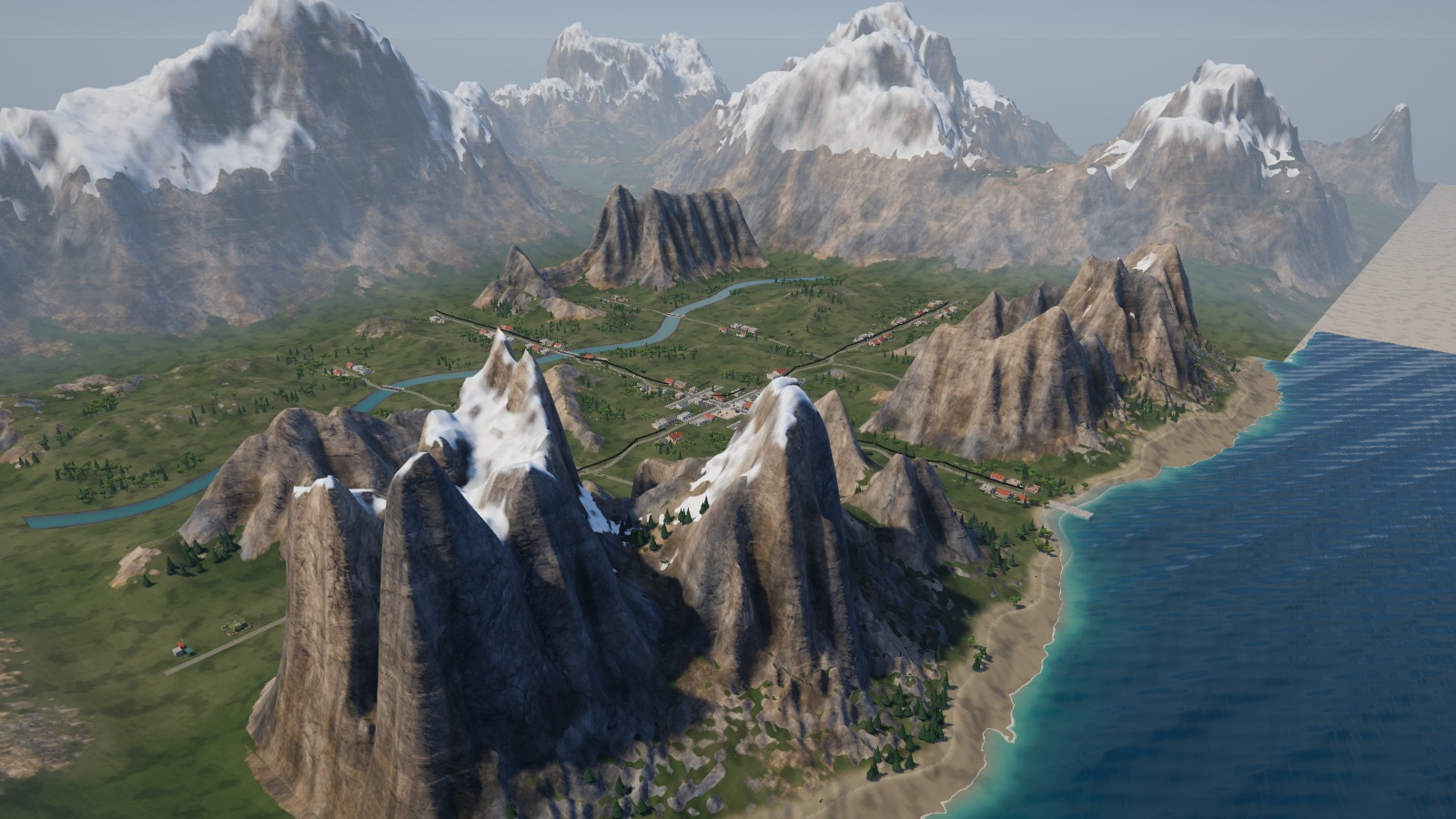
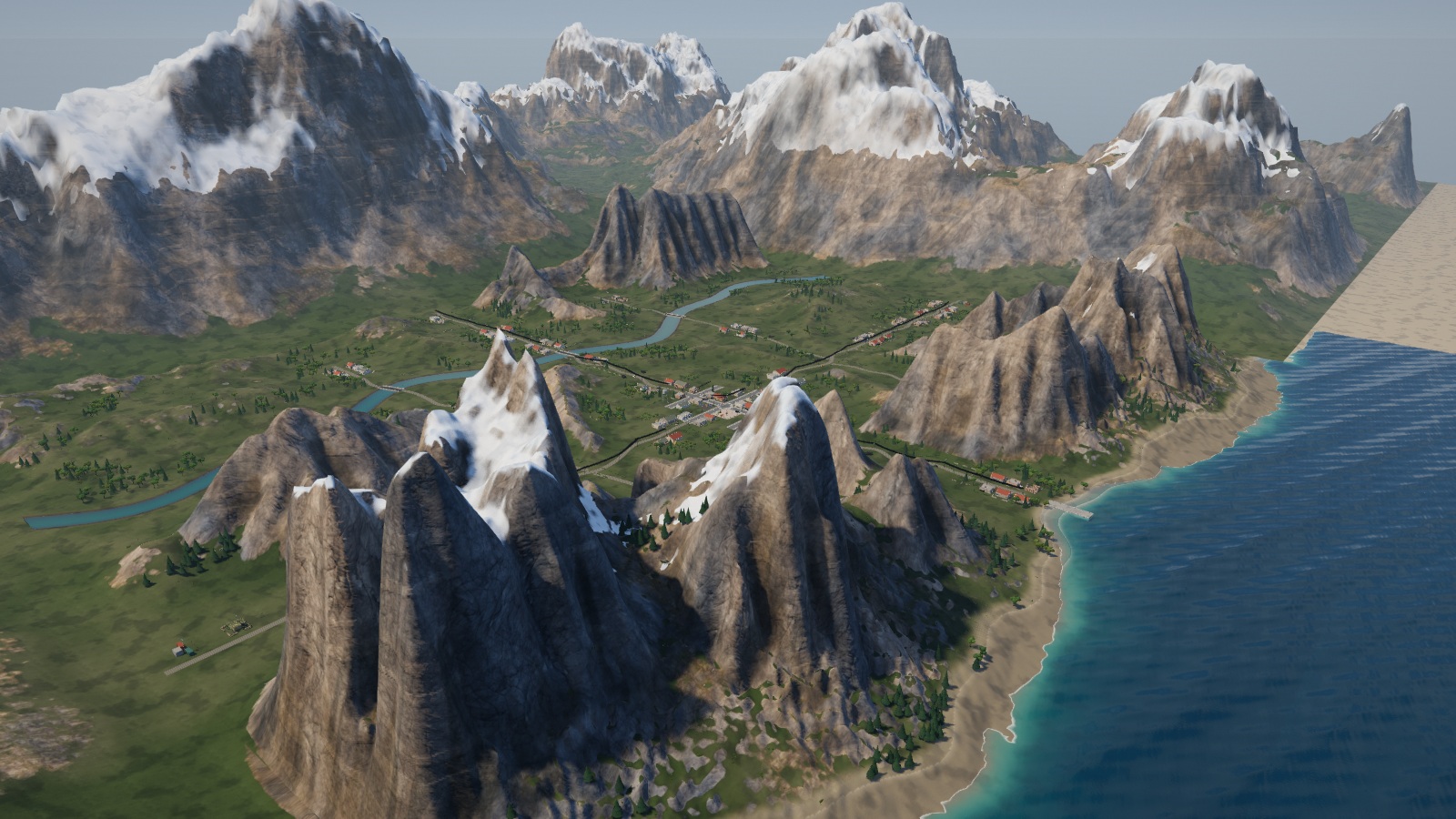
Separate ranges with distance-based scattering
Distant mountain groups lose contrast into sky-coloured haze while nearby ground retains its detail.
Explore this change
Exponential extinction with sky-coloured in-scattering; a deliberately simplified approximation, not a full atmospheric solver. Uses the existing Alpine haze option.
Research: primary reference.
The revision reduces the broad pale wash, delays scattering until beyond nearby terrain, and lets high ridges retain contrast. Approved layer relief and texture-scale changes are retained in this parent branch.
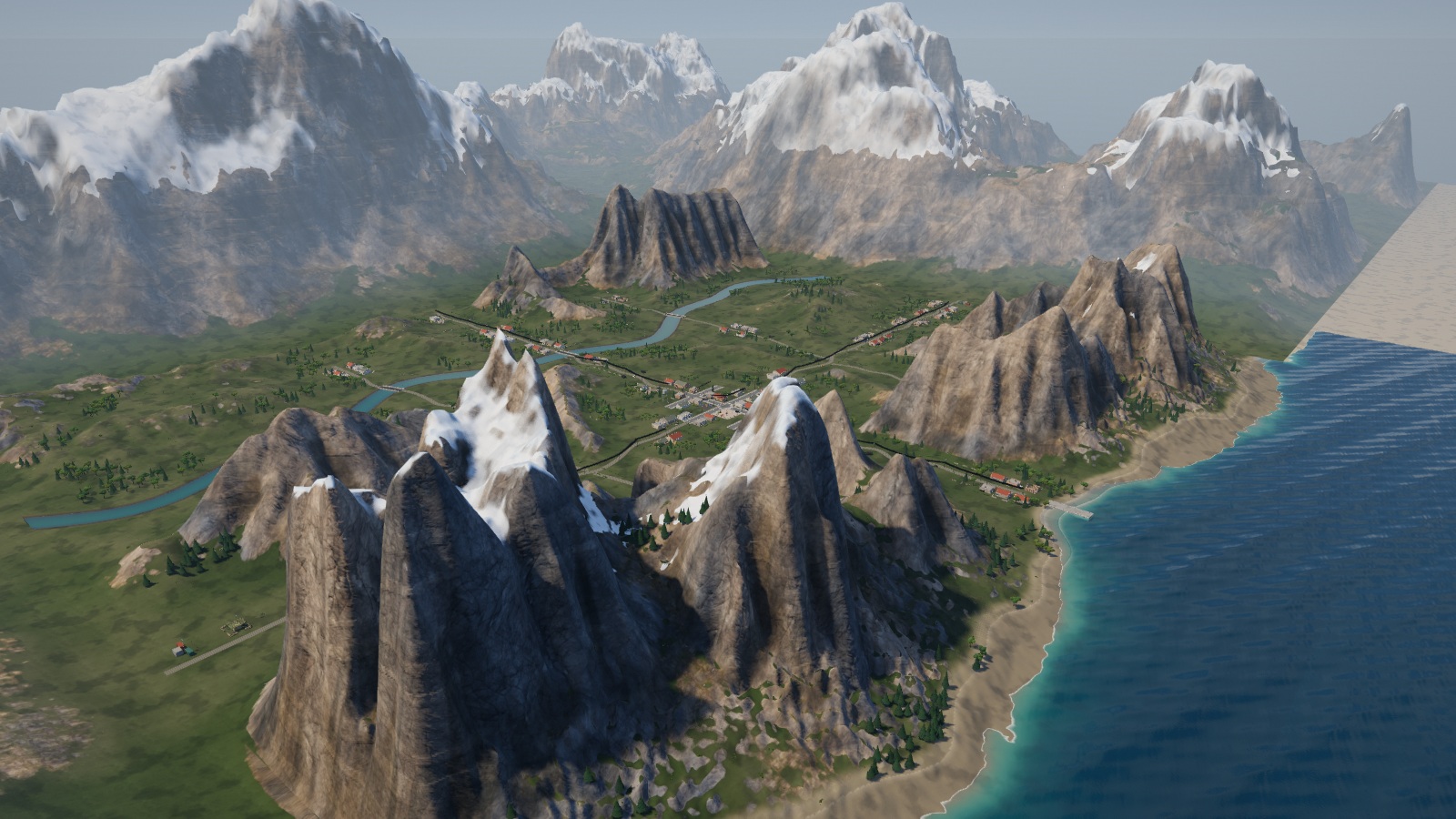
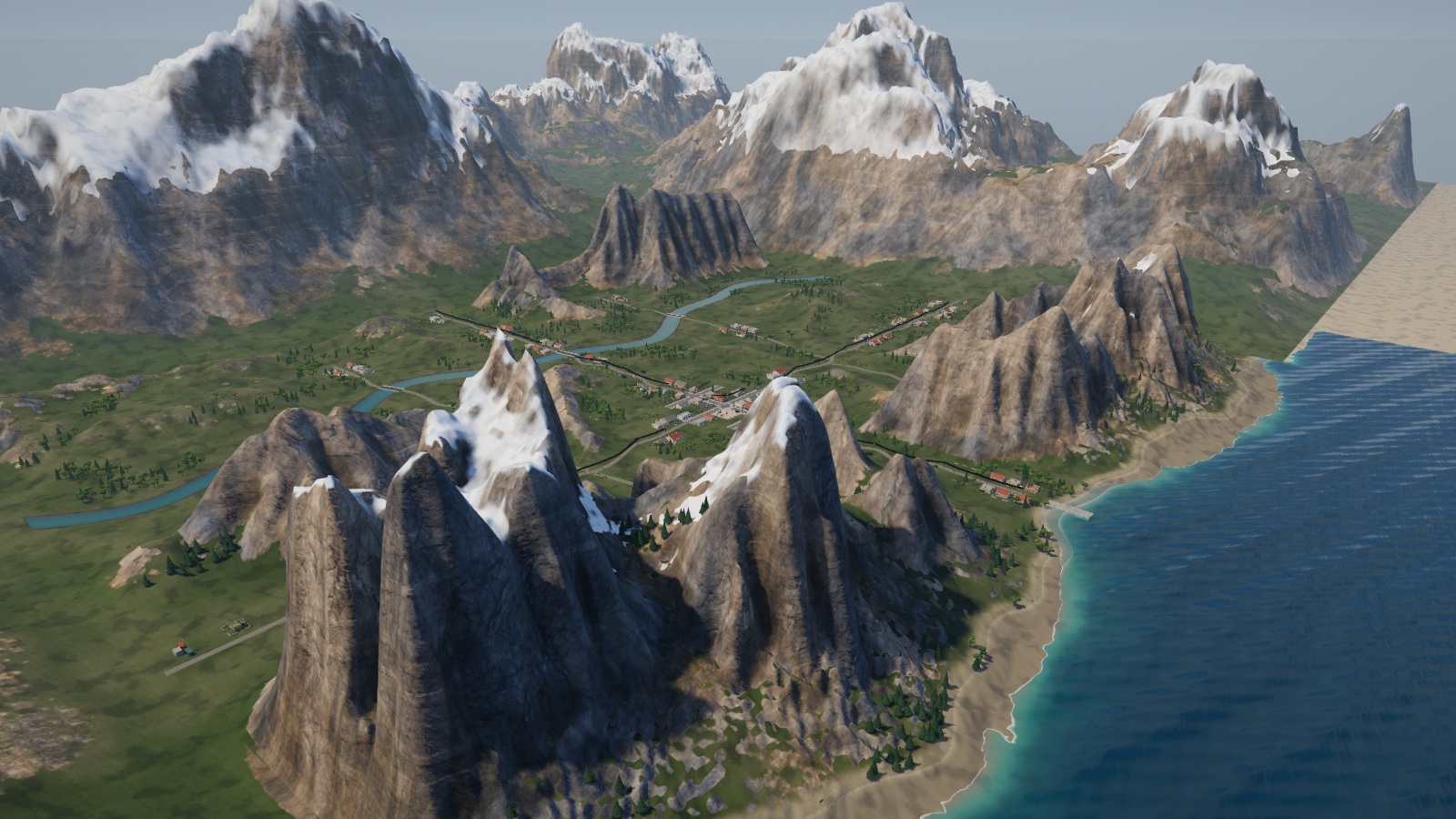
Give geological layers surface relief
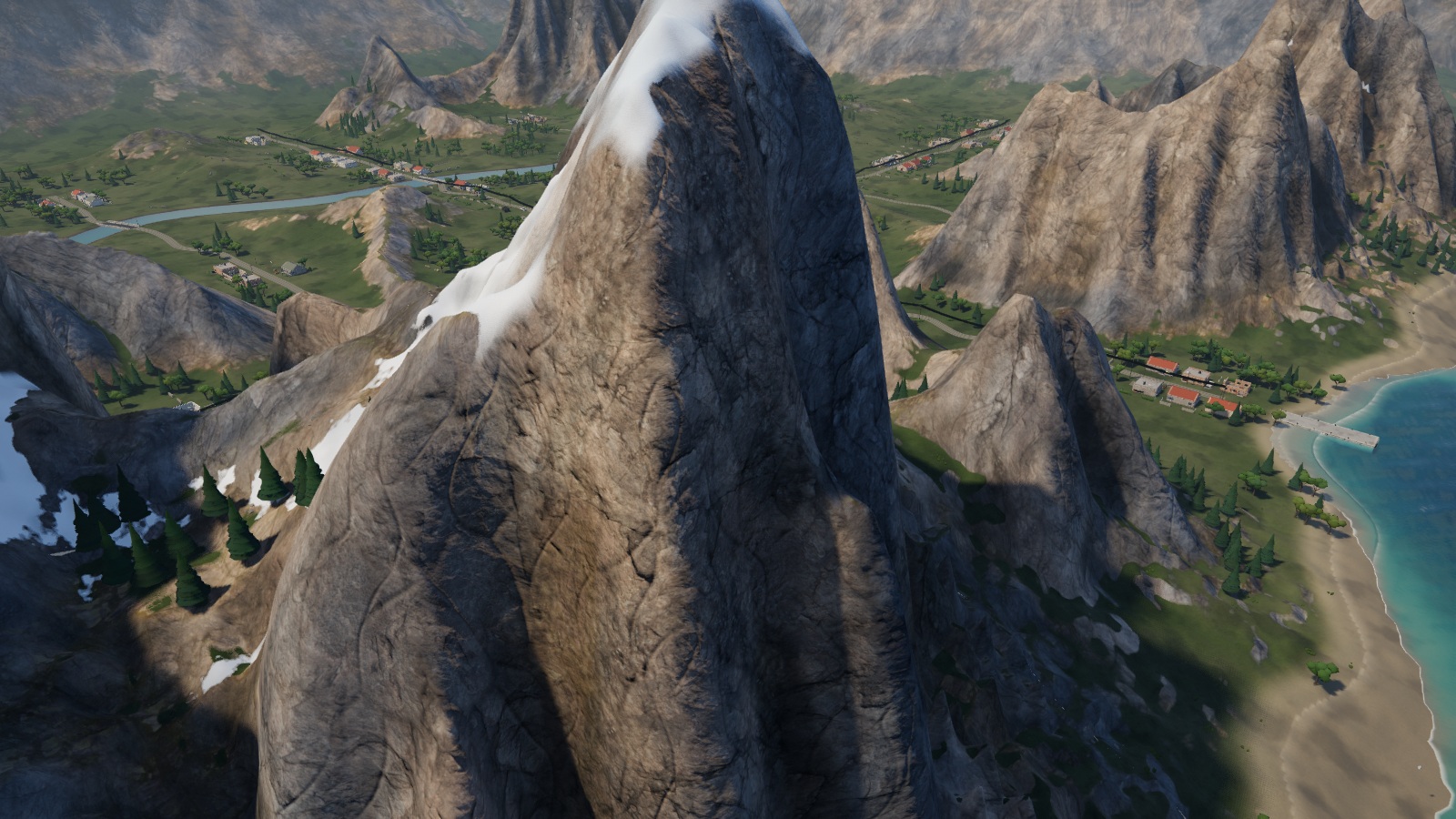
Rock beds catch light along their ledges instead of appearing only as painted colour bands.
Explore this change
Screen-space derivatives perturb normals from the existing tilted bedding field. No displaced collision surface or new texture reads.
Research: primary reference.
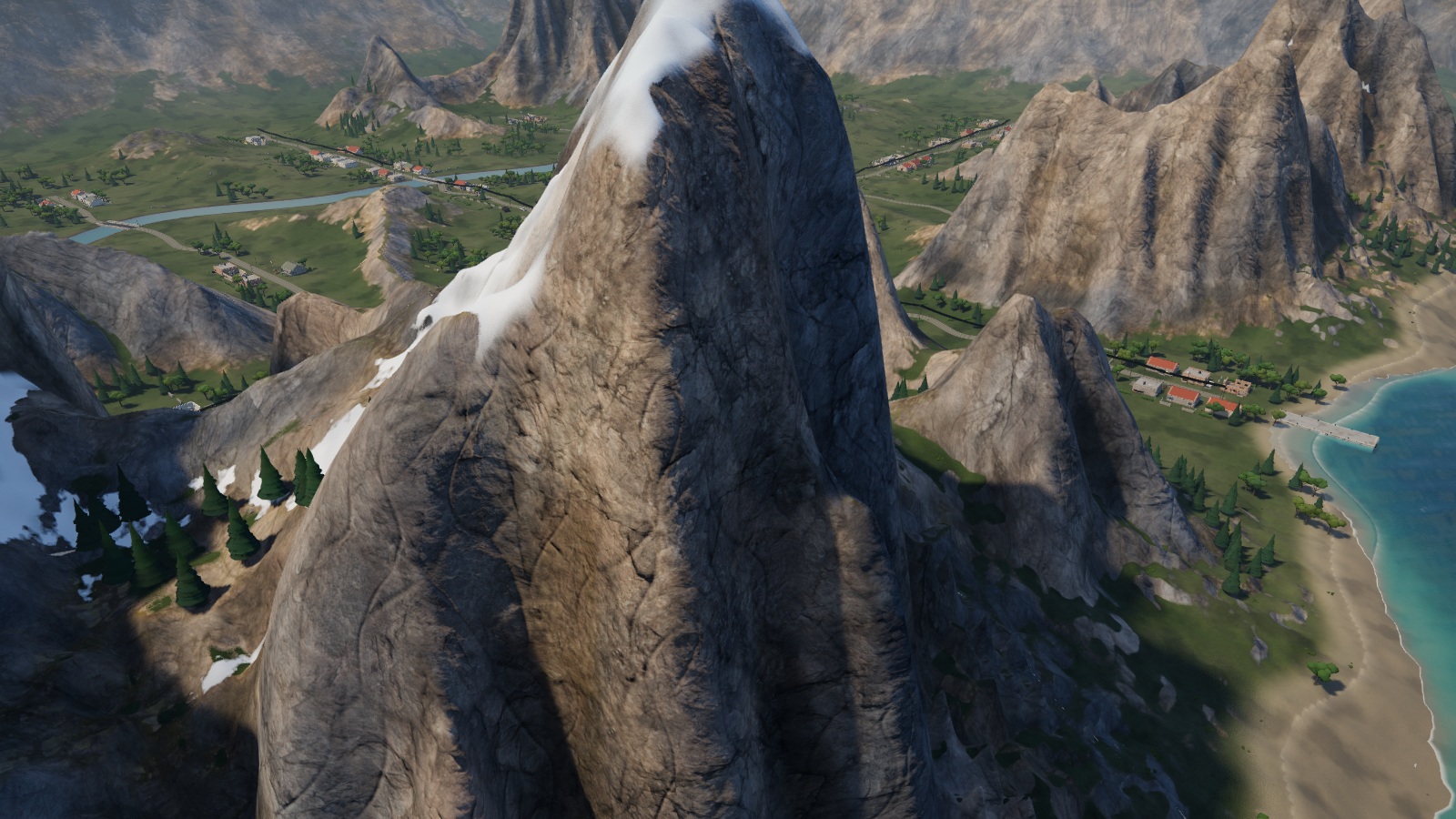
Blend rock detail across different scales
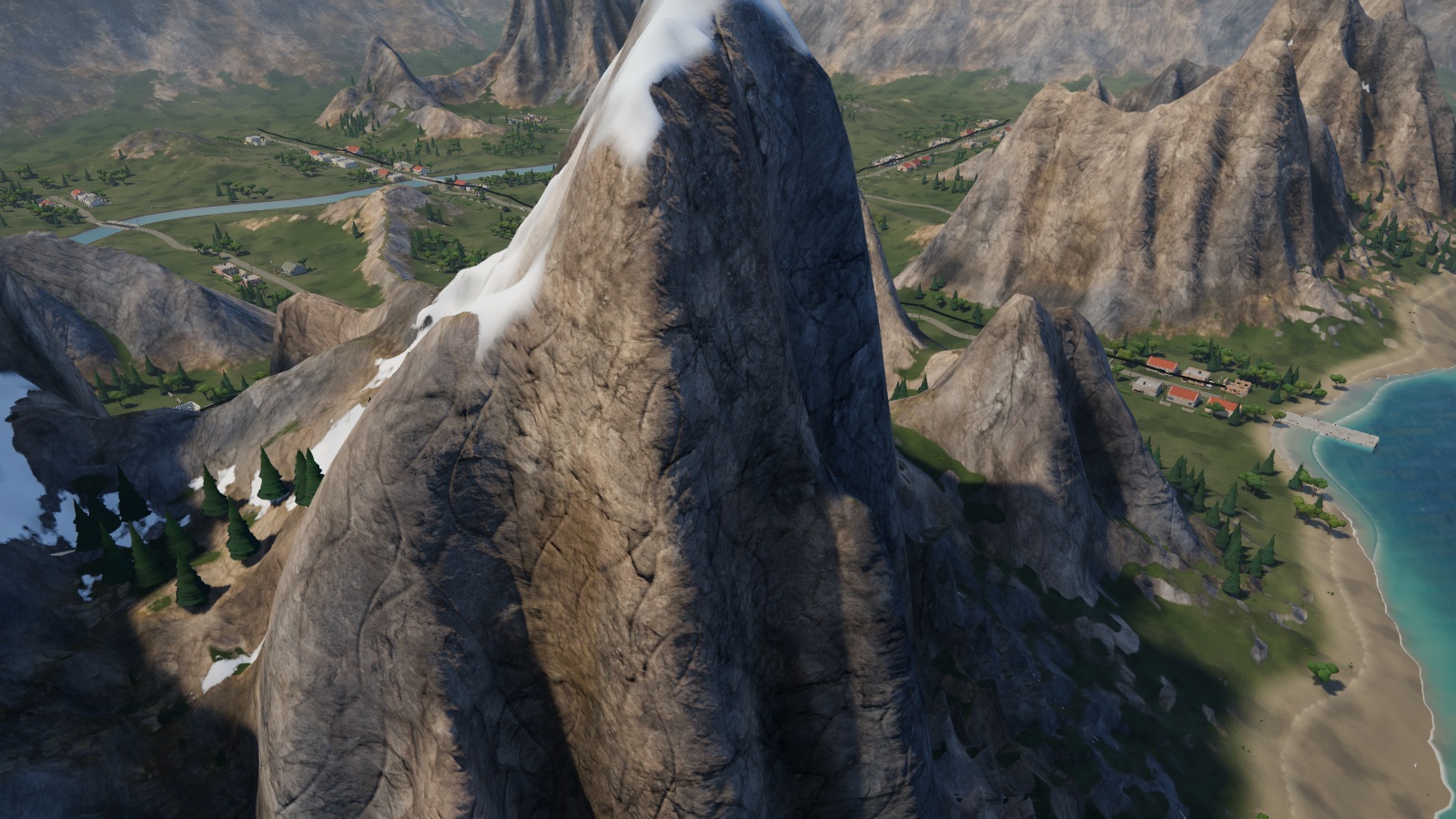
Broad cliff fractures and smaller joint patterns break up recognisable repeated rock tiles.
Explore this change
A second triplanar colour/normal scale is blended coherently. Six extra material reads at Medium/Far detail; Near keeps the cheaper original material.
Research: primary reference.
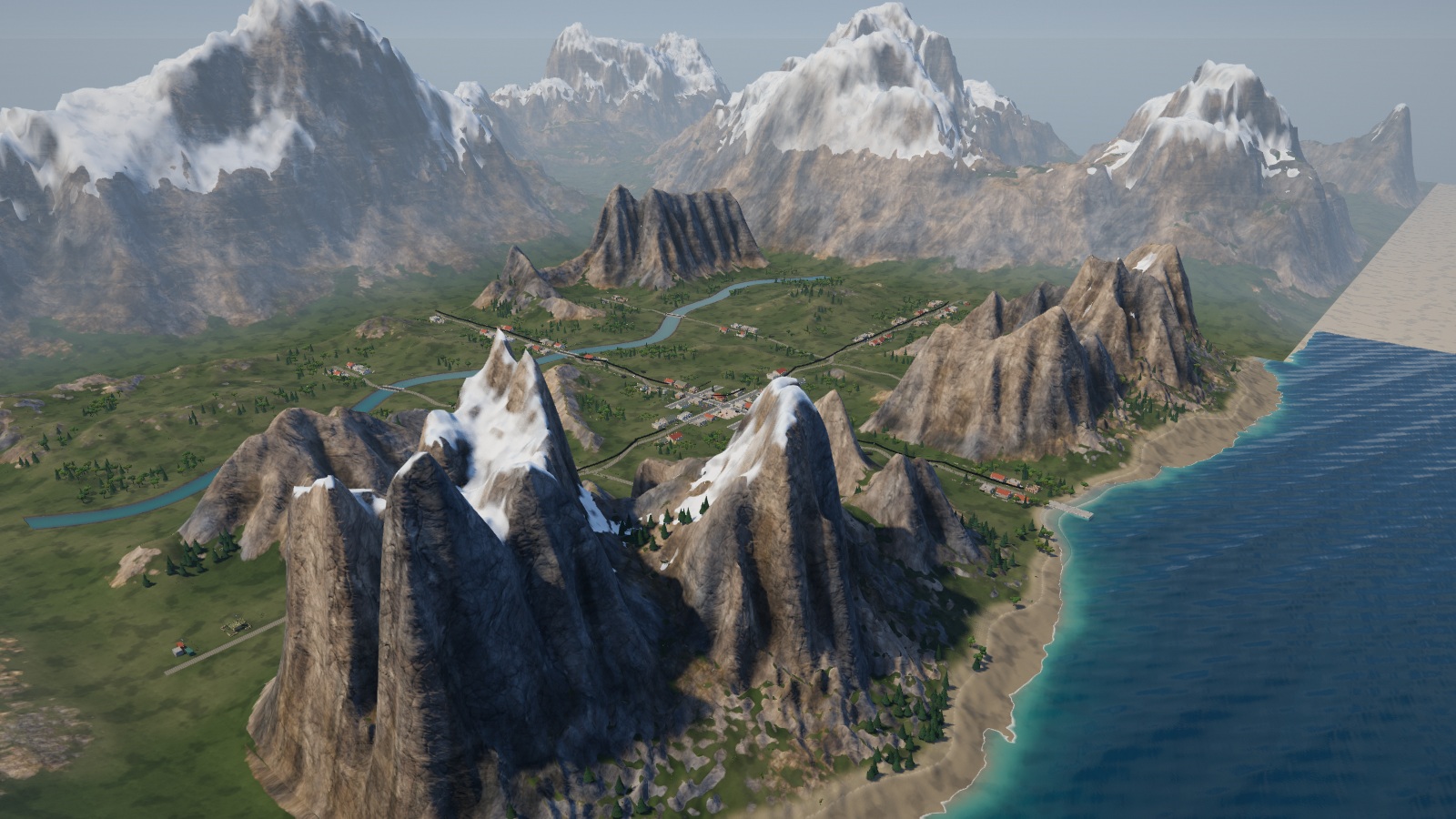
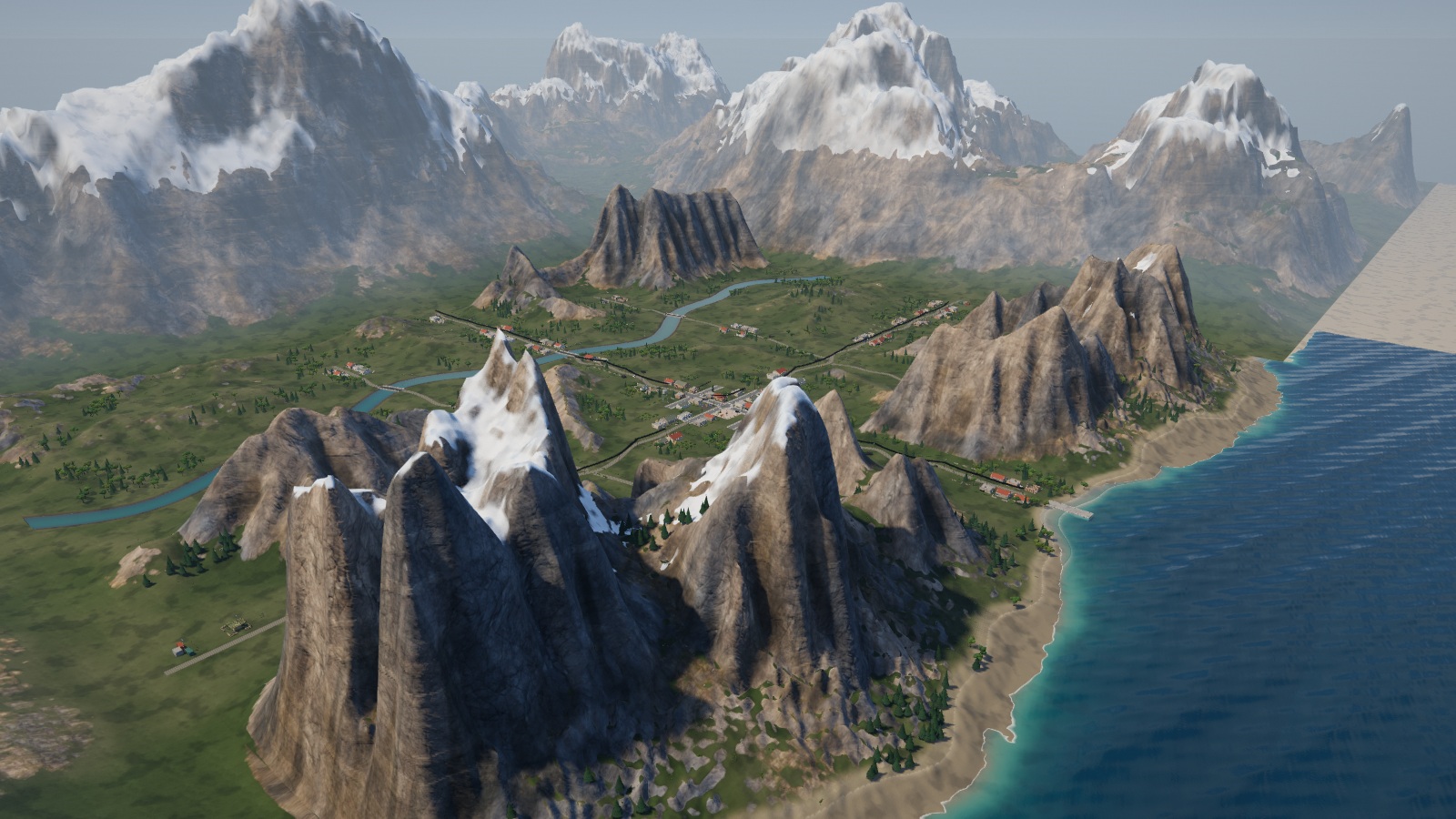
Distinguish loose scree from solid cliffs
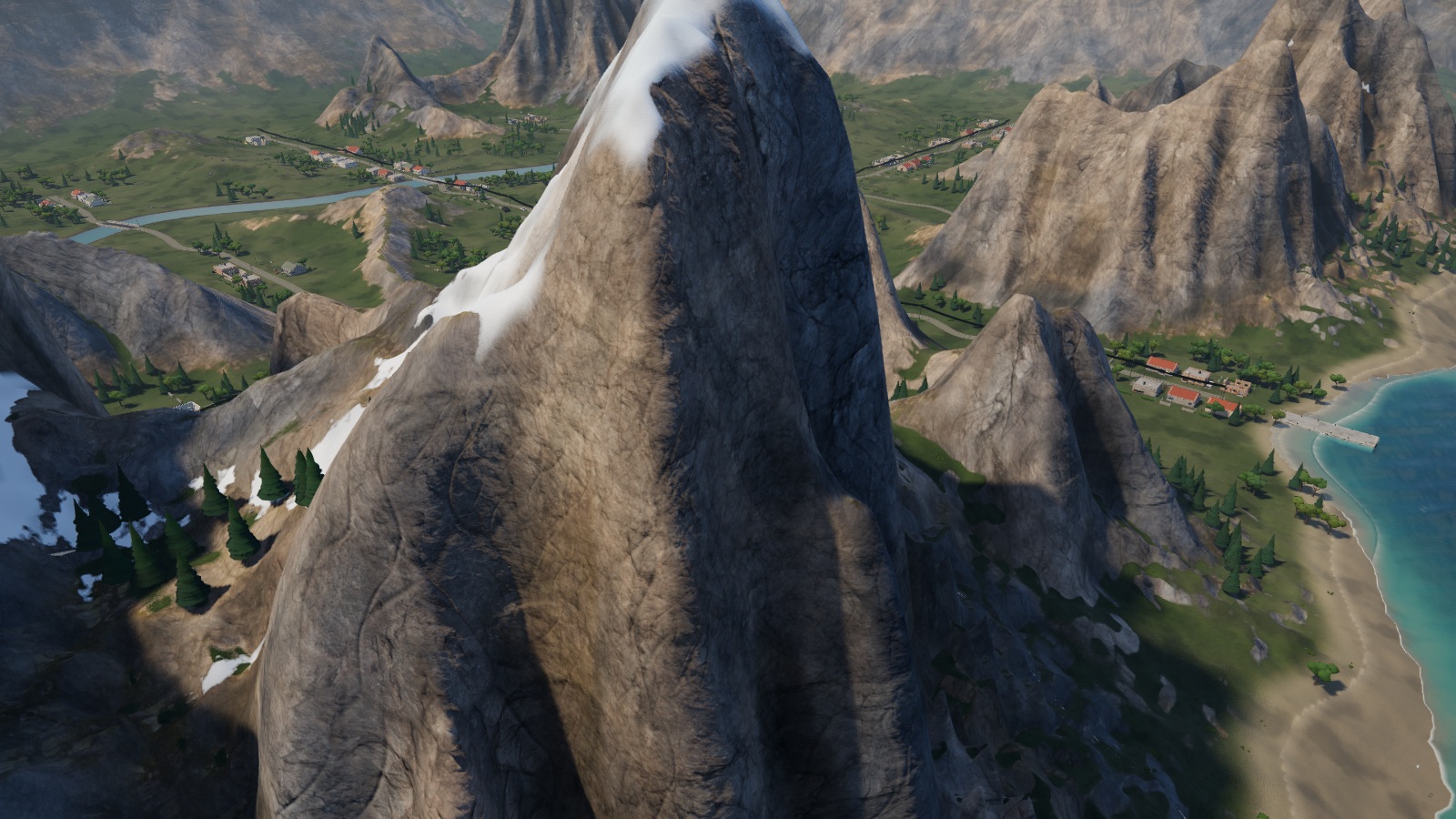
Sheltered lower slopes collect pale loose stone while exposed walls retain darker bedrock.
Explore this change
Uses existing slope, elevation and baked shelter to weight the existing scree photographs. A deposition-inspired material mask, not new sediment simulation.
Research: primary reference.
Loose stone collects in broken sheltered pockets, with photographic height detail breaking the deposit edge instead of a pale blanket across every lower slope.
Scree now forms irregular drainage fans instead of repeating yellow bands across distant mountains. Neutral stone coloration, coarse breakup and exposed bedrock interrupt the deposits.
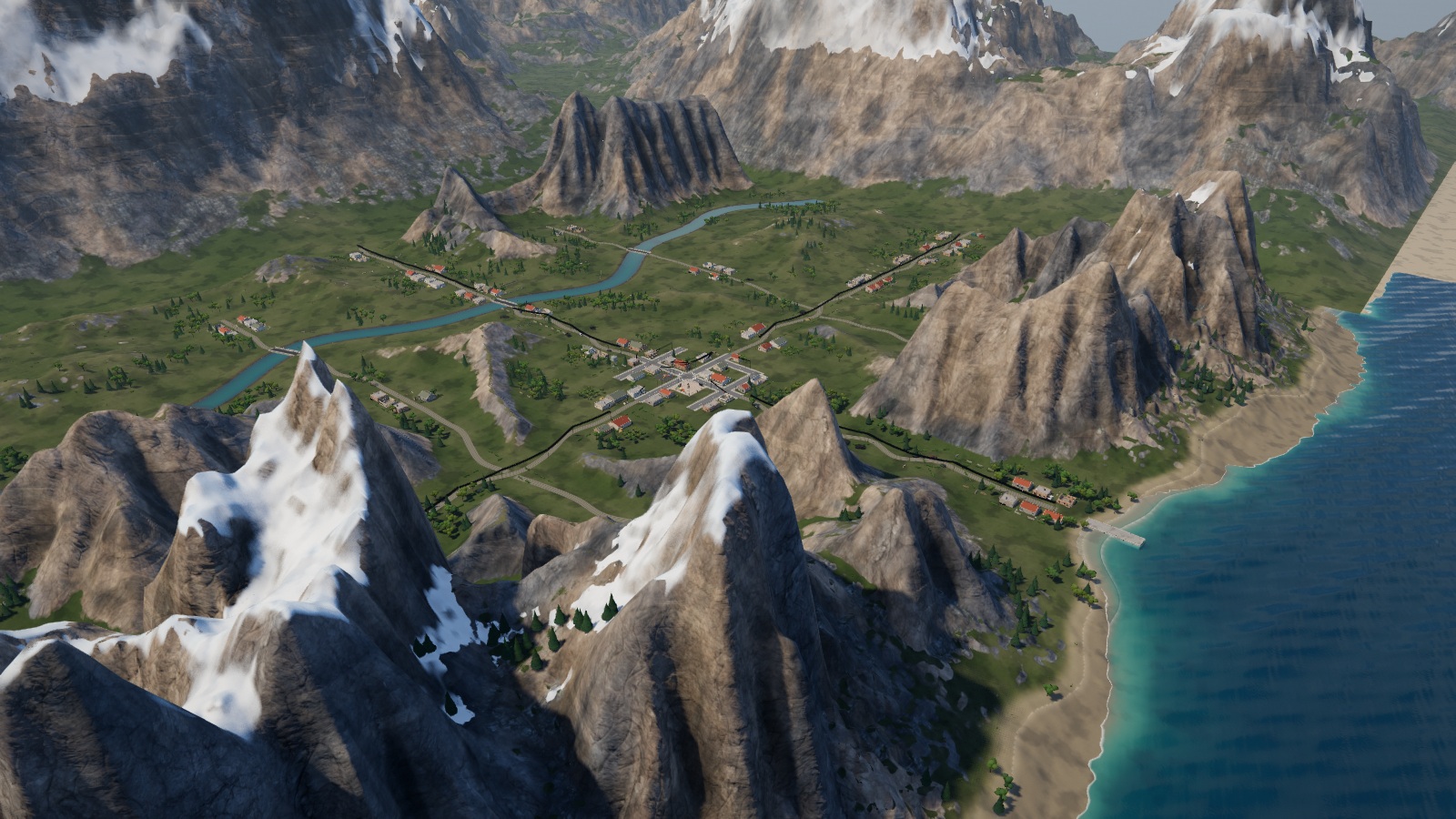
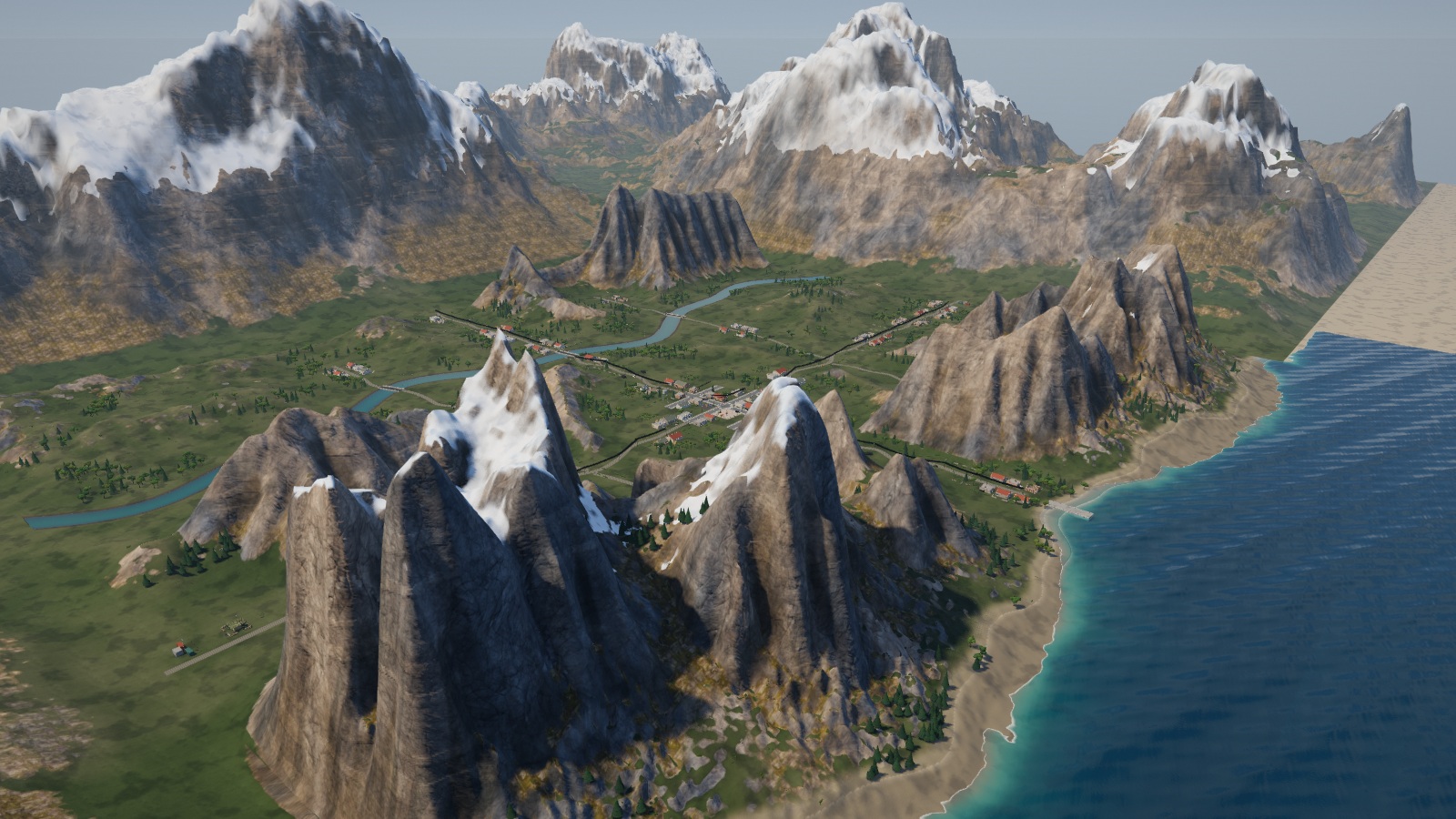
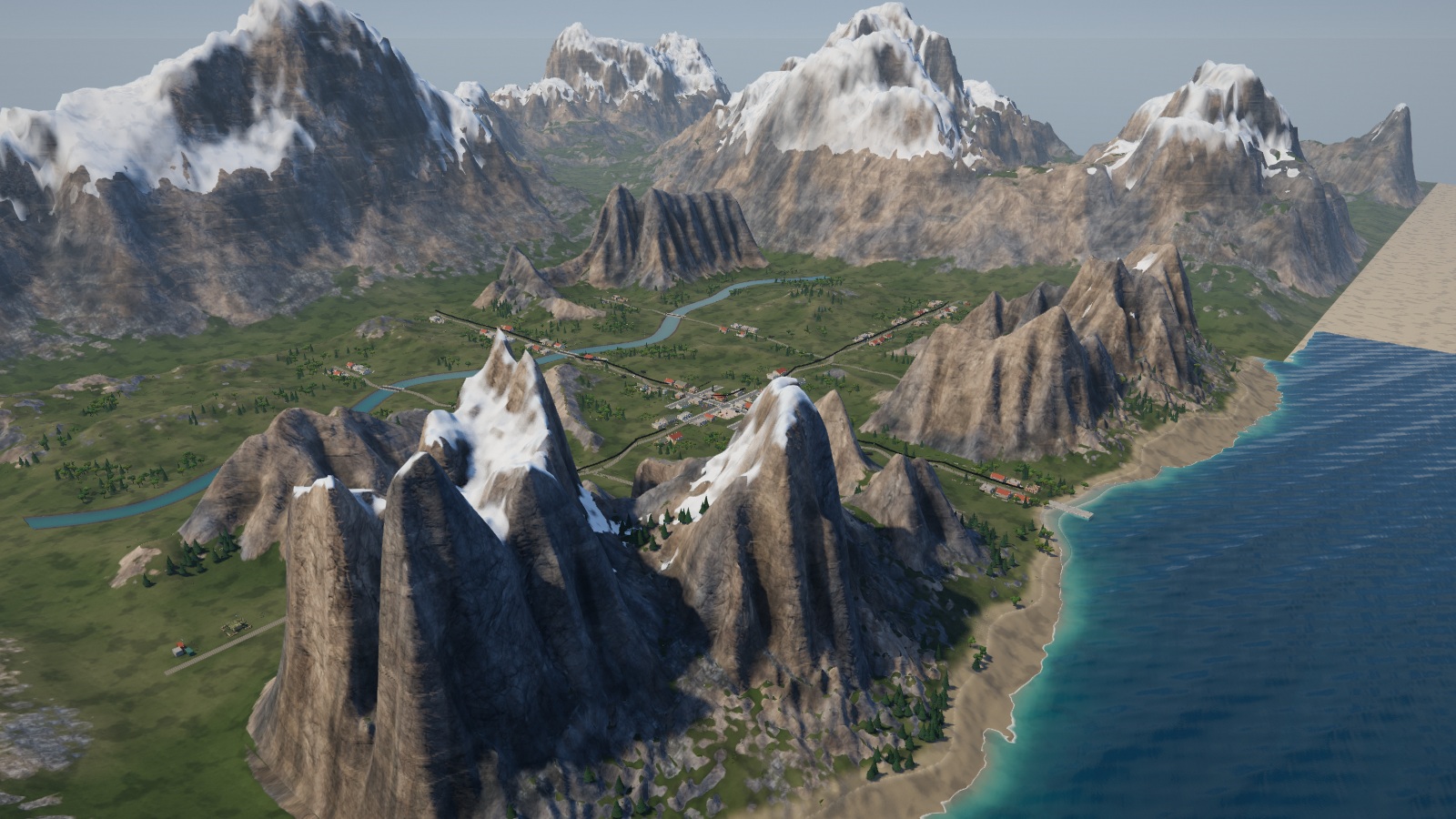
Break up smooth snow with wind-shaped surface detail
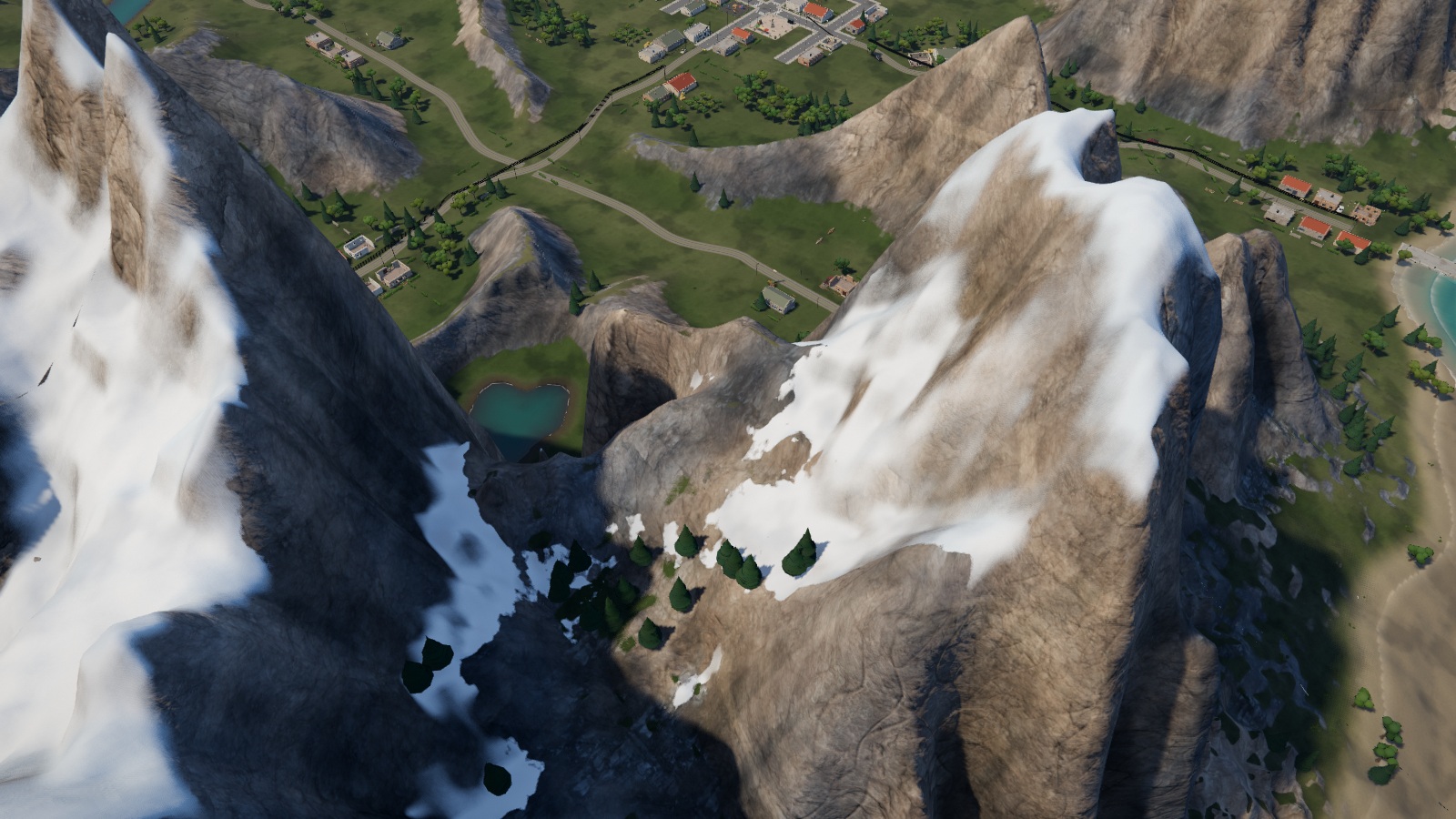
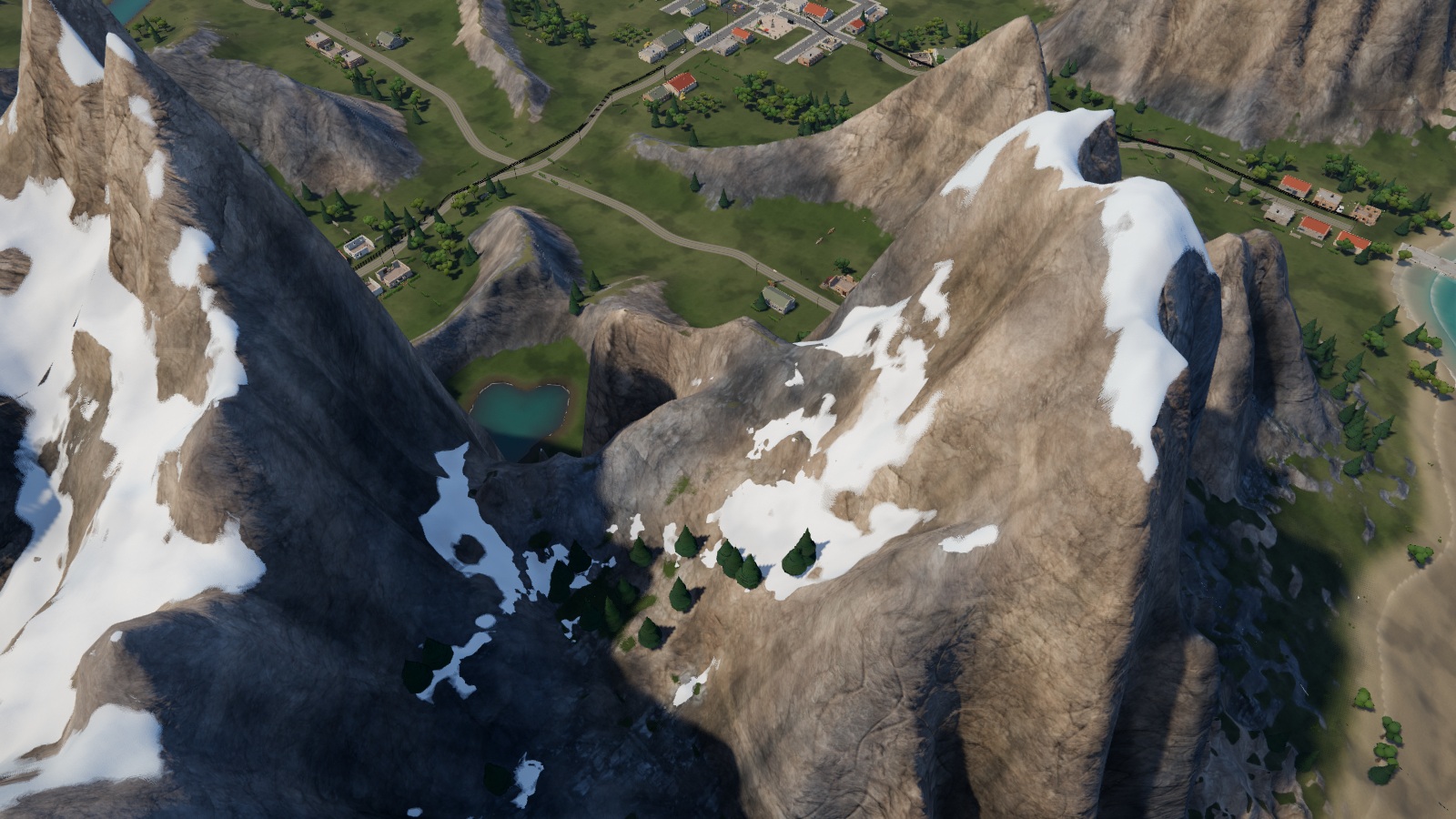
Snow shelves gain shallow wind grooves and granular highlights instead of perfectly smooth white surfaces.
Explore this change
Adds derivative-filtered snow surface relief and changes its roughness coherently. The wind-groove approximation extends the existing slope/exposure snow coverage; it does not implement the reference occlusion map.
Research: primary reference.
Wind grooves now bend and break at two scales, with subdued granular shading, rather than forming evenly spaced parallel stripes.
Snow collects in connected sheltered shelves with irregular wind-scoured rock windows, broken edges and softer two-scale surface relief.
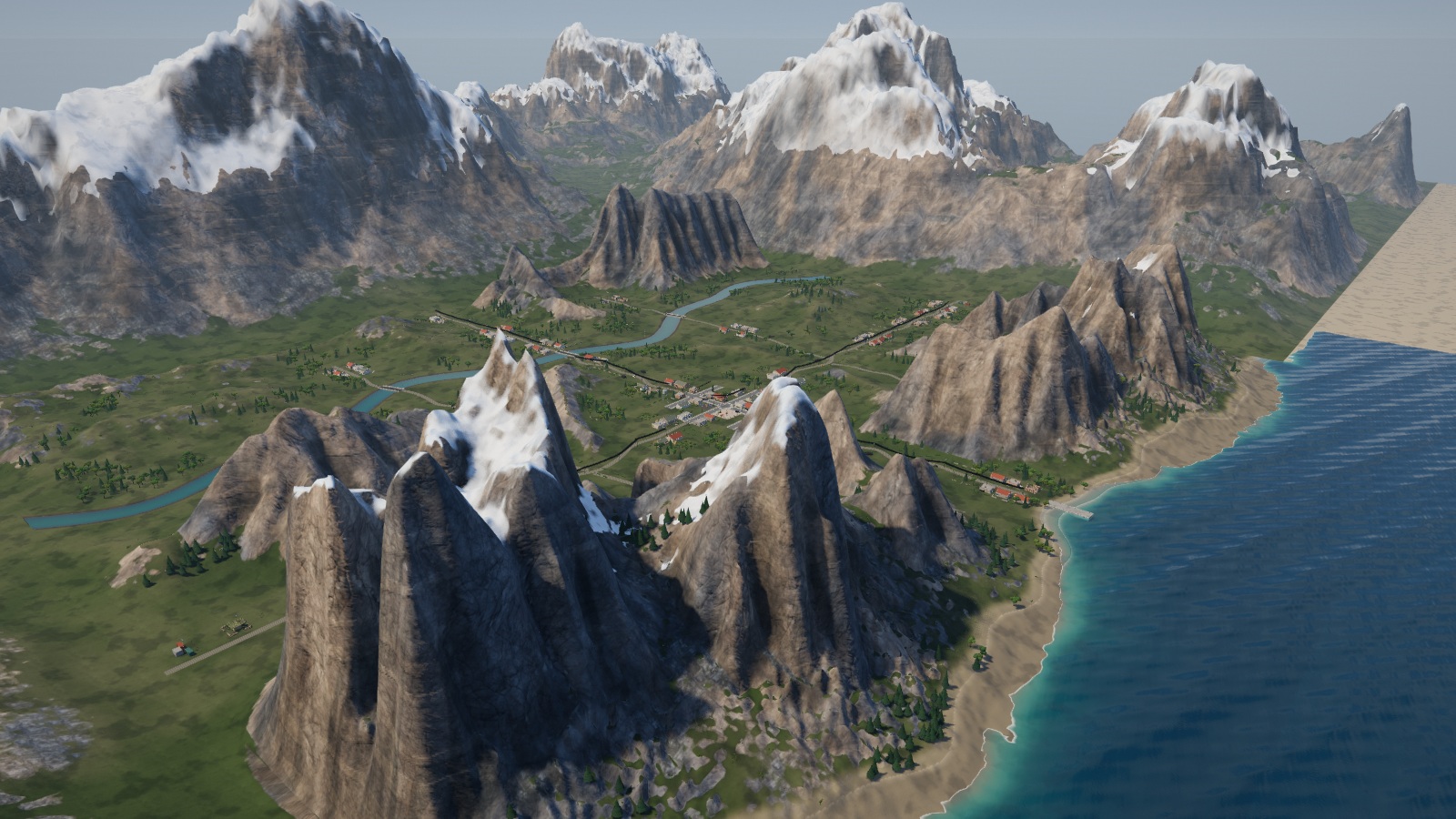
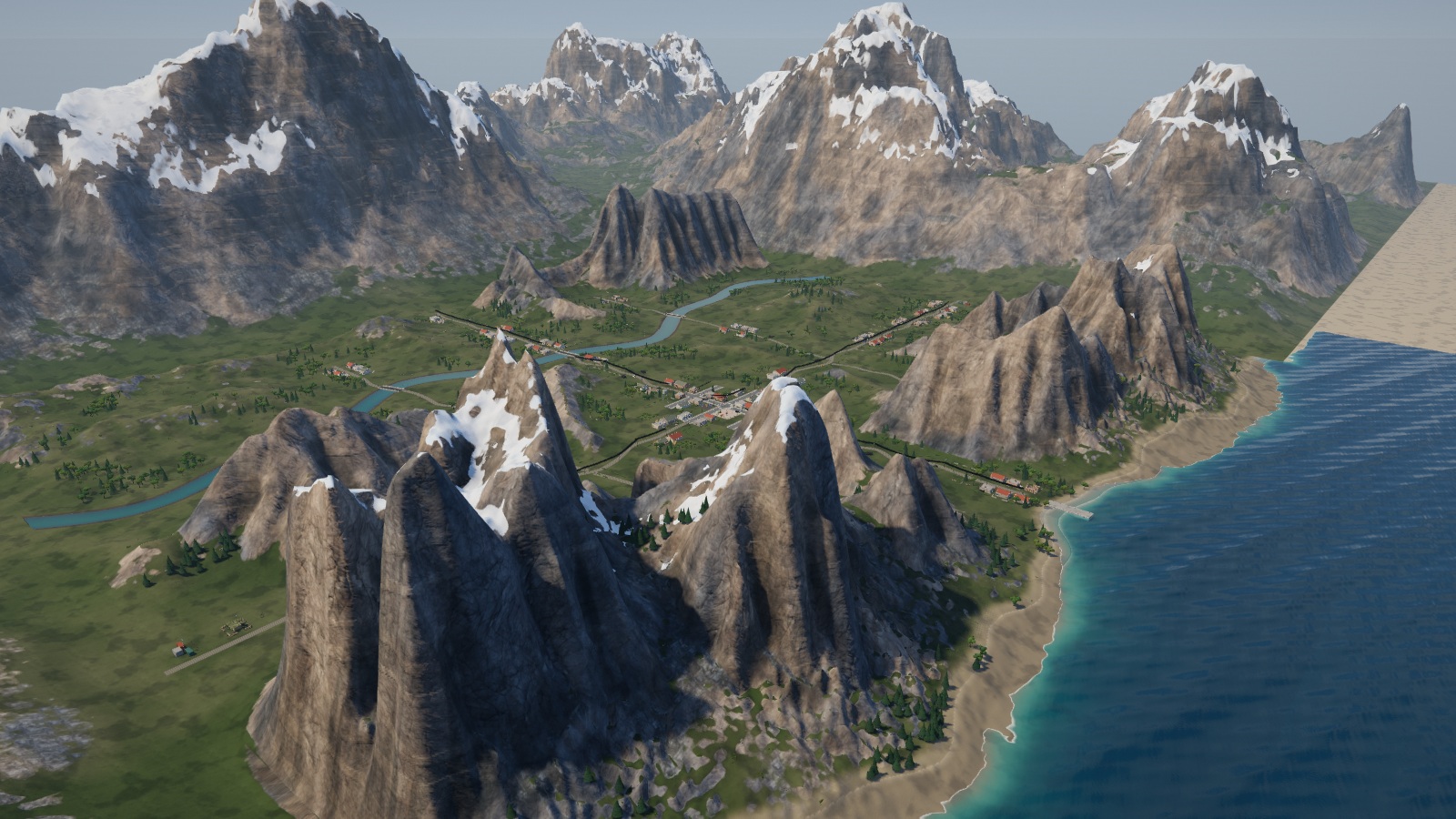
Give damp cliff streaks a wet surface response
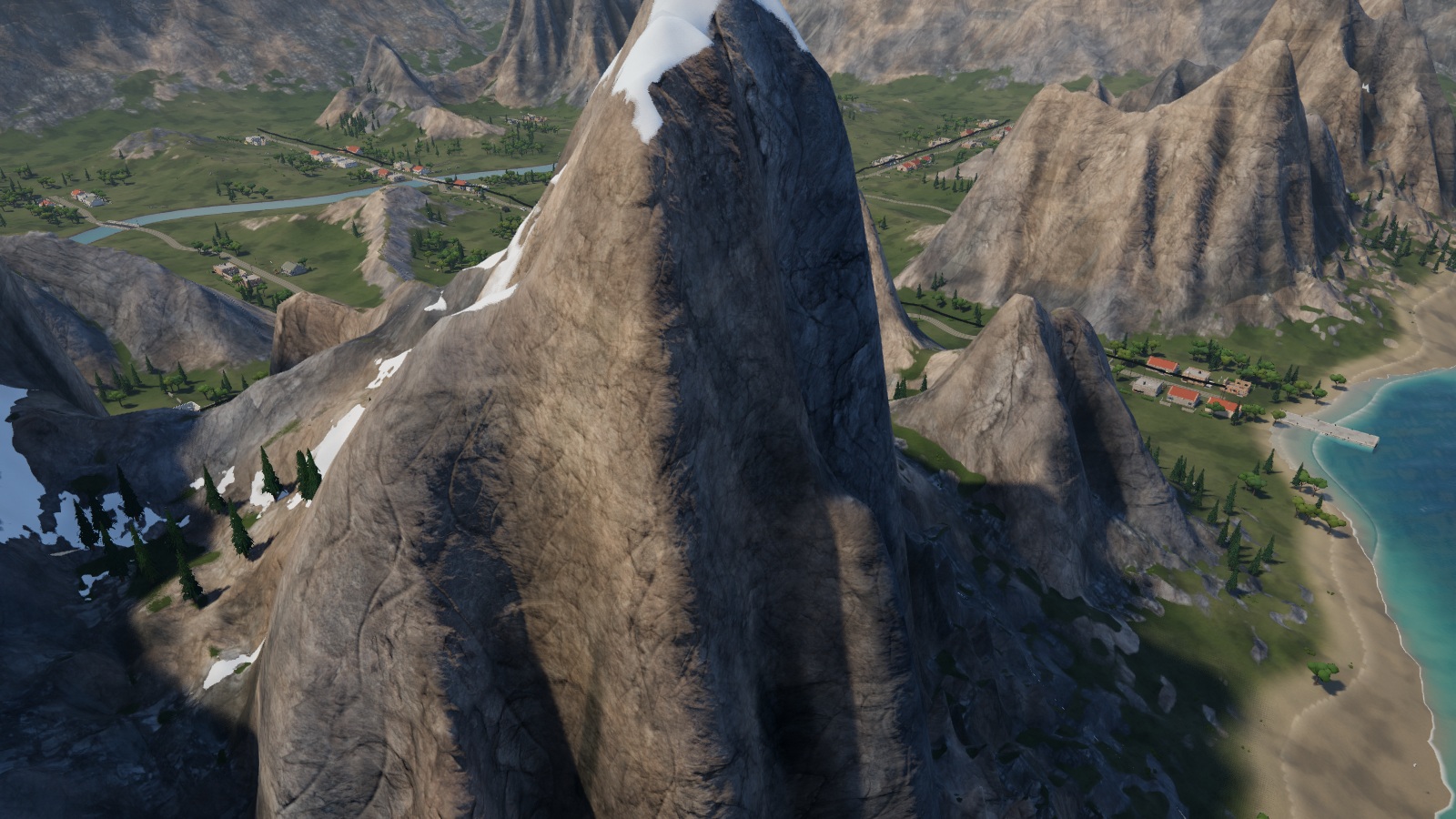
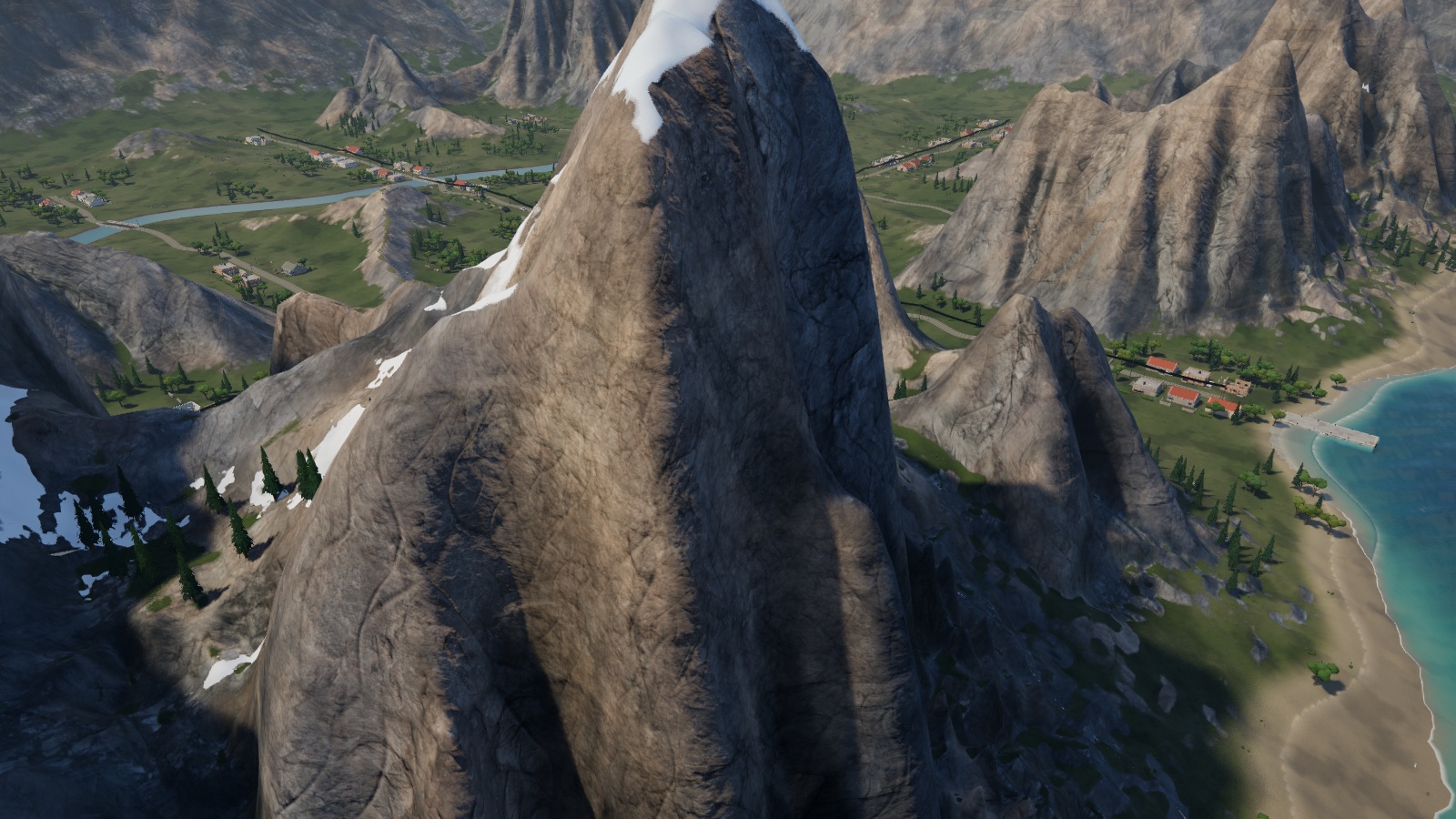
Sheltered runoff channels darken and develop a restrained sheen while exposed rock remains dry.
Explore this change
Existing runoff/shelter fields drive darkening, roughness and a bounded direct-light lobe. This is persistent seepage styling, not a hydrology simulation.
Research: primary reference.
Compatibility retains damp colour and roughness but skips the extra direct-light sheen to avoid bright faceting.
Seepage follows connected runoff channels with variable shelter, darkening narrow damp areas rather than tinting a whole cliff.
Wet cliffs now show broad connected drainage stains and smaller vertical tributaries, with a darker, cooler surface response that remains visible at normal viewing distances.
Replace cone-like spruce tiers with ragged boughs
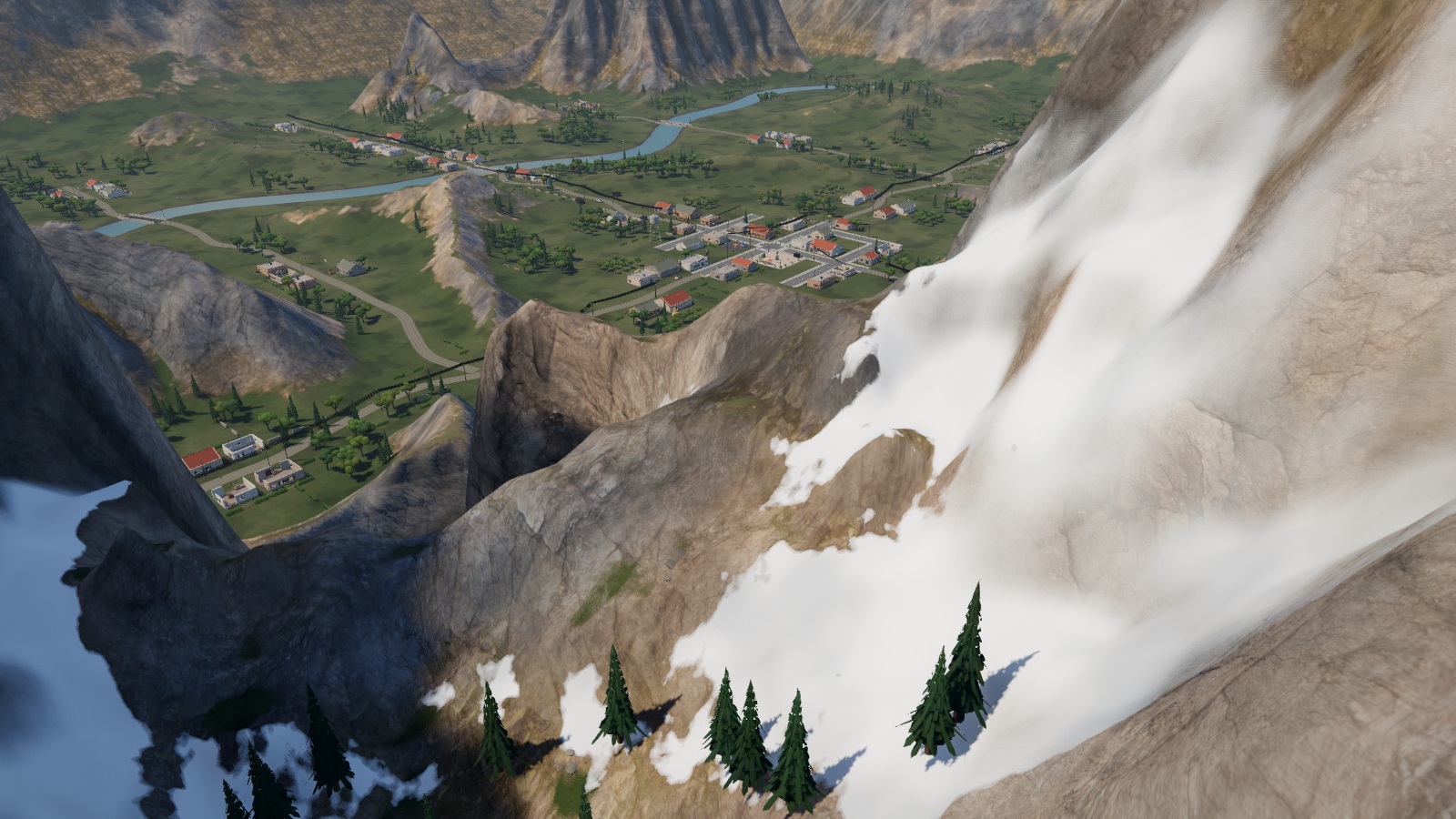
Conifers have broken, asymmetric branch silhouettes that read as trees against rock and snow.
Explore this change
A shared low-polygon bough mesh replaces each solid cone tier, preserving the existing tree batching, burn state and placement.
Research: primary reference.
Spruce sprays have divided tips and irregular branch lengths, producing fuller foliage with broken edges rather than flat triangular tiers.
Give alpine stones angular fractured shapes
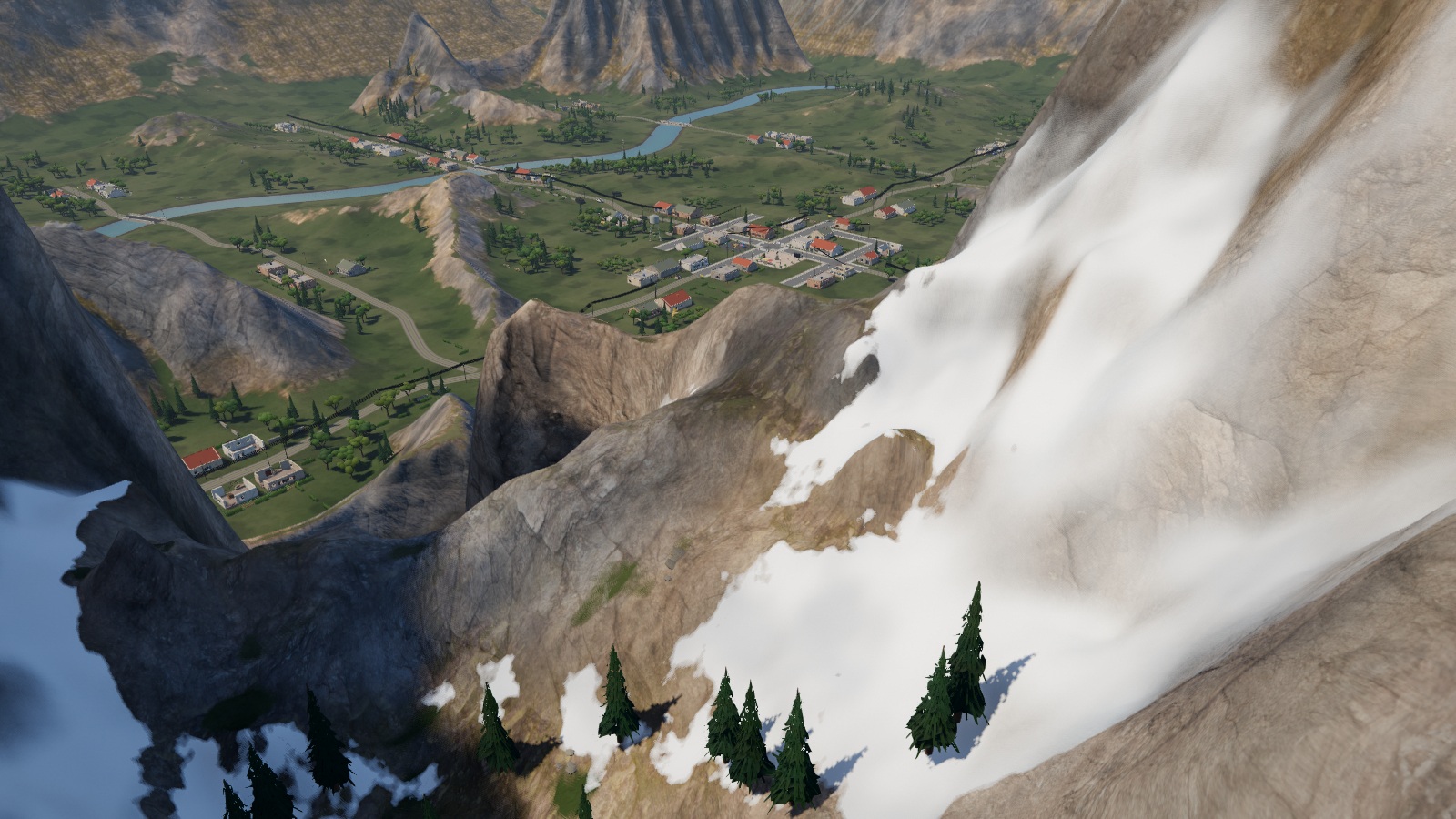
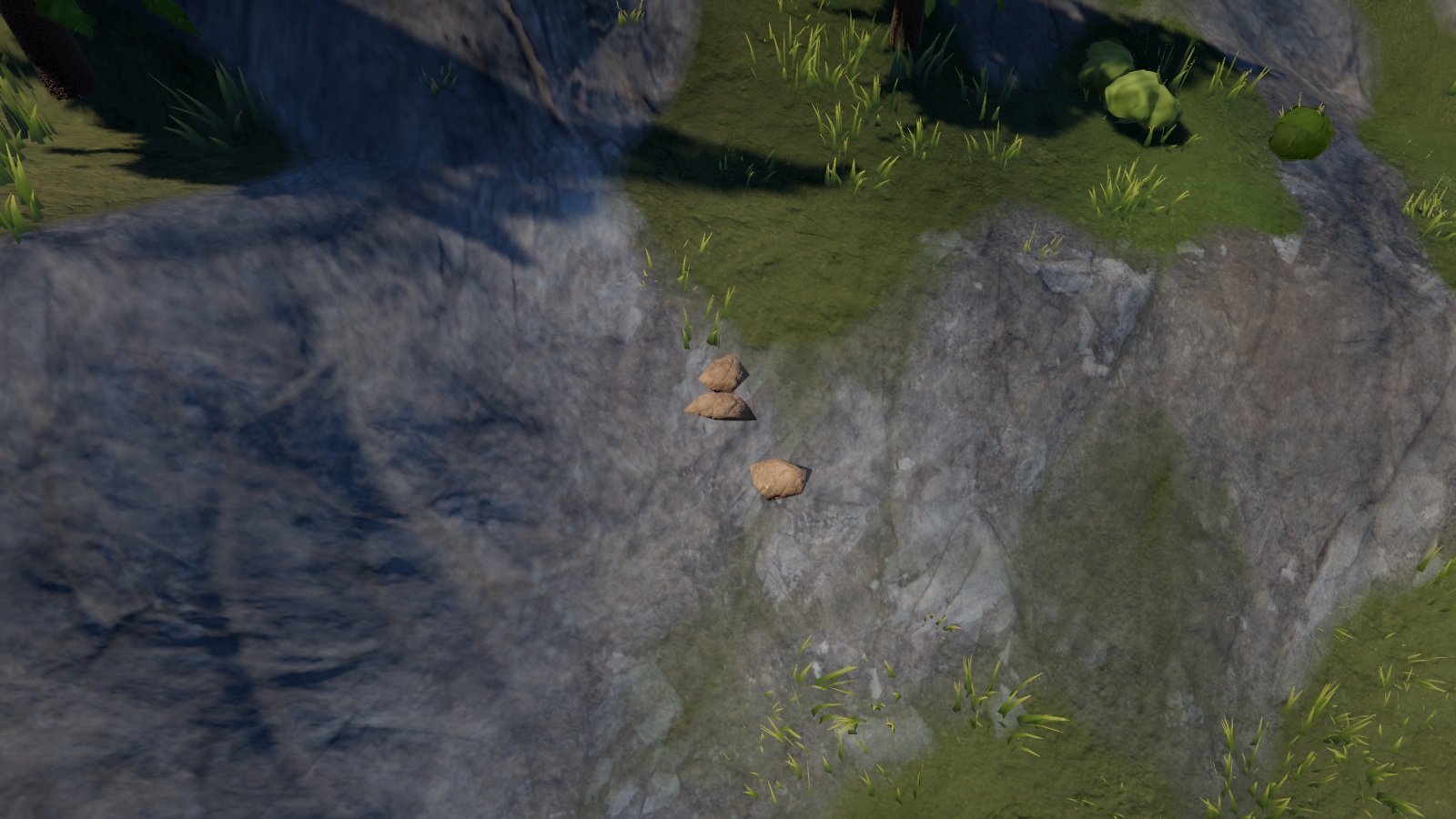
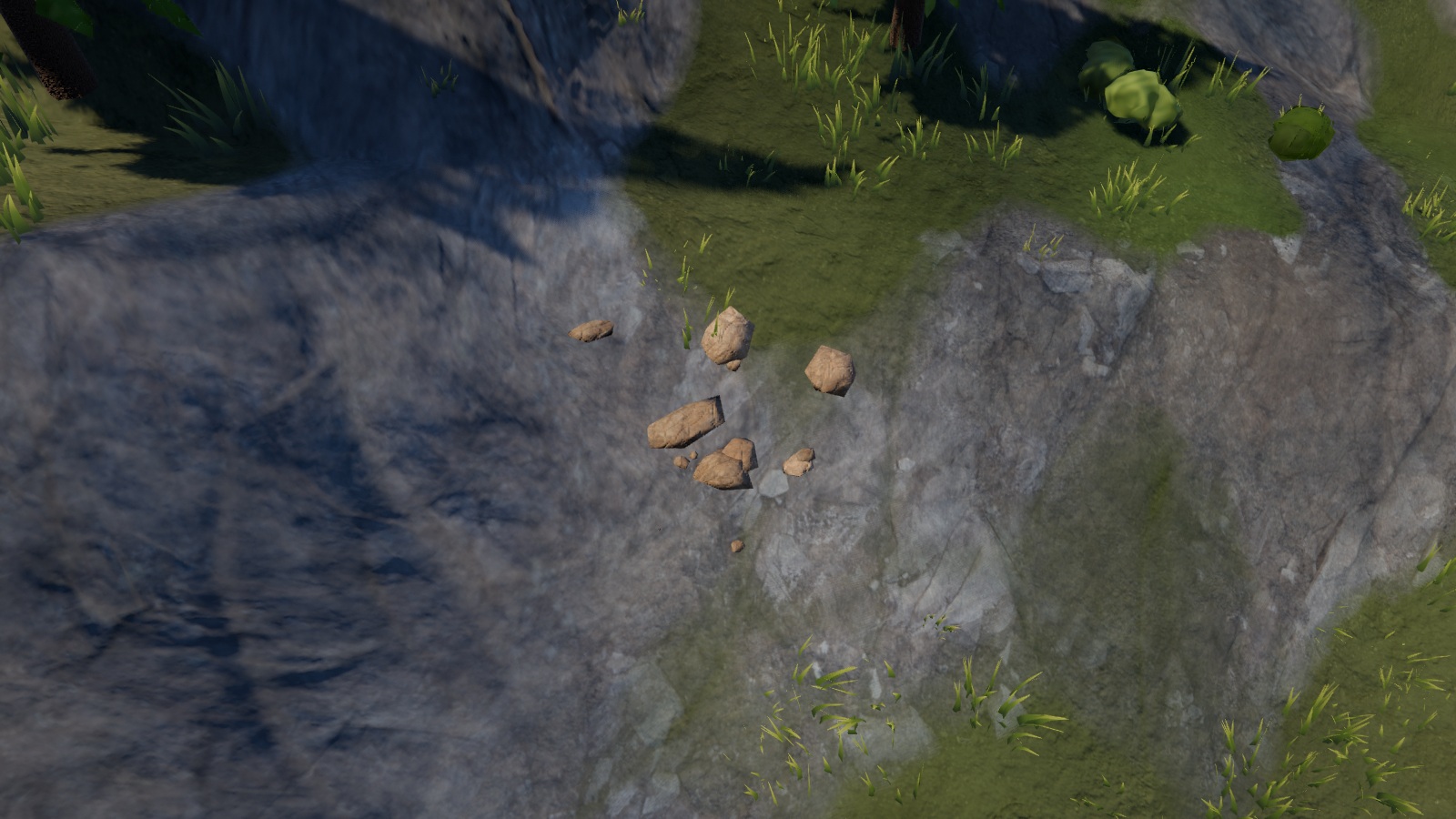
Stones at the mountain foot have irregular broken faces instead of flattened round primitives.
Watch: Fractured stones at close range, then the surrounding slope. Native current-PR camera recording; simulation held, wind animated. The matched stills below show before and after. (Direct WEBM)
Explore this change
A small set of cached seeded faceted meshes replaces decorative pebble spheres. Placement, passability and replicated dressing data stay unchanged.
Research: primary reference.
Natural stones also use a rough granular material instead of the masonry material with mortar joints.
Decorative stones use the bundled rock photograph with triplanar projection, retaining their shared fractured meshes and avoiding flat grey surfaces.
Alpine dressing combines slabs, angular cobbles and smaller fragments in denser, varied clusters. Fine fragments are batched separately and culled at distance; larger stones remain visible.
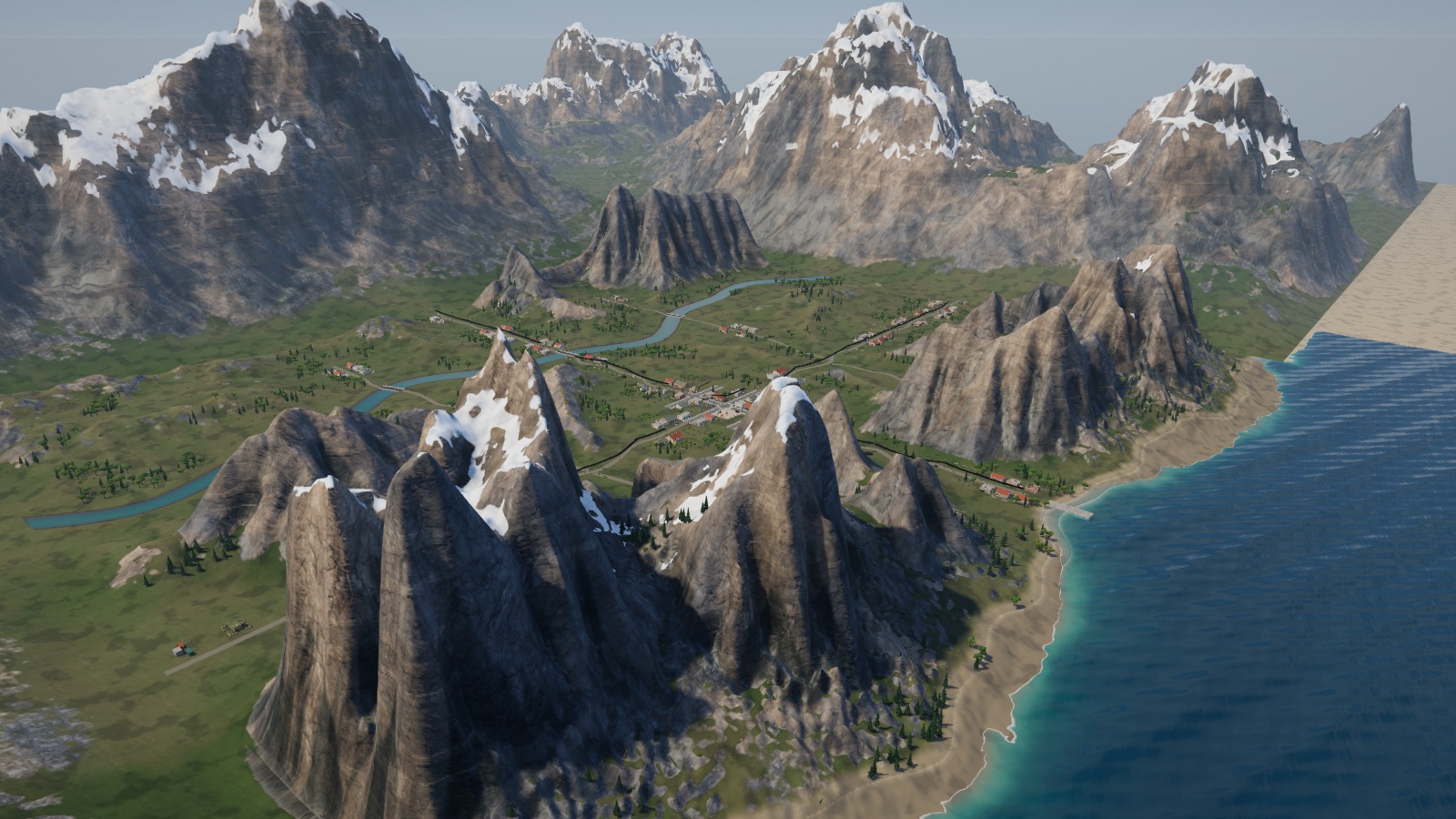
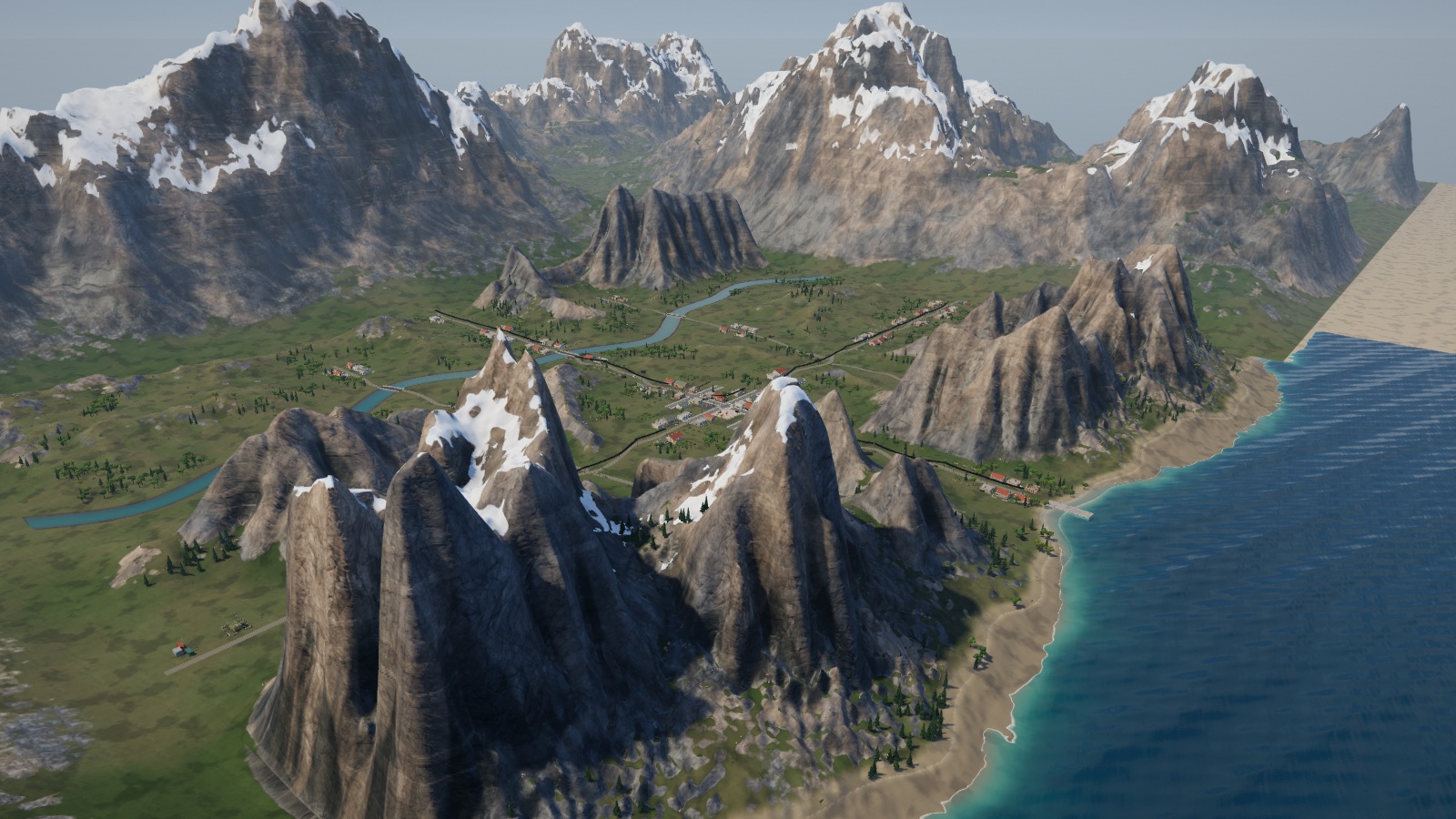
Make meadow colour follow broad soil pockets
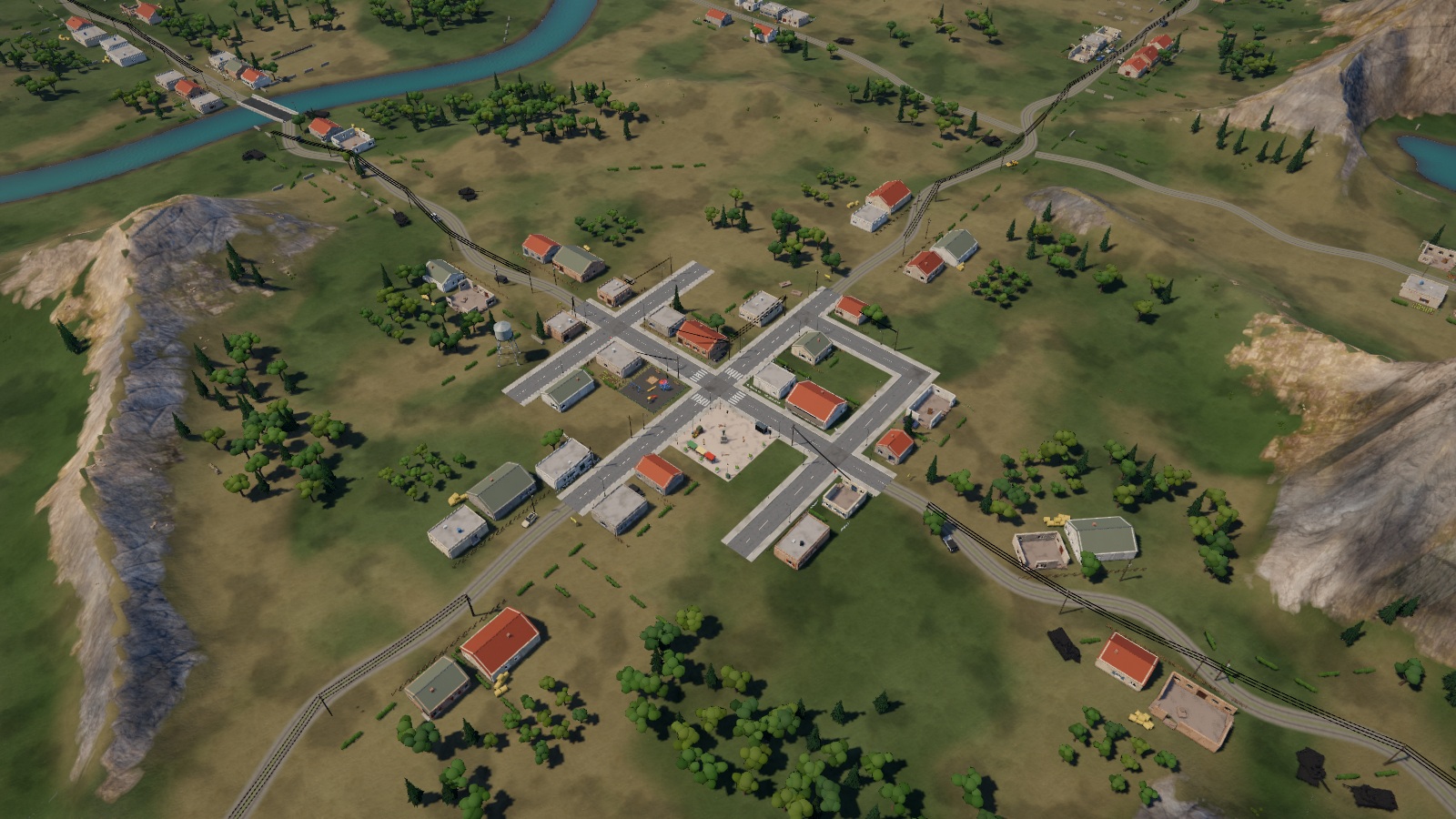
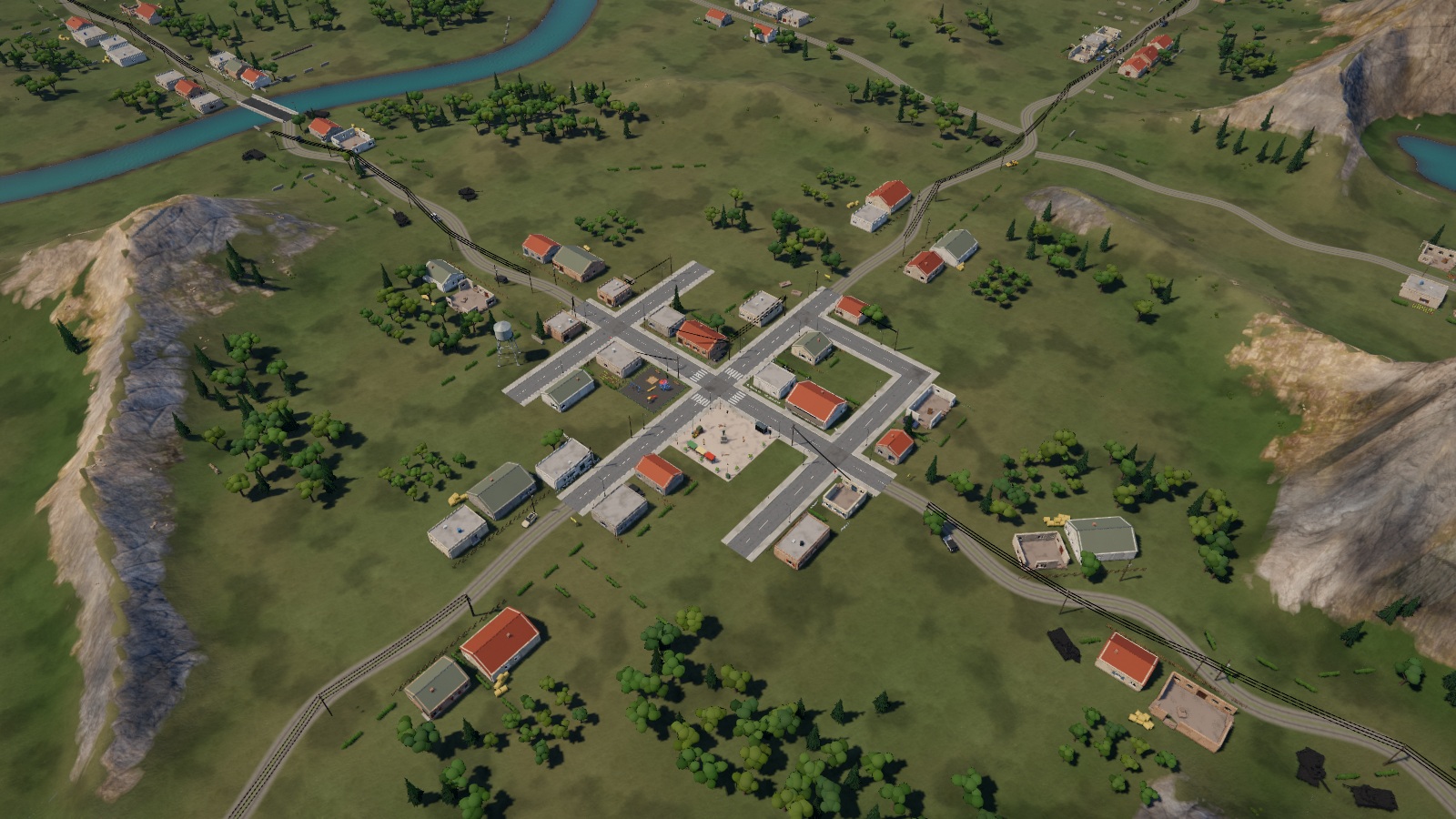
Connected dry grass and richer moss patches replace evenly green valley floors.
Explore this change
Broad moisture and exposure masks reuse existing world-space noise and shelter, with fine photographic detail retained. No extra scatter or draw calls.
Research: primary reference.
Meadow colour follows shelter and aspect more strongly, with quieter dry-grass colour that avoids broad camouflage-like brown blobs.
Blend gravel into alpine shorelines
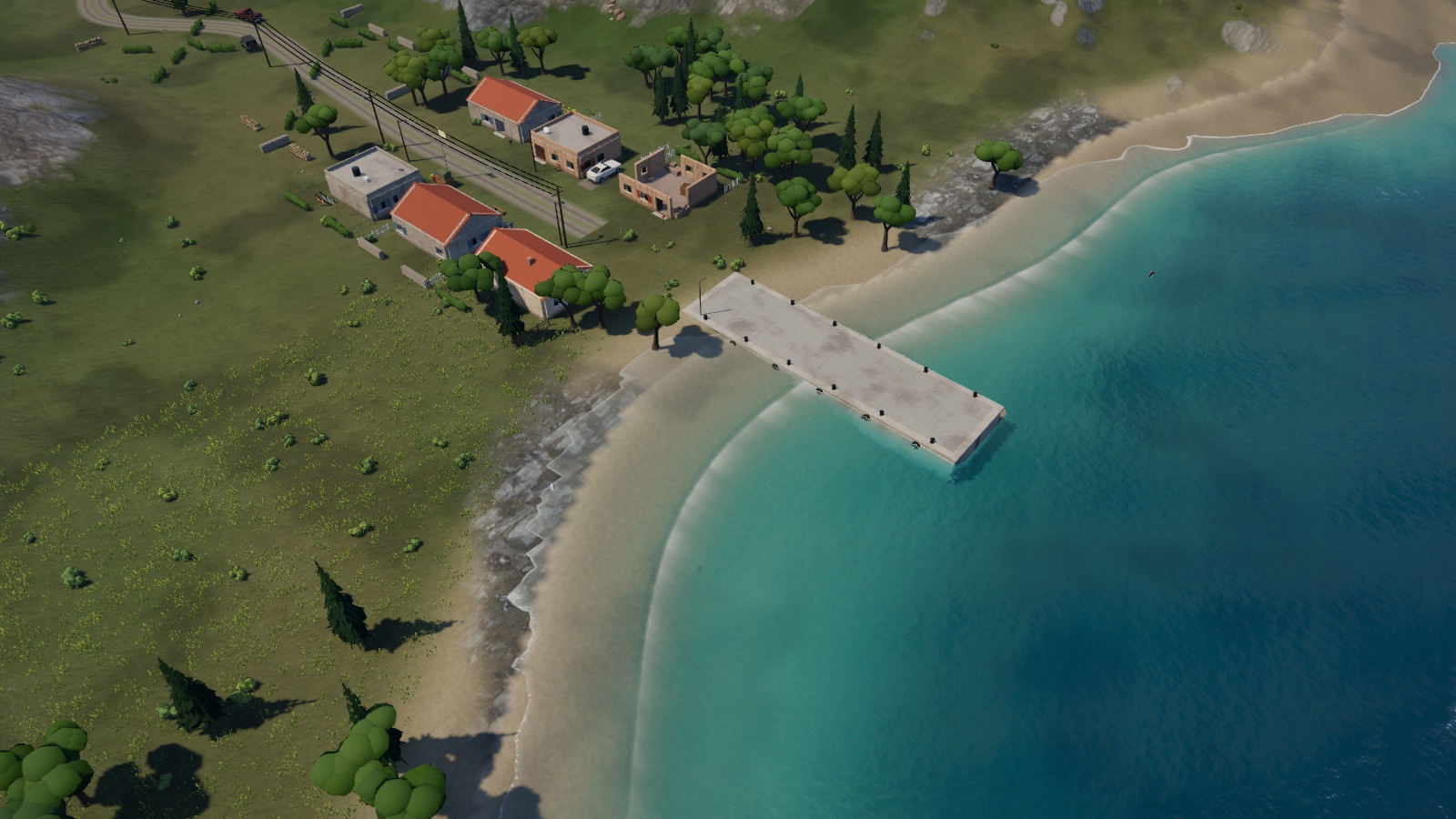
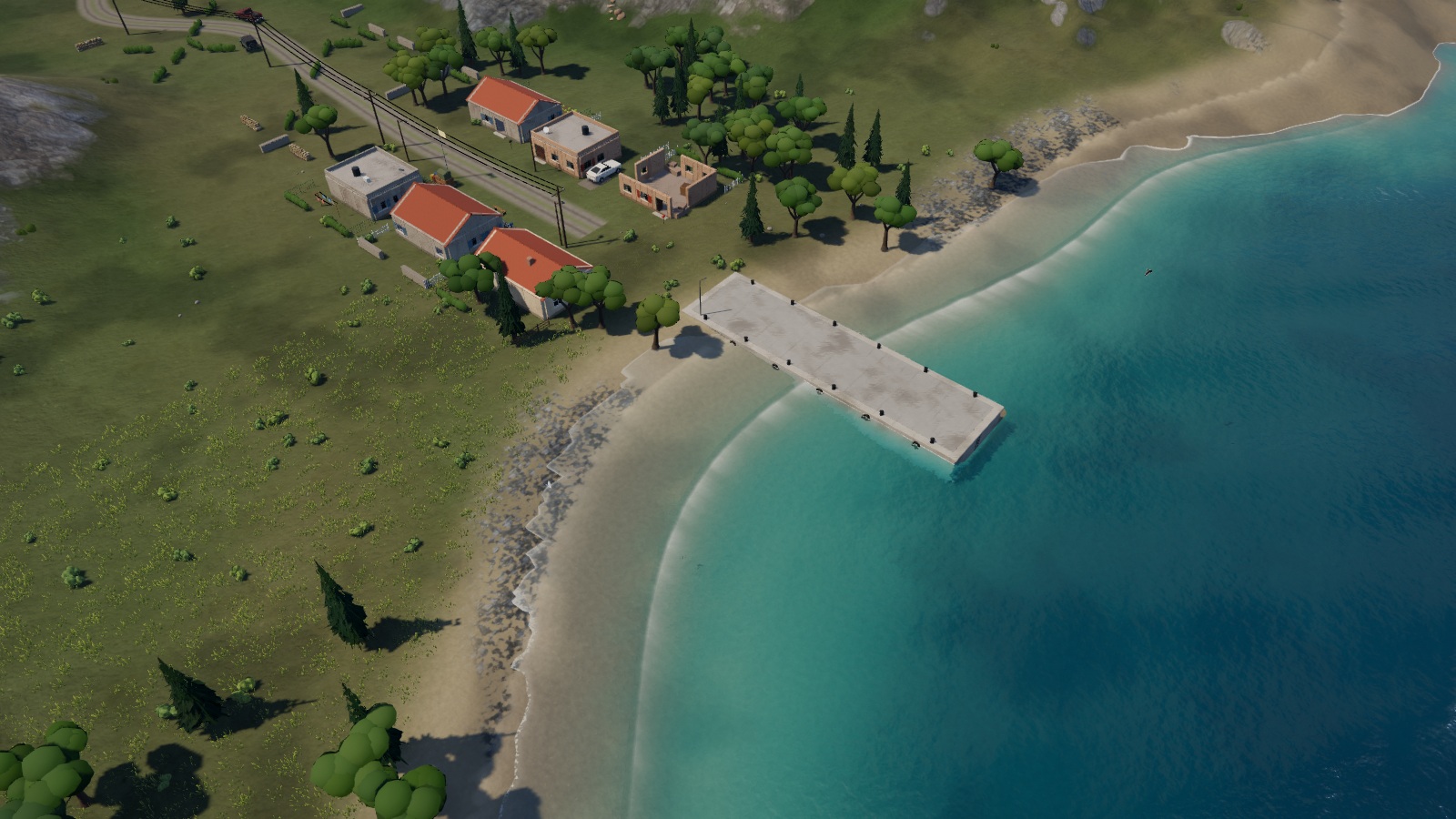
Coastal margins transition through exposed gravel and darker wet stone instead of a uniformly sandy strip.
Watch: A close orbit over gravel, wet margins and exposed sand, followed by coastal context. Native current-PR recording; camera and water animated. Compare the matched stills below. (Direct WEBM)
Explore this change
The existing shoreline and slope masks select photographic gravel and damp roughness. Water depth, wading and boat navigation remain authoritative and unchanged.
Research: primary reference.
Gravel collects in broken coves and steeper banks, preserving sandy openings instead of tracing a continuous band around the whole coast.
Shorelines now blend neutral gravel, darker washed margins and exposed sand through irregular deposits, with photographic breakup at their edges.
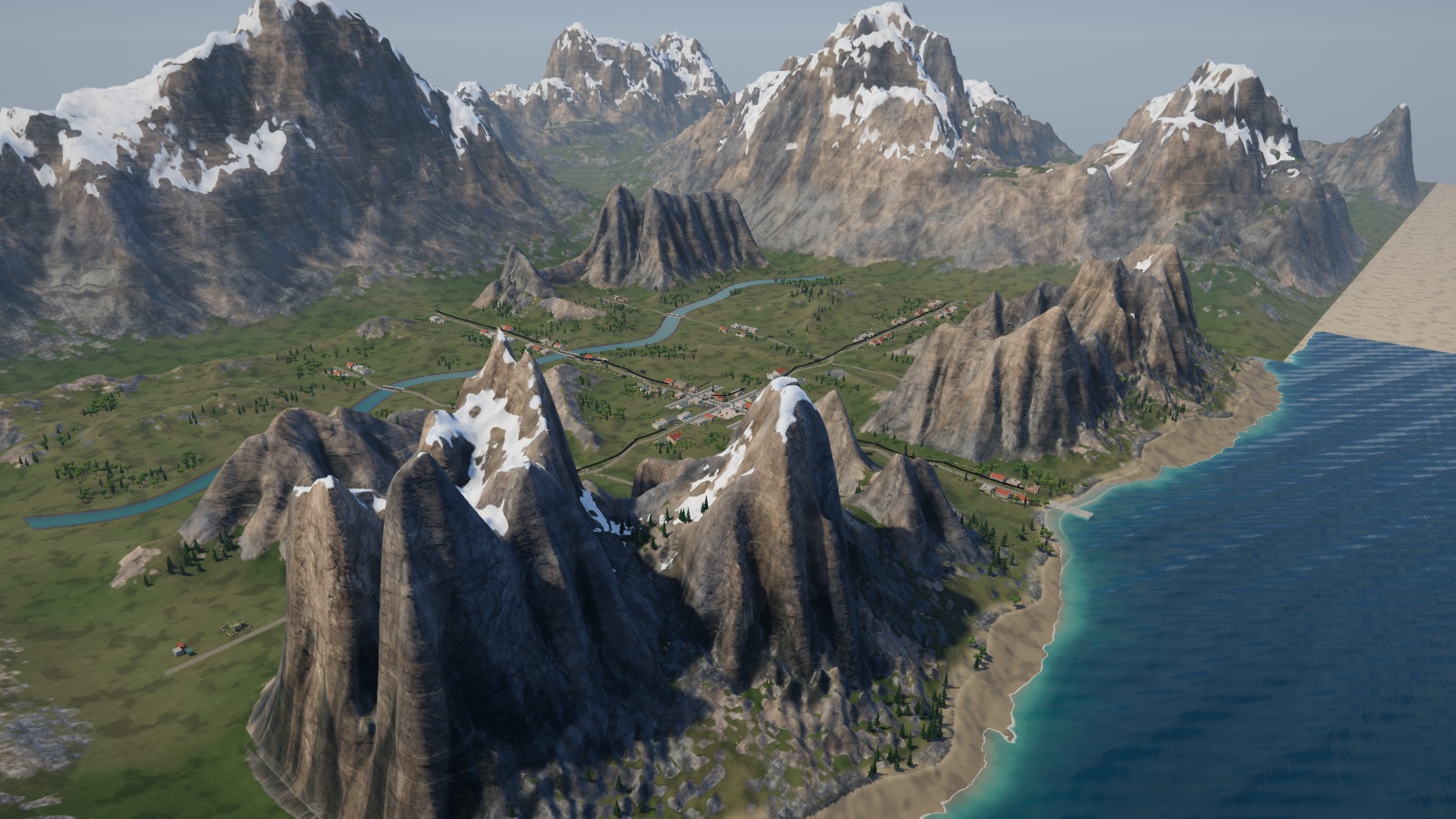
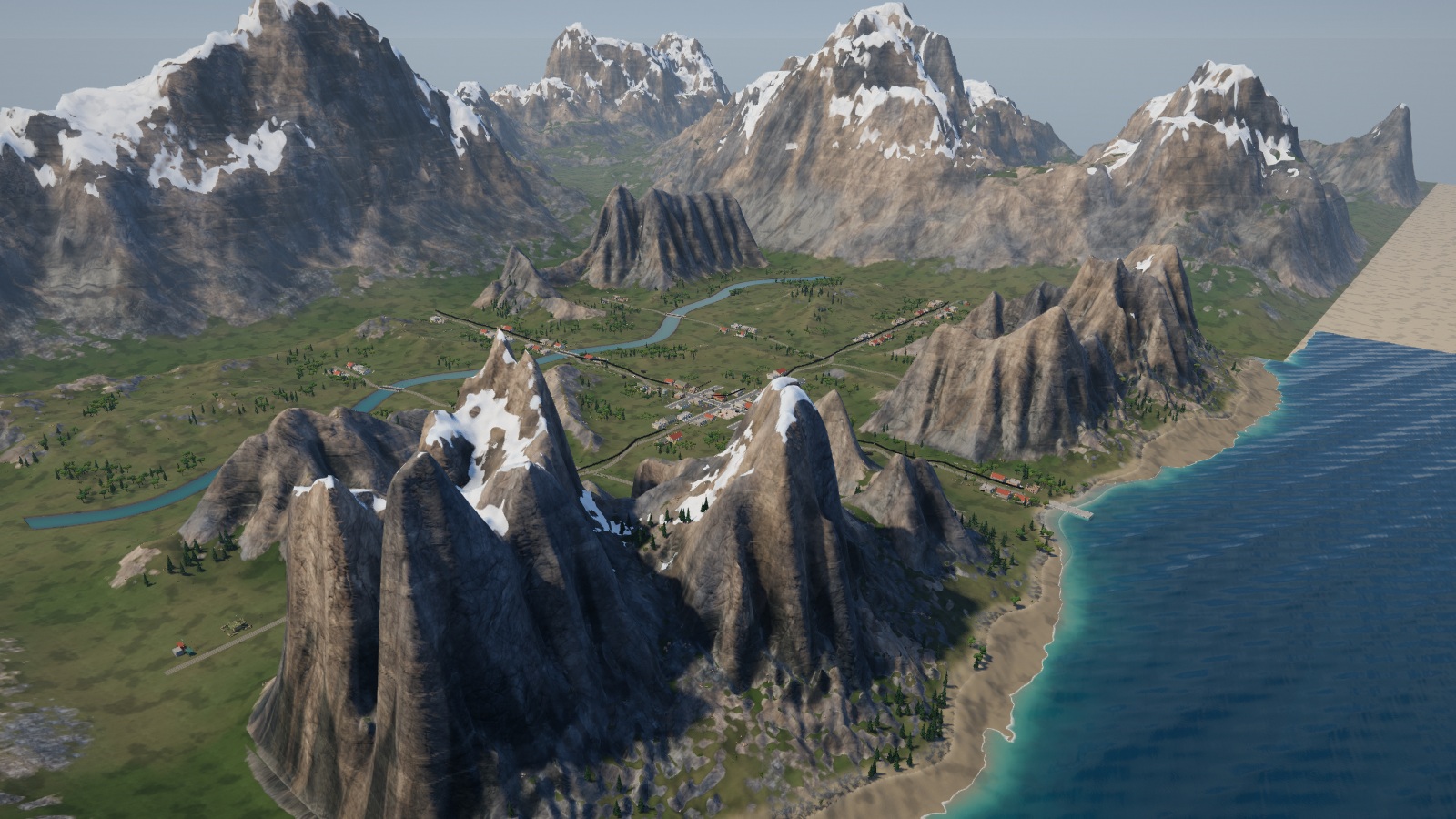
Give rock crevices more depth
Sheltered rock crevices receive stronger ambient occlusion while exposed rock stays open to sky light.
Explore this change
No new texture reads. Occlusion affects ambient lighting, with the existing direct-light contribution retained. This is a material approximation, not new ray tracing.
Technique reference: research source.
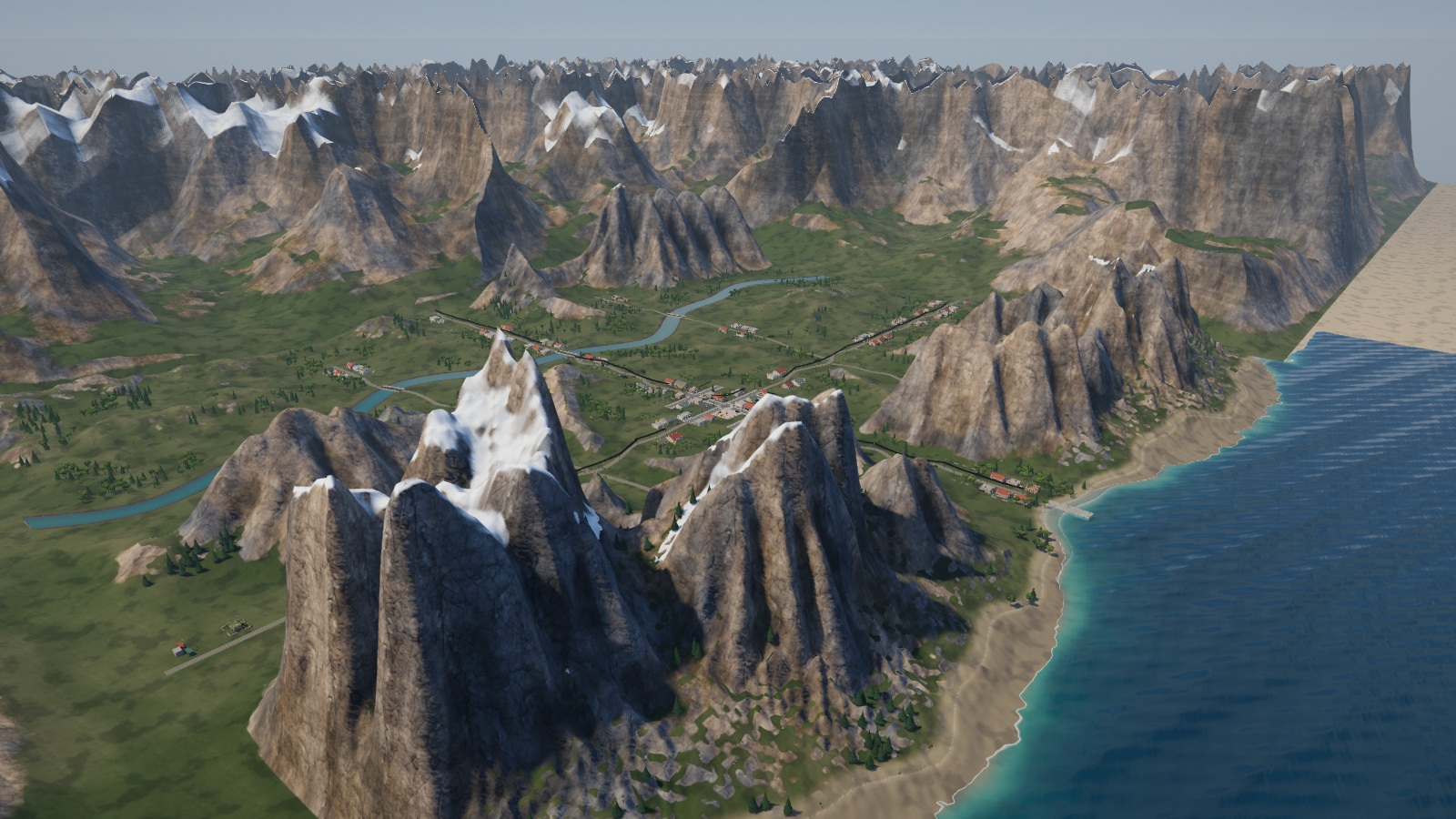
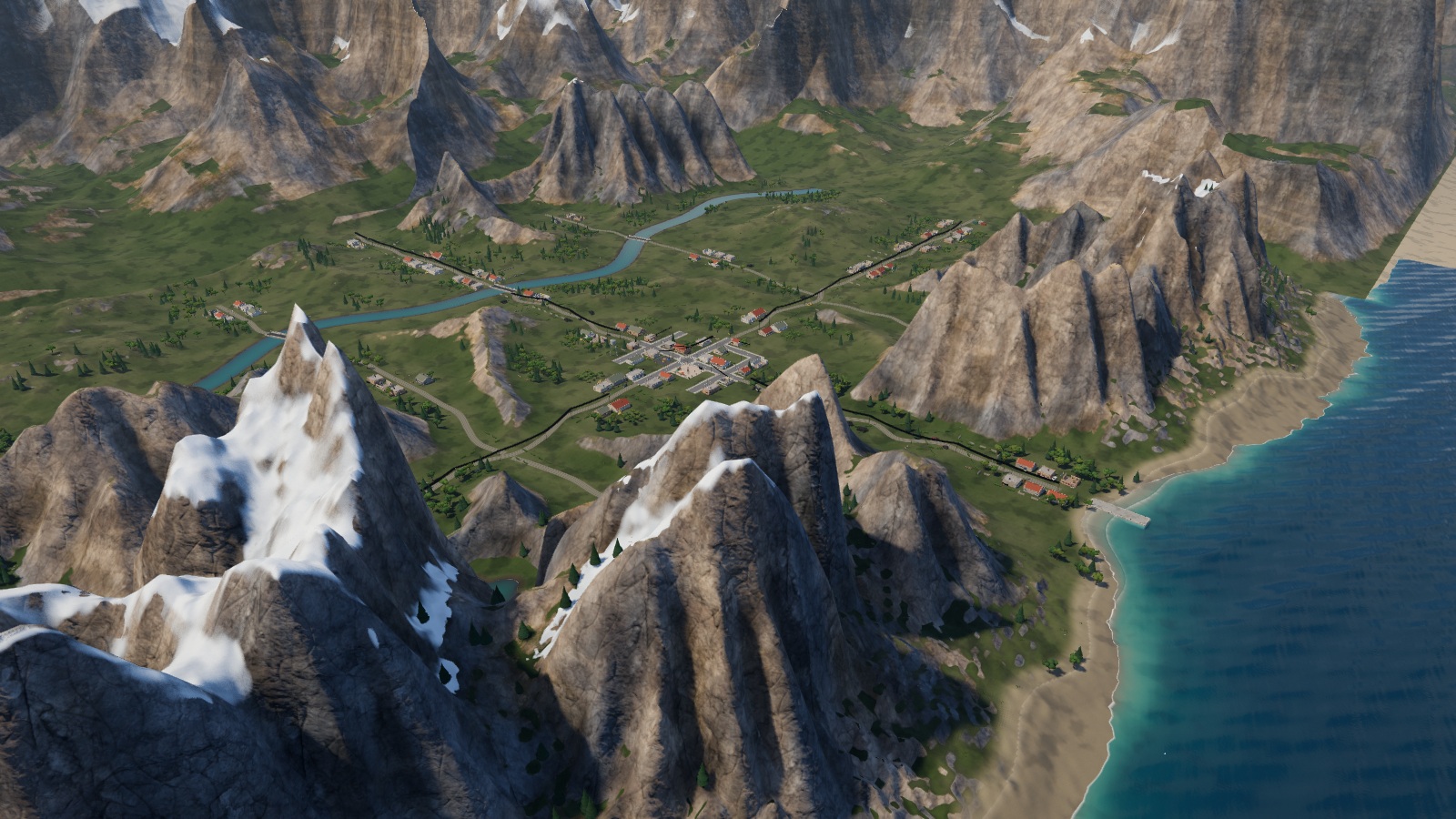
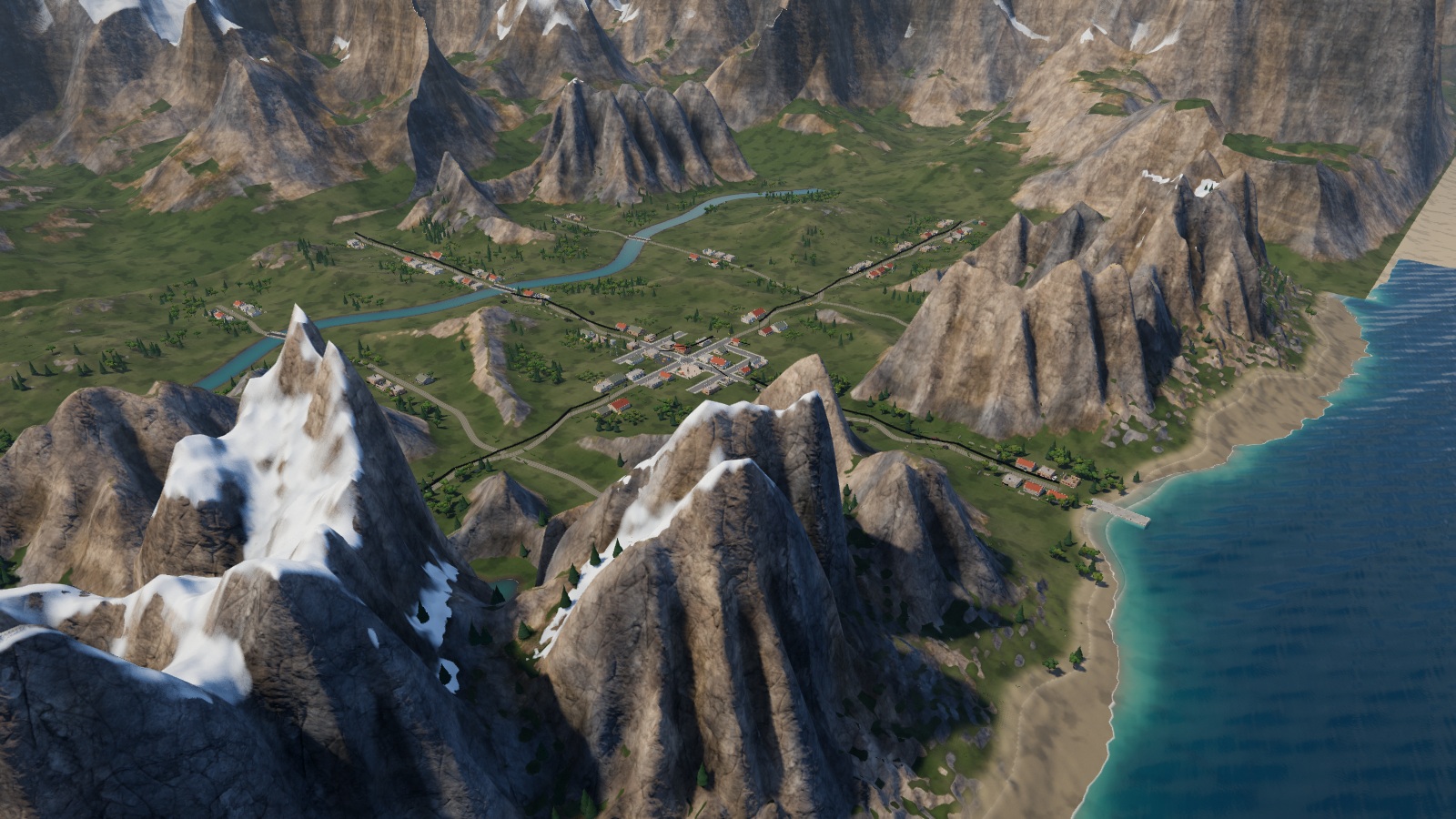
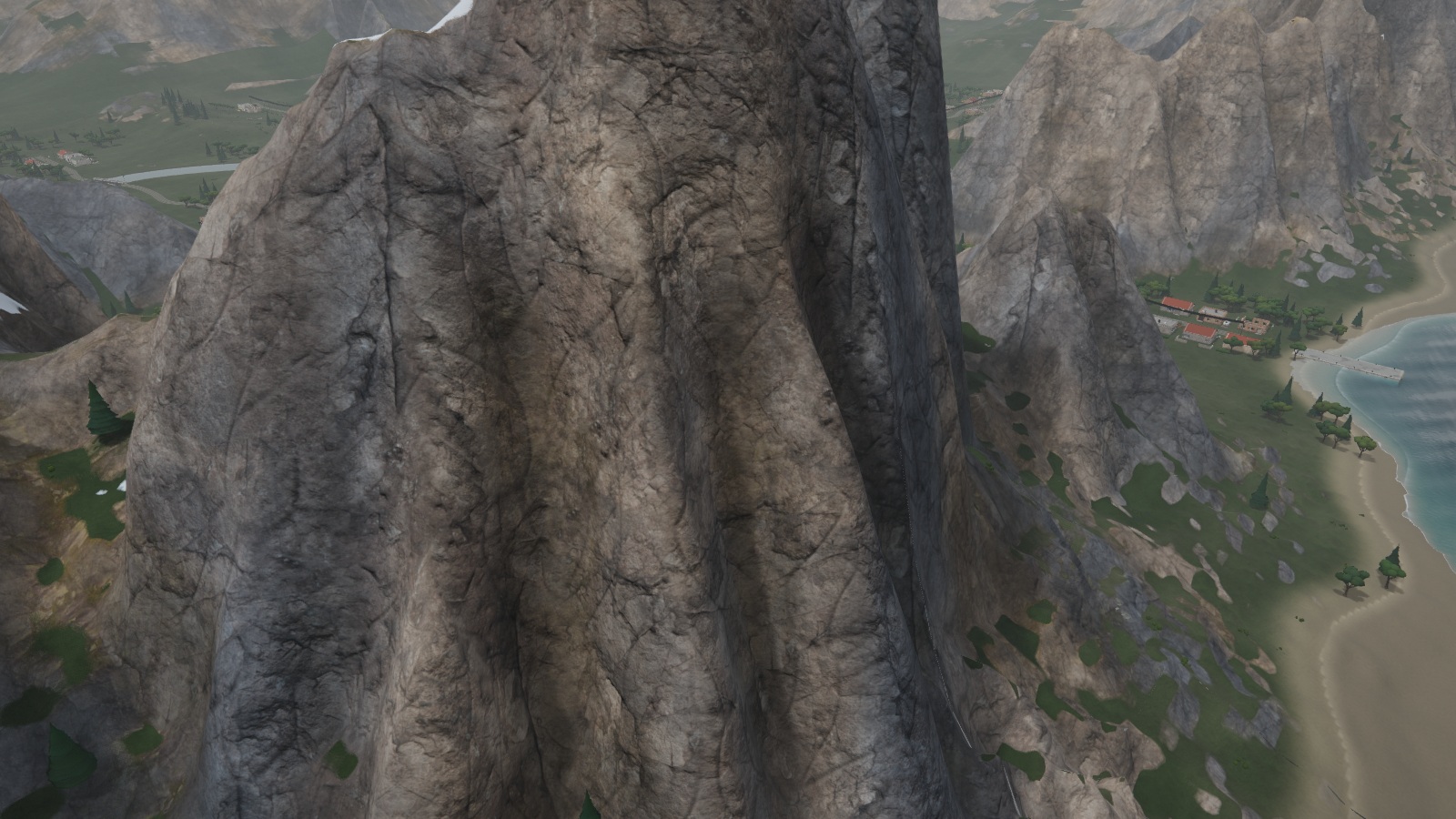
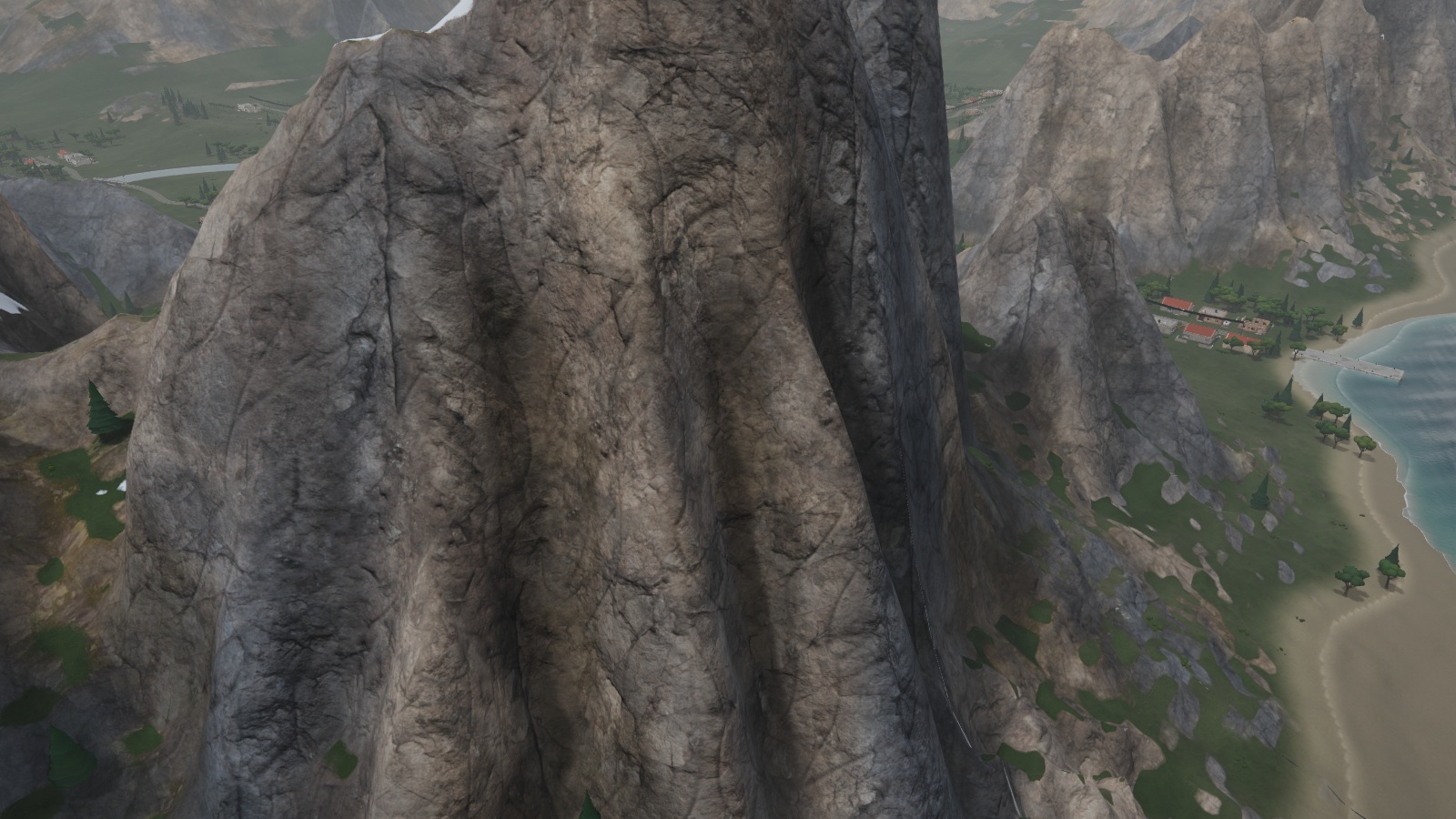
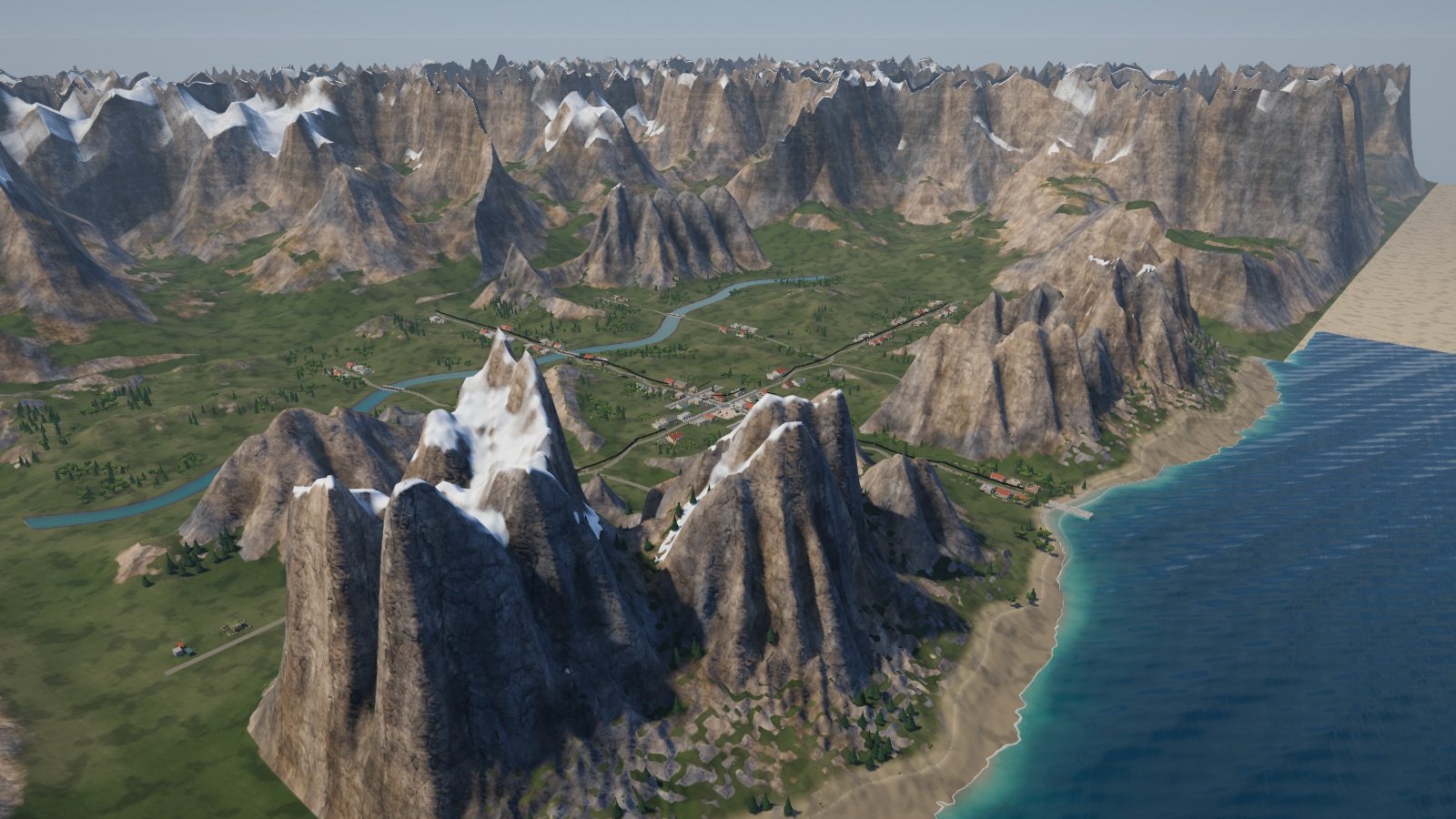
Break up repeating cliff textures
World-space texture warping breaks up repeated slab patterns without adding material samples.
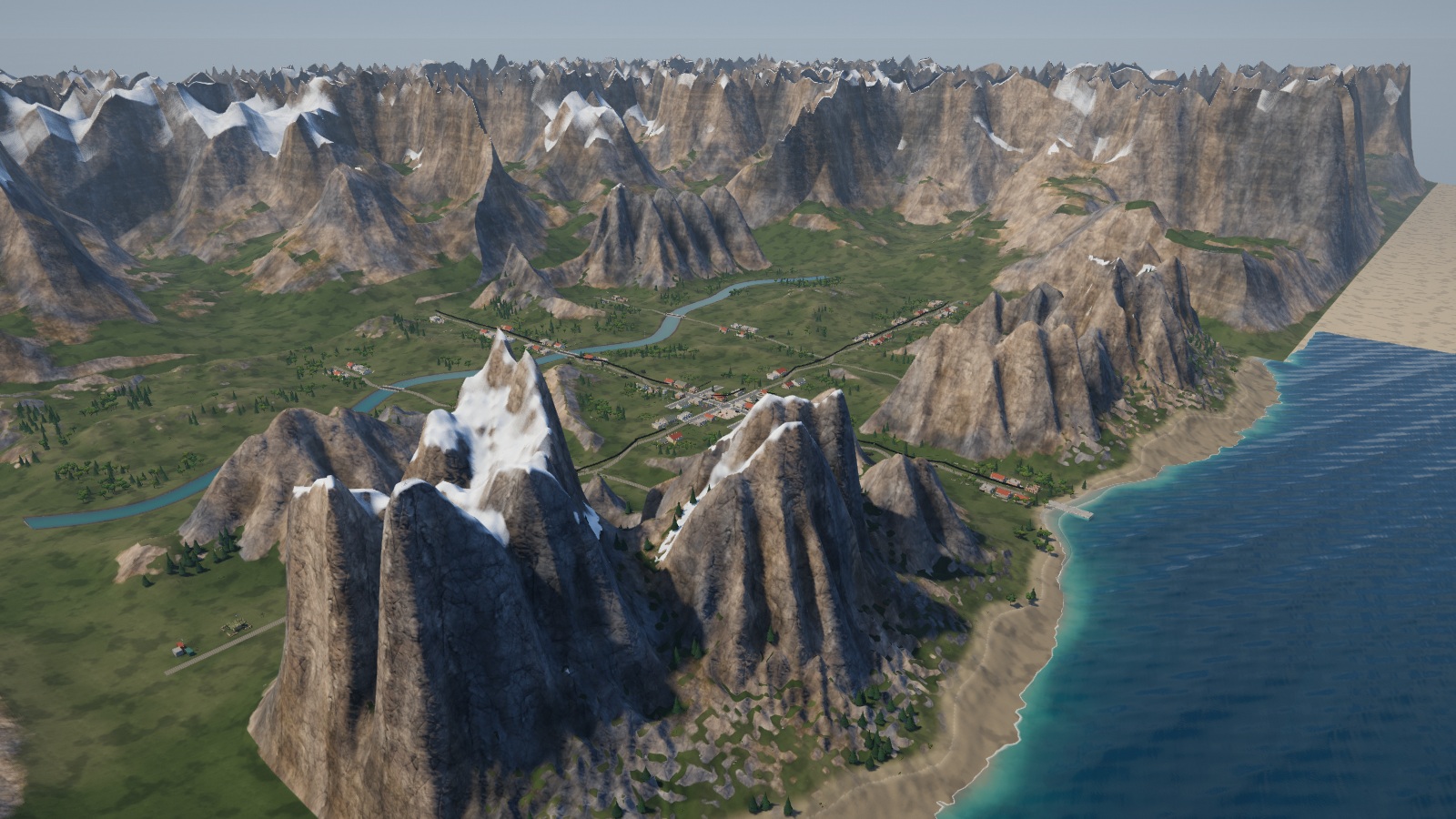
Explore this change
Three additional scalar noise reads per terrain fragment; material reads stay at eighteen. Warping is fixed in world space and shared by colour and normal coordinates.
Technique reference: research source.
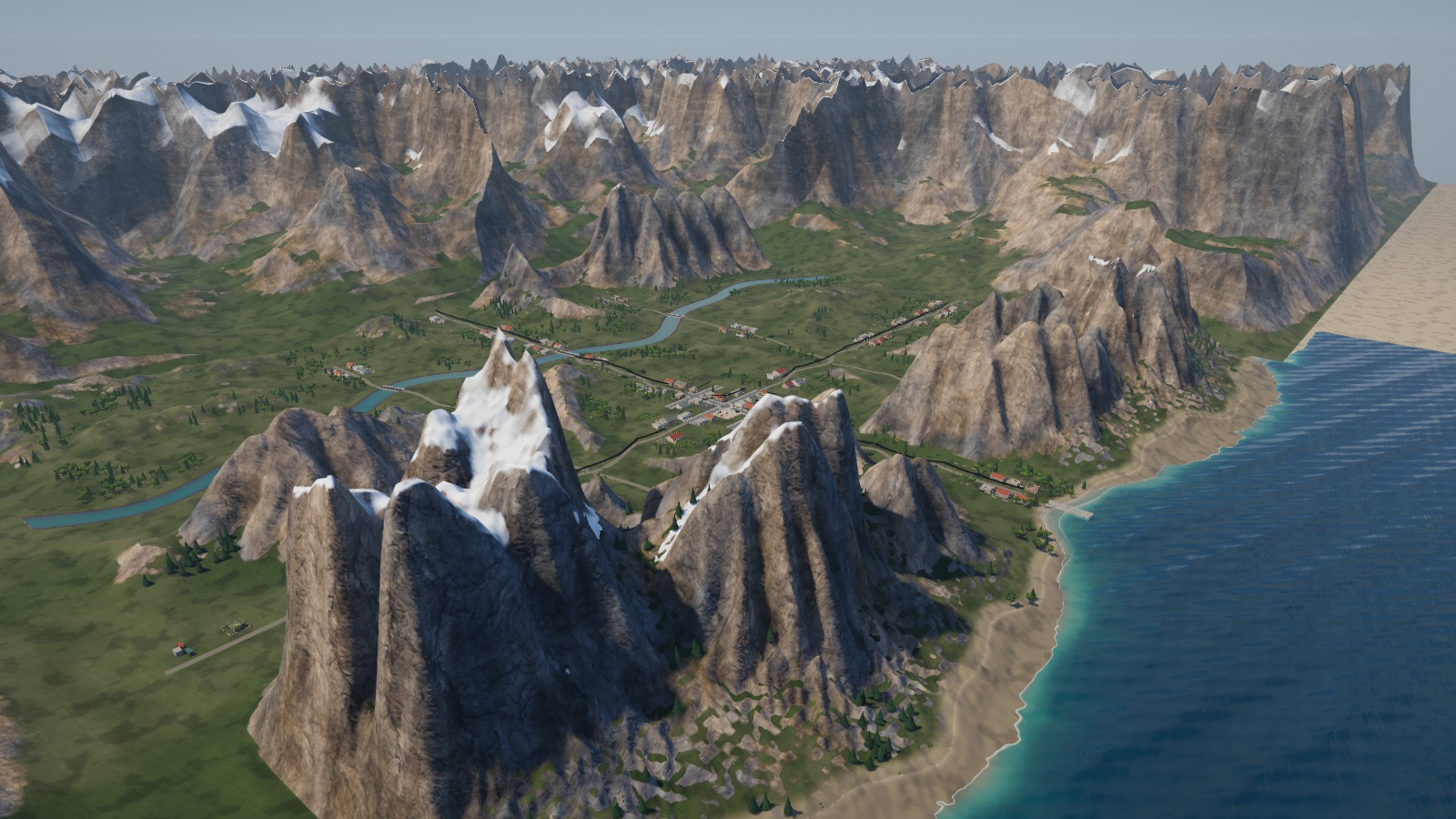
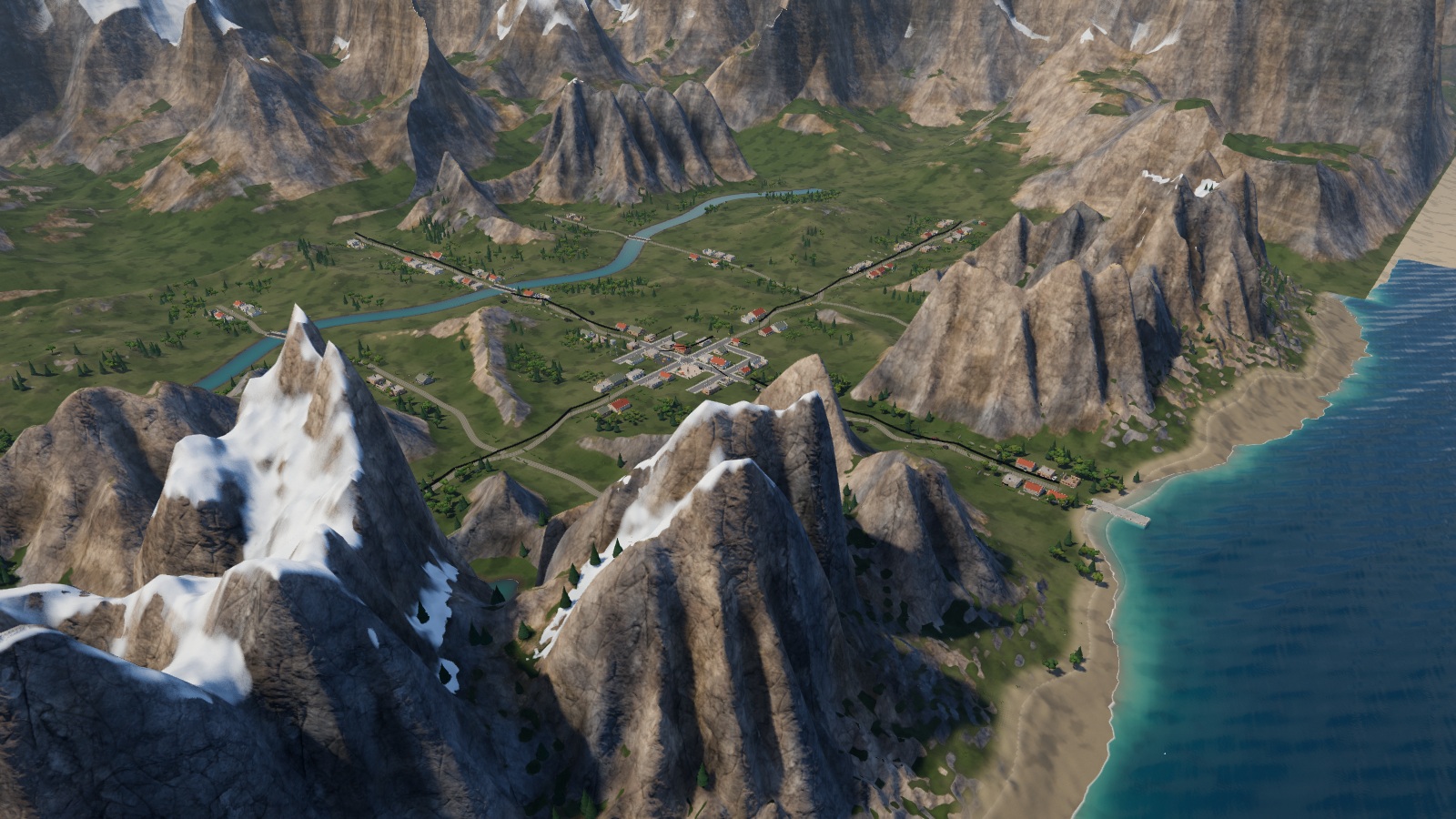
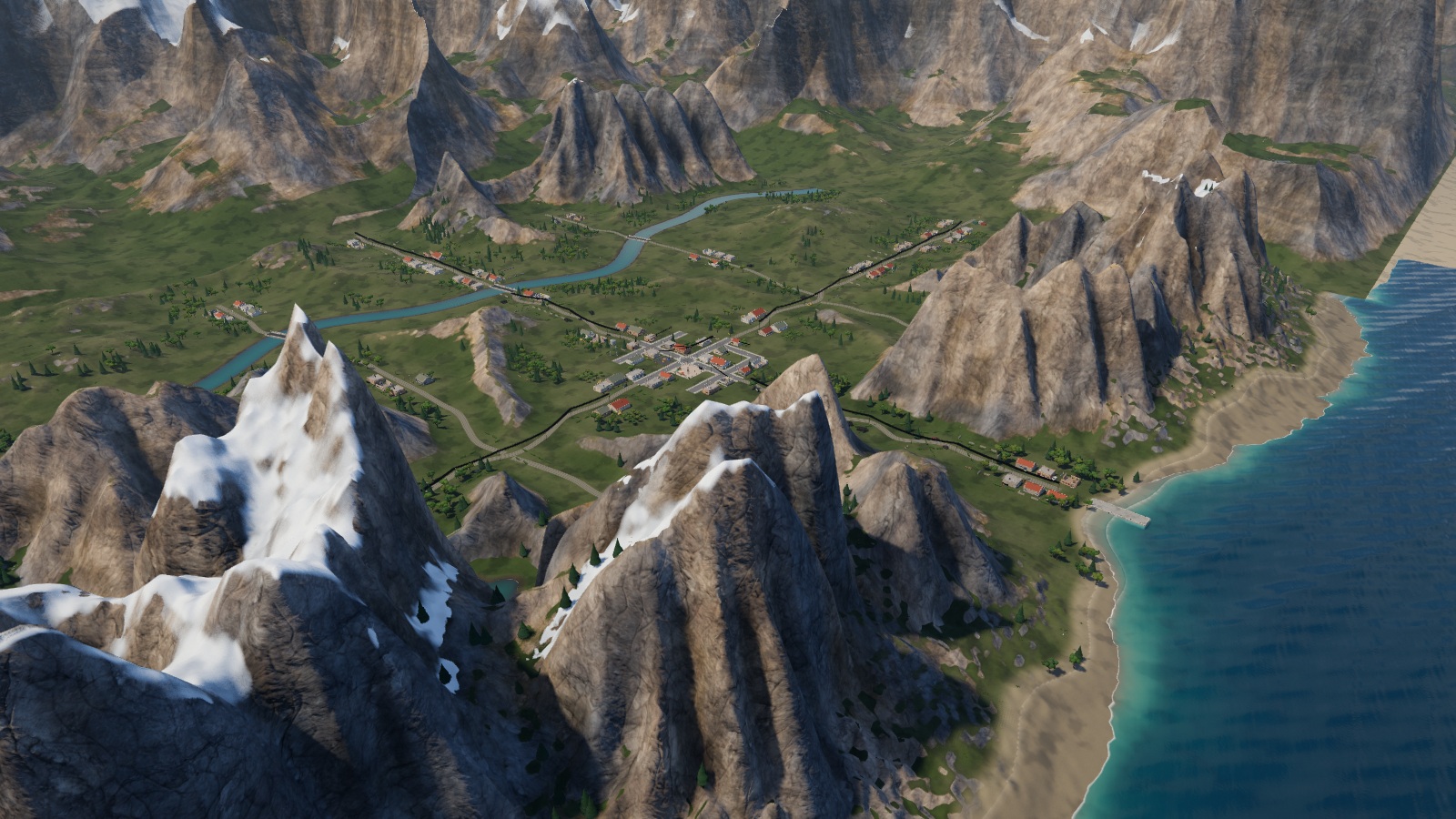
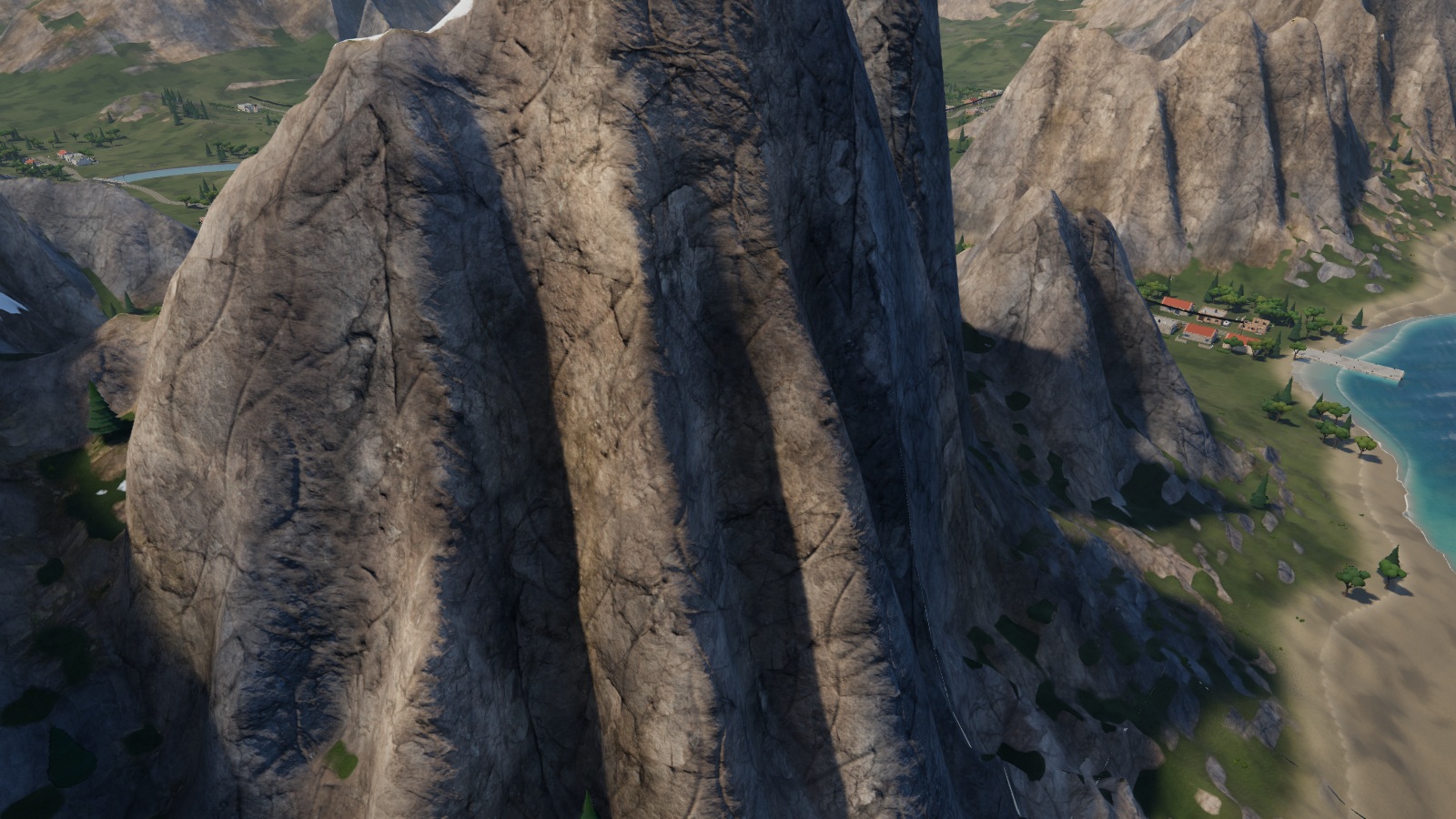
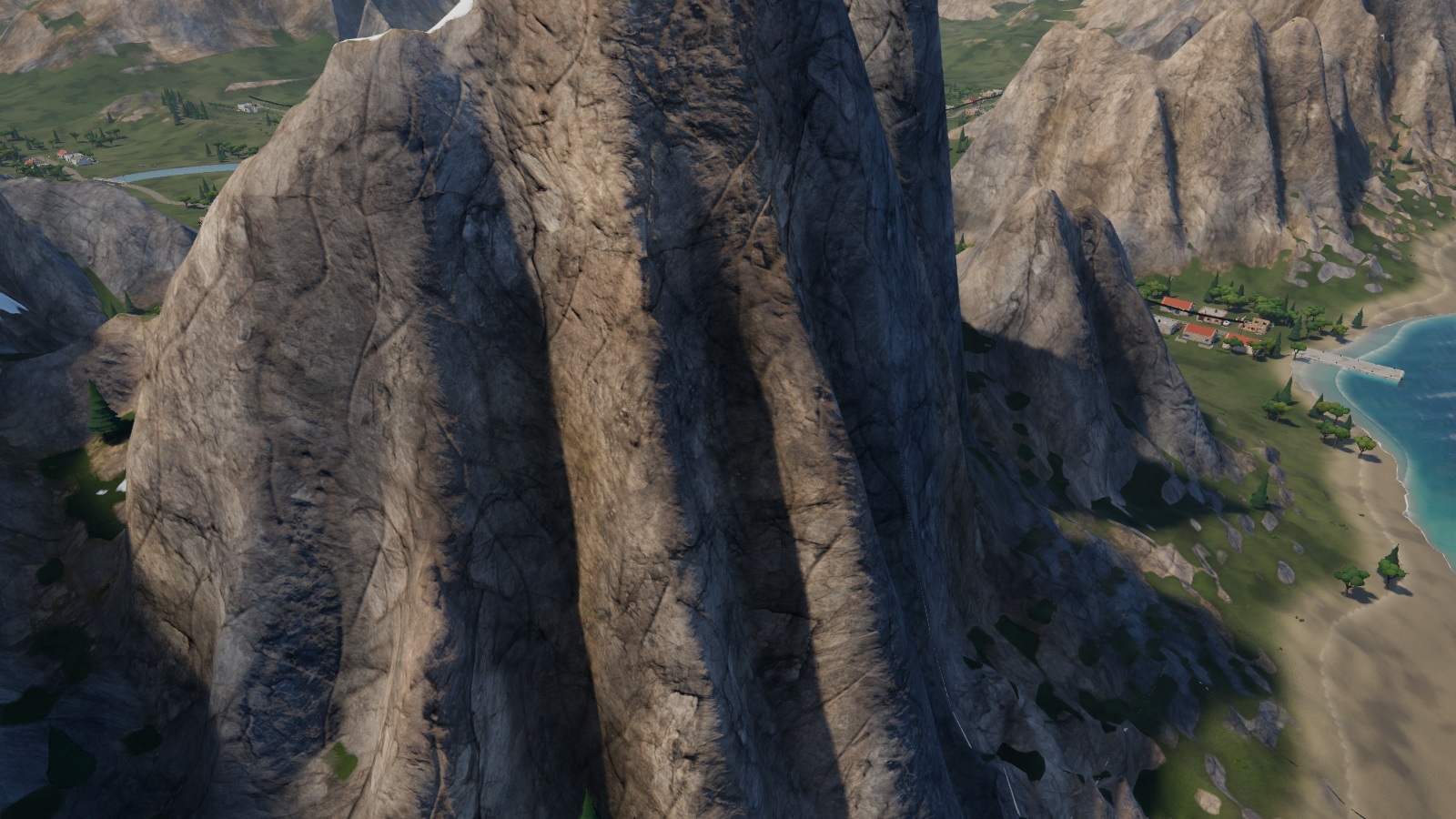
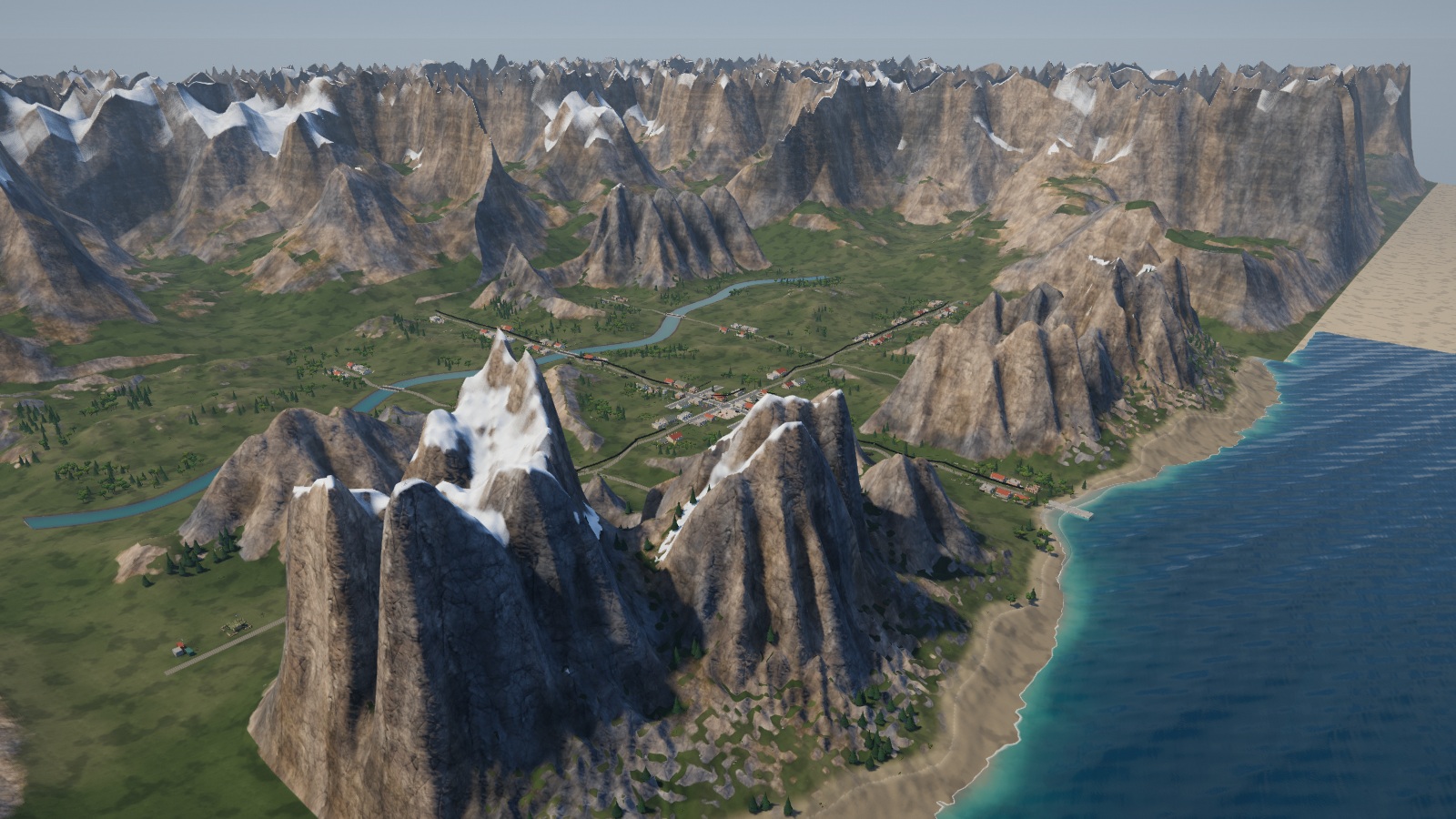
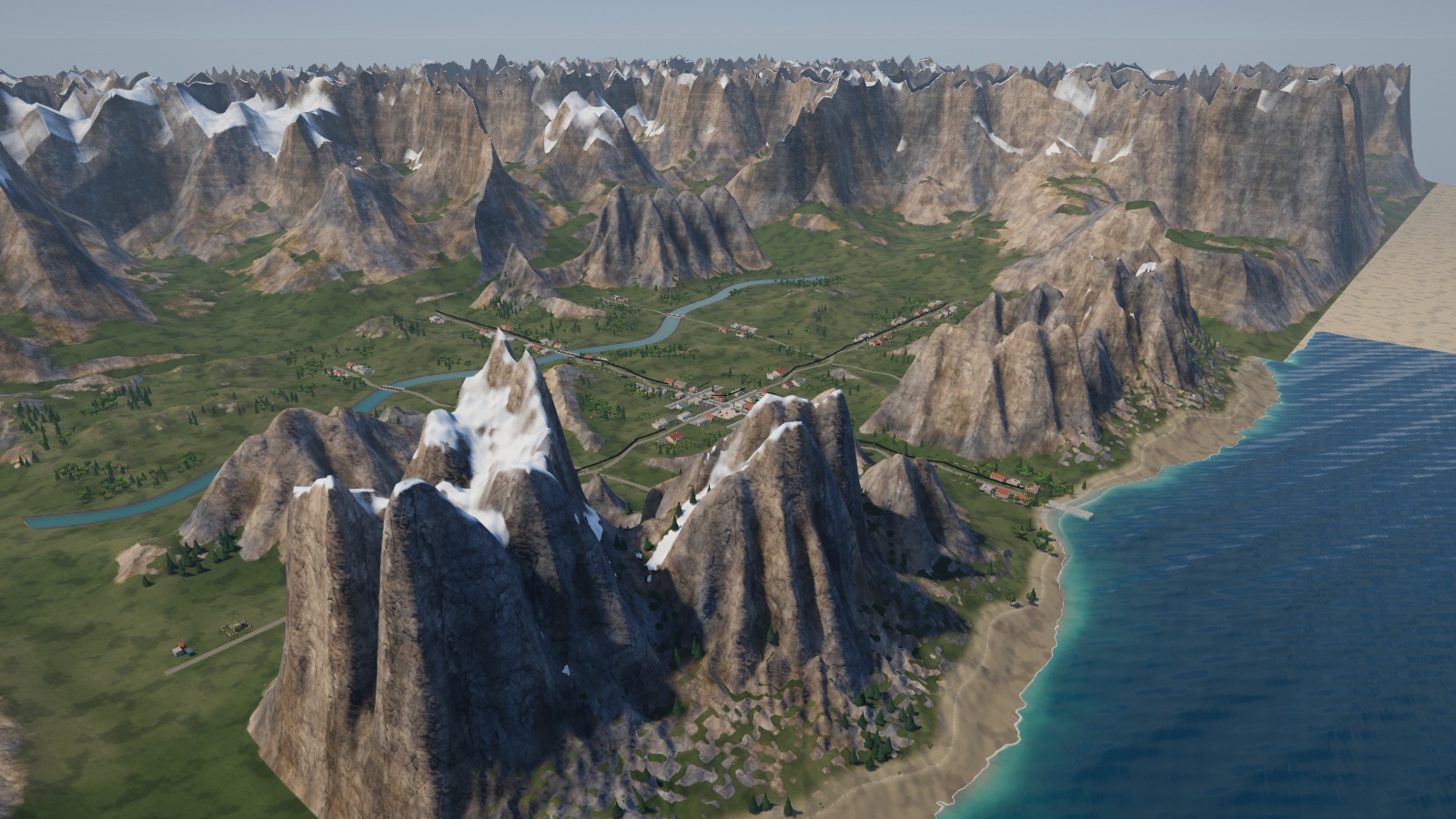
Break up alpine snowfields
Wind exposure and rock relief break up snow edges, with cooler compacted snow in sheltered pockets.
Explore this change
No new texture reads. Fixed prevailing wind is a visual deposition heuristic, not weather simulation. Authoritative terrain and snowline settings are unchanged.
Technique reference: research source.
More deliberate tank handling
Tank turrets accelerate and settle onto targets, hold their bearing through hull turns, and acquire a steady aim before firing.
Watch: The tank turns, traverses its turret and advances past the wall. Recorded in the current build, October 2026. (Direct MP4)
Explore this change
- Tank drivers build into turns rather than instantly changing their turning speed.
- Turrets traverse with acceleration and braking, and return forward by the shortest arc.
- Gunners hold a steady aim briefly before firing, including when switching targets.
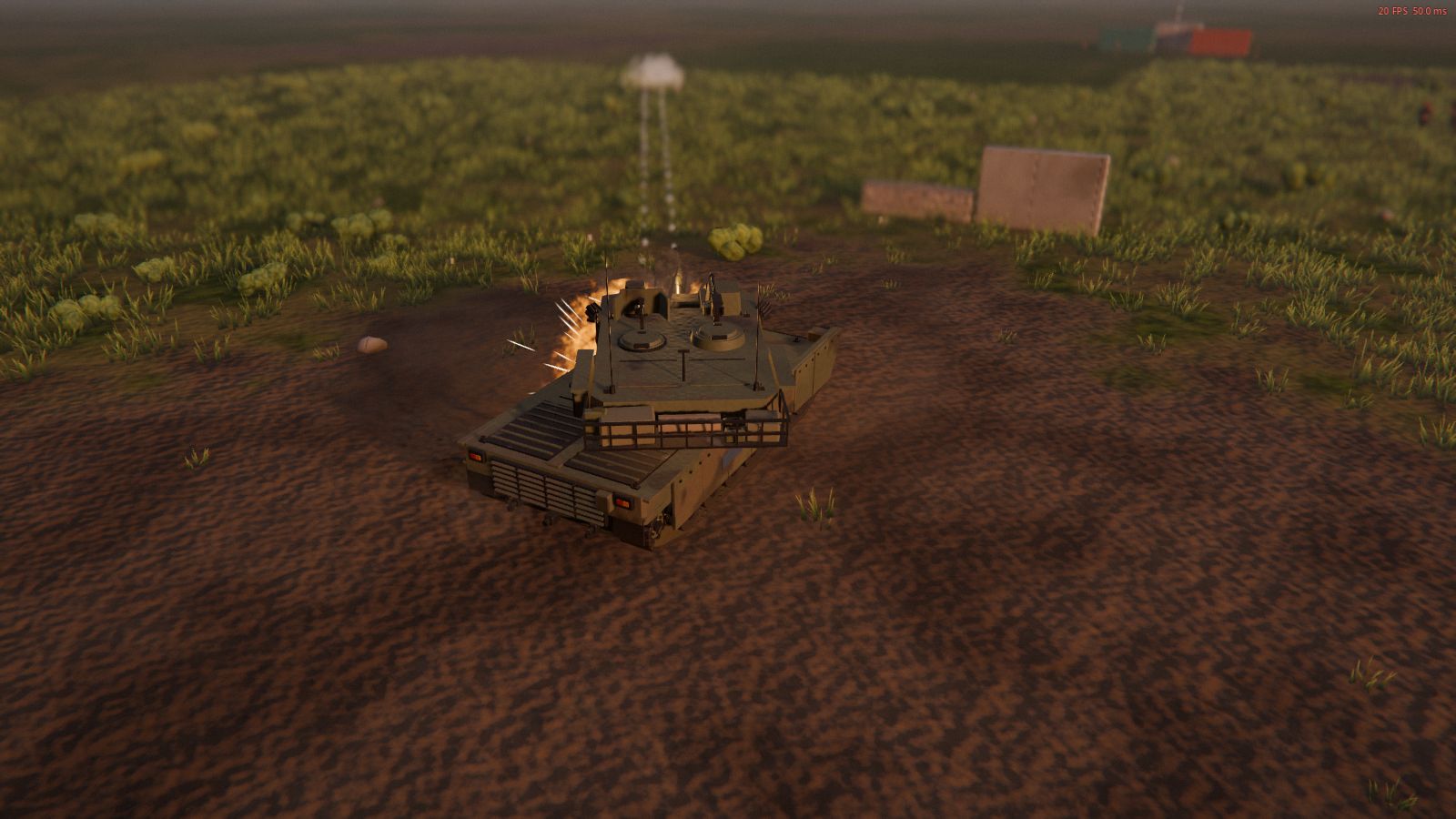
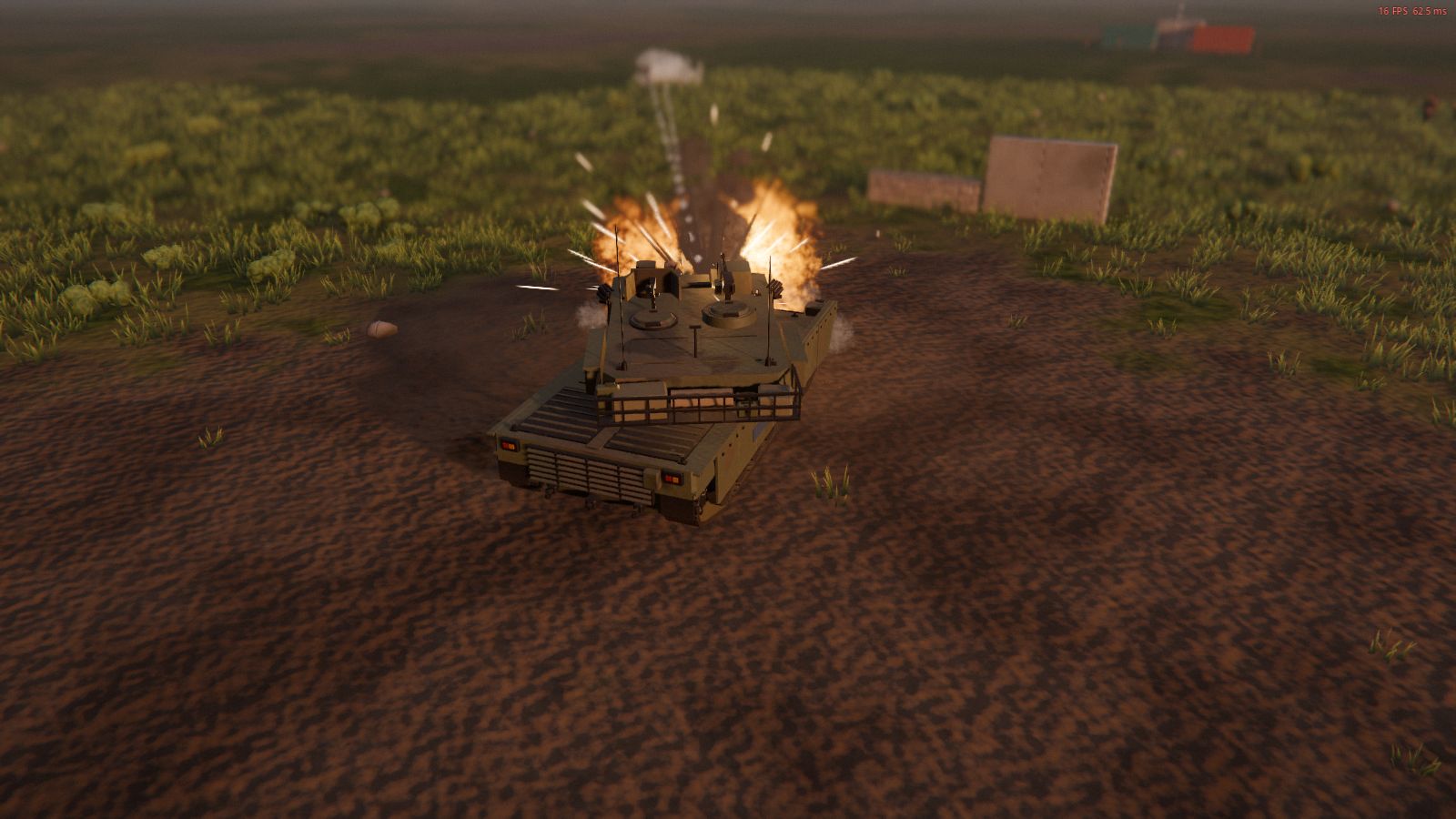
Compare changelog layouts
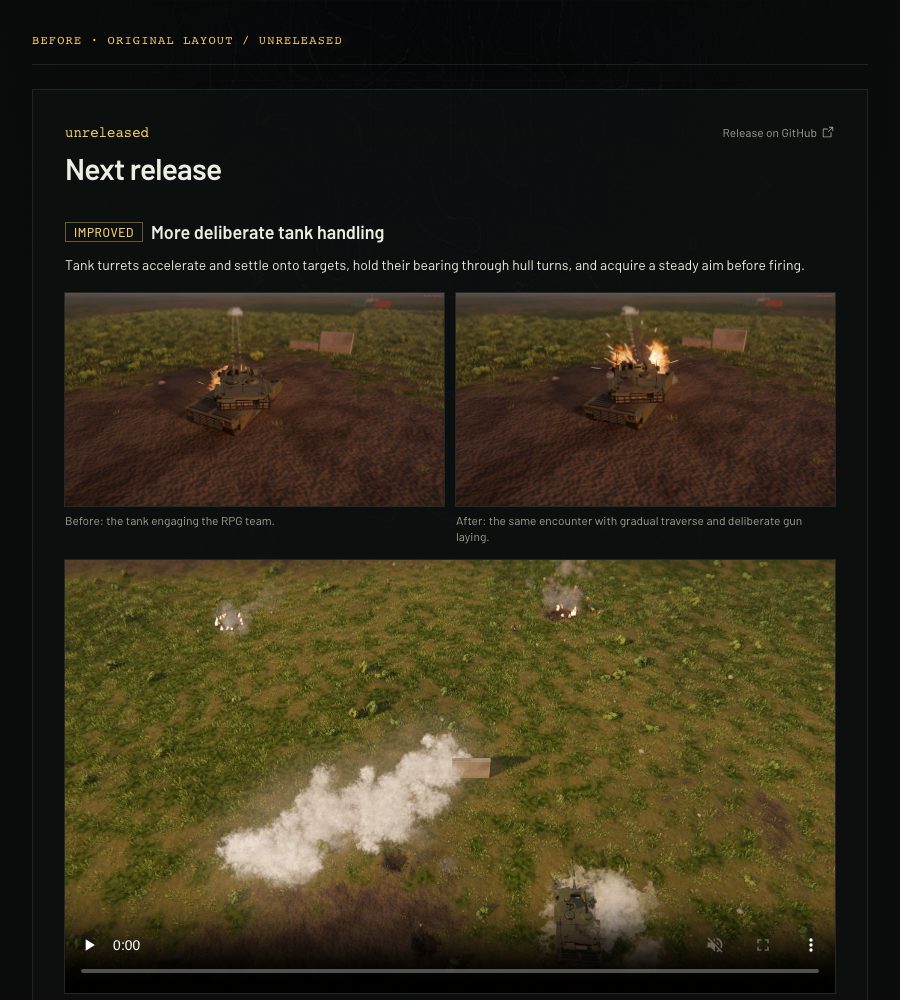
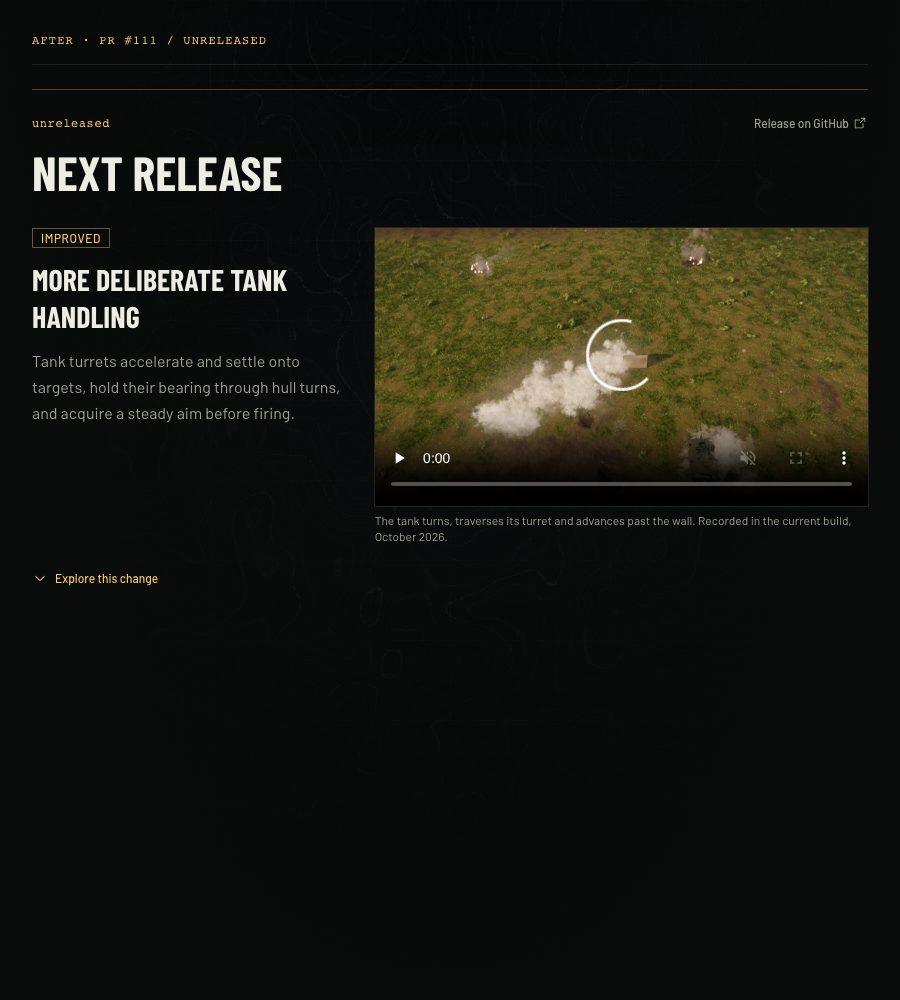
Changelog presentation comparison, not gameplay: the top 1,000 pixels of this entry at the same 900-pixel viewport width. Open either image to inspect it.
Safer routes across hills and water
Tracks and wheels choose suitable slopes, and infantry wade through shallows instead of walking underwater.
Explore this change
- Infantry, wheeled vehicles and tracked vehicles use separate terrain limits. Vehicles account for nearby steep ground across their footprint, and supply trucks no longer bypass blocked terrain.
- Routes favour easier ground and roads. Connected areas are calculated when the map loads, and newly opened passages become available without treating separated shores as reachable.
- Soldiers can wade through water up to 55 cm deep. Deeper water is blocked even if an old terrain label calls it shallow; bridge decks remain usable.
- Movement checks the whole step, including dives, separation and vehicle recovery. Old routes cannot carry units through newly blocked ground or deep water.
- Living soldiers stay upright while wading. Spawning and disembarking use safe ground; soldiers stranded by a removed crossing recover to a safe bank.
- Ambush Alley autoplay uses its available mortars against spotted convoy vehicles stopped on the road, so it can finish the ambush under the updated movement rules.
Connect houses and streets with gardens, paths and grounded furniture
Scanned materials, weathered roads and leafy canopies give towns and their surrounding hills more natural detail.
Watch: Native camera tour of photographed town surfaces, door paths and connected plots. Current PR with simulation held; the original stills below provide before/after evidence. (Direct WEBM)
Explore this change
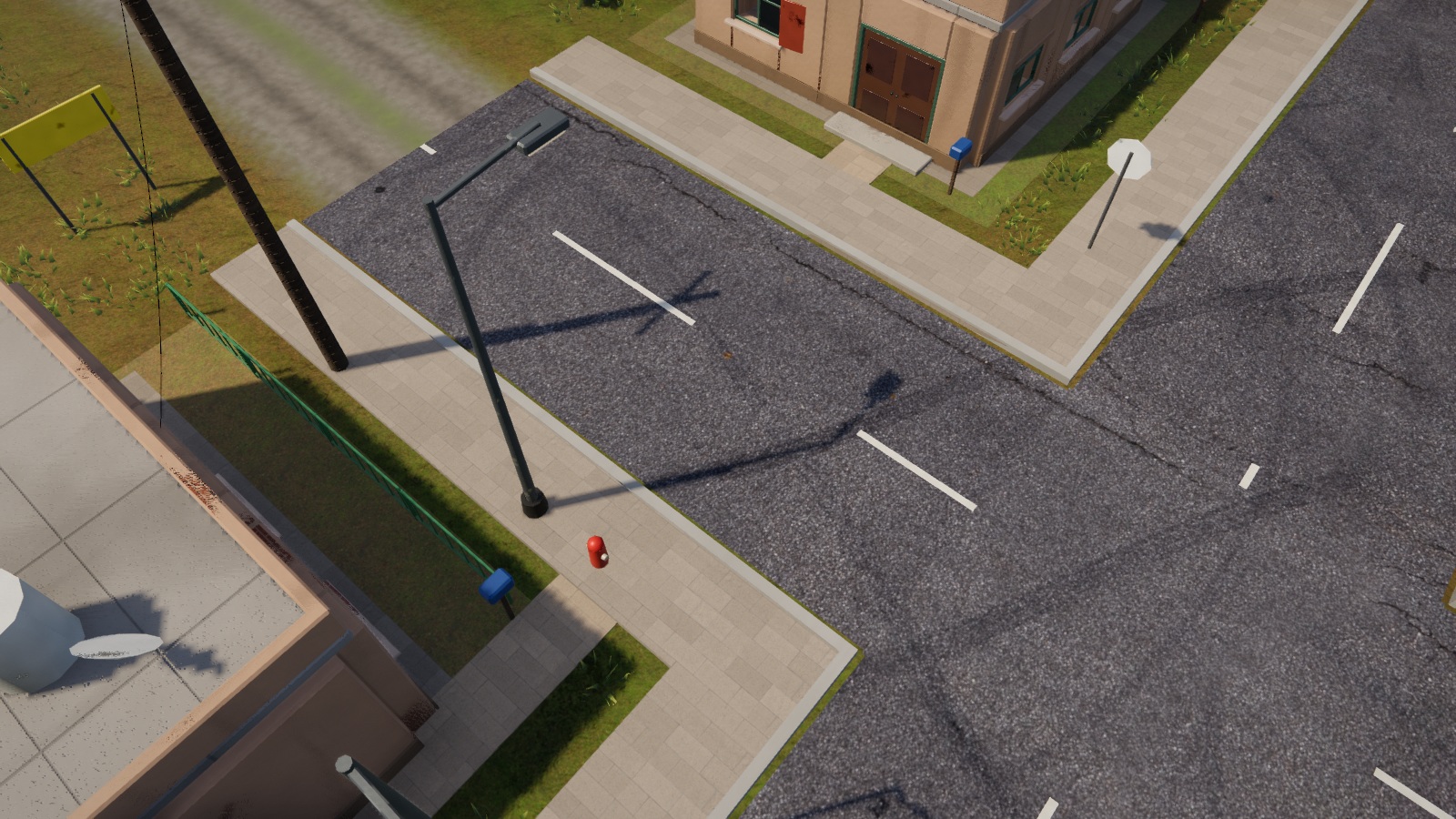
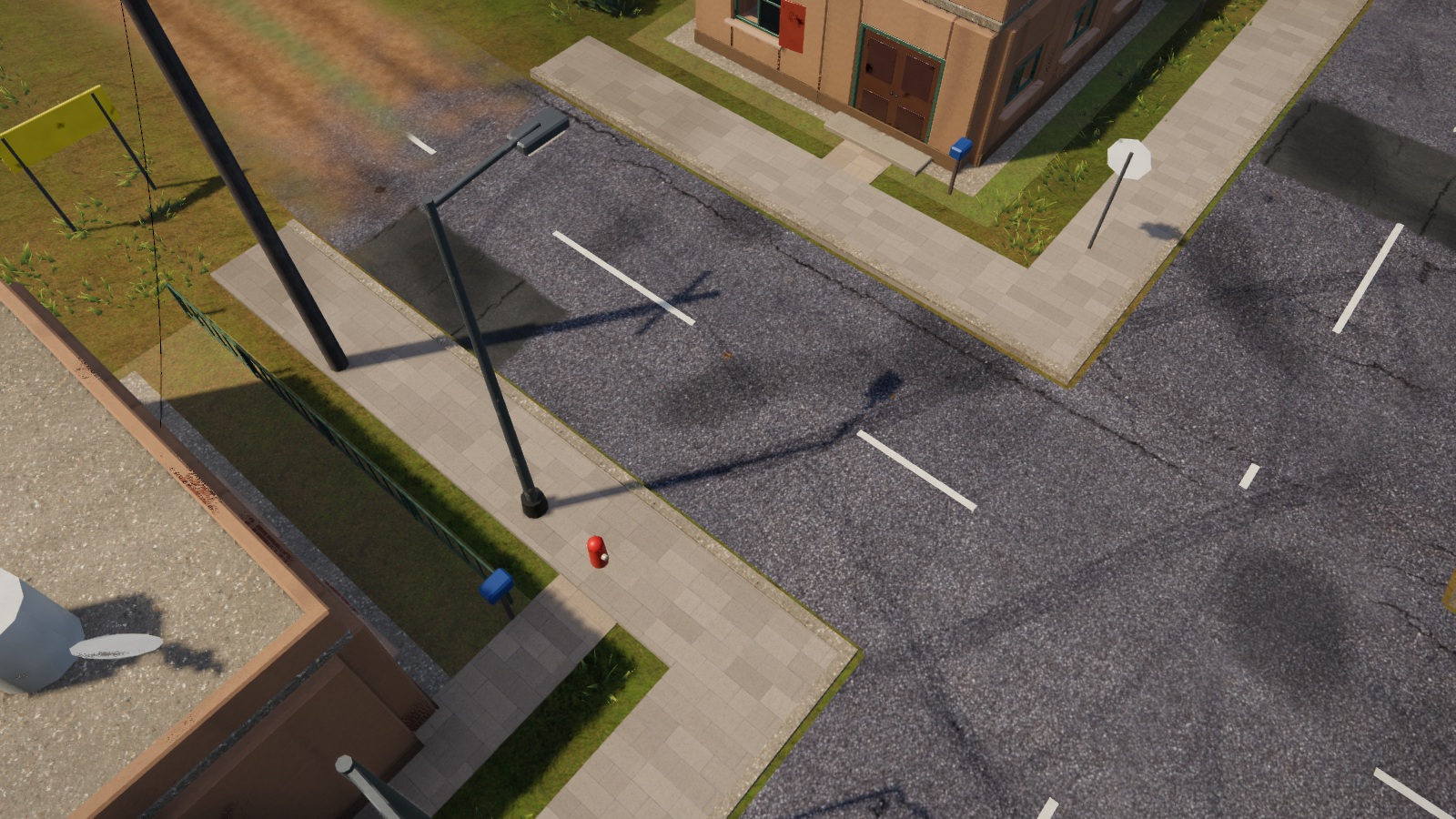
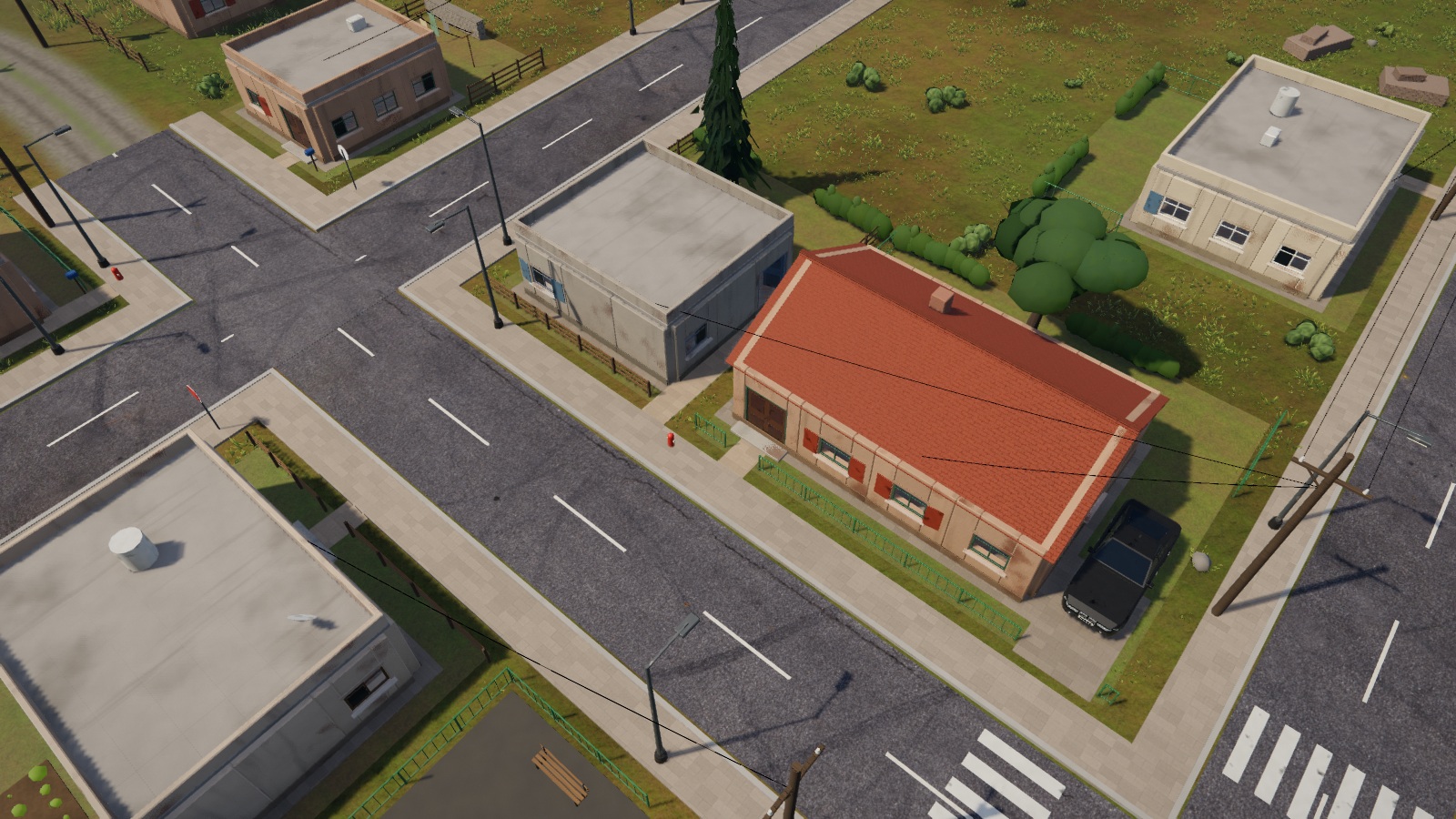
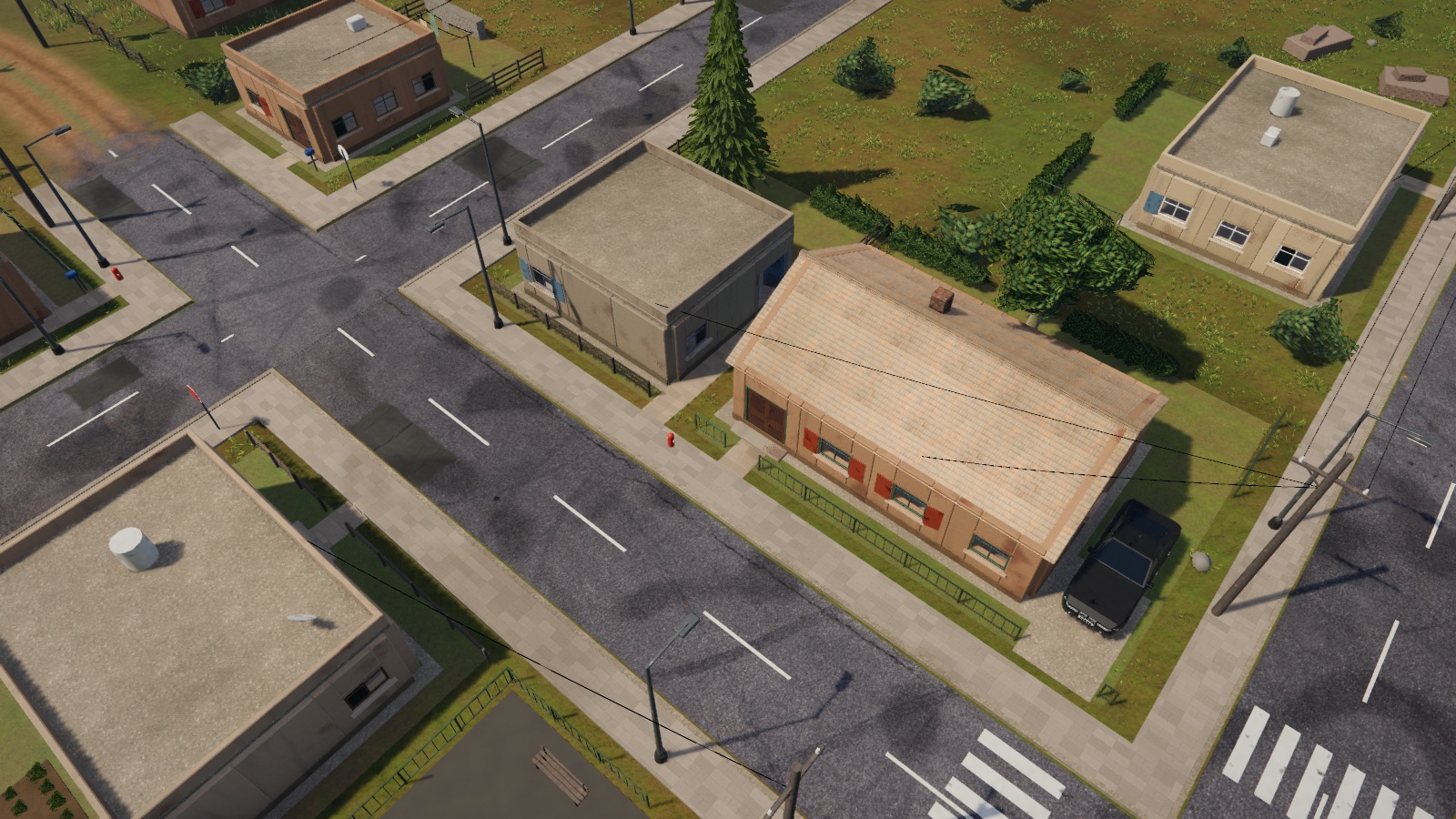
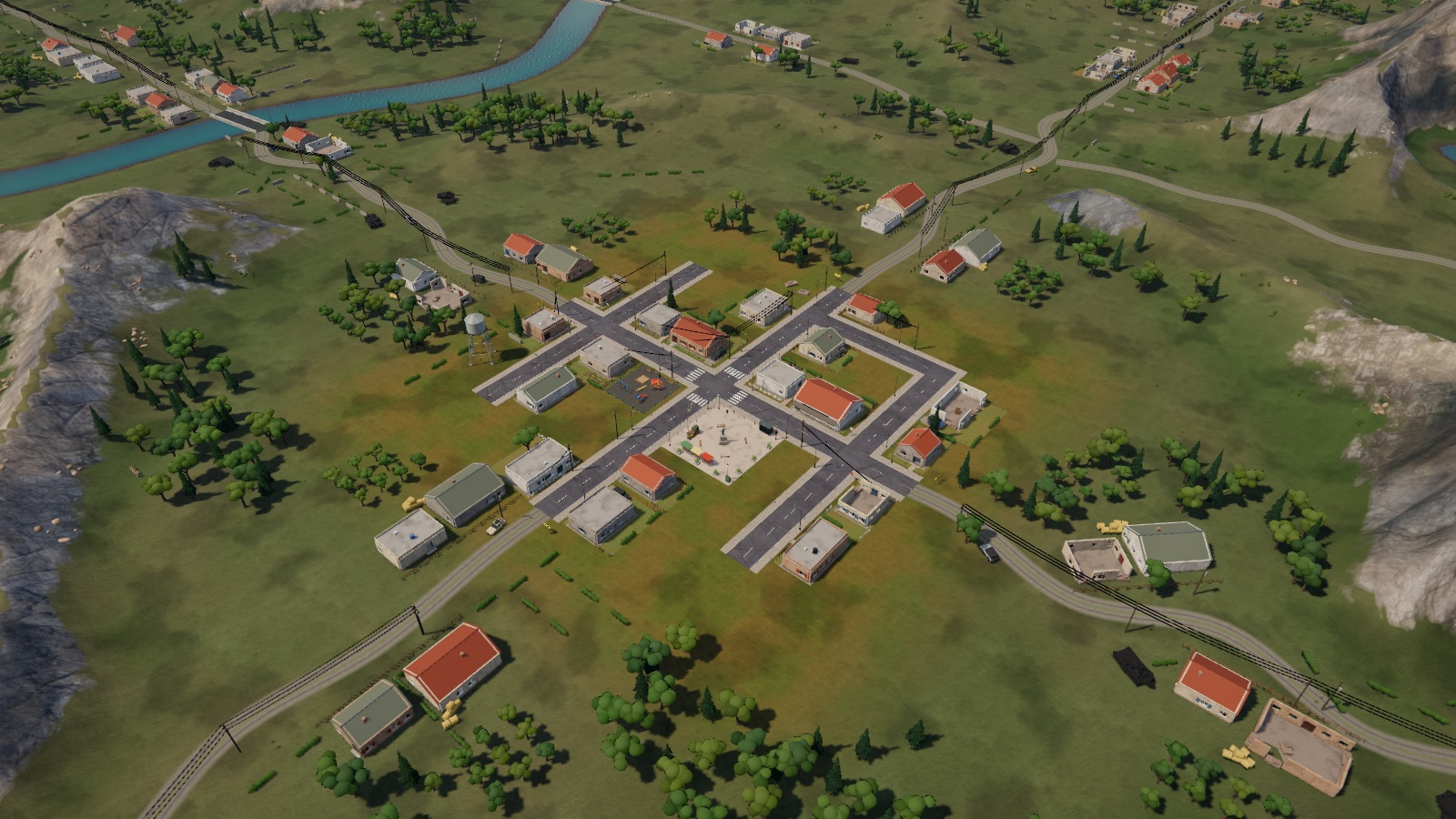
Paving follows the terrain instead of sitting at flat-map height. Street furniture and wire endpoints carry their authoritative elevation into multiplayer and replays. House plots have maintained ground, narrow foundation aprons and routes to actual front or side doors; fences leave pedestrian and driveway gaps and break into short sections. Wild grass and shrubs stay outside maintained plots.
Photographic CC0 asphalt, paving slabs and grass/soil replace the flat procedural surfaces. Real-world texture scale, normal and roughness maps, per-slab wear and broad dry/green patches keep detail readable near houses and across the town. Urban grass clumps are shorter.
Road entrances blend through broken gravel edges; repaired asphalt patches and dark stains interrupt the carriageway. Roofs use aged tile and rough concrete scans, while timber fences have photographed grain and section-to-section weathering. Metal fences show dull paint and rust.
Brick, plaster, bark and country-road gravel also use scanned detail. Concrete driveways differ from paving-slab footpaths, with broad staining across sidewalks and roofs.
Trees, hedges and shrubs have open, photographed leaf and needle silhouettes. Patchy distant forests follow hills outside the battlefield using a small prebaked tree atlas: two triangles per tree, with cliffs, high peaks and coasts kept clear. Set View distance / detail to Near for the lighter view.
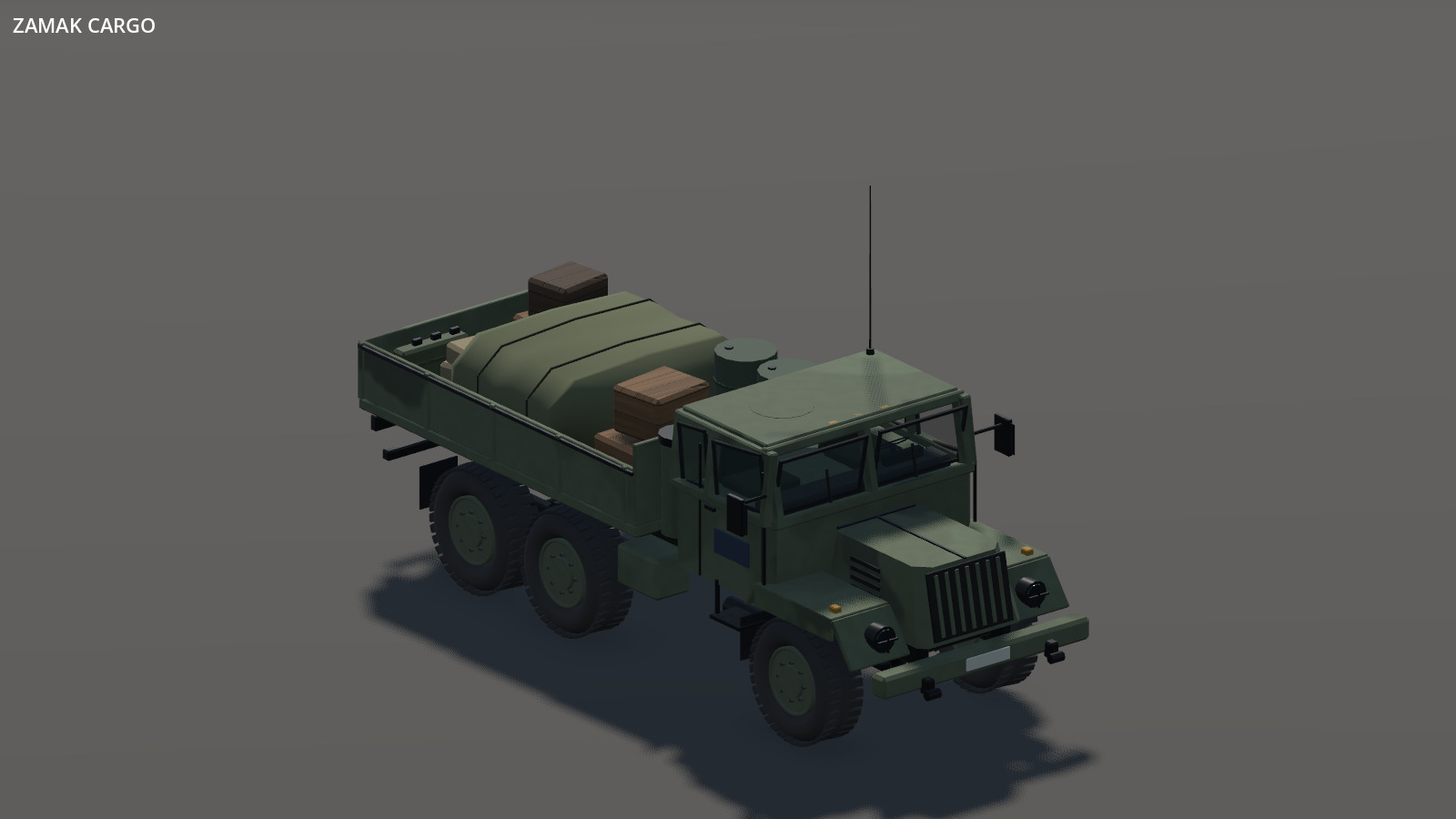
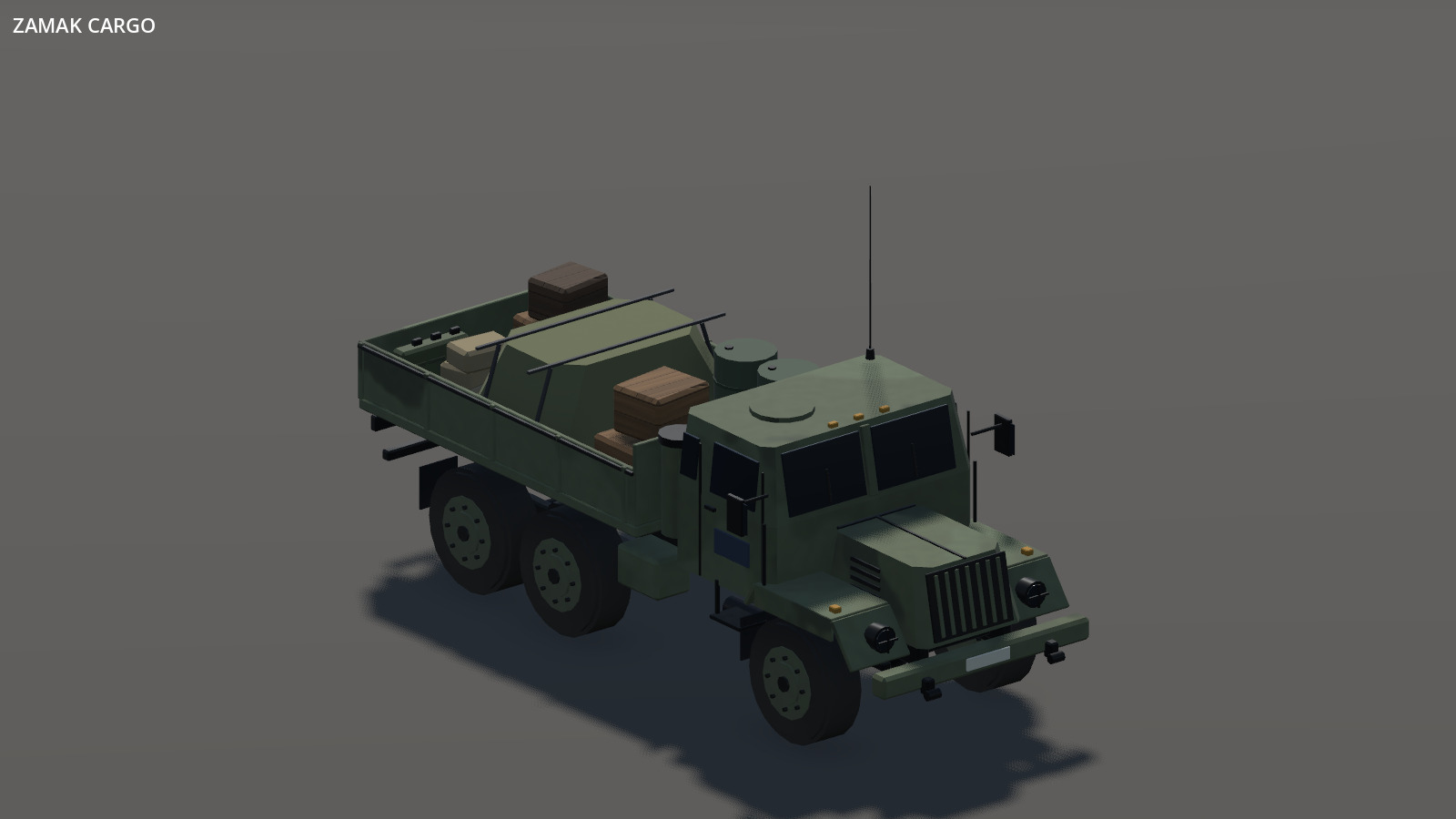
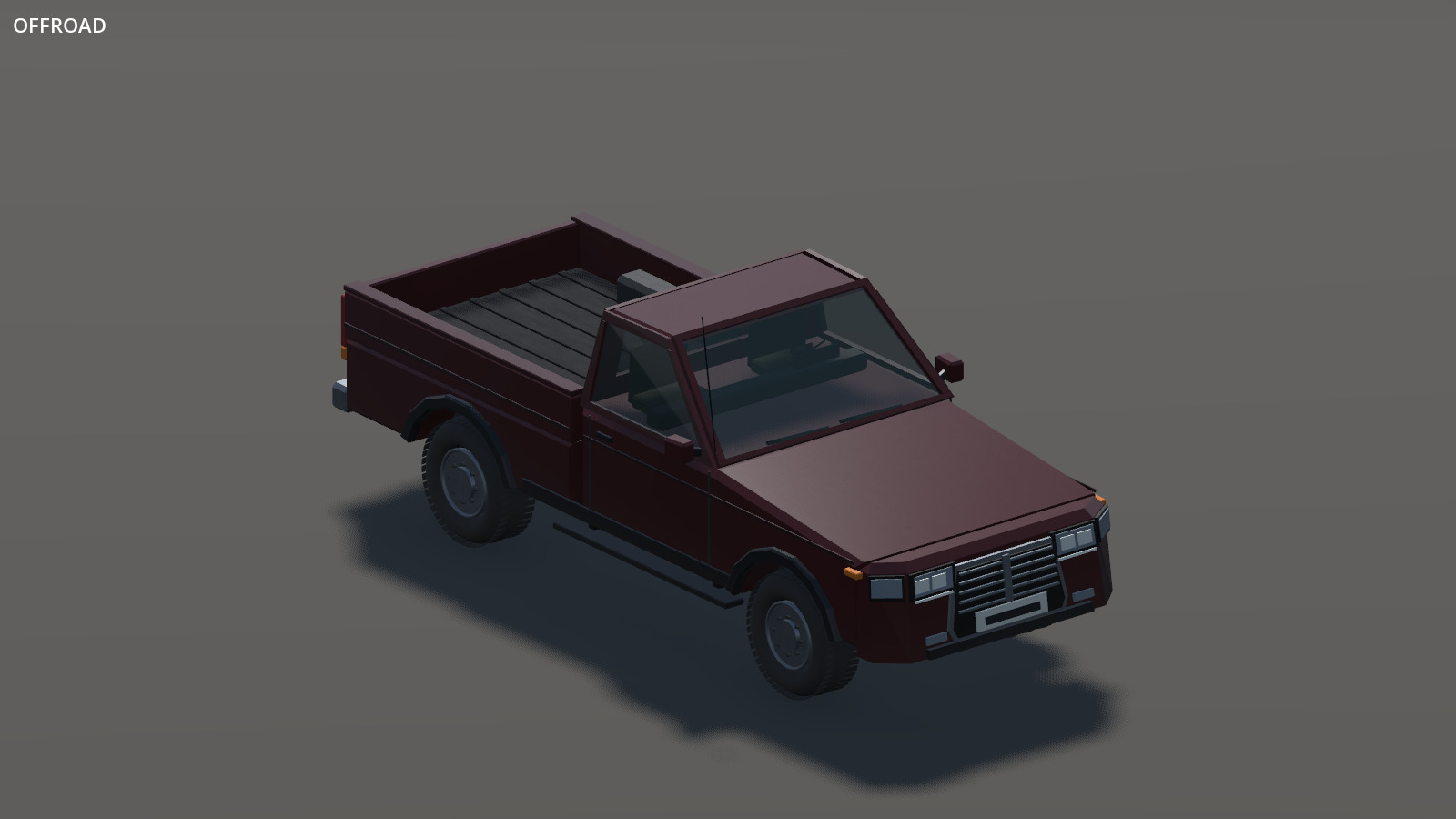
Deeper cabs and rounded tyres across more vehicles
Military truck variants and civilian cars gain visible interiors, while shared wheels gain rounded tyres, recessed rims and fitted tread.
Explore this change
- The cab treatment now covers every HEMTT, Zamak and Tempest mission body, plus the Offroad pickup, hatchback and SUV families.
- Rounded tyres and inset rims extend across the shared wheel builders. Road vehicles use finer tread; aircraft tyres stay smooth, and specialised tracked road wheels keep their own construction.
- The Zamak cargo and ammunition loads use the same draped cloth system as the HEMTT. Restraints follow the cover instead of floating over it.
- Glass switches to an opaque fallback at long distances and is removed from wrecks. Wheel detail rotates with the existing wheel pivots.
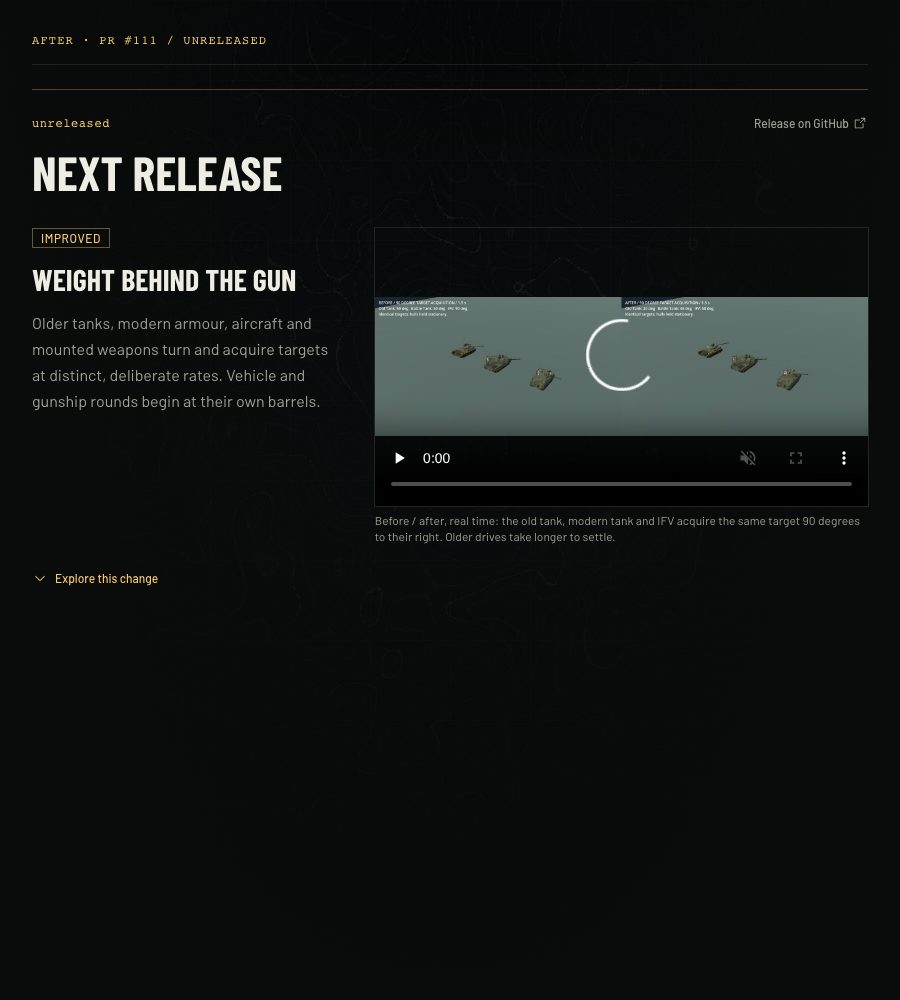
Weight behind the gun
Older tanks, modern armour, aircraft and mounted weapons turn and acquire targets at distinct, deliberate rates. Vehicle and gunship rounds begin at their own barrels.
Watch: Before / after, real time: the old tank, modern tank and IFV acquire the same target 90 degrees to their right. Older drives take longer to settle. (Direct WEBM)
Explore this change
-
Tank, IFV, anti-aircraft, artillery, light vehicle and helicopter weapons have different traverse rates, with acceleration and braking onto the target.
-
Older tank drives take longer to acquire; modern tanks keep a steady firing solution as the hull turns, within the turret motor's available speed.
-
Mounted machine guns, mortars and anti-tank posts must lay onto their bearing before firing.
-
Tracked hulls build into pivots, wheeled vehicles cannot spin in place while reversing, and heavy-lift helicopters answer more slowly than lighter airframes.
-
Vehicle and gunship rounds leave the correct model barrels, including scaled helicopter mounts and each of the gunship's separately positioned guns.
-
Boats now have hull-specific cruise speeds, acceleration, engine and helm response, turning circles and astern thrust: quick RHIBs, heavier riverine craft, a deliberate jet patrol ship and a slow steel trawler.
Watch: Before / after, real time: RHIB, patrol ship and trawler receive six seconds of full ahead, four seconds hard right, then a stop order. Course dots show the different turns. (Direct WEBM)
Watch: Before / after launch-origin visualization: coloured pulses mark the actual 25, 40 and 105 mm launch points. Each gun now starts at its own barrel instead of below the fuselage. (Direct WEBM)
Compare changelog layouts
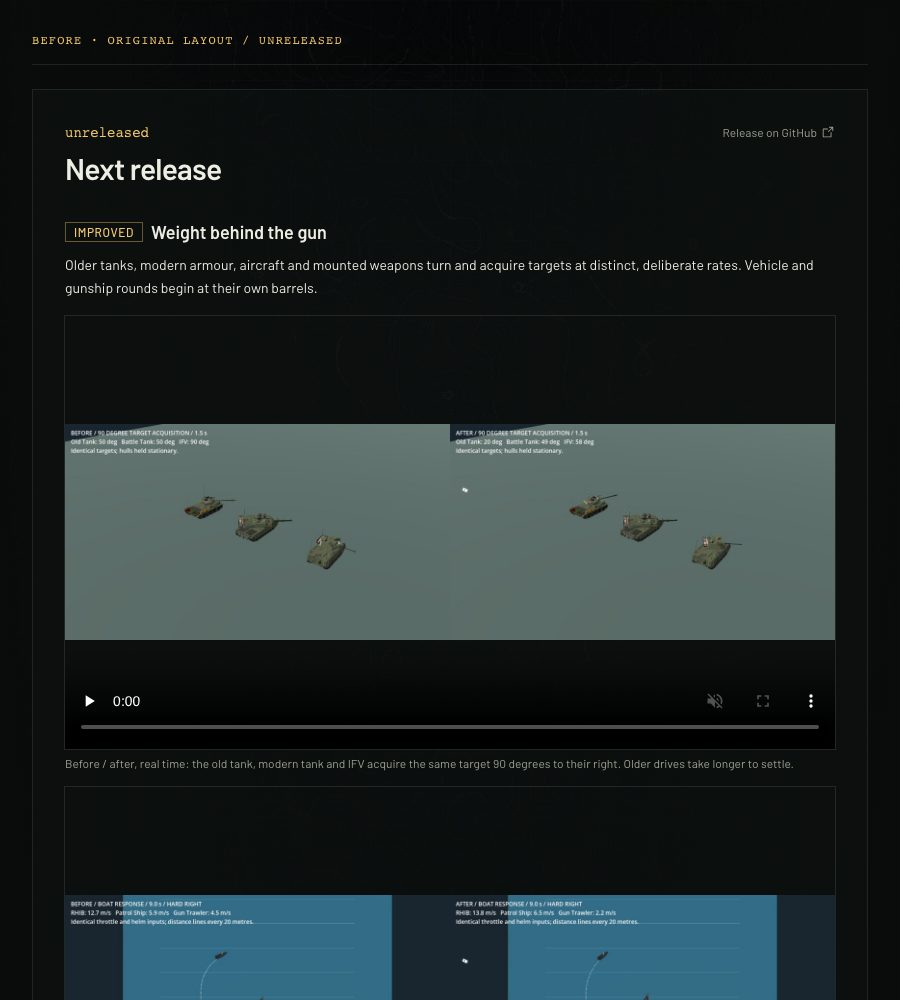
Changelog presentation comparison, not gameplay: the top 1,000 pixels of this entry at the same 900-pixel viewport width. Open either image to inspect it.
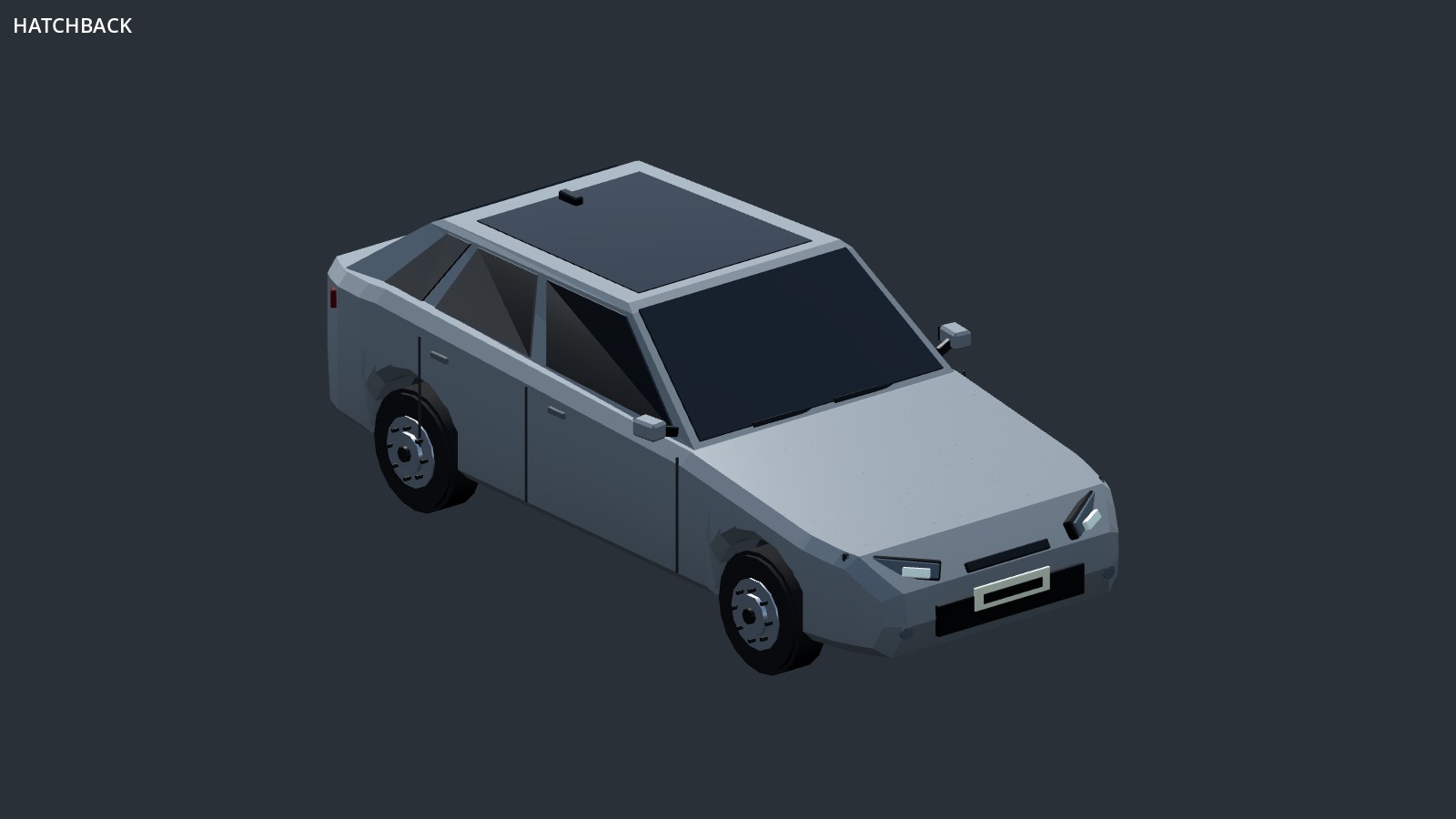
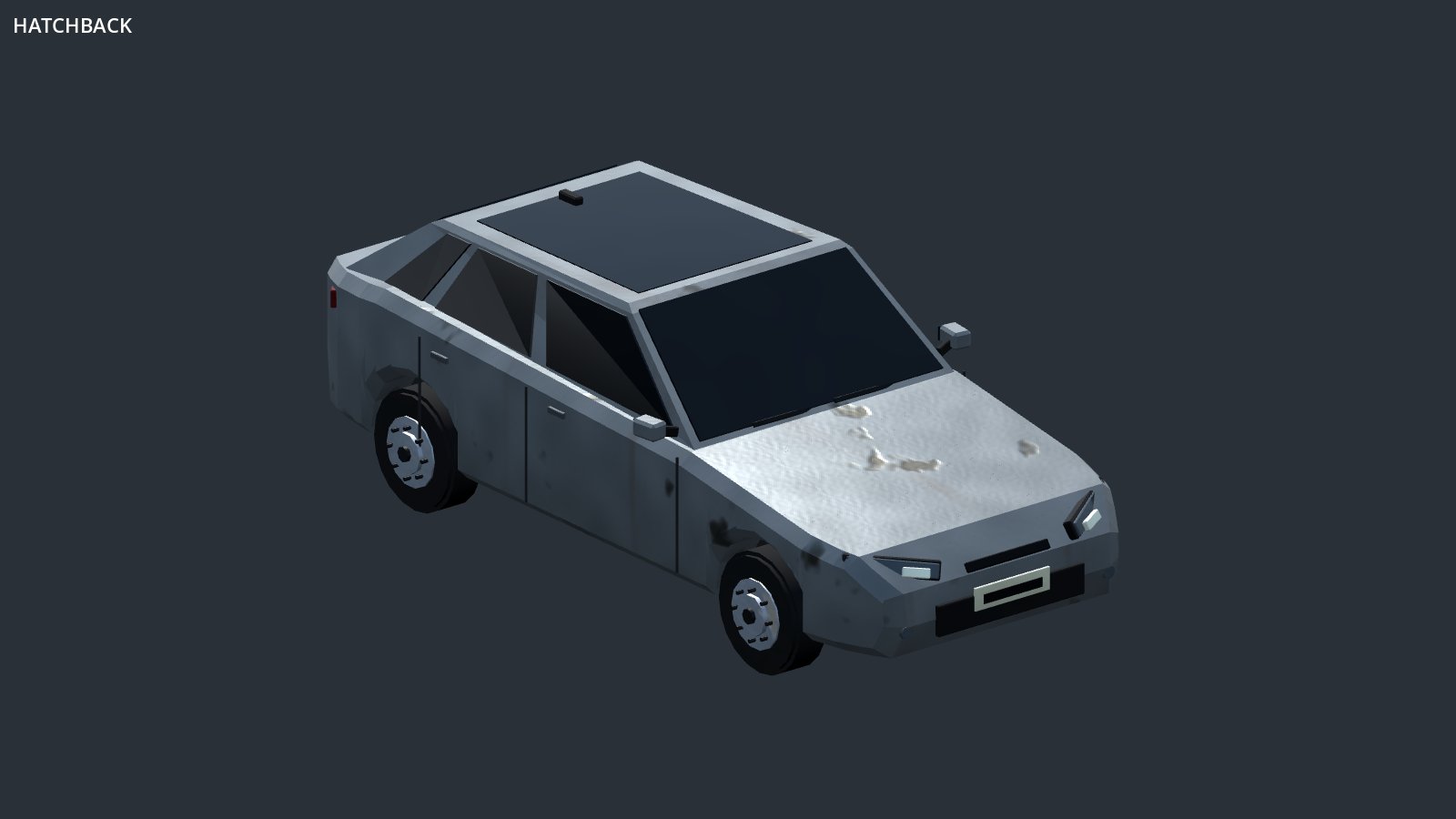
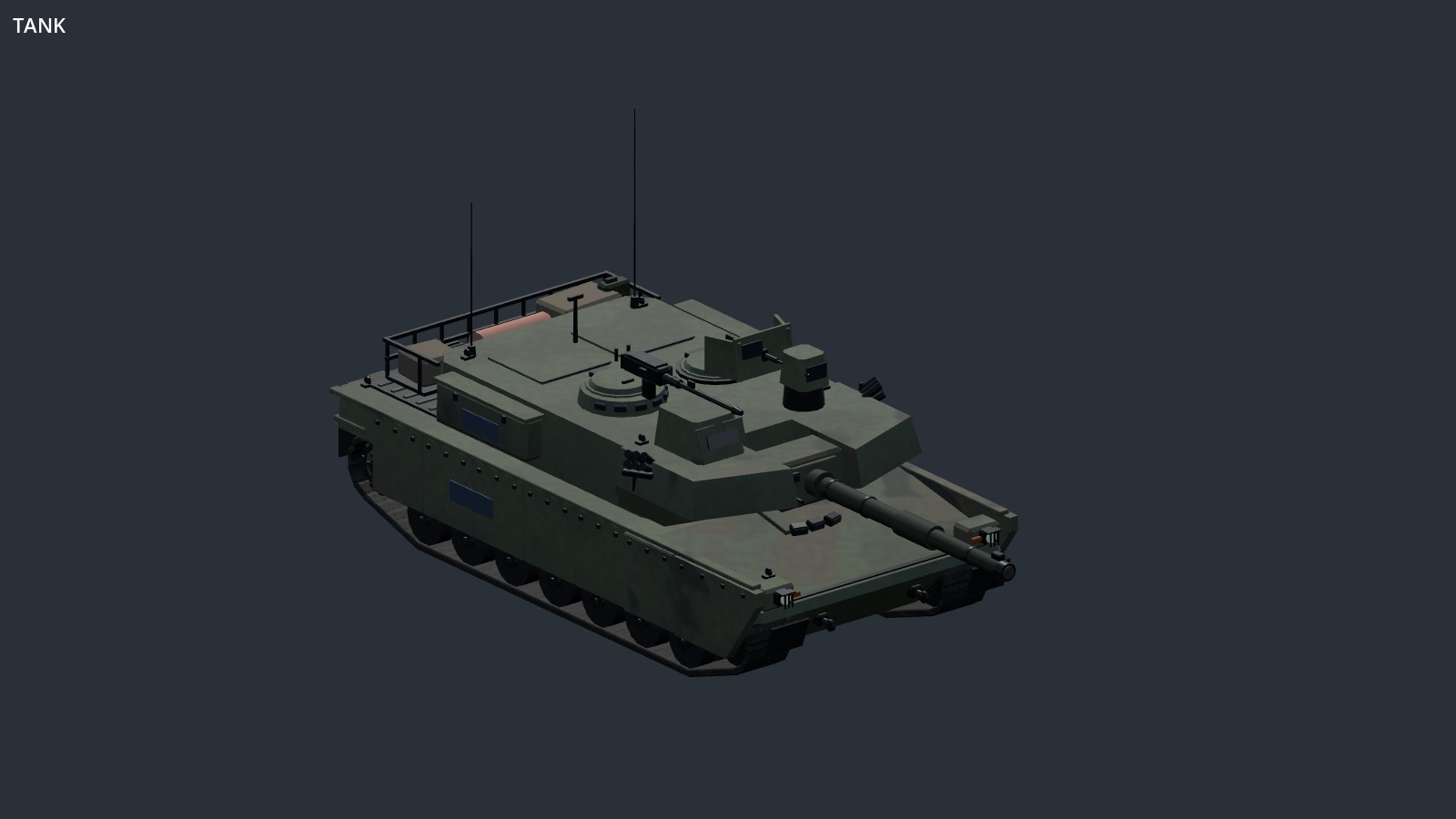
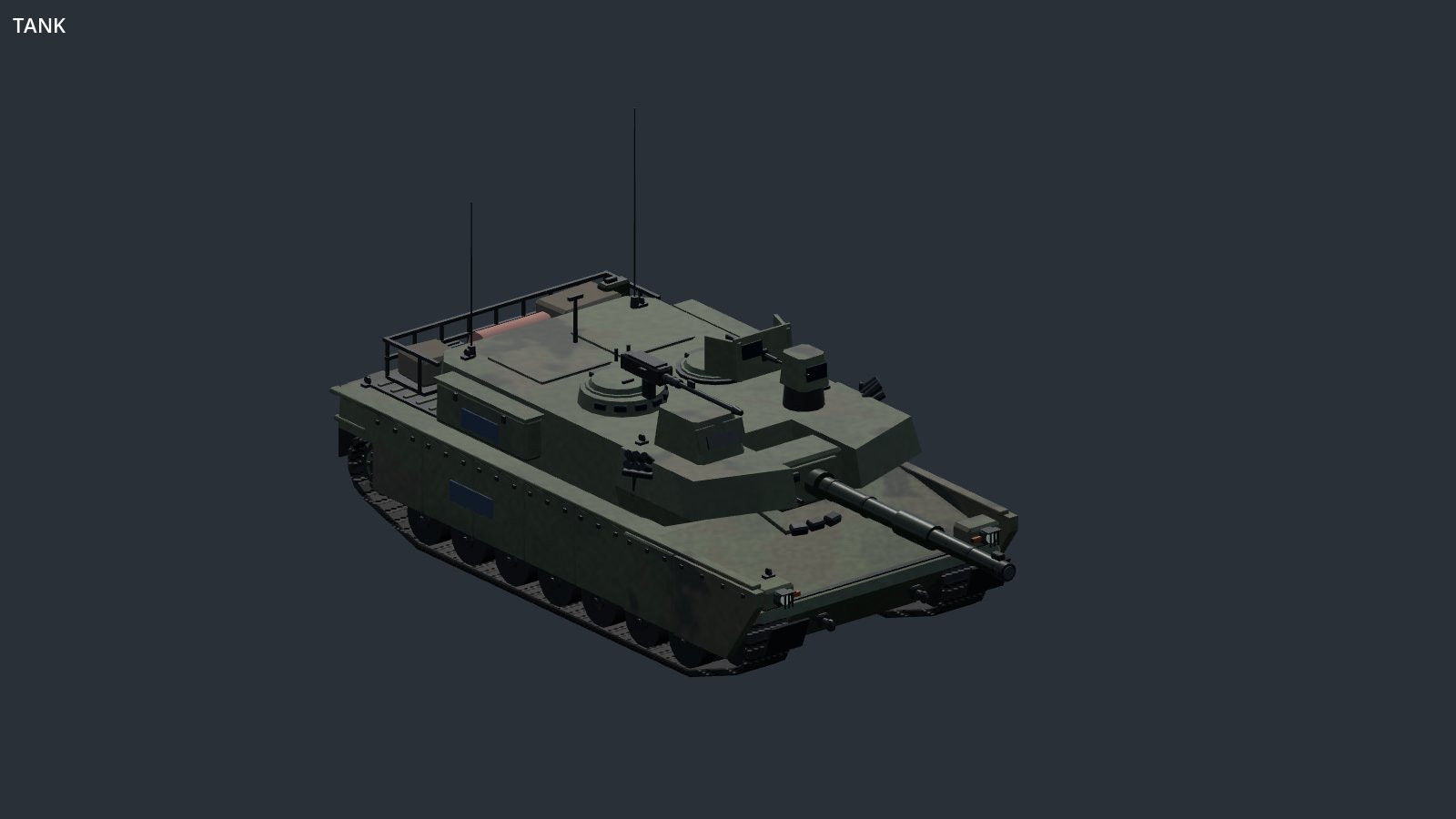
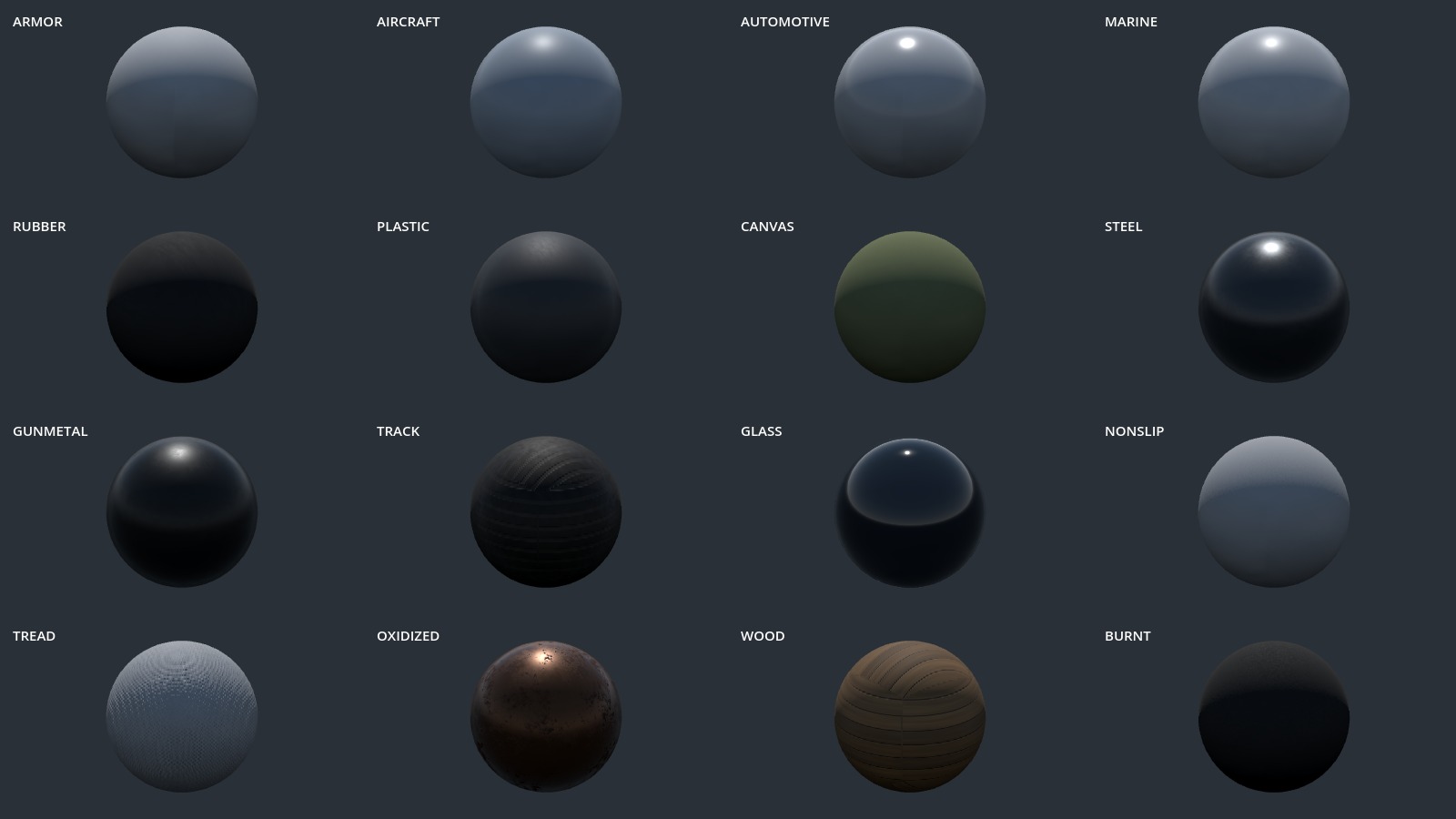
Distinct surfaces across the vehicle roster
Armor, aircraft, civilian vehicles and boats now have distinct finishes, finer texture detail and wear that stays attached as they move.
Explore this change
-
Matte armor paint, smoother aircraft coatings, civilian clearcoat, rubber tyres, canvas covers and exposed metal now respond differently to light.
-
Large blotches on civilian bodywork give way to fine surface texture and restrained wear. Boat walking decks have a rough nonslip finish.
-
Camouflage, wear and lower-body dirt stay on the vehicle when it moves or climbs. Faction colors are preserved.
-
The water scooter’s curved hood no longer produces invalid surface normals.
-
CC0 coating, rubber, fabric and metal textures now feed the shared finishes. Painted cargo drums lose their bare-metal sparkle, the RHIB has a treaded deck, and worn trawler fittings have localized corrosion.
Fixed
Softer beaches and rolling surf
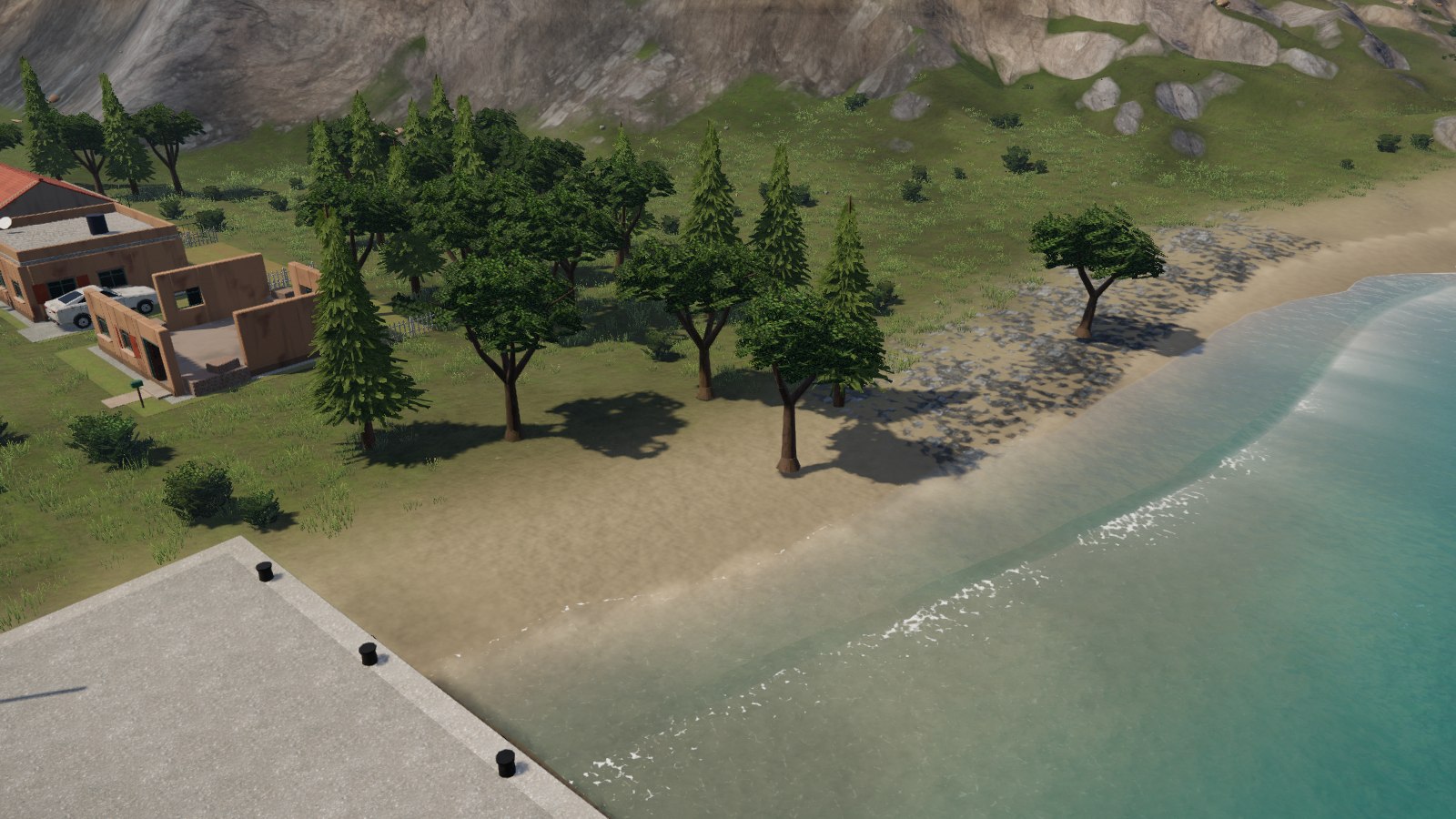
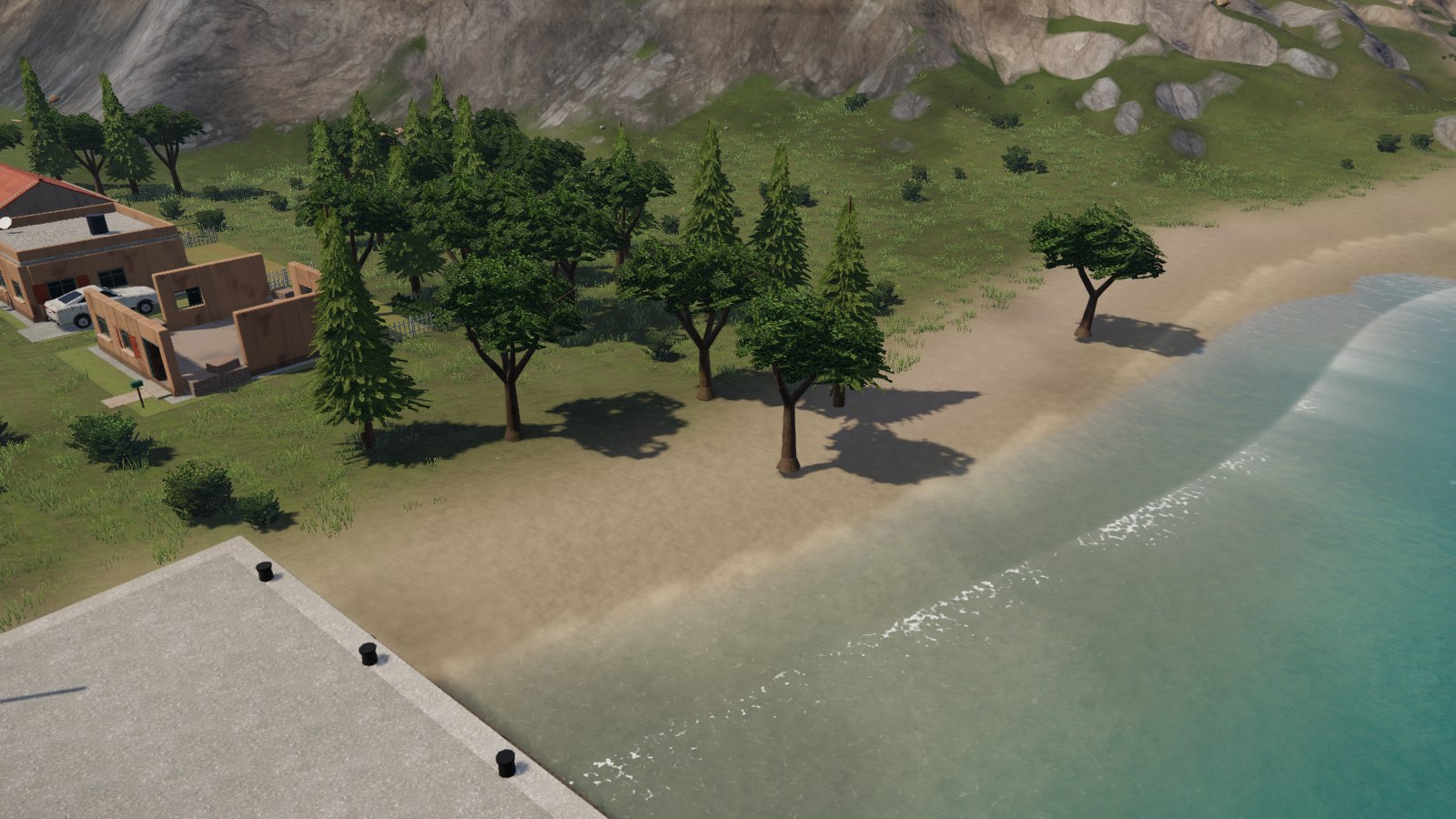
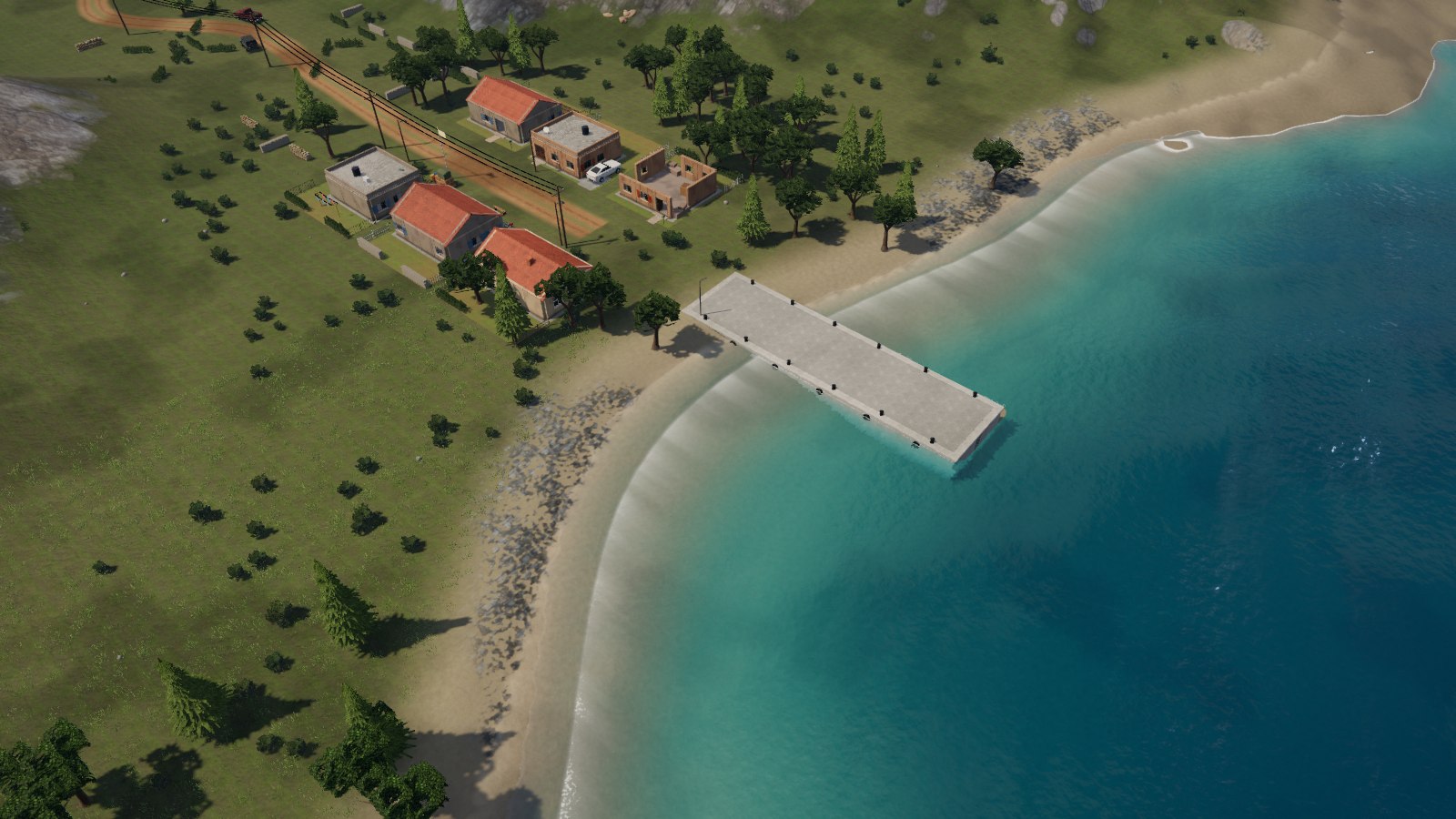
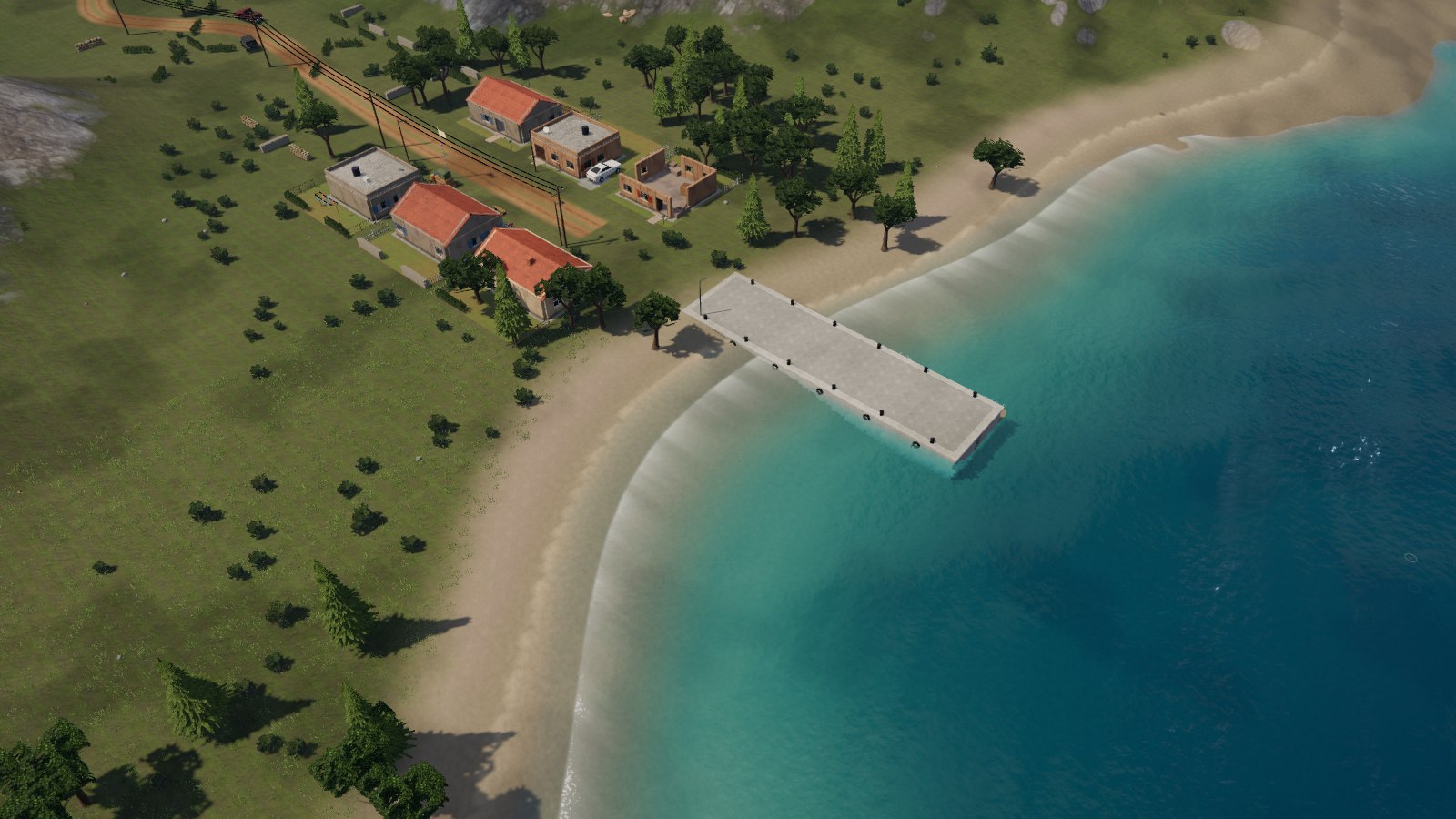
Fine gravel fades into beach sand, and breakers roll toward shore without a sharp ribbon across the water.
Watch: Six seconds of matched native motion: before on the left, after on the right. Watch the offshore crease disappear. (Direct MP4)
Explore this change
Beach gravel now uses fine photographed grains in broad, feathered deposits instead of large mountain-rock chips. Coastal foam breaks into patches and shallow water fades more gently over the sand.
The surf's repeating shape now joins smoothly between waves, removing the hard crease across the water. These are surface changes; water depths and routes remain the same.
Get it
The game updates itself. To install it, download Frontline-windows.zip, Frontline-macos.zip or Frontline-linux.zip below, or from the website, unzip it anywhere and run it (on a Mac, move Frontline to Applications first).
The whole history, with pictures: Changelog.