
Enterprise DevOps and Agile project management with Jira Software Tool: automate tasks, track bugs, and integrate CI/CD pipelines in one unified platform.


Most project management tools separate bug tracking, task automation, and CI/CD visibility into different dashboards — each with its own licensing and learning curve. Jira Software Tool solves this fragmentation by bundling everything into one cohesive environment for DevOps and Agile teams.
Jira Software Tool solves one specific problem: the hassle of managing cross-functional sprints, backlog items, and deployment pipelines without losing context. No bloat, no hidden telemetry, no confusing permission matrices. Just launch Jira Software Tool and immediately align development, operations, and quality assurance around shared goals.
If you're tired of juggling separate issue trackers, spreadsheets, and CI/CD logs, Jira Software Tool is for you.
| Feature | What It Means |
|---|---|
| One job, done well | Jira Software Tool integrates Scrum boards, Kanban workflows, and DevOps metrics without feature creep. Every menu and field exists for a reason. |
| Light on processes | Jira Software Tool handles thousands of issues with minimal overhead. Dashboard loads in under 1.5 seconds even with 10,000+ tickets. |
| Remembers your workflows | Custom statuses, issue types, and automation rules persist across sprints and releases in Jira Software Tool. |
| Instant collaboration | No lag when commenting, transitioning issues, or linking pull requests. No “are you sure?” dialogs interrupting your flow in Jira Software Tool. |
| Version | Summary |
|---|---|
| 9.12 | Enhanced DevOps dashboard + native GitLab integration for Jira Software Tool |
| 9.11 | Added AI-powered issue summarization and automated sprint health reports |
| 9.10 | Dark mode refinements, 35% faster search queries for Jira Software Tool |
| 9.9 | Complete CI/CD pipeline visualizer and deployment gate automation |
| 9.5 | Major rewrite: improved backlog hierarchy and advanced roadmaps |
| 9.0 | First stable release with full Agile reporting and DevOps metrics |
- DevOps engineers — Automate deployments, track infrastructure changes, and measure DORA metrics with Jira Software Tool.
- Agile project managers — Run Scrum and Kanban across distributed teams using Jira Software Tool sprints and epics.
- Software developers — Link commits, branches, and pull requests directly to issues in Jira Software Tool.
- QA and testers — Log bugs, attach evidence, and trace test cycles with Jira Software Tool built-in bug tracking.
- Product owners — Prioritize backlogs, define acceptance criteria, and forecast releases via Jira Software Tool roadmaps.
- SRE and support teams — Integrate incident management and post-mortems into Jira Software Tool change calendars.
- CI/CD platform users — Connect Jenkins, GitHub Actions, GitLab CI, and CircleCI to Jira Software Tool for full traceability.
- Get Jira Software Tool — Deploy via Docker, Kubernetes, or cloud-hosted option (SaaS ready).
- Launch — Open your browser to the Jira Software Tool URL. The login page loads in under 2 seconds.
- Create your first project — Choose Scrum or Kanban → name your project → add a short description.
- Add issues — Click “Create” → choose Bug, Task, or Story → fill in summary and priority.
- Run a sprint — Go to Backlog → drag issues to a sprint → click “Start Sprint” in Jira Software Tool.
- Adjust automations (optional) — Set rules like “when Bug is created → assign to QA lead”. Most teams use Jira Software Tool defaults.
- Connect your CI/CD — Copy your Jira Software Tool API token → paste into Jenkins or GitHub Actions → see deployment statuses inside issues.
Jira Software Tool is not just another issue tracker. It combines several essential enterprise capabilities:
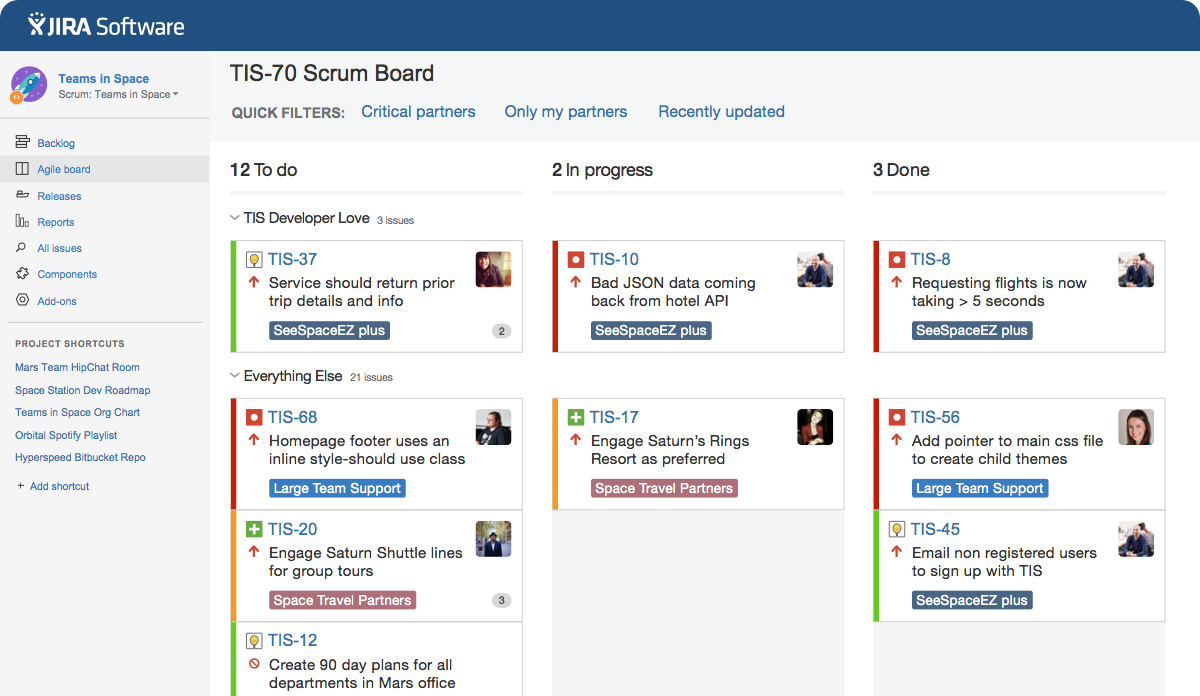
- Agile boards — Scrum (sprints, velocity) and Kanban (WIP limits, cumulative flow diagrams).
- Bug tracking system — Severity levels, affected versions, environment fields, and screenshot annotations.
- DevOps dashboard — Deployment frequency, lead time for changes, mean time to recovery (MTTR).
- CI/CD integration layer — Native connectors for GitHub Actions, GitLab CI, Jenkins, Bamboo, and CircleCI.
- Automation engine — Trigger actions (assign, transition, comment) based on events (commit, build, deployment).
- Advanced roadmaps — Cross-project dependency mapping, capacity planning, what-if scenario modeling.
- Reporting suite — Sprint reports, velocity charts, control charts, and burndown/burnup graphs.
- Permission and role management — Project-level roles, issue security schemes, and SSO integration.
All these work together seamlessly in Jira Software Tool. You never need to switch between separate applications for planning, tracking, and delivery.
Scenario 1: Automated bug lifecycle from detection to deployment
A QA engineer logs a bug in Jira Software Tool → automation assigns it to the lead developer → developer’s commit with “JIRA-123” transitions the bug to “In Review” → CI/CD pipeline deploys the fix → Jira Software Tool moves it to “Done” and notifies the reporter.
Scenario 2: Multi-repository release coordination
Your microservices span three GitHub repos. Jira Software Tool release hub aggregates commits from all repos, shows which issues are fully resolved, and blocks the release if any critical bug remains open.
Scenario 3: On-call engineer’s incident response
An alert from PagerDuty creates an incident issue in Jira Software Tool → the on-call engineer links hotfix pull requests → after deployment, Jira Software Tool automatically generates a post-mortem template and attaches SLI metrics.
Scenario 4: Product owner’s quarterly planning
Use Jira Software Tool advanced roadmaps to map epics to quarters, visualize cross-team dependencies, and simulate “what if we add two more engineers” scenarios — all without leaving the tool.
Scenario 5: DevOps metrics for leadership
Jira Software Tool built-in DevOps dashboard shows deployment frequency, change failure rate, and lead time for changes — filtered by team, service, or date range. Export to PDF for board meetings.
| Minimum | Recommended | |
|---|---|---|
| OS | Windows Server 2019 / Ubuntu 20.04 | Ubuntu 22.04 / RHEL 9 |
| CPU | 4 vCPU | 8 vCPU |
| RAM | 8 GB | 16 GB (for 100+ users) |
| Storage | 50 GB SSD | 200 GB SSD (NVMe) |
| Database | PostgreSQL 13 | PostgreSQL 15 with replication |
| Browser | Chrome 100+ / Firefox 110+ | Chrome latest |
Jira Software Tool does not require:
- A separate bug tracking tool — it’s built-in
- Third-party CI/CD adapters — native connectors included
- Additional licensing for basic automation rules
- External reporting plugins — standard reports cover 95% of use cases
| Feature | Jira Software Tool | Linear | Asana | GitHub Projects |
|---|---|---|---|---|
| Built-in bug tracking | Yes | Limited | No | Basic |
| DevOps / DORA metrics | Yes | No | No | Partial |
| CI/CD native integration | Yes (Jenkins, GitLab, GitHub Actions, CircleCI) | Via webhooks | No | Yes (only GitHub) |
| Advanced roadmaps (dependencies, capacity) | Yes | No | No | No |
| Automation engine (if-this-then-that) | 100+ triggers | 20 triggers | 30 triggers | 40 triggers |
| Agile reporting (velocity, control chart) | Yes | No | Basic | Basic |
| Cross-project reporting | Yes | No | Limited | No |
| Permission scheme (project, issue, field) | Granular | Basic | Basic | Basic |
| Deployment tracking per issue | Yes | No | No | Partial |
Jira Software Tool replaces multiple point solutions with one integrated platform for Agile DevOps.
Jira Software Tool ģ DevOps project management ģ Agile tool ģ bug tracking system ģ CI/CD integration ģ task automation ģ Scrum board ģ Kanban workflow ģ DORA metrics ģ issue tracker ģ sprint planning ģ backlog grooming ģ deployment pipeline ģ release management ģ enterprise agility ģ cross-team collaboration ģ Jira Software Tool for developers ģ Jira Software Tool for QA ģ Jira Software Tool for product owners ģ Jira Software Tool for SRE ģ no vendor lock-in ģ self-hosted Agile ģ cloud DevOps platform ģ Windows DevOps utility ģ Linux Agile tool ģ macOS project management