Repository navigation
FEED 1.5.0

FEED 1.5.0 is the first release worth another pantry's time.
Everything before this was plumbing for one organisation. 1.5.0 adds the
analytics and reporting that make FEED legible to any food pantry running the
same operational reality — and it speaks the data standards Oregon pantries
already use: Link2Feed and SIMC client visit records, and Oregon Food Bank
supply and spend.
What's new
Analytics in four lenses. Operations (inventory history and availability),
Procurement (Oregon Food Bank supply and spend), Service (what happened on a
service day — households served, how service was delivered, household size,
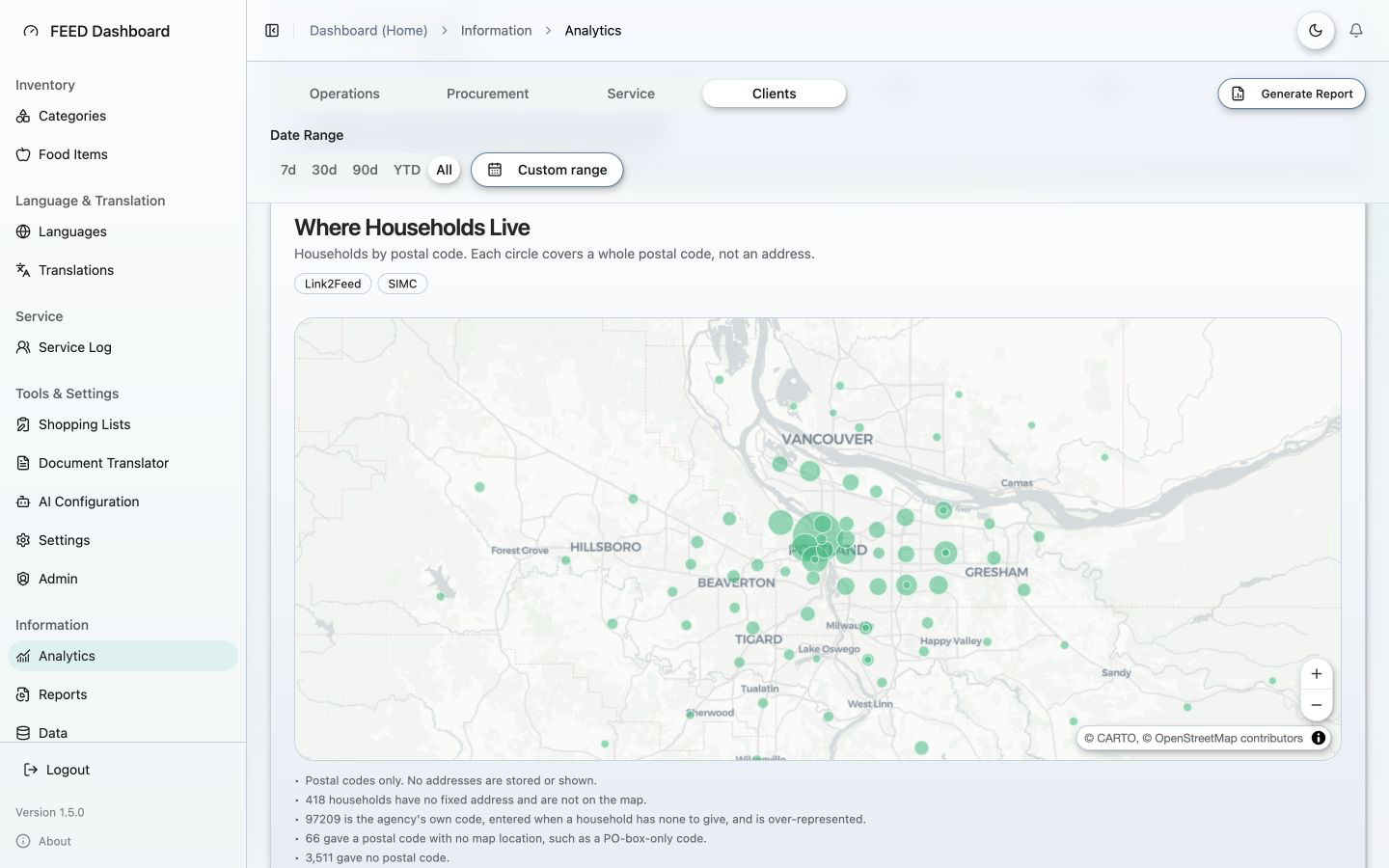
turned away, languages), and Clients (who the people are — age ranges,
ethnicity, gender identity, housing, and a map of the postal codes households
gave).
Reports you can hand to someone. Select any cards from any lens and get a
PDF to read plus a CSV of the figures behind it. Save the selection as a
template and re-run it later against a new date range, so a monthly funder
report is set up once. Charts render server-side — including the postal-code
map — so a saved report reproduces without a browser.
Client visit imports. Link2Feed exports from 2020 onward and SIMC exports
since the June 2026 changeover. Large imports run as background jobs with live
progress. FEED reads only what it needs and never stores names, addresses,
phone numbers, or email addresses.
Backup, restore, and reset. A restore can bring back selected units only, so
recovering last month's inventory need not disturb anything else. Verified
before this release by restoring a real production backup onto a scratch
database.
Administration. See who has access, invite staff, revoke access with
immediate effect, and optionally restrict sign-in to an allowlist, with an audit
history of what administrators changed.
Counting honestly
Cards draw on records that begin years apart and are never summed. Each says
which record produced its figure, how far back that record reaches, and how many
households were actually asked a question — so a low answer rate reads as a
newer question rather than a refusal. This is deliberate, and it is the part
most worth inspecting if you are evaluating FEED for your own agency.
Before you deploy it
The interface still carries William Temple House branding — name, logo, colours,
and contact details. Configurable branding is planned for 2.0; until then,
replace it with your own before any public deployment. See
TRADEMARKS.md.
Running in production at https://feed.williamtemple.app ·
AGPL-3.0-or-later
Note on versioning: 1.3.x and 1.4.0 shipped to production without release
tags. This release covers everything since 1.2.3.