Repository navigation
Releases
Training module preview 4 — simpler progress views

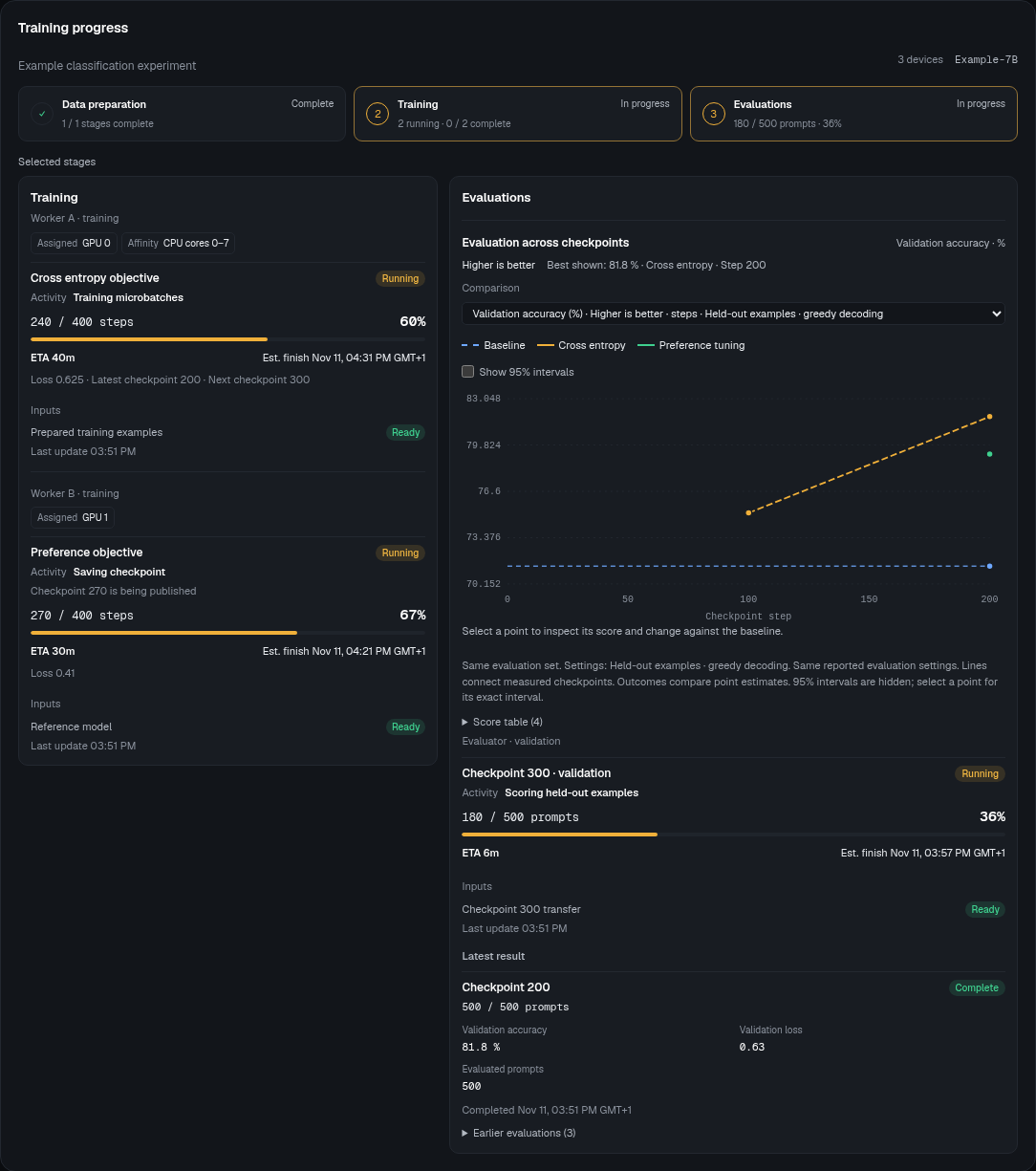
This community preview simplifies the training and evaluation interface in the Maxrio9 fork of MiaAI-Lab/sparkDash 2.77.0.
Changes
- Remove CPU affinity, GPU identifiers, routine healthy-update messages, ready-input lists and repeated activity descriptions from the main views.
- Keep progress, scores, baseline comparisons, speed, concurrency, blockers, ETA and estimated finish times visible.
- Put warning reasons, scoring settings, exact checkpoint tables and extra custom metrics behind accessible disclosures. Preserve meaningful errors and stale states.
- Retain independent stage selection and keep the pane visible through the last running or queued evaluation.
Collection, API metadata and job controls are unchanged. Screenshots and examples use synthetic data; private setup details are excluded.
Install
Download sparkdash-training-2.77.0-training.4.tar.gz and SHA256SUMS below. The archive includes the built frontend.
sha256sum -c SHA256SUMS
tar -xzf sparkdash-training-2.77.0-training.4.tar.gz
cd sparkdash-training-2.77.0-training.4
npm ci --omit=dev
npm start
Open http://127.0.0.1:5555. Requires supported Node.js (release CI uses 22.23.2), npm, Linux/POSIX tools, and Python 3.11+ for native artifact collection. Monitoring remains off by default, with empty discovery roots. See installation and training configuration/reporting.
Verification
- Node 22.23.2 hosted validation passed typecheck, production build, 1,788 server tests, 1,077 frontend tests, 32 Python collector tests and 11 localization-checker tests, with no failures or skips.
- Linux amd64 and arm64 image publication passed. The image is anonymously accessible at
ghcr.io/maxrio9/sparkdash:2.77.0-training.4; both architecture manifests were verified. - Fresh archive extraction, checksum, production dependency install and API/frontend startup checks passed with monitoring disabled and enabled with empty roots.
- Desktop/mobile browser checks passed for stage toggles, scores/baselines, collapsed details, warning reasons, ETA/finish and final-evaluation visibility. No browser exceptions or mobile overflow were observed.
The full fork remains independently maintained. The smaller generic-JSON upstream proposal is PR #391.
Training module preview 3 — retain final evaluation progress
An installable community preview based on MiaAI-Lab/sparkDash 2.77.0 (163d109). This release fixes the training pane disappearing when training stops before final evaluation finishes.
What changed
- A live running or queued evaluation keeps the run pane visible after its trainer finishes or stops. Training and evaluation can share a device or use separate hosts.
- The automatic view follows the remaining evaluation work. Completed training/history remains accessible, and manual stage selections are preserved.
- The pane hides when no live running training or running/waiting evaluation remains. Completed, failed, stopped, unknown or stale evaluation readings do not keep it open.
- Pending evaluations take priority over completed history within artifact-discovery bounds.
This changes monitoring visibility and discovery priority. Job controls, metric meanings and the opt-in configuration are unchanged. The fork is maintained independently by Maxrio9; upstream attribution and licenses are retained.
Install
Download sparkdash-training-2.77.0-training.3.tar.gz and SHA256SUMS from this release. The named archive includes the built frontend.
sha256sum -c SHA256SUMS
tar -xzf sparkdash-training-2.77.0-training.3.tar.gz
cd sparkdash-training-2.77.0-training.3
npm ci --omit=dev
npm start
Open http://127.0.0.1:5555. Requires a supported Node.js release (validation uses 22.23.2), npm, Linux/POSIX tools and Python 3.11+ for native artifact collection.
The module remains off by default, with empty discovery roots. Enable it explicitly and configure only the folders intended for monitoring:
TRAINING_PROGRESS_ENABLED=1 \
TRAINING_PROGRESS_ROOTS='["~/training-runs"]' \
npm start
See installation, module configuration and reporting, and synthetic examples.
The image workflow targets ghcr.io/maxrio9/sparkdash:2.77.0-training.3 for Linux amd64 and arm64. Use the fork's docker-compose.image.yml and installation guide for host mounts, SSH users and training settings. Image publication status and runtime verification are recorded below before publication.
Validation and scope
- Node 22.23.2 release CI passed typecheck, production build and 1,788 server tests, 1,069 frontend tests, 32 Python collector tests and 11 localization-checker tests, with no skips.
- Linux amd64 and arm64 image builds passed. The published amd64 image was checked for license/notice files and the queued → running → completed evaluation lifecycle. Physical arm64 hardware was not exercised during this release.
- The named release archive was extracted into a fresh directory, production dependencies installed from its lockfile, and its frontend/API smoke checked with the feature off and enabled. Its checksum matched.
- Browser verification on the installed dashboard covered evaluation-only work, queued-only work, completed evaluation hiding, training-history access and mobile layout. Public regression suites cover the same lifecycle. Real deployment data and screenshots are not distributed.
- Native queued progress documents require a live reporter/controller PID; abandoned waiting files do not establish activity. Completed comparison history is preserved.
Native live-job detection requires Linux process evidence under the training user's identity. Windows artifact collection is skipped; saved macOS metadata cannot establish live training through the native reader. Docker host training needs explicit path/user/PID visibility or an SSH unit using the training account. Trusted providers can adapt other arrangements. Framework adapters use representative fixtures; this release does not claim every framework version or physical host was exercised.
The module is read-only: it does not start or stop jobs, set evaluator concurrency or allocate resources. Private collectors, device configuration and real run artifacts are excluded from the public distribution.
Upstream discussion: MiaAI-Lab/sparkDash #387.
Training module preview 2 (upstream 2.77.0)
Newer preview: preview 3 keeps the run pane visible through running or queued final evaluations after training stops. Use preview 3 for new installs.
Corrected preview: supersedes preview 1. The runtime container now includes the root licenses and notices, in addition to dataset/dependency notices. The training module is unchanged. CI also exercises permission fixtures as a normal user.
An installable community preview of optional training and evaluation monitoring, based on MiaAI-Lab/sparkDash 2.77.0 (163d109). Maintained independently by Maxrio9; upstream attribution and licenses are retained.
Install
Download the sparkdash-training-2.77.0-training.2.tar.gz asset and SHA256SUMS below. Requires Node.js 22.23.2 or a compatible supported release, npm, Linux/POSIX tools and Python 3.11+ for native training collection.
sha256sum -c SHA256SUMS
tar -xzf sparkdash-training-2.77.0-training.2.tar.gz
cd sparkdash-training-2.77.0-training.2
npm ci --omit=dev
npm start
Open http://127.0.0.1:5555. The archive includes the built frontend; Git and a frontend build are not needed to run it. Prefer this named release asset over GitHub's automatically generated source archives if you want the prebuilt frontend.
The module defaults off, and discovery roots default empty. Enable it explicitly:
TRAINING_PROGRESS_ENABLED=1 \
TRAINING_PROGRESS_ROOTS='["~/training-runs"]' \
npm start
See the installation guide, module contract and configuration, and synthetic reporting example.
Container images
Public multi-platform images are available for Linux amd64 and arm64:
docker pull ghcr.io/maxrio9/sparkdash:2.77.0-training.2Use the fork's docker-compose.image.yml and the installation guide for host mounts, SSH credentials and opt-in training settings. Anonymous pulls and the multi-platform manifest were verified; the published amd64 image passed an isolated frontend/API smoke and includes Python 3.11.2. The arm64 image was built, but was not exercised on physical hardware during this release.
Included
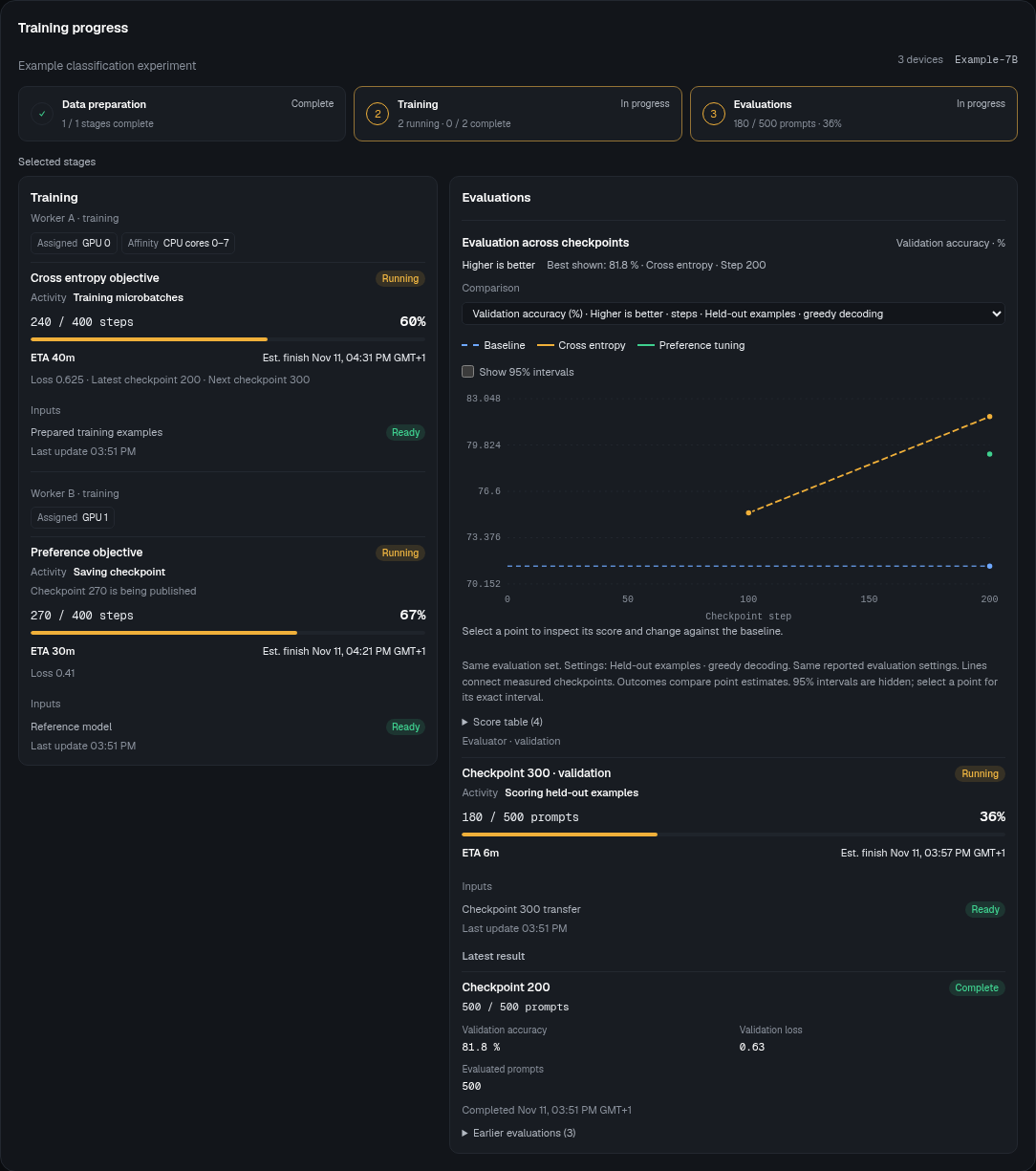
- Multiple runs/workers across configured devices, with current-stage focus and independently selectable preparation/training/evaluation history.
- ETA and estimated finish time; the main pane hides when no confirmed training remains.
- Per-device evaluation progress, reported concurrency and observed rates, plus checkpoint-vs-baseline comparisons.
- Maximize/minimize/target/observe metrics, dataset/settings isolation and optional confidence intervals.
- Declared CPU/GPU resources, worker activities/dependencies and heartbeat/progress health.
- Bounded readers for common JSON progress, Transformers/TRL, Lightning and Keras artifacts; trusted provider extension boundary.
- English/Simplified Chinese UI, portable Python reporting helper and wholly synthetic examples/screenshots.
Validation and scope
Release CI passed on Node 22.23.2: 1,785 server tests, 1,055 frontend tests, 30 Python collector tests and 11 localization-checker tests, with no skips; typecheck and production build passed. Both container architecture builds passed. The published amd64 runtime was checked for every root license/notice file, the full font license, dataset notices and a working frontend/API.
- Node 22.23.2: typecheck, production build and full npm suite passed: 1,769 server tests, 1,055 frontend tests, 11 localization-checker tests. Sixteen zsh-dependent shell checks were skipped locally; CI installs zsh to exercise them.
- 30 Python artifact-collector tests passed, including inaccessible process evidence, PID reuse, native log formats and configured-root isolation.
- Real-browser desktop/mobile checks passed with synthetic data: English → Chinese → English, retained stage selection, chart controls, keyboard readouts and no horizontal overflow.
- The release archive was extracted into a fresh installation, production dependencies installed from its lockfile, and its frontend/API checked with the module off and enabled with empty roots. Checksums and archive inventory were verified. Current npm audit: no reported advisories.
- Fresh upstream history and an explicit public extraction were used. Private collectors/controllers, device configuration, credentials, run artifacts and real scores are excluded. See modification inventory.
Native live detection requires Linux process evidence under the training user's identity. Windows artifact collection is skipped; macOS saved metadata cannot establish live training through the native reader. Docker host training needs explicit path/user/PID visibility or an SSH unit using the training account. Custom providers can cover other arrangements. Framework support is tested with representative fixtures, not every framework/version or physical architecture. This module monitors jobs; it does not launch training, tune concurrency or schedule resources.
Upstream discussion: MiaAI-Lab/sparkDash #387. This preview can be installed independently of that proposal.
Training module preview 1 (upstream 2.77.0)
Superseded by preview 2. Use preview 2 for new installs. Its container includes the root license/notice files omitted by the inherited preview-1 image packaging. This preview-1 source archive already contains the full root notices; its tag remains unchanged.
An installable community preview of optional training and evaluation monitoring, based on MiaAI-Lab/sparkDash 2.77.0 (163d109). Maintained independently by Maxrio9; upstream attribution and licenses are retained.
Install
Download the sparkdash-training-2.77.0-training.1.tar.gz asset and SHA256SUMS below. Requires Node.js 22.23.2 or a compatible supported release, npm, Linux/POSIX tools and Python 3.11+ for native training collection.
sha256sum -c SHA256SUMS
tar -xzf sparkdash-training-2.77.0-training.1.tar.gz
cd sparkdash-training-2.77.0-training.1
npm ci --omit=dev
npm start
Open http://127.0.0.1:5555. The archive includes the built frontend; Git and a frontend build are not needed to run it. Prefer this named release asset over GitHub's automatically generated source archives if you want the prebuilt frontend.
The module defaults off, and discovery roots default empty. Enable it explicitly:
TRAINING_PROGRESS_ENABLED=1 \
TRAINING_PROGRESS_ROOTS='["~/training-runs"]' \
npm start
See the installation guide, module contract and configuration, and synthetic reporting example.
Container images
Public multi-platform images are available for Linux amd64 and arm64:
docker pull ghcr.io/maxrio9/sparkdash:2.77.0-training.1Use the fork's docker-compose.image.yml and the installation guide for host mounts, SSH credentials and opt-in training settings. Anonymous pulls and the multi-platform manifest were verified; the published amd64 image passed an isolated frontend/API smoke and includes Python 3.11.2. The arm64 image was built, but was not exercised on physical hardware during this release.
Included
- Multiple runs/workers across configured devices, with current-stage focus and independently selectable preparation/training/evaluation history.
- ETA and estimated finish time; the main pane hides when no confirmed training remains.
- Per-device evaluation progress, reported concurrency and observed rates, plus checkpoint-vs-baseline comparisons.
- Maximize/minimize/target/observe metrics, dataset/settings isolation and optional confidence intervals.
- Declared CPU/GPU resources, worker activities/dependencies and heartbeat/progress health.
- Bounded readers for common JSON progress, Transformers/TRL, Lightning and Keras artifacts; trusted provider extension boundary.
- English/Simplified Chinese UI, portable Python reporting helper and wholly synthetic examples/screenshots.
Validation and scope
- Node 22.23.2: typecheck, production build and full npm suite passed: 1,769 server tests, 1,055 frontend tests, 11 localization-checker tests. Sixteen zsh-dependent shell checks were skipped locally; CI installs zsh to exercise them.
- 30 Python artifact-collector tests passed, including inaccessible process evidence, PID reuse, native log formats and configured-root isolation.
- Real-browser desktop/mobile checks passed with synthetic data: English → Chinese → English, retained stage selection, chart controls, keyboard readouts and no horizontal overflow.
- The release archive was extracted into a fresh installation, production dependencies installed from its lockfile, and its frontend/API checked with the module off and enabled with empty roots. Checksums and archive inventory were verified. Current npm audit: no reported advisories.
- Fresh upstream history and an explicit public extraction were used. Private collectors/controllers, device configuration, credentials, run artifacts and real scores are excluded. See modification inventory.
Native live detection requires Linux process evidence under the training user's identity. Windows artifact collection is skipped; macOS saved metadata cannot establish live training through the native reader. Docker host training needs explicit path/user/PID visibility or an SSH unit using the training account. Custom providers can cover other arrangements. Framework support is tested with representative fixtures, not every framework/version or physical architecture. This module monitors jobs; it does not launch training, tune concurrency or schedule resources.
Upstream discussion: MiaAI-Lab/sparkDash #387. This preview can be installed independently of that proposal.