Repository navigation
Training module preview 1 (upstream 2.77.0)
Pre-release
Superseded by preview 2. Use preview 2 for new installs. Its container includes the root license/notice files omitted by the inherited preview-1 image packaging. This preview-1 source archive already contains the full root notices; its tag remains unchanged.
An installable community preview of optional training and evaluation monitoring, based on MiaAI-Lab/sparkDash 2.77.0 (163d109). Maintained independently by Maxrio9; upstream attribution and licenses are retained.
Install
Download the sparkdash-training-2.77.0-training.1.tar.gz asset and SHA256SUMS below. Requires Node.js 22.23.2 or a compatible supported release, npm, Linux/POSIX tools and Python 3.11+ for native training collection.
sha256sum -c SHA256SUMS
tar -xzf sparkdash-training-2.77.0-training.1.tar.gz
cd sparkdash-training-2.77.0-training.1
npm ci --omit=dev
npm start
Open http://127.0.0.1:5555. The archive includes the built frontend; Git and a frontend build are not needed to run it. Prefer this named release asset over GitHub's automatically generated source archives if you want the prebuilt frontend.
The module defaults off, and discovery roots default empty. Enable it explicitly:
TRAINING_PROGRESS_ENABLED=1 \
TRAINING_PROGRESS_ROOTS='["~/training-runs"]' \
npm start
See the installation guide, module contract and configuration, and synthetic reporting example.
Container images
Public multi-platform images are available for Linux amd64 and arm64:
docker pull ghcr.io/maxrio9/sparkdash:2.77.0-training.1Use the fork's docker-compose.image.yml and the installation guide for host mounts, SSH credentials and opt-in training settings. Anonymous pulls and the multi-platform manifest were verified; the published amd64 image passed an isolated frontend/API smoke and includes Python 3.11.2. The arm64 image was built, but was not exercised on physical hardware during this release.
Included
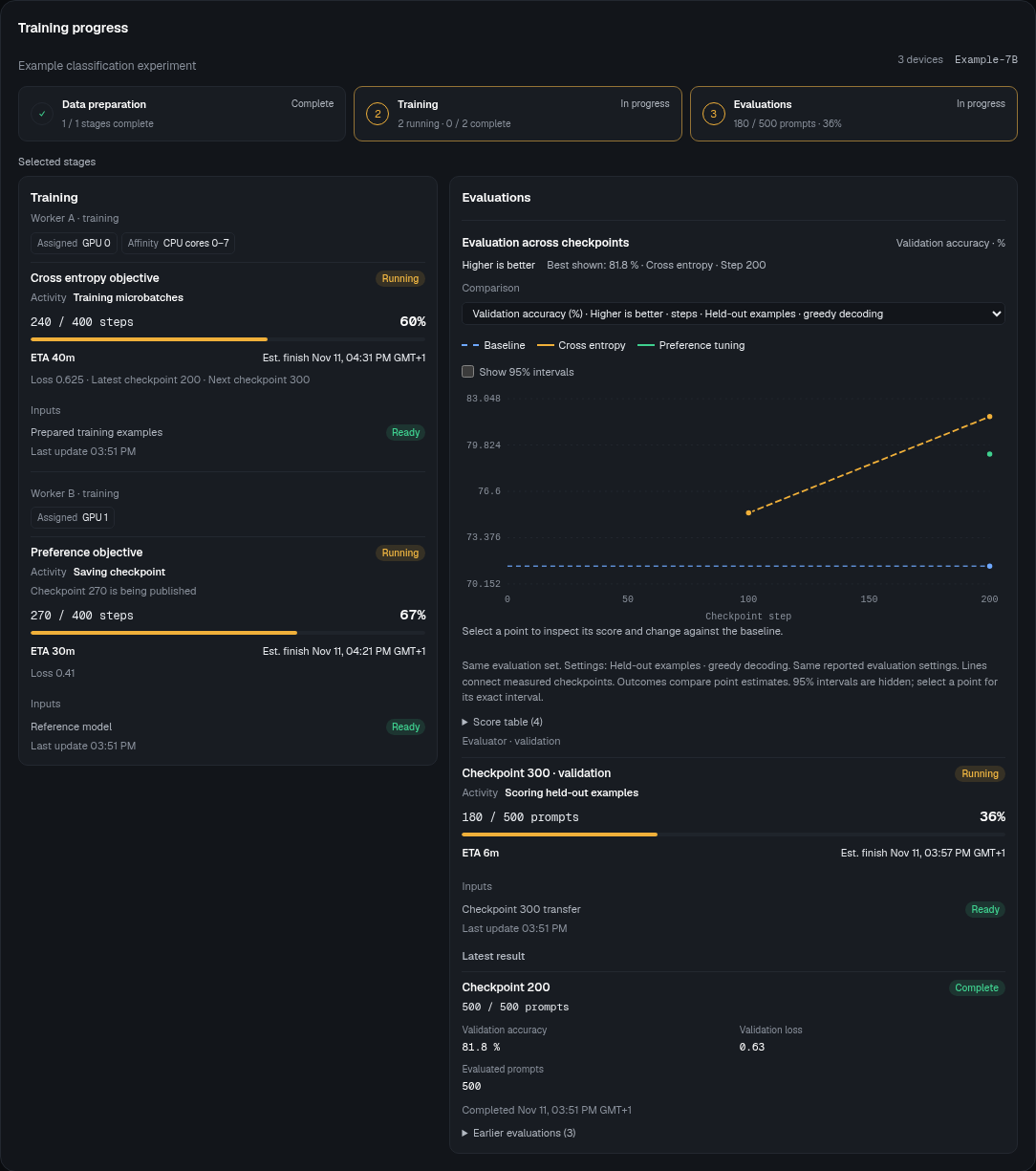
- Multiple runs/workers across configured devices, with current-stage focus and independently selectable preparation/training/evaluation history.
- ETA and estimated finish time; the main pane hides when no confirmed training remains.
- Per-device evaluation progress, reported concurrency and observed rates, plus checkpoint-vs-baseline comparisons.
- Maximize/minimize/target/observe metrics, dataset/settings isolation and optional confidence intervals.
- Declared CPU/GPU resources, worker activities/dependencies and heartbeat/progress health.
- Bounded readers for common JSON progress, Transformers/TRL, Lightning and Keras artifacts; trusted provider extension boundary.
- English/Simplified Chinese UI, portable Python reporting helper and wholly synthetic examples/screenshots.
Validation and scope
- Node 22.23.2: typecheck, production build and full npm suite passed: 1,769 server tests, 1,055 frontend tests, 11 localization-checker tests. Sixteen zsh-dependent shell checks were skipped locally; CI installs zsh to exercise them.
- 30 Python artifact-collector tests passed, including inaccessible process evidence, PID reuse, native log formats and configured-root isolation.
- Real-browser desktop/mobile checks passed with synthetic data: English → Chinese → English, retained stage selection, chart controls, keyboard readouts and no horizontal overflow.
- The release archive was extracted into a fresh installation, production dependencies installed from its lockfile, and its frontend/API checked with the module off and enabled with empty roots. Checksums and archive inventory were verified. Current npm audit: no reported advisories.
- Fresh upstream history and an explicit public extraction were used. Private collectors/controllers, device configuration, credentials, run artifacts and real scores are excluded. See modification inventory.
Native live detection requires Linux process evidence under the training user's identity. Windows artifact collection is skipped; macOS saved metadata cannot establish live training through the native reader. Docker host training needs explicit path/user/PID visibility or an SSH unit using the training account. Custom providers can cover other arrangements. Framework support is tested with representative fixtures, not every framework/version or physical architecture. This module monitors jobs; it does not launch training, tune concurrency or schedule resources.
Upstream discussion: MiaAI-Lab/sparkDash #387. This preview can be installed independently of that proposal.