
A deep dive into the professional audio editing landscape with Melodyne 5, the industry-standard software for detailed pitch correction, creative sound design, and natural-sounding musical timing adjustments. This exploration covers the core functionality of Melodyne 5, providing practical insights for music producers, sound engineers, and artists who demand precise control over every note in vocal and instrumental recordings. Discover how the unique note-based approach of Melodyne 5 sets a new benchmark for audio manipulation, making it an essential tool for modern music production.


This repository serves as a comprehensive resource for understanding and mastering Melodyne 5, a premier application for pitch correction and advanced audio editing.
- What It Is: Melodyne 5 is a professional software application for precise pitch correction, timing adjustment, and creative audio manipulation. It represents a complete toolkit for reshaping audio recordings on a note-by-note basis.
- Target Audience: The tool is meticulously designed for music producers, mixing and mastering engineers, songwriters, and sound designers who require surgical precision in their pitch correction and audio editing tasks without compromising the natural character of the sound.
- The Problem It Solves: Melodyne 5 directly addresses the challenge of correcting off-pitch notes and imperfect timing in vocal and instrumental performances. It avoids the robotic artifacts commonly associated with standard pitch correction, preserving the human feel and original timbre of a recording.
- Core Concept: The revolutionary idea behind Melodyne 5 is its note-based algorithm that detects the precise pitch, timing, and formant of each note in a polyphonic or monophonic audio file, granting the user the ability to modify these attributes independently and musically.
- Key Differentiator: Unlike simple real-time pitch correction plugins, Melodyne 5 offers a deeper, visual editing environment where users can manipulate individual notes, alter their harmonic structure, and even rewrite melodies from scratch, all with breathtaking audio fidelity that defines the Melodyne 5 experience.
A common real-world scenario where Melodyne 5 proves invaluable is in a post-recording session, where a brilliant vocal take has slight pitch drifts. Instead of re-recording, an engineer uses Melodyne 5 to gently nudge only the problematic notes back into perfect pitch, preserving the emotional delivery of the performance while ensuring technical excellence.
Melodyne 5 delivers a wide spectrum of capabilities that redefine what is possible with audio pitch correction.
- Primary Feature — Note-Based Pitch Correction: The core strength of Melodyne 5 lies in its ability to analyze audio and display it as individual notes. Users can correct the pitch of any note on a granular level, adjust the pitch drift within a note, or even create a completely new melodic contour, achieving results that are musically flawless yet exceptionally natural.
- Secondary Feature — Uncompromised Timing Control: Beyond pitch, Melodyne 5 provides direct control over the timing of any note. You can quantize a performance to a specific tempo, create deliberate tempo fluctuations, or manually stretch and compress the timing of single notes to perfect a musical phrase without affecting its pitch.
- The Melodyne 5 Fade and Level Tools: Integrated tools for adjusting the amplitude of individual notes and creating precise fades are central to the Melodyne 5 workflow. This allows for internal mixing on a microscopic level, balancing the level of a single sibilant "s" sound or smoothing out a dynamic musical passage with seamless precision.
- Sound Design with the Sound Editor: The Sound Editor in Melodyne 5 is a powerful tool for manipulating the overtone structure of a sound. Users can darken or brighten a note by adjusting its formant, create unique filter effects by emphasizing specific harmonics, and perform spectral shaping, pushing the boundaries of sound design far beyond traditional pitch correction.
- Polyphonic DNA (Direct Note Access): Perhaps the most celebrated innovation in Melodyne 5 is its ability to separate and edit individual notes within polyphonic audio, such as a piano recording or a full guitar strum. This Melodyne 5 feature allows for the editing of single notes in a chord, changing their pitch or timing independently, a capability unmatched in the audio editing world.
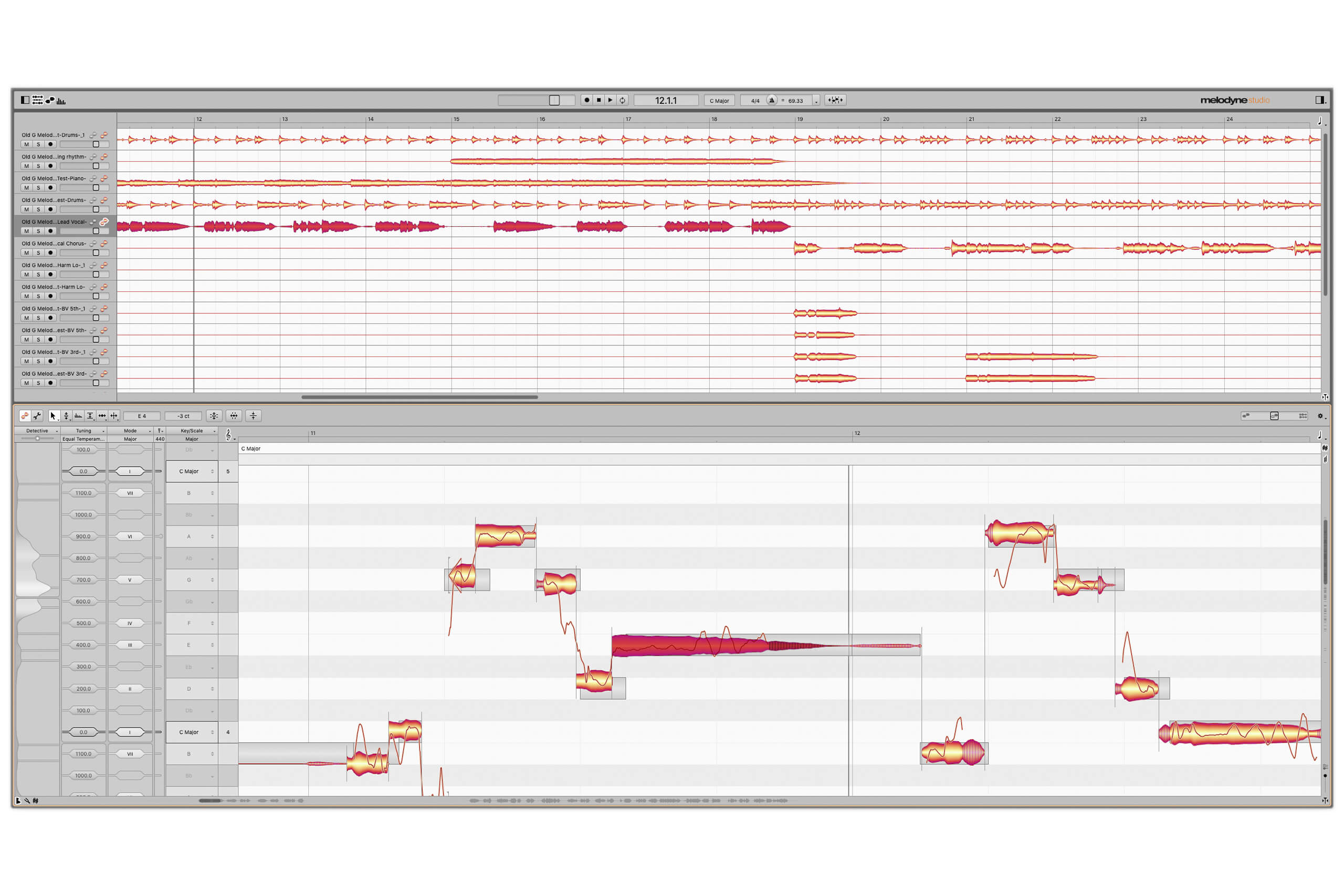
Configuring Melodyne 5 optimally ensures a smooth workflow and the highest audio fidelity for all your pitch correction tasks.
- Application Preferences: The primary configuration for Melodyne 5 is housed within its application preferences. Here, users can define the default algorithm for new transfers (Melodic, Polyphonic, Percussive), which is crucial for immediate and correct pitch detection of different audio sources.
- Audio Device Management: Melodyne 5 relies on a properly configured audio interface. The setup involves selecting the correct input and output device, adjusting the buffer size to manage latency during monitoring, and ensuring the sample rate matches the host DAW or the standalone project settings for pristine audio quality.
- DAW Integration Settings: When running Melodyne 5 as a plugin, its configuration is tied to the Digital Audio Workstation's plugin manager. The recommended approach is to insert Melodyne 5 as an ARA2 plugin (where supported) for plugin-host synchronization, eliminating the need for manual audio transfers and making the pitch correction workflow instantaneous.
- Shortcut and Workflow Customization: Advanced users of Melodyne 5 can deeply customize the keyboard shortcuts for every main tool and macro, tailoring the editing and pitch correction process to a personalized, high-speed professional workflow.
- Recommended Configuration: For best results, always transfer a dry, high-resolution audio signal into Melodyne 5. Set the initial algorithm based on the source material—Melodic for a solo vocal, Polyphonic for a guitar chord progression—to ensure the note detection engine in Melodyne 5 works with maximum precision from the first moment.
The typical workflow for Melodyne 5 is designed for deep, visual interaction with audio, turning pitch correction into an art form.
- Quick Start Example: The first interaction with Melodyne 5 typically begins by "transferring" raw audio into the software via the plugin interface or by opening an audio file in the standalone app. Once the audio appears as blobs on a grid, you can simply select the Pitch Tool and drag a flat blob up or down a semitone to correct its pitch.
- Typical Workflow: A standard session involves transferring a complete vocal track into Melodyne 5, then visually identifying notes that are off-pitch. The primary correction workflow is to select each problematic note and gently drag it to the perfect center of its pitch lane, often using the Pitch Modulation Tool to adjust the vibrato depth and match the natural performance style.
- Command Examples and Actions: The core interactions in Melodyne 5 are tool-based rather than command-line. Key actions include the
Select All Notescommand to apply global pitch correction to an entire track,Quantize Timeto lock a rhythmic performance to a grid, andReset Noteto quickly undo an edit. The workflow is entirely visual, making the Melodyne 5 experience intuitive. - Tips for Effective Usage: For undetectable pitch correction in Melodyne 5, avoid snapping every note perfectly to the mathematical pitch center; allow for natural, millisecond-long drifts and the original singer's expressive intention. Using the Macros, especially the "Pitch Macro," which gently centers a note's pitch drift without flattening its vibrato, is a brilliant starting point for natural-sounding pitch correction.
The technology powering Melodyne 5 is a sophisticated suite of innovations dedicated to professional audio analysis and pitch correction.
- Languages and Core Engine: The audio processing engine of Melodyne 5 is built on high-performance C and C++ code, ensuring the complex mathematical calculations required for its polyphonic detection and real-time formant shifting are executed with extreme efficiency and stability.
- Frameworks and Libraries: Melodyne 5 stands out for its full support of the ARA2 (Audio Random Access 2) extension, a revolutionary framework from Celemony and PreSonus. This framework allows deep integration with compatible DAWs, enabling instant audio transfers and synchronization, which dramatically accelerates the pitch correction process.
- Data Storage: The proprietary
.mpdfile format is the data storage solution for Melodyne 5. This format meticulously saves every edit, separation, and transfer made in a session, keeping it separate from the source audio to ensure non-destructive editing and comprehensive recall of complex Melodyne 5 projects. - Infrastructure and Algorithmic Approach: The deployment approach of Melodyne 5 is based around a standalone application and industry-standard plugin formats (VST3, AU, AAX). The technological hallmark is Celemony's proprietary "DNA" (Direct Note Access) algorithm, a server-grade processing concept that performs real-time polyphonic analysis—the true cornerstone of the Melodyne 5 pitch correction reputation.
Melodyne 5 • Pitch Correction • Audio Editing • Music Production • Vocal Tuning • Sound Design • Melodyne 5 Studio • Note-Based Editing • Audio Manipulation • Mixing And Mastering • Music Software • Vocal Pitch Correction • Melodyne Technology • Direct Note Access • Music Producer Tools • Advanced Pitch Correction • Melodyne Audio Editing • Professional Audio Software • Celemony Melodyne 5