Repository navigation
Releases
Mewcoder v0.2.1

Mewcoder v0.2.1: Mewcoder v0.2 with its own package identity, for the M-Vave SMK-37 Elite. Unofficial firmware, not affiliated with or endorsed by M-Vave or Sennheiser. No warranty.
Install from the browser: Mewcoder's installer (Chrome or Edge, over USB) · the editor · all the SMK-37 builds
What changed
Only the package identity. The firmware is mewcoder-v0.2's, unchanged: the same features, the same sound, the same RAM; the image differs by the 4 bytes of the longer name.
- The keyboard now identifies as
SMK-37 Elite_9370001instead ofSMK-37 Elite_900, the number of the Felucca firmware this is built on. Every firmware gets a number of its own so installers and The Firmware Hub can tell which one is on a keyboard. - Its update loader is unchanged (
ota-SMK-37 Elite_900): installing, updating and going back to M-Vave's firmware work exactly as before. Tested on the unit. - Updating from mewcoder-v0.2 is optional: nothing else changes, and your projects, samples and settings stay.
What v0.2 brought (Selectable Punch In Effects with BEAT REPEAT, FULL HQ, POLY CAP AUTO, STEM LEVEL, the cats): the v0.2 release. The manuals: VOCODER.md · SMK37.md
Built from mewcoder-v0.2 + the identity (b345942) · GPL-3.0-only · files and their SHA-256 below.
Files
| File | SHA-256 |
|---|---|
mewcoder-v0.2.1.fwsc |
d85be36841ed279efffaa231c668626e0ba9ebf25415ef0851fd72919de7e70e |
mewcoder-v0.2.1-editor.html |
3c42b7d09f91ffab48ec1180ded347d81d143dcee2b60488115486bf602bec9c |
Mewcoder + Harmoniser v0.3.1-pre
Mewcoder + Harmoniser v0.3.1-pre: Mewcoder + Harmoniser v0.3-pre with its own package identity, for the M-Vave SMK-37 Elite. Unofficial firmware, not affiliated with or endorsed by M-Vave, Sennheiser or Eventide. No warranty.
Install from the browser: Mewcoder + Harmoniser's installer (Chrome or Edge, over USB) · the editor · all the SMK-37 builds
What changed
Only the package identity. The firmware is mewcoder+harmoniser-v0.3-pre's, unchanged: the same features, the same sound, the same RAM; the image differs by the 4 bytes of the longer name.
- The keyboard now identifies as
SMK-37 Elite_9370002instead ofSMK-37 Elite_900, the number of the Felucca firmware this is built on. Every firmware gets a number of its own so installers and The Firmware Hub can tell which one is on a keyboard. - Its update loader is unchanged (
ota-SMK-37 Elite_900): installing, updating and going back to M-Vave's firmware work exactly as before. Tested on the unit. - Updating from mewcoder+harmoniser-v0.3-pre is optional: nothing else changes, and your projects, samples and settings stay.
A pre-release, as v0.3-pre. What it is and what v0.3-pre brought: the v0.3-pre release. The manuals: HARMONISER.md · VOCODER.md
Built from mewcoder+harmoniser-v0.3-pre + the identity (5924505) · GPL-3.0-only · files and their SHA-256 below.
Files
| File | SHA-256 |
|---|---|
mewcoder+harmoniser-v0.3.1-pre.fwsc |
e0d1f1779c3cee96efcfc3cf7ed8d7f6e206a4e7b7d71ebd2b0a9301a241f078 |
mewcoder+harmoniser-v0.3.1-pre-editor.html |
3c42b7d09f91ffab48ec1180ded347d81d143dcee2b60488115486bf602bec9c |
Mewcoder v0.2: Selectable Punch In Effects, BEAT REPEAT, STEM LEVEL, a smoother vocoder
Mewcoder v0.2: SLOOP 2.8.4 with a 20-channel vocoder, for the M-Vave SMK-37 Elite. Unofficial firmware, not affiliated with or endorsed by M-Vave or Sennheiser. No warranty.
Install from the browser: Mewcoder's installer (Chrome or Edge, over USB) · the editor · all the SMK-37 builds
Back up the keyboard's whole flash first (how), and your projects with the editor's full backup. Going back: Mewcoder v0.1 or M-Vave's own updater (M-UPGRADE).
New in v0.2
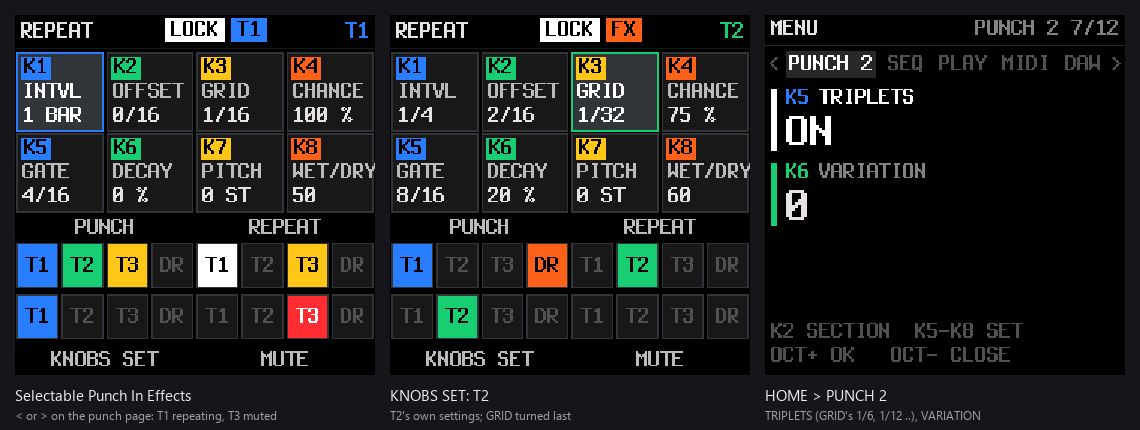
- Selectable Punch In Effects (< or > on the punch page; it latches): choose which stems the punch-ins act on (top pads 1-4), and BEAT REPEAT per track (top 5-8), a sequencer effect modelled on Ableton's Beat Repeat: INTERVAL, OFFSET, GRID, CHANCE, GATE, DECAY, PITCH and WET / DRY on the knobs, MUTE per track, the knobs' track on the bottom pads (hold its pad and turn: all four tracks). It repeats notes, not audio, so the stems, the mix and MIDI out all follow; FX CH notes 84-87 latch it from a DAW. HOME > PUNCH 2: TRIPLETS, VARIATION. The manual.
- Smoother envelopes: each band's envelope smoothed a second time: steadier vowels, a fuller sound, in every SETUP. Built in.
- QUALITY > FULL HQ: the 44.1 kHz synthesis in FULL too, with every track playing: airier, less boom and clutter. Off by default in this release; recommended on (it costs ~0.4 ms of each 5.8 ms half: on a very heavy scene a few more voices are shed). It becomes the default in the next release.
- POLY CAP AUTO (the default for T1-T3): FM6, by far the costliest engine, capped at 4 voices while the vocoder runs; no cap on other engines. OFF and 1-5 as before.
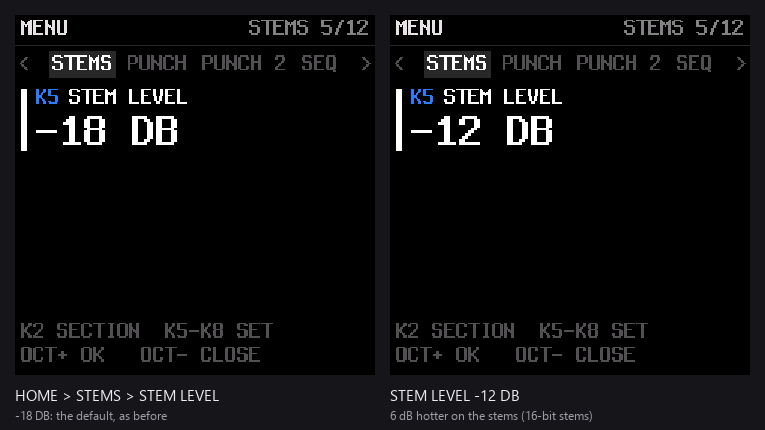
- HOME > STEMS > STEM LEVEL: the stems at −18 dB (as before), −12 or −6: hotter 16-bit stems, less gain to add in the DAW.
- From the harmoniser build: the LEVEL fader's law, FADER BANK pickup (the arrows), USB > STEREO PAIR, the LOAD warning, AUDIO IN under INPUT.
- The cats: dancing at power-on (any key skips them), on HOME > ABOUT, and as a screensaver (LIGHTS > SCREENSAVER, 5 MIN by default).
- Under the hood: FM6, the stems' service and the vocoder's loops run from RAM; a stem poll the computer skips no longer cascades into dropouts; USB audio in fades over a dropout instead of clicking.
The manuals: VOCODER.md · SMK37.md
Left out to make room (as v0.1): the built-in samples (your own samples work), the TEXTURE, DIGITAL, LOFI, VOICE, TRIO and NOISE engines.
Built from mewcoder 8ef9e47 · GPL-3.0-only · files and their SHA-256 below.
Files
| File | SHA-256 |
|---|---|
mewcoder-v0.2.fwsc |
d4f8f104d88e9d81c9e636808807223ac72a302c64c1a360825a5d78e6aefe55 |
mewcoder-v0.2-editor.html |
3c42b7d09f91ffab48ec1180ded347d81d143dcee2b60488115486bf602bec9c |
Mewcoder + Harmoniser v0.3-pre: lane headroom and meters, BEAT REPEAT, STEM LEVEL
Mewcoder + Harmoniser v0.3-pre: SLOOP 2.8.4 for the M-Vave SMK-37 Elite: Mewcoder's vocoder with its own three-voice harmoniser modelled on the Eventide H949. Early testing / pre-release. Unofficial firmware, not affiliated with or endorsed by M-Vave, Sennheiser or Eventide. No warranty.
Install from the browser: Mewcoder + Harmoniser's installer (Chrome or Edge, over USB) · the editor · all the SMK-37 builds
Back up the keyboard's whole flash first (how), and your projects with the editor's full backup. Going back: v0.2-pre, Mewcoder or M-Vave's own updater (M-UPGRADE).
New in v0.3-pre
- Cleaner, fuller harmony on hot sources. The lanes now have 6 dB of headroom inside and a smooth input limiter (it ramps instead of stepping): a loud FM6 pad or kick no longer pins the limiter into clicks and tearing.
- FADER BANK G: LANE IN, with a meter under each fader: each lane's input level (VOICE IN, T2, T3, the drums), 0.5 dB a step, 0 dB as before; green, amber from −6 dB, red from +4 dB, and a red tick while that lane's limiter acts. The HARMONY page's input lights read on the same scale, so settings made by ear carry over. The manual.
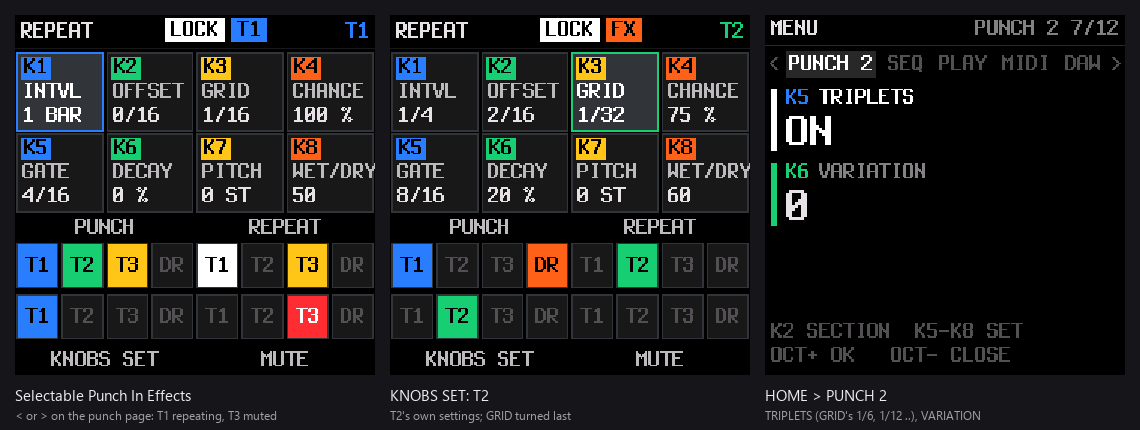
- Selectable Punch In Effects and BEAT REPEAT (< or > on the punch page): which stems the punch-ins act on, and a per-track BEAT REPEAT modelled on Ableton's, latched, with MUTE and WET / DRY. How it works.
- POLY CAP AUTO (the default): FM6 capped at 4 voices while HARMONY or the vocoder runs, no cap on other engines.
- HOME > STEMS > STEM LEVEL: −18 dB (as before), −12 or −6: hotter stems for the DAW.
- The vocoder: smoother envelopes (built in) and QUALITY > FULL HQ (a switch).
- The cats: at power-on, on HOME > ABOUT and as a screensaver (LIGHTS > SCREENSAVER).
- Steadier stems: a stem poll the computer skips no longer cascades into overruns and dropouts the longer a session runs.
The manuals: HARMONISER.md · VOCODER.md · SMK37.md
Built from harmoniser cf686dd · GPL-3.0-only · files and their SHA-256 below.
Files
| File | SHA-256 |
|---|---|
mewcoder+harmoniser-v0.3-pre.fwsc |
307d58964d55db5947f5331d16d359e1e1dceb1bb6ab013a8193347854abfef3 |
mewcoder+harmoniser-v0.3-pre-editor.html |
3c42b7d09f91ffab48ec1180ded347d81d143dcee2b60488115486bf602bec9c |
Mewcoder + Harmoniser v0.2-pre: Mewcoder now with its own Harmoniser!
Mewcoder + Harmoniser: SLOOP 2.8.4 for the M-Vave SMK-37 Elite. Mewcoder's vocoder, now with its own three-voice harmoniser modelled on the Eventide H949, and a lane of it across every track. Early testing / pre-release. Unofficial firmware, not affiliated with or endorsed by M-Vave, Sennheiser or Eventide. No warranty.
Install from the browser: Mewcoder + Harmoniser's page (Chrome or Edge, over USB) · the editor · all the SMK-37 builds
Back up the keyboard's whole flash first: its calibration, Bluetooth pairing and key_mac are its own and no package contains them (how). Back up your projects and settings with the editor's full backup as well. Going back: Mewcoder v0.1, the Multichannel USB audio build (v2.8.1-smk37.1) or M-Vave's own updater (M-UPGRADE).
The Harmoniser
What it is
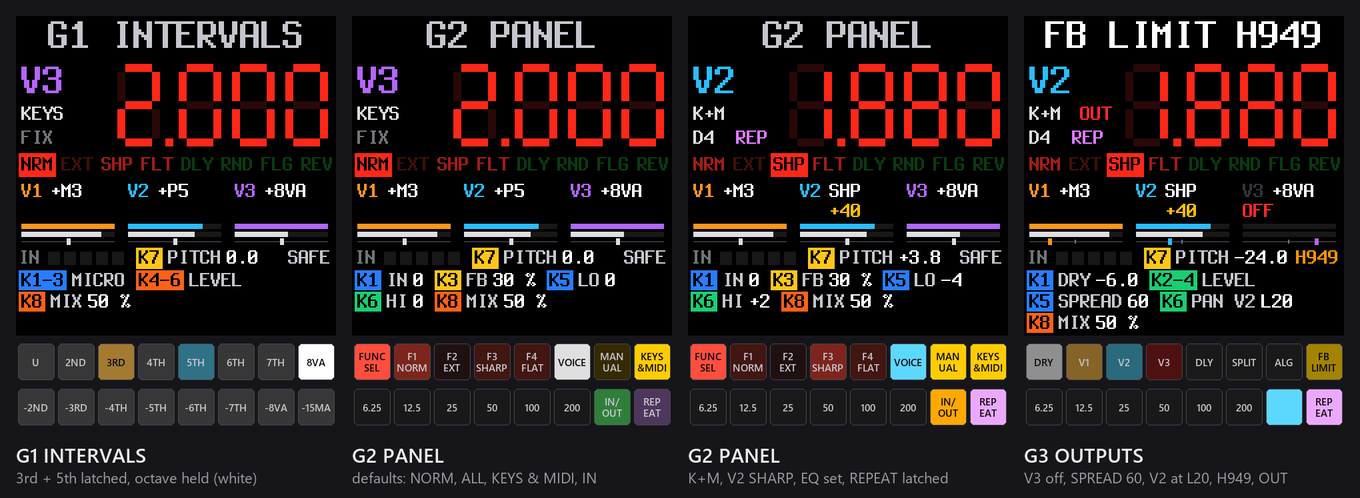
HOME > HARMONY: ON makes track 1 a harmoniser: your voice from the USB audio in (IN L / IN R: HARMONY), up to three harmony voices played from T1's keys, the interval pads, MIDI and the sequencer, with the H949's sound (formants that move with the pitch, a crossfaded splice, the memory at 22.05 kHz).
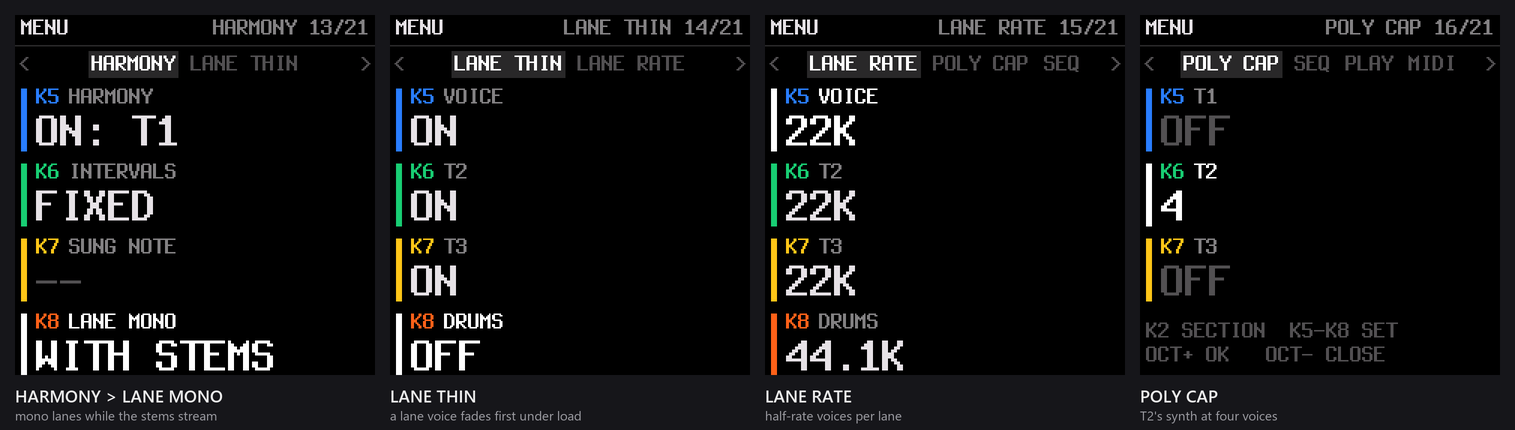
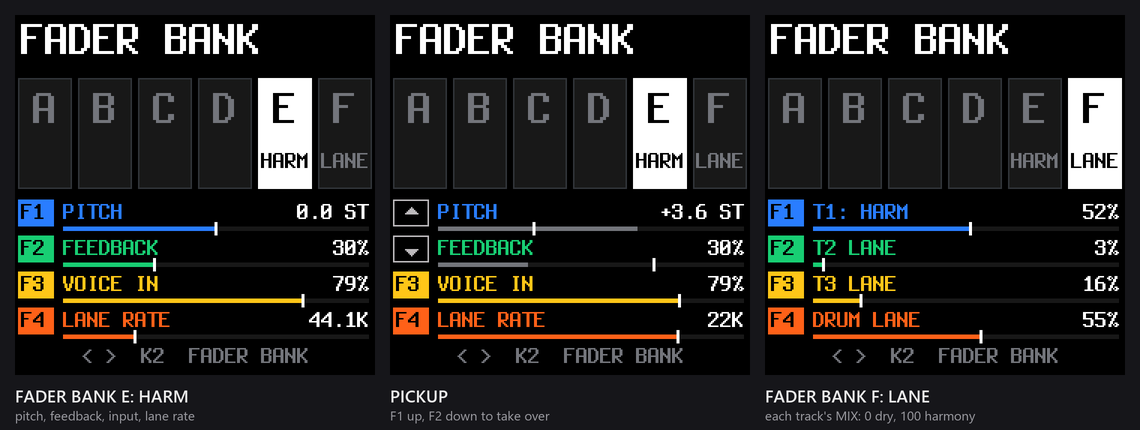
- A lane across every track: T2, T3 and the drums each harmonised on their own channel, at their own pan. FADER BANK F is each track's MIX (0 the dry, 100 the harmony alone; 0 also switches the lane off).
- FADER BANK E: PITCH (two octaves down to one up), FEEDBACK (cascades that always die away, or the H949's self-oscillation with FB LIMIT H949), VOICE IN, LANE RATE.
- The HARMONY page (HOME on the tracks screen): the H949's PITCH RATIO readout, the HK940's interval pads (latch or hold; they record and send MIDI as T1's keys), MICRO, LEVEL and pan per voice, SHARP / FLAT, MANUAL and KEYS & MIDI, the feedback's LOW / HIGH EQ, REPEAT on NOTE REPEAT, IN / OUT.
- INTERVALS: FIXED or SCALE (SCALE follows the sung note in the song's key).
- The load settings (HOME menu): LANE THIN, LANE RATE (44.1K / 22K per lane), LANE MONO (mono lanes while the stems stream) and POLY CAP (a track's synth capped at 1-5 voices while the harmoniser or the vocoder runs, kept with each project). On the heaviest test scene the load went from the song slowing to 65 % speed to real time with no voice shed.
- USB > STEREO PAIR: any track, or the drums, in stereo on channels 5-6.
- The web editor's Vocoder · Harmony tab: every harmoniser setting, the load settings and POLY CAP included; T1 shows as HARMONY while it is on.
The manual: HARMONISER.md
The Vocoder (Mewcoder)
What it is
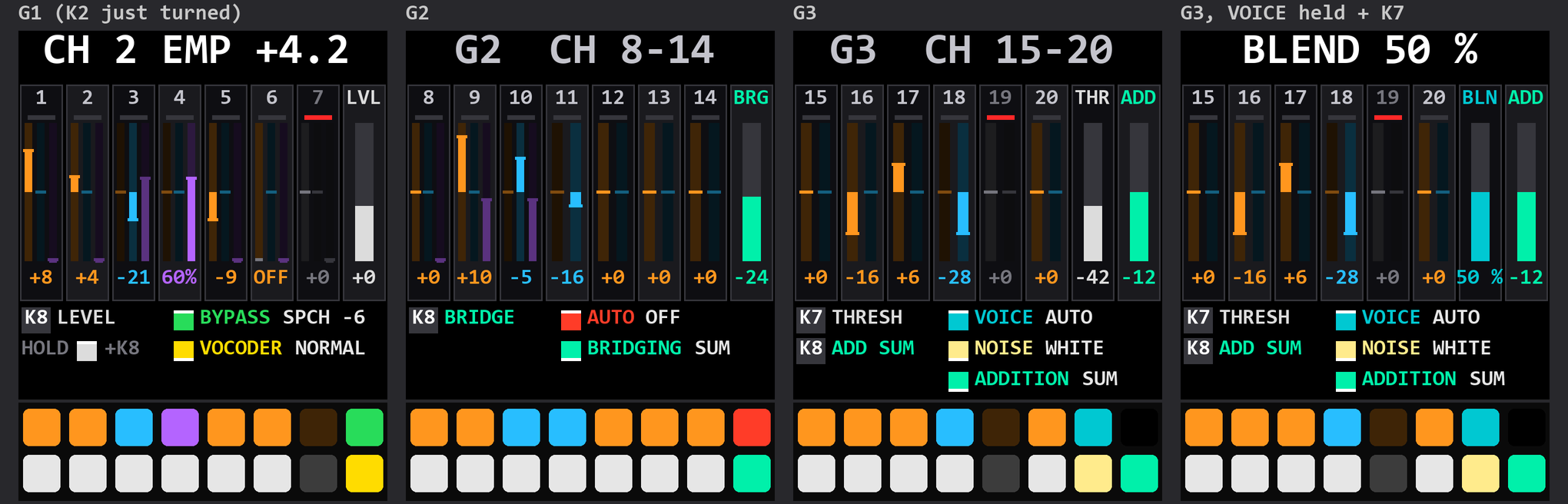
Track 3 becomes an audio track: audio from the computer plays as it is (AUDIO) or through a 20-channel vocoder modelled on the Sennheiser VSM201 (VOCODER), played from the keys and the sequencer. Everything from Mewcoder v0.1, unchanged. The vocoder is off while HARMONY is on; HARMONY OFF gives it back as it was.
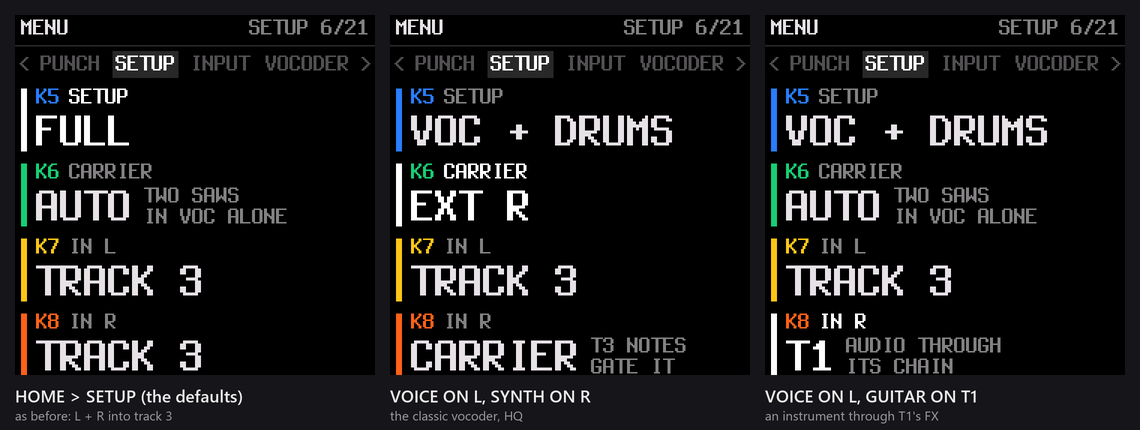
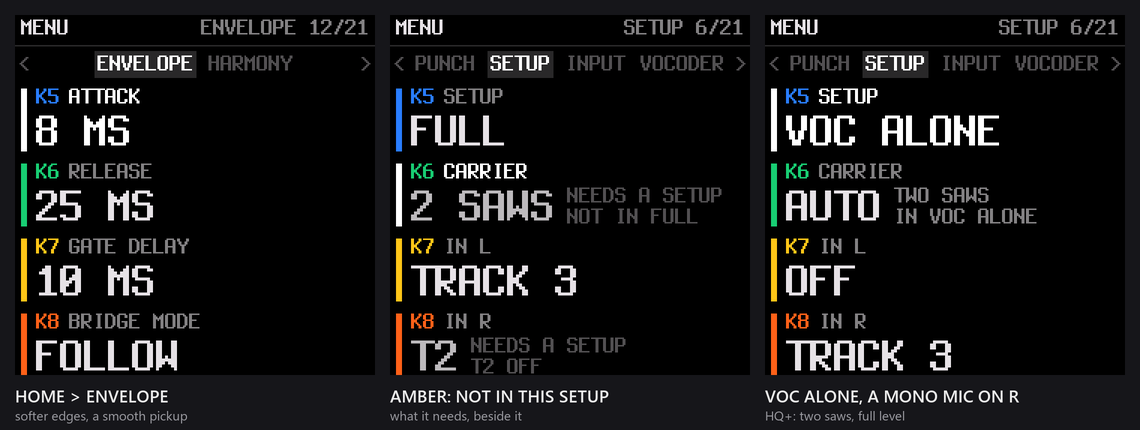
- Two USB audio inputs, each routed (HOME > SETUP > IN L, IN R): TRACK 3 (your voice into the vocoder), CARRIER (your own synth as the carrier, gated by track 3's notes), T1 / T2 (an instrument through that track's effects and slicer), HARMONY (into the harmoniser), OFF.
- SETUP: FULL, VOC + DRUMS, VOC + SYNTH, VOC ALONE. With any of SLOOP's tracks off, the vocoder runs at 44.1 kHz.
- The carrier: the built-in saws (AUTO, 1 SAW, 2 SAWS) or an external synth (EXT L / EXT R, with GATE DELAY).
- HOME > INPUT: TRIM L / TRIM R (−18 .. +6 dB) with a level meter each; aim your voice's peaks at the −10 tick.
- Shaping: ENVELOPE (ATTACK, RELEASE, BRIDGE MODE), voiced / unvoiced detection with a noise source, the speech addition (HF), silence bridging and BRIDGE TONE, AUTOCONTROL, the carrier's AGC, RESPONSE (FLAT, NORMAL, EMPHASIS).
- The vocoder page (PATCH on the tracks screen): the 20 channels on the knobs and pads.
The manual: VOCODER.md · the branch's page
Built and tested for heavy use
A great deal of optimisation went into this build, and it was tested on the unit with high-BPM, heavy patterns: six USB channels out and both USB inputs in at full load, the harmoniser across every track, FM6 pads and sample kits, played for hours. Each change was checked against the build before it, bit for bit where the sound must not change, by the host tests in the repository, run on every build.
Every setup is different. To keep a similarly heavy scene in time, use the load settings: LANE RATE 22K on the lanes that do not need the top end, POLY CAP on a thick FM6 track, LANE THIN, LANE MONO, and FADER BANK F at 0 for a track you do not harmonise (HARMONISER.md A8).
What it leaves out (to make room)
As Mewcoder v0.1: no built-in samples (your own sample slots work), no TEXTURE, DIGITAL, LOFI, VOICE, TRIO or NOISE engines, the delay at 22 kHz; a console build (the keyboard is also a serial port). SLICER STUT records nothing while HARMONY is on (its memory is the harmoniser's).
Files
| File | For |
|---|---|
mewcoder+harmoniser-v0.2-pre.fwsc |
the firmware, SMK-37 Elite only |
mewcoder+harmoniser-v0.2-pre-editor.html |
the web editor for this build, as one file, offline (Chrome / Edge) |
SHA256SUMS |
their SHA-256 |
Or install with Python, from the harmoniser branch: python3 tools/fm1_install.py mewcoder+harmoniser-v0.2-pre.fwsc (needs pip install mido python-rtmidi). The installer checks the package against the keyboard's model before it writes anything. Use the editor that comes with this build.
Tested on an SMK-37 Elite. Settings from Mewcoder v0.1 carry over (the new ones start at their defaults).
Built on SLOOP 2.8.4 by isod89, Felucca by Leo Kuroshita / Hügelton Instruments, and the SMK-37 board layer by M. Geisler (genkigenki). GPL-3.0-only.
Mewcoder v0.1: SLOOP 2.8.4 with a vocoder and two USB audio inputs, for the SMK-37 Elite
Mewcoder: SLOOP 2.8.4 with a 20-channel vocoder and two USB audio inputs, for the M-Vave SMK-37 Elite. Unofficial firmware, not affiliated with or endorsed by M-Vave. No warranty.
Back up the keyboard's whole flash first: its calibration, Bluetooth pairing and key_mac are its own and no package contains them (how). Back up your projects and settings with the editor's full backup as well. Going back: the Multichannel USB audio build (v2.8.1-smk37.1) or M-Vave's own updater (M-UPGRADE).
Install from the browser: Mewcoder's page (Chrome or Edge, over USB).
What it is
Track 3 becomes an audio track: audio from the computer plays as it is (AUDIO) or through a 20-channel vocoder modelled on the Sennheiser VSM201 (VOCODER), played from the keys and the sequencer.
- Two USB audio inputs, each routed (HOME > SETUP > IN L, IN R): TRACK 3 (your voice into the vocoder), CARRIER (your own synth as the carrier, gated by track 3's notes), T1 / T2 (an instrument through that track's effects and slicer), OFF.
- SETUP: FULL, VOC + DRUMS, VOC + SYNTH, VOC ALONE. With any of SLOOP's tracks off, the vocoder runs at 44.1 kHz.
- The carrier: the built-in saws (AUTO, 1 SAW, 2 SAWS) or an external synth (EXT L / EXT R, with GATE DELAY).
- HOME > INPUT: TRIM L / TRIM R (−18 .. +6 dB) with a level meter each; aim your voice's peaks at the −10 tick.
- Shaping: ENVELOPE (ATTACK, RELEASE, BRIDGE MODE), voiced / unvoiced detection with a noise source, the speech addition (HF), silence bridging and BRIDGE TONE, AUTOCONTROL, the carrier's AGC, RESPONSE (FLAT, NORMAL, EMPHASIS).
- ENVELOPE > BRIDGE MODE: FOLLOW keeps the bridged pauses below your words and picks each word up smoothly. Try it if words have a rough, choppy edge with BRIDGE turned up. FIXED (the default) is the bridging as before.
- AUTOCONTROL reworked: it steadies your voice's level slowly, never boosts the gaps between words, and ignores breath and plosives.
- HF and DRY in 3 dB steps down to −30 dB.
- GLO's MIDI pages in plain words: T1 CH .. DRM CH; MIDI IN/OUT (IN: ALL / CLOCK, SPARE, OUT: KEYS / +SEQ); MIDI 3.
- The vocoder page (PATCH on the tracks screen): the 20 channels on the knobs and pads.
- The web editor's Vocoder tab: every setting and the 20 channels; kept with each project slot and in the full backup.
- The build on the splash and ABOUT (
82aeaad VOC).
The manual: VOCODER.md.
What it leaves out (to make room)
No built-in samples (your own sample slots work), no TEXTURE, DIGITAL, LOFI, VOICE, TRIO or NOISE engines, and the delay runs at 22 kHz. It is also a console build: the keyboard shows up as a serial port as well. If you need those, use the Multichannel USB audio build.
Files
| File | For |
|---|---|
sloop-smk37-elite-vocoder.fwsc |
SMK-37 Elite only |
sloop-editor-2.8.4-smk37-82aeaad.html |
the web editor for this build, as one file, offline (Chrome / Edge) |
SHA256SUMS |
their SHA-256 |
Or install with Python, from the mewcoder branch: python3 tools/fm1_install.py sloop-smk37-elite-vocoder.fwsc (needs pip install mido python-rtmidi). The installer checks the package against the keyboard's model before it writes anything. Use the editor that comes with this build.
Tested on an SMK-37 Elite. Your settings from an earlier Mewcoder build carry over.
Built on SLOOP 2.8.4 by isod89, Felucca by Leo Kuroshita / Hügelton Instruments, and the SMK-37 board layer by M. Geisler (genkigenki). GPL-3.0-only.
SLOOP 2.8.1 for the SMK-37 (first public build)
SLOOP 2.8.1 for the M-Vave SMK-37: the first public build. Unofficial firmware, not affiliated with or endorsed by M-Vave. No warranty.
Install from the browser: https://milomeowzers.github.io/sloop-smk37/ (Chrome or Edge, pick your model). Back up the keyboard's whole flash first: its calibration, Bluetooth pairing and key_mac are its own and no package contains them (how). Going back: M-Vave's own updater (M-UPGRADE).
What it adds to SLOOP 2.8.1
- The keyboard as SLOOP's panel: 37 velocity keys, 16 RGB pads (drum kit or steps), 4 faders, 8 knobs, the wheels, TRS MIDI out.
- USB audio stems: six mono channels, 24 bit, to the DAW (drums in four groups, the synths, the reverb / delay return); 48 or 44.1 kHz; a layout change re-plugs USB by itself.
- Punch-ins on the stems (HOME > PUNCH > STEM FX): loops, stutter, reverse, stop, half, rewind, gate on every stem, seamless loop joins, settable XFADE and CURVE.
- The stem punch-in page: FX held, or locked with FX + FADER BANK: four colour rows of effects on the pads; FREEZE holds the reverb.
- Sequencer effects (row 4): FLIP, LOOP BACK (2 bars down to 1/16, PRESETS changes it while held), RAMP UP / DOWN (the DAW stays the clock master); recorded and replayed as MIDI on FX CH.
- DAW mode (< + >) with an editable CC map, and punch-in MIDI out.
Everything is in SMK37.md.
Files
| File | For |
|---|---|
sloop-smk37.fwsc |
SMK-37 Pro, and the Starrykey 37 Play |
sloop-smk37-elite.fwsc |
SMK-37 Elite |
sloop-smk37-mke.fwsc |
MKE-P37 |
SHA256SUMS |
their SHA-256 |
sloop-editor-2.8.1-smk37-26ef4c7.html |
the web editor as one file, offline (Chrome / Edge) |
With Python: python3 tools/fm1_install.py sloop-smk37-elite.fwsc (needs pip install mido python-rtmidi). The installer checks the package against the keyboard's model before it writes anything.
Tested on an SMK-37 Elite. The other models' builds differ only in the name the keyboard reports, and have not been tried on those units yet: reports are welcome in the issues.
Built on SLOOP by isod89, Felucca by Leo Kuroshita / Hügelton Instruments, and the SMK-37 board layer by M. Geisler (genkigenki). GPL-3.0-only.